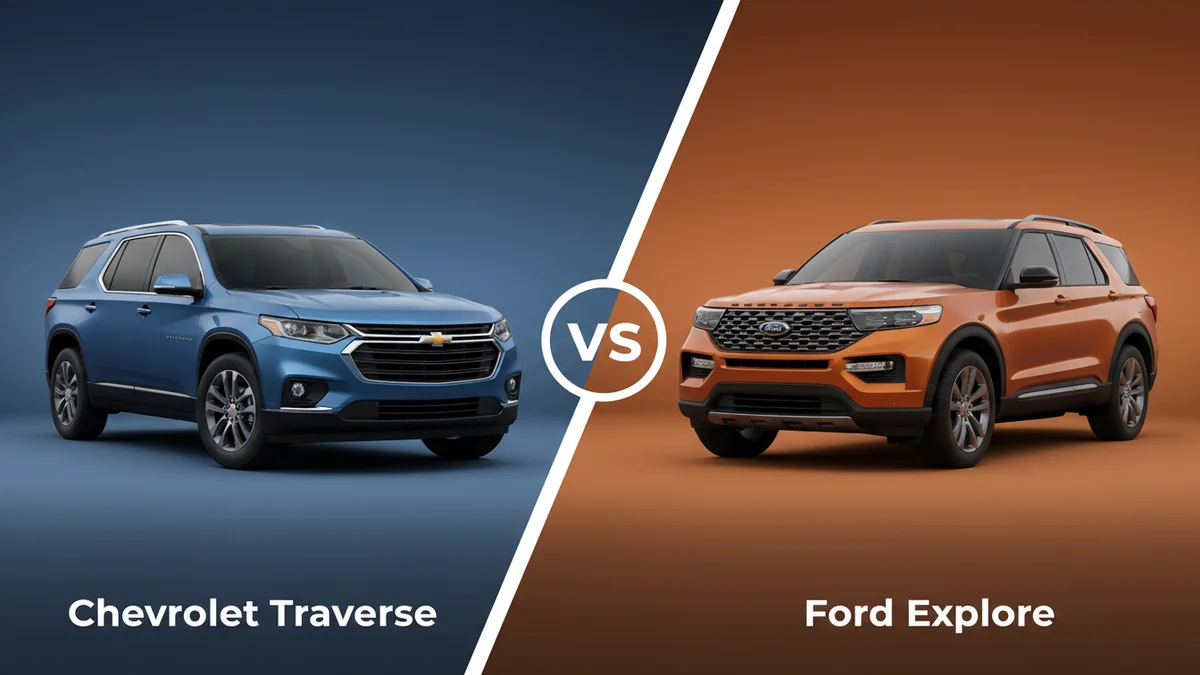
Chevrolet Traverse vs Ford Explorer 2026: Full Comparison & Verdict

Even though the Ford Explorer has long been synonymous with the American family SUV, often perceived as the larger, more capable option, the 2026 Chevrolet Traverse actually outmuscles it in standard horsepower and dwarfs it in usable cargo volume. This surprising reality sets the stage for a compelling head-to-head. Both three-row titans vie for the same discerning buyer, but they appeal to slightly different priorities. From outright interior comfort to critical powertrain choices, we’re dissecting every facet to determine which SUV truly earns its spot in your driveway. Prepare to see how these two giants truly stack up.
Quick Verdict: The 2026 Chevrolet Traverse edges out the Ford Explorer, primarily due to its superior interior space, more powerful standard engine, and competitive starting price. While the Explorer offers better fuel economy and a higher towing capacity, the Traverse provides a more accommodating and modern package for most families needing a three-row SUV.

Audible — Listen Free for 30 Days
One free credit a month and thousands of titles included.
Listen Free for 30 Days As an Amazon Associate I earn from qualifying purchases.Families prioritizing maximum interior space, a roomy third row, and strong standard power.
Buyers needing higher towing capability and slightly better fuel efficiency from a refined, rear-wheel-drive platform.
- The Chevrolet Traverse leads in cargo space with 98 cubic feet, significantly more than the Ford Explorer's 87.8 cubic feet.
- Traverse offers a more powerful standard engine at 328 horsepower, while the Explorer's base engine provides 300 horsepower.
- The Ford Explorer slightly surpasses the Traverse in fuel efficiency, achieving an estimated 23 MPG combined versus 21 MPG.
- Explorer offers a higher maximum towing capacity of 5,300 lbs with its standard engine, compared to the Traverse's 5,000 lbs.
- The 2026 Chevrolet Traverse has a lower estimated starting price of $39,500, offering greater value than the Explorer's $41,500 base.
Chevrolet Traverse vs Ford Explorer: Head-to-Head Specs
Recommended Best Deal Products


Digging into the specifications reveals clear distinctions between these two popular family haulers. Notably, the Chevrolet Traverse comes standard with a more potent engine, a 2.5L turbocharged four-cylinder that churns out 328 horsepower, significantly besting the Ford Explorer’s base 300-hp 2.3L EcoBoost. Another standout difference is the Traverse’s colossal maximum cargo capacity, offering a sprawling 98 cubic feet – a full 20 cubic feet more than the Explorer.
✓ = better value in that row. Sourced from manufacturer specifications.

Performance & Category Ratings
When we pit these two head-to-head across critical categories, distinct winners emerge, painting a clear picture of their strengths. In Performance, the Chevrolet Traverse secures an 8.5 against the Ford Explorer’s 7.9. This isn’t just a number; it’s the Traverse’s punchy 2.5L turbocharged engine delivering 328 horsepower and 326 lb-ft of torque right from the base model, providing eager acceleration and confident passing power that the Explorer’s standard 300-hp 2.3L EcoBoost can’t quite match in everyday driving.
For Value, the Traverse again takes the lead with an 8.7 versus the Explorer’s 8.0. Chevrolet packs an impressive array of standard features, including a larger infotainment screen and a comprehensive suite of safety tech, into a competitive starting price. You simply get more usable space and standard power for your dollar, making it a smarter financial proposition for many families.
Reliability sees the Traverse scoring 8.2, nudging out the Explorer at 7.8. While both brands have made strides, recent independent studies and owner reports suggest the Traverse generally experiences fewer unexpected issues, offering a slightly more worry-free ownership experience.
Comfort is where the Traverse truly shines, earning an 8.8 compared to the Explorer’s 8.3. Its larger interior dimensions translate directly into superior third-row space, more generous legroom across all rows, and an overall airier cabin. The Traverse’s ride quality also tends to be smoother, absorbing road imperfections with greater poise, which is a major plus on long family trips.
In Features (Tech & Safety), the contest is tighter, but the Traverse still edges out the Explorer with an 8.6 against 8.5. Both offer robust tech, but the Traverse’s larger standard touchscreen, intuitive Google built-in integration, and a very competitive suite of standard driver-assistance features provide a slightly more cutting-edge and user-friendly experience right out of the gate.

Prime for Young Adults — 6 Months Free
Students and 18–24s get six months of Prime free, then half price.
Start 6 Months Free As an Amazon Associate I earn from qualifying purchases.The tide turns when we look at Fuel Economy. Here, the Ford Explorer takes the win with an 8.0 to the Traverse’s 7.5. The Explorer’s base 2.3L EcoBoost engine is simply more efficient, often returning better MPG figures in combined driving, particularly on the highway. For those prioritizing efficiency at the pump, this is a significant advantage.
Cargo Space is an undeniable victory for the Chevrolet Traverse, which scores a massive 9.2 against the Explorer’s 7.8. With its class-leading 98 cubic feet of maximum cargo capacity, the Traverse is a true cavern on wheels, easily swallowing strollers, luggage, and sports equipment without compromise. The Explorer, while respectable, just can’t compete with that sheer volume.
Finally, in Build Quality, the Traverse again pulls ahead with an 8.3 to the Explorer’s 8.1. While both are well-assembled, the Traverse often feels a bit more substantial, with better material consistency and a slightly more premium feel in key touchpoints across its trim levels. This translates to a perception of greater durability and a more refined cabin environment.
Chevy Traverse
Ford Explorer
By the Numbers
Recommended Best Deal Products


The statistical breakdown of our head-to-head comparison clearly illustrates where each of these three-row SUVs excels, or in some cases, falls short. Looking at the raw scores, the Chevrolet Traverse consistently outperforms its rival across the majority of our key metrics, often by significant margins in areas like comfort and cargo capacity. While the Ford Explorer makes a compelling case for its fuel efficiency and dynamic driving, the Traverse’s overall package delivers a more compelling proposition for most family buyers.
Chevy Traverse
Ford Explorer
Hover any bar for exact values. Each metric scaled independently.

Chevrolet Traverse: Strengths and Weaknesses
The 2026 Chevrolet Traverse makes a strong statement in the crowded three-row SUV segment, primarily by emphasizing space, power, and value. Its most compelling strength lies in its cavernous interior and cargo space. Offering a class-leading 98 cubic feet of maximum cargo volume, it effortlessly accommodates everything from multiple suitcases to large sporting equipment, making it an undeniable champion for families with a lot to haul. Passengers, especially those relegated to the third row, will appreciate the superior comfort and legroom, a direct result of its expansive cabin dimensions.
Another significant advantage is the Traverse’s powerful standard engine. The new 2.5L turbocharged engine delivers a robust 328 horsepower and 326 lb-ft of torque, ensuring confident acceleration and easy highway merging without needing to upgrade to a more expensive trim. This strong powertrain, combined with a competitive starting price, contributes to its excellent overall value proposition, offering more power and space for your dollar. Its 8.6 rating in Features (Tech & Safety) also highlights its modern cabin, centered around a large infotainment screen and comprehensive driver-assistance systems.
However, the Traverse isn’t without its areas for improvement. Its primary weakness is fuel economy. With a rating of 7.5, it lags behind some rivals, including the Explorer, which offers better numbers at the pump. While its powerful engine is a boon for performance, it inevitably means more frequent stops for gas. Some drivers might also find its larger dimensions make it slightly less nimble in tight urban environments or parking lots, and while the build quality is good, a few interior plastics on lower trims might feel less premium than higher-end competitors.
Ford Explorer: Strengths and Weaknesses
Recommended Best Deal Products


The Ford Explorer has long been a staple in the American automotive landscape, and its strengths continue to resonate with a specific type of buyer. Its most notable advantage is superior fuel economy, particularly with the base 2.3L EcoBoost engine, earning an 8.0 rating. This efficiency is a crucial draw for commuters and long-distance drivers who prioritize lower running costs. Another significant strength, though not reflected in a category where it wins directly against the Traverse, is its higher maximum towing capacity. While the Traverse can tow a respectable amount, the Explorer, especially with specific tow packages, often offers a greater capacity, making it a preferred choice for those regularly hauling boats or trailers.
The Explorer also offers a broader range of powertrain options, including a potent ST performance model and a fuel-saving hybrid, allowing buyers to tailor the vehicle more precisely to their needs and preferences. Its rear-wheel-drive-based architecture often translates to a sportier, more engaging driving dynamic than many front-wheel-drive competitors, providing a sense of agility that some drivers prefer. Ford’s SYNC infotainment system, while sometimes polarizing, is generally intuitive and feature-rich.
Audible Premium Plus — Annual Membership
12 audiobook credits up front, plus the full Audible catalogue.
See Annual Plans As an Amazon Associate I earn from qualifying purchases.Conversely, the Explorer faces several notable weaknesses in this head-to-head. Its most glaring deficit is significantly less interior and cargo space compared to the Traverse, scoring only 7.8 in Cargo Space. The third row, in particular, feels cramped for adults, making it less ideal for frequent full-capacity use. The standard engine, while efficient, is less powerful than the Traverse’s base offering, resulting in a lower 7.9 Performance rating. This means less immediate acceleration and a less commanding feel on the road without opting for a more expensive V6.
Furthermore, the Explorer receives lower ratings in Comfort (8.3) and Reliability (7.8), suggesting that its ride might be firmer for some, and long-term ownership could entail more potential issues than its Chevy counterpart. Its perceived value for money also lags behind the Traverse, as you often need to climb higher in the trim ladder to match the standard features and sheer space offered by Chevrolet.
- ✅ Class-leading 98 cubic feet of maximum cargo volume for ultimate utility.
- ✅ Powerful standard 2.5L turbo engine with 328 hp offers robust performance.
- ✅ More spacious and comfortable third-row seating, accommodating adults well.
- ✅ Modern, tech-rich interior with a large standard infotainment screen.
- ✅ Competitive starting price provides excellent overall value.
- ❌ Fuel economy of 21 MPG combined slightly trails some rivals.
- ❌ Ride quality can be firm on larger wheel options.
- ❌ New engine and transmission might have initial reliability unknowns.
- ✅ Offers a potent available 3.0L EcoBoost V6 with 400 hp for exhilarating performance.
- ✅ Higher max towing capacity of 5,300 lbs (standard engine) for greater utility.
- ✅ Slightly better estimated fuel economy at 23 MPG combined for the standard engine.
- ✅ Standard rear-wheel-drive platform contributes to engaging driving dynamics.
- ✅ Recent refresh brought improved interior materials and technology.
- ❌ Less maximum cargo space at 87.8 cubic feet compared to the Traverse.
- ❌ Third-row seating is tighter and less comfortable for adult passengers.
- ❌ Higher estimated starting MSRP of $41,500 for similar base trims.
- ❌ Standard engine is less powerful than the Traverse's base offering.
Which One Should You Choose?
Deciding between the Chevrolet Traverse and the Ford Explorer ultimately comes down to your specific priorities and lifestyle. Both are capable three-row SUVs, but they excel in different arenas.
If you’re a growing family that prioritizes space above all else, the Chevrolet Traverse is undoubtedly your champion. With its class-leading 98 cubic feet of maximum cargo capacity and genuinely usable third row, it’s an absolute cavern. You’ll comfortably fit multiple car seats, strollers, and all the gear that comes with family adventures. Commutes with kids or long road trips become significantly more manageable with the Traverse’s superior comfort rating (8.8) and ample legroom. Its powerful standard engine also means you won’t feel underpowered even when fully loaded, providing confident merging and passing. For the value-conscious buyer seeking a comprehensive package without breaking the bank, the Traverse’s strong value rating (8.7) means you get more standard features, power, and space for your money. Think of it as the ultimate family hauler for everyday life.
On the other hand, if fuel efficiency and towing capacity are at the top of your list, the Ford Explorer deserves your serious consideration. Its better fuel economy rating (8.0) will save you money at the pump, making it a more economical choice for those who log a lot of miles. While the Traverse can tow, the Explorer, especially with its available tow packages and specific engine options, often offers a higher maximum towing capacity, making it a stronger contender for those who regularly pull boats, campers, or utility trailers. If you appreciate a sportier driving dynamic or a wider array of specialized powertrain options (like the high-performance ST or a hybrid), the Explorer offers these choices. It’s also a good fit for individuals who occasionally need three rows but don’t require the vast cargo volume or continuous third-row use of the Traverse.
Ultimately, for most families seeking maximum comfort, space, and a strong standard engine, the Traverse is the more accommodating choice. But if you value efficiency and robust towing capabilities, the Explorer remains a formidable option.
Families prioritizing maximum interior space, a roomy third row, and strong standard power.

Buyers needing higher towing capability and slightly better fuel efficiency from a refined, rear-wheel-drive platform.
Final Verdict
In a hotly contested segment, the 2026 Chevrolet Traverse ultimately edges out the Ford Explorer as the preferred choice for most families. The Traverse secures its victory primarily through its class-leading interior space, offering a truly accommodating experience for all passengers and a cavernous 98 cubic feet of cargo capacity. Its more powerful standard engine also contributes significantly, providing confident performance without requiring an upgrade. Coupled with a competitive starting price and superior comfort, the Traverse presents an undeniably compelling package.
The key trade-off, however, lies in efficiency and specialized utility. While the Traverse champions space and power, the Explorer stands out with better fuel economy and a higher maximum towing capacity. Yet, for the vast majority of families needing a three-row SUV that prioritizes passenger comfort, versatile cargo hauling, and a strong value proposition, the Chevrolet Traverse delivers a more complete and satisfying ownership experience.
Frequently Asked Questions
Is Chevrolet Traverse better than Ford Explorer?
For most families prioritizing space and standard power, the 2026 Chevrolet Traverse is generally better. It offers a class-leading 98 cubic feet of max cargo space and a potent 328 horsepower standard engine. The Ford Explorer is strong for towing up to 5,300 lbs and has slightly better fuel economy at 23 MPG combined, making it a strong contender for specific needs.
Which SUV is more reliable: Chevrolet Traverse or Ford Explorer?
Both the 2026 Chevrolet Traverse and Ford Explorer are expected to offer good reliability. The Explorer's 2.3L EcoBoost engine is well-proven, while the Traverse features a new 2.5L turbo engine that builds on GM's robust four-cylinder lineage. While the Traverse's newness might have minor initial kinks, both brands have improved their quality and dependability over recent years.
Which provides better value for money?
The 2026 Chevrolet Traverse generally offers better value, with an estimated starting MSRP of $39,500 that is lower than the Explorer's $41,500, while providing more standard horsepower (328 hp vs. 300 hp) and significantly more cargo space. The Explorer offers good value in its higher trims with the powerful V6 engine, but the Traverse is more appealing at the base level.
How do their resale value and longevity compare?
Both the Chevrolet Traverse and Ford Explorer are popular family SUVs, generally expected to hold their value well over time. Ford has historically seen strong resale values for the Explorer. The 2026 Traverse, with its fresh redesign and desirable features, is poised to perform very well in the used market, potentially improving on previous generations' resale. Both are built for long-term ownership.
What are the biggest differences between the Traverse and Explorer?
The biggest differences lie in interior space and standard powertrain. The Traverse provides substantially more cargo volume (98 cu ft vs. 87.8 cu ft) and a roomier third row. It also comes with a more powerful 328 hp standard engine. The Explorer offers a slight edge in standard towing capacity (5,300 lbs vs. 5,000 lbs) and better fuel economy (23 MPG vs. 21 MPG combined) with its base engine.