How to Reset Ford F-250 DEF Counter: Clear the 50 MPH Limiter

The Ford F-250 Super Duty, powered by the formidable 6.7L Powerstroke diesel engine, is an engineering marvel capable of immense torque. However, it relies on a highly complex and sensitive emissions management system.
This emissions network is designed to minimize harmful environmental outputs but frequently induces severe operational limitations for the driver. The Selective Catalytic Reduction (SCR) system is the primary mechanism for reducing nitrogen oxide (NOx) emissions in these modern diesel trucks.

Prime for Young Adults — 6 Months Free
Students and 18–24s get six months of Prime free, then half price.
Start 6 Months Free As an Amazon Associate I earn from qualifying purchases.The SCR system functions by injecting Diesel Exhaust Fluid (DEF) directly into the superheated exhaust stream. DEF is a highly specific chemical solution comprised of 32.5% high-purity urea and 67.5% deionized water.
When the powertrain control module (PCM) detects an anomaly within this DEF system, it initiates a strict anti-tamper protocol mandated by federal regulations. This protocol is designed to force the operator into compliance by restricting vehicle performance.
The most notorious and dreaded symptom of this protocol is the “Speed Limited to 50 MPH” message on the dashboard. Once this countdown expires, the vehicle severely restricts power output, hampering towing capabilities and highway driving safety.
Clearing this message and resetting the DEF counter requires significantly more effort than simply topping off the fluid reservoir. The system often demands specific mechanical repairs, advanced software recalibrations, and highly precise drive cycles to verify the integrity of the emissions hardware.
This comprehensive report provides an exhaustive technical breakdown of the Ford F-250 DEF system. It covers basic fluid level resets, common hardware failures, advanced FORScan diagnostics, and OEM-specified drive cycle procedures.
Understanding the DEF Warning Progression
Recommended Best Deal Products


The 6.7L Powerstroke employs a tiered warning system to alert operators of impending emissions intervention. The instrument cluster message center provides distinct stages of alerts based on the remaining fluid range and system health.
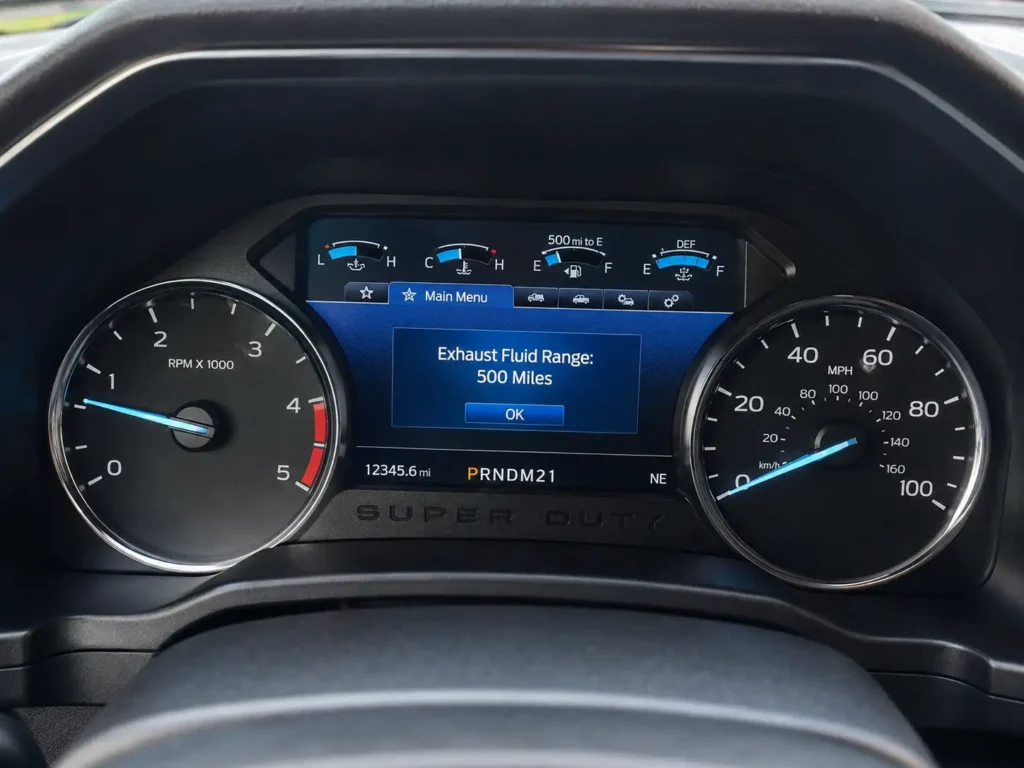
The initial warning appears as a relatively benign “Exhaust Fluid Range: 500 Miles” (or 805 km). At this stage, the vehicle operates completely normally, but the operator is prompted to plan a fluid refill soon.
If the operator ignores this warning, the system escalates to a more urgent “In XX Miles, Speed Limited to 50 MPH”. The countdown becomes highly aggressive, accompanied by audible chimes to ensure the operator cannot ignore the impending derate.
Once the mileage countdown reaches absolute zero, the vehicle must be safely shut off and restarted for the limiter to take full effect. Upon the subsequent restart, the message reads “Speed Limited to 50 MPH”.

Audible — Listen Free for 30 Days
One free credit a month and thousands of titles included.
Listen Free for 30 Days As an Amazon Associate I earn from qualifying purchases.During this 50 MPH limitation, the vehicle will continue to make normal engine power and spool the turbocharger efficiently in lower gears. However, the PCM initiates a hard fuel cut or throttle restriction the exact moment the vehicle attempts to cross the 50 MPH threshold.
If the vehicle continues to operate in this crippled state and the fluid completely depletes, the system enters a final “Engine Idled” or forced idle mode. In this severe state, the vehicle cannot be driven and requires an immediate IDS or FORScan parameter reset.
The Standard DEF Level Reset (No Tools Required)
In many everyday instances, the DEF counter fails to reset immediately after the operator adds fluid at a commercial fuel station. This delay is a frequent source of driver frustration, leading many to falsely assume a hardware failure has occurred.
The primary culprit for this delay is the PCM’s aforementioned anti-slosh programming. The DEF tank level sensor utilizes four stainless steel electrodes to measure the electrical conductivity of the urea solution.
Three of these electrodes are arranged vertically to provide high, middle, and low-level signals, while the fourth acts as a continuous ground. Because the fluid sloshes violently during transit, the software averages these inputs over time to present a stable dashboard reading.
Consequently, the physical gauge may not register the newly added fluid for several miles of driving. Additionally, the system logic implements a specific 500-mile lockout threshold.
If the “miles to empty” warning falls below 500 miles, adding a fractional amount of fluid will often not trigger the reset calculation. The PCM must detect a substantial volume of fluid that pushes the calculated range well above that threshold.
To force a standard level reset without diagnostic tools, the operator should fill the DEF tank to its absolute maximum capacity. After filling, start the engine and drive the vehicle at a steady, moderate highway speed for 20 to 30 minutes.
Normal engine load and steady cruising allow the anti-slosh algorithm to gather consistent data from the newly submerged electrodes. The warning should eventually vanish, and the gauge will slowly climb to the full mark.
If the gauge remains stuck at empty after extensive driving and a verified full tank, a hardware failure is likely present. The reductant level sensor or its exterior wiring harness has likely failed and requires multimeter diagnosis.
Audible Premium Plus — Annual Membership
12 audiobook credits up front, plus the full Audible catalogue.
See Annual Plans As an Amazon Associate I earn from qualifying purchases.Diagnosing Exhaust Fluid System Faults
Recommended Best Deal Products


When the dashboard displays “Exhaust Fluid System Fault” rather than a standard low fluid warning, the vehicle has detected a physical component failure. No amount of fresh DEF fluid will clear this specific message.
The technician must connect an OBD-II scan tool to extract the specific Diagnostic Trouble Codes (DTCs) from the powertrain control module. These codes provide the initial roadmap for hardware troubleshooting.
[Visual Plan: A comprehensive data table outlining common SCR system DTCs, their technical definitions, and the most probable component failures. This table will serve as a quick-reference guide for diagnostics.]
Table 1: Common 6.7L Powerstroke DEF System DTCs
| Diagnostic Trouble Code (DTC) | Technical Definition | Most Probable Component Failure |
|---|---|---|
| P207F | Reductant Quality Performance | Degraded DEF fluid, clogged injector, or biased NOx sensor. |
| P20BA / P20B9 | Reductant Heater Performance / Control Circuit Open | Burned-out heating element inside the DEF tank assembly. |
| P2201 | NOx Sensor Circuit Range/Performance (Bank 1) | Failing upstream NOx sensor or outdated PCM software requiring an FDRS update. |
| P20EE | SCR NOx Catalyst Efficiency Below Threshold | Catalyst failing to reduce emissions, often due to DEF crystal blockage or poor fluid. |
| P204C / P21DD | Reductant Pressure Sensor Circuit Low / System Performance | Harness corrosion at connector C3613 or an internal DEF pump failure. |
Determining the exact cause requires following Ford’s official pinpoint tests using a multimeter and scan tool. However, real-world data shows distinct patterns in part failures.
The most frequent failure points on the 6.7L Powerstroke are the internal DEF tank heater, the exhaust-mounted DEF injector nozzle, and the exterior reductant wiring harnesses.
Troubleshooting the DEF Injector and Crystallization
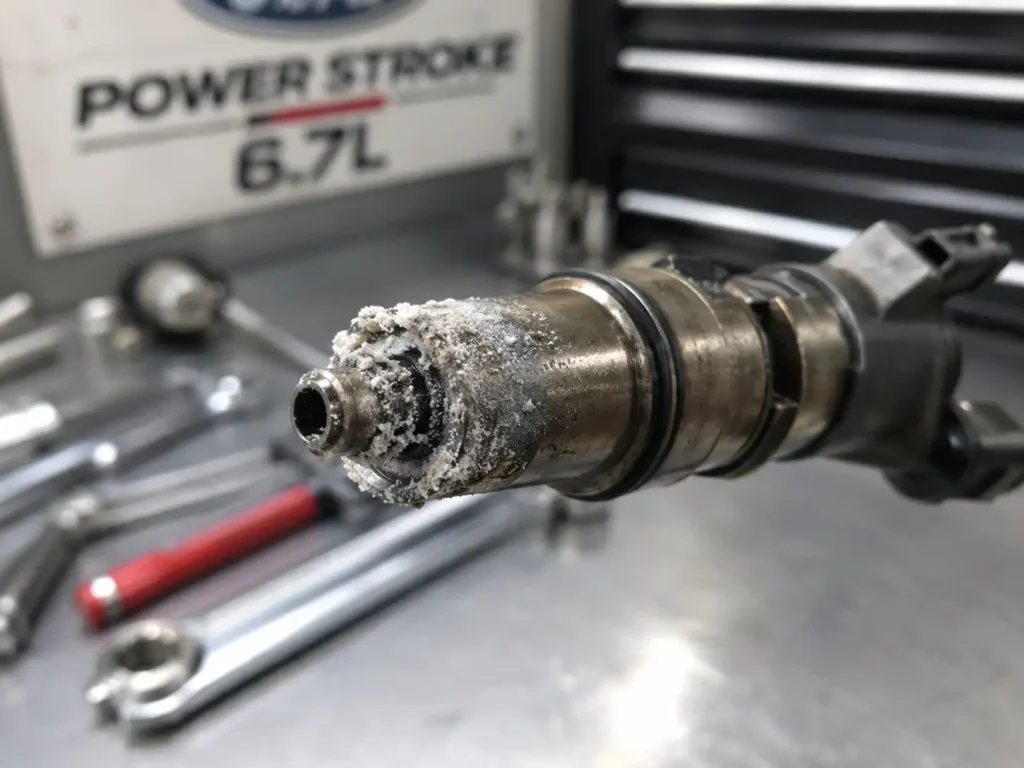
Before replacing expensive electronic modules or tank assemblies, technicians should visually inspect the DEF injector. This simple mechanical component is highly susceptible to severe urea crystallization.
Because DEF contains exactly 32.5% urea, exposure to ambient air causes its water content to evaporate rapidly. This chemical reaction leaves behind white, rock-hard urea crystals that adhere to metal surfaces.
The DEF injector (OEM Part number FC4Z-5J281-B) is mounted directly in the high-temperature exhaust pipe, typically positioned just upstream of the SCR catalyst. It must withstand extreme thermal cycling and soot exposure daily.
When urea crystals accumulate on the injector tip, they physically obstruct the engineered spray pattern. The reductant pump continues to supply fluid from the tank, causing line pressure to spike dramatically.
The PCM registers this pressure anomaly and may trigger a system fault, falsely suggesting a pump failure to the technician. Furthermore, the lack of fluid entering the exhaust triggers P207F or P20EE efficiency codes.
The Zero-Cost DIY Cleaning Fix
The technician should carefully remove the injector from the exhaust pipe, which usually requires loosening a single v-band clamp or retaining bolt. Caution is advised as the exhaust pipe may be incredibly hot.
Inspect the delicate nozzle for white crystalline buildup. If a blockage is present, the injector can often be revived by soaking the tip in warm, deionized water.
A soft-bristled brush should be used to gently scrub the nozzle holes until they are completely clear of solid obstructions. Never use harsh chemical solvents or stiff wire brushes, as they will permanently damage the precision metering orifices.
Once thoroughly cleaned, reinstall the injector into the exhaust bung. If crystallization was the sole issue, commanding a dosing test via a scan tool or driving the vehicle may restore normal system pressure and clear the active fault.
Diagnosing and Replacing the Reductant Heater Assembly
Recommended Best Deal Products


The absolute most prevalent hardware failure on the 2011–2016 Ford F-250 is the internal reductant heater assembly (OEM Part BC3Z-5J225-L).
Diesel Exhaust Fluid has a relatively high freezing point, turning solid at -11 degrees Celsius (12 degrees Fahrenheit). To prevent the emissions system from freezing solid in harsh winter climates, Ford engineered a plastic heating element directly inside the DEF tank reservoir.
The PCM monitors ambient temperatures and commands the Glow Plug Control Module (GPCM) to send voltage to this heater when conditions approach freezing. Unfortunately, repeated freeze-thaw cycles stress the plastic housing and degrade the internal wiring.
This thermal stress leads to inevitable premature failure of the heating element. When the heater circuit breaks, the PCM logs codes P20BA or P20B9 and initiates the 50 MPH speed limiter countdown to protect the pump from dead-heading against frozen fluid.
Repair Costs and Tank Drop Procedures
Replacing the reductant heater requires dropping the entire plastic DEF tank from the vehicle chassis. The factory skid plates, filler neck hoses, and mounting straps must be removed, taking great care not to spill the highly corrosive urea fluid onto exposed skin or wiring.
Dealership repair costs for a DEF heater replacement are notoriously steep. Estimates range from $1,100 to well over $1,400, split evenly between OEM parts markup and high hourly labor rates.
For independent repair facilities or capable DIYers, premium aftermarket or OEM replacement heaters cost between $125 and $450 online. The replacement assembly is a complete unit that includes the fluid pickup tube, heating element, temperature sensor, and fluid level electrodes.
After installing the new heater core and reinstalling the tank to the chassis, the technician must refill the fluid. They must then use a capable scan tool to clear the P20BA continuous memory codes and verify heater circuit resistance.
Wiring Harness Fretting and NHTSA TSB 23-2161
Before replacing any DEF tank components on newer models (specifically 2017–2022), technicians must consult NHTSA TSB 23-2161.
This highly critical Technical Service Bulletin addresses widespread manufacturing issues with the reductant harness connectors. These faulty connections cause false pump, heater, and level sensor diagnostic codes.
The primary root causes identified by Ford engineers are chronic water intrusion and severe terminal fretting. Vehicle vibration causes the wiring harness to shift constantly, physically wearing away the protective plating on the connector pins.
This fretting disrupts the highly sensitive micro-volt signals traveling between the sensors and the PCM. Technicians must disconnect the 16-pin connector (C3613) at the reductant pump and the 4-pin connector (C4851/C3610) at the level sensor module.
Inspect all delicate pins for visible green corrosion, moisture, or dark discoloration. If corrosion is strictly limited to the harness side of the connection, only the wiring harness requires replacement.
However, if the green corrosion has spread into the component side pins, both the harness and the respective pump or sensor module must be completely replaced.
Crucially, TSB 23-2161 explicitly forbids the use of dielectric grease during the reassembly process. To prevent future fretting from vibration, the new harness must be tightly secured to the metal lock ring of the pump using a heavy-duty 40-lb tensile strength zip tie (Rotunda part TMRCL6).
Software Updates and TSB 24-2136 (NOx Sensor 11)
On the newest 2020–2024 Powerstroke models, the P2201 DTC (NOx Sensor Circuit Range/Performance) has become a frustratingly frequent cause of the 50 MPH limiter.
Many independent owners and mechanics attempt to fix this code by simply swapping the upstream NOx sensor (Sensor 11) located in the exhaust downpipe. However, the code almost always returns immediately after the repair.
According to Ford TSB 24-2136 (covering 2020-2022 models) and TSB 24-2256 (covering 2023-2024 models), this fault is actually a complex combination of hardware and software issues.
The factory PCM software contains overly sensitive diagnostic logic that falsely flags the NOx sensor during normal operational variances. To enact a permanent fix, the technician must replace the physical NOx sensor and update the software logic.
This requires utilizing the Ford Diagnostic & Repair System (FDRS) to reprogram both the PCM and Transmission Control Module (TCM) with the latest calibration files.
This intricate process requires dealership-level software access and a stable internet connection. Attempting a DIY sensor repair without the subsequent PCM flash will completely fail to clear the emissions fault long-term.
The SCR Parameter Reset and Drive Cycle Procedure
Once a physical hardware fault has been successfully repaired, the Ford F-250 will not automatically exit its protective limp mode. The “Speed Limited to 50 MPH” message will persist on the dash until the SCR system proves it can actively reduce emissions.
This proof requires performing the Selective Catalytic Reduction Parameter Reset using a diagnostic scan tool. This must be followed by a highly specific, multi-stage drive cycle.
The drive cycle is designed to force the exhaust gas temperatures (EGTs) high enough to trigger the DEF injector dosing. The system then measures the temperature differential and NOx reduction across the catalyst to verify the repair’s success.
Step 1: Pre-Conditioning and Scan Tool Setup
Ensure the DEF tank is filled to 100% capacity before beginning the procedure. Connect an advanced scan tool (such as FORScan or the factory Ford IDS) and completely clear all continuous memory DTCs.
Access the datalogger function and actively monitor the following PIDs: EGT11, EGT12, EGT13, EGT14, REDUCT_TNK_P (Pressure), and REDUCT_INJ_DC# (Injector Duty Cycle). Ensure the initial EGT12 temperature is below 65 degrees Celsius (150 degrees Fahrenheit) before starting the engine.
Step 2: The High-Idle EGT Warm-Up
Start the cold engine and ensure the transmission remains in Park or Neutral. Use the accelerator pedal to manually increase the engine speed to a steady 1,000 – 2,000 RPM.
Maintain this elevated idle state until the exhaust gas temperatures (specifically monitoring EGT12 and EGT13) reach a minimum of 130 degrees Celsius (266 degrees Fahrenheit). This thermal saturation process typically takes several minutes.
Once the target temperatures cross the threshold, return the engine to a standard idle. At this exact point, the REDUCT_TNK_P PID should show an increase in line pressure to approximately 496 kPa (72 psi).
Within 90 seconds of this pressure build, the REDUCT_INJ_DC# PID should begin displaying a square wave pattern on the datalogger. This visually indicates the injector is actively dosing the exhaust stream with urea.
[Visual Plan: A streamlined drive cycle checklist table, formatted for technicians to print and use inside the vehicle cabin during the road test phase.]
Table 2: SCR Highway Drive Cycle Checklist

| Phase | Speed / Action Required | Duration / Target Metric |
|---|---|---|
| 1. Acceleration | Accelerate smoothly to 80 km/h (50 MPH) | Reach cruising speed safely. |
| 2. Deceleration | Closed-pedal coast down (Zero brake input) | Minimum of 6 uninterrupted seconds. |
| 3. Repeat | Repeat the Acceleration/Deceleration cycle | Execute 3 separate times total. |
| 4. Verify Heat | Monitor EGT13 PID on scan tool | Must climb above 220°C (428°F). |
| 5. Load Testing | Medium-to-hard wide open throttle accelerations | 5 events, lasting 3 seconds each. |
Step 3: The Highway Drive Cycle
If the urea dosing is confirmed at idle, transition the vehicle to a safe, open roadway. Accelerate the vehicle smoothly and steadily until reaching 80 km/h (50 MPH).
Perform a strict closed-pedal deceleration event. Release the accelerator pedal completely and allow the heavy truck to coast for a minimum of 6 seconds without touching the brake pedal.
The PCM actively monitors the emissions system during this zero-fueling coast-down phase. You must repeat this strict deceleration event three separate times to satisfy the software logic.
Step 4: The Hard Acceleration Phase
After completing the decelerations, verify via the live scan tool data that the EGT13 PID has climbed above 220 degrees Celsius (428 degrees Fahrenheit).
Once this high thermal threshold is reached, execute five medium-to-hard acceleration events. Each individual acceleration must sustain a heavy engine load for a minimum of 3 seconds to generate maximum NOx output.
If the repaired hardware is functioning correctly, the PCM will register the successful NOx reduction during these extreme thermal spikes. The “Speed Limited to 50 MPH” message will finally disappear from the cluster, restoring full engine power.
Executing the Reset Using FORScan Diagnostics
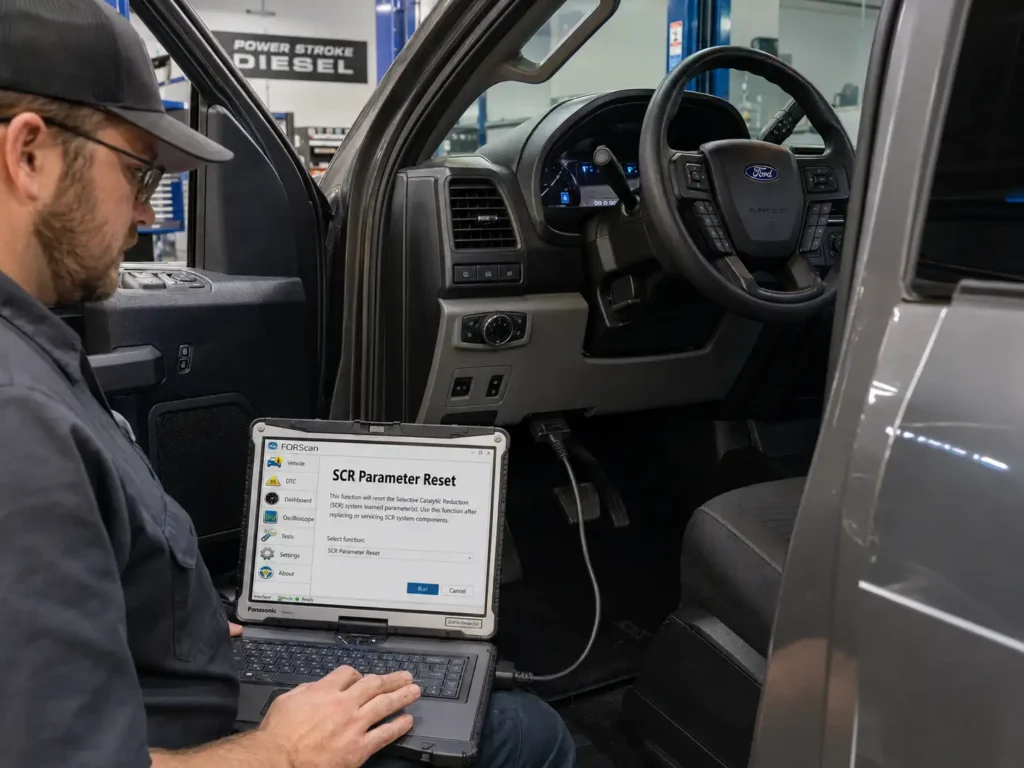
For independent technicians and capable DIY owners, FORScan is the absolute most powerful software available for Ford diagnostics. It provides dealership-level access to module programming and SCR parameter resets without the exorbitant cost of an official IDS subscription.
To utilize FORScan effectively, the user must have a modern Windows laptop and a highly compatible OBD-II adapter. Adapters with an automatic electronic switch, such as the OBDLink EX or the ELS27, are highly recommended to seamlessly read both the HS-CAN and MS-CAN vehicle networks.
[Visual Plan: A hardware requirements table outlining the specific tools needed to interface with the Ford PCM for emissions resets.]
Table 3: FORScan Hardware Requirements
| Requirement Category | Specification Needed for 6.7L Diagnostics |
|---|---|
| Software Platform | FORScan for Windows (Extended License strictly required for service functions) |
| Hardware Interface | OBDLink EX, ELS27, or ELM327 with HS/MS-CAN automatic toggle switch |
| Vehicle Connection | Standard 16-pin OBD-II port under the driver’s side dash |
| Operating System | Windows 10/11 (Administrator privileges recommended for driver installation) |
Once securely connected to the vehicle, navigate to the “Service Procedures” menu, which is indicated by the wrench icon on the left sidebar. Locate the specific function titled “Selective Catalytic Reduction (SCR) Parameter Reset” or “DPF/SCR Reset,” which varies slightly depending on the vehicle year.
Execute the procedure through the prompts. The software will command the PCM to clear the adaptive learning tables associated with the emissions hardware, preparing it for the drive cycle.
The Critical “3-Minute Key Off” Rule
A major, frustrating pitfall for technicians using FORScan or IDS is failing to allow the PCM to power down properly after the software flash.
After running any parameter reset on the SCR, DPF, or MAF systems, the technician must turn the ignition key to the OFF position and leave it there untouched for a minimum of 3 full minutes.
This specific duration allows the powertrain control module to run through its internal power-down sequence and securely commit the cleared adaptive tables to non-volatile memory.
If the vehicle is restarted immediately after the scan tool confirms the reset, the parameters will simply fail to save. The vehicle will re-trigger the P207F or speed limiter codes falsely upon the next startup, wasting hours of diagnostic time.
Ford 6.7L Powerstroke Fluid Capacities by Year
Proper preventative maintenance of the DEF system requires an exact understanding of the vehicle’s specific fluid capacities. Overfilling or underfilling these systems can trigger secondary sensor errors and unnecessary dashboard warnings.
Ford significantly increased the physical capacity of the DEF tank in later generations of the Super Duty. This design change was implemented to extend the service intervals for owners doing heavy, continuous towing.
[Visual Plan: A comprehensive fluid capacity matrix comparing the evolution of DEF, engine oil, and coolant volumes across the three major 6.7L Powerstroke generations.]
Table 4: 6.7L Powerstroke Fluid Capacity Specifications
| Model Year Range | DEF Tank Capacity | Engine Oil Capacity (with filter) | Coolant Capacity (Primary Loop) |
|---|---|---|---|
| 2011 – 2016 (Gen 1) | 5.0 to 6.0 Gallons | 13.0 Quarts (12.3 L) | 29.4 to 30.3 Quarts |
| 2017 – 2022 (Gen 2) | 7.2 to 7.4 Gallons | 13.0 Quarts (12.3 L) | 31.7 to 35.1 Quarts |
| 2023 – Present (Gen 3) | 7.4 Gallons | 15.0 Quarts (14.2 L) | 35.1 Quarts |
| F-650 / F-750 (2023+) | N/A | 17.0 Quarts (16.1 L) | N/A |
When refilling the DEF tank, operators must exclusively use high-quality fluid that explicitly meets the ISO 22241 / API Certified standards.
Attempting to bypass the system by using tap water, windshield washer fluid, or severely degraded urea will instantly contaminate the delicate SCR catalyst. This triggers immediate NOx sensor faults and necessitates a highly expensive complete tank drain and chemical flush.
The “Delete” Alternative vs. OEM Repair
For many 2011–2019 Ford 6.7L Powerstroke owners, the recurring failures of the OEM DEF and DPF systems create a massive, unsustainable financial burden. Out-of-warranty repairs at a dealership can easily exceed $4,000 to $6,000 when factoring in DPF replacements, NOx sensors, and DEF heaters.
As a direct result of these exorbitant costs, a vast aftermarket industry has emerged offering “Delete Kits.” These kits provide a permanent mechanical solution to the 50 MPH speed limiter by physically removing the failure points entirely.
A full delete bundle typically includes a straight exhaust pipe to replace the DPF/SCR catalyst, block-off plates for the EGR system, and a digital OBD-II tuner, such as an EZ LYNK or Mini Maxx.
The digital tuner flashes the vehicle’s ECU with custom software that disables the DEF system logic completely from the operating code. The PCM no longer monitors tank levels, heater circuits, or NOx outputs, stopping the countdown permanently.
Cost Analysis and Return on Investment (ROI)
Purchasing a complete hardware and software delete kit usually costs between $1,200 and $2,000, depending on the exhaust material quality. If installed professionally by a performance shop, labor adds an additional $500 to $800 to the total bill.
Compared to a single $4,000 dealership emissions repair that will inevitably fail again in the future, the delete kit represents a one-time, permanent investment. Furthermore, removing the highly restrictive exhaust hardware dramatically improves engine breathing and turbo spool times.
Owners consistently report a fuel economy increase of 2 to 4 MPG post-delete. When factoring in the complete elimination of DEF fluid purchases and the steady boost in fuel efficiency, a heavy-use truck can recoup the entire cost of a delete kit in roughly one year of driving.
Legal and Environmental Warnings
It is absolutely imperative to state that deleting or tampering with emissions equipment is a direct, severe violation of the EPA’s Clean Air Act (40 CFR Part 86).
These aftermarket modifications are strictly designated by manufacturers for off-road or sanctioned closed-course competition use only. Operating a deleted vehicle on public highways is unequivocally illegal across the United States.
Getting caught operating a deleted vehicle can result in massive federal fines, vehicle impoundment, or denial of service at commercial repair facilities and dealerships. Additionally, deleting the vehicle immediately voids any and all remaining factory powertrain warranties.
Preventative Maintenance for the 6.7L DEF System
Avoiding the dreaded 50 MPH speed limiter requires highly proactive maintenance of the DEF system before codes appear. The fluid itself is the source of most unforced operator errors.
DEF has a finite, chemical shelf life that operators must respect. It degrades incredibly rapidly when exposed to high ambient heat and direct ultraviolet light.
Storing spare DEF jugs in the open bed of a truck during the blazing summer months causes the urea to break down chemically. This thermal degradation renders the fluid unacceptable to the highly sensitive NOx quality sensors, triggering P207F codes instantly upon filling.
Operators should only purchase DEF from high-turnover fuel stations or auto parts stores to ensure freshness. It must be stored in a cool, dark environment until the exact moment of use.
Preventing Urea Crystallization in Storage
Trucks that sit idle for extended periods—such as seasonal RV haulers, winter plows, or weekend-only vehicles—are highly prone to severe DEF crystallization.
As the truck sits unused, the water content in the DEF lines and injector naturally evaporates, leaving behind solid crystals. These crystals then violently clog the system upon the next startup attempt.
To combat this stagnation, operators should utilize high-quality, specialized chemical stabilizing additives. Products like Hot Shot’s Secret Premium DEFender or NüDef stabilize the fluid chemistry and actively dissolve existing crystal formations inside the pump.
Treating the DEF tank with these stabilizers prior to winter storage prevents the concentration spikes that occur during repeated freeze-thaw cycles. Keeping the lines clear of crystals is the cheapest insurance policy against a $1,200 heater replacement.
FAQs – Ford F-250 DEF
Why won’t my Ford F-250 DEF gauge reset after filling the tank?
The Ford PCM utilizes a specialized anti-slosh algorithm that slowly averages the fluid level sensor readings over time. This software programming is necessary to prevent the dashboard gauge from wildly fluctuating while driving over uneven terrain or accelerating.
Furthermore, if the “miles to empty” warning drops below the critical 500-mile threshold, the system enforces a strict lockout. The PCM requires the fluid level to be filled significantly above that threshold before it will calculate a reset.
Adding a mere gallon of fluid when the tank is nearly empty will often fail to trigger this reset calculation. The operator must fill the tank completely and drive steadily to allow the anti-slosh parameters to update.
How do I clear the “Speed Limited to 50 MPH” message?
If the limiter message is caused by a hardware fault rather than just low fluid, replacing the faulty component will not instantly clear the message. The vehicle’s computer remains in a protective limp mode until it proves the repair was successful.
The technician must first clear the continuous memory diagnostic trouble codes (DTCs) using a capable scan tool. Following this, they must initiate a specific SCR parameter reset within the PCM software.
Finally, the operator must successfully execute a highly specific SCR drive cycle. This drive cycle generates the thermal conditions necessary for the PCM to verify that NOx reduction is actively occurring across the catalyst.
What does the P207F code mean on a Ford Super Duty?
Diagnostic Trouble Code (DTC) P207F translates directly to “Reductant Quality Performance” within the Ford emissions hierarchy. This code indicates the NOx sensors have detected inadequate emissions reduction across the SCR catalyst chamber.
The code is most commonly caused by degraded, contaminated, or expired DEF fluid. Using fluid that has been exposed to direct sunlight or temperatures above 86 degrees Fahrenheit accelerates urea degradation.
Alternatively, P207F can be triggered by crystallization blocking the DEF injector nozzle, or by a biased NOx sensor providing false readings to the PCM. It is a critical code that will eventually lead to an engine derate if ignored.
Can I bypass the DEF system to prevent limp mode entirely?
Bypassing, colloquially known as “deleting” the emissions system, involves physically removing the DPF and SCR hardware from the exhaust stream. The technician then flashes the Engine Control Unit (ECU) with a custom aftermarket tune.
While this permanently eliminates DEF-related limp modes and restores mechanical reliability, it is strictly limited to off-road or closed-course competition use. Deleting a street-driven truck violates the EPA’s Clean Air Act and federal emissions laws.
Operating a deleted vehicle on public highways can result in massive federal fines and the immediate voiding of any remaining factory powertrain warranties. Owners must carefully weigh the mechanical benefits against the severe legal liabilities.
Mastering the F-250 DEF System
An exhaustive technical guide to resetting counters, clearing speed limiters, and diagnosing the 6.7L Powerstroke emissions network.
The Anatomy of a Derate
The Ford 6.7L Powerstroke emissions system is designed to protect the environment, but it can quickly become a driver’s nightmare. When sensors detect low levels or hardware faults, the PCM initiates a strict, federally mandated anti-tamper protocol.
Below is the visual progression of the Ford Speed Limiter protocol based on remaining range:
Figure 1: Notice how the vehicle speed is hard-capped at 50 MPH once the mileage countdown hits zero. This “limp mode” requires a successful SCR verification to clear.
Common Diagnostic Faults (DTCs)
If your dashboard displays “Exhaust Fluid System Fault,” a hardware component has failed. Replacing the part is only half the battle; the PCM requires a software reset to acknowledge the repair.
Data based on NHTSA TSB frequency reports. P20BA (Heater) remains the most prevalent hardware failure.
The “Speed Limited” Logic
- 1 500 Mile Warning: Initial notification. Standard fluid refill triggers an automatic reset via anti-slosh algorithms.
- 2 Countdown Active: PCM begins tracking distance. Refilling now may require 20+ minutes of highway driving to update.
- 3 Limp Mode Locked: 50 MPH cap is enforced. Hardware repair AND an SCR Parameter Reset are now mandatory.
Repair Economics: OEM vs. DIY vs. Delete
Emissions repairs are notoriously expensive. For many owners, the cycle of recurring heater and sensor failures leads to a difficult choice between maintaining factory compliance or opting for aftermarket solutions.
Dealership Repair
$4,500+
Includes DPF, NOx Sensors, and Labor
DIY Maintenance
$450
Heater kit and stabilizer additives
Delete ROI
~12 Months
Recouped via fuel and fluid savings
The SCR Drive Cycle Protocol
Follow this strict sequence to prove emissions efficiency to the PCM. Note: You must clear all DTCs and perform a “Parameter Reset” in FORScan before starting.
High-Idle Warmup
Hold 1,500 RPM in Park until EGT13 reaches 130°C (266°F). This stabilizes system pressure.
Coast-Down Verification
Accelerate to 50 MPH. Release pedal and coast for 6+ seconds without braking. Repeat 3 times.
Thermal Loading
Perform 5 hard accelerations (3 seconds each) to spike NOx production for sensor testing.
Limiter Clear
If NOx reduction is detected, the message will vanish and full power will be restored.
DEF Shelf Life vs. Temperature
Many P207F “Poor Quality” codes are caused by degraded fluid. Urea is highly sensitive to heat. Using fluid stored in a hot truck bed can immediately trigger a system fault.
Relationship modeled via ISO 22241 standards. Notice the exponential degradation above 86°F.