Ford Focus Oil Change Reset: All Models Step-By-Step Guide 2026

Ford Focus Oil Change Reset: All Models Step-By-Step Guide 2026
Recommended Best Deal Products



📤 Share Image
The reliable Ford Focus demands precise maintenance, and few tasks are as fundamental yet commonly misunderstood as the oil change reset. Drivers often perform crucial oil changes but overlook the essential step of resetting the vehicle’s oil life monitor, leading to persistent dashboard warnings and an inaccurate representation of engine oil health. This authoritative guide provides Ford Focus owners with comprehensive, model-year-specific, step-by-step instructions to correctly reset their oil change indicator, ensuring optimal vehicle performance and extending engine longevity for all models up to 2026.


Understanding the Ford Focus Oil Change Indicator System
Modern Ford Focus vehicles are equipped with an advanced diagnostic feature known as the Intelligent Oil-Life Monitor (IOLM) system. This sophisticated system goes beyond a simple mileage counter; it actively calculates engine oil degradation based on a complex algorithm that considers various operating conditions. Factors such as engine temperature, ambient temperature, engine load, vehicle speed, and driving habits (e.g., frequent short trips, sustained high-speed driving, towing) are continuously monitored to determine the actual remaining life of your engine oil. This dynamic assessment allows the IOLM to recommend an oil change precisely when it’s needed, rather than at fixed, arbitrary intervals.
The distinction between performing an oil change and executing an oil life monitor reset is critical. An oil change involves the physical replacement of old, degraded engine oil and the oil filter with fresh, new lubricants and a clean filter. The reset, conversely, is a digital command that tells the IOLM system that new oil has been introduced, effectively giving it a fresh start or reboot. Failing to reset the system after a physical oil change means the IOLM will continue to calculate oil degradation based on the old oil’s assumed life. This can lead to a premature ‘Oil Change Required’ warning or, more critically, an inaccurate understanding of your engine’s actual oil health, potentially resulting in premature engine wear and significant damage if the actual service is delayed based on the monitor’s misleading display.
Your Ford Focus communicates its oil life status through various dashboard indicators. Common messages include ‘Oil Change Required,’ ‘Engine Oil Life XXX%,’ or simply a wrench icon accompanied by a text prompt. For instance, in earlier models (e.g., 2010-2014 Focus), an analog display might show a wrench and a static text message. Newer models (e.g., 2015-2018 Focus with SYNC 3 or advanced instrument clusters) often feature digital readouts displaying a percentage of oil life remaining, like ‘Engine Oil Life: 15%.’ These prompts serve as vital signals for necessary maintenance.
Historically, automotive oil change intervals were largely fixed at around 3,000 miles. However, the introduction of IOLM systems by manufacturers like Ford marked a significant evolution. Research indicates that IOLM systems can extend typical oil change intervals from traditional 3,000 miles to 7,500-10,000 miles under ideal conditions, as per Ford’s recommendations. This not only offers potential cost savings for owners by reducing the frequency of services but also brings environmental benefits through less waste oil generation and reduced resource consumption. A driver who performs an oil change but forgets the reset, for example, will continually see the ‘Oil Change Required’ warning, creating unnecessary concern and hindering the system’s ability to accurately monitor subsequent oil life.
How to Perform a Ford Focus Oil Change Reset: Step-by-Step Procedures
Recommended Best Deal Products


Resetting the oil life monitor on your Ford Focus is a straightforward process, though the exact steps vary by model year and trim level, particularly concerning the type of instrument cluster present. It’s crucial to ensure the engine is off, but the ignition is in the ‘ON’ position (accessory mode or full power without starting the engine), and that the procedure is completed within a single ignition cycle.
📋
Step-by-Step Guide
This method is prevalent across second and third-generation Ford Focus models, including popular trims like the SE, SEL, ST, and RS, especially those without a full digital instrument cluster. It often takes 20-30 seconds to complete.
- Ensure the vehicle is off and in Park (P).
- Turn the ignition to the ‘ON’ position without starting the engine. You may see the ‘Oil Change Required’ message.
- Fully depress both the accelerator and brake pedals simultaneously. Hold both pedals down firmly.
- Continue to hold the pedals. The message center display will typically show ‘Service: Oil Reset In Progress’ and then ‘Service: Oil Reset Complete’ once successful. This confirmation is crucial.
- Once ‘Service: Oil Reset Complete’ is displayed (which usually takes about 20-30 seconds), release the pedals and turn the ignition off.
- Start the engine to verify the warning message is gone. The IOLM should now be initialized to 100% oil life.
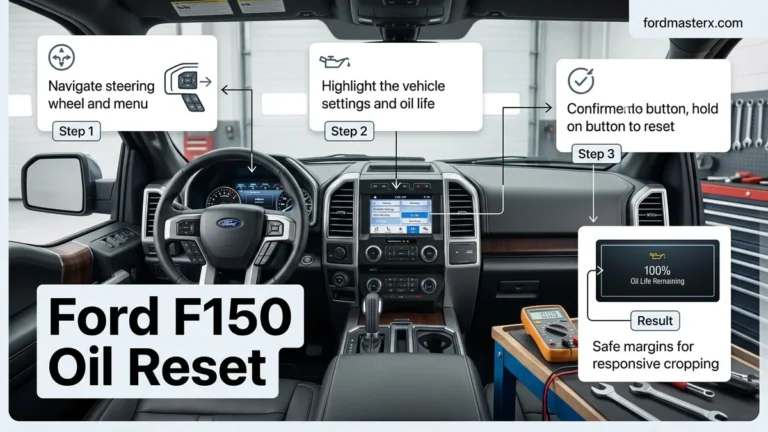
This method is common for late model third-generation Focus vehicles (e.g., 2016-2018 with upgraded instrument clusters, and potentially some international fourth-generation models up to 2026, though the Focus was discontinued in North America after 2018). It utilizes the controls on your steering wheel to navigate the digital display.

Audible — Listen Free for 30 Days
One free credit a month and thousands of titles included.
Listen Free for 30 Days As an Amazon Associate I earn from qualifying purchases.- Ensure the ignition is in the ‘ON’ position (engine off).
- Using the arrow keys (typically left/right or up/down) on your steering wheel, navigate to the main menu on your instrument cluster display.
- Scroll through the options until you find ‘Settings’ or ‘Driver Assist’ (wording can vary slightly by year and region).
- Select ‘Settings’ and then look for ‘Vehicle’ or ‘Maintenance.’
- Within ‘Vehicle’ or ‘Maintenance,’ you should find an option like ‘Oil Life Reset,’ ‘Oil Life,’ or ‘Oil Life %.’
- Press the ‘OK’ button (or equivalent) to select this option.
- The display will usually ask to confirm the reset (e.g., ‘Hold OK to Reset Oil Life’). Hold ‘OK’ until the system confirms ‘Oil life set to 100%’ or a similar message.
- Turn the ignition off and then restart to verify the reset is complete. This action effectively gives the IOLM a clean slate.
For first-generation Ford Focus models (manufactured before 2008), the integrated oil life monitoring system that requires a manual reset via the dashboard controls is generally not present. These vehicles typically operate on fixed mileage intervals. Therefore, for most pre-2008 Ford Focus models, there is no specific electronic oil change reset procedure to perform. Maintenance is tracked by traditional mileage or time, and no dashboard indicator requires a digital reset. Owners should simply follow the manufacturer’s recommended service schedule based on mileage or time since the last change.
Always consult your Ford Focus owner’s manual for the most precise and model-specific instructions. While these methods cover the vast majority of models, minor variations can exist, especially between different regional markets or specific production years within a generation. The manual will provide a definitive guide for your specific vehicle’s initialize sequence.
Troubleshooting Common Issues During a Ford Focus Oil Change Reset
Recommended Best Deal Products


Even with clear instructions, users sometimes encounter challenges when attempting to restore their Ford Focus oil life monitor. Understanding common pitfalls and their solutions can save time and frustration.
Reset Not Registering
This is perhaps the most common issue. You’ve performed the steps, but the ‘Oil Change Required’ light persists, or the oil life percentage doesn’t default to 100%. Reasons for failure can include:
- Incorrect Pedal Timing/Pressure: For the pedal method, both accelerator and brake pedals must be fully and firmly depressed, and held consistently for the entire duration (typically 20-30 seconds). Releasing them too early or not pressing them hard enough will prevent the reset from registering.
- Incorrect Ignition Position: The ignition must be in the ‘ON’ position (all dashboard lights on, but engine not running). If the engine starts, or if the key is only in the ‘ACC’ position, the reset will fail.
- Interruption: The reset sequence must be completed within a single ignition cycle without interruption.
- Low Battery Voltage: While less common, a weak car battery can sometimes cause intermittent electrical issues that interfere with system resets. Ensure your battery is healthy.
If the reset doesn’t register, the first step is to repeat the process carefully from the beginning, paying close attention to the timing and consistency of pedal pressure or menu navigation. Ensure you see the confirmation message like ‘Service: Oil Reset Complete’ or ‘Oil life set to 100%.’
Persistent Warning Lights
Sometimes, even after a successful oil life reset, other warning lights persist. This often indicates a separate, underlying issue. For example, a persistent ‘CHECK ENGINE’ light alongside the oil life warning suggests a diagnostic trouble code (DTC) stored in the vehicle’s computer. This is not directly related to the oil life monitor and requires professional diagnosis. A common scenario is a faulty oil pressure sensor or oil level sensor that may require replacement, causing the light to remain on despite a proper oil change and reset. These issues require diagnostic tools to read error codes and identify the root cause, which a professional Ford technician or service center can provide.
Never attempt to perform a factory reset on your vehicle’s entire computer system unless specifically instructed by a certified technician. An improper factory reset could lead to loss of other vehicle settings, programming, or even critical operational data. The oil life reset is a specific, isolated function to reboot the monitoring system, not a global system overhaul.
Difficulty Accessing Menus (Steering Wheel Method)
For models relying on steering wheel controls, navigating complex digital dashboards can be tricky. Always refer to your owner’s manual for the precise menu tree for your specific year and trim. Ensure the vehicle is stationary when attempting menu navigation. Sometimes, a software update for the vehicle’s infotainment or instrument cluster system (if available) can resolve minor glitches affecting menu access. If you’ve exhausted all self-troubleshooting steps, and especially if diagnostic trouble codes are present, seeking professional assistance is highly recommended. The average cost of a diagnostic scan at a dealership typically ranges from $100-$150, a worthwhile investment to accurately pinpoint and resolve persistent issues.
Maintaining Optimal Oil Life and Reset Practices for Your Ford Focus
Beyond merely knowing how to perform a reboot of your oil life monitor, establishing best practices for oil changes and overall vehicle maintenance is paramount to ensuring the long-term health and reliability of your Ford Focus engine. The reset is a procedural step, but proper maintenance is the foundation.
Audible Premium Plus — Annual Membership
12 audiobook credits up front, plus the full Audible catalogue.
See Annual Plans As an Amazon Associate I earn from qualifying purchases.Manufacturer-Recommended Oil and Filters
The single most critical factor in engine longevity is using the correct engine oil. Ford specifies particular oil viscosity grades and performance standards for each engine type. For most Ford Focus models, this means using SAE 5W-20 or 5W-30, which must be API certified (American Petroleum Institute) and meet Ford’s specific WSS-M2C9xx-A specifications (e.g., WSS-M2C945-A for 5W-20 or WSS-M2C946-A for 5W-30). These specifications are clearly outlined in your owner’s manual. Using genuine Ford or equivalent high-quality oil filters is equally important. Subpar filters can restrict oil flow, reduce filtration efficiency, and compromise engine protection, leading to inaccurate IOLM operation and premature oil degradation.
Best Practices for Oil Change Intervals
While the IOLM system is designed to provide dynamic recommendations, it’s essential to understand its limitations and supplement its guidance with common sense. Adhere to the IOLM’s recommendation, but also consider your specific driving conditions:
- Severe Conditions: Frequent short trips (less than 10 miles), extreme hot or cold temperatures, heavy towing, or extensive idling can accelerate oil degradation. In such cases, it’s prudent to change your oil earlier than the IOLM suggests, typically every 5,000 to 7,500 miles.
- Highway Driving: Sustained highway driving under moderate conditions is less taxing on oil, allowing for longer intervals closer to the IOLM’s maximum recommendations.
Periodic Checks and Consequences
Even with an IOLM, routine manual oil level checks between service intervals are vital. Check for leaks and observe the oil’s condition (color, consistency). This proactive maintenance ensures you’re always aware of your engine’s lubricant status. Neglecting oil changes or performing improper resets can lead to severe consequences:
- Engine Damage: Degraded oil loses its lubricating properties, leading to increased friction, overheating, and accelerated wear on critical engine components.
- Reduced Fuel Economy: Worn-out oil increases engine drag, directly impacting fuel efficiency.
- Increased Emissions: Poorly lubricated engines run less efficiently, contributing to higher emissions.
- Voided Warranties: Failure to follow Ford’s recommended maintenance schedule and use specified fluids can void your powertrain warranty.
Remember, the reset merely provides a fresh start for the monitoring system; it is not a substitute for actual service. Consistent and proper maintenance helps keep not only your engine but also integral systems like the IOLM in optimal working condition. A properly maintained Focus is a reliable Focus.
By The Numbers
Typical Oil Capacity (depending on engine)
IOLM Extended Oil Change Interval
Average Pedal Method Reset Time
Common Recommended Oil Viscosity
Successfully resetting your Ford Focus oil life monitor is crucial after every oil change to maintain accurate system readings. Procedures vary by model year, primarily using either the accelerator-brake pedal method for older models or steering wheel controls for those with advanced digital dashboards. Troubleshooting involves re-checking steps, ignition status, and understanding when professional diagnostic help is needed. Adhering to manufacturer oil specifications and consistent maintenance practices are key for long-term engine health. Implement these steps to keep your Ford Focus operating efficiently and its oil life monitor providing accurate data. Consult your owner’s manual for model-specific nuances, and for persistent issues, schedule a service appointment with a certified Ford technician to ensure a complete restore of your vehicle’s optimal performance.
Frequently Asked Questions
Why does my Ford Focus need an oil change reset if I just changed the oil?
Your Ford Focus uses an Intelligent Oil-Life Monitor (IOLM) that tracks oil degradation. Changing the oil replenishes the lubricant, but the system needs a manual reset to ‘know’ that fresh oil has been installed. Without the reset, the IOLM continues its count from the old oil’s status, leading to inaccurate warnings and potentially recommending another change prematurely or, worse, not detecting when actual fresh oil has degraded.
Can I damage my engine by not resetting the oil life monitor?
Not directly, but an unreset oil life monitor can lead to indirect damage. If you consistently rely on the IOLM for oil change reminders and it’s not reset, it might prompt you for an oil change too late after subsequent services, or create confusion. The primary risk is if you neglect actual oil changes because the indicator is showing an inaccurate or ‘stuck’ reading, potentially leading to critical engine wear.
What if my Ford Focus doesn’t have the pedal method for reset?
Newer Ford Focus models, particularly those with digital instrument clusters, often utilize steering wheel controls to navigate through the vehicle’s menu system. You’ll typically find the oil life reset option under ‘Settings,’ ‘Maintenance,’ or ‘Vehicle Information.’ Refer to your owner’s manual for the exact menu path and button presses specific to your vehicle’s trim and model year for this ‘factory’ reset.
How often should I change the oil in my Ford Focus?
Ford recommends following the Intelligent Oil-Life Monitor (IOLM) system. This dynamic system calculates your oil change interval based on driving conditions, typically ranging from 7,500 to 10,000 miles or once a year, whichever comes first. However, severe driving conditions (e.g., extreme temperatures, heavy towing, frequent short trips) may necessitate more frequent changes, sometimes as early as 5,000 miles, to keep a ‘clean’ start.
My ‘Oil Change Required’ light is still on after performing the reset. What should I do?
If the light persists, first re-attempt the reset procedure carefully, ensuring you’re holding the pedals long enough or navigating the menus correctly. Verify the ignition is in the correct ‘ON’ position (engine off). If it still remains, there might be an underlying issue such as a sensor malfunction, a separate diagnostic trouble code, or an electrical fault. In such cases, professional diagnosis by a certified Ford technician is recommended to ‘restore’ proper system function.
Focus Oil Reset By Model Year
All Ford models: Ford Oil Life Monitor Reset Guide (All Models & Years)