
F-150 3.5 EcoBoost Turbo Diagram: Layout, Plumbing and Failure Points

The F-150 3.5L EcoBoost uses twin parallel turbochargers, not one turbo and not a hot-V layout. Each turbo bolts to its own bank’s exhaust manifold outlet. A shared front-mounted charge air cooler sits between the compressors and the throttle body.
Hardware, output and wastegate type all changed by generation. Most pages online still show one generic chart for all of them, from a 2011 truck to a 2023 Raptor.


This page gives the real layout and the real plumbing path. It also gives the Ford-documented failure points by build date, not by model year alone.
The one number a generic auto site does not have is the production cutoff. Ford redesigned the charge air cooler for trucks built after September 18, 2012.
It offered the new part free to earlier owners starting October 29, 2012. That cutoff decides which CAC part number your truck actually needs.
For the broader engine beyond the turbo system, see our F-150 3.5 EcoBoost engine diagram.
Most F-150 3.5 EcoBoost turbo diagrams mix three different trucks into one chart



Search for an F-150 EcoBoost turbo diagram and most results show one picture. A 2012 truck, a 2019 truck and a 2022 Raptor get treated as the same engine. They are not.
The 2011-2016 trucks use a BorgWarner K03-frame turbo with a pneumatic, boost-referenced wastegate. BorgWarner confirmed itself as the Gen 1 F-150 supplier in its own 2012 press announcement. Other EcoBoost applications of the same era used a different frame, the Garrett GT15, which is a separate part entirely.


Ford redesigned the turbine for 2017: a low-mass wheel cast from MAR-M-247 superalloy, with an electrically actuated wastegate. Output on the standard engine climbed again for 2021 without new turbo hardware, through recalibration alone.
A generation rule follows from this. Never apply one generation’s wastegate type, part number or output figure to another. The failure points below are grouped the same way, by generation, not blended across all years.
Where are the turbos, and how is air, oil and coolant routed?


Both turbos sit low, one bolted to each bank’s exhaust manifold outlet. This is a parallel layout, not a hot-V design that stacks the turbos between the cylinder banks. Intake air reaches each compressor inlet through the factory air filter housing.


Compressed air leaves both turbos through separate charge pipes. Those pipes merge at a single, shared, front-mounted air-to-air charge air cooler. From there, cooled air passes through the throttle body into the intake manifold and the cylinders.
Oil reaches each turbo’s center housing through a pressurized supply tube from the block. It drains back through a separate, unpressurized return tube to the oil pan. Ford’s own 2025 service guidance calls it rare for the turbo housing itself to leak oil externally.
The supply and return tube gaskets are the more likely source of an external leak, not the turbo housing.
Turbo hardware, horsepower and torque by generation


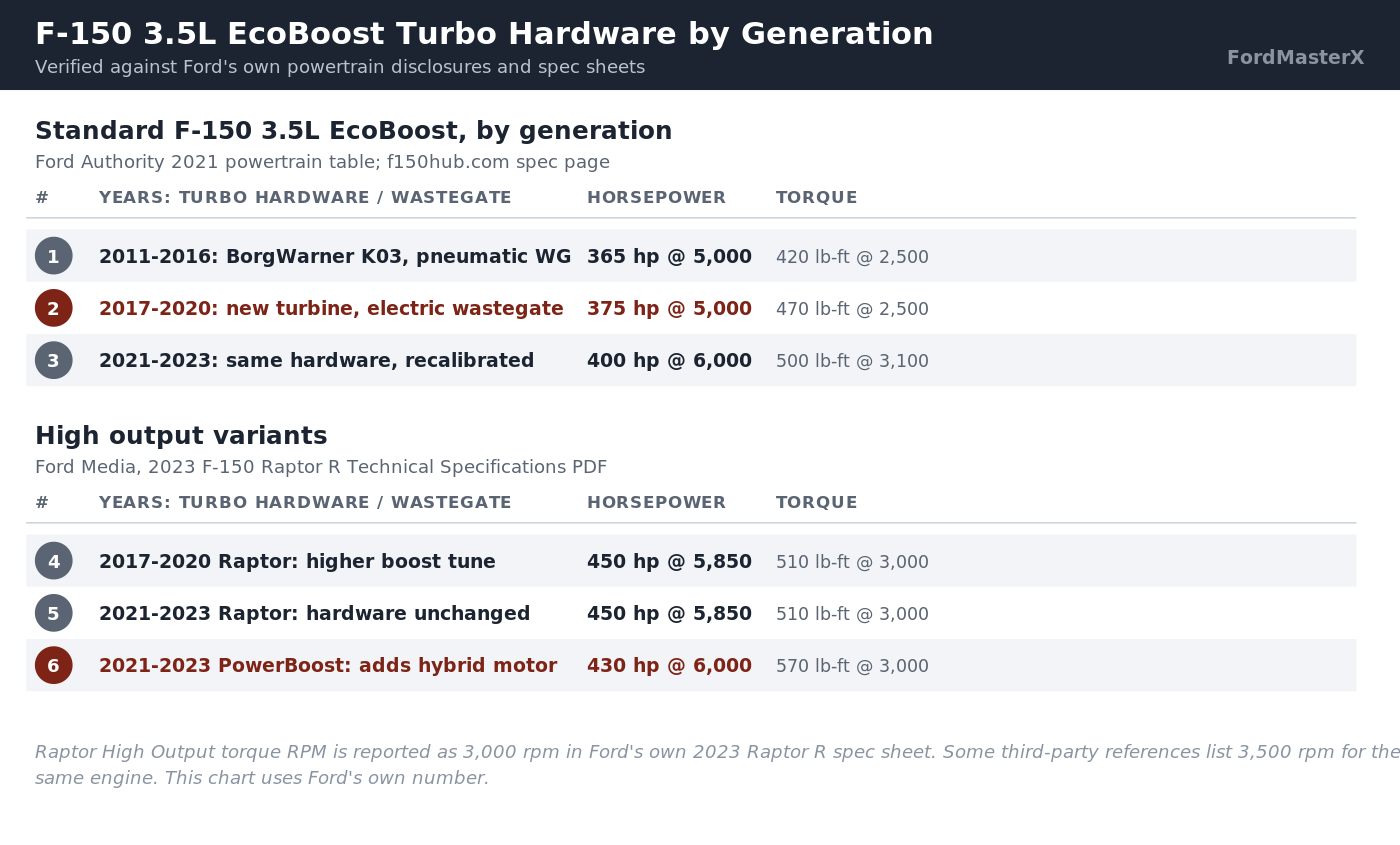
Three distinct turbo setups have powered the standard 3.5 EcoBoost truck engine since 2011. The Raptor and PowerBoost hybrid use variations of the newer hardware. The table below separates every figure by generation and verifies it against two independent sources.


| Years | Turbo hardware / wastegate | Horsepower | Torque |
|---|---|---|---|
| 2011-2016 | BorgWarner K03 frame, pneumatic boost-referenced wastegate | 365 hp @ 5,000 rpm | 420 lb-ft @ 2,500 rpm |
| 2017-2020 | Low-mass turbine (MAR-M-247 superalloy), electric wastegate | 375 hp @ 5,000 rpm | 470 lb-ft @ 2,500 rpm |
| 2021-2023 | Same Gen 2 hardware, recalibrated | 400 hp @ 6,000 rpm | 500 lb-ft @ 3,100 rpm |
| Variant | Turbo hardware | Horsepower | Torque |
|---|---|---|---|
| 2017-2020 Raptor (High Output) | Same Gen 2 hardware, higher boost tune, 10.0:1 compression | 450 hp @ 5,850 rpm | 510 lb-ft @ 3,000 rpm |
| 2021-2023 Raptor (High Output) | Same High Output hardware carried over | 450 hp @ 5,850 rpm | 510 lb-ft @ 3,000 rpm |
| 2021-2023 PowerBoost hybrid | Same base twin-turbo engine, hybrid motor added in the driveline | 430 hp @ 6,000 rpm | 570 lb-ft @ 3,000 rpm |
Watching live boost pressure is the fastest way to catch a developing underboost condition before it throws a code. A digital boost gauge reads this in real time from the cabin.
Ford-documented turbo and wastegate failure points, by generation
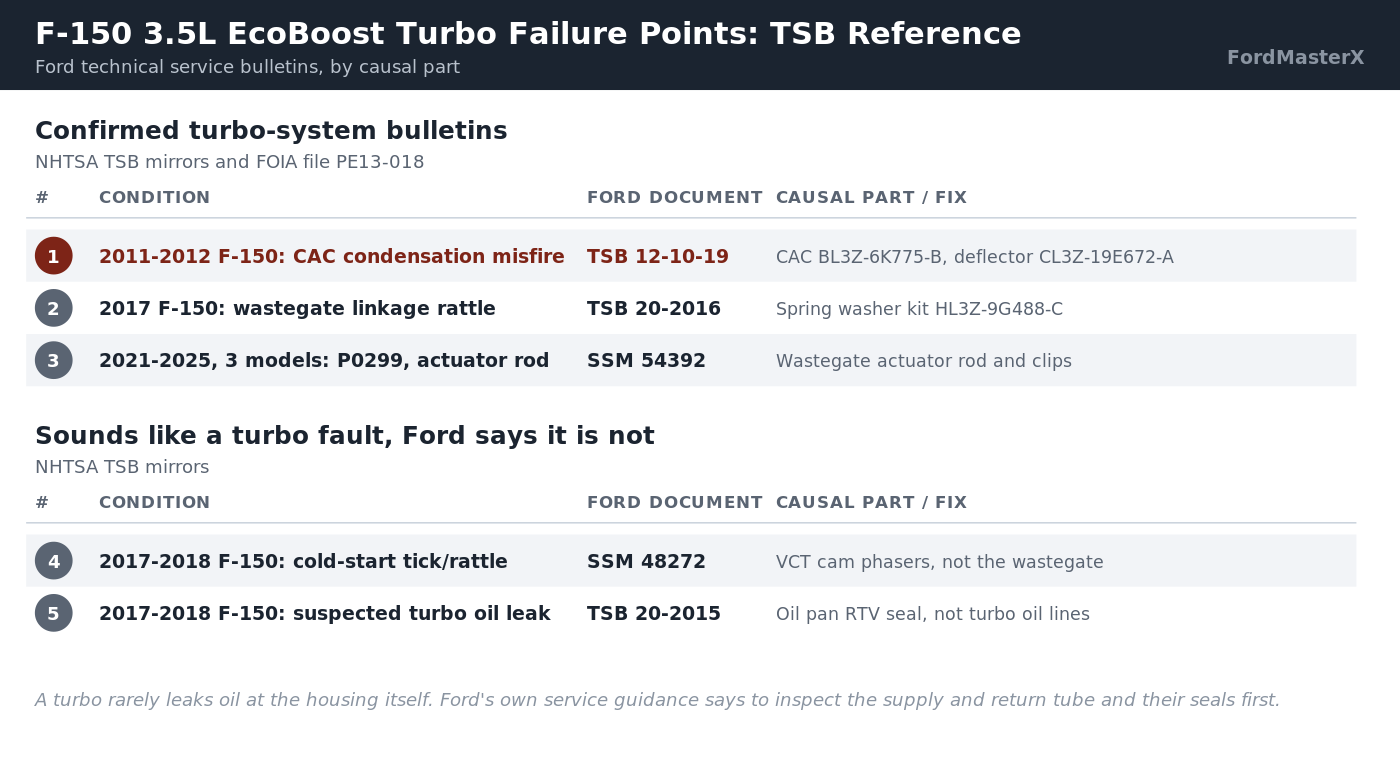
Three Ford service bulletins trace directly back to the turbo or wastegate hardware itself. Two more produce a similar sound or code but trace to a different part entirely. The table below separates confirmed turbo issues from look-alike complaints.
| Years / models | Condition | Ford document | Causal part / fix |
|---|---|---|---|
| 2011-2012 F-150 | Intermittent stumble or misfire after humid highway driving, from condensation in the charge air cooler | TSB 12-10-19 | Charge air cooler BL3Z-6K775-B, deflector plate CL3Z-19E672-A |
| 2017 F-150 | Rattle from the engine bay, excessive play in the wastegate linkage | TSB 20-2016 | Wastegate actuator spring washer kit HL3Z-9G488-C, one kit per actuator |
| 2021-2025 F-150, Expedition, Navigator | DTC P0299 stored, may also rattle, wastegate actuator rod disconnected | SSM 54392 | Wastegate actuator rod and retention clips, serviced without replacing the whole actuator |
The redesigned charge air cooler deleted the internal turbulators and changed the fin density, per Ford’s own 2012 internal communications. If repeated misfire has already damaged the left catalytic converter, the same bulletin calls for replacing it too. That applies whenever DTC P0430 is also present, part BL3Z-5E212-E.
Two more complaints sound like the same turbo system but trace elsewhere entirely. Misdiagnosing these wastes a turbo replacement on a part that was never the problem.
| Years / models | Condition | Ford document | Actual cause |
|---|---|---|---|
| 2017-2018 F-150, built on or before 10-Jul-2018 | Tick, tap or rattle from the top front cover, 2 to 5 seconds after a cold soak of 6+ hours | SSM 48272 / TSB 20-2191 | Worn VCT cam phasers, not the turbo or wastegate |
| 2017-2018 F-150 (qualifying build dates) | Oil pooling or leak blamed on the turbo | TSB 20-2015 | Oil pan RTV seal, not the turbo supply or return tubes |
Raptor owners get one more look-alike, covered by TSB 25-2103, which supersedes 23-2341. It covers a rattle from the exhaust tailpipe actuators on Raptor trucks built on or before October 14, 2022. That is a muffler-mounted valve actuator, not the turbocharger.
For the full list of EcoBoost-specific trouble codes beyond the turbo system, see our Ford 3.5 EcoBoost problems guide.
Before replacing a wastegate actuator, a shop typically bench-tests it off the truck first. A hand vacuum and pressure pump kit confirms whether the actuator holds pressure before any part gets ordered.
Are both F-150 EcoBoost turbos the same part?
Yes, within a given generation. Ford documents no left/right turbo split for this engine, the way some V8 applications use mirror-image parts. TSB 20-2016 calls for the same spring washer kit on both wastegate control actuators, not two different kits.
Each turbo still bolts to its own bank, so a failure on one side does not require touching the other. Bulletins that call for work on both sides say so explicitly, as TSB 20-2016 does.
Does a P0299 code always mean a bad wastegate actuator?
No. P0299 is a generic underboost code. A boost leak, a failing turbo or a stuck-open wastegate can all trigger it, on any generation.
SSM 54392 narrows the cause to a disconnected wastegate actuator rod, but only for 2021-2025 F-150, Expedition and Navigator trucks. A rattle alongside the stored code is the detail that points there specifically, not the code by itself.
F-150 3.5 EcoBoost turbo symptom to answer guide
Match the symptom to the generation it actually affects before ordering a part.
| Symptom | Most likely generation | Check this first |
|---|---|---|
| Stumble or misfire after a humid highway drive | 2011-2012 | CAC condensation, TSB 12-10-19 |
| Rattle from the engine bay at idle or load | 2017 | Wastegate linkage play, TSB 20-2016 |
| P0299 (underboost) stored | 2021-2025 | Wastegate actuator rod, SSM 54392 |
| Cold-start tick for a few seconds, then quiet | 2017-2018 | VCT cam phasers, not the turbo |
| Oil pooling near the turbo | 2017-2018 | Oil pan RTV seal, not the turbo lines |
| Rattle from the exhaust tip area on a Raptor | 2021-2023 Raptor | Exhaust tailpipe actuator, TSB 25-2103 |
A scan tool that reads live wastegate duty cycle narrows this down fast, instead of guessing from the symptom.
Some owners add a larger aftermarket intercooler after a charge air cooler replacement, hoping for extra cooling margin. Our 3.5 EcoBoost intercooler guide covers that option if you want to compare it.
Where the sources disagree
Ford’s own 2023 Raptor R technical specifications PDF lists High Output torque peaking at 3,000 rpm. A widely used independent spec page lists 3,500 rpm for the same engine. This page uses Ford’s own number, and the gap is flagged here, not hidden.
The PowerBoost hybrid shares the same base twin-turbo engine covered throughout this page. Its added torque and horsepower come from a hybrid motor in the driveline, not from turbo changes. Treat its turbo hardware and failure points as identical to the 2021-2023 standard engine.
F-150 3.5 EcoBoost turbo quick reference
Every generation’s key numbers in one place.
| Generation | Wastegate type | Known failure point | Ford document |
|---|---|---|---|
| 2011-2016 standard | Pneumatic, boost-referenced | CAC condensation (2011-2012 only) | TSB 12-10-19 |
| 2017-2020 standard | Electric | Wastegate linkage play (2017) | TSB 20-2016 |
| 2021-2023 standard and PowerBoost | Electric | Wastegate actuator rod, P0299 | SSM 54392 |
| 2017-2020 and 2021-2023 Raptor | Electric, higher boost tune | Exhaust actuator rattle (not the turbo) | TSB 25-2103 |
Confirm your exact build date against the cutoffs above before ordering any part. Ford’s own bulletins, not a generic parts-site chart, are what this page is built from.


