Ford 3.5 EcoBoost Problems: Year, Symptoms and Fixes 2026

Ford 3.5 EcoBoost problems vary significantly by model year. A 2012 F-150 with a P0016 code needs a different diagnostic path from a 2019 truck that rattles for several seconds after a cold start.
Ford service bulletins document specific issues including early timing-chain wear, humid-weather misfires, turbo wastegate faults, fuel dilution, and later VCT cam-phaser noise. A small VIN-specific population of newer 3.5L GTDI trucks was also recalled for a possible rapid engine-oil leak.

Prime for Young Adults — 6 Months Free
Students and 18–24s get six months of Prime free, then half price.
Start 6 Months Free As an Amazon Associate I earn from qualifying purchases.
The practical way to diagnose your truck is to start with its year, exact symptom, stored trouble codes, and service history.
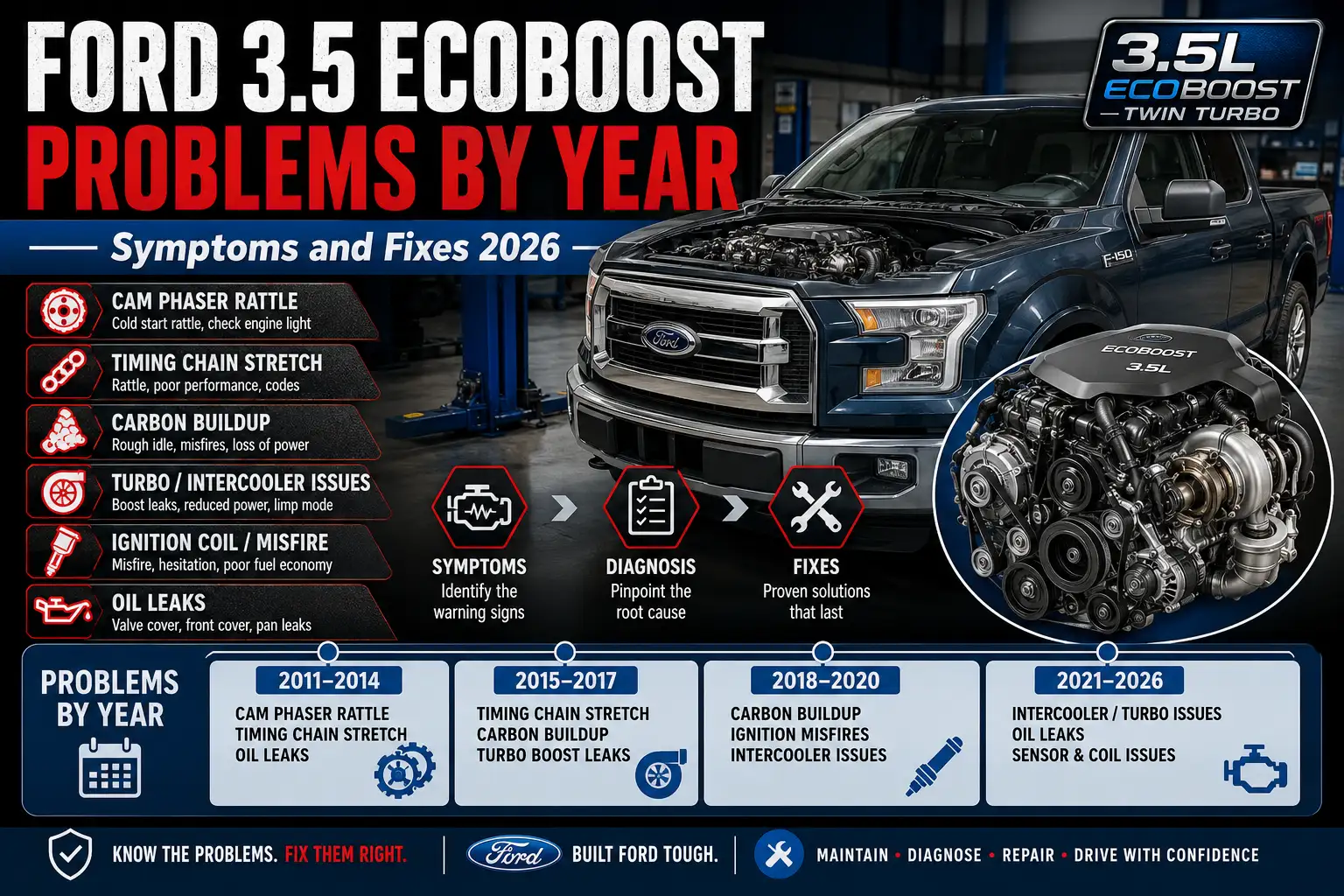
3.5 EcoBoost Problem Diagnostic Decision Guide
Start with the model year, then match the symptom and stored trouble code before replacing parts.
This infographic is a diagnostic starting point, not a substitute for Ford service procedures. TSB and recall applicability depends on model, build date, VIN, symptoms, and stored diagnostic data.
What 3 Year Groups Change About 3.5 EcoBoost Problems
Recommended Best Deal Products

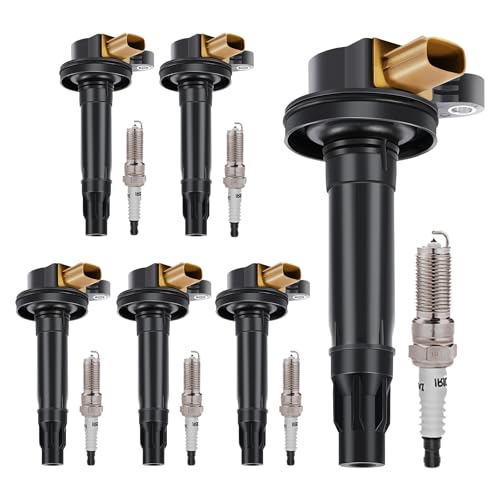

The 3.5 EcoBoost has been revised significantly since its F-150 introduction, so one problem list should not be applied equally to every truck.
| Model Years | Problems Worth Checking First | Useful Clues |
|---|---|---|
| 2011 to 2014 | Timing chain, fuel dilution, CAC misfire, turbo control | P0016, high oil level, acceleration misfire, P0299 |
| 2015 to 2016 | Turbo control, boost leaks, ignition and service history | P0234, P0299, low boost |
| 2017 to 2020 | VCT cam phasers, ignition, boost system | Cold-start rattle, P164C |
| 2021 to 2026 | Symptom-specific faults and VIN campaigns | Misfires, oil loss, coolant loss, stored codes |
Early 2011 to 2014 Engines
The oldest F-150 3.5L GTDI engines have the largest amount of Ford service documentation for timing, charge-air, turbo, and crankcase-related complaints.
Ford TSB 14-0194 specifically covers some 2011 to 2014 F-150s built on or before October 10, 2014 with P0016 caused by primary timing-chain wear.
Middle 2015 to 2016 Engines
A 2015 or 2016 truck should not automatically be diagnosed using every bulletin written for a 2011 model.
Build date matters. For example, Ford TSB 16-0013 covers 2011 to 2015 F-150s with qualifying 3.5L GTDI engine build dates on or before February 28, 2015 for certain P0234 or P0299 complaints.
Later 2017 to 2020 Engines
Cam-phaser noise becomes one of the more important checks on this group.

Audible — Listen Free for 30 Days
One free credit a month and thousands of titles included.
Listen Free for 30 Days As an Amazon Associate I earn from qualifying purchases.Ford TSB 23-2143 applies to certain 2017 to 2020 F-150 3.5 EcoBoost trucks built on or before November 30, 2019. Ford describes a cold-start ticking, tapping, or rattle that can last about 2 to 5 seconds.
For a deeper look at that repair, FordMasterX already has a dedicated 3.5 EcoBoost cam phaser replacement guide.
Newer 2021 to 2026 Engines
Do not assume a newer 3.5 EcoBoost automatically carries every early-engine weakness.
Start with its actual symptom, codes, maintenance history, and VIN campaigns. The newest trucks also have less accumulated high-mileage data than engines that have been on the road for a decade or more.
7 Most Documented 3.5 EcoBoost Problems by Year
These seven problems do not affect every 3.5 EcoBoost. The affected year, build date, and symptom determine which path deserves attention.
Primary Timing Chain Wear
Ford TSB 14-0194 is one of the clearest examples of why year-specific diagnosis matters.
It covers some 2011 to 2014 F-150 3.5L GTDI trucks built on or before October 10, 2014 with P0016. Ford states that the condition may be caused by a worn primary timing chain.
Ford’s diagnostic procedure did not simply say to replace the chain whenever P0016 appeared. Technicians checked a VCT parameter with the engine running. The bulletin specified chain replacement when VCT_INT_ACT1 measured +6 degrees or greater under its procedure.
Ford listed 8.9 labor hours for diagnosis and primary timing-chain replacement under that TSB.
RepairPal’s August 2026 national estimate lists a general timing-chain replacement at about $2,109 to $2,751, although your F-150 quote can differ because that figure is not specific to this Ford bulletin.
Audible Premium Plus — Annual Membership
12 audiobook credits up front, plus the full Audible catalogue.
See Annual Plans As an Amazon Associate I earn from qualifying purchases.If your truck has already been diagnosed with chain wear, our 3.5 EcoBoost timing chain replacement guide covers the repair in more detail.
Humid Weather Charge Air Misfire
Some 2011 and 2012 F-150 3.5L GTDI trucks can stumble or misfire during hard acceleration after extended highway driving in humid or damp weather.
Ford documented that behavior in TSB 13-3-3. Possible codes include P0304, P0305, P0306, and P0430, although Ford also notes that misfire freeze-frame data may exist without an active code.
This symptom pattern matters.
If your truck drives normally around town but misfires after a long humid highway run when you accelerate hard, the charge-air bulletin deserves attention before you start replacing random coils or injectors.
Turbo Wastegate and Underboost Problems
A P0299 code does not automatically mean both turbochargers are bad.
Ford TSB 16-0013 covers certain 2011 to 2015 F-150 3.5L GTDI engines built on or before February 28, 2015. Ford lists P0234 overboost, P0299 underboost, surging, and noises described as an air rush, hiss, whoosh, whistle, grinding, growling, or scraping.
The Ford procedure tested wastegate actuator movement before turbo replacement. The actuator rod should begin moving between 3 and 9 psi and reach full extension between 12 and 19 psi under the bulletin’s test.
If the wastegate and actuator operate correctly, Ford directs technicians back to normal diagnostics rather than automatically replacing a turbo.
RepairPal’s current F-150 data shows how expensive a wrong diagnosis can become. A 2019 F-150 turbocharger assembly replacement is estimated at roughly $1,579 to $2,044 per repair estimate, depending on location and related work.
Our dedicated guide on 3.5 EcoBoost turbo replacement cost is the better place for a full cost breakdown.
Fuel Dilution and High Oil Level
A raw fuel smell in the crankcase or an oil level that appears too high deserves investigation on certain early engines.
Ford TSB 15-0003 applies to 2011 to 2014 F-150 3.5L GTDI trucks exhibiting raw fuel odor from the engine oil and or an overfull oil-level indication.
Ford’s service procedure starts by identifying the PCV valve version by color. A black valve triggers PCV replacement, while the procedure also calls for an oil and filter change and further build-date-dependent checks.
Do not treat rising oil level as normal. Confirm the reading on level ground using the correct checking procedure, then investigate why fuel may be entering the crankcase.
Cam Phaser Cold Start Rattle
The best-known later 3.5 EcoBoost problem is the short rattle heard immediately after a true cold start.
Ford TSB 23-2143 covers applicable 2017 to 2020 F-150s and certain 2018 to 2020 Expedition and Navigator models built on or before November 30, 2019. Ford describes noise from the upper front-cover area after a cold soak of at least six hours.
The noise can last approximately 2 to 5 seconds. Some affected trucks may also experience an auto-start-stop no-restart condition with or without P164C. Ford identifies worn VCT units as the potential cause and specifies replacement of all four VCT units when the bulletin applies.
Ford lists 9.6 labor hours for the standard F-150 procedure and 9.7 hours for the Raptor.
Real owner quotes show why diagnosis matters. In an F150Forum thread, one 2017 owner reported a $3,200 independent-shop estimate for a phaser and timing-kit repair at about 72,000 miles, while a 2018 owner reported an approximately $5,000 dealer quote near 76,000 miles. These are individual owner reports, not fixed 2026 prices.
Cylinder Misfires and Ignition Faults
P0300 through P0306 codes require diagnosis before you label the engine itself unreliable.
A cylinder-specific misfire can come from ignition, fueling, mechanical compression, wiring, or air and fuel problems. Early 2011 to 2012 trucks also have the special humid-weather branch Ford documented for cylinders 4, 5, and 6.
Check the spark plug and coil for the affected cylinder, review freeze-frame data, and compare cylinder behavior before replacing expensive fuel or engine components.
A misfire under heavy boost also deserves closer attention to plug condition and gap because cylinder pressure rises under load.
Newer Engine Cup Plug Oil Leak
A small population of newer 3.5L GTDI Ford trucks received a safety recall for a possible rapid oil leak.
NHTSA campaign 24V-851, Ford campaign 24S70, covers certain 2024 to 2025 F-150s, 2024 Expeditions, and 2024 Lincoln Navigators equipped with the 3.5L GTDI. NHTSA listed 2,418 potentially affected units.
The issue involves a potentially misaligned engine cup plug. A rapid oil leak could cause an engine stall and increase crash risk. Oil contacting hot engine or exhaust components could also increase fire risk.
Ford’s dealer notice lists F-150 build windows beginning September 12, 2024 at Dearborn Truck and September 15, 2024 at Kansas City, with affected production ending in early October.
This is a VIN-specific recall. Do not assume every 2024 or 2025 3.5 EcoBoost is affected.
Which 3.5 EcoBoost Problem Matches Your Symptoms
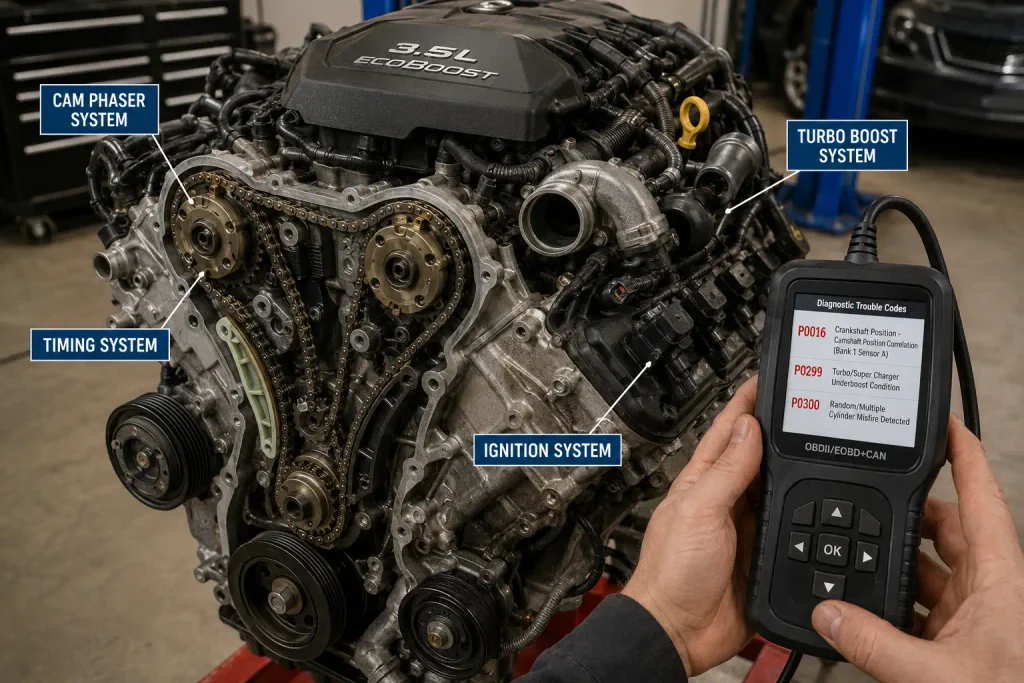
Your symptom is often more useful than mileage when choosing the first diagnostic path.
| Symptom | Year Clue | First Area to Investigate | First Check |
|---|---|---|---|
| P0016 | 2011 to 2014 | Primary timing system | Verify build date and VCT data |
| Misfire after humid highway driving | 2011 to 2012 | Charge-air system | Pull freeze-frame data |
| P0234 or P0299 | 2011 to 2015 bulletin range | Wastegate and boost system | Test actuator operation |
| Fuel smell and high oil level | 2011 to 2014 | PCV and fuel dilution | Inspect PCV version and oil |
| 2 to 5 second cold rattle | 2017 to 2020 | VCT cam phasers | Confirm six-hour cold-soak symptom |
| Cylinder-specific misfire | Multiple years | Ignition, fuel, compression | Identify the affected cylinder |
| Rapid oil loss | VIN-specific 2024 to 2025 | Cup plug recall | Check VIN campaign status |
If your early truck has P0016, confirm timing data before buying a camshaft or crankshaft sensor.
If your 2011 to 2012 truck stumbles specifically after sustained highway driving in damp conditions, check whether Ford’s charge-air bulletin fits the symptom.
If you have P0299, inspect the boost system and wastegate operation before condemning either turbo.
If a 2017 to 2020 truck produces a short front-cover rattle only after sitting for six hours or longer, the VCT bulletin becomes a strong diagnostic lead.
If a newer truck rapidly loses oil, stop treating it as a normal seep and check the VIN against current Ford or NHTSA campaigns.
What 4 Trouble Codes Reveal About EcoBoost Failures
A trouble code identifies an operating fault. It does not always identify the component you should replace.
P0016 Timing Correlation
P0016 points to a crankshaft and camshaft timing correlation problem.
On qualifying 2011 to 2014 F-150s, Ford specifically connected P0016 with possible primary timing-chain wear in TSB 14-0194.
That makes mechanical timing and VCT data more important than immediately installing a new position sensor.
P0299 Turbo Underboost
P0299 means the commanded boost level is not being achieved.
Possible paths include a charge-air leak, wastegate issue, control fault, sensor problem, or actual turbocharger defect. Ford’s early-engine bulletin specifically tests wastegate operation before authorizing turbo replacement.
The 3.5 EcoBoost MAP sensor location is useful when your diagnostic path requires checking boost-pressure sensor readings.
P0300 Through P0306 Misfires
P0300 indicates a random or multiple-cylinder misfire. P0301 through P0306 narrow the problem to a specific cylinder.
Use freeze-frame data to determine when the fault occurred. Load, engine speed, temperature, and boost conditions can help separate a normal ignition problem from the early humid-weather CAC pattern.
P164C VCT Related Symptoms
P164C may appear on some trucks covered by Ford’s later cam-phaser bulletin, but the code is not required for the bulletin to apply.
Ford says the cold-start rattle and intermittent auto-start-stop no-restart condition may occur with or without P164C.
The symptom and build date therefore matter as much as the code.
Which 3.5 EcoBoost Years Need the Closest Inspection
No complete model year should be rejected solely because a problem exists in a Ford bulletin.
A bulletin describes a condition that may affect qualifying trucks. It does not prove that every truck from that year has the defect.
Inspect 2011 to 2014 Carefully
Check for P0016 history, timing-system repairs, abnormal oil level, fuel smell in the oil, boost codes, and previous CAC work.
For trucks built on or before October 10, 2014, P0016 deserves particular attention because Ford specifically documented primary-chain wear in that population.
Inspect 2015 to 2016 by Build
Ask for service records and scan the PCM even if the check-engine light is off.
For 2015 engines, build date matters when investigating the P0234 and P0299 turbo bulletin. Ford’s cutoff is February 28, 2015.
Inspect 2017 to 2020 Cold
Do not let the seller warm the truck before you arrive if cam-phaser condition matters to your purchase decision.
Ford’s bulletin requires a cold soak of at least six hours before the characteristic 2 to 5 second noise may occur.
That makes a genuine first start of the day much more informative than restarting an already warm engine.
Inspect 2021 to 2023 by Symptom
Do not transfer every first-generation diagnosis to these trucks.
Scan for codes, inspect fluids, review oil-change records, cold-start the engine, and road-test it under enough load to expose boost or misfire complaints.
Check 2024 to 2026 by VIN
Newer trucks should always get a VIN recall check.
The 24S70 engine cup-plug campaign proves why this matters. Only a limited population is affected, so model year alone is not enough to establish recall status.
How to Diagnose 3.5 EcoBoost Problems in 7 Steps
Parts swapping can turn an EcoBoost fault into a very expensive guessing game.
- Confirm the exact year and build date. Ford TSB applicability often ends at a specific production date.
- Record the exact symptom. Note cold versus warm, idle versus boost, weather conditions, noise duration, and whether the problem is intermittent.
- Scan all DTCs. Check current, pending, and permanent codes rather than relying only on the warning light.
- Save freeze-frame data. Engine load, RPM, temperature, and operating conditions can reveal when a misfire or boost fault happened.
- Check oil and coolant. Look for abnormal levels, fuel odor, rapid loss, and visible external leaks.
- Match the condition to Ford service information. A qualifying TSB can give you a much narrower test path.
- Test before replacing parts. Confirm mechanical timing, wastegate movement, boost leaks, ignition function, fuel delivery, or VCT operation as appropriate.
Advanced timing and VCT work is not a basic driveway repair. Ford itself states that its TSB procedures are intended for trained technicians with the proper equipment.
Is the 3.5 EcoBoost Reliable After These Problems
The 3.5 EcoBoost can still be a reasonable engine to own, but its risk profile depends heavily on year, service history, current symptoms, and whether known problems have already been repaired correctly.
If you own or are buying a 2011 to 2014 truck, focus on timing correlation, fuel dilution, charge-air behavior, and boost history.
For 2017 to 2020, a true cold start should be part of any inspection because Ford documented the VCT rattle on qualifying builds.
For newer trucks, current symptoms and VIN-specific campaigns matter more than assuming every early EcoBoost problem still applies.
The strongest used 3.5 EcoBoost purchase is not simply the model year with the fewest complaints. It is the truck with clean diagnostics, documented maintenance, no unresolved cold-start or boost symptoms, and repair records you can verify.
5 Common Questions About Ford 3.5 EcoBoost Problems
What Is the Most Common 3.5 EcoBoost Problem
There is no single problem that applies to every 3.5 EcoBoost year. Early 2011 to 2014 trucks have documented timing-chain and fuel-dilution concerns, while certain 2017 to 2020 engines have a documented VCT cam-phaser cold-start rattle.
What Years Have 3.5 EcoBoost Cam Phaser Problems
Ford TSB 23-2143 covers certain 2017 to 2020 F-150 3.5 EcoBoost trucks built on or before November 30, 2019. The key symptom is a 2 to 5 second ticking, tapping, or rattling sound after a cold soak of at least six hours.
Which 3.5 EcoBoost Years Should I Avoid
There is no Ford document that says an entire 3.5 EcoBoost model year should be avoided. Inspect 2011 to 2014 trucks carefully for early timing and fuel-related issues, and cold-start qualifying 2017 to 2020 trucks to check for VCT noise.
How Much Does a 3.5 EcoBoost Repair Cost
Cost depends on the fault. RepairPal estimates a 2019 F-150 turbocharger replacement at about $1,579 to $2,044, while its general timing-chain estimate is $2,109 to $2,751 as of August 2026.
Cam-phaser jobs are labor intensive. Ford assigns 9.6 labor hours to its applicable F-150 VCT procedure, and owner-reported quotes have ranged from roughly $3,200 to $5,000 for broader phaser or timing work.
Can a 3.5 EcoBoost Last 200000 Miles
A 3.5 EcoBoost can reach high mileage, but there is no reliable Ford figure guaranteeing 200,000 miles for every engine. Maintenance history, oil-change intervals, operating conditions, previous timing or VCT repairs, boost-system health, and the truck’s current mechanical condition matter more than a promised mileage number.
What to Check Before Repairing Your 3.5 EcoBoost
Ford 3.5 EcoBoost problems make more sense once you stop treating every model year as the same engine.
For an early truck, start with timing, charge-air behavior, fuel dilution, and boost control. For an applicable 2017 to 2020 truck, pay close attention to a true cold-start VCT rattle. On newer trucks, check current codes and VIN campaigns before assuming an older failure pattern applies.
Start with the year and build date. Record the exact symptom, scan the PCM, save the freeze-frame data, and test the affected system before buying expensive parts.
That sequence gives you a much better chance of fixing the actual fault instead of replacing the component most commonly blamed online.