Ford F-150 Alternator Amperage Chart and Upgrade Guide 2026

The electrical demands of the Ford F-150 have grown exponentially over the last four decades of automotive engineering. Early models required minimal amperage to support basic ignition coils and incandescent lighting systems.
Modern iterations of the F-150 operate as rolling mobile command centers and job-site electrical generators. They demand massive electrical throughput for infotainment networks, climate control, and advanced driver assistance systems.

Prime for Young Adults — 6 Months Free
Students and 18–24s get six months of Prime free, then half price.
Start 6 Months Free As an Amazon Associate I earn from qualifying purchases.Understanding the precise alternator amperage specifications for specific model years is critical for routine vehicle maintenance. It is equally vital for planning aftermarket electrical upgrades without overloading the factory architecture.
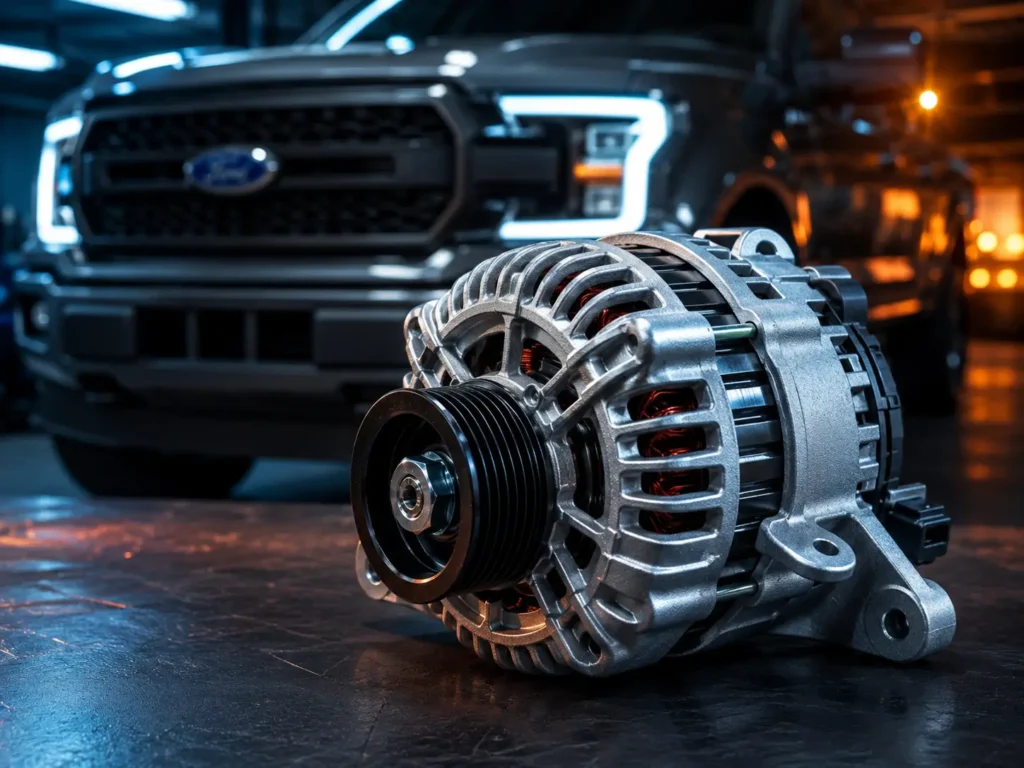
This comprehensive report details the evolutionary timeline of the Ford F-150 charging system from 1980 to the modern era. It provides granular data on factory alternator outputs across all generations and powertrain configurations.
The analysis also covers high-output alternator upgrades, required wiring modifications, and advanced diagnostic procedures. Particular attention is given to the intricacies of Ford’s Smart Charge systems and Battery Management System (BMS) integration.
The Complete Ford F-150 Alternator Amperage Chart
Recommended Best Deal Products


Knowing your exact Ford F-150 alternator amperage is crucial before installing heavy-draw accessories like winches, snow plows, or high-end audio systems.
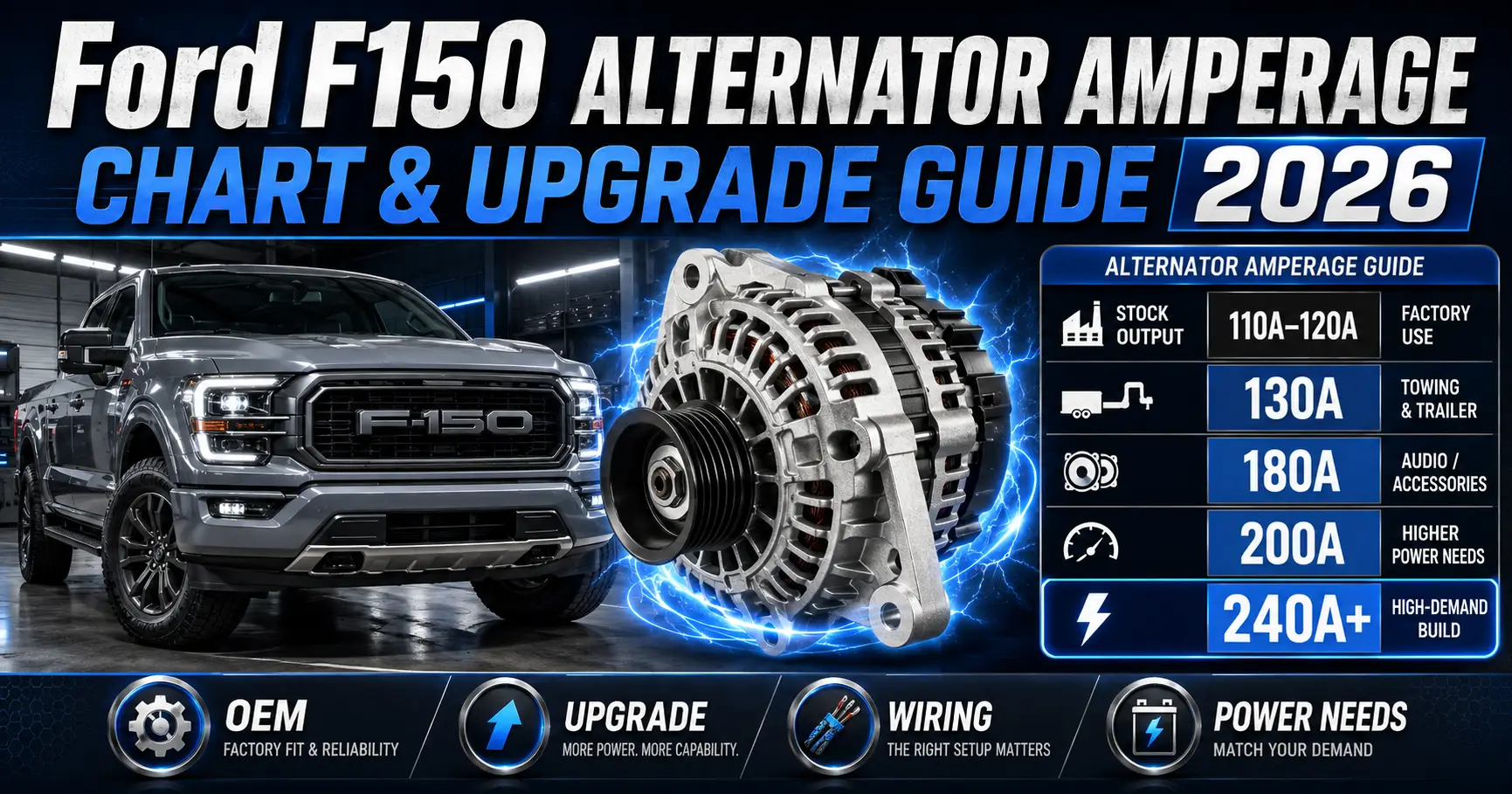
We analyzed decades of OEM specifications to build this definitive guide. Discover if your stock 150A, 200A, or 240A unit can handle the load.
Modern Standard
The standard alternator capacity for 13th and 14th Gen F-150s (2015-Present) without heavy-duty packages.
Max Tow Upgrade
Included with the Max Trailer Tow Package and Snow Plow Prep Package on modern EcoBoost and V8 engines.
PowerBoost Hybrid
Hybrids lack a traditional alternator. They use a massive DC-DC converter pulling from the high-voltage battery.
Historical F-150 Alternator Output by Generation
Automotive electrical demands have skyrocketed over the past three decades. Early 10th-generation trucks could survive on a mere 95 amps.

Audible — Listen Free for 30 Days
One free credit a month and thousands of titles included.
Listen Free for 30 Days As an Amazon Associate I earn from qualifying purchases.Today, with advanced infotainment, heated seats, and sophisticated engine management, Ford has pushed base alternators to 200 amps. Review the chart below to find your generation’s baseline and upgraded capabilities.
| Generation | Years | Base Amperage | Upgraded/HD Option |
|---|---|---|---|
| 10th Gen | 1997 – 2003 | 95A | 130A |
| 11th Gen | 2004 – 2008 | 130A | 130A (Standardized) |
| 12th Gen | 2009 – 2014 | 150A | 155A / 175A (Plow Prep) |
| 13th Gen | 2015 – 2020 | 200A | 240A (Max Tow) |
| 14th Gen | 2021 – Present | 200A | 240A / DC-DC (Hybrid) |
Why High Amperage Matters: Accessory Draw
Recommended Best Deal Products


Your factory electronics already consume 40-60% of your alternator’s base capacity just running the engine, HVAC, and lights.
Adding aftermarket parts can easily overwhelm a stock 130A or 150A system. A heavy winch pull can temporarily draw massive current, requiring a dual battery setup or a high-output alternator upgrade.
The Evolution of OEM Capacity
This visualization illustrates the rapid growth in standard alternator output provided by Ford factory configurations.
As reported by automotive authorities like Car and Driver, the shift to electric power steering (EPAS) and Pro Power Onboard systems forced massive upgrades to base electrical architecture.
The Evolutionary Arc of F-150 Charging Systems
Recommended Best Deal Products


The engineering behind automotive alternators has transitioned from simple external mechanical regulation to complex, computer-controlled power management. This shift reflects the broader automotive industry’s move toward complete digital integration.
Early F-150 trucks prioritized mechanical simplicity and extreme durability over high electrical capacity. The electrical loads were strictly limited to halogen headlights, basic AM/FM radios, and low-draw heater blowers.
As vehicle technology advanced, so did the absolute necessity for robust alternating current generation. Ford continuously upgraded the stator designs, rectifier bridges, and cooling mechanisms to keep pace with demand.
The introduction of Electronic Fuel Injection (EFI) and electronic transmission controls in the late 1980s forced a paradigm shift. Alternators were no longer just battery chargers; they became the lifeblood of the powertrain control modules.
The 1G and 2G Alternator Era (1980–1996)
During the early 1980s, the Ford F-Series relied primarily on the First Generation (1G) and Second Generation (2G) alternators. These units were functionally basic and offered relatively low output ceilings.
Audible Premium Plus — Annual Membership
12 audiobook credits up front, plus the full Audible catalogue.
See Annual Plans As an Amazon Associate I earn from qualifying purchases.Standard equipment on the F-Series and Bronco during this period was a remarkably modest 40-amp unit. Optional factory upgrades included a 60-amp alternator for standard light-duty trucks.
A slightly more robust 70-amp unit was strictly reserved for vehicles equipped with heavy-duty options. The factory snow plow prep package, for example, required this 70-amp unit to support the hydraulic pump load.
A 100-amp unit was virtually nonexistent in standard light-duty configurations directly from the factory. Owners requiring more power often had to seek out aftermarket tractor or industrial components.
The transition to the 2G alternator around 1985 brought internal voltage regulation to the light-duty truck lineup. However, it still featured an external cooling fan and suffered from limited amperage generation.
The 2G alternator is historically notorious among Ford enthusiasts for its electrical connector design. The push-in style plug was prone to developing high electrical resistance over time.
This resistance generated severe heat under continuous load, frequently resulting in melted wiring harnesses. Because of these inherent design flaws, upgrading from the 2G system became a rite of passage for vintage F-150 restorers.
The 3G Alternator Upgrade Revolution
The introduction of the Third Generation (3G) alternator marked a pivotal shift in Ford’s electrical engineering strategy. The 3G featured dual internal cooling fans and a vastly improved, highly reliable internal voltage regulator.
These units were designed in two primary case sizes to accommodate different engine bays. Ford manufactured a small case generating roughly 95 amps, and a large case producing 130 amps.
The large case 3G alternator became highly sought after for retrofits on older Bullnose and OBS (Old Body Style) trucks. It allowed owners to support modern accessories like high-lumen off-road lighting and high-draw electric recovery winches.
Distinguishing between the two cases involves measuring the mounting ear locations on the alternator housing. The mounts are situated exactly 180 degrees apart, located at the 12 o’clock and 6 o’clock positions.
The physical spacing between these mounting holes dictates compatibility with the engine bracket. Case variants feature either a 7-inch or an 8.25-inch hole-to-hole dimension, depending on the specific accessory drive setup.
Vehicles utilizing a traditional V-belt required a different pivot spacing than those utilizing a modern serpentine belt. When executing a 3G swap, owners must also install a dedicated 150-amp inline mega fuse for safety.
Furthermore, older carbureted trucks using the electric choke required wiring modifications during this swap. The original 1G stator terminal provided 7.5V for the choke, which had to be converted to a modern 12V source.
The 10th Generation F-150 (1997–2003)
The debut of the 10th generation F-150 introduced the overhead-cam modular V8 engine family. This lineup, including the 4.6L and 5.4L variants, necessitated a more robust electrical foundation for the sophisticated ignition coils.
Standard factory alternators during this era typically hovered around the 95-amp to 130-amp range. While adequate for factory equipment, these units fell short for tradesmen running heavy power inverters or plows.
Aftermarket manufacturers quickly developed high-output replacements to fill this gap in the market. Options scaling up to 200 amps became widely available for both the 4.6L and 5.4L modular engines.
Extreme performance applications and custom car audio builds drove the development of even larger aftermarket units. Alternators producing 270 amps and 320 amps were engineered specifically for this chassis.
These massive 320-amp alternators are typically custom-built to order, requiring a 6-to-8 week lead time. They provide the necessary current for competition-level audio systems that factory engineering never anticipated.
The 11th Generation F-150 (2004–2008)
The 11th generation F-150 saw a significant increase in standard interior luxury electronics. The introduction of the 3-valve 5.4L V8 engine required slightly more sophisticated and stable power delivery.
Factory alternators for this generation typically generated between 110 and 135 amps. This incremental increase accommodated new motorized seating, advanced climate control arrays, and early navigation systems.
These alternators utilized an internal fan design and an internal voltage regulator, continuing the engineering trend of the previous decade. They featured a standard 6-groove pulley designed for the factory serpentine belt.
For extreme power demands, aftermarket solutions expanded significantly into the 6-phase hairpin stator designs. Upgrades delivering 250 amps to 370 amps became the industry standard for dedicated audio enthusiasts.
These high-output units retained exact OEM fitment parameters for simple bolt-on installation. They utilized the factory 11:00 clock position plug to ensure seamless integration with the factory wiring harness.
The 12th Generation F-150 (2009–2014)
Ford revolutionized its powertrain lineup during the 12th generation with massive technological leaps. The introduction of the highly advanced 5.0L Coyote V8 and the twin-turbo 3.5L EcoBoost V6 changed the electrical landscape entirely.
Direct injection fuel pumps, dual independent variable camshaft timing, and electronic throttle bodies required highly stable, continuous voltage. Base alternator amperage was consequently raised to the 150-amp to 180-amp range.
The introduction of Electronic Power Assist Steering (EPAS) replaced traditional hydraulic power steering pumps during this generation. EPAS requires sudden, massive bursts of electrical current during low-speed maneuvering, necessitating higher-capacity alternators.
The 3.5L EcoBoost engines, in particular, featured a standard 180-amp alternator from the factory. High-output replacements for these advanced engines routinely target the 250-amp to 370-amp bracket.
By this generation, the alternator was no longer a standalone, “dumb” generator spinning blindly on the engine block. It became a highly integrated component communicating directly with the vehicle’s Powertrain Control Module (PCM).
The 13th Generation F-150 (2015–2020)
The 13th generation F-150 transitioned to a revolutionary military-grade aluminum-alloy body structure. While the vehicle shed roughly 700 pounds of weight, its underlying electrical complexity reached unprecedented levels.
Features like Auto Start-Stop technology, advanced SYNC infotainment, and active safety sensor suites required massive power reserves. Standard alternators were upgraded to a baseline of 180 amps for the 5.0L V8 models.
The highly popular 3.5L EcoBoost engines saw standard factory fitments ranging from 180 amps up to 200 amps. Optional equipment packages frequently dictated which specific alternator rolled down the assembly line.
A 240-amp alternator became an essential factory option for heavily optioned trims. It was standard on Special Service Vehicle (SSV) models and trucks equipped with the factory 110-volt power converter.
The grounding architecture also had to change due to the new aluminum body panels. Engineers had to carefully route ground paths back to the steel frame to prevent galvanic corrosion and electrical resistance issues.
The 14th Generation F-150 (2021–Present)
The current generation of the F-150 incorporates transformative electrical architectures designed for the modern connected era. Standard internal combustion models utilize massive alternators ranging from 180 amps to 240 amps.
However, the introduction of the 3.5L PowerBoost Full Hybrid powertrain fundamentally altered Ford’s charging mechanics. This advanced hybrid system entirely eliminates the conventional 12V alternator from the engine bay.
Instead, the PowerBoost relies on a highly sophisticated Belt-Integrated Starter-Generator (BISG) or Integrated Starter-Generator (ISG). This specialized unit functions simultaneously as the high-torque engine starter and the primary electrical generator.
The BISG generates high-voltage direct current to charge the hybrid lithium-ion battery pack situated under the chassis. A specialized DC-to-DC converter then steps down this high voltage to maintain the standard 12V accessory battery.
The 14th generation also introduced the groundbreaking Pro Power Onboard system. This integrated bed generator provides exportable AC power for heavy job-site tools and remote recreational use.
For non-hybrid trucks equipped with Pro Power Onboard, Ford relies on a complex dual-alternator configuration. Specifically, the 5.0L V8 utilizes twin alternators working in tandem to support the massive electrical export requirements.
Historical F-150 Alternator Amperage Data Specifications

The following structured data tables synthesize the factory and aftermarket alternator capabilities across the modern era. This data provides a clear comparative baseline for owners planning system upgrades.
| Generation Bracket | Engine Specification | Standard Factory Output | High-Output Upgrade Range |
| 1980–1986 (Bullnose) | 4.9L I6, 5.0L, 5.8L V8 | 40A – 70A | 100A – 130A (via 3G Swap) |
| 1987–1996 (OBS) | 4.9L I6, 5.0L, 5.8L V8 | 60A – 95A | 130A – 200A (via 3G Swap) |
| 1997–2003 (10th Gen) | 4.2L V6, 4.6L, 5.4L V8 | 95A – 130A | 200A – 320A |
Early generation data highlights the massive leap required when transitioning from carbureted to fuel-injected systems.
| Generation Bracket | Engine Specification | Standard Factory Output | High-Output Upgrade Range |
| 2004–2008 (11th Gen) | 4.6L, 5.4L V8 | 110A – 135A | 250A – 370A |
| 2009–2014 (12th Gen) | 5.0L V8 | 150A – 180A | 250A – 370A |
| 2009–2014 (12th Gen) | 3.5L EcoBoost V6 | 180A | 250A – 370A |
Mid-era data reflects the integration of heavy computational modules and EPAS steering racks.
| Generation Bracket | Engine Specification | Standard Factory Output | High-Output Upgrade Range |
| 2015–2020 (13th Gen) | 5.0L V8 | 180A | 250A – 370A |
| 2015–2020 (13th Gen) | 3.5L EcoBoost V6 | 180A – 200A | 250A – 370A |
| 2021–Present (14th Gen) | 5.0L V8 | 180A – 240A | 250A – 320A (or Dual Config) |
| 2021–Present (14th Gen) | 3.5L EcoBoost V6 | 200A – 240A | 250A – 320A |
| 2021–Present (14th Gen) | 3.5L PowerBoost Hybrid | N/A (BISG System) | Upgrades Not Applicable |
Modern era data sourced from historical fleet specifications and high-output manufacturer engineering data.
The Mechanics of Ford Smart Charge (RVC) Systems
Understanding modern F-150 alternators requires a deep comprehension of the Powertrain Control Module (PCM). The PCM actively governs electrical generation through algorithmic load balancing.
Introduced roughly around the 2006 model year, Ford’s Smart Charge system revolutionized alternator behavior. This sophisticated architecture is also commonly referred to in technical literature as Regulated Voltage Control (RVC).
Traditional alternators output a constant maximum voltage, blindly pushing current to the battery regardless of need. Conversely, the Smart Charge system dynamically adjusts output based on instantaneous vehicle data.
The PCM constantly monitors the battery’s precise state of charge using a negative terminal current sensor. It also registers ambient battery temperature and real-time driving conditions to optimize charging.
Cold batteries resist chemical charging, requiring higher voltage to overcome internal resistance. The Smart Charge system seamlessly elevates voltage on cold winter mornings to ensure rapid replenishment of cranking energy.
The Highway Cruise Voltage Drop Phenomenon
A common point of severe confusion for F-150 owners occurs during extended highway driving. When cruising with a fully charged battery and minimal electrical demand, the PCM intentionally reduces alternator output.
This reduction lessens the parasitic mechanical drag on the engine’s serpentine pulley system. The primary engineering goal of this intentional voltage drop is to incrementally improve overall fuel economy.
By disengaging the alternator’s heavy magnetic field, the engine burns slightly less fuel to maintain vehicle speed. During these low-demand cruising periods, dashboard voltage gauge readings drop significantly.
It is completely normal and expected to observe resting voltage between 12.5V and 13.2V at highway speeds. Thousands of fully functional F-150 alternators are mistakenly replaced every year because of this specific behavior.
Owners incorrectly assume that a 12.5V reading indicates impending catastrophic alternator failure. Mechanics must educate consumers that this is a feature of the Regulated Voltage Control, not a defect.
High Load Voltage Ramping and Recovery
While the Smart Charge system saves fuel at cruise, it is highly responsive to immediate electrical demands. When heavy accessories are activated, the PCM instantaneously commands the alternator to increase its output field.
Turning on the air conditioning compressor, high-beam headlights, or heated seats triggers this rapid response. The system voltage will quickly rise from the resting state to a robust 14.0V to 14.8V.
This dynamic voltage sweeping ensures that battery reserves are never depleted during high-draw scenarios. It protects the chemical longevity of the battery while preventing thermal burnout of the alternator internals.
True alternator failure presents entirely different symptoms that are easy to verify with proper testing. A genuine mechanical or electrical issue is indicated if the voltage drops below 13.0V at engine idle, rather than at highway cruise.
Furthermore, if the voltage fails to rise when heavy accessories are activated, the charging system is demonstrably malfunctioning. A dashboard warning light or a diagnostic trouble code (DTC) will typically accompany this specific failure mode.
Integrating High-Output Alternators with Smart Charge
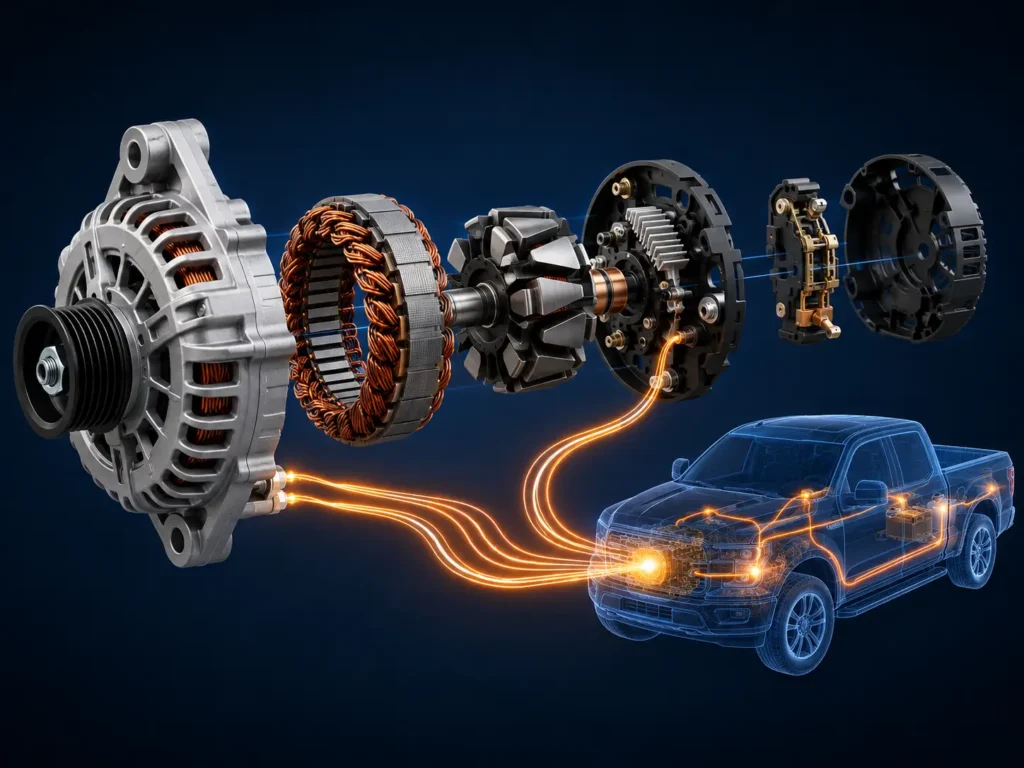
A pervasive myth on automotive forums suggests that upgrading to a high-output alternator disrupts the Smart Charge system. This is fundamentally incorrect when utilizing premium quality aftermarket units.
Elite high-output alternators are engineered with proprietary factory-style voltage regulators. They plug directly into the OEM PCM harness without requiring any wire splicing or physical modification.
This direct digital communication ensures that the PCM retains full authoritative control over voltage set points. The vehicle’s computer commands the high-output unit exactly as it would command the factory Motorcraft unit.
Consequently, the proper installation of a high-output alternator does not trigger dashboard warning lights. It requires absolutely no software reprogramming or “tuning” of the powertrain control module.
The Smart Charge system continues to drop voltage during highway cruising as designed. However, when called upon by the PCM, the high-output unit delivers its massive amperage reserves instantaneously.
Fleet and Special Service Vehicle (SSV) Specifications
Law enforcement, emergency response, and commercial fleet operations place extreme demands on the F-150 charging system. These vehicles idle for extended periods while operating heavy, constant-draw electrical equipment.
Standard factory alternators suffer from rapid thermal degradation under these punishing conditions. The 2018 Ford F-150 Police Responder, for example, required specialized electrical engineering to survive daily pursuit duty.
Ford explicitly equips the F-150 SSV and Police Responder packages with a massive 240-amp alternator from the factory. This capacity is absolutely necessary to reliably support radios, rugged computers, and LED warning strobes.
Official Ford literature explicitly highlights this 240-amp unit as a cornerstone of the Special Service Vehicle package. It ensures that critical communication arrays do not power down during prolonged incident management.
Idle Output vs. Maximum Peak Output
The critical performance metric for fleet alternators is not just the advertised peak output at redline. The most important specification is the raw amperage generated at low engine idle speeds.
A standard 120-amp factory alternator may only produce a meager 50 to 60 amps at engine idle. This is entirely insufficient to run emergency lighting arrays while a police truck is parked at an accident scene.
High-output 240-amp fleet alternators utilize specialized 6-phase hairpin stators instead of traditional wire-wound stators. This advanced design allows them to generate over 160 amps while the engine is barely turning above 800 RPM.
These heavy-duty units also feature enhanced heat sinks and massive twin rectifier assemblies. The upgraded friction materials and thermal mass prevent catastrophic diode failure during extended high-draw events.
Car Audio Alternator Upgrades: Sizing and Mathematics
Custom aftermarket audio systems draw instantaneous peak power that standard factory alternators cannot supply. This results in severe voltage sag, dimming headlights on bass hits, and expensive amplifiers entering thermal protection mode.
Determining the correct high-output alternator size requires precise mathematical calculation of current draw. It is not sufficient to simply guess the required amperage based on subwoofer size or amplifier branding.
The calculation must account for the inherent thermal inefficiency of audio amplifiers. It must also factor in the baseline electrical current constantly required to operate the truck’s factory modules.
Failure to perform these calculations often leads to undersized upgrades. This wastes thousands of dollars and leaves the electrical system vulnerable to premature component death.
The Precise Amperage Demand Formula
The standard mathematical formula for calculating total vehicle amperage requirements is universally applied in 12-volt mobile electronics design. Professional installers rely on this equation before recommending any hardware.
The equation is: Amps needed = ((Total RMS watts / 13.8V) * 1.25) + vehicle base load.
The 1.25 multiplier is crucial; it compensates for the thermal inefficiency inherent in amplifier design. For example, Class A/B amplifiers lose a significant amount of energy as heat, requiring more input current to produce their rated output.
The vehicle base load represents the power needed just to keep the engine running and the lights on. For modern F-150s, this constant operational load is generally calculated at a steady 80 amps.
Output Requirements by Wattage (Calculation Matrix)
The following matrix illustrates the recommended alternator size based on total system RMS wattage. This data helps F-150 owners avoid undersizing their costly electrical upgrades.
| Audio System Size (RMS Watts) | Calculated Audio Current Draw | Total System Need (Inc. 80A Base) | Recommended Alternator Upgrade Tier |
| 500 Watts | ~45 Amps | ~125 Amps | Stock (150A) or 180A Upgrade |
| 1,000 Watts | ~91 Amps | ~171 Amps | 200A – 240A High-Output |
| 1,500 Watts | ~136 Amps | ~216 Amps | 240A – 270A High-Output |
| 2,000 Watts | ~181 Amps | ~261 Amps | 270A – 320A High-Output |
| 3,000 Watts | ~272 Amps | ~352 Amps | 320A – 370A High-Output |
| 4,000+ Watts | ~362+ Amps | ~442+ Amps | 370A+ or Dual Alternator Setup |
This matrix is derived from baseline F-150 vehicle loads and standard audio industry current draw ratios.
When current draw radically exceeds the capacity of a single 370-amp alternator, major structural changes are necessary. Massive competition-level systems require secondary AGM or Lithium battery banks mounted securely in the rear of the vehicle.
Audio capacitors are frequently misunderstood and misused in this specific context. While they absorb incredibly quick bass transients, they cannot manufacture raw energy; they only buffer an adequately sized primary alternator.
The Mandatory “Big 3” Wiring Upgrade
Installing a massive 300-amp alternator without upgrading the factory wiring creates a severe thermal bottleneck. The factory 4-gauge or 6-gauge cables are physically incapable of safely transmitting that sheer volume of current.
Pushing 300 amps through a factory wire will cause the insulation to melt and potentially ignite. The universal solution to this physics problem is known in the industry as the “Big 3” wiring upgrade.
This procedure replaces three critical factory paths with high-strand-count 1/0 AWG or 2/0 AWG pure copper cable. It is considered the foundational step for any serious automotive electrical modification.
Pure oxygen-free copper (OFC) is strictly mandatory for this high-amperage application. Copper-clad aluminum (CCA) wire possesses significantly higher internal resistance and is highly prone to dangerous heat generation under load.
The Three Critical Copper Cable Paths
The first connection runs directly from the positive output stud on the alternator to the positive battery terminal. This massive 1/0 AWG path ensures absolutely unrestricted current flow from the generator to the storage cell.
An inline fuse is strictly required on this positive wire to prevent catastrophic fires in the event of a short circuit. The fuse must be rated slightly higher than the maximum output of the new alternator to prevent nuisance tripping.
The second connection establishes a solid, low-resistance ground from the engine block to the vehicle chassis. The alternator is grounded to the engine block via its mounting bolts, making this specific path critically important.
The third connection runs from the negative battery terminal directly to the vehicle’s steel chassis. This completes the circuit and eliminates the high-resistance factory ground loop that causes voltage sag.
All mounting points must be aggressively sanded down to bare, shiny metal before attaching the heavy ring terminals. Paint, rust, and factory coatings create electrical resistance, which causes severe voltage drops and dangerous thermal buildup.
Upgrading the Big 3 wiring often cures headlight dimming entirely on its own for audio systems under 1,000W RMS. It remains the absolute mandatory first step before investing a single dollar in a high-output alternator.
Advanced F-150 Power Systems: Pro Power Onboard
The 14th generation F-150 completely redefined mobile power generation for the entire automotive industry. The introduction of the Pro Power Onboard system literally turned the truck bed into a specialized, exportable electrical grid.
This system is available in multiple output tiers, depending entirely on the purchased powertrain configuration. It ranges from a 2.0kW output on standard gas engines to a massive 9.6kW output on the Lightning EV variants.
Standard internal combustion engines, like the naturally aspirated 5.0L Coyote V8, require highly specialized hardware to support this feature. Generating 2.0kW of exportable 120V AC power demands immense, sustained DC current generation.
A single standard alternator simply cannot sustain the thermal load of running heavy job-site tools continuously. Engineers had to devise a mechanical solution to prevent alternator burnout under these unique conditions.
The 5.0L Dual Alternator Configuration
To meet this massive sustained demand, Ford engineers equipped specific Pro Power Onboard 5.0L models with dual alternators. This setup perfectly splits the generation load across two heavy-duty units.
Dual alternator setups utilize custom water necks, specific coolant routing, and highly specialized serpentine belts. This careful engineering ensures physical clearance and proper, slip-free belt tension across both accessory pulleys.
Aftermarket performance manufacturers must account for this highly complex accessory drive when designing parts. Supercharger kits, for example, are specifically engineered with specialized adapter brackets to retain dual alternator functionality.
This ensures that owners can add forced induction without sacrificing their job-site power generation capabilities. It highlights the incredible modularity of the modern F-150 engine bay.
The PowerBoost Hybrid BISG System
The 3.5L PowerBoost hybrid powertrain takes a radically different, high-voltage approach to power generation. It completely abandons the traditional, belt-driven 12V alternator concept found in legacy internal combustion engines.
Instead, it integrates a powerful, liquid-cooled electric motor directly between the gasoline engine and the transmission. This Belt-Integrated Starter-Generator (BISG) operates at incredibly high voltages to manage massive energy transfers.
The BISG captures kinetic energy during vehicle deceleration and acts as a massive generator during engine operation. It sends high-voltage direct current directly to the 1.5 kWh lithium-ion hybrid battery pack mounted under the cabin.
A sophisticated DC-to-DC converter then safely steps down the high voltage to maintain the standard 12V battery system. Because of this unique architecture, traditional 12V high-output alternator upgrades are physically and electrically impossible on hybrid models.
Diagnostic Protocols for F-150 Charging Systems
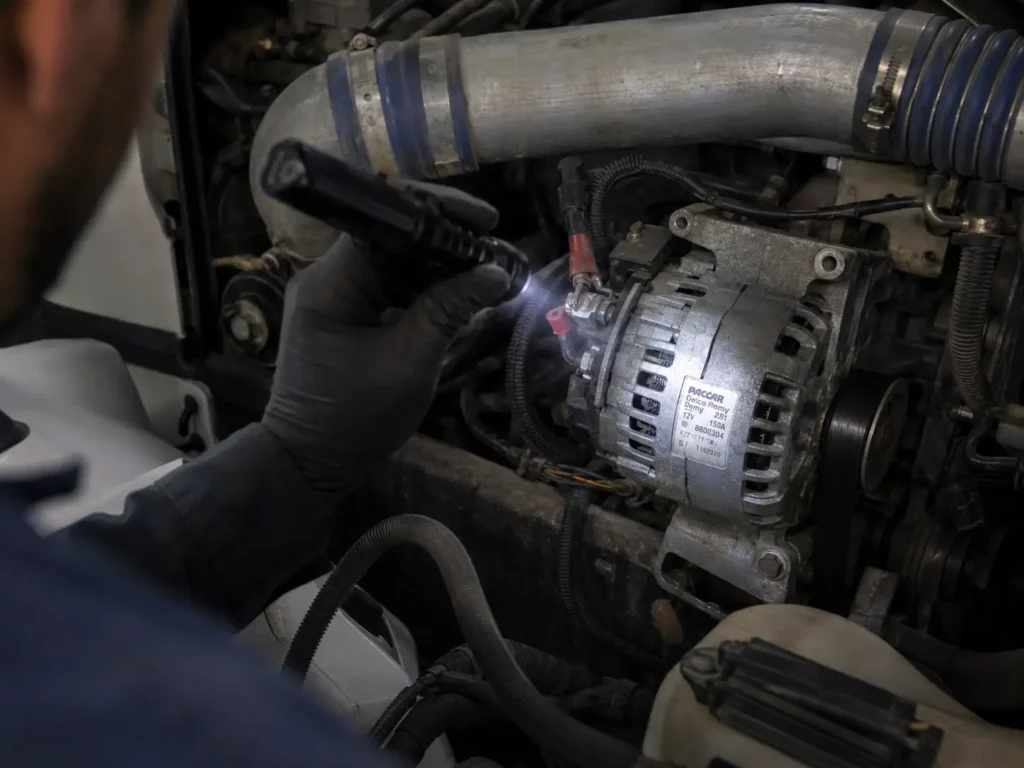
Modern F-150 charging systems are highly complex networks, rendering traditional diagnostic methods somewhat obsolete. Simply testing voltage across the battery terminals with a cheap meter is no longer a definitive test of component health.
The Battery Management System (BMS) introduces dynamic variables that can easily mislead inexperienced mechanics. Proper diagnostic workflows are absolutely essential to avoid replacing perfectly functional, expensive OEM components.
Misdiagnosing an F-150 electrical issue often leads to the infamous “parts cannon” approach. This wastes thousands of dollars without actually resolving the underlying electrical fault.
Step-by-Step Multimeter Diagnosis
The initial diagnostic test requires measuring the static battery voltage with the engine completely off. A healthy, fully charged 12V AGM battery should rest steadily between 12.4 and 12.6 volts.
Upon starting the engine, the voltage should initially spike as the alternator rapidly replenishes the energy spent during cranking. The resting voltage with the engine running should then stabilize between 13.5V and 14.7V.
A formal electrical load test is the next critical step in verifying the integrity of the stator and diodes. Technicians must aggressively activate the high beams, the air conditioning blower on maximum, and the radio simultaneously.
Under this heavy, sudden electrical load, the system voltage will inevitably dip for a fraction of a second. However, a properly functioning charging system will quickly recover and forcefully maintain a minimum of 13.0 volts.
The Mega Fuse and Battery Junction Box
A pervasive and frustrating issue on late-model F-150s is the sudden appearance of the “Check Charging System” dashboard warning. This ominous warning frequently leads panicking owners to erroneously replace the alternator.
In a significant percentage of these cases, the alternator is generating perfect voltage, but the current never reaches the battery. This total disconnect is caused by a blown high-amperage “mega fuse”.
The mega fuse is typically located within the primary battery junction box or attached to the positive terminal block. If this massive fuse severs due to a short, the electrical path is broken, perfectly mimicking a catastrophic alternator failure.
Technicians must always use a multimeter to verify continuity across the mega fuse before condemning the alternator. Replacing a blown $10 fuse is a fraction of the cost and labor of a $600 alternator swap.
For further verification of OEM electrical diagrams, technicians often reference the official(https://www.motorcraftservice.com).
The Battery Management System (BMS) Reset Procedure
The Manual Reset Technique (Flash and Brake)
The 8-Hour Sleep Method and FORScan
You can verify advanced OBD2 diagnostic procedures and module programming through deep-dive safety data at(https://www.nhtsa.gov).
Alternator Replacement Economics and Sourcing
The financial cost of replacing an F-150 alternator varies drastically based on the specific sourcing strategy. Modern BMS-integrated alternators require incredibly precise digital handshakes with the PCM to function correctly.
For this reason, utilizing cheap, unbranded aftermarket alternators from generic auto parts stores frequently results in failure. They often lack the correct proprietary internal regulators, causing persistent charging system errors and dashboard lights.
Mechanics refer to this as a “compatibility rejection,” where the truck refuses to accept commands from the counterfeit regulator. Investing in quality hardware upfront prevents paying for labor twice.
Cost Comparison Breakdown Matrix
The financial investment required depends heavily on the chosen tier of replacement hardware. Independent shop labor rates generally add an estimated $150 to $300 to the total repair cost.
| Part Sourcing Tier | Estimated Part Cost Range | Reliability and Compatibility Factor |
| New OEM (Motorcraft) | $450 – $700+ | Excellent (Guaranteed BMS and PCM digital compatibility) |
| New Aftermarket (Generic) | $200 – $400 | Variable (High risk of PCM communication errors and warning lights) |
| Remanufactured | $215 – $350 | Moderate (Depends heavily on the rebuilder’s quality control standards) |
| Used OEM (Low Mileage) | $75 – $200 | Very Good (Retains factory digital regulators and precise fitment) |
Data aggregated from national auto parts suppliers and independent service center averages.
When purchasing a genuine OEM unit, cross-referencing the exact engineering number is strictly mandatory. Part numbers like ML3T-10300-HC or HL3Z-10346-B dictate the precise amperage and internal communication protocols.
Used OEM units pulled from low-mileage donor vehicles are highly recommended by Ford electrical specialists. They guarantee seamless digital integration with the Ford Battery Management System at a fraction of the dealership cost.
Frequently Asked Questions
Does a high-output alternator hurt the F-150’s computer?
No, it does not. Quality high-output alternators are designed with OEM-compliant internal voltage regulators that perfectly match factory specifications. They plug directly into the factory PCM harness and communicate seamlessly, safely providing higher amperage only when the electrical system actually demands it.
Why does my 2018 F-150 voltage drop to 12.5V on the highway?
This is completely normal behavior governed by Ford’s advanced Smart Charge (RVC) system. The PCM intentionally lowers the alternator output during highway cruising to reduce parasitic engine drag and measurably improve fuel economy.
How do I know if my F-150 has Pro Power Onboard?
Pro Power Onboard is easily identifiable by the specialized 120V or 240V AC electrical outlets located inside the truck bed. Furthermore, non-hybrid 5.0L models equipped with this system feature a highly visible, factory dual-alternator configuration under the hood.
What is the Big 3 wiring upgrade and why is it necessary?
The Big 3 upgrade replaces restrictive factory grounding and charging wires with massive 1/0 AWG pure copper cable. It is absolutely mandatory when installing a high-output alternator to prevent massive thermal resistance, melted wires, and severe voltage bottlenecks.
Can I put a standard alternator in my 3.5L PowerBoost Hybrid?
Absolutely not. The PowerBoost Hybrid utilizes a high-voltage Belt-Integrated Starter-Generator (BISG) instead of a traditional 12V alternator. Conventional 12V alternators are mechanically and electrically incompatible with this specific hybrid powertrain.
How do I manually reset the BMS after a battery swap?
Turn the ignition on without starting the engine to enter full accessory mode. Flash the high beams exactly five times, then forcefully pump the brake pedal three times. The red battery icon on the dashboard will flash rapidly to visually confirm the reset.
Will an audio capacitor fix my dimming headlights on bass hits?
No, it will not solve the root problem. A capacitor only buffers instantaneous energy; it cannot physically generate new electrical current. If your audio system draws more total amperage than the alternator produces, you must upgrade the alternator and the Big 3 wiring.
What was the standard alternator size on the OBS (1980-1996) F-150?
Base models featured incredibly weak 40-amp to 60-amp 2G alternators that were prone to plug failures. Owners frequently upgrade these older trucks to the much safer and significantly more powerful 130-amp 3G alternator.
Do I need a new serpentine belt for a high-output alternator?
In most standard replacement scenarios, the factory serpentine belt length remains perfectly adequate. However, if the aftermarket alternator utilizes a significantly smaller pulley to increase low-RPM idle output, a slightly shorter belt may be required to maintain proper tension.
What is the mega fuse and how does it mimic alternator failure?
The mega fuse is a massive safety fuse located in the battery junction box that protects the main charging wire. If it blows due to a short circuit, zero current reaches the battery, perfectly mimicking a dead alternator even if the alternator is generating 14 volts.
Related Ford Guides
- Ford Power Stroke comparison chart
- Ford Expedition payload capacity chart
- how to reset the Ford Escape oil light