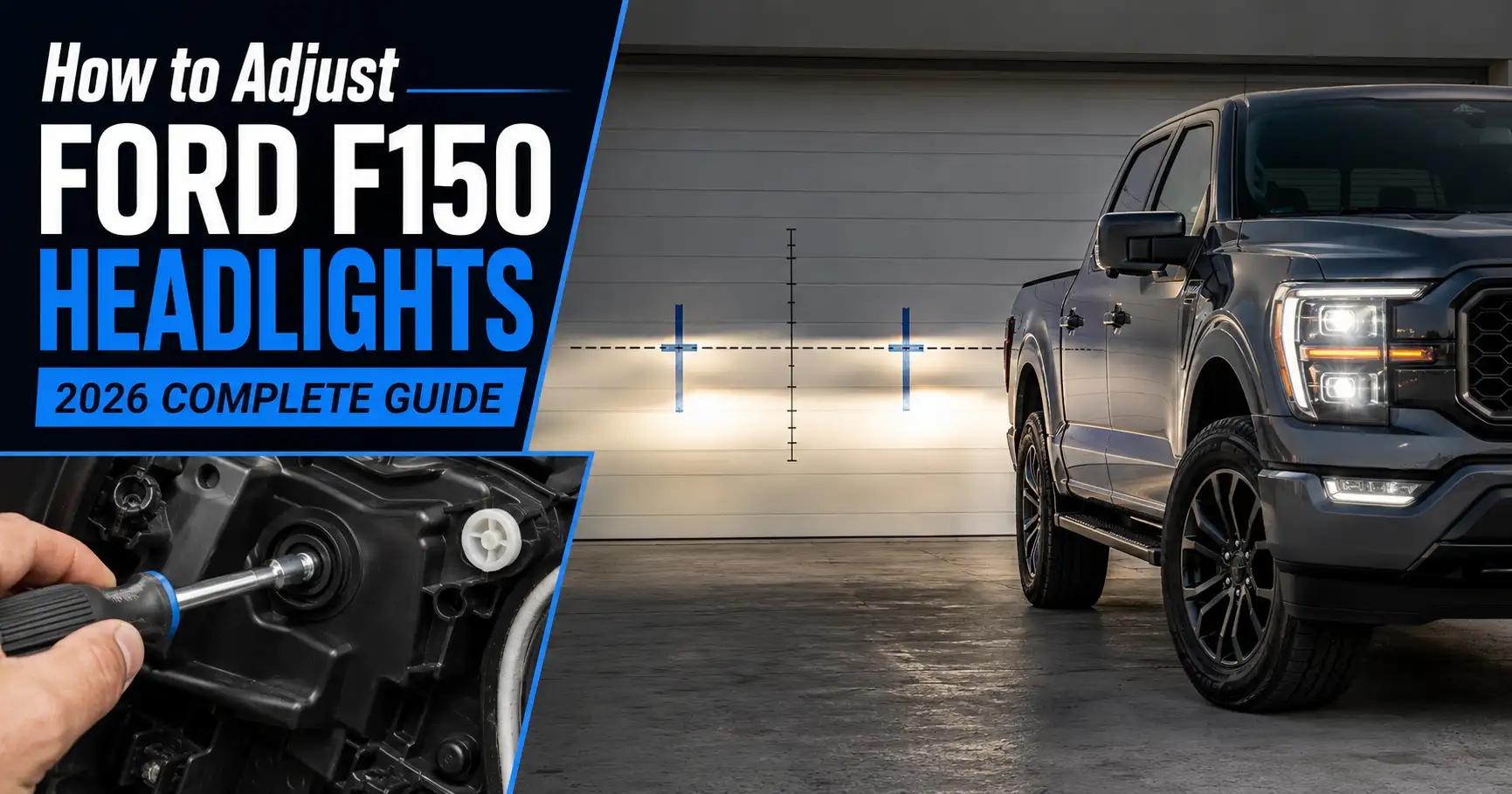
How to Adjust Ford F150 Headlights: 2026 A Complete Guide

Proper headlight alignment is a critical, yet frequently overlooked, aspect of routine automotive maintenance. Misaligned headlamps severely degrade nighttime visibility and create dangerous glare for oncoming traffic.
On heavy-duty and light-duty trucks, the factory suspension geometry often changes over time. Payload variations, towing, and aftermarket suspension upgrades alter the vehicle’s rake, pushing headlight beams out of specification.

Prime for Young Adults — 6 Months Free
Students and 18–24s get six months of Prime free, then half price.
Start 6 Months Free As an Amazon Associate I earn from qualifying purchases.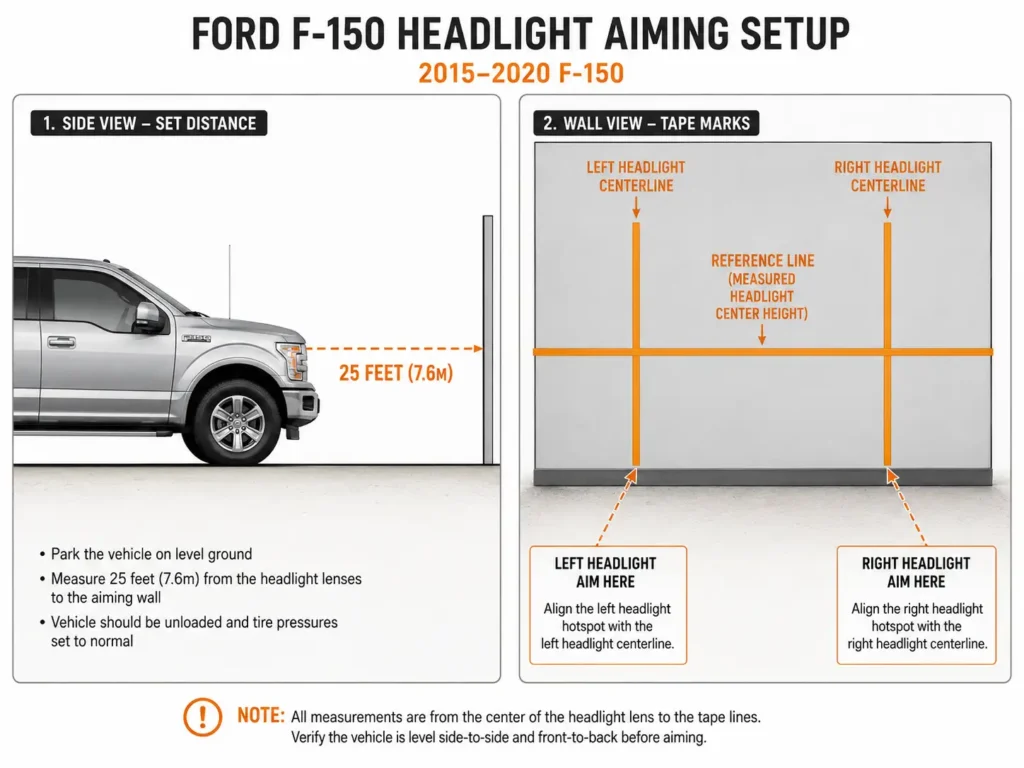
Calibrating a vehicle’s lighting system ensures compliance with federal safety standards while maximizing forward illumination. Modern trucks feature incredibly bright LED and High-Intensity Discharge (HID) projectors, making proper alignment more vital than ever.
The alignment process fundamentally relies on precise optical geometry. The standard calibration distance is 25 feet, a metric universally applied to automotive lighting tests across the industry.
This comprehensive technical report details the exact adjustment procedures for Ford F150 models spanning multiple generations. The analysis covers factory housings, aftermarket assemblies, and electronic ride-height recalibrations.
Understanding Automotive Optical Standards
Recommended Best Deal Products


Before turning any adjustment screws, technicians must identify the optical standard of the headlight housing. The housing face or lower lens edge typically bears a specific designation marking molded into the plastic.
The two primary DOT-approved beam patterns in the United States are Visually Optically Right (VOR) and Visually Optically Left (VOL). These designations dictate the required alignment height for the specific housing.
Halogen reflector assemblies generally utilize the VOR standard for optical dispersion. The light output lacks a perfectly sharp cutoff, producing a softer gradient that requires the beam center to rest exactly on the horizontal reference line.
HID and modern LED projector housings typically employ the stricter VOL standard. These modern projectors cast a concentrated, highly intense beam with a razor-sharp upper cutoff line to prevent blinding oncoming traffic.
Because VOL optics scatter less light and maintain higher intensity directly below the cutoff, they must be aimed slightly lower. The top edge of a VOL cutoff should sit exactly two inches below the horizontal reference line at a distance of 25 feet.
Federal Regulations and FMVSS 108
Automotive lighting in the United States is strictly governed by the National Highway Traffic Safety Administration (NHTSA). The specific regulatory code dictating headlight performance is FMVSS 108.

Audible — Listen Free for 30 Days
One free credit a month and thousands of titles included.
Listen Free for 30 Days As an Amazon Associate I earn from qualifying purchases.This federal standard dictates minimum illumination for visibility and maximum photometrics to prevent disability glare. Headlamps must satisfy these two opposing safety needs simultaneously.
Current OEM headlamps frequently push the absolute maximum allowable glare limits to maximize long-distance road illumination. Because the regulatory margins are so tight, any upward misaiming immediately violates safety thresholds.
Testing institutes like the Insurance Institute for Highway Safety (IIHS) utilize advanced software to simulate beam gradients. Their testing proves that vehicles with headlamps mounted above 90 cm inherently pose severe glare risks if not aimed downward.
The Ford F150 consistently features headlamp mounting heights that exceed this 90 cm threshold. Therefore, adhering to the VOL requirement of a 2-inch drop at 25 feet is mandatory to keep the intense hot-spot below the eye line of oncoming sedans.
Symptoms Indicating a Calibration is Required
Recommended Best Deal Products

Drivers rarely notice gradual, millimeter-by-millimeter shifts in headlight alignment. However, several distinct indicators suggest that a full optical calibration is immediately required.
The most obvious sign is drastically reduced forward visibility at night. If the low beams appear to illuminate only the immediate bumper area, the vertical aim has dropped too low.
Conversely, if oncoming drivers frequently flash their high beams, the truck’s headlights are likely aimed too high. This upward shift commonly occurs when heavy cargo or a trailer compresses the rear suspension.
Modifying the vehicle’s suspension geometry guarantees that the aim will shift. Installing a standard two-inch front leveling kit alters the chassis pitch, aiming the headlight beam several inches higher at a distance of 25 feet.
Replacing headlight housings also necessitates a full recalibration. Even high-quality OEM replacements or premium aftermarket upgrades seat slightly differently in the factory mounting points.
Finally, general suspension wear naturally affects alignment over time. As shock absorbers and rear leaf springs sag over tens of thousands of miles, the vehicle’s resting height deviates from factory specifications.
Audible Premium Plus — Annual Membership
12 audiobook credits up front, plus the full Audible catalogue.
See Annual Plans As an Amazon Associate I earn from qualifying purchases.The Geometry of Suspension Modifications
Suspension modifications fundamentally alter vehicle aerodynamics and lighting geometry. A standard leveling kit raises the front suspension to match the factory rear height, eliminating the factory rake.
Because the headlights are mounted at the extreme front of the chassis pivot point, even minor lift increments create massive trajectory shifts. A 2.5-inch leveling kit can tilt the headlight beam several degrees upward.
At a projection distance of 100 meters, a mere 0.25-degree upward angle deviation causes the low beam to completely blind oncoming traffic. The beam cutoff completely overshoots the opposing driver’s visual plane.
Therefore, immediately after installing a lift kit, the truck must be placed in front of the 25-foot target wall. The mechanical adjusters must be turned downward to aggressively compensate for the new chassis rake.
Suspension Lift Deflection Rates
| Front Suspension Lift | Headlight Beam Deviation at 25ft | Required Calibration Action |
| 1.0 Inch Level | +0.8 Inches Upward | Turn adjusters down slightly |
| 1.5 Inch Level | +1.3 Inches Upward | Turn adjusters down moderately |
| 2.0 Inch Level | +1.8 Inches Upward | Turn adjusters down significantly |
| 2.5 Inch Level | +2.3 Inches Upward | Turn adjusters down aggressively |
| 4.0+ Inch Lift | +3.5+ Inches Upward | Extreme downward recalibration required |
Pre-Calibration Vehicle Preparation Protocol
Recommended Best Deal Products


Accurate calibration requires the vehicle to sit exactly as it would during normal, unladen driving conditions. If the truck is calibrated improperly, the resulting beam pattern will be permanently flawed.
First, the tire pressure must be checked and set to the OEM specifications listed on the driver’s door jamb. Underinflated front tires will artificially lower the beam angle during testing.
The fuel tank should be at least half full to replicate standard driving weight. Additionally, the vehicle should not contain any abnormal payload, tools, or cargo in the bed.
Once parked on the level surface, the technician should physically bounce all four corners of the suspension. Jouncing the suspension settles the shocks and springs into their natural resting positions, removing any binding.
Any active suspension systems, electronic dampers, or aftermarket air bags must be set to their normal ride height. For vehicles equipped with continuous control damping, the engine should be idling during the initial measurement phase.
Establishing the 25-Foot Target Matrix
The 25-foot distance is not an arbitrary number; it is the industry standard dictated by federal optical testing protocols. This specific distance allows the beam pattern to fully form and project its intended optical gradient.
To begin the setup, pull the truck squarely against the target wall or garage door. The front bumper should be nearly touching the surface to completely eliminate any angular distortion.
Using a reliable tape measure, find the physical center of the headlight bulb lens. Many modern housings feature a small dot, crosshair, or tiny circle molded into the outer polycarbonate lens to denote this optical center.
Measure the vertical distance from the ground to this center mark on the lens. Record this measurement for both the driver and passenger side headlights, as manufacturing tolerances often cause slight height variations.
Transfer these exact measurements to the wall using horizontal strips of highly visible painter’s tape. Then, place a vertical strip of tape intersecting the horizontal line directly in front of each headlight’s center axis to create a crosshair.
Once the crosshairs are firmly established on the wall, reverse the vehicle in a perfectly straight line. Stop the vehicle when the front face of the headlights is exactly 25 feet (7.6 meters) away from the wall.
Aiming Target Matrix
| Headlight Standard | Optic Type | Target Height at 25 Feet | Lateral Aim |
| VOR Specification | Halogen Reflector | Exactly on the horizontal tape line | Centered on vertical tape line |
| VOL Specification | HID / LED Projector | 2 inches (5cm) below horizontal line | Centered on vertical tape line |
| Lifted Suspension | Any Optic Type | Recalculated based on actual ride height | Centered on vertical tape line |
11th Generation Calibration (2004-2008)
The 11th generation F150 utilizes a mechanical adjustment system that differs significantly from later, more modern models. These headlights feature a rear-mounted 4mm hex stud that controls the pitch of the internal reflector bowl.
Because clearance behind the headlight and the core support is extremely tight, utilizing a standard socket wrench is often physically impossible. The tight confines make blind adjustments incredibly frustrating for mechanics.
To service these older models properly, technicians highly recommend investing in a specialty tool. The Lisle 14540 Headlight Adjusting Ratchet is explicitly designed to bypass these tight clearances without removing surrounding engine bay components.
This reversible 4mm hex ratchet allows for infinite, micro-adjustment settings. It prevents the user from stripping the soft, aging adjuster gears that are prone to breaking on 11th generation trucks.
Turn on the low beams and carefully observe the beam pattern against the 25-foot wall target. Block one headlight with a dark towel or a piece of cardboard to effectively isolate the specific beam being adjusted.
Engage the 4mm hex stud with the specialized adjustment tool. Rotating the stud will gradually tilt the internal reflector, raising or lowering the beam cutoff along the vertical axis.
Match the most intense portion of the halogen beam to the corresponding VOR target line. Ensure both the driver and passenger sides are adjusted symmetrically to prevent scattered, uneven illumination on dark roads.
12th Generation Calibration (2009-2014)
Ford intelligently simplified the adjustment process starting with the 12th generation F150. The primary adjustment mechanism was moved to the top of the housing, making it easily accessible directly under the open hood.
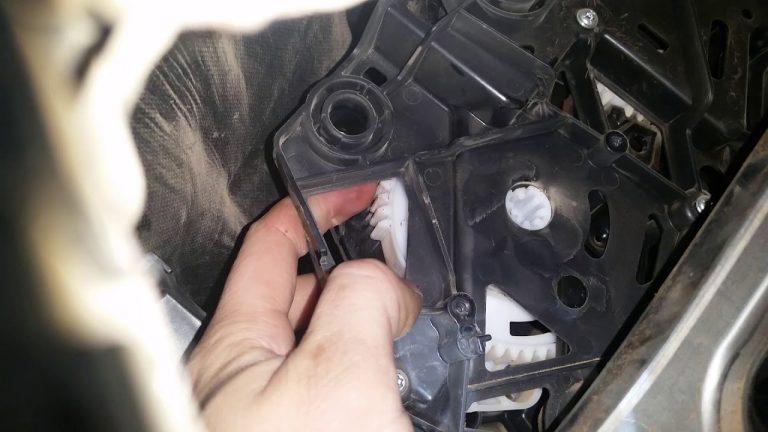
Locate the vertical adjustment port situated directly above the headlight assembly. Looking down into the port, technicians will see a geared cog mechanism designed to accept a standard flathead or #2 Phillips screwdriver.
Insert the screwdriver down into the port so the metal teeth perfectly mesh with the plastic adjuster cog. Turning the screwdriver counterclockwise lowers the headlight beam trajectory.
Conversely, turning the screwdriver in a clockwise motion will raise the headlight beam. Technicians should always make these adjustments in small, deliberate increments, allowing the beam to settle on the wall target.
For the high-performance SVT Raptor models within this generation, the mechanical procedure remains identical. However, Raptor models sit noticeably higher from the factory, requiring precise measurement of the initial center bulb height to avoid blinding traffic.
It is vital to note that 12th generation trucks could be optioned with either halogen or premium HID projectors. The HID units follow the VOL standard, meaning their sharp cutoffs must be aimed a full two inches below the tape line.
13th Generation Calibration (2015-2020)
The 13th generation F150 continued the use of convenient, top-mounted adjustment ports. However, this specific generation saw the widespread introduction of powerful factory LED headlights on Lariat, Platinum, and Limited trim levels.
Open the aluminum hood and locate the access hole directly behind the upper headlight fascia trim. A long #2 Phillips screwdriver is absolutely required to reach the recessed adjustment gear nestled deep within the housing.
As with the previous generation, turning the screwdriver interfaces with the gear teeth to adjust the pitch. Turning the adjuster clockwise pushes the intense LED beam downward, while counterclockwise raises it.
The high beams on the 13th generation F150 utilize a completely separate optical cavity within the housing. Adjusting the low beam mechanism typically does not alter the high beam alignment independently, as the internal cradle moves as a single, unified structure on most factory housings.
It is highly recommended to perform this adjustment in the pitch black of night. The razor-sharp cutoff of the factory LED housings makes it extremely easy to align the driver and passenger sides perfectly against the wall tape.
14th Generation Calibration (2021-2026)
The 14th generation introduces highly complex lighting electronics, marking a massive leap in automotive technology. These trucks feature Active Matrix LED technology and advanced Glare-Free lighting systems that adapt to the environment.
Basic mechanical adjustment remains somewhat similar to previous years. A Phillips screwdriver or a 6mm Allen key is used to turn the top-mounted cog, adjusting the baseline vertical pitch of the housing cradle.
However, models equipped with Automatic Headlamp Leveling feature active suspension sensors on the chassis. These sensors constantly monitor vehicle pitch and automatically adjust the headlight beam height dynamically while driving.
If the vehicle has a lift or leveling kit installed, the mechanical adjustment alone will not suffice. The Vehicle Dynamics Module (VDM) will read the new lifted chassis angle as an abnormal payload condition, attempting to auto-correct the headlights improperly.
In these specific lifted cases, technicians must perform a deep electronic recalibration. This requires specialized OBD2 interface software, completely bypassing the manual limitations of the physical adjustment screw.
Electronic Recalibration Using FORScan
FORScan is a highly advanced, engineering-grade diagnostic software tailored specifically for Ford and Mazda vehicles. It allows advanced users to modify module programming, read deep PID data, and execute dealer-level service procedures.
When an auto-leveling 14th generation F150 is lifted or leveled, the corner height sensors transmit skewed, inaccurate data to the VDM. To permanently correct this, the technician must connect a compatible OBDLink EX or MX+ adapter to the OBD2 port and launch the FORScan Software.
Navigate to the PID Data Reader icon and load the Vehicle Dynamics Module (VDM). Select the four specific corner height parameters: FL_Height, FR_Height, RL_Height, and RR_Height.
Record the live data to visually verify the sensor discrepancies caused by the aftermarket suspension modification. Stop the live data stream and navigate directly to the “Service Functions” menu designated by the wrench icon.
Execute the “VDM Ride Height Calibration” service procedure. The software will prompt for the current fuel level to calculate chassis weight, then automatically zero out the sensors to establish the new lifted baseline.
Failing to perform this electronic calibration on equipped models results in highly erratic headlight behavior. The vehicle’s adaptive systems will constantly fight the mechanical adjustments, creating dangerous glare scenarios for other drivers.
Integrating Aftermarket Headlight Assemblies
The Ford F150 aftermarket is heavily saturated with high-performance headlight upgrades. Brands like Morimoto, AlphaRex, and VLAND offer premium LED matrix and projector assemblies that dramatically outshine factory halogens.
Installing these complex units requires transferring electrical harnesses, safely tapping fuse boxes for Daytime Running Lights (DRL), and ensuring proper physical mounting.
Crucially, aftermarket housings are never perfectly pre-aimed from the factory. Every single aftermarket installation requires immediate vertical alignment using the standard 25-foot wall method before street driving.
AlphaRex and Morimoto assemblies typically feature their own brand-specific adjustment screws located on the rear casing. Depending on the exact model year and tier, these may require a Phillips screwdriver or a small 8mm socket.
Furthermore, premium aftermarket housings may offer independent high beam adjustments. Technicians must align the low beams first, block them off with cardboard, and then carefully align the high beam hot-spots to the center axis.
The Absence of Horizontal Adjustment
A highly common point of confusion during F150 headlight calibration is the topic of horizontal aiming. The vast majority of modern vehicles, including the F150, do not feature factory horizontal adjustment mechanisms.
Federal regulations and aerodynamic, flush-mount housing designs have largely eliminated the need for consumer-level lateral adjustments. The horizontal aim is permanently fixed into the mounting geometry of the radiator core support.
If a technician finds that the beam is tracking too far left or right on the wall, it indicates a structural alignment issue. This usually stems from an improperly seated housing, a broken plastic mounting tab, or latent collision damage to the front fascia.
To correct severe horizontal misalignment, the technician must physically loosen the main 10mm mounting bolts holding the housing to the truck frame. Shift the entire assembly laterally within the minor tolerance of the mounting holes, then securely re-torque the bolts.
Common Calibration Pitfalls and Troubleshooting
The most frequent error made by DIY mechanics is attempting to quickly adjust only one headlight. Mismatched beams create asymmetric illumination, severely confusing the driver’s depth perception and scattering light erratically.
Another incredibly common pitfall is ignoring the vehicle’s load condition during the adjustment process. If the truck is calibrated while the bed is loaded with 500 pounds of gear, the headlights will aim dangerously high once the cargo is removed.
Mechanically, the plastic adjustment gears inside the headlamp housing are notoriously fragile. Applying excessive torque with a power tool or forcing a stuck gear will instantly strip the internal mechanism, rendering it useless.
If the adjustment screw spins freely but the beam pattern does not move vertically, the internal reflector bracket has likely snapped off its threaded rod. In this unfortunate scenario, the entire headlamp assembly must be replaced.
For older housings experiencing heavy UV haze and oxidation, alignment alone will not restore visibility. The cloudy polycarbonate scatters the beam, destroying the sharp cutoff line absolutely necessary for accurate calibration.
Upgrading the F150 Headlight Control Module (HCM)
When F150 owners attempt to upgrade from basic halogen reflectors to OEM projector LEDs, they often encounter massive electrical roadblocks. The factory wiring harnesses do not support the advanced data requirements of the projectors.
To make this conversion functional on 14th generation models, a new Headlight Control Module (HCM) must be installed. This module acts as the brain for the active matrix and high beam functionalities.
Installing the HCM requires custom wiring harnesses that tie into the dashboard and existing headlight looms. Simply plugging in the new lights will result in flashing errors and non-functional high beams.
Once the new HCM is physically installed, the truck’s computer still will not recognize it. Technicians must use FORScan to flash the new module, updating the firmware so it communicates with the Body Control Module (BCM).
This firmware update process is highly sensitive and requires a reliable power supply to prevent battery drain during the flash. A cloned or cheap OBD2 adapter will likely fail during this procedure, corrupting the HCM entirely.
Advanced LED Programming via Dial Sequences
Certain premium aftermarket headlights, such as the Diode Dynamics Elite LED series, offer advanced programmable features without needing an OBD2 scanner. These units use the factory headlight switch to trigger internal programming modes.
To program the DRL color or turn signal style, the driver must perform a specific sequence with the headlight dial. For example, quickly toggling the switch between OFF and PARK three times enters the DRL configuration mode.
Once in programming mode, the aftermarket headlight will flash its DRLs to confirm the sequence was accepted. The driver then uses the high beam stalk on the steering column to cycle through various aesthetic options.
These headlights even feature advanced Low Beam Assist (LBA) and dynamic show modes. To reset the lights to factory defaults, the user simply toggles the headlight dial fifteen times in rapid succession.
This innovative approach allows F150 owners to heavily customize their lighting experience safely. It completely bypasses the need for complex FORScan coding while delivering show-quality aesthetics.
People Also Ask
How do you fix F150 headlights that point too high after towing?
If the vehicle squats during heavy towing, the front end naturally lifts. Drivers with auto-leveling systems should allow the sensors to adjust automatically over a few miles. For manual systems, temporary heavy loads should never dictate a permanent screw adjustment. Instead, consider installing rear helper springs or airbags to completely eliminate the towing squat.
Can you adjust Ford F150 headlights horizontally?
No. Ford F150 OEM headlamps from 2009 onwards strictly do not feature horizontal adjustment screws. The horizontal aim is permanently set by the structural mounting points on the chassis. Any severe lateral deviation requires thoroughly inspecting the housing clips and core support for latent impact damage.
What is the correct 4mm tool for 2004-2008 F150 headlights?
The Lisle 14540 Headlight Adjusting Ratchet is the absolute industry-standard tool for this specific generation. Its extra-long handle and 4mm ratcheting hex head easily bypass the tight clearances that prevent standard sockets from reaching the recessed adjustment stud.
Does changing a headlight bulb require realigning the F150 headlights?
Yes. Even minor millimeter variations in the filament position of a halogen bulb or the diode placement on an aftermarket LED bulb will shift the optical focal point inside the reflector bowl. Always verify the 25-foot wall alignment after replacing any bulbs to ensure optimal output.
How do I calibrate my 2021+ F150 Auto-Leveling Headlights?
Following any suspension modification, the VDM module must be electronically recalibrated. Connect an OBD2 adapter, launch the FORScan software, open the VDM Service Procedures menu, and execute the “Ride Height Calibration” function on a perfectly level surface.
Why do my F150 Auto High Beams activate at the wrong time?
The automatic high beam system relies on a windshield-mounted camera to detect ambient light and oncoming traffic. If the windshield is dirty, or if the camera was not recalibrated following a glass replacement, the system will trigger erratically. FORScan can be used to disable this feature entirely if preferred.
What is the difference between VOR and VOL markings?
These are strictly DOT optical standards. Visually Optically Right (VOR) is used primarily for halogen reflectors and requires the beam center to rest exactly on the horizontal target. Visually Optically Left (VOL) is used for projectors and requires the sharp cutoff to rest two inches below the target line to prevent glare.
Related Ford Guides
- how to reset the Ford Escape oil light
- how to change the F-150 cabin air filter
- Ford F-150 coolant capacity chart
- how to calibrate Ford SYNC
- how to disable the Ford speed limiter