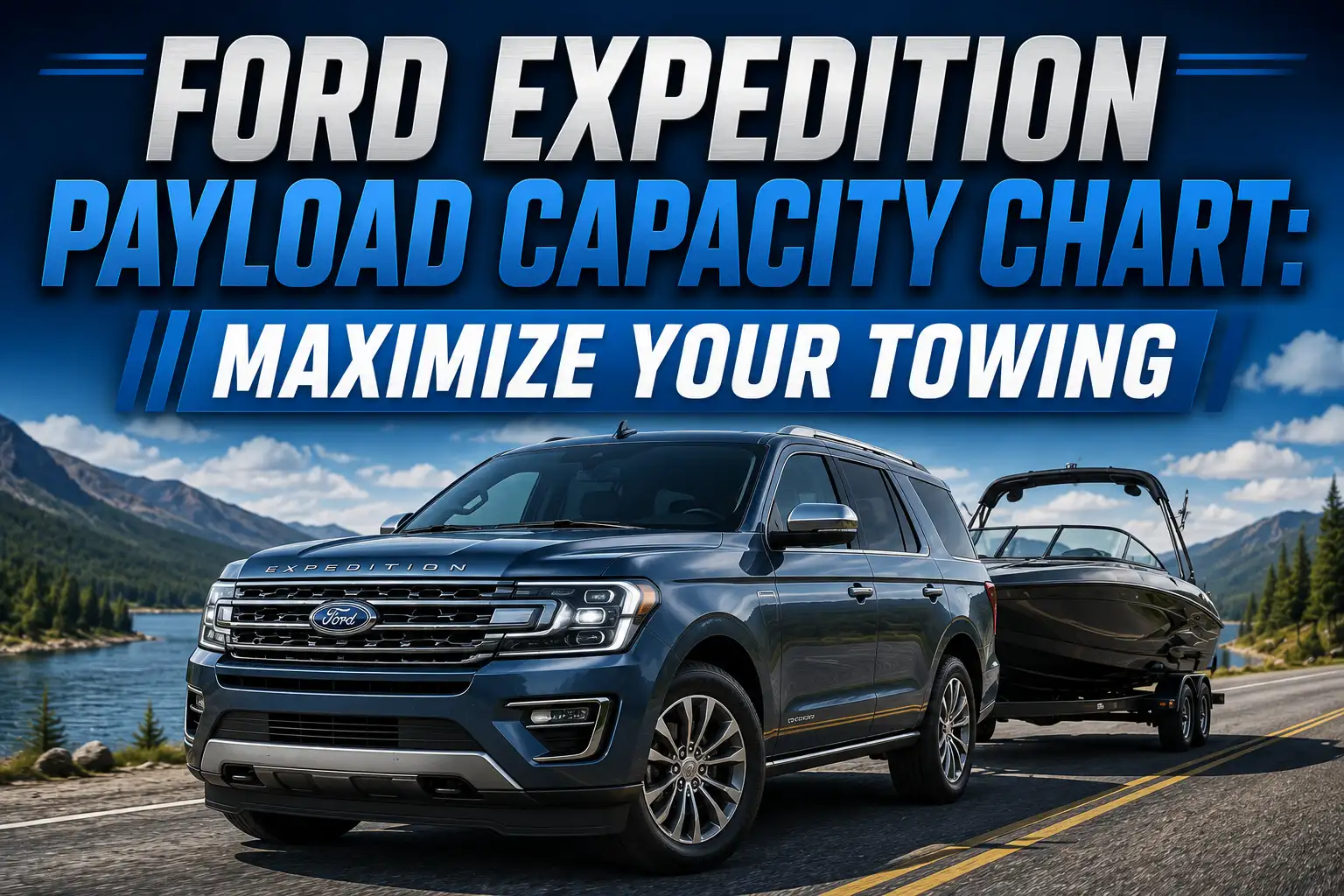
Ford Expedition Payload Capacity Chart & Comprehensive Towing Guide 2026

The Ford Expedition stands as a dominant force in the full-size SUV segment, merging massive family-hauling practicality with truck-like structural capability. Buyers consistently turn to this body-on-frame vehicle when a standard unibody crossover fails to meet their extreme hauling demands.
However, maximizing this impressive capability requires a strict, mathematical understanding of the vehicle’s specific weight limits. While maximum towing capacity often dominates dealership conversations, payload capacity is the true operational bottleneck for safely loading any full-size SUV.

Prime for Young Adults — 6 Months Free
Students and 18–24s get six months of Prime free, then half price.
Start 6 Months Free As an Amazon Associate I earn from qualifying purchases.Exceeding the factory payload capacity compromises suspension geometry, drastically increases braking distances, and places dangerous thermal stress on the drivetrain. Understanding exactly how much internal weight the Expedition can carry is an absolute necessity for safe, legal highway travel.
This deeply researched guide breaks down the Ford Expedition payload capacity across multiple generations, trim levels, and drivetrain configurations. It explores the critical engineering relationship between passenger weight, cargo mass, and trailer tongue weight.
Ford Expedition Payload Mastery
Recommended Best Deal Products


Maximizing capability requires understanding weight limits. While towing capacity is high, payload is the true operational bottleneck. Learn why every pound in the cabin matters for your safety.
⚙ The Core Weight Equation
Payload is not a random number; it is a strict structural result. It is calculated by subtracting the vehicle’s empty weight from its maximum safe limit.
2025 Payload Rankings
Adding luxury features and four-wheel-drive hardware adds curb weight. This directly reduces the amount of cargo and passengers you can safely carry.
The Tremor Anomaly
Despite heavy off-road tires and skid plates, the Tremor offers 1,957 lbs of payload. Ford upgraded its chassis GVWR to compensate for the rugged hardware.
Luxury Weight Penalty
Premium features like the 22-speaker B&O system and panoramic roofs add 150+ lbs. This is why the King Ranch trim has significantly less payload than the Active trim.
The Real-World “Payload Budget”
Most owners fail to realize that towing a trailer consumes payload capacity via Tongue Weight. See how quickly a 1,600 lb limit disappears in a standard trip scenario.
Gen 4 Capability Stability
Since the shift to aluminum in 2018, the Expedition has maintained a consistent payload profile. This chart tracks the maximum payload capability over the last seven model years.

Audible — Listen Free for 30 Days
One free credit a month and thousands of titles included.
Listen Free for 30 Days As an Amazon Associate I earn from qualifying purchases.HD Trailer Tow Upgrades (Opt 536)
To reach maximum towing and payload efficiency, the Heavy-Duty package is required. It provides the thermal and mechanical cooling needed for extreme loads.
Check Your Door Jamb
General charts are estimates. To find your vehicle’s legally binding limit, check the yellow and white “Tire and Loading” sticker on the B-pillar. This account for every factory-installed option on your specific VIN.
Decoding the Core Weight Metrics: Payload, GVWR, and Curb Weight
Before analyzing the generation-specific charts, operators must understand the terminology that dictates legal vehicle loading. These metrics are mathematically intertwined and establish the fundamental safety parameters of the chassis.
Gross Vehicle Weight Rating (GVWR): This is the absolute maximum allowable weight of the fully loaded vehicle. It is a strict structural limit engineered by Ford, encompassing the vehicle itself, all fluids, passengers, cargo, and the tongue weight of any attached trailer.
Curb Weight: This metric represents the total physical weight of the vehicle sitting on the pavement with a full tank of fuel and all factory-installed equipment. Importantly, curb weight does not include the weight of the driver, passengers, or any aftermarket accessories.
Payload Capacity: Payload is the maximum amount of weight the vehicle can safely transport internally or on its roof. It is calculated by a strict formula: GVWR minus Curb Weight equals the available Payload Capacity.
When evaluating these numbers, every optional feature added at the factory increases the curb weight, which in turn reduces the available payload. This fundamental rule explains why a base model will always carry more internal weight than a fully loaded luxury trim.
The 2025 – 2026 Ford Expedition Payload Capacity Chart
Recommended Best Deal Products


The 2025 and 2026 Ford Expedition lineup introduces a significant mid-cycle refresh, bringing new styling, a split liftgate, and upgraded interior technology. The lineup also introduces the Active trim and the off-road-focused Tremor trim, replacing the previous Timberline model.
These modern models utilize Ford’s advanced 3.5L EcoBoost V6 engine, delivering between 400 and 440 horsepower depending on the specific tuning.
Because payload is intrinsically tied to curb weight, the configuration chosen at the dealership drastically impacts how much cargo the vehicle can legally carry. The base rear-wheel-drive (4×2) models boast the highest payload numbers, while luxury four-wheel-drive (4×4) models see significantly reduced capacity.
Audible Premium Plus — Annual Membership
12 audiobook credits up front, plus the full Audible catalogue.
See Annual Plans As an Amazon Associate I earn from qualifying purchases.2025–2026 Payload Specifications by Trim Level
| Trim Level & Configuration | Drivetrain | Wheelbase | Max Payload Capacity | Est. GVWR |
| XL STX (Fleet/Base) | 4×2 | Standard | Up to 1,971 lbs | 7,375 lbs |
| Active | 4×2 | Standard | 1,758 lbs | 7,400 lbs |
| Tremor | 4×4 | Standard | 1,957 lbs | 7,625 lbs |
| Platinum | 4×4 | Standard | 1,640 – 1,700 lbs | 7,450 lbs |
| King Ranch | 4×4 | Standard | 1,575 lbs | 7,450 lbs |
| Expedition MAX Active | 4×2 | Extended | 1,600 lbs | 7,550 lbs |
| Expedition MAX Platinum | 4×4 | Extended | 1,400 – 1,550 lbs | 7,550 lbs |
Data synthesized from authoritative automotive databases and official Ford towing guides.
The 4×2 Active trim features an impressive payload capacity of 1,758 lbs, making it highly capable for large families traveling with heavy luggage. Conversely, the luxurious 4×4 King Ranch trim drops to 1,575 lbs of payload capacity due to its extensive list of premium features.
The payload drop in higher trims is caused by the literal physical weight of premium additions. Features like the 22-speaker Bang & Olufsen Unleashed audio system, the panoramic Vista roof, and heavy power-folding leather captain’s chairs add substantial mass to the vehicle’s curb weight.
The off-road-ready Tremor trim presents an interesting engineering anomaly within the lineup. Despite its heavy front skid plates, 33-inch all-terrain tires, and locking differentials, Ford upgraded its structural GVWR to a robust 7,625 lbs.
This elevated GVWR allows the 2026 Tremor to maintain a stellar payload capacity of up to 1,957 lbs, bypassing the usual weight penalties associated with off-road hardware.
The 2018 – 2024 Ford Expedition Payload Capacity (4th Generation)
The fourth-generation Ford Expedition debuted for the 2018 model year, introducing a revolutionary aluminum-alloy body paired with a fully boxed, high-strength steel frame. This transition mirrored the F-150’s development and saved roughly 300 pounds of curb weight compared to the previous steel-bodied generation.
Ford engineers reinvested this massive weight savings directly into the vehicle’s capability profile, resulting in excellent towing and payload metrics. During this era, the standard wheelbase Expedition consistently offered slightly more payload than the extended MAX variants due to its shorter, lighter frame.
Gen 4 Payload & GVWR Historical Chart
| Model Year | Configuration | Max Payload Capacity | GVWR Range |
| 2024 | Standard 4×2 / 4×4 | 1,757 lbs | 7,200 – 7,450 lbs |
| 2024 | MAX 4×2 / 4×4 | 1,700 lbs | 7,450 – 7,550 lbs |
| 2022 – 2023 | Standard 4×2 / 4×4 | 1,756 – 1,758 lbs | 7,200 – 7,450 lbs |
| 2022 – 2023 | MAX 4×2 / 4×4 | 1,690 – 1,756 lbs | 7,450 – 7,550 lbs |
| 2018 – 2021 | Standard 4×2 / 4×4 | 1,757 lbs | 7,200 – 7,450 lbs |
| 2018 – 2021 | MAX 4×2 / 4×4 | 1,620 – 1,690 lbs | 7,450 – 7,550 lbs |
Throughout this fourth-generation run, a base model XLT 4×2 could reliably achieve nearly 1,760 lbs of internal payload capacity. The standard 3.5L EcoBoost engine produced 375 to 380 horsepower during these years, providing ample low-end grunt to move these heavy loads efficiently.
The Expedition MAX, while offering significantly more cargo room behind the third row, required a heavier frame to support its extended body structure. This added curb weight generally restricted the MAX’s payload to the 1,600–1,700 lbs range.
The 2015 – 2017 Ford Expedition Payload Specs (3rd Generation)
Recommended Best Deal Products


The third-generation Expedition (specifically the 2015-2017 mid-cycle refresh) marked the end of the traditional heavy steel body panels before the brand’s shift to aluminum. It also introduced the very first application of the 3.5L twin-turbo EcoBoost V6 in this SUV platform, permanently replacing the aging naturally aspirated 5.4L Triton V8.
Due to the heavier steel sheet metal construction, the curb weights of these specific vehicles were notably higher than modern iterations. A 2015 Expedition EL (the extended-length precursor to the modern MAX) featured a hefty curb weight of approximately 6,103 lbs.
Despite the heavier steel body, Ford engineered the suspension and frame to support impressive structural loads. The standard payload capacity for a 2015 Expedition EL hovered around 1,725 lbs when properly configured.
How Drivetrain Selection Impacts Payload Capacity
When configuring a Ford Expedition at the dealership, buyers must consciously choose between a 4×2 (Rear-Wheel Drive) and a 4×4 (Four-Wheel Drive) layout. This decision dictates more than just winter weather traction; it directly alters the fundamental payload mathematics of the vehicle.
A 4×4 drivetrain requires additional, heavy mechanical components, including a specialized transfer case, a front differential, and robust front drive axles. These heavy steel and aluminum components easily add between 150 and 250 pounds to the vehicle’s total curb weight.
Because the Gross Vehicle Weight Rating (GVWR) is often identical between 4×2 and 4×4 models of the exact same trim, the extra curb weight of the 4×4 system eats directly into the available payload capacity.
For example, a modern 4×2 Active trim offers 1,758 pounds of payload, while a similarly equipped 4×4 variant will see that number drop closer to 1,600 pounds. Operators must carefully weigh the absolute necessity of four-wheel drive against their strict need to haul maximum internal cargo.
Expedition Standard Wheelbase vs. Expedition MAX
The choice between the standard-length Expedition and the extended Expedition MAX is a critical dimensional decision for active families. The MAX variant adds approximately 11.8 inches of overall length to the vehicle’s footprint.
This extension radically transforms the interior volume, offering 37.4 cubic feet of cargo space behind the third row, compared to just 20.9 cubic feet in the standard model. However, physics dictates that a larger vehicle body inherently requires more steel, more glass, and a longer, heavier frame.
This extra mass increases the curb weight of the Expedition MAX by roughly 200 pounds over the standard wheelbase model. While Ford occasionally bumps the GVWR of the MAX to compensate for this bulk, the extended model almost always features a slightly lower overall payload capacity.
The deep irony of the Expedition MAX is that while it provides vastly more physical space to put items, it offers a slightly lower weight limit for those exact items. Owners must be highly mindful of loading the massive cargo area with dense, heavy gear, as the volume can easily exceed the payload limit.
The Critical Relationship Between Towing Capacity and Payload
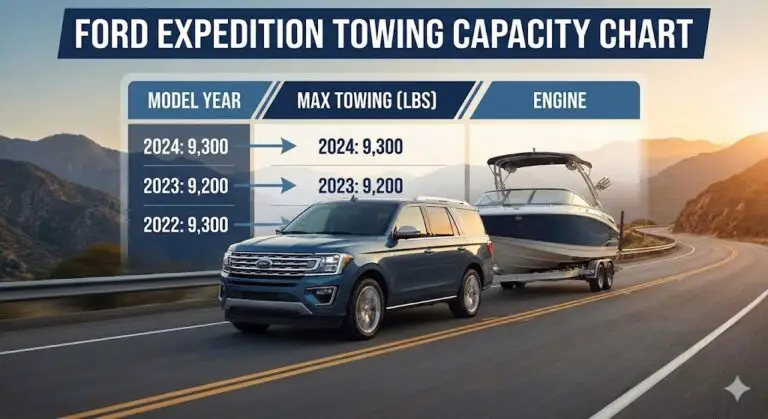
The Ford Expedition is widely celebrated for its gargantuan towing limits, capable of pulling up to 9,600 lbs when properly equipped with the right packages. However, towing a heavy trailer is not an isolated event; it directly and substantially consumes the vehicle’s payload capacity.
This consumption occurs through “Tongue Weight,” which is the downward physical force the trailer coupler exerts directly on the vehicle’s rear hitch. For stable and safe highway towing, the tongue weight must represent roughly 10% to 15% of the total loaded trailer weight.
If an operator is towing a 7,000-pound travel trailer, there will be roughly 700 pounds of tongue weight resting on the back of the Expedition. That 700 pounds must be subtracted directly and entirely from the vehicle’s available payload capacity.
A Real-World Payload Depletion Scenario
Imagine an owner operating a 2025 Ford Expedition Platinum 4×4 with a sticker-verified payload capacity of 1,600 lbs. The owner decides to tow a large boat that weighs 6,000 lbs, generating exactly 600 lbs of tongue weight on the hitch.
Subtracting the 600 lbs of trailer tongue weight leaves the operator with exactly 1,000 lbs of remaining payload for the entire cabin. The owner then places four adult men in the vehicle, weighing an average of 220 lbs each, consuming another 880 lbs of payload capacity.
The vehicle now has only 120 lbs of capacity left for luggage, coolers, fuel for the boat, and any heavy aftermarket accessories. This mathematical reality highlights why payload, not maximum towing capacity, is the true limiting factor for family road trips.
Unlocking Capability: The Heavy-Duty Trailer Tow Package (Option 536)
To achieve the maximum towing numbers advertised by Ford in their marketing materials, the vehicle must be explicitly equipped with the Heavy-Duty Trailer Tow Package (Option Code 536). Without this specific package, the Expedition’s towing capability is severely capped by the factory.
A standard Expedition 4×2 without the Heavy-Duty package can only tow up to 6,000 lbs. Adding the Heavy-Duty Trailer Tow Package to a 4×4 model elevates the gross combined weight rating (GCWR) to an impressive 15,900 lbs, unlocking the famous 9,600-lb max tow rating.
This package is not merely a software update; it includes robust mechanical and thermal upgrades designed to manage intense physical stress. For a deeper dive into how automotive manufacturers stress-test these components, external resources like the experts at Edmunds provide excellent insights into SAE J2807 towing standards.
Key Components of the Heavy-Duty Trailer Tow Package:
- 3.73 Axle Ratio: Replaces the standard 3.31 axle gear, multiplying torque more aggressively to help move incredibly heavy loads from a standstill.
- Upgraded Radiator: Enhances engine thermal cooling to prevent the twin-turbo 3.5L EcoBoost from overheating on steep mountain grades.
- Integrated Trailer Brake Controller: Allows the driver to seamlessly modulate the electric brakes on the heavy trailer directly from the dashboard.
- Pro Trailer Backup Assist 2.0: A sophisticated technological aid that allows the driver to steer the trailer in reverse using a simple dashboard knob.
It is critically important to note that a Weight-Distributing Hitch is strictly required by Ford to reach trailer weights over 7,000 lbs. This mechanical hitch mechanism uses heavy spring bars to lever weight off the rear axle and distribute it back to the front axle, preventing dangerous rear suspension sag.
The EcoBoost Engine: Engineering Torque for Heavy Payloads
Unlike traditional heavy-duty SUVs that relied on massive displacement V8 engines, the modern Expedition relies entirely on the 3.5L EcoBoost V6 architecture. This engine utilizes twin turbochargers and direct injection to force massive amounts of air and fuel into the cylinders.
The standard output variant generates 400 horsepower and 480 lb-ft of torque, peaking at a relatively low 3,300 RPM. The High-Output variant, found in the Tremor and Platinum trims, pushes those numbers to 440 horsepower and an astonishing 510 lb-ft of torque.
This torque curve is vital for payload management. Because maximum torque is delivered early in the rev range, the vehicle does not need to constantly downshift to climb hills when fully loaded.
This engine is paired exclusively with a 10-speed SelectShift automatic transmission. The ten gear ratios ensure the engine remains in its optimal power band, reducing thermal strain on the powertrain when operating at maximum GVWR.
Suspension Dynamics: Managing Vertical Weight
The Ford Expedition utilizes an independent rear suspension (IRS) setup, which sets it apart from traditional solid-axle pickup trucks like the F-150. An independent rear suspension provides a vastly superior ride quality for passengers in the third row.
However, independent suspensions are inherently more complex when engineered to handle massive vertical payload forces. Ford utilizes a multi-link rear suspension with heavy-duty coil springs to manage the weight without sacrificing ride comfort.
On higher trims, the Expedition features Continuously Controlled Damping (CCD). This adaptive suspension system uses sensors to read the road surface and adjust the shock absorbers in milliseconds.
When the vehicle is loaded near its maximum payload capacity, the CCD system actively firms up the rear dampers. This prevents the bouncing and “porpoising” effect that often plagues heavily loaded SUVs on uneven highways.
How to Find the Vehicle’s Exact Legal Payload Limit
Because every trim level, optional package, and drivetrain combination alters the vehicle’s final curb weight, referencing a general online chart is only the first step. To find the exact, legally binding payload capacity of a specific vehicle, operators must check the physical door jamb.
Open the driver’s side door and locate the yellow and white “Tire and Loading Information” sticker affixed to the B-pillar. This federal compliance label is printed at the factory and accounts for the exact weight of every single component installed on that specific VIN.
Operators must look for the text that reads: “The combined weight of occupants and cargo should never exceed XXX kg or XXX lbs.”.
This specific printed number is the absolute legal payload limit for that exact SUV. If the owner adds heavy aftermarket parts later—such as steel brush guards, heavy-duty running boards, or massive all-terrain tires—they must manually subtract the weight of those parts from the number listed on the sticker.
Advanced Towing Technology and Safety Systems
Beyond raw horsepower and strong payload figures, the modern Ford Expedition is equipped with advanced software designed to mitigate the inherent risks of hauling heavy loads. Ford’s Co-Pilot360 suite integrates its safety algorithms directly with the towing hardware.
Trailer Sway Control is a standard, critical safety feature that works in tandem with the AdvanceTrac Roll Stability Control system. If the vehicle’s yaw sensors detect the trailer beginning to fishtail dangerously, the system can selectively apply individual brakes and reduce engine power to bring the massive load back into alignment.
The Blind Spot Information System (BLIS) with Trailer Coverage extends the radar’s reach backward to account for the total length of the trailer. This ensures that drivers do not execute a catastrophic lane change while a smaller vehicle is hiding alongside the towed load.
These interconnected systems ensure that operating the vehicle at its maximum payload and towing capacity remains as safe and predictable as possible for the driver.
People Also Ask (In-Depth Technical FAQs)
What is the payload capacity of a 2024 Ford Expedition?
The 2024 Ford Expedition offers a maximum payload capacity of 1,757 lbs on standard-wheelbase 4×2 models. Higher luxury trims and 4×4 configurations will see slightly lower payload limits due to increased curb weight, while the extended MAX models hover around the 1,700 lb mark. Operators must always check the Tire and Loading sticker on their specific door jamb for exact, VIN-specific figures.
Can a Ford Expedition tow 10,000 lbs?
No, the absolute maximum towing capacity for a properly equipped Ford Expedition is 9,600 lbs. This rating is only achieved on a standard-wheelbase 4×4 model equipped with the factory Heavy-Duty Trailer Tow Package (Option 536). Attempting to tow 10,000 lbs illegally exceeds the manufacturer’s Gross Combined Weight Rating (GCWR) and is fundamentally unsafe.
Why does the Expedition MAX have a lower payload than the standard Expedition?
The Expedition MAX features an extended wheelbase and is nearly a foot longer in overall length than the standard model. This extra steel frame, safety glass, and interior trim adds roughly 200 pounds of physical curb weight. Because Payload equals GVWR minus Curb Weight, that extra body mass directly subtracts from the vehicle’s allowable payload capacity.
Do I need a weight-distributing hitch for my Expedition?
Yes, Ford engineering specifically requires the use of a weight-distributing hitch when towing trailers that weigh more than 7,000 lbs. Without this specialized hitch, the massive tongue weight will overload the rear axle, causing severe rear-end sag, compromised front-wheel steering traction, and unsafe upward headlight aim.
How much does the 4×4 system reduce payload?
Opting for four-wheel drive adds heavy mechanical components like a transfer case, prop shafts, and a front differential, which typically increase curb weight by 150 to 200 pounds. Because the GVWR usually remains static across drivetrains, a 4×4 Expedition will generally have 150 to 200 pounds less payload capacity than its identical 4×2 equivalent.
Does the 3.5L EcoBoost engine provide enough torque for heavy payloads?
Absolutely, the 3.5L twin-turbocharged EcoBoost V6 is an incredibly potent power plant, producing 400 horsepower and 480 lb-ft of torque in its standard form. The high-output variant generates 440 horsepower and 510 lb-ft of torque. This immense low-end torque allows the Expedition to confidently move heavy payloads up steep grades without the excessive, noisy downshifting associated with older, naturally aspirated V8 engines.
What is the maximum tongue weight limit for the Ford Expedition?
The maximum tongue weight for the standard Ford Expedition is 960 lbs, which perfectly correlates with its 9,600-lb maximum towing capacity (following the industry standard 10% rule). For the extended Expedition MAX, the maximum tongue weight is 900 lbs, correlating strictly to its 9,000-lb tow limit. This exact weight must always be calculated as part of the vehicle’s total internal payload.
Does installing aftermarket accessories affect my payload limit?
Yes, any physical item bolted onto the vehicle after it leaves the factory—including larger all-terrain tires, steel brush guards, heavy roof racks, and thick rubber floor mats—adds to the vehicle’s curb weight. Operators must mathematically subtract the weight of these aftermarket accessories from the payload capacity listed on their factory door sticker to determine the new true payload limit.
Related Ford Guides
Full payload guide: Ford F-150 Payload Capacity Chart