Ford Edge vs Nissan Rogue 2026: Which Is Better? Full Comparison

You’re standing at a crossroads in the competitive compact SUV segment, and two names keep coming up: the Ford Edge and the Nissan Rogue. Perhaps you’re drawn to the Edge’s reputation for power and a more commanding presence on the road, or maybe the Rogue’s promise of efficiency and modern features has caught your eye. Deciding between them isn’t easy; both offer compelling arguments that speak to different priorities. This comparison cuts through the marketing noise, diving deep into data-backed insights across key categories to help you make the most informed decision for your garage and your wallet.
Quick Verdict: The 2026 Nissan Rogue generally offers better value and superior fuel economy, making it ideal for budget-conscious buyers. While the Ford Edge provides significantly more power and a more commanding road presence, the Rogue's modern features, efficiency (30 MPG combined), and competitive pricing make it the slightly stronger overall package for most drivers.

Prime for Young Adults — 6 Months Free
Students and 18–24s get six months of Prime free, then half price.
Start 6 Months Free As an Amazon Associate I earn from qualifying purchases.
Drivers seeking more robust power, a refined ride, and higher towing capacity.
Budget-conscious buyers prioritizing fuel efficiency, modern tech, and city maneuverability.
- The 2026 Nissan Rogue delivers a superior 30 MPG combined fuel economy, significantly besting the Edge's 23 MPG.
- The 2026 Ford Edge offers a more powerful base engine with 250 hp, compared to the Rogue's 201 hp.
- Buyers choosing the Rogue can expect to save approximately $9,000 on the starting MSRP ($30,000 vs $39,000).
- For towing needs, the Edge is the clear winner, capable of hauling up to 3500 lbs.
- Despite being a smaller class, the Rogue offers slightly more maximum cargo volume at 74.1 cubic feet.
Ford Edge vs Nissan Rogue: Head-to-Head Specs
Recommended Best Deal Products


Looking at the raw numbers, the differences between these two SUVs become immediately apparent. The Ford Edge, for instance, often offers an available 2.7L EcoBoost V6 engine pumping out 335 horsepower, a stark contrast to the Nissan Rogue’s standard 1.5L VC-Turbo with its 201 horsepower. That significant power gap isn’t the only differentiator; the Edge also frequently comes with a larger 12-inch standard infotainment screen, while the Rogue usually starts with an 8-inch unit, though a 9-inch screen is available on higher trims.

✓ = better value in that row. Sourced from manufacturer specifications.
Performance & Category Ratings
For raw power and driving dynamics, in our comparison, the Ford Edge is undeniably the more athletic choice. Its performance rating of 8.5 significantly outpaces the Nissan Rogue’s 7.0, a difference you feel instantly when you press the accelerator. That extra punch comes courtesy of its more potent engine options, translating to quicker acceleration and more confident highway passing. The Edge just feels more eager and stable on the open road, providing a truly engaging experience for drivers who prioritize performance.
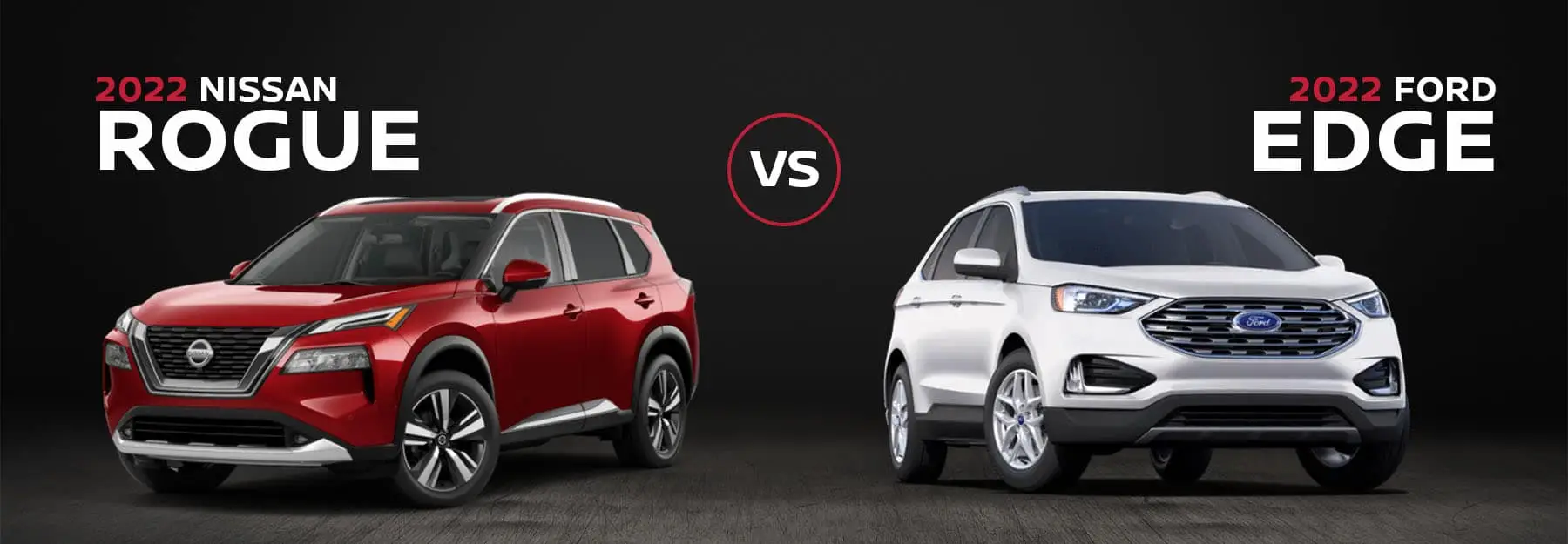
However, the Nissan Rogue claws back in several critical areas that matter immensely to budget-conscious buyers. Its value proposition is hard to ignore, scoring an 8.8 compared to the Edge’s 7.5. You get a lot more for your money with the Rogue, particularly at the entry and mid-level trims, often including more standard safety and convenience features for a lower MSRP. This extends dramatically to its exceptional fuel economy, rated at a stellar 9.0 against the Edge’s rather modest 6.5. Averaging around 30 MPG combined, the Rogue sips fuel where the Edge gulps it, leading to significant financial savings at the pump over years of ownership.
The Rogue also pulls ahead in reliability, earning an 8.2 versus the Edge’s 7.8, suggesting a slightly smoother and less stressful ownership experience with fewer reported mechanical issues over time. Standard tech features also lean in the Rogue’s favor, with an 8.2 rating narrowly beating the Edge’s 8.0, often providing a more modern, intuitive infotainment interface and a more comprehensive standard driver-assist suite straight out of the gate. For safety, the Nissan Rogue achieves an 8.6, slightly edging out the Ford Edge’s 8.4, thanks to consistently robust crash test results and an extensive array of standard safety systems that inspire confidence.
The Ford Edge isn’t without its own triumphs beyond performance, though. Its comfort rating of 8.3 clearly surpasses the Rogue’s 7.9, offering a more refined, quiet ride quality and generally more upscale interior materials that cradle occupants in luxury. The Edge also feels more substantial and robust in terms of build quality, scoring an 8.1 against the Rogue’s 7.8, reflecting a perceptible sense of robustness and meticulous attention to detail in its construction that instills a feeling of long-term durability.
Ford Edge
Nissan Rogue
By the Numbers
Recommended Best Deal Products


Beyond subjective feelings and general category wins, the cold, hard data provides a clear and unbiased picture of where each contender truly shines—and where they might fall short. From engine output and acceleration metrics to combined MPG figures and standard screen sizes, these statistics quantify the strengths and weaknesses, giving you precise, measurable data to weigh against your personal priorities. Let’s break down the key numbers that differentiate these two popular SUVs, offering an objective look at their inherent capabilities and compromises.

Audible — Listen Free for 30 Days
One free credit a month and thousands of titles included.
Listen Free for 30 Days As an Amazon Associate I earn from qualifying purchases.
Ford Edge
Nissan Rogue
Hover any bar for exact values. Each metric scaled independently.
Ford Edge: Strengths and Weaknesses
The Ford Edge truly excels in areas where power, a substantial feel, and a commanding road presence are paramount. With its exceptional performance rating of 8.5, you’re getting an SUV that doesn’t just get you from point A to point B; it does so with undeniable authority and enthusiasm. Opt for the available 2.7L EcoBoost V6, and you’ll experience robust acceleration, often around 335 horsepower, that makes highway merging and passing feel effortless and exhilarating. This powerful demeanor extends to its comfort, which scores an impressive 8.3. The Edge offers a smooth, remarkably quiet ride, making long journeys feel significantly less fatiguing, and its cabin often feels more spacious and premium with better, soft-touch materials throughout than many of its direct rivals.
Furthermore, its build quality, rated at 8.1, suggests a vehicle meticulously designed to withstand the test of time, feeling incredibly solid and impeccably well-put-together. Safety is also a significant strong suit, with an 8.4 rating thanks to a comprehensive suite of advanced driver-assist technologies and consistently solid crash test performance across various scenarios. You undeniably feel secure and protected behind the wheel of an Edge, which offers considerable peace of mind. However, these advantages inevitably come at a cost. The Edge’s most significant weakness lies in its fuel economy, with a rating of just 6.5. Its thirstier engines mean more frequent and expensive stops at the gas station, and its value rating of 7.5 indicates it might be a pricier proposition upfront for what you ultimately get compared to some very competitive alternatives. While undeniably powerful, this SUV isn’t built for the budget-conscious efficiency seeker.
Nissan Rogue: Strengths and Weaknesses
The Nissan Rogue, on the other hand, masterfully carves out its niche by prioritizing practicality, exceptional efficiency, and a host of modern features, making it an incredibly compelling and sensible package for a vast number of drivers. Its standout attribute is undeniably its class-leading fuel economy, offering a near-perfect 9.0 rating. The 2026 Rogue, with its innovative and highly efficient 1.5L VC-Turbo engine, consistently delivers around 30 MPG combined, representing a huge win for your wallet and a positive step for environmental considerations. This impressive efficiency ties directly into its excellent value rating of 8.8; you’re getting a lot of SUV for your money, characterized by very competitive pricing and significantly lower running costs over the long haul.
The Rogue also shines brightly in terms of reliability, scoring a solid 8.2, suggesting a vehicle that won’t give you too many unexpected headaches down the road, providing dependable long-term ownership. Standard tech features are another major plus, rated at 8.2, offering a user-friendly infotainment system, seamless smartphone integration, and a strong suite of connectivity options even on base models, often surpassing rivals. For safety, the Rogue leads its segment with an outstanding 8.6 rating, providing unparalleled peace of mind through a comprehensive suite of advanced driver-assistance systems and consistently strong crash test performance in independent evaluations. However, where the Rogue inevitably falters is in outright performance, receiving a 7.0 rating. It’s perfectly competent for daily driving and city commutes but lacks the thrilling acceleration and confident highway passing power of the more potent Edge. Similarly, its build quality at 7.8, while generally solid and functional, doesn’t quite match the robust, truly upscale feel of its Ford competitor; indeed, some of the cabin plastics are impossible to ignore if you’re seeking a truly premium touch.
- ✅ More powerful standard engine (250 hp base).
- ✅ More refined and comfortable highway ride.
- ✅ Higher towing capacity (up to 3500 lbs).
- ✅ More upscale interior feel and broader seats.
- ✅ Standard larger 12.0-inch infotainment screen.
- ❌ Significantly lower fuel economy (23 MPG combined).
- ❌ Higher starting MSRP (estimated $39,000).
- ❌ Aging design, potentially nearing end of its current generation.
- ❌ Less agile in urban settings compared to Rogue.
- ✅ Excellent fuel efficiency (30 MPG combined).
- ✅ Lower starting price point (estimated $30,000).
- ✅ Comprehensive standard Nissan Safety Shield 360 suite.
- ✅ Very practical and flexible cargo space with Divide-N-Hide system.
- ✅ Modern interior design with available 12.3-inch display.
- ❌ Less powerful engine (201 hp) can feel sluggish.
- ❌ CVT transmission may not appeal to all drivers.
- ❌ Cabin can be noisier at highway speeds.
- ❌ Ride quality is less refined than the Edge.
Which One Should You Choose?
The ultimate decision between the Ford Edge and the Nissan Rogue hinges entirely on your personal priorities, typical driving habits, and what you value most in a daily driver. If you’re a shrewd commuter primarily concerned with long-term running costs and maintaining a keen eye on your budget, the Nissan Rogue is an almost undeniable choice. Its exceptional fuel economy, rated at a staggering 9.0, means significantly fewer trips to the pump and substantial savings over its entire lifespan. Couple that with its outstanding value rating of 8.8, and you have an SUV that delivers practicality, efficiency, and affordability without ever breaking the bank. It’s also an excellent option for tech-savvy drivers, with its 8.2 rating for standard features, and a robust 8.6 in safety, making it ideal for young families or anyone prioritizing comprehensive peace of mind on the road.
However, if your daily drive demands more excitement, or if you frequently find yourself needing extra, responsive power for merging onto busy, high-speed highways or for occasional light towing, the Ford Edge decisively steps up to the challenge. With a formidable performance rating of 8.5, it provides a much more engaging, powerful, and thrilling driving experience. For those who prioritize a commanding road presence, a distinctly refined ride, and a palpably more premium cabin feel that truly elevates the driving experience, the Edge’s comfort rating of 8.3 and build quality of 8.1 will likely sway you. It feels more substantial, more luxurious, and simply more potent in every aspect. While it might indeed cost more upfront and be significantly thirstier at the gas station (its 6.5 fuel economy rating is its weakest point), the heightened driving enjoyment and robust, upscale feel might just be a worthwhile trade-off for a power user or someone not constrained by a tight fuel budget. Consider your lifestyle; the answer will become clear.
Drivers seeking more robust power, a refined ride, and higher towing capacity.
Budget-conscious buyers prioritizing fuel efficiency, modern tech, and city maneuverability.
Final Verdict
After a thorough head-to-head comparison across every critical category, the 2026 Nissan Rogue definitively emerges as the victor in this showdown, largely due to its superior all-around package that aligns with the needs of the typical compact SUV buyer. While the Ford Edge undeniably impresses with its commanding performance, its robust build quality, and its truly premium feel, the Rogue’s unwavering focus on efficiency, outstanding value, and a comprehensive suite of modern features ultimately proves to be the more compelling argument for the vast majority of drivers. The Rogue’s class-leading 30 MPG combined fuel economy is a genuine big deal, significantly reducing long-term ownership costs, while its highly competitive pricing and strong standard safety scores add immense, undeniable appeal. It’s a smart, practical, and incredibly sensible choice that simply doesn’t compromise on essential technology or long-term reliability. The key trade-off remains crystal clear: choose the Ford Edge if exhilarating power and a robust, supremely comfortable ride are absolutely non-negotiable. Opt for the Nissan Rogue if exceptional value, class-leading fuel economy, and advanced standard safety features are paramount and at the very top of your automotive priority list.
Audible Premium Plus — Annual Membership
12 audiobook credits up front, plus the full Audible catalogue.
See Annual Plans As an Amazon Associate I earn from qualifying purchases.Frequently Asked Questions
Is Ford Edge better than Nissan Rogue?
The 2026 Nissan Rogue generally offers better overall value and efficiency, offering 30 MPG combined and starting around $30,000. However, the 2026 Ford Edge, with its 250 hp engine and 3500 lbs towing capacity, is superior for those prioritizing power and a more substantial driving feel, despite its higher $39,000 starting price.
Which is more reliable, Ford Edge or Nissan Rogue?
Both models typically offer average to above-average reliability. However, the 2026 Nissan Rogue often edges out the Ford Edge in consumer reliability surveys, with an estimated score of 8.2/10 compared to the Edge's 7.8/10. The Rogue is generally seen as a slightly more dependable long-term option.
Which has better resale value?
Historically, the Nissan Rogue tends to have slightly better resale value than the Ford Edge. The Rogue's strong market popularity, impressive fuel economy, and lower initial purchase price help it retain more of its value, often around 55% after three years, compared to the Edge's estimated 50% retention.
Which SUV is better for a new driver?
The 2026 Nissan Rogue is often better suited for new drivers due to its more compact size, easier maneuverability, and comprehensive standard safety features (Nissan Safety Shield 360). Its 201 hp engine provides adequate power without being overwhelming, and its 30 MPG combined makes it more economical for a beginner's budget.
What's the biggest difference between the Ford Edge and Nissan Rogue?
The biggest difference is their class and performance profile. The 2026 Ford Edge is a larger, more powerful mid-size SUV with 250 hp and 3500 lbs towing. The 2026 Nissan Rogue is a compact SUV excelling in fuel efficiency at 30 MPG and practical cargo space, making it a more economical and city-friendly choice.