
Ford F150 8.8 Rear End Width Chart 2026: Complete Guide

Ford F150 8.8 rear end width chart searches lead to one frustrating fact. There is no single published WMS width for the F-150 8.8.
Ford never published housing widths in its owner manuals. The axle references that do publish widths cover the Ranger, Explorer, Mustang, and Bronco, and they do not list a separate F-150 8.8 figure.


This guide gives you the honest chart. You will see exactly which F-150 8.8 widths are published, which are not, and which numbers floating around online you should not trust.
You will also learn how to measure your own axle in your driveway and how to confirm it is an 8.8 before you order parts. That measurement matters more than any chart, because it is the only number that fits your truck.
The Short Answer on F-150 8.8 Width


The short answer is that no single published WMS width covers every F-150 8.8. The 8.8 served the F-150 from 1983 through 2014, then changed into the Super 8.8 in 2015, and no source we checked publishes a separate WMS figure for any F-150 generation.
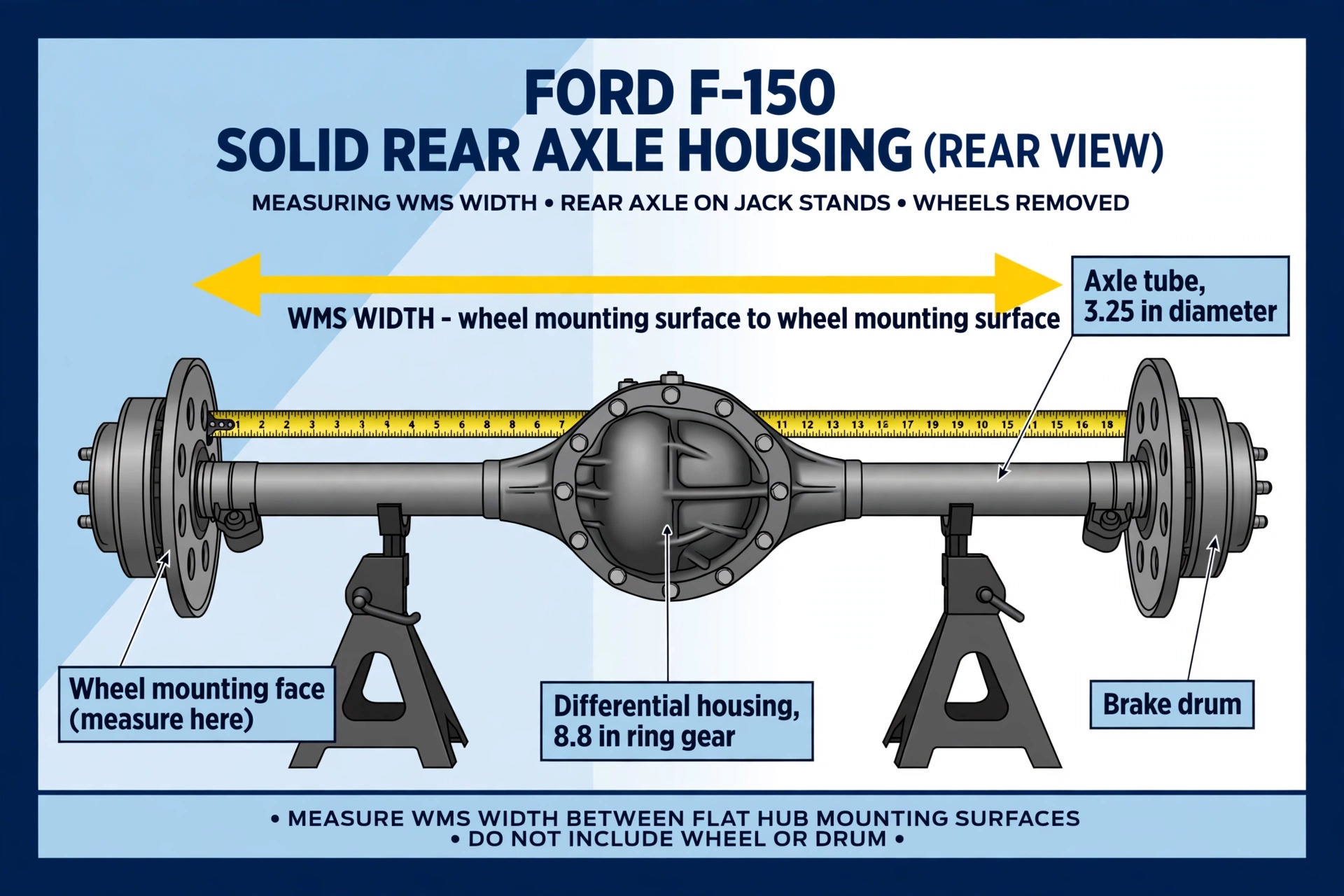
WMS means wheel mounting surface: the distance from the flat face where one wheel bolts on to the flat face where the other wheel bolts on. Wheel and tire fitment depends on this number, so it is the one worth getting right.
Three numbers get confused with the F-150 8.8 width. The 65.125 inch figure belongs to the 1983 to 1996 full-size Bronco, not the F-150.
The 67.6 inch figure from Ford is rear track, not WMS width. A year-by-year table on another site lists 65.5 to 67.0 inches with no source behind it.
Our Ford 8.8 rear end width chart lists the published widths for every Ford vehicle that carries the axle, from the 56.5 inch Ranger to the 65.125 inch Bronco. That chart is the reference this guide builds on. Its F-150 row reads “not separately published.”
That leaves one reliable path. Use the published numbers for related axles as a reference, then measure the axle under your truck. The sections below show you both, starting with the chart and ending with the tape measure.
Published vs Unpublished F-150 8.8 Widths by Year
The chart below is the core of this guide. Each row shows one F-150 8.8 generation, its published status, and the facts you can verify.
| Generation | Published WMS Width | Bolt Pattern | Splines | Cover Bolts |
|---|---|---|---|---|
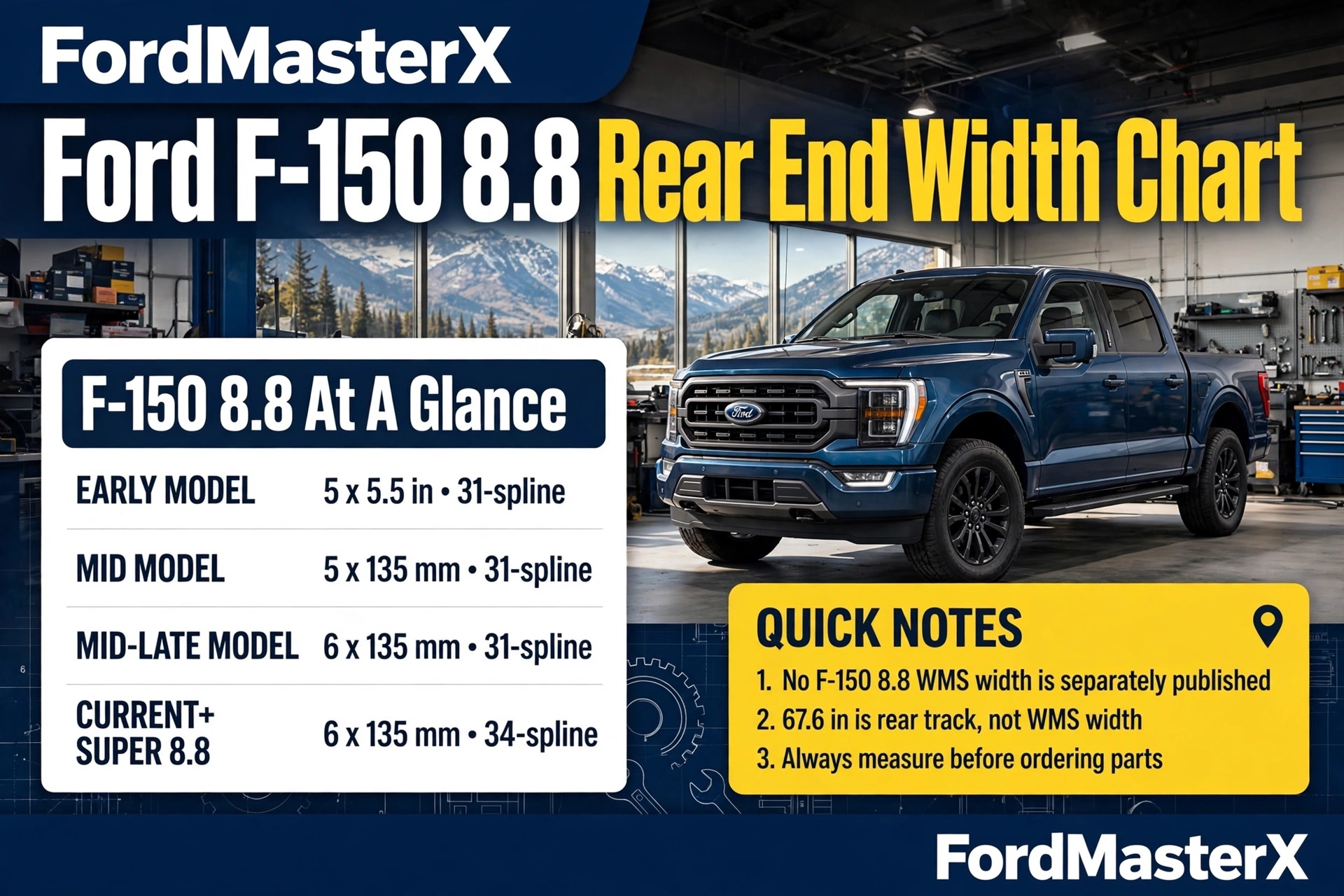
| 1983-1996 | Not separately published (same-era Bronco: 65.125 in) | 5 x 5.5 in | 31 | 10 |
| 1997-2003 | Not published | 5 x 135 mm | 31 | 10 |
| 2004-2014 | Not published | 6 x 135 mm | 31 | 10 |
| 2015-2026 | Not published (Super 8.8) | 6 x 135 mm | 34 | 12 |
Ford F-150 8.8 Rear End Width by Generation
Published status, bolt pattern, splines, and cover bolts
| Generation | Published WMS Width | Bolt Pattern | Splines | Cover |
|---|---|---|---|---|
| 1983-1996 | Not published Same-era Bronco: 65.125 in |
5 x 5.5 in | 31 | 10-bolt |
| 1997-2003 | Not published | 5 x 135 mm | 31 | 10-bolt |
| 2004-2014 | Not published | 6 x 135 mm | 31 | 10-bolt |
| 2015-2026 Super 8.8 |
Not published | 6 x 135 mm | 34 | 12-bolt |
The 1983 to 1996 row needs care. The Bronco shared the F-150 platform in those years, and its 8.8 measures 65.125 inches WMS according to The Ranger Station.
That does not make 65.125 a confirmed F-150 figure, so treat it as a clue, not a specification. Measure before you buy shafts or wheels for an early truck.


The 2015 change matters more than the width question. Blue Oval Trucks reports that the Super 8.8 uses a 12-bolt cover, larger bearings, and different ring and pinion parts.
Those parts do not interchange with the earlier 8.8, so a gear set or carrier from a 2014 axle will not fit a 2015 axle. Stage 3 Motorsports adds that the 2015 and newer F-150 8.8 and 9.75 both use 12 cover bolts and 34-spline axles, so the cover shape tells them apart, not the bolt count alone.
Ford 2015 F-150 technical specifications list the same 67.6 inch rear track for every cab and bed. Track is the distance between tire centerlines, so it tells you nothing about the axle flange width. Anyone who quotes 67.6 inches as the 8.8 WMS width is mixing up two different measurements.
For the full picture across axle types, our Ford rear axle width chart covers the 8.8, 9.75, Sterling 10.5, and Dana axles used under F-150 and Super Duty trucks. Use it when your truck might carry a different axle than the 8.8.
How to Measure Your F-150 8.8 Width in 6 Steps
Measuring WMS width takes about ten minutes and one helper. Measure from the flat wheel mounting face on one side to the same face on the other side, with the wheels off and the truck sitting level.
- Park on level ground, set the parking brake, and chock the front wheels.
- Raise the rear axle on jack stands and remove both rear wheels.
- Clean the wheel mounting faces on both hubs or brake drums so the tape sits flat.
- Hold a straightedge flat against one mounting face to give the tape a true edge.
- Measure from that face to the opposite mounting face with a steel tape.
- Repeat the measurement, then write both numbers down before you touch anything else.
Measure to the flat face where the wheel sits, not to the outer edge of the drum or the end of the housing. The drum edge adds width that has nothing to do with wheel fitment, and the housing end is not a mounting surface at all. A wrong reference point is the most common reason a measured width disagrees with a published one.
A second person helps at step five. One person holds the tape dead flat on the far face while the other reads the number at the near face, because a tape that sags or angles across the axle reads long.
Once you have the width, check your wheel bolt pattern against our Ford bolt pattern chart before you order wheels. The pattern changed three times across F-150 generations, so a wheel that fits the width can still fail on the bolt circle. Width and bolt pattern are separate checks, and both must pass.
Speedway Motors notes that F-150 and Bronco 31-spline axles use 3.25 inch axle tubes. That tube diameter is a useful check when you are standing under a donor truck with no tag and no door sticker to read. A tape around the tube will not give you the width, but it will confirm the axle family.
How to Identify Your F-150 8.8 Axle in 5 Checks
Width means little until you know which axle you are measuring. Run these five checks in order before you trust any number, because each one narrows the answer.
- Door-jamb axle code. Read the axle code on the driver door jamb sticker and decode it against a Ford axle code chart. The code tells you the axle model and the gear ratio in one lookup.
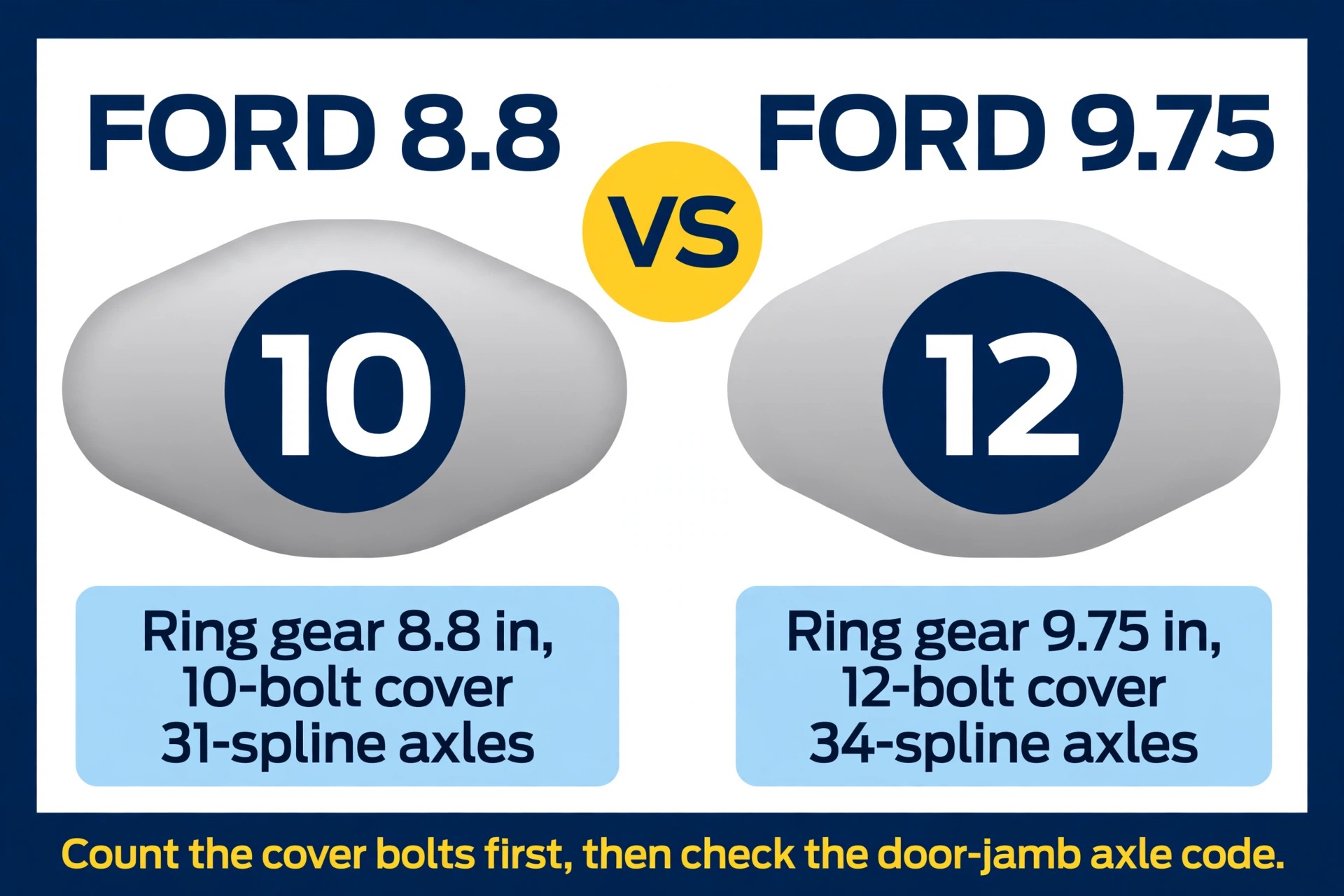
- Cover bolt count. Count the bolts on the rear cover. Ten bolts means a standard 8.8 on a 2014 or older truck, while twelve bolts on a 2015 or newer truck means the Super 8.8.
- Axle tag. Read the metal tag bolted to a cover bolt, or the sticker on the axle tube on later trucks. The tag lists the gear ratio and the ring gear size, and a Traction-Lok unit shows an L in the ratio code.
- Spline count. Pull an axle shaft and count the splines. F-150 8.8 shafts are 31-spline through 2014 and 34-spline from 2015, so the count dates the axle even when the tag is gone.
- Ring gear size. The 8.8 ring gear measures 8.8 inches across. The 9.75 measures 9.75 inches, and its cover is visibly larger, so a side-by-side look settles most arguments.
The cover shape also helps. Hemmings measures the 8.8 cover at about 10.5 inches high by 11 inches long, with flat top and bottom edges and rounded corners.
The 7.5 inch axle cover is nearly square by comparison, so the rectangle shape points to the 8.8 at a glance. Keep a tape in your pocket when you shop for a donor axle.
The tag and door code also give you the gear ratio. Our Ford rear end gear ratio chart explains what each ratio means for towing and fuel economy, so you can judge whether a donor axle helps or hurts your truck.
F-150 8.8 vs 9.75 Rear End in 6 Differences
Many F-150s could carry either axle in the same model year. Some 4×4, SuperCab, and Lightning trucks got the 9.75 while other trucks the same year kept the 8.8, so the year alone never settles which axle sits under your truck. The table below shows the six differences that matter.
| Feature | Ford 8.8 | Ford 9.75 |
|---|---|---|
| Ring gear diameter | 8.8 in | 9.75 in |
| Cover bolts | 10 (12 on Super 8.8) | 12 |
| Axle splines | 31 (34 on Super 8.8) | 34 |
| F-150 years | 1983-2014 standard, 2015+ Super | Selected 4×4, SuperCab, Lightning, then common |
| Strength | Lighter duty, huge aftermarket | Stronger, heavier, built for towing |
| Cover size | About 10.5 x 11 in | Larger |
The 9.75 is the stronger axle, and Ford fitted it where towing and payload demanded more. The 8.8 is the lighter axle with the bigger aftermarket, and the two take different parts, so knowing which one you own comes before any order.
MotorTrend notes that the 8.8 uses a 10-bolt cover and C-clip axles, with 31-spline shafts measuring 1.31 inches in diameter against 1.29 inches for 28-spline shafts. That C-clip design holds the shafts inside the differential. The 9.75 uses the same basic layout with larger parts throughout.
If your truck is older, the 9-inch axle is a different animal again. Our Ford 9-inch rear end width chart lists its published widths, including 65.25 inches for 1973 to 1986 F-150s. Do not mix 9-inch numbers into an 8.8 chart, because the two axles share almost nothing but a brand.
F-150 8.8 Swap Width Rules for 3 Common Projects
Donor axles tempt every F-150 owner at some point. The rules below cover the three donor projects we see most, and each one starts with the same step. Measure the donor before you pay for it.
Bronco Donor Axle


The 1983 to 1996 full-size Bronco 8.8 is the closest donor for an early F-150. Its published WMS width is 65.125 inches, with 31-spline shafts and a 5 x 5.5 inch bolt pattern that matches early F-150 wheels. That match is why the Bronco axle is the first one swappers ask about.
Measure the Bronco axle anyway, even with the published number in hand. Spring perches, shock mounts, and brake hardware still need checking, because the width is only the first of several fitment checks.
Explorer Donor Axle
The solid-axle Explorer 8.8 is much narrower, at about 59.5 to 59.625 inches WMS depending on the source. That width suits narrower builds and older trucks, but it will not fill out a full-size F-150 wheel track without spacers or custom shafts. Most swappers choose it for the disc brakes and the Traction-Lok units, not for the width.
Our Ford Explorer rear end width chart lists the Explorer 8.8 widths and years in full. Check it before you buy an Explorer donor, because 1995 and newer trucks changed brakes and mounts.
Ranger Donor Axle
The Ranger 8.8 is the narrowest of the family, at 56.5 inches for 1990 to 1992 trucks and 58.5 inches for 1993 to 2009 trucks. It is far too narrow for a full-size F-150 without major work, and it was built for a much lighter truck. The Ranger axle shines in smaller projects, where its width is a feature rather than a problem.
Do not let a low price override the width math. An axle that is seven inches too narrow costs more in spacers, shafts, and fabrication than a correct-width donor costs up front.
3 Width Mistakes That Cost F-150 Owners Money
Three mistakes show up again and again in owner forums, and each one starts with trusting a number instead of checking it. Avoid all three and your width work stays cheap.
- Using rear track as WMS width. The 67.6 inch figure from Ford is rear track, the distance between tire centerlines, and wheels ordered on that number will not fit.
- Trusting an unsourced year table. One site lists 65.5, 66.0, 66.5, and 67.0 inches by year for the F-150 8.8, with no source cited. No axle reference we checked supports those figures.
- Assuming same-year trucks share a width. Cab, bed, drive, and package change the axle under the truck. Two F-150s from the same year can carry different axles, so measure the truck in front of you.
Super Duty widths follow the same rule, and our Ford F-250 rear axle width chart shows how much wider those axles run. The habit transfers across every Ford truck. Published number first, tape measure second, purchase last.
Your Next Step After Checking the Chart
The ford f150 8.8 rear end width chart has no single magic number, and that is the honest answer. The published record covers the Bronco, Ranger, Explorer, and Mustang, while the F-150 figure stays unpublished for every generation. Your tape measure fills that gap in ten minutes.
Measure your axle, read your door-jamb code, and count the cover bolts before you order wheels, shafts, or a donor axle. Those three checks cost nothing and prevent the most common fitment mistakes.
Then use the chart above as your reference, not your specification. Keep this guide bookmarked for the next time a seller quotes you a width with no source.
F-150 8.8 Width Questions Answered
What is the WMS width of a Ford F-150 8.8 rear end?
No single published figure exists for the F-150 8.8. The same-era Bronco 8.8 is 65.125 inches, but that is not a confirmed F-150 number. Measure your axle from mounting face to mounting face.
What is the width of a 2015 F-150 8.8 rear end?
Ford never published a WMS width for the 2015 Super 8.8. The 67.6 inch figure is rear track, not WMS width. The Super 8.8 has a 12-bolt cover and 34-spline axles.
How do I tell if my F-150 has an 8.8 or a 9.75?
Count the cover bolts and check the door-jamb axle code. A 10-bolt cover means a standard 8.8 on a 2014 or older truck. The 9.75 has a larger cover and a 9.75 inch ring gear.
Will a Bronco 8.8 fit my F-150?
A 1983 to 1996 Bronco 8.8 is the closest donor at 65.125 inches WMS with the same 5 x 5.5 bolt pattern. Measure both axles first, because spring perches and brakes still need checking.
What bolt pattern does an F-150 8.8 use?
It depends on the year. Trucks through 1996 use 5 x 5.5 inches, trucks from 1997 to 2003 use 5 x 135 mm, and trucks from 2004 on use 6 x 135 mm.