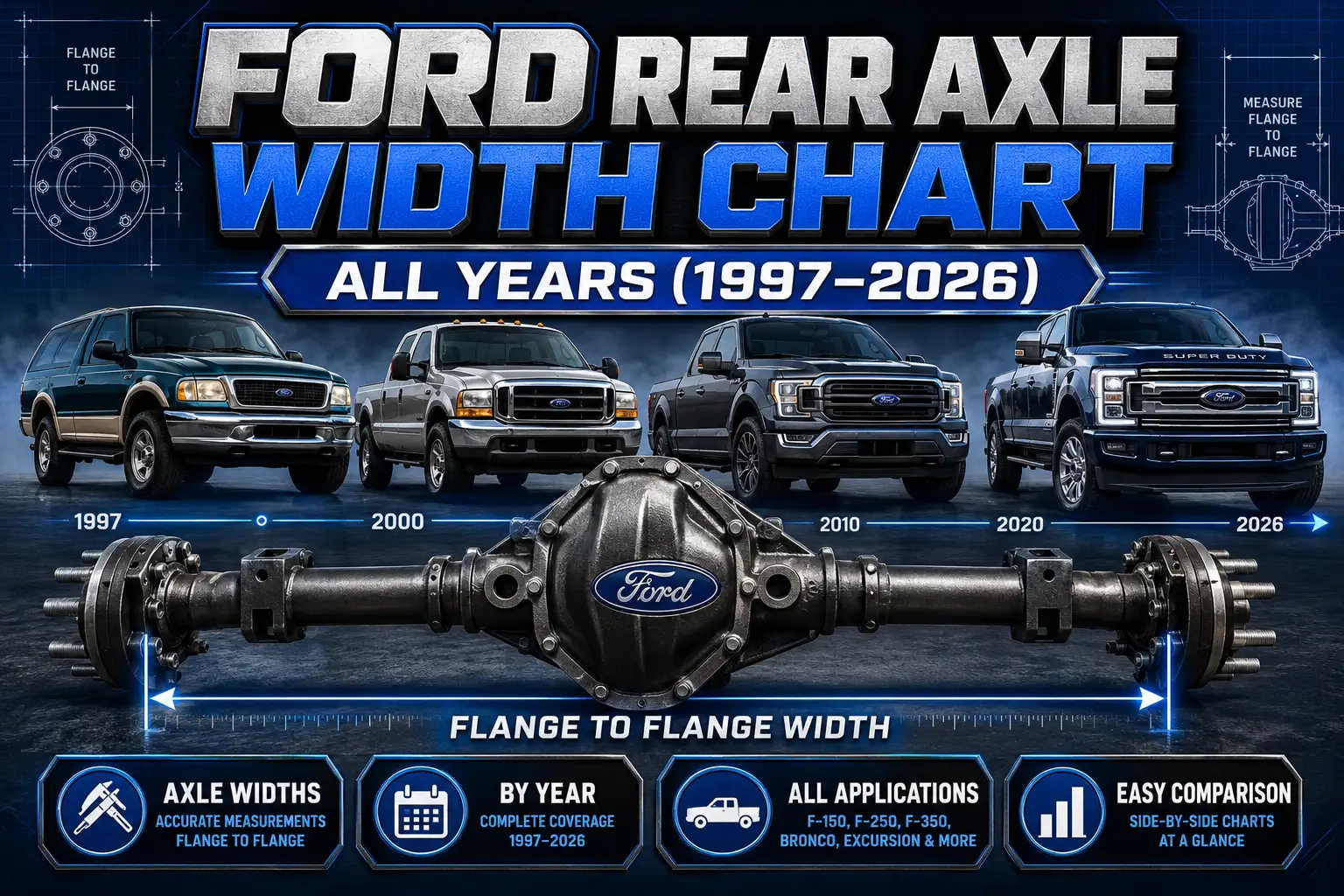
Ford Rear Axle Width Chart: All Years (1997–2026)

Ford F-150 rear axles run from roughly 65 to 71 inches wide depending on whether the truck has an 8.8-inch or 9.75-inch axle, while Super Duty rear axles run from about 67.5 to 72 inches depending on the Sterling 10.5, Dana 60, Dana M275, or Dana 80 fitted. Width is measured wheel mounting surface to wheel mounting surface (WMS-to-WMS), and it changes by axle type, model year, and single rear wheel (SRW) versus dual rear wheel (DRW) configuration.
This chart covers modern Ford trucks only: F-150 from 1997 forward and Super Duty from 1999 forward. If you’re restoring or swapping a classic Ford 9-inch axle from a 1957–1986 Mustang, Bronco, or F-100, use the Ford 9 Inch Width Chart instead — that axle family isn’t covered here.

Prime for Young Adults — 6 Months Free
Students and 18–24s get six months of Prime free, then half price.
Start 6 Months Free As an Amazon Associate I earn from qualifying purchases.Ford Rear Axle Width at a Glance
F-150 and Super Duty, 1997–2026 · wheel-mounting-surface to wheel-mounting-surface
Width by Axle Type (WMS-to-WMS)
Check the door-jamb sticker for your two-character axle code.
Cross-reference the code against the Ford axle code chart for ratio and diff type.
Confirm axle family (8.8″, 9.75″, Sterling, Dana) and width against a parts diagram before ordering.
Ford F-150 Rear Axle Width Chart by Axle Type (1997–2026)
| Axle Type | Model Years | Typical Application |
|---|---|---|
| 8.8-Inch | 1983–2006 (F-150), 2007–2014 (partial overlap) | Base V6/V8 F-150, lower GVWR configs |
| 8.8-Inch HD (12-bolt cover) | 2015–present | Updated F-150 8.8″ with revised ring & pinion, not interchangeable with pre-2015 8.8″ |
| 9.75-Inch | 1997–2020 | 5.4L V8, high-GVWR package F-150s, Expedition (heavy towing package) |
| 9.75HD | Select high-capacity F-150 configs | Max GAWR package, up to 4,800 lbs |
| 9.75-Inch | 2010–2019 | F-150 Raptor |
Owners confirm the 9.75″ is measurably wider than the 8.8″ in practice: forum reports on 8.8″-to-9.75″ swaps note the factory driveshaft comes up short and needs to be shortened to fit the wider axle, even though neither forum thread gave an exact inch figure for the difference.
Ford Super Duty Rear Axle Width Chart by Axle Type (1999–2026)
| Axle Type | Model Years | SRW or DRW | WMS-to-WMS Width |
|---|---|---|---|
| Sterling 10.5-Inch | 1999–2009 | SRW | 68.875″ |
| Sterling 10.5-Inch | 2005–present (reported) | SRW | ~72″ (conflicting source, see note below) |
| Dana 60 (rear) | 2005–present | SRW, high-capacity builds | ~72″ (community-reported, not Ford factory spec) |
| Dana M275 | 2020–present | SRW, 6.7L diesel F-350 | |
| Dana M300 | 2020–present | DRW, higher-capacity builds | |
| Dana 80 | 1998–2011 | DRW (F-350) | 67.5″ |
One Powerstroke.org forum thread lists the Sterling 10.5″ as 68.875″ WMS for 1999–2004 trucks, then states the width increased for 2005+ trucks without giving a confirmed number for the rear axle specifically (the 69″–72″ figures found in research referred primarily to the front Dana 60, not the rear Sterling). Before publishing a specific 2005+ Sterling 10.5″ rear width, verify against a Ford parts diagram or motorcraftservice.com.
Recall note: The 2020–2021 F-350 SRW with the 6.7L Power Stroke and Dana M275 rear axle was subject to NHTSA Recall 21V-536 (Ford recall 21S31) for an axle housing spring seat weld that could allow the housing to deform under load, risking driveshaft separation. Ford notified approximately 27,604 owners in September 2021; the remedy was dealer inspection and, where needed, weld repair or full housing replacement, at no cost. Owners of an affected F-350 should confirm the recall was completed via Ford’s VIN lookup before assuming their M275 housing is factory-original.
Dually (DRW) axles like the Dana 80 and Dana M300 exist specifically to widen the rear track for stability under heavier loads — that’s the practical reason a DRW rear axle runs wider than the SRW version of the same truck, beyond just clearing dual tires.
How to Measure Rear Axle Width Correctly
Two different measurements get confused constantly, and using the wrong one leads to wheel rub or a driveshaft that’s the wrong length.

Audible — Listen Free for 30 Days
One free credit a month and thousands of titles included.
Listen Free for 30 Days As an Amazon Associate I earn from qualifying purchases.- Housing flange-to-flange width measures the bare axle housing only, from the flat mounting face on one side to the flat mounting face on the other. It does not include the axle shafts or brake hardware.
- Axle flange-to-flange width (WMS-to-WMS) measures from the face of the driver’s side wheel hub to the face of the passenger’s side wheel hub — this is the number that actually matters for wheel fitment and is the number used throughout this chart.
- Don’t measure at the tires. Track width (outer tire edge to outer tire edge) changes with wheel offset and tire size, so it is not a reliable stand-in for axle width.
- If you only have a bare housing (axles removed), add an estimated offset for the axle shafts and brake hardware — this offset varies by axle family, so confirm the exact figure for your specific axle type rather than assuming a flat number.
How to Identify Your Ford’s Rear Axle Type
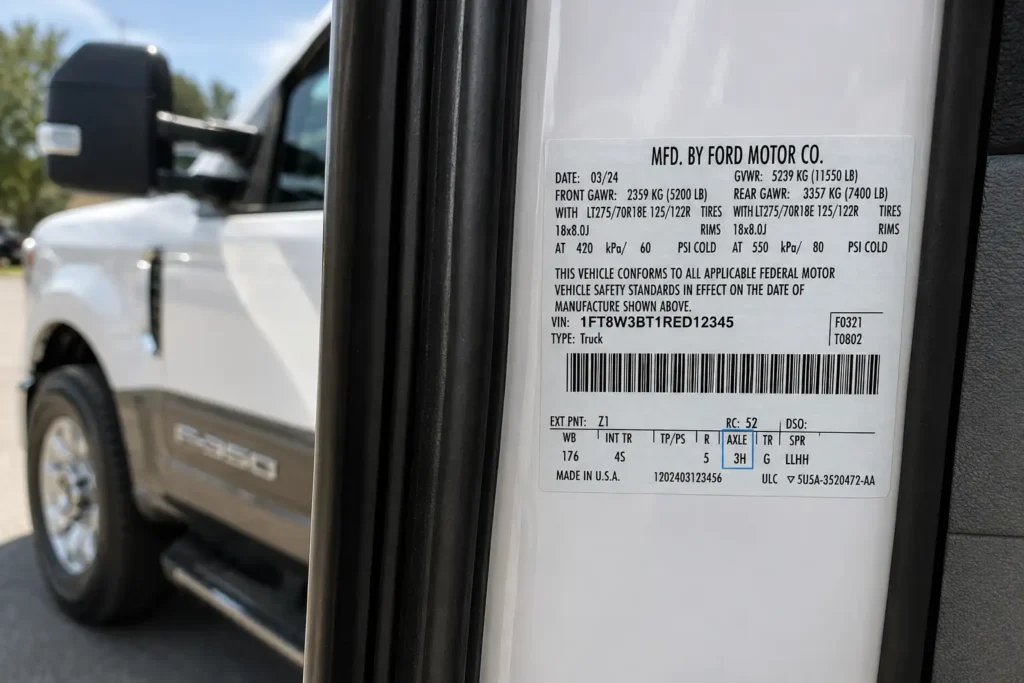
Before ordering parts, wheels, or a driveshaft based on this chart, confirm which axle is actually under the truck.
- Open the driver’s door and check the certification label on the door jamb or door post for an axle code — a two-character code (numeric-only means an open differential, alphanumeric means limited-slip or locking).
- Cross-reference that code against the Ford Axle Code Chart to confirm gear ratio and differential type.
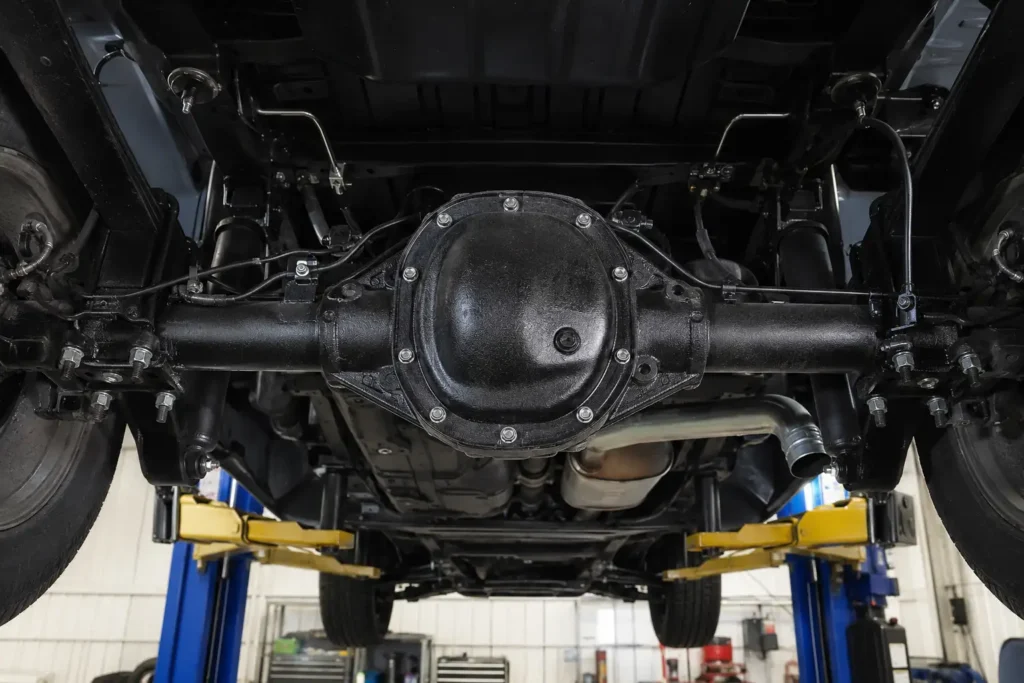
- The axle code identifies ratio and differential type, not width directly — width is inferred from the axle family (8.8″, 9.75″, Sterling 10.5″, Dana 60, etc.), which you can confirm from the build sheet, a Ford parts lookup by VIN, or a visual check (differential cover bolt count and shape differ noticeably between Sterling and Dana housings).
- If the sticker is missing or illegible, a dealer or independent shop can pull the axle type from the VIN through Ford’s parts system.
Why Rear Axle Width Matters for Wheel Fitment and Towing
Getting axle width wrong has consequences beyond a spec sheet mismatch. Wheel offset and backspacing are calculated against the specific axle’s track width — a wheel that clears fine on an 8.8″ F-150 can rub the frame or fender liner on a 9.75″-equipped truck with the same wheel and tire size, or vice versa. Confirm bolt pattern and offset against the Ford Super Duty Wheel Offset Chart before buying wheels for a Super Duty specifically.
Swapping axle types (owners report doing this on F-150s to upgrade from 8.8″ to 9.75″ for towing capacity or a factory e-locker) changes the driveshaft length requirement — the stock driveshaft is built for the original axle’s width and will need to be shortened or replaced to fit a wider replacement axle. Cab and bed configuration also affects driveshaft length independent of axle width, so check the Ford F-150 Wheelbase Chart if you’re also changing cab/bed combinations during a build.
F-150 vs Super Duty Rear Axle Width Comparison Table
| Axle Type | Truck Line | WMS-to-WMS Width | Notes |
|---|---|---|---|
| 8.8-Inch | F-150 | Base F-150 axle, pre- and post-2015 versions not interchangeable | |
| 9.75-Inch | F-150 | HD towing package, Raptor | |
| Dana 80 | Super Duty (F-350 DRW) | 67.5″ | Narrowest of the Super Duty DRW axles listed |
| Sterling 10.5-Inch | Super Duty (F-250/F-350 SRW) | 68.875″ (99–04); ~72″ reported for 2005+, | Standard Super Duty SRW axle |
| Dana 60 (rear) | Super Duty (SRW, high-capacity builds) | ~72″ (community-reported) | Used in 2005+ high-capacity rear configurations |
| Dana M275 / M300 | Super Duty (2020+) | M275 subject to NHTSA recall 21V-536 on 2020–2021 F-350 SRW |
Confirming Your Ford’s Rear Axle Width Before You Buy
Rear axle width on a modern Ford comes down to which axle is actually bolted under the truck, not just the model name on the tailgate. An F-150 could carry an 8.8″ or 9.75″ axle depending on year and GVWR package, and a Super Duty could carry a Sterling 10.5″, Dana 60, Dana M275, or Dana M300 depending on year and SRW/DRW configuration. Confirm your axle code from the door-jamb sticker, cross-reference it against the axle code chart, and verify width against a parts diagram before ordering wheels, a driveshaft, or swap components. When a number in this chart is flagged unverified, treat it as a starting point, not a final measurement — grab a tape measure or call a Ford parts counter with your VIN before you cut metal or place an order.
FAQ
What is the rear axle width on a Ford F-150?
It depends on the axle: F-150s came with either an 8.8″ or 9.75″ rear axle depending on year and GVWR package. Exact wheel-mounting-surface widths for these axles need direct verification against a Ford parts diagram, as available enthusiast sources conflict.
Is the 9.75 rear axle wider than the 8.8?
Yes, according to owner reports from axle swaps, the 9.75″ is measurably wider than the 8.8″, enough that a driveshaft swapped from an 8.8″-equipped truck typically needs to be shortened to fit. An exact inch-for-inch difference wasn’t confirmed in a primary Ford source.
How wide is a Super Duty dually rear axle?
The Dana 80, used in 1998–2011 F-350 DRW trucks, measures 67.5″ wheel-mounting-surface to wheel-mounting-surface. Newer DRW Super Duty axles (Dana M300, 2020+) have not been independently verified for this chart and should be confirmed by VIN.
How do I know if I have a Sterling 10.5 or Dana 60 rear axle?
Check the differential cover shape and bolt count, or pull the axle type from your VIN through a Ford parts lookup. The door-jamb axle code confirms gear ratio and differential type but not the axle family itself.
Can I swap a 9.75 axle into an 8.8 F-150 without other changes?
No. Owners report the driveshaft needs to be shortened for the wider 9.75″ axle, and wheel offset that worked on the 8.8″ may cause rubbing on the 9.75″ depending on your specific wheel and tire setup.