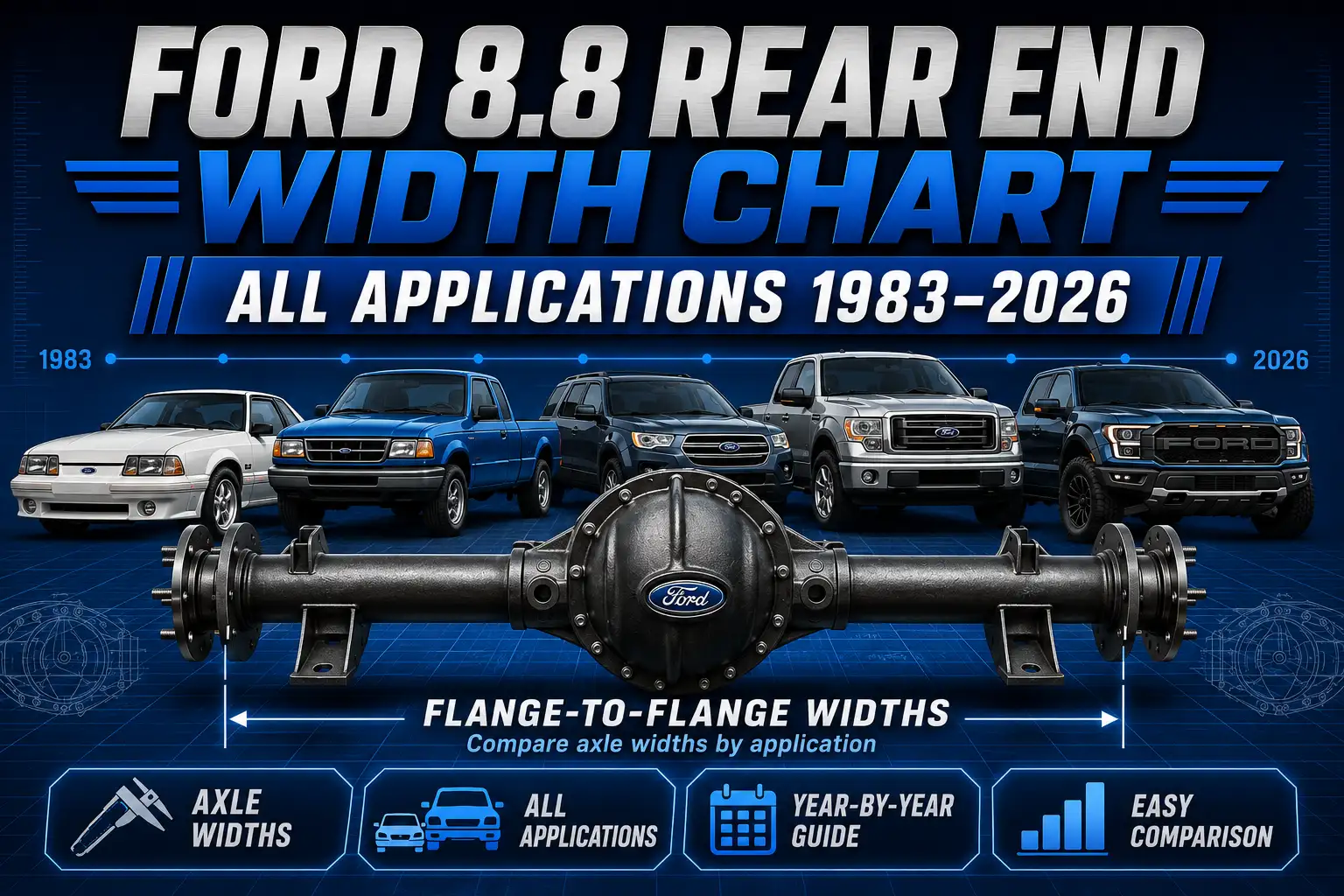
Ford 8.8 Rear End Width Chart: All Applications & Years (1983–2026)

There’s no single “Ford 8.8 width” — it depends entirely on which vehicle it came out of. A Fox Body Mustang 8.8 measures roughly 57″ wheel-mounting-surface to wheel-mounting-surface, while an F-150 or full-size Bronco 8.8 runs over 8 inches wider at 65.125″. If you’re identifying a used axle, planning a swap, or checking wheel/tire fitment, the application it came from matters more than the “8.8” label on the cover.
This chart covers every major Ford 8.8 application from the axle’s 1983 introduction through the current Super 8.8 used in the 2015+ F-150 and S550 Mustang, with bolt pattern and spline count included so you get the full fitment picture, not just a number.

Prime for Young Adults — 6 Months Free
Students and 18–24s get six months of Prime free, then half price.
Start 6 Months Free As an Amazon Associate I earn from qualifying purchases.Ford 8.8 Rear End Width Chart
Wheel mounting surface (WMS) width by vehicle application, 1983–2026
| Vehicle | Years | Width (WMS) | Spline |
|---|---|---|---|
| Mustang (Fox Body) | 1979–1993 | ~57″ | 28 |
| Mustang (SN95) | 1994–1998 | ~58.5″ | 28 |
| Mustang (New Edge) | 1999–2004 | ~59.875″ | 28 |
| Ranger (1st Gen) | 1983–1992 | ~56.5″ | 28 |
| Ranger (2nd Gen / FX4) | 1993–2009 | ~58.5″ | 28 (31 FX4) |
| Explorer (solid axle) | 1991–2001 | ~59.5″–59.75″ | 31 |
| Explorer Sport Trac | 2001–2005 | ~59.5″ | 31 |
| F-150 / Full-Size Bronco | 1983–2004 | ~65.125″ | 28/31 |
| Crown Victoria (Panther) | 1992–2011 | UnresolvedVerify | 28 (31 on 2005+) |
| Super 8.8 — F-150 / Mustang | 2015–present | UnresolvedVerify | 34 |
Ford 8.8 Width Chart by Vehicle and Year (1983–2026)
Recommended Best Deal Products


All widths below are measured wheel mounting surface to wheel mounting surface (WMS) — the outer face where the wheel bolts on — since that’s the number that actually matters for fitment and fender clearance. See the measuring section below if you need to confirm this yourself.
| Vehicle | Years | 8.8 Width (WMS to WMS) | Spline Count |
|---|---|---|---|
| Mustang (Fox Body) | 1979–1993 | ~57″ | 28 |
| Mustang (SN95) | 1994–1998 | ~58.5″ | 28 |
| Mustang (New Edge) | 1999–2004 | ~59.875″ | 28 |
| Ford Ranger (1st Gen) | 1983–1992 | ~56.5″ | 28 |
| Ford Ranger (2nd Gen / FX4) | 1993–2009 | ~58.5″ | 28 (31 on FX4) |
| Ford Explorer (solid axle) | 1991–2001 | ~59.5″–59.75″ | 31 |
| Ford Explorer Sport Trac | 2001–2005 | ~59.5″ | 31 |
| F-150 / Full-Size Bronco (solid axle) | 1983–1996 (Bronco), 1983–2004 (F-150) | ~65.125″ | 28/31 |
| Aerostar (2WD, 4.0L) | 1991–1997 | Not independently confirmed | — |
| Crown Victoria / Grand Marquis (Panther) | 1992–2011 | Unresolved — sources conflict (59.25″ to 65.5″) | 28 (31 on 2005+) |
| Super 8.8 — F-150 | 2015–present | Not independently confirmed | 34 |
| Super 8.8 — Mustang (S550) | 2015–present | Not independently confirmed | 34 |
Community sources give conflicting figures (one thread cites 59.25″ flange-to-flange for pre-2005 cars, another cites 65.5″ WMS for both pre- and post-2005, and a third flags “62.5”, conflicting info” for the same generation). This is likely a mix of flange-to-flange versus WMS measurements being reported interchangeably. Confirm with a direct measurement or a Ford parts diagram before using a Crown Vic 8.8 as a swap donor based on width alone.
Widely confirmed specs exist for the 12-bolt cover, 34-spline shafts, and larger bearings, but a corroborated WMS width figure wasn’t found in community sources during this research pass. Check Ford Performance Parts documentation or measure directly.
How to Measure Flange-to-Flange Width on a Ford 8.8
Most of the width confusion you’ll find online comes down to where the tape measure starts. There are two different numbers people report, and they’re not interchangeable:
- Flange-to-flange (or “housing width”): measured from the outer axle flange face on one side to the outer axle flange face on the other, before any brake components are installed. This is the number axle builders and narrowing shops use.
- Wheel mounting surface to wheel mounting surface (WMS): measured from the outer face of the wheel hub on one side to the outer face on the other, after brakes (drum or rotor) are installed. This is the number that actually determines whether your wheels and tires will clear the fenders.
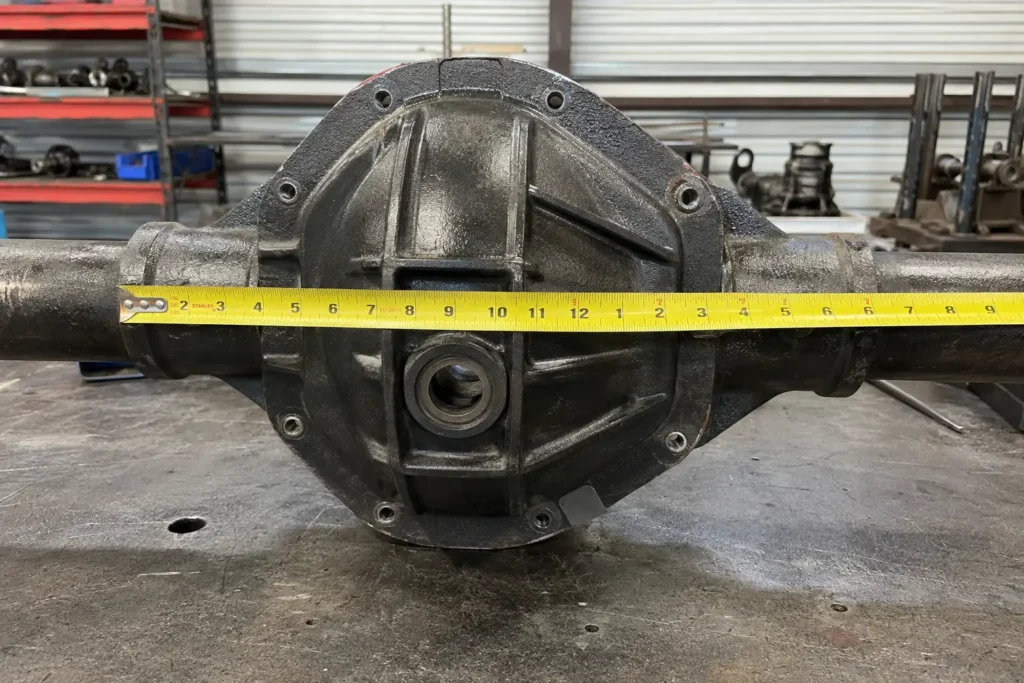
To measure WMS yourself: with the axle out of the vehicle and brakes installed, run a tape measure straight across the back of the housing from the outer wheel mounting face on one side to the outer wheel mounting face on the other. Keep the tape level and square to the axle tubes, not diagonal. If you’re comparing to a chart, always confirm which measurement convention that chart is using first, since a drum-brake WMS figure and a flange-to-flange figure on the same axle can differ by 1.5″–2″.
Once you’ve confirmed your own axle’s dimension, you can check it against a rear end identification guide to also verify whether you’re actually working with an 8.8 or a 9.75-inch axle, since both were used across F-150 production and the cover shape is the fastest way to tell them apart.
Ford 8.8 Width for Mustang and Panther Platform Cars (1979–2014)
Recommended Best Deal Products


The Fox Body Mustang (1979–1993) is the narrowest common 8.8 application at roughly 57″ WMS, and it’s also the most swapped-into platform for hot rods and early Fords because of how many were produced. The SN95 (1994–1998) picked up about 1.5″ of additional width to 58.5″, and the New Edge generation (1999–2004) added roughly another 1.5″ to land near 59.875″. All three generations use a centered pinion with equal-length axle shafts, unlike most 8.8 truck applications, which use an offset pinion and unequal axle lengths.

Audible — Listen Free for 30 Days
One free credit a month and thousands of titles included.
Listen Free for 30 Days As an Amazon Associate I earn from qualifying purchases.Mustang 8.8s use coil springs rather than leaf springs, so if you’re pulling one for a leaf-spring swap, you’ll need to fabricate spring perches regardless of which generation you use.
The Panther platform (Crown Victoria, Grand Marquis, Town Car) also used the 8.8 across most of its production run, and it’s a popular budget swap donor because of how many were sold as former police and fleet vehicles. Unfortunately, as noted in the table above, the width figure for this platform has conflicting reports online and should be measured directly before you commit to it for a build.
Ford 8.8 Width for F-150, Bronco, Ranger, and Explorer
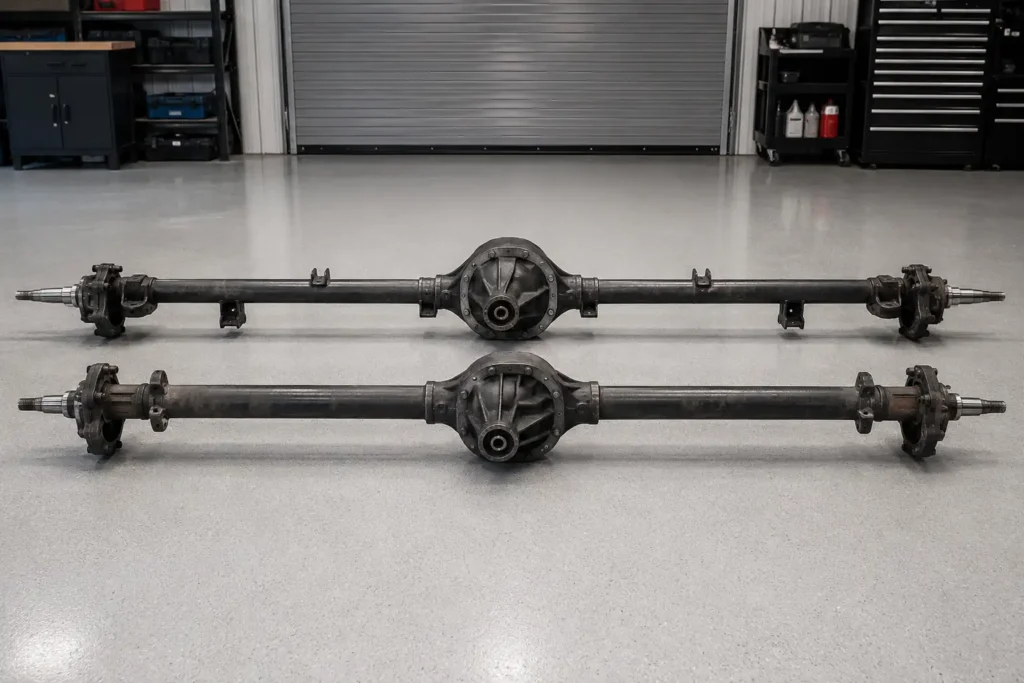
Truck and SUV 8.8 axles run noticeably wider than anything found in a Mustang or Panther car, and they use an offset pinion with unequal-length axle shafts.
The F-150 and full-size Bronco (solid rear axle years) share the widest common 8.8 application at approximately 65.125″ WMS, corroborated independently across multiple owner measurements. This width, combined with the 5×5.5″ bolt pattern used before 2004, makes it a common choice when builders need to retain a wider stance without narrowing.
The Ford Ranger is narrower and split into two distinct widths by generation: first-generation Rangers (1983–1992) measure around 56.5″, while second-generation Rangers (1993–2009), including the FX4, widen to about 58.5″. The FX4 trim is the only Ranger variant that came with a 31-spline 8.8 from the factory; standard Rangers used 28-spline shafts.
The Ford Explorer (solid axle years, 1991–2001, plus the Explorer Sport Trac through 2005) is the most commonly recommended 8.8 swap donor in off-road communities, landing around 59.5″–59.75″ WMS with 31-spline shafts and factory disc brakes on most model years. It’s roughly 1″–1.25″ wider than a same-era Ranger, which is close enough that builders sometimes debate the two interchangeably, but they are not identical widths.
Standard 8.8 vs Super 8.8 Width and Bolt Pattern Differences (2015–2026)
Recommended Best Deal Products


Ford introduced the “Super 8.8” for the 2015 model year alongside the S550 Mustang redesign and the 2015 F-150, and it’s a meaningful revision rather than a cosmetic update. The clearest identifier is the rear cover: standard 8.8 axles use a 10-bolt cover, while the Super 8.8 uses a 12-bolt cover. Super 8.8 units also step up to 34-spline axle shafts (or half-shafts on IRS applications), larger bearings, and a longer pinion with a larger retaining nut, compared to the 28- or 31-spline shafts used on every prior 8.8 generation.
The Super 8.8 shows up in solid-axle form on the 2015+ F-150 and both solid-axle and independent rear suspension (IRS) form on the S550 Mustang. If you’re shopping a wrecking yard for a 2015-or-newer donor, the 12-bolt cover is the fastest way to confirm you’re looking at a Super 8.8 rather than a standard-generation unit, even before you check spline count.
Ford 8.8 Bolt Pattern and Spline Count by Application
Width only tells half the fitment story. Bolt pattern and spline count decide whether the axle will actually bolt up to your wheels and match your intended axle shafts.
| Vehicle | Bolt Pattern | Spline Count | Brake Type |
|---|---|---|---|
| Mustang (Fox/SN95/New Edge) | 5×4.5″ | 28 | Drum (early) / Disc (later) |
| Ford Ranger | 5×4.5″ | 28 (31 on FX4) | Drum (mostly) |
| Ford Explorer (solid axle) | 5×4.5″ | 31 | Disc (most years) |
| F-150 / Full-Size Bronco (pre-2004) | 5×5.5″ | 28/31 | Drum |
| F-150 (2004+, 8.8-equipped trims) | 6-lug | 31 | Disc |
| Super 8.8 (2015+ F-150 / Mustang) | 6-lug (F-150) / 5×114.3mm (Mustang) | 34 | Disc |
One more fitment detail worth knowing before you buy: every pre-Super 8.8 axle is a C-clip design, meaning the axle shafts are retained inside the differential by C-clips rather than an external flange. If a C-clip axle shaft breaks while driving, the wheel can come completely off the vehicle. This is rarely an issue in a stock street application, but it’s a real consideration for anyone building a high-power or off-road rig, where aftermarket C-clip-eliminator kits are a common upgrade.
Audible Premium Plus — Annual Membership
12 audiobook credits up front, plus the full Audible catalogue.
See Annual Plans As an Amazon Associate I earn from qualifying purchases.Picking the Right 8.8 Width for Your Swap or Build
Once you know your target width, matching it to a donor axle is straightforward. Start by measuring the width of the axle you’re replacing (or your desired track width, if you’re building from scratch), using the same WMS-to-WMS method described above. Then compare that number against the chart to find the closest factory match.
A few practical notes from real swap builds:
- If your target width falls between two factory options, it’s almost always easier to buy the wider axle and narrow it than to buy the narrower one and try to widen it, since widening requires new axle shafts and re-welded tubes.
- Wheel spacers (typically 3/4″ to 1″ per side) can close small gaps of an inch or two without any cutting, but they add stress to wheel studs and bearings and aren’t a substitute for the correct width on a heavily-loaded application.
- If you’re building anything performance-oriented or off-road, budget for a C-clip eliminator kit regardless of which donor axle you choose — it’s cheap insurance against a dropped axle shaft.
- Professional narrowing/widening at an axle shop is a routine service, but exact pricing varies enough by shop and axle condition that it isn’t included here — get a local quote before budgeting for it.
Getting the Right 8.8 Width the First Time
The Ford 8.8 rear end spans a wide range of widths depending on which vehicle it came from, from roughly 56.5″ on an early Ranger to over 65″ on an F-150 or full-size Bronco. The single biggest source of confusion isn’t the axle itself, it’s measurement convention: always confirm whether a number is flange-to-flange or wheel-mounting-surface before comparing it against your own axle or a chart like this one.
Use the table above to identify your exact application, measure your own axle the same way, and you’ll know within minutes whether the 8.8 in front of you is a direct fit or a narrowing/widening project.
Frequently Asked Questions
How wide is a Ford 8.8 rear end?
It depends on the vehicle. Widths range from about 56.5″ (early Ford Ranger) to roughly 65.125″ (F-150 and full-size Bronco), measured wheel mounting surface to wheel mounting surface. There is no single universal 8.8 width.
What is the width difference between a Mustang and F-150 8.8 axle?
A Fox Body Mustang 8.8 measures around 57″ WMS, while an F-150/Bronco solid-axle 8.8 measures around 65.125″ WMS — roughly an 8-inch difference. The two also use different bolt patterns and pinion offsets, so they aren’t interchangeable without modification.
How do I measure my Ford 8.8 rear end width?
Measure straight across the back of the housing from the outer wheel mounting face on one side to the outer wheel mounting face on the other, with the axle level and the tape square to the tubes. Confirm whether you need flange-to-flange or WMS before comparing your number to a chart.
What’s the difference between a standard 8.8 and a Super 8.8?
The Super 8.8, introduced for 2015, uses a 12-bolt rear cover instead of the standard 10-bolt cover, along with 34-spline axle shafts, larger bearings, and a longer pinion. It’s used in the 2015+ F-150 and S550 Mustang.
Can I narrow a Ford 8.8 rear end to fit a different width?
Yes, narrowing (cutting and re-welding the axle tubes with shortened shafts) is a routine service at axle and driveline shops. It’s generally easier and cheaper than widening an axle, which is why builders typically buy a slightly wider donor axle rather than a narrower one when a choice is available. If you need help confirming whether your donor is an 8.8 or a Ford 9-inch before you start cutting, check the identification differences first, and if lug pattern is your remaining question, the Ford bolt pattern chart covers every pattern used across the lineup.