
Ford Rear End Gear Ratio Chart: Mapped Out by Torque and Tire Diameter

A Ford rear end gear ratio chart lists the numerical relationship between the pinion gear and ring gear teeth, determining your vehicle’s acceleration and top-end speed. Lower numerical ratios, like 2.73, prioritize fuel economy and highway cruising, while higher ratios, such as 4.10, maximize torque and towing performance. Use these tables to identify your specific axle configuration, verify your factory build, and calculate the mechanical impact of tire diameter changes.
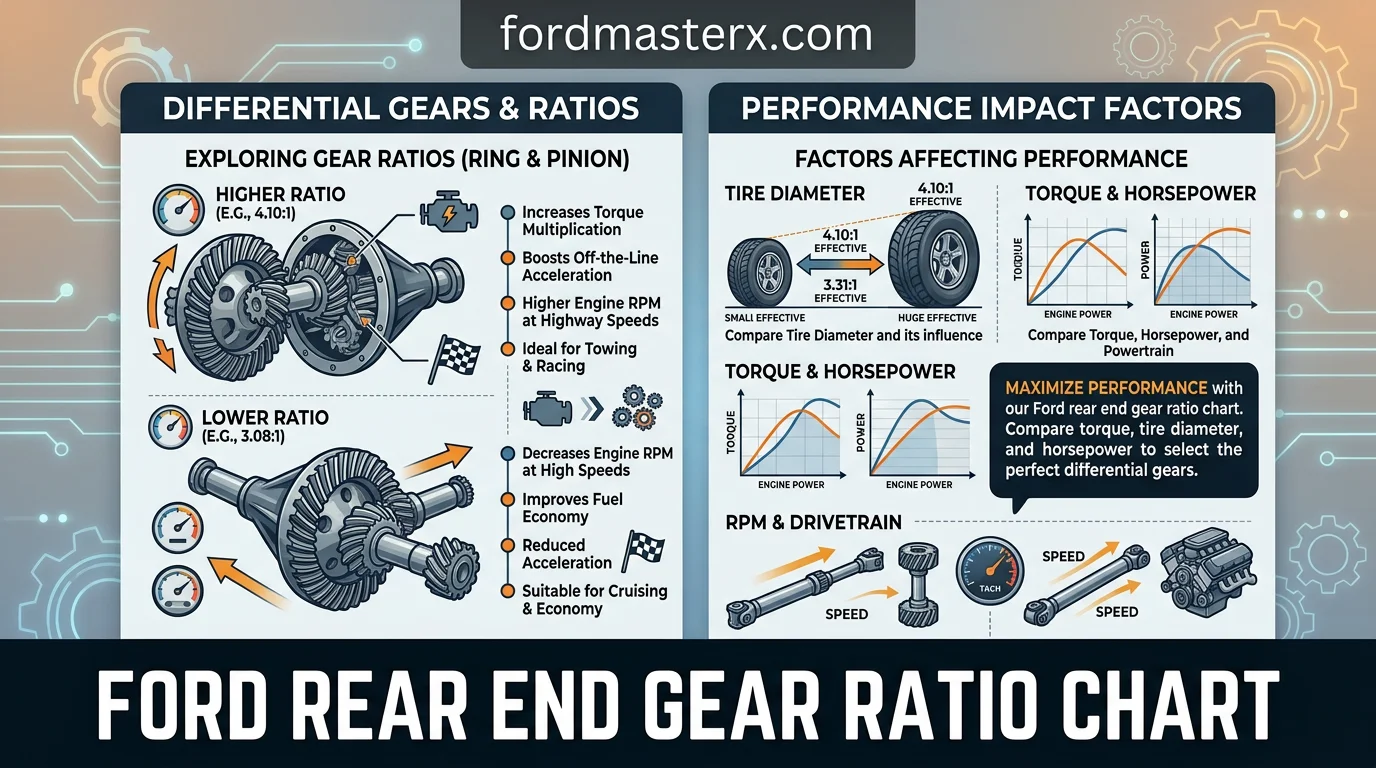
Ford Rear End Gear Ratio Chart: Quick Reference Guide
How to Read This Chart
The “Gear Ratio” column represents the mathematical relationship between the ring gear and the pinion gear. This number is derived by dividing the total number of teeth on the ring gear by the number of teeth on the pinion gear. For instance, a 4.10 ratio indicates the pinion spins 4.10 times for every single rotation of the rear tires.


The “Performance Profile” column helps you understand the mechanical trade-offs. Lower numerical values (like 2.73) provide higher top-end speeds and better fuel efficiency during highway driving because the engine maintains lower RPMs at speed. Conversely, higher numerical values (like 4.10 or 4.88) increase torque multiplication at the wheels.

Higher ratios are preferred for towing and heavy-duty applications because they reduce the load on the engine during acceleration, providing superior “pulling power.” When selecting your configuration, consider your primary use case: if you prioritize fuel economy for daily commuting, a lower ratio is likely superior; if you frequently haul heavy equipment or off-road, a higher ratio is the standard choice.
Always cross-reference these general profiles with your vehicle’s specific axle tag or door sticker. While these ratios apply across most Ford platforms, the specific ring and pinion tooth count may vary based on the specific axle assembly, such as an 8.8-inch or 9.75-inch housing. Verify your exact configuration before ordering new gear sets.
Ford Rear End Gear Ratio Chart: Understanding Ratio Mechanics: Torque


The final drive ratio in a Ford differential defines the mechanical relationship between the rotation of the driveshaft and the rotation of the wheels. A gear ratio represents the number of times the pinion gear must rotate to turn the ring gear one full revolution.
This ratio acts as a mechanical lever for your engine’s power. By choosing a specific set, you fundamentally alter how much torque is delivered to the ground, directly impacting the vehicle’s personality during acceleration and its composure during sustained highway cruising.
Why High Numerical Ratios Boost Acceleration


High numerical ratios, such as 4.10:1 or 4.56:1, provide aggressive torque multiplication at the wheels. Because the engine must spin faster to achieve the same ground speed, the vehicle benefits from an increased mechanical advantage that makes it feel much quicker off the starting line.
When you increase the numerical value of the gear set, you are effectively shortening the gearing. This forces the engine into its power band much faster, which is ideal for towing heavy loads, racing, or improving the responsiveness of a vehicle equipped with larger, heavier aftermarket tires.
However, this added torque comes at the cost of higher engine RPM during daily driving. A vehicle equipped with a 4.10 gear set will maintain a significantly higher engine speed at 65 mph compared to a factory-standard 2.73 gear set, leading to increased cabin noise and reduced mechanical longevity.


The “short” gear set (high numerical ratio) multiplies torque but decreases top speed potential in each gear, requiring more frequent shifting in a manual transmission vehicle.
Why Low Numerical Ratios Improve Fuel Economy
Low numerical ratios, often referred to as “tall” or “highway” gears, include values like 2.73:1 or 3.08:1. These configurations prioritize engine efficiency by allowing the vehicle to maintain highway speeds at a much lower RPM, which reduces internal engine friction and thermal heat buildup.
By lowering the engine speed at cruising velocity, these gear sets minimize fuel consumption for long-distance drivers. If your daily commute involves primarily flat, high-speed highway driving, a lower numerical ratio is generally preferred to keep the engine operating within its most efficient load range.
The primary trade-off is a noticeable reduction in off-the-line torque. Because the mechanical advantage is reduced, the engine may feel sluggish when accelerating from a dead stop or when trying to pass at highway speeds. For trucks, this can also reduce the vehicle’s maximum rated towing capacity.


Ultimately, selecting the right gear set is a balancing act between the “snap” of high numerical acceleration and the “efficiency” of low numerical cruising. Analyze your daily drive and intended use case to determine which end of the spectrum best fits your specific Ford configuration.
How to Find and Decode Your Ford Axle Tag
Reading the Ford Differential Axle Tag


The most reliable method to identify your specific rear end gear ratio is the physical metal tag attached to the differential housing. On Ford 8.8 and 9.75-inch rear ends, you will typically find this small, stamped metal strip held in place by one of the differential cover bolts.
Clean the area thoroughly with a wire brush to reveal the stamped characters. You are looking for a string of numbers that includes the gear ratio. For instance, a tag might display “3.73” directly, or it may use a specific identification code like “S-code.”
If the tag is missing or covered in heavy corrosion, rotate the driveshaft and count the number of turns it takes to make one full rotation of the axle shaft. This manual check serves as an important verification if the factory tag has been removed or damaged over time.
📋
Step-by-Step Guide: Physical Inspection


Look at the rear differential cover bolts. The tag is usually a small rectangular piece of steel trapped under one of the bolts at the 9 o’clock or 3 o’clock position.
Use degreaser and a wire brush to make the numbers legible. Record the full alphanumeric string, specifically looking for numbers like 3.55, 3.73, or 4.10.
Interpreting Door Jamb Axle Codes
Most Ford vehicles feature an information sticker located on the driver-side door jamb. This decal contains an “AXLE” code, which provides the factory-configured gear ratio for your specific VIN. This code is often a single digit or a combination of one letter and one number.
Always exercise caution when using this sticker as your primary source of truth. If the vehicle has had its rear end swapped or the gears upgraded by a previous owner, the sticker will be inaccurate. The door jamb code reflects how the vehicle left the assembly line, not necessarily its current state.
When discrepancies arise between the door jamb code and the differential tag, always trust the differential tag. The physical component tag provides the “as-built” data for that specific axle housing, making it the superior reference for ordering internal parts like ring and pinion gear sets or limited-slip differentials.
Accounting for Tire Diameter and Effective Gear Ratio
| Tire Diameter (Inches) | Effective Gear Ratio |
|---|---|
| 30.0″ | 4.10 |
| 33.0″ | 3.72 |
| 35.0″ | 3.51 |
| 37.0″ | 3.32 |
How to Read This Chart


The table above demonstrates how changing tire diameter alters the performance characteristics of a vehicle equipped with a 4.10 ring and pinion set. The first column lists the total outer diameter of the tire in inches, while the second column provides the resulting effective gear ratio.
These figures represent the mechanical advantage your engine sees at the wheels. When you move from a 30-inch tire to a 35-inch tire, the effective ratio drops from 4.10 to approximately 3.51. This indicates that despite your physical gears remaining at 4.10, the engine performs as if it were running a much higher, “taller” gear set.
The Relationship Between Tire Size and Effective Ratio
Tire diameter acts as a direct multiplier on your final drive ratio. A larger tire increases the distance traveled per single revolution of the axle shaft. This effectively “stretches” the gear, requiring more torque from the engine to initiate movement and maintain acceleration, which is why your truck may feel more sluggish after installing larger aftermarket tires.
When you increase tire size without changing the physical gears in your Ford differential, you are creating a “taller” effective ratio. This shifts your power band, often resulting in lower engine RPMs at highway speeds but degraded towing capacity and slower off-the-line performance. Conversely, smaller tires increase your “mechanical advantage,” making the axle feel shorter and more aggressive.
For example, moving from 30-inch factory tires to 35-inch off-road tires drastically reduces your 4.10 ratio’s perceived performance. To regain the original driving feel, owners often compensate by installing a numerically higher gear set, such as moving from 4.10 to 4.56 or 4.88, to offset the diameter increase and bring the effective ratio back into an optimal range.
Recalibrating Speedometers After Gear Changes
Changing gear ratios or tire sizes significantly often requires recalibrating the vehicle’s speedometer and ECU. Because the vehicle’s computer calculates road speed based on tire revolutions and the final drive ratio, altering either variable will result in inaccurate speed readings, incorrect shift points in automatic transmissions, and potential ABS system errors.
On older Ford models, this was typically achieved by swapping a plastic gear located on the transmission tail shaft. This gear matched the tooth count to your specific tire size and rear-end ratio to ensure the speedometer output remained accurate. Without this manual swap, your indicated speed will vary significantly from your actual ground speed.
For modern Ford vehicles, recalibration is handled through the ECU or PCM via a handheld programmer or dealer-level diagnostic tool. You must input the new tire diameter and the updated gear ratio into the computer. This allows the vehicle to correctly interpret wheel speed sensor data, ensuring the transmission shifts at the right time and the speedometer displays the correct velocity.
Ford Axle Architecture: Carrier and Housing Considerations
When upgrading gear ratios in Ford rear ends, the physical architecture of the axle housing and the internal carrier dictates which parts will fit. The two most common platforms, the Ford 9-inch and the Ford 8.8-inch, utilize vastly different internal designs that affect how gears mesh and how components are swapped.
The Ford 9-inch is famous for its removable “third member” or drop-out center section. This design allows for the entire gear assembly to be removed and replaced as a unit. In contrast, the Ford 8.8-inch is an integral housing design where the gears are serviced through a rear cover, making internal modifications more labor-intensive.
Distinguishing Between Carrier Designs
A common pitfall for enthusiasts is the assumption that all Ford 8.8 carriers are interchangeable regardless of the target gear ratio. This is incorrect. The carrier serves as the mounting point for the ring gear, and the thickness of the ring gear changes based on the gear ratio selected.
For most 8.8-inch axles, there is a specific break point in gear ratios that mandates a change in the carrier assembly. Typically, gear sets with lower numerical ratios (such as 3.08:1 or 3.27:1) utilize a different carrier offset than numerically higher sets (like 3.73:1 or 4.10:1). Attempting to pair a “thin” ring gear with the wrong carrier will result in incorrect pinion depth and inevitable gear failure.
If you are planning to switch from a highway-geared ratio to a performance-oriented ratio, you must verify if your current carrier is compatible. If your desired gear set exceeds the physical offset capacity of your existing carrier, you will need to purchase an aftermarket carrier or a spacer kit designed to bridge the gap between these specific gear ranges.
Standard vs. Limited-Slip Differential Compatibility
The carrier also determines whether your axle uses an open differential or a limited-slip differential (LSD). An open differential allows wheels to spin independently, while an LSD uses clutch packs or mechanical gears to distribute torque to both wheels simultaneously, providing better traction in performance applications.
When swapping gears, you must consider the footprint of the limited-slip mechanism. Some high-performance LSD units are physically larger than standard open-differential carriers. This creates clearance issues within the stock housing, especially when paired with aggressive gear sets that require a thicker ring gear profile.
Always inspect the internal clearance of the housing before final assembly. If you are upgrading from an open differential to a limited-slip unit, ensure the carrier is specifically machined for your axle spline count (typically 28 or 31 splines for Ford 8.8-inch units). Matching the correct spline count, carrier offset, and differential type is essential for a reliable gear set installation that avoids premature wear or catastrophic failure under load.
Professional Installation and Gear Set Maintenance Tips
Achieving maximum longevity from a new Ford rear end gear set requires meticulous attention to assembly tolerances. Unlike engine components that may tolerate minor variances, ring and pinion gears demand precise alignment to manage the extreme pressure generated during torque transfer.
Why Backlash Adjustment Prevents Premature Failure
Backlash is defined as the clearance between the mating teeth of the ring and pinion gears. Neglecting to account for backlash during gear installation leads to premature failure, as improper spacing causes the gears to bind or impact each other harshly under load.
If the backlash is set too tight, the gears will overheat, causing the lubricating oil to break down and metal to gall. Conversely, excessive backlash leads to a clunking sensation during throttle transitions, which eventually causes tooth chipping or total gear fracture.
Use a dial indicator to measure the backlash at multiple points around the ring gear. Most Ford rear ends require a specification between .006 and .010 inches, though you must always verify the specific manufacturer’s sheet included with your gear set.
Setting Proper Pinion Depth
Pinion depth determines how deep the pinion gear sits relative to the centerline of the ring gear. Achieving the correct depth is finalized by using marking compound to check the gear mesh pattern. Apply a thin layer of compound to the ring gear teeth and rotate the assembly to view the contact footprint.
A centered contact pattern indicates correct pinion depth. If the pattern favors the heel or toe of the gear tooth, you must adjust the shim pack behind the pinion head. This process is iterative; continue adjusting shims until the wear pattern is perfectly centered.
Once the assembly is installed, a formal break-in period is mandatory. Drive the vehicle for 20 to 30 miles at moderate speeds, then allow the differential to cool completely for at least one hour. This heat cycling process prevents the gear teeth from hardening improperly under initial load.
During the first 500 miles, avoid heavy towing, aggressive acceleration, or prolonged highway speeds. After this initial mileage, perform a fluid change to remove any metallic particles generated during the mating process. This simple maintenance step ensures your new gear set remains quiet and reliable for the life of the vehicle.
✨ Key Benefits
Extended Gear Life
Correct backlash and pinion depth eliminate stress concentrations, significantly reducing the likelihood of gear tooth breakage or premature wear.
Optimal Performance
Properly set gears run quieter and cooler, ensuring that the engine’s power is transferred to the wheels efficiently without parasitic drivetrain noise.
Key Takeaways
-
✓
Higher numerical ratios like 4.10 provide faster acceleration but increase engine cruising RPM. -
✓
Lower numerical ratios like 3.08 improve fuel economy and highway comfort but reduce off-the-line torque. -
✓
Tire diameter acts as a multiplier; larger tires effectively ‘lower’ your gear ratio, requiring higher numerical gearing. -
✓
Decoding your axle tag using the provided Ford identification methods is critical before purchasing new ring and pinion sets. -
✓
Understanding carrier breaks is essential, as different ratios require specific housing or carrier sizes for proper fitment.
❓ Frequently Asked Questions
1
What is a Ford rear end gear ratio?
A gear ratio represents the number of times the driveshaft rotates for every single full rotation of the rear wheels. A 3.55:1 ratio means the driveshaft spins 3.55 times for each wheel turn, directly impacting the balance between torque output and top-end speed.
2
How does gear ratio affect torque?
Higher numerical ratios increase the mechanical advantage, allowing the engine to multiply torque more effectively for quicker acceleration. This is a primary advantage for towing or drag racing, though it sacrifices top speed and fuel economy compared to lower numerical gear sets.
3
Why is tire diameter important for gear selection?
Tire diameter changes your effective gear ratio. Larger tires act like a lower numerical gear, making your engine work harder to get moving. To maintain stock-like performance with oversized tires, you must install a higher numerical gear ratio to compensate for the lost leverage.
4
What are the pros and cons of changing gear ratios?
The main advantage of a gear swap is customized performance, such as improved towing capacity or faster 0-60 times. The disadvantages include potential loss of highway fuel efficiency, increased cabin noise at speed, and the significant cost of professional installation and parts.
5
How can I get started with selecting a gear ratio?
Start by identifying your current axle tag to determine your baseline ratio. Analyze your vehicle’s primary use—towing, drag strip, or daily commuting—and use a gear ratio calculator alongside your tire size to estimate your target RPM at highway speeds.
6
What does a 3.73 gear ratio actually mean?
The driveshaft turns 3.73 times for every single rotation of the rear wheels.