
Ford Ranger Fuel Tank Capacity by Year for U.S. Pickups

A 2019–2023 U.S. Ford Ranger has a Ford-published fuel capacity of 18.8 U.S. gallons (71.2 L). The 2024–2026 Ranger owner manuals list 18.76 U.S. gallons (71 L) for the 2.3L and 2.7L engines and 20.34 U.S. gallons (77 L) for the 3.0L Ranger Raptor. Start with the model year and engine to find the matching row.
These are published capacities for factory U.S. pickups. A fuel receipt tells you how much went in at a specific stop. It usually shows a smaller number because fuel was already in the tank when you arrived.
Ford Ranger factory tank capacities
- 2019–2023 2.3L
- 18.8 US gal (71.2 L)
- 2024–2026 2.3L and 2.7L
- 18.76 US gal (71 L)
- 2024–2026 3.0L Ranger Raptor
- 20.34 US gal (77 L)
Ford’s U.S. owner documentation. The amount added at one stop depends on fuel already in the tank.
Ford Ranger fuel tank capacity chart for 2019–2026
| U.S. model year | Engine or configuration | Fuel capacity, U.S. gallons | Fuel capacity, liters |
|---|---|---|---|
| 2019 | 2.3L EcoBoost | 18.8 | 71.2 |
| 2020 | 2.3L EcoBoost | 18.8 | 71.2 |
| 2021 | 2.3L EcoBoost | 18.8 | 71.2 |
| 2022 | 2.3L EcoBoost | 18.8 | 71.2 |
| 2023 | 2.3L EcoBoost | 18.8 | 71.2 |
| 2024 | 2.3L or 2.7L EcoBoost | 18.76 | 71 |
| 2024 | 3.0L EcoBoost Ranger Raptor | 20.34 | 77 |
| 2025 | 2.3L or 2.7L EcoBoost | 18.76 | 71 |
| 2025 | 3.0L EcoBoost Ranger Raptor | 20.34 | 77 |
| 2026 | 2.3L or 2.7L EcoBoost | 18.76 | 71 |
| 2026 | 3.0L EcoBoost Ranger Raptor | 20.34 | 77 |
Ford’s 2019, 2020, 2021 and 2022 U.S. manuals and its 2023 U.S. quick reference guide give the earlier capacity. Ford’s fuel-tank pages for 2024, 2025 and 2026 provide the two newer engine rows. Use those pages to verify individual trucks if the vehicle has special hardware, a replacement tank or an unclear build date. 2019 Ford Ranger Owner’s Manual · 2023 Ford Ranger Quick Reference Guide · 2024 Ford Ranger fuel tank manual section · 2026 Ford Ranger fuel tank manual section
Why you may see 18.7, 18.8 or 18 gallons
The 2024 Ford Ranger U.S. media technical specification lists 18.7 gallons for the 2.3L and 2.7L. The North American owner’s manual lists 18.76 gallons, or 71 L, for both engines. A Ford order guide also calls a standard tank an 18-gallon tank in its feature list. These are different published descriptions, with different levels of precision. The materials do not explain every discrepancy, so the chart uses Ford’s year-specific owner’s-manual capacities and retains the media figure here for reference.
The Raptor has a similar difference in presentation. Ford’s 2024 Raptor media sheet lists 20.3 gallons, whereas the owner’s manual lists 20.34 gallons for the 3.0L. The manual value rounds to the media value at one decimal place. The manual’s 18.76 rounds to 18.8, so 18.7 is a different published figure.
Keep the original figures from each document when comparing quotes or articles. A rounded configuration label can identify the general tank size, while the manual is a better choice when you need a specific published capacity. The difference between these figures cannot establish whether a particular truck has a different tank part number.
How to identify your Ranger’s capacity
Start with the model year in the vehicle documents or the manufacturer lookup for your VIN. Do not substitute the year you bought the truck for its model year. A late-in-the-year purchase can be a different model year from the calendar year on the sales paperwork. If you are looking at a truck online, ask the seller to confirm which year is shown in the VIN-specific listing.
Next, confirm the engine. For the 2019–2023 U.S. range in this guide, the relevant engine is the 2.3L EcoBoost. In 2024–2026, use the 18.76-gallon row for a U.S. factory truck with either a 2.3L or 2.7L. Use the 20.34-gallon row for the 3.0L Ranger Raptor. A Ranger with off-road graphics or aftermarket badges should be identified by its build information. A trim description by itself can be incomplete.
Then check the market. The modern Ranger is sold in multiple jurisdictions with different engines and configurations. A diesel Ranger owner’s manual from another country will often report liters and a different list of engines. If the truck was imported, identify where it was originally sold before comparing the figures. When converting units, distinguish U.S. gallons from imperial gallons. They have different volumes.
Finally, consider modifications. A factory chart describes the original configuration. If the truck has an aftermarket extended-range tank or a nonstandard replacement tank, use the manufacturer or repair documentation for that part. When buying a used pickup, ask whether the fuel system has ever been replaced and request the corresponding invoices if that affects your decision.
How much more does a Ranger Raptor hold?
Using Ford’s 2024–2026 owner-manual values, the Raptor’s nominal tank capacity is 1.58 U.S. gallons larger than the 2.3L or 2.7L Ranger. The calculation is 20.34 minus 18.76. Using Ford’s stated liter values, the difference is 6 L, or 77 minus 71. These are differences in published volume, derived from the values in the chart.
That extra capacity does not tell you which truck will travel farther between stops. Actual consumption depends on the engine, driving conditions, speed, tires, towing and load. Even for the same truck, a stretch of slow traffic and a highway trip can yield different fuel economy. A comparison gets more useful when you combine tank capacity with fuel use you measured under comparable conditions.
For example, consider two hypothetical trucks that both average 20 mpg under the same conditions. The additional 1.58 gallons would represent about 32 miles of theoretical difference, because 1.58 multiplied by 20 equals 31.6. That example is arithmetic, not a published Ranger efficiency rating or a recommendation to use the full tank. Include a reserve in any route plan.
If two trucks average different fuel economy, use their own measured values in the calculation. A larger tank can be offset by higher consumption. Towing or low-speed off-road use can change the relationship substantially from the impression you get during a normal commute. When fuel stations are sparse, plan around the more demanding conditions of the trip.
Why the amount on a gas pump receipt is lower
Ford’s newer manual distinguishes the published capacity from the amount you may be able to add after the gauge shows empty. It explains that fuel can remain as an empty reserve. The exact amount available at a given reading is not a dependable distance allowance. Refuel before the tank is critically low, and follow the refueling instructions in the applicable manual.
Most refueling stops happen while fuel is still present. A receipt showing 14 gallons on a truck with a nominal capacity near 19 can simply mean there was fuel in the tank. Do not subtract the receipt from the manual value and treat the result as an exact measurement of fuel remaining. The gauge, parked angle, fuel dispenser’s shutoff and the quantity already present all influence what you observe.
At the other end of the process, stop when the nozzle shuts off automatically the first time and follow Ford’s instructions for that filler arrangement. Repeated topping off is not a way to confirm the published capacity. It can make one receipt harder to compare with the next and can leave fuel in places that are not intended to serve as a measuring container. Do not deliberately run the truck out of fuel to test the spec.
If one pump stops early, note the circumstances and compare with later refueling events rather than treating a single receipt as a diagnosis. If you repeatedly experience very early shutoff, cannot refuel normally, smell fuel or see signs of a leak, follow the manual’s safety instructions and have an appropriate technician evaluate the truck. A capacity chart cannot identify a filler, gauge or fuel-system fault.
Measuring your consumption for travel planning
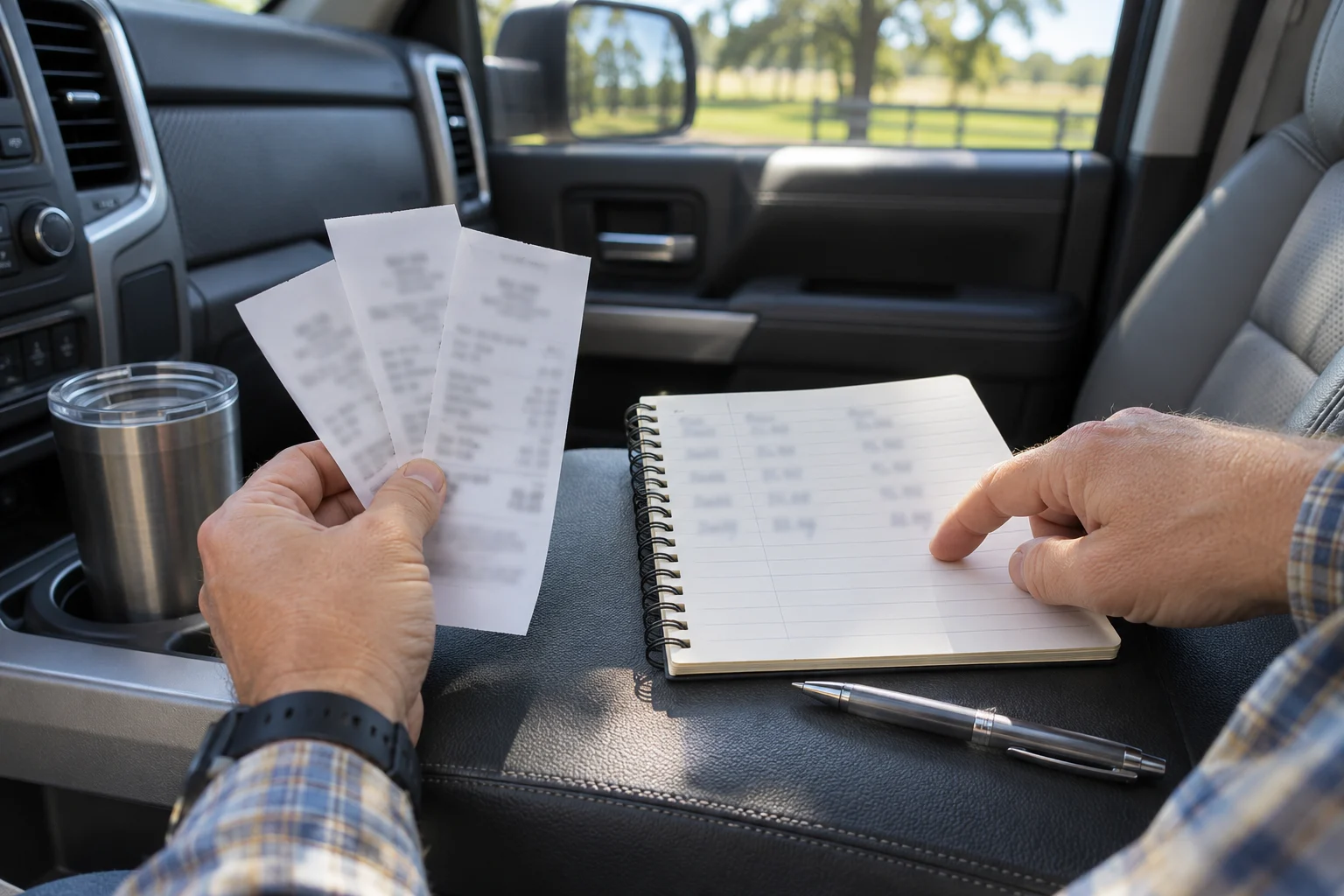
A practical measurement comes from a consistent fill-to-fill record. Fill normally at the beginning of the interval and record the odometer. At the next normal fill, record the miles traveled and the gallons added. Divide the first number by the second. If the distance was 286 miles and the second receipt showed 13 gallons, the result would be 22 mpg for that interval. This is an illustration and is not a Ford rating.
Keep records from more than one trip. Separate highway, city, towing and off-road drives if those uses matter to you. If you tow on weekends, a weekday commute average may underestimate your weekend fuel consumption. Check whether the load is within the configuration covered by the Ford Ranger towing capacity chart. A handful of comparable receipts can show a practical range for planning without assuming every trip will produce the same numbers.
For route planning, choose a fuel amount below nominal capacity and combine it with a conservative estimate from comparable driving. If you want to plan around 13 gallons at 17 mpg, the arithmetic is 221 miles. Then choose a real fuel stop sooner if the route, weather or alternative stations warrant it. The plan can be adjusted as conditions change.
If a dashboard distance-to-empty reading drops faster than expected after towing or idling, treat it as an estimate that can change with driving. It does not establish that the tank is smaller than Ford’s published capacity. Use your reading, route options and a reasonable margin to decide when to refuel rather than testing how far the truck will travel at zero.
Which number to use when buying a tank or related part
Tank volume alone is insufficient for a parts order. A technician may need the VIN, engine, drivetrain, body configuration and the current part number to identify the correct component. Physical fit, the sender, connections and applicable emissions equipment matter alongside nominal volume. Ask the seller to confirm fitment using the exact truck details.
Use the owner’s manual for the capacity value and the appropriate parts catalog or service documentation for replacement fitment. A description such as “18-gallon Ranger tank” may be a shorthand category rather than a guarantee that it interchanges across years. Ask whether the listed volume refers to the stock size or an aftermarket design, and verify what additional parts or procedures the supplier requires.
Comparing the same tank across sources
Copy both the units and the number on the source you are using. Ford pairs 18.8 U.S. gallons with 71.2 L in the earlier material and 18.76 U.S. gallons with 71 L in the later manual. Recalculating from a rounded value can introduce a second rounding step. For a specification comparison, keep the factory pair together and label the document that supplied it.
A common mistake is to compare the 18.8 figure on an earlier manual with the 18.7 figure in the 2024 launch media materials and treat the difference as a measured reduction in usable capacity. The numbers come from presentations that differ in precision and purpose. They do not tell you how much the pump will dispense on an individual visit or how much is usable when the vehicle is on a slope. If you are buying parts, use the supplier’s fitment process. If you are planning stops, use measured consumption and a reserve.
Frequently asked questions
Do 2.3L and 2.7L Rangers have different tank capacities?
The 2024–2026 U.S. owner manuals give 18.76 gallons (71 L) for both engines. The 3.0L Raptor uses a different published figure of 20.34 gallons (77 L).
Is 18.76 gallons the same as 18.8?
An 18.76-gallon figure rounds to 18.8 to one decimal place. The 2019–2023 values in the chart are taken from Ford’s documents for those years. The similarity should not be used to infer that the older and newer trucks share a replacement fuel tank.
Why can I put only 15 gallons into a nearly empty Ranger?
There may already be fuel in the tank, and Ford explains that reserve fuel can remain even when the gauge shows empty. A receipt measures fuel dispensed. If the truck consistently cannot refuel normally, have the behavior checked rather than forcing more fuel into the tank.
Does this chart include older Rangers or overseas diesels?
The figures here apply to factory 2019–2026 U.S. pickups. For an older Ranger, overseas model or imported truck, look up the original market and model year and use the corresponding manual. If the vehicle has an aftermarket tank, confirm the manufacturer’s specification for that tank.