Expert Ford 9 Inch Rear End Width Chart 2026 Guide

The Ford 9 inch rear end width chart provides critical dimensions like housing width and axle flange to flange measurements for popular donor vehicles. This data empowers enthusiasts and builders to select the correct axle for custom projects and swaps, ensuring proper fitment and performance.
The ford 9 inch rear end width chart provides critical dimensions for automotive enthusiasts aiming to select or build the perfect drivetrain for their projects. Finding precise measurements for this legendary axle can be challenging, given the vast array of factory applications and aftermarket solutions.

Prime for Young Adults — 6 Months Free
Students and 18–24s get six months of Prime free, then half price.
Start 6 Months Free As an Amazon Associate I earn from qualifying purchases.Accurate data on housing width, axle flange to flange, and wheel mounting surface (WMS) is essential for proper fitment and safe operation.
Our goal is to cut through the confusion, offering a definitive guide to the most common Ford 9 inch rear end widths available by 2026. Whether you are planning a classic car restoration, a hot rod build, or a performance upgrade, having the correct dimensions is paramount.
Understanding the various dimensions is the first step, so let’s explore the common factory and aftermarket options available for this iconic rear end.
Key Takeaways
Recommended Best Deal Products


- Dimension charts are crucial for swaps.
- Donor vehicles vary significantly in width.
- Accurate measurement prevents costly errors.
- Aftermarket housings offer custom widths.
- Consider WMS for wheel fitment.
How Many Ford 9 Inch Rear End Widths Exist?
The exact number of Ford 9 inch rear end widths is vast, encompassing both original factory specifications and numerous aftermarket solutions. There isn’t a single “standard” width, as Ford engineered this versatile axle for a wide range of vehicles, from compact cars to heavy-duty trucks over several decades.

This broad application led to significant variations in dimensions, which can be a puzzle for builders.
Factory Width Ranges
Ford produced 9 inch rear ends in many widths to suit specific vehicle models and their chassis designs. These factory units typically varied in overall WMS measurements, ranging from as narrow as approximately 52 inches for some early Mustangs to over 65 inches for certain F-Series trucks.
Each specific model year often had its own precise dimensions, further contributing to the diversity. Identifying these original applications is key to sourcing a suitable donor.
Aftermarket Options
Beyond factory offerings, the aftermarket community has greatly expanded the available width options. Companies specialize in creating new housings that can be built to virtually any custom width required for a project. This allows for perfect wheel and tire fitment, especially for highly modified vehicles. These custom solutions provide builders with unparalleled flexibility.
Customization Possibilities
Aftermarket manufacturers often offer housings that are stronger and lighter than their factory counterparts, designed for high-horsepower applications. This ability to order a precise width eliminates the need for expensive and labor-intensive modifications to donor axles.

Audible — Listen Free for 30 Days
One free credit a month and thousands of titles included.
Listen Free for 30 Days As an Amazon Associate I earn from qualifying purchases.To truly grasp the specifics, we need to dive into the core measurements and the vehicles that originally housed these diverse 9 inch rear ends.
7 Most Common Ford 9 Inch Rear End Widths Chart
Recommended Best Deal Products


Our detailed chart presents the 7 most common Ford 9 inch rear end widths, crucial for any automotive project or restoration. Accurately knowing these dimensions helps you select the right unit for your build, preventing costly mistakes and rework. We focus on key measurements that builders use.
Understanding Key Measurements
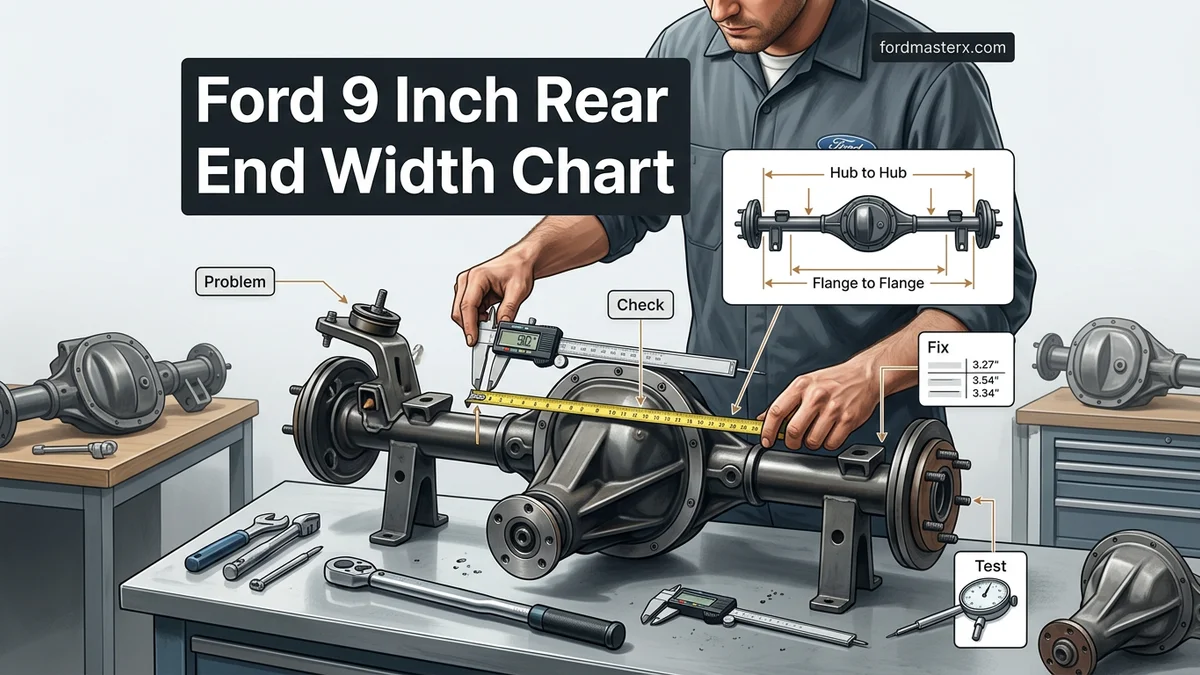
Before diving into the chart, understanding the terminology is vital. “Wheel Mounting Surface (WMS) to WMS” is the overall width from the outside of one wheel hub flange to the other, where the wheels bolt on. “Housing Width” refers to the distance between the outside edges of the axle tubes, where they meet the brake backing plates.
“Axle Flange to Flange” is similar to WMS but specifically refers to the axle shaft flanges, before considering brake drums or rotors. Pinion offset, while not always listed, describes how far the pinion gear is from the centerline of the housing.
Popular Passenger Car Widths
Passenger cars generally feature narrower 9 inch rear ends compared to trucks. Hot rod builders and classic car restorers frequently seek these dimensions for a clean, tucked-in wheel fitment. These units are often lighter, making them ideal for performance applications where weight is a concern. The WMS dimension is particularly important for tire clearance.
Truck and SUV Dimensions
Truck and SUV 9 inch rear ends are typically wider, providing stability for heavier loads and larger vehicles. These often come with stronger housings and larger axle tubes. While wider, they can be excellent candidates for narrowing for custom builds, or for projects that require a broader stance.
Refer to the table below for common dimensions:
| Donor Vehicle (Model & Years) | WMS (inches) | Housing Width (inches) | Axle Flange-to-Flange (inches) |
|---|---|---|---|
| 1964-1965 Mustang (Early) | 57.25 | 51.25 | 53.25 |
| 1966-1970 Mustang / Cougar | 59.25 | 53.25 | 55.25 |
| 1967-1970 Fairlane / Torino | 61.00 | 55.00 | 57.00 |
| 1970-1977 Maverick / Comet | 58.00 | 52.00 | 54.00 |
| 1960-1970 Galaxie / Full Size Ford | 61.00 – 61.50 | 55.00 – 55.50 | 57.00 – 57.50 |
| 1957-1972 F-100 Truck | 61.00 – 62.00 | 55.00 – 56.00 | 57.00 – 58.00 |
| 1966-1977 Early Bronco | 58.00 | 52.00 | 54.00 |
Knowing these numbers is invaluable, but equally important is understanding which specific Ford models originally provided these widely sought-after 9 inch rear ends.
Which Ford Models Carried 9 Inch Rear Ends?
Many iconic Ford models carried the 9 inch rear end, making them prime candidates for donor vehicles in restoration and custom build projects. Their widespread use means that salvage yards and online marketplaces often have these units available. However, knowing which models and years to target simplifies your search.

Classic Mustang Sources
Early model Mustangs are a frequent source for narrower 9 inch rear ends, highly prized by hot rod and street rod builders. The 1964-1970 Mustangs and their Mercury Cougar counterparts often featured these axles. The 1964-1965 units are typically the narrowest, followed by the slightly wider 1966-1970 versions.
Audible Premium Plus — Annual Membership
12 audiobook credits up front, plus the full Audible catalogue.
See Annual Plans As an Amazon Associate I earn from qualifying purchases.Always verify the exact year, as dimensions could vary even within a model run. These cars provide ideal widths for many custom applications.
F-Series Truck Donors
The Ford F-Series trucks, particularly the F-100 from 1957 through the early 1970s, are excellent sources for wider 9 inch rear ends. These axles are often , designed for heavier loads, and can be narrowed if needed. Later F-150 models sometimes used a 9 inch, but it became less common as other axle designs were introduced.
Look for trucks from this era for a strong foundation.
Full-Size Car Applications
Several full-size Ford cars and intermediates also came equipped with the 9 inch rear end. Models like the Fairlane, Torino, Ranchero, Galaxie, and even some Mavericks and Comets from the 1960s and 1970s are potential donors. These vehicles often bridge the gap in width between the narrowest Mustangs and the widest F-100s.
They offer versatile dimensions for various projects. Once you’ve identified a potential donor or purchased a unit, knowing how to accurately measure a Ford 9 inch rear end yourself is absolutely critical to verify its dimensions.
How to Accurately Measure a Ford 9 Inch Rear End
To confirm the dimensions of any Ford 9 inch rear end, you must precisely measure its key components yourself. Relying solely on advertised dimensions can lead to costly fitment issues. Following a methodical approach ensures you get accurate numbers.
Essential Measuring Tools
You will need a few basic tools for accurate measurement. A long, rigid tape measure (preferably a steel one) is essential. A straightedge (like a long level or metal ruler) is critical for WMS measurements. Calipers can be useful for measuring axle flange thickness or smaller components. A plumb bob or large square can help ensure your straightedge is perpendicular.
Housing Tube Procedures
To measure the housing width, measure from the outside edge of one axle tube to the outside edge of the other. Do this where the brake backing plates would mount. This provides the core housing dimension before axles or brakes. For pinion offset, measure from the center of the pinion to the center of the housing.
This dimension impacts driveline alignment.
Wheel Mount Surface Check
Measuring WMS-to-WMS is the most critical dimension for wheel fitment. With the axles installed, place a long, straightedge across the face of each axle flange, perpendicular to the axle centerline. Then, measure the distance between the outside faces of these straightedges. This technique accounts for the thickness of the axle flanges.
Always double-check your measurements to ensure accuracy. While factory units offer a great starting point, many projects demand a custom fit, which often leads builders to consider an aftermarket 9 inch housing.
When to Consider an Aftermarket 9 Inch Housing?
For many custom builds and high-performance applications, deciding when to consider an aftermarket 9 inch housing becomes a crucial decision. While donor axles are a good starting point, sometimes a brand-new, purpose-built unit is the superior choice for your project.

Custom Fitment Needs
If your project demands a unique width not readily available from factory donors, an aftermarket housing is often the most practical solution. Aftermarket manufacturers can fabricate housings to virtually any WMS dimension you specify. This eliminates the labor and expense of cutting, welding, and straightening a salvaged housing. You get a perfect fit from the start.
Performance Strength Upgrades
High-horsepower engines and extreme driving conditions often exceed the strength of original factory 9 inch housings. Aftermarket units are frequently constructed from heavier gauge steel, feature larger diameter axle tubes, and incorporate stronger welds. This enhanced durability is vital for drag racing, off-roading, or any application pushing serious power.
Brand New Components
Opting for an aftermarket housing means starting with all-new, un-fatigued components. This eliminates concerns about rust, hidden damage, or metal fatigue that can plague decades-old salvage parts. New housing ends, mounting brackets, and even differential cases are often part of the package, ensuring peak performance and longevity for your build by 2026.
Understanding these options helps you select the best foundation, but a recap of the key takeaways will solidify your decision-making process.
Choosing Your Ideal Ford 9 Inch Rear End
Selecting the correct Ford 9 inch rear end for your project is a critical decision that impacts fitment, performance, and overall satisfaction. We’ve explored the diverse range of factory and aftermarket widths, identifying key donor vehicles and precise measurement techniques. Always prioritize accurate measurements, whether you are sourcing a used unit or ordering a custom piece for your 2026 build.
Consider your specific application, horsepower goals, and desired wheel fitment when evaluating your options. The ford 9 inch rear end width chart and the knowledge gained here empower you to make an informed choice, ensuring your vehicle performs and looks exactly as envisioned. A well-chosen axle is the backbone of any successful custom automotive endeavor.
Common Questions About Ford 9 Inch Rear Ends
What Is WMS on a Rear End?
WMS stands for Wheel Mounting Surface, representing the total width from the outside face of one wheel hub flange to the other. This measurement is crucial for determining how far your wheels will stick out and for proper tire clearance within your vehicle’s fender wells.
Can a Ford 9 Inch Rear End Be Narrowed?
Yes, a Ford 9 inch rear end can be narrowed by a qualified fabricator. This involves cutting the axle tubes, shortening the axle shafts, and re-welding the housing ends. Narrowing is common for custom applications needing a specific, often tighter, wheel fitment than factory dimensions.
Which Ford 9 Inch Is the Strongest?
Generally, aftermarket Ford 9 inch housings are the strongest, especially those designed for high-performance use, featuring thicker steel and larger diameter tubes. Among factory units, those from heavy-duty F-Series trucks tend to be more than passenger car versions, though all factory 9-inch units are considered durable.
How Do I Identify a Ford 9 Inch Rear End?
You can identify a Ford 9 inch rear end by its distinctive removable third member (center section) that bolts into the front of the housing. Other visual cues include an oval-shaped housing and often a larger, more appearance compared to other axle types. The housing itself does not split.
Are All Ford 9 Inch Axles the Same Length?
No, all Ford 9 inch axles are not the same length. Their lengths vary significantly depending on the original vehicle application, directly correlating to the WMS and housing width. Custom builds often require specific axle lengths, necessitating either donor axles or new custom-length shafts.