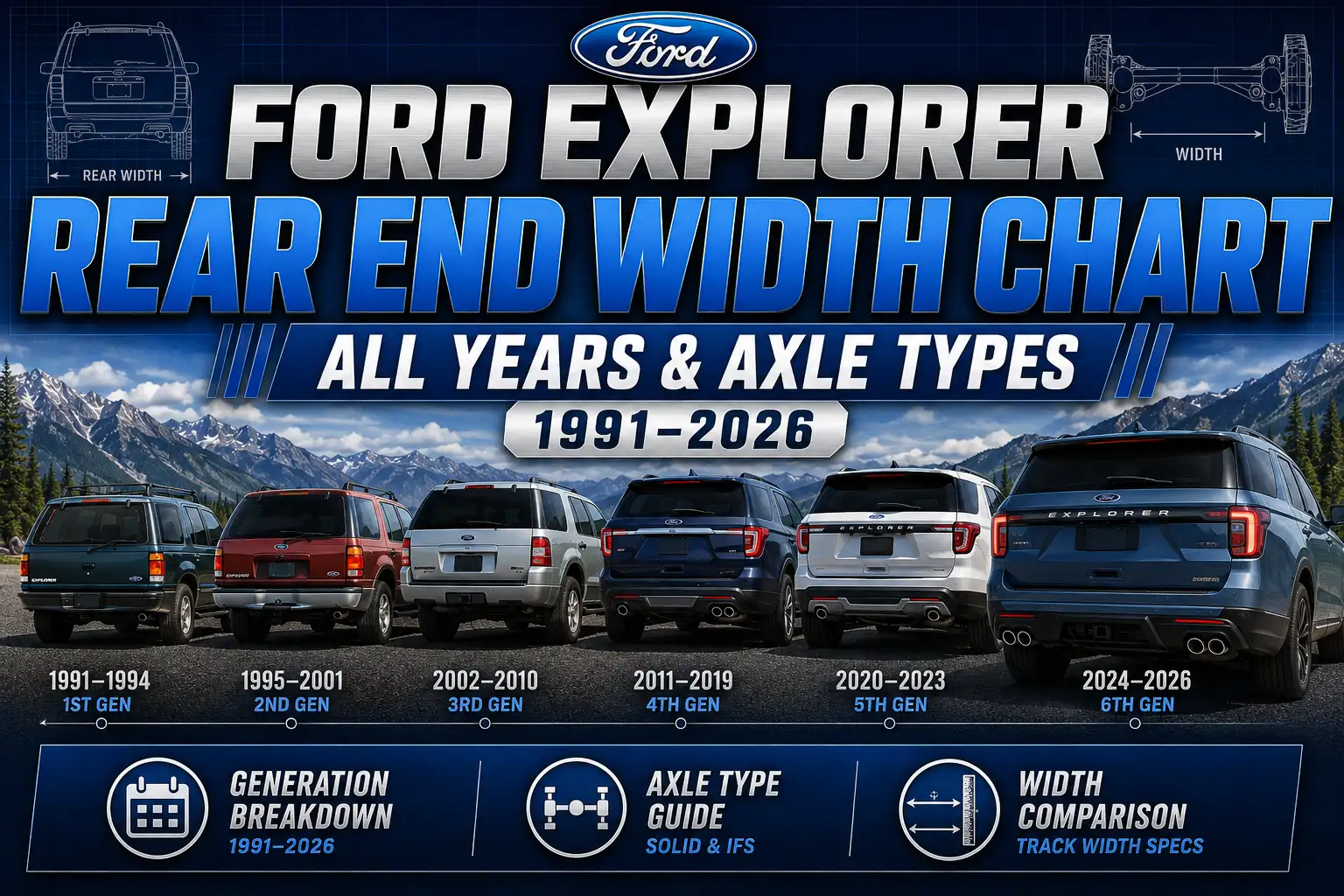
Ford Explorer Rear End Width Chart: All Years & Axle Types

“Rear end width” means two different things depending on which Explorer you own. On 1991–2001 solid-axle Explorers, it’s the physical width of the 8.8-inch axle assembly — the number swap builders need. On 2002–2025 Explorers, the solid axle is gone, replaced by independent rear suspension, so “width” means rear track width — the number that matters for wheel fitment and spacers.
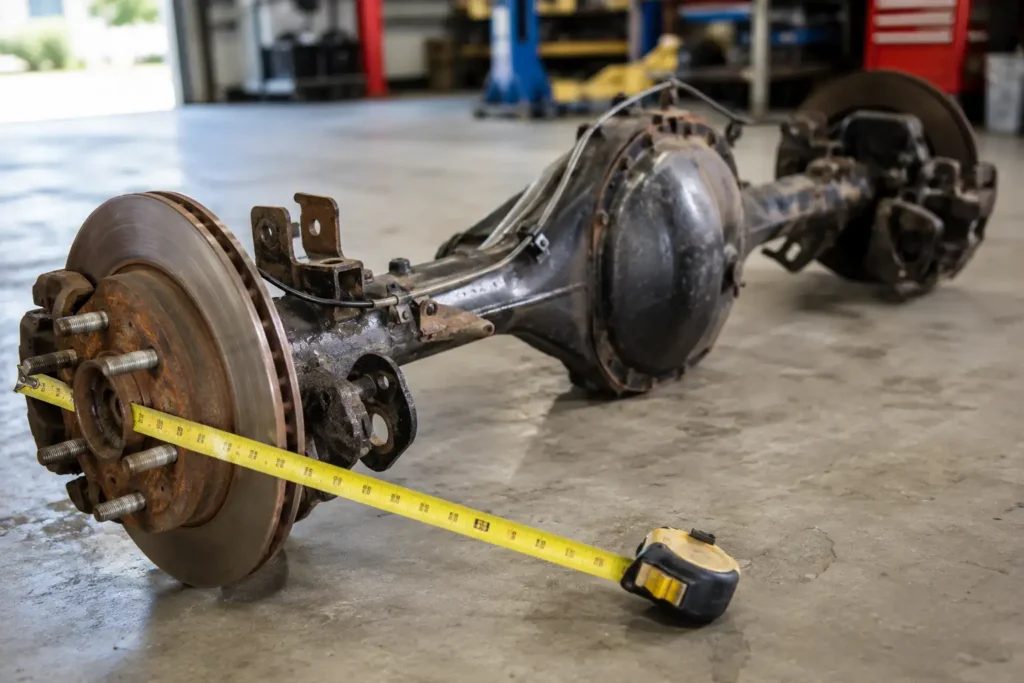
This chart covers both eras, with every source cited so you can see where the data agrees and where it doesn’t.

Prime for Young Adults — 6 Months Free
Students and 18–24s get six months of Prime free, then half price.
Start 6 Months Free As an Amazon Associate I earn from qualifying purchases.Ford Explorer Rear End Width Chart
Solid axle assembly width (1991–2001) vs. rear track width (2002–2025)
| Years | Width (WMS–WMS) | Splines | Brakes |
|---|---|---|---|
| 1991–1994 | ~59.0″–59.5″ | 28-spline | Rear drum |
| 1995–2001 | ~59.5″–59.75″ | 31-spline | Rear disc |
| Generation | Years | Front Track | Rear Track |
|---|---|---|---|
| U152 | 2002–2005 | 60.9″ | 61.2″ |
| U251 | 2006–2010 | 60.9″ | 61.8″ |
| U502 | 2011–2019 | 67.0″ | 67.0″ |
| CD6 | 2020–2025 | 66.9″ | 66.9″ |
Ford Explorer Solid Axle Rear End Width by Year (1991–2001)
Recommended Best Deal Products


| Years | Axle Type | Width (Wheel Mounting Surface to Wheel Mounting Surface) | Spline Count | Brake Type |
|---|---|---|---|---|
| 1991–1994 | 8.8-inch solid axle | ~59.0″–59.5″ (sources vary — see note below) | 28-spline | Rear drum |
| 1995–2001 | 8.8-inch solid axle | ~59.5″–59.75″ (sources vary — see note below) | 31-spline | Rear disc |
No single Ford factory service manual figure could be confirmed for this measurement during research. Enthusiast and swap-community sources give three different numbers for the same 8.8 axle: 59.5″ (BlueOvalFanatics axle-width compilation and a Ford 8-body forum measurement), 59.625″ (“Assembly Width,”
The Fabrication Series narrowing guide, measured wheel-mounting-surface to wheel-mounting-surface), and 59.75″ (a Ranger Station data sheet reposted on Chevy Tri-Five Forum). A separate Ford Truck Enthusiasts thread cites 59.25″–59.5″ for the same generation.
The spread is likely due to rotor-hat thickness differences between rotor manufacturers, which the Fabrication Series source explicitly notes affects the measurement. If you’re planning a swap that requires exact tolerances, measure your specific donor axle rather than relying on a published figure.
The 1995–2001 disc-brake version (31-spline) is the one most swap builders target — it’s stronger and easier to source than the earlier drum-brake, 28-spline version. This is also the generation covered on FordMasterX’s Ford axle code chart if you need to confirm your specific gear ratio and differential type from the door-jamb code before pulling the axle.
Explorer 8.8 Axle Assembly Dimensions (Spring Perch, Tube, Spline)
| Spec | Value | Source Confidence |
|---|---|---|
| Spring perch spacing (center-to-center) | 39″ | Ranger Station data (via Chevy Tri-Five Forum) — conflicts with a separate Ford Truck Enthusiasts forum report of 39.5″; treat as approximate until measured on your specific axle |
| Axle tube diameter | 3.25″ (necks to 2.75″ near the flange) | Confirmed across 3 independent sources (Ranger Station, Fabrication Series, Tri-Five Forum) |
| Axle tube wall thickness | 0.25″ or 0.188″ (varies by production run) | Fabrication Series narrowing guide |
| Axle shaft diameter | 1.31″–1.32″ | Confirmed across multiple sources |
| Spline count | 31-spline (1995–2001 disc models) | Confirmed |
| Pinion offset from centerline | ~2″ to 2-3/16″ toward passenger side | Ranger Station data; a separate Mopar forum measurement independently reports a similar passenger-side offset |
The exact spring perch spacing (39″ vs. 39.5″) could not be resolved from available sources. If this article is used as a swap reference, recommend the reader measure their own axle before cutting or relocating perches.
Explorer Rear Track Width by Generation (2002–2025)
Recommended Best Deal Products


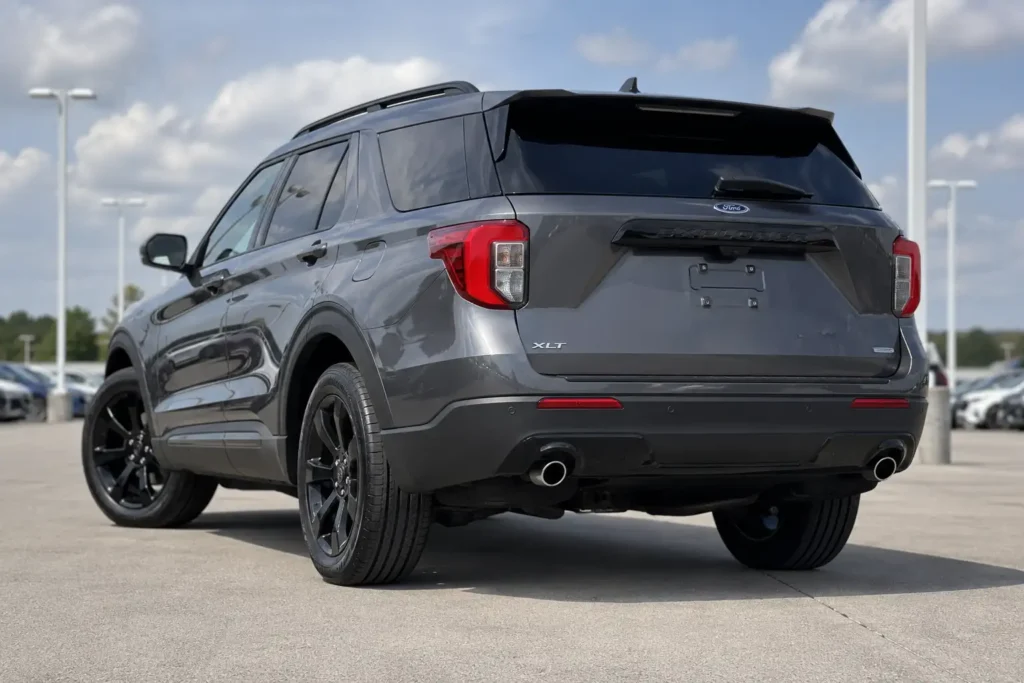
Once Ford moved the Explorer to a unibody platform with independent rear suspension in 2002 (and again with the CD6 platform in 2020), “rear end width” stopped being an axle measurement and became rear track width — the distance between the centerlines of the left and right rear tires.
| Generation | Model Years | Front Track | Rear Track |
|---|---|---|---|
| U152 | 2002–2005 | 60.9″ | 61.2″ |
| U251 | 2006–2010 | 60.9″ | 61.8″ |
| U502 | 2011–2019 | 67.0″ | 67.0″ |
| CD6 (current) | 2020–2025 | 66.9″ | 66.9″ |
The jump from ~61″ track width (2002–2010) to ~67″ (2011–present) reflects the Explorer’s move to the wider CD3/CD4-derived platform in 2011, not a data error — it’s a real, significant width increase. For overall exterior body width across every current Ford SUV (not just track width), see FordMasterX’s Ford SUV size chart.
How to Measure Your Explorer’s Rear End Width Yourself
Given how much published figures disagree with each other, measuring your own truck is the most reliable option.

Audible — Listen Free for 30 Days
One free credit a month and thousands of titles included.
Listen Free for 30 Days As an Amazon Associate I earn from qualifying purchases.For 1991–2001 solid-axle Explorers:
- Park on level ground and set the parking brake.
- Measure from the outer face of one rear wheel mounting surface (where the wheel bolts on, not the outside of the tire) straight across to the outer face of the opposite wheel mounting surface.
- Record the number and note your brake type (drum or disc) and spline count if known — this affects which published range applies.
For 2002–2025 IRS Explorers:
- Measure from the center of the rear-left tire’s contact patch to the center of the rear-right tire’s contact patch (track width), or
- If you’re checking wheel/spacer fitment, measure from the inner fender liner to the tire sidewall on each side instead — track width alone doesn’t tell you clearance.
You’ll need a tape measure and, ideally, jack stands if you want to measure the axle assembly itself rather than tire-to-tire.
Ford Explorer 8.8 Axle Width vs. Other Ford Axles (Ranger, F-150, Bronco)
Recommended Best Deal Products


| Vehicle | Axle | Width (WMS to WMS) | Notes |
|---|---|---|---|
| Ranger (1993+) | 7.5″ / 8.8″ | 58″–58.5″ (sources conflict slightly) | 28-spline standard; 31-spline on some 4×4 models |
| Explorer (1991–2001) | 8.8″ | ~59.0″–59.75″ (see conflict note above) | 31-spline on disc-brake years |
| F-150 / Bronco (1987–1996) | 8.8″ | 64.75″ | Single forum-measured figure (Ford Truck Enthusiasts); not cross-verified against a second source |
F-150/Bronco figure is single-sourced from one forum measurement. Confirm against a parts catalog or second independent source before treating as authoritative.
The Explorer’s 8.8 is popular for swaps specifically because it splits the difference — wider and stronger (31-spline, disc brakes) than a Ranger axle, but narrower and lighter than the full-size F-150/Bronco version, which makes it a common choice for Mustangs, Jeeps, and classic muscle cars rather than full-size trucks. For the broader Ford 9-inch swap-axle family (a different axle design entirely, often cross-shopped against the 8.8), see the Ford 9-inch width chart.
Ford Explorer Rear End Width FAQ
Does the Ford Explorer 8.8 axle fit other vehicles?
It’s a common swap candidate for older Mustangs, Jeep Wranglers/Cherokees, and various hot rod builds, largely because of its width, disc brakes, and 31-spline strength on 1995–2001 models. Exact fitment depends on the donor vehicle’s spring perch spacing and pinion angle, which typically require modification — this isn’t a bolt-in swap for most applications.
Which Explorer years have rear disc brakes on the 8.8 axle?
1995–2001 Explorers with the solid 8.8 axle use rear disc brakes. Earlier 1991–1994 models used rear drums.
Is the Explorer 8.8 axle stronger than the Ranger 8.8?
The Explorer’s 31-spline axle shafts are generally considered stronger than the Ranger’s 28-spline shafts (except on certain 4×4 Ranger trims that also got 31-spline). Both share the same 8.8-inch ring gear.
Why did the Explorer’s rear end width increase so much after 2011?
It’s a platform change, not inconsistent data. The Explorer moved to a wider unibody platform in 2011, pushing rear track width from roughly 61″ to about 67″ — a genuine, documented dimensional increase tied to the redesign.