Ford Super Duty Towing Capacity Chart By Year

Quick Answer
Ford Super Duty trucks from 1999 through 2026 demonstrate immense towing capabilities, ranging from approximately 9,000 lbs to over 40,000 lbs. Maximum towing ratings are factory specifications and highly depend on the model year, engine option, specific configuration, and presence of a proper tow package. Always consult your vehicle’s door jamb sticker for the precise payload and towing capacity for your specific truck.
The Ford Super Duty line has long stood as the benchmark for heavy-duty truck performance, designed for demanding tasks like hauling substantial trailers. Determining the precise towing capacity for a specific Super Duty model, given its numerous configurations, engine options, and generational updates, can be a complex challenge for owners and prospective buyers alike. This comprehensive chart and guide provides detailed towing capacities for Ford F-250, F-350, and F-450 trucks from 1999 to 2026, alongside critical factors influencing these ratings, empowering you to tow safely and confidently.

Prime for Young Adults — 6 Months Free
Students and 18–24s get six months of Prime free, then half price.
Start 6 Months Free As an Amazon Associate I earn from qualifying purchases.Ford Super Duty Towing Capacity Chart By Year (1999-2026)
Recommended Best Deal Products


📤 Share Image
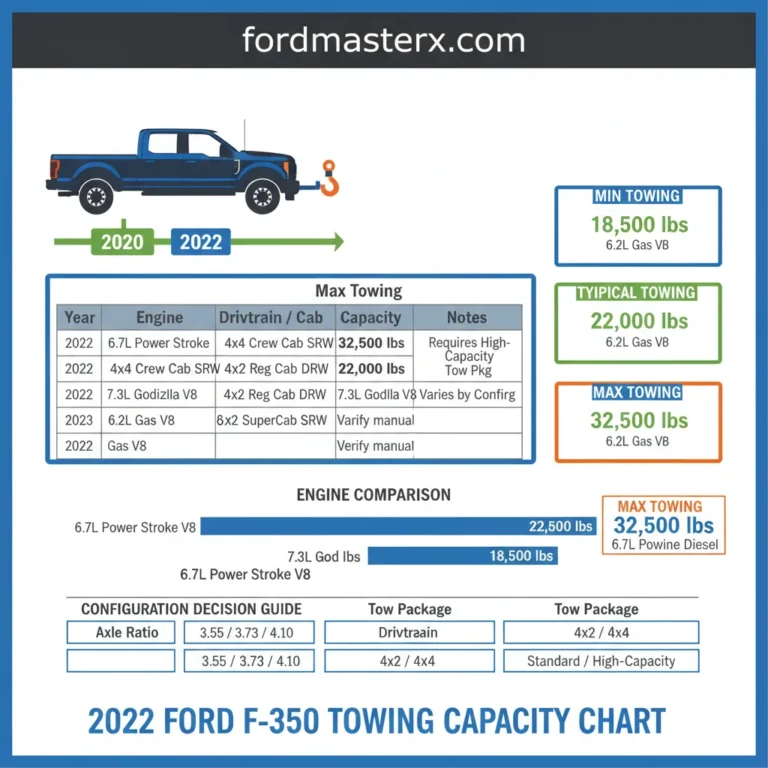
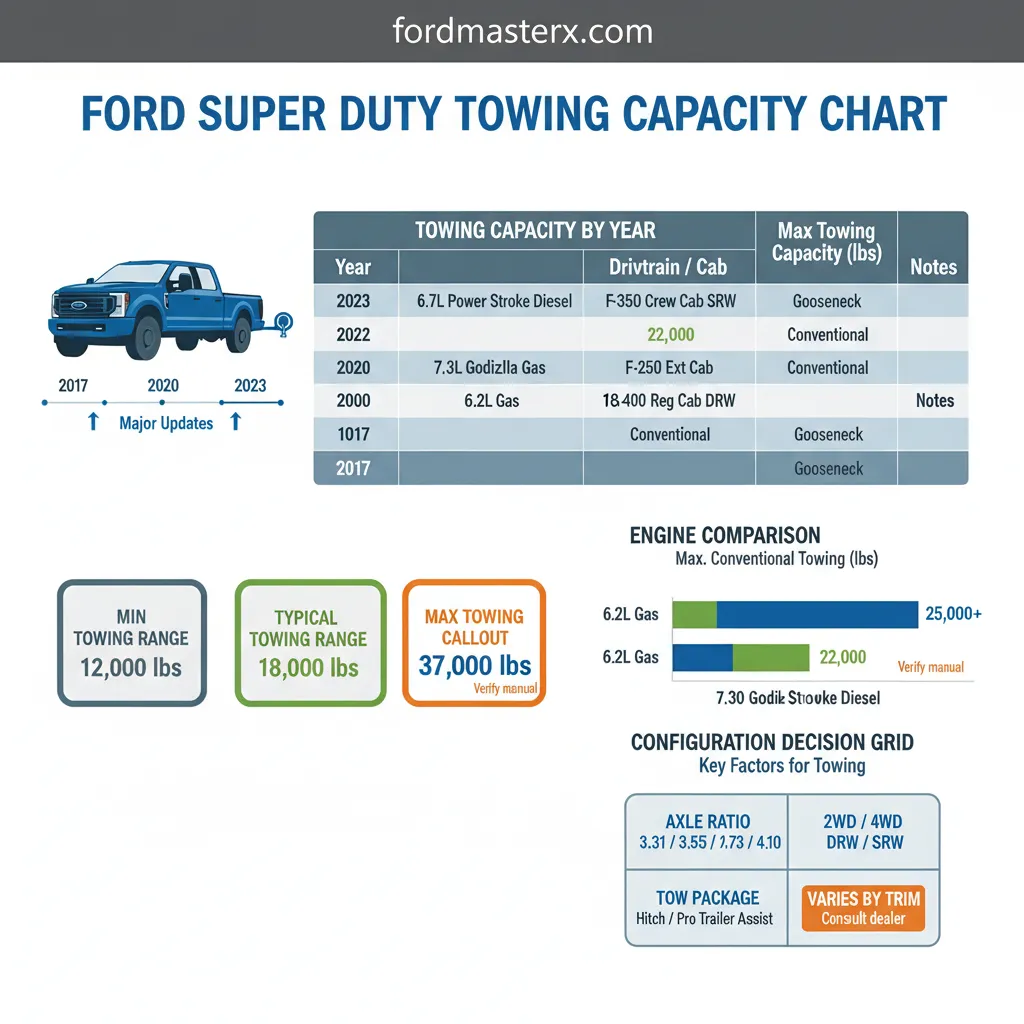
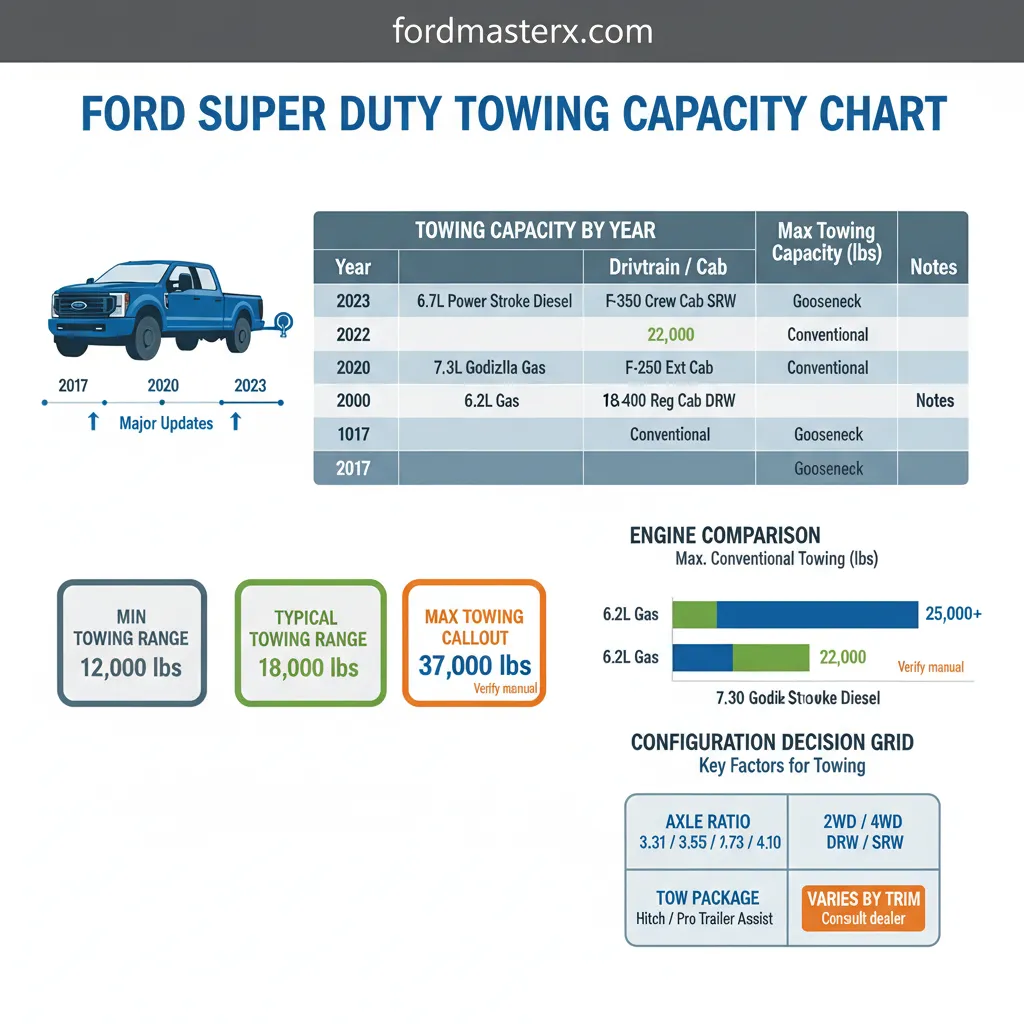
This chart compiles maximum towing capacities for Ford F-250, F-350, and F-450 Super Duty models from their introduction in 1999 through the projected 2026 model year. Capacities listed are peak factory ratings, often achieved with specific engine options, axle ratios, 2WD drivetrain, Regular Cab/Long Box configurations, and the optional heavy-duty towing package. Actual capacities for individual vehicles will vary based on specific options, trim level, curb weight, and payload. Always consult your vehicle’s owner’s manual and the unique door jamb sticker for the precise, legally binding maximum capacities of your truck. Values are based on available manufacturer towing guides and data. Last reviewed: May 2026.
| Year | Model & Engine | Drivetrain / Cab | Max Towing Capacity (lbs) | Notes |
|---|---|---|---|---|
| 1999 | F-250 / F-350 7.3L Power Stroke Diesel | 2WD Reg Cab | ~14,000 (Conv.) | Max conventional for SRW. 5th-wheel capacity varies higher. |
| 1999 | F-350 DRW 7.3L Power Stroke Diesel | 2WD Reg Cab | ~15,000 (5th-wheel) | Gooseneck ratings similar. |
| 2005 | F-350 DRW 6.0L Power Stroke Diesel | 2WD Reg Cab | ~15,800 (5th-wheel) | With appropriate axle ratio and tow package. |
| 2005 | F-450 Chassis Cab 6.0L Power Stroke Diesel | 2WD Reg Cab DRW | Varies; consult manual | Specific ratings heavily depend on upfit. |
| 2011 | F-350 DRW 6.7L Power Stroke Diesel | 2WD Reg Cab | ~24,500 (5th-wheel) | First major jump with new Power Stroke and 6-speed auto. |
| 2011 | F-450 6.7L Power Stroke Diesel | 4×4 Crew Cab DRW | ~24,700 (5th-wheel) | Dedicated F-450 pickup model max rating. |
| 2017 | F-350 DRW 6.7L Power Stroke Diesel | 2WD Reg Cab | ~32,000 (5th-wheel) | New frame and aluminum body led to significant gains. |
| 2017 | F-450 6.7L Power Stroke Diesel | 4×4 Crew Cab DRW | ~32,500 (5th-wheel) | Also saw increases for conventional towing (21,000 lbs). |
| 2020 | F-250 7.3L “Godzilla” V8 Gas | 2WD Reg Cab | ~15,000 (Conv.) | New 7.3L gas engine with 10-speed transmission. |
| 2020 | F-350 DRW 6.7L Power Stroke Diesel | 2WD Reg Cab | ~35,700 (5th-wheel) | Upgraded 6.7L Power Stroke. |
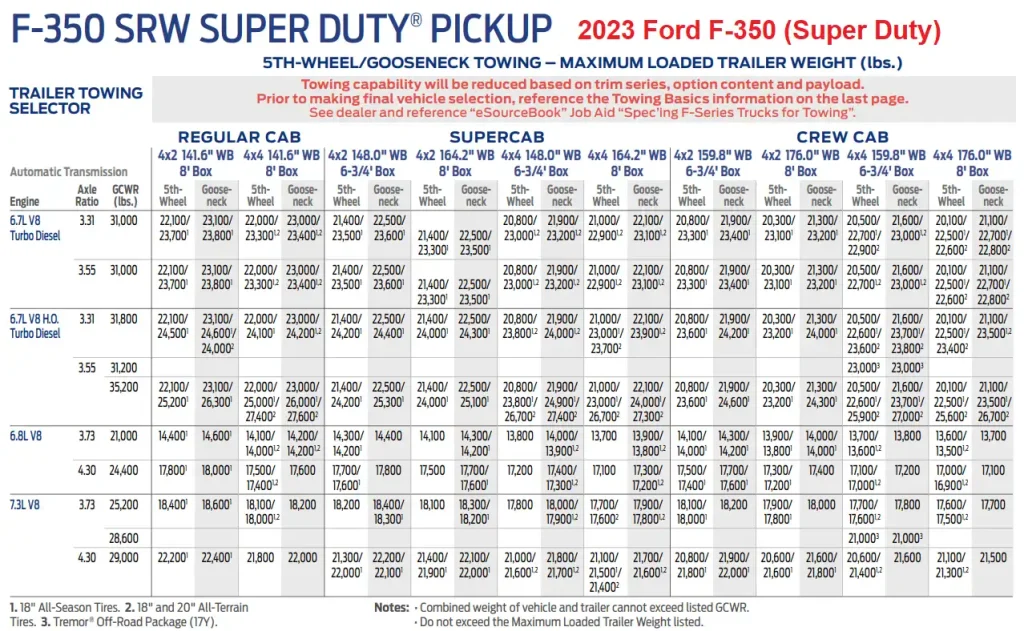
| 2023 | F-350 DRW 6.7L High Output Power Stroke Diesel | 2WD Reg Cab | ~38,000 (5th-wheel) | Max conventional towing for F-350 is 30,000 lbs. |
| 2023 | F-450 6.7L High Output Power Stroke Diesel | 4×4 Crew Cab DRW | ~40,000 (5th-wheel) | Achieved with max tow package, specific axle. Also 30,000 lbs conventional. |
| 2026 | F-250 / F-350 / F-450 | All Configurations | Expected similar to 2023-2025 | Consult future official Ford towing guides upon release for precise figures. |
How to read this chart: The capacities presented above represent the maximum theoretical towing ratings published by Ford for optimal configurations. Your truck’s actual capacity will be influenced by its specific build, options, and added accessories. Always cross-reference these figures with your vehicle’s unique door jamb sticker and owner’s manual for the definitive limits applicable to your Ford Super Duty.
Year-by-Year Changes in Ford Super Duty Towing Capabilities
The evolution of the Ford Super Duty’s towing capabilities is a testament to continuous engineering advancements. Since its introduction in 1999, each major generational refresh has brought significant improvements in power, durability, and hauling capacity, firmly cementing its reputation as a leader in the heavy-duty segment.
Introduced as a dedicated heavy-duty line, separating from the F-150. Launched with 7.3L Power Stroke Diesel and Triton V8 gas engines, establishing strong initial tow ratings.
Significant chassis and suspension upgrades. Introduced the 6.4L Power Stroke Diesel. The F-450 became available as a consumer pickup, pushing max ratings higher.
A game-changer: the all-new 6.7L Power Stroke V8 diesel and TorqShift 6-speed automatic transmission. This combination led to substantial increases in both horsepower, torque, and towing capacity across the lineup, with max fifth-wheel ratings surging to the mid-20,000 lb range.
Revolutionary aluminum-alloy body reduced curb weight, which was reinvested into a high-strength steel frame, axles, and hitch receivers. This enabled record-setting conventional and fifth-wheel towing capacities, exceeding 30,000 lbs for the F-350 and F-450.
Introduction of the powerful 7.3L “Godzilla” gasoline V8 and the 10-speed TorqShift automatic transmission. The 6.7L Power Stroke also received power bumps, further increasing towing capabilities.

Audible — Listen Free for 30 Days
One free credit a month and thousands of titles included.
Listen Free for 30 Days As an Amazon Associate I earn from qualifying purchases.A comprehensive redesign featuring enhanced exterior and interior, an available High-Output 6.7L Power Stroke diesel, and advanced towing technologies. This iteration pushed the F-450’s fifth-wheel/gooseneck towing capacity to an astounding 40,000 lbs.
Research indicates that each successive generation of the Super Duty has seen a consistent upward trend in maximum conventional and fifth-wheel/gooseneck towing capacities, driven by stronger frames, more powerful and efficient powertrains, and improved driveline components.

Ford Super Duty Engine Options and Configuration Impact on Towing Capacity
Recommended Best Deal Products


The heart of any heavy-duty truck’s towing prowess lies in its powertrain, but the final towing capacity is a complex interplay of engine, drivetrain, axle ratio, and even the truck’s physical configuration. Understanding these nuances is crucial for matching your Super Duty to your towing needs.
Engine Power and Torque: Gas vs. Diesel
Ford Super Duty trucks historically offer robust gasoline and Power Stroke diesel engine options. While gasoline engines like the 6.2L V8, 6.8L V8, and the powerful 7.3L “Godzilla” V8 provide substantial towing for most applications, the Power Stroke diesel engines consistently deliver the highest maximum towing capacities due to their superior torque output at lower RPMs. For instance, the latest 6.7L High Output Power Stroke diesel generates over 1200 lb-ft of torque, a level unmatched by gasoline counterparts, making it ideal for the heaviest loads and sustained towing over long distances or steep grades.
Engine Max Conventional Towing Comparison (2023 F-350 SRW 4×2)
Axle Ratio: The Gearing Advantage
The axle ratio is a primary determinant of towing capacity. A higher numerical axle ratio (e.g., 4.30:1 vs. 3.73:1) means the engine spins more revolutions for each wheel rotation, providing more torque to the wheels. This directly translates to increased pulling power and higher tow ratings. While higher ratios can impact fuel economy, they are essential for maximizing the truck’s hauling potential. For instance, selecting a 4.30 axle over a 3.73 on a 7.3L gas F-250 can increase its conventional tow rating by several thousand pounds.
Drivetrain and Cab/Bed Configuration
The truck’s curb weight directly impacts its available payload and, consequently, its towing capacity, especially for fifth-wheel/gooseneck setups where tongue weight is critical.
- Drivetrain (2WD vs. 4WD): A 2WD Super Duty is typically lighter than a comparable 4WD model due to the absence of front differential, transfer case, and associated components. This reduced weight often translates to a slightly higher payload capacity and, in turn, a marginally higher maximum towing rating.
- Cab and Bed Configuration: Heavier configurations, such as a Crew Cab (four-door) with a Long Box, consume more of the truck’s Gross Vehicle Weight Rating (GVWR) with their own weight. Conversely, a Regular Cab with a Long Box is generally the lightest configuration, leaving more available payload for tongue weight and thus often yielding the highest maximum towing capacities.
F-250, F-350, F-450: Specialized for Different Loads
Each Super Duty model is designed for progressively heavier tasks:
- F-250: Excellent for substantial conventional towing and lighter fifth-wheel trailers. Its main limitation for heavier fifth-wheel loads is often its GVWR, which dictates payload capacity.
- F-350: The workhorse. With options for Single Rear Wheel (SRW) or Dual Rear Wheel (DRW), the F-350 DRW offers significantly higher payload and fifth-wheel/gooseneck towing capacities than the F-250, making it suitable for larger RVs and commercial trailers.
- F-450: The ultimate towing machine in the consumer pickup segment. The F-450 comes standard with dual rear wheels, a wider front axle, larger brakes, and specific tires to handle the absolute heaviest fifth-wheel and gooseneck trailers, often exceeding 40,000 lbs in modern iterations.
Higher numeric axle ratios (e.g., 4.30 vs 3.73) increase available torque for towing, boosting maximum capacity. Essential for heavy loads.
2WD models often have slightly higher towing capacities due to lower curb weight compared to 4WD versions. Check your specific configuration.
Lighter configurations (Regular Cab, Long Box) typically offer the highest max towing due to more available payload for tongue weight.
Audible Premium Plus — Annual Membership
12 audiobook credits up front, plus the full Audible catalogue.
See Annual Plans As an Amazon Associate I earn from qualifying purchases.A factory heavy-duty tow package is almost always required to achieve the maximum advertised towing capacities.

What Factors Affect Ford Super Duty Towing Capacity Ratings
While engine power and axle ratios lay the groundwork, a multitude of other factors significantly influence and ultimately limit a Ford Super Duty’s effective and safe towing capacity. Overlooking any of these can lead to unsafe towing conditions or potential damage.
Factory-Installed Tow Packages
To achieve the maximum advertised towing ratings, a Super Duty typically requires a factory-installed tow package. These packages often include critical components such as a heavy-duty engine cooling system, transmission cooler, upgraded alternator, larger brakes, stronger frame crossmembers, and an integrated trailer brake controller. Without these upgrades, your truck’s actual towing capacity will be lower than the headline figures.
Gross Combined Weight Rating (GCWR) and Gross Vehicle Weight Rating (GVWR)
These are paramount limits:
- Gross Combined Weight Rating (GCWR): This is the absolute maximum allowable weight of the fully loaded truck (including passengers, cargo, and tongue weight) AND the fully loaded trailer. The GCWR is often the most restrictive limit for heavy towing. For example, if your Super Duty has a 35,000 lb GCWR and your truck, fully loaded, weighs 12,000 lbs, you can only tow a trailer weighing up to 23,000 lbs.
- Gross Vehicle Weight Rating (GVWR): This is the maximum weight the fully loaded truck can safely weigh. This includes the truck’s curb weight, all passengers, cargo, and the trailer’s tongue weight. The tongue weight of a conventional trailer is typically 10-15% of the total trailer weight, while for fifth-wheel/gooseneck trailers, it’s generally 15-25%. Exceeding GVWR means you’re overloading the truck itself, regardless of trailer weight.
Payload Capacity and the Door Sticker
Payload capacity is perhaps the most overlooked, yet critical, factor. The payload is your GVWR minus the truck’s curb weight. Every pound of added equipment, passengers, and cargo in the truck directly reduces the available payload for the trailer’s tongue weight. This is where the payload sticker (or ‘Tire and Loading Information’ sticker) on the driver’s side door jamb becomes indispensable. This sticker provides the exact maximum payload for your specific vehicle as it left the factory, accounting for all installed options. It is the most accurate and legally binding source for your truck’s true carrying capacity.
Manufacturer towing guides often quote “maximum possible” ratings under ideal, specific configurations. However, the yellow-and-white ‘Tire and Loading Information’ sticker on your Super Duty’s driver’s side door jamb provides the precise, legally-mandated maximum payload and seating capacity for your exact vehicle. This number accounts for factory options and is the most important figure for determining your real-world towing limits, especially for fifth-wheel/gooseneck trailers which impose significant pin weight on the truck’s bed.
Tire Ratings and Proper Inflation
The tires on your Super Duty are rated for a specific load capacity (e.g., Load Range E, F, or G). Exceeding these limits is highly dangerous and illegal. Always ensure your tires are properly inflated according to the vehicle’s placard pressures, especially when towing. Under-inflated tires can lead to overheating, blowouts, and reduced vehicle stability, regardless of engine or axle.
Interpreting Your Ford Super Duty’s Towing Capacity for Real-World Use
Recommended Best Deal Products


Understanding charts and specifications is one thing; safely applying that knowledge in the real world is another. Here’s how to accurately determine and safely utilize your Super Duty’s towing capabilities.
Locating Your Truck’s Specific Capacities
The most authoritative sources for your individual truck’s towing and payload capacities are:
- Owner’s Manual: Provides detailed charts based on engine, axle ratio, and configuration, often with specific footnotes.
- Door Jamb Sticker: The ‘Tire and Loading Information’ sticker on the driver’s side door frame is critical. It lists your truck’s specific maximum payload and Gross Vehicle Weight Rating (GVWR) as it left the factory. This value accounts for all factory-installed options and is legally binding.
For example, if a general chart indicates a 25,000 lb maximum fifth-wheel capacity for an F-350, but your specific truck’s door sticker shows a payload of 4,500 lbs and your fifth-wheel trailer has a 5,000 lb pin weight, you are exceeding your truck’s payload capacity, and thus its safe towing limit, despite the higher theoretical rating.
Conventional vs. Fifth-Wheel/Gooseneck Towing
There are fundamental differences in hitch types and their impact on weight distribution and stability:
- Conventional Towing: Uses a bumper-mounted or frame-mounted receiver hitch. Tongue weight (typically 10-15% of trailer weight) is applied behind the rear axle. Max ratings are lower due to leverage effects and limited hitch receiver strength.
- Fifth-Wheel/Gooseneck Towing: Utilizes a hitch mounted over or slightly forward of the rear axle in the truck bed. This shifts the trailer’s pin weight (typically 15-25% for fifth-wheel, 20-25% for gooseneck) directly onto the truck’s frame, distributing the load more effectively. This results in significantly higher towing capacities and improved stability. Requires a factory prep package or aftermarket bed-mounted hitch installation.
When calculating your maximum safe towing capacity, always adhere to the lowest rating among all components: the truck’s GCWR, GVWR, individual axle ratings (GAWR), tire load capacities, and the hitch receiver’s rating. For example, if your truck’s conventional tow rating is 20,000 lbs but your hitch is only rated for 18,000 lbs, your maximum towing capacity with that hitch is 18,000 lbs.
Safety and Legal Implications
Exceeding any of your truck’s rated capacities is not only dangerous but can also be illegal, potentially voiding insurance coverage in the event of an accident. Always ensure:
- Proper Weight Distribution: For conventional trailers over 5,000 lbs, a weight-distributing hitch is highly recommended, if not required, to return weight to the front axle for steering and braking stability.
- Trailer Brake Controller: Necessary for safely stopping most trailers over 1,500-2,000 lbs. Ford Super Duty trucks typically come with an integrated trailer brake controller (ITBC) on tow package equipped models.
- Pre-Trip Check: Verify tire pressures, lights, brakes, and secure connections before every tow.
Factors Reducing Effective Capacity
Beyond the numbers, certain conditions can further reduce your effective towing capacity:
- Altitude: Internal combustion engines lose power at higher altitudes, reducing their ability to pull heavy loads.
- Steep Grades: Prolonged towing up steep inclines puts immense strain on the powertrain, brakes, and cooling system.
- Adverse Weather: High winds, heavy rain, or icy conditions significantly impact vehicle stability and braking distances, necessitating a reduction in towed weight or speed.
Ford Super Duty towing capacities vary significantly by model year, engine option, and specific configuration. Always consult your vehicle’s door jamb sticker and owner’s manual for the precise, legally binding towing and payload limits of your individual truck. Safe and effective towing requires understanding not only maximum ratings but also factors like GCWR, GVWR, and proper equipment setup. To ensure maximum safety and compliance, verify your truck’s specific towing capacity and ensure all components—truck, hitch, and trailer—are rated for your intended load. Consult a Ford dealership or certified technician if you have any uncertainties regarding your vehicle’s capabilities.
Frequently Asked Questions (FAQs)
What is the highest towing capacity for a Ford Super Duty?
The highest towing capacity for a Ford Super Duty reaches approximately 40,000 lbs for fifth-wheel/gooseneck trailers, as seen in the latest F-450 models equipped with the High-Output 6.7L Power Stroke Diesel and max tow package.
How do I find my specific Ford Super Duty’s towing capacity?
The most accurate way to find your specific Ford Super Duty’s towing and payload capacity is to check the ‘Tire and Loading Information’ sticker located on the driver’s side door jamb. This sticker provides the vehicle’s precise payload, GVWR, and tire specifications, accounting for all factory options. You should also consult your owner’s manual for detailed towing charts based on your truck’s configuration.
Does 4×4 reduce towing capacity on a Super Duty?
Typically, a 4×4 configuration will have a slightly lower maximum towing capacity compared to an equivalent 2WD model. This is because the additional weight of the 4×4 components (front differential, transfer case, heavier axles) reduces the truck’s available payload capacity, which in turn can limit the amount of tongue weight it can support, especially for fifth-wheel/gooseneck towing.
What is the difference between conventional and fifth-wheel towing ratings?
Conventional towing uses a hitch at the rear bumper or receiver, with tongue weight applied behind the rear axle. Fifth-wheel towing uses a hitch mounted in the truck’s bed, positioning the pin weight over or slightly forward of the rear axle. Fifth-wheel/gooseneck setups typically allow for significantly higher towing capacities due to better weight distribution, increased stability, and higher structural ratings for the truck’s frame in those areas.
Is a tow package required for maximum towing?
Yes, a factory-installed heavy-duty tow package is almost always required to achieve the maximum advertised towing capacities for a Ford Super Duty. These packages include essential upgrades like heavy-duty cooling, transmission coolers, uprated alternators, and often an integrated trailer brake controller, all of which are critical for safe and effective heavy towing.
Frequently Asked Questions
What is the maximum towing capacity for a Ford Super Duty?
The maximum towing capacity for a Ford Super Duty varies significantly by model year, series (F-250, F-350, F-450), engine, and configuration. The highest ratings, often found in F-450 models with the 6.7L Power Stroke diesel, can exceed 40,000 lbs for fifth-wheel/gooseneck applications, while conventional towing can reach over 30,000 lbs in certain configurations.
How do I find my specific Super Duty’s towing capacity?
The most accurate source for your specific Ford Super Duty’s towing and payload capacity is the ‘Tire and Loading Information’ sticker located on the driver’s side door jamb. This sticker accounts for your truck’s exact build, including factory options. Additionally, consult your owner’s manual for detailed charts and guidelines specific to your model year and configuration.
What is the difference between conventional, fifth-wheel, and gooseneck towing for Super Duty trucks?
Conventional towing uses a hitch receiver on the truck’s frame with a ball hitch, typically rated lower. Fifth-wheel and gooseneck towing utilize a hitch mounted directly over the rear axle in the truck bed. This central mounting point offers superior stability, better weight distribution, and allows for significantly higher towing capacities compared to conventional hitches.
Does the axle ratio significantly impact Super Duty towing capacity?
Yes, the axle ratio is a crucial factor in a Super Duty’s towing capacity. A higher numerical axle ratio (e.g., 4.30 vs. 3.73) provides greater mechanical advantage, allowing the truck to pull heavier loads or maintain speed on inclines more effectively. This often results in a higher published maximum towing capacity, though it can slightly impact fuel efficiency.
Can I increase my Ford Super Duty’s towing capacity?
Generally, you cannot legally or safely increase your Ford Super Duty’s *factory-rated* towing capacity. These ratings are determined by the manufacturer based on extensive engineering and testing. While aftermarket upgrades might enhance components like suspension or brakes, they do not increase the vehicle’s official GVWR or GCWR. Always adhere to the limits specified on your door jamb sticker for safe operation.
Related Ford Super Duty Towing Guides
For model-specific numbers and axle/engine details, use these companion charts across the Super Duty towing cluster:
- Ford F-250 Towing Capacity Chart — All Years & Engines
- Ford F-350 Towing Capacity Chart & Powertrain Guide
- Ford F-250 Towing Capacity By Year (2011–2026)
- Ford F-150 Towing Capacity Chart — All Years
- Ford Axle Code Chart — Decode your axle ratio