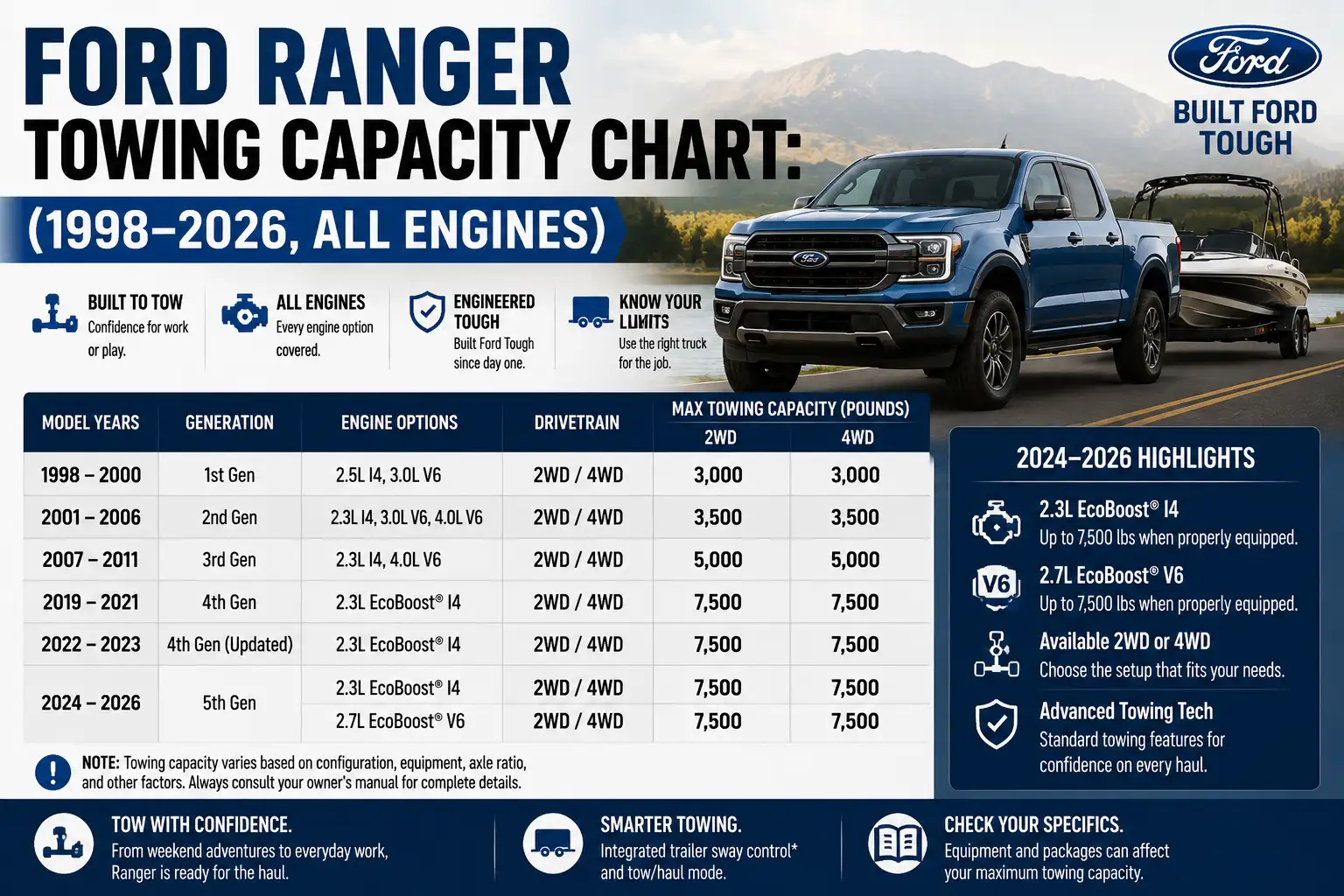
Ford Ranger Towing Capacity Chart (2011–2026, All Engines)

The Ford Ranger has long been a dominant force in the midsize pickup truck segment, praised for its blend of everyday usability and rugged capability. For truck owners, one of the most critical metrics of that capability is towing capacity. Whether hauling a camper for a weekend getaway, a boat to the lake, or a trailer full of equipment to a job site, knowing your truck’s limits is essential for safety and performance.
This comprehensive guide provides a detailed breakdown of the Ford Ranger’s towing capacity. We will explore the official ratings for the latest models, examine the specific configurations and equipment required to achieve maximum performance, and explain the key terminology every truck owner should know. Furthermore, we will see how the Ranger stacks up against its fiercest competitors and look back at the capabilities of previous generations.
Ford Ranger Towing Capacity: A Visual Guide


Understanding the 2026 Ford Ranger’s Hauling Power
2026 Ford Ranger Maximum Conventional Towing
7,500 lbs


This maximum rating is achieved when the Ranger is equipped with either the 2.3L or 2.7L EcoBoost engine and the essential Trailer Tow Package.
2026 Ranger Towing by Engine (Max)
The current generation (2024 on) added new engines. For 2026, the 2.3L and 2.7L V6 both hit the 7,500-lb max (with the tow package), the high-performance Raptor is rated lower by Ford.
What’s Required for 7,500-lb Towing?
Not every Ranger can tow the maximum. The key is the optional Trailer Tow Package, which adds a Class IV hitch, 7-pin wiring, and enhanced cooling.
Ranger vs. The Competition (Max Towing)
The 2026 Ranger is a top contender in the mid-size segment. Competitor figures are each maker’s published maximum when properly equipped; ratings vary by trim and year.
A New Generation of Power
From 2019-2023, the Ranger relied solely on the 2.3L EcoBoost. The 2024-and-later Ranger adds V6 options, increasing the available horsepower.
Towing Terms to Know
Towing capacity is just one number. Always check your owner’s manual and consider these factors:
- Payload: The max weight your truck can carry in its cab and bed (including passengers, cargo, and trailer tongue weight).
- Tongue Weight: The downward force the trailer’s tongue puts on the hitch. Should be 10-15% of total trailer weight.
- GCWR: Gross Combined Weight Rating. The absolute maximum weight of your loaded truck AND your loaded trailer combined.
The Bottom Line: 2026 Ford Ranger Towing Capacity at a Glance


For those seeking a quick answer, the 2026 Ford Ranger offers a maximum conventional towing capacity of 7,500 pounds. This rating applies to the XL, XLT, and Lariat trims, regardless of whether they are equipped with the standard 2.3L EcoBoost® engine or the available 2.7L EcoBoost® V6. However, achieving this figure is entirely dependent on equipping the truck with the optional Trailer Tow Package.
Without this crucial package, the Ranger’s towing capability is limited to 3,500 pounds when using the standard rear bumper hitch. The Ranger Raptor is rated lower by Ford, at a maximum towing capacity of 5,510 pounds.
For a clear, skimmable summary of the key performance figures, the table below outlines the maximum capabilities for each available powertrain.
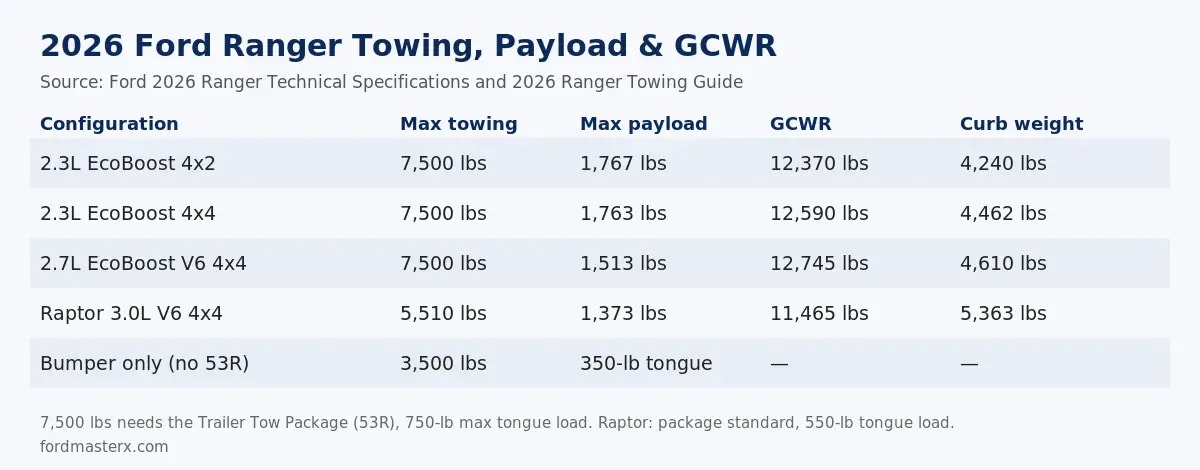
Sources: Ford 2026 Ranger Technical Specifications and 2026 Ford Ranger Towing Guide.
Quick Reference: 2026 Ford Ranger Max Towing & Payload by Engine
| Engine | Horsepower / Torque | Maximum Towing Capacity | Maximum Payload Capacity |
| 2.3L EcoBoost® I4 | 270 hp / 310 lb-ft | 7,500 lbs* | 1,767 lbs |
| 2.7L EcoBoost® V6 | 315 hp / 400 lb-ft | 7,500 lbs* | 1,513 lbs |
| 3.0L EcoBoost® V6 (Raptor) | 405 hp / 430 lb-ft | 5,510 lbs | 1,373 lbs |
The Complete 2026 Ford Ranger Towing Capacity Chart
A truck’s towing capacity is not a single, universal number. It is a carefully calculated rating that varies based on several factors, including the engine, drivetrain configuration (4×2 vs. 4×4), axle ratio, and installed equipment. The most critical figure for understanding a truck’s absolute limit is the Gross Combined Weight Rating (GCWR), which represents the maximum allowable weight of the fully loaded truck and its attached trailer combined.
2026 Ford Ranger Towing & GCWR Chart (lbs.)
| Engine | Drivetrain | Axle Ratio | GCWR (lbs.) | Max Loaded Trailer Weight (lbs.) |
| 2.3L EcoBoost® I4 | 4×2 SuperCrew® | 3.73 | 12,370 | 7,500 |
| 2.3L EcoBoost® I4 | 4×4 SuperCrew® | 3.73 | 12,590 | 7,500 |
| 2.7L EcoBoost® V6 | 4×4 SuperCrew® | 3.73 | 12,745 | 7,500 |
| 3.0L EcoBoost® V6 (Raptor) | 4×4 SuperCrew® | 4.27 | 11,465 | 5,510 |
A close look at the data reveals a compelling story about the Ranger’s engineering. It may seem counter-intuitive that the standard 2.3L EcoBoost® I4 and the more powerful 2.7L EcoBoost® V6, which boasts an additional 45 horsepower and 90 lb-ft of torque, share the same 7,500-pound maximum tow rating. This indicates that for the standard Ranger models, the engine’s power output is not the primary limiting factor for towing.
Instead, the maximum capacity is determined by the truck’s chassis as a complete system. This includes the strength of its high-strength steel frame, the durability of its suspension components, the effectiveness of its braking system, and its cooling capacity. Ford has engineered these components to a specific threshold that safely manages the forces exerted by a 7,500-pound trailer, a rating certified by the rigorous SAE J2807 standard.
The Ranger Raptor, despite having the most powerful engine, is rated lower by Ford, at 5,510 pounds. Ford does not publish the reason for the lower rating.
Understanding Ford Ranger Payload Capacity
Beyond towing, a truck’s utility is defined by its payload capacity—the maximum weight of cargo and passengers it can carry in its cab and bed. This figure is just as important as the tow rating, as it directly impacts what you can haul and is a critical component of safe towing calculations.
Payload capacity varies based on the truck’s configuration. Heavier components, such as a V6 engine or a 4×4 drivetrain, increase the vehicle’s curb weight, which in turn reduces the available payload.
2026 Ford Ranger Max Payload Capacity (lbs.)
| Engine & Drivetrain | Max Payload Capacity (lbs) | Real-World Example (What it can carry) |
| 2.3L EcoBoost® I4 (4×2) | 1,767 | A large ATV and associated gear, or roughly 50 sheets of plywood. |
| 2.3L EcoBoost® I4 (4×4) | 1,763 | A full load of heavy camping equipment for an extended trip. |
| 2.7L EcoBoost® V6 (4×4) | 1,513 | A large ATV or a bed filled with furniture and moving boxes. |
| 3.0L EcoBoost® V6 (Raptor) | 1,373 | Lighter recreational gear, tools, and supplies for an off-road adventure. |
The Key to 7,500 Pounds: The Trailer Tow Package (53R)
To unlock the Ranger’s full potential, the factory-installed Trailer Tow Package (option code 53R) is non-negotiable. Ford explicitly states that any trailer weighing over 3,500 pounds requires this package. Attempting to tow heavier loads without it is not only unsafe but may also void the New Vehicle Limited Warranty.
This essential package includes the hardware needed for heavy-duty towing:
- Class IV Trailer Hitch Receiver: A frame-mounted hitch that provides the structural connection point for the trailer.
- 4-Pin and 7-Pin Wiring Harness: This integrated connector allows the truck to power the trailer’s lights (brake lights, turn signals) and, crucially, to operate electric trailer brakes via an integrated trailer brake controller.
The tow package also increases the truck’s Frontal Area Limitation from 30 square feet to 55 square feet. This specification refers to the maximum size of the trailer’s front profile that the truck can pull without performance being significantly compromised by wind resistance.
Finally, the hitch receiver itself has specific weight limits. The Class IV hitch on standard Ranger models is rated for a maximum trailer tongue weight of 750 pounds, while the Raptor’s hitch is rated for 550 pounds.
Midsize Truck Showdown: Ranger Towing vs. The Competition
The midsize truck market is fiercely competitive, with each manufacturer vying for the top spot in capability. The Ford Ranger’s 7,500-pound rating places it squarely in the top tier of its class, offering more than enough power for the needs of most buyers.
2024/2026 Midsize Truck Towing Comparison
| Truck Model | Maximum Towing Capacity | Engine Achieving Max Tow | Horsepower / Torque |
| Ford Ranger | 7,500 lbs | 2.3L I4 / 2.7L V6 | 270-315 hp / 310-400 lb-ft |
| Chevrolet Colorado | 7,700 lbs | 2.7L TurboMax I4 | 310 hp / 430 lb-ft |
| Toyota Tacoma | 6,500 lbs | i-FORCE 2.4L I4 | 278 hp / 317 lb-ft |
| Nissan Frontier | Varies by trim/year (check Nissan) | 3.8L V6 | 310 hp / 281 lb-ft |
The analysis shows that the Chevrolet Colorado holds a slight advantage with a best-in-class maximum rating of 7,700 pounds. However, the Ford Ranger’s 7,500-pound capacity is exceptionally competitive, putting it ahead of the Tacoma. It out-pulls the 2026 Toyota Tacoma, which Toyota rates at up to 6,500 pounds. Nissan’s Frontier rating varies by trim and year, so check Nissan’s current figure. For prospective buyers, this places the Ranger among the most capable trucks in the segment.
Decoding the Lingo: A Practical Guide to Towing Weights
Knowing your truck’s maximum tow rating is only the beginning. To tow safely and legally, it is critical to understand the various weight ratings that govern your vehicle and trailer. Exceeding any of these manufacturer-set limits can lead to dangerous handling, accelerated wear on components, and potential mechanical failure. For a deeper dive into these topics, consider this guide to understanding key towing terms.
- Curb Weight: This is the weight of the truck with all standard equipment and a full tank of fuel, but with no passengers or cargo on board.
- Payload: This is the maximum weight of all items you can add to your truck, including all passengers, gear in the cab and bed, and—most importantly for towing—the trailer’s tongue weight. It is calculated by subtracting the truck’s curb weight from its GVWR.
- Gross Vehicle Weight Rating (GVWR): This is the absolute maximum weight the truck is designed to handle. It is the sum of the truck’s curb weight plus its payload. You can find this rating on the Tire and Loading Information label on the driver’s side door jamb.
- Tongue Weight (TW): This is the downward force that the trailer’s tongue exerts on the hitch ball. For a conventional trailer, it should be 10-15% of the total loaded trailer weight to ensure stable handling. Tongue weight is counted against your truck’s payload capacity.
- Gross Combined Weight Rating (GCWR): This is the most important number for towing. It is the maximum allowable weight of the fully loaded truck and the fully loaded trailer combined. You must never exceed this limit.
The Critical Link Between Payload and Towing
Many people mistakenly view payload and towing capacity as separate, independent limits. In reality, they are directly linked. When you attach a trailer, its tongue weight eats into your truck’s available payload. This can significantly reduce the amount of weight you can carry in the truck itself.
Consider this real-world example:
- You have a 2026 Ford Ranger 4×2 with the 2.3L EcoBoost engine. Its maximum payload is 1,767 pounds and its GCWR is 12,370 pounds.
- You want to tow a travel trailer that weighs 7,000 pounds when fully loaded.
- First, calculate the tongue weight. At 12% of the trailer’s weight, the tongue weight is 7,000 x 0.12 = 840 pounds. This is too high for the Ranger’s 750-pound hitch limit, so you must redistribute the trailer’s cargo to achieve a 10% tongue weight, which is 700 pounds.
- Next, subtract the tongue weight from your truck’s payload capacity: 1,767 lbs (max payload) – 700 lbs (tongue weight) = 1,067 pounds. This is the remaining payload capacity for you, your passengers, and any gear inside the truck.
- Finally, check against the GCWR. If your truck’s base curb weight is 4,240 pounds and you add 800 pounds of passengers and gear (well within your remaining payload), your truck’s actual weight is 5,040 pounds. The total combined weight is 5,040 lbs (truck) + 7,000 lbs (trailer) = 12,040 pounds. This is safely under the 12,370-pound GCWR.
This calculation demonstrates that even when towing a heavy trailer, you must always be mindful of your truck’s payload and total combined weight to remain within safe operating limits.
The Gold Standard of Towing: Understanding SAE J2807
When you see a tow rating for the Ford Ranger, it is accompanied by a note that it was “calculated with SAE J2807® method”. This is a crucial detail that guarantees the number is trustworthy and comparable to other trucks.
SAE J2807 is a set of performance standards established by the Society of Automotive Engineers (SAE) to create a universal, apples-to-apples methodology for rating a vehicle’s towing capacity. Before its widespread adoption around 2015, manufacturers used their own proprietary testing methods, making it difficult for consumers to compare trucks accurately.
To earn an SAE J2807-certified rating, a truck must pass a series of grueling real-world tests while loaded to its maximum GCWR. These tests include:
- Acceleration: The truck and trailer must accelerate from 0-60 mph and 40-60 mph within set time limits to prove it can safely merge with highway traffic.
- Braking: The combination must stop from 20 mph within a specified distance, ensuring the brakes can handle the load.
- Grade Launch: The vehicle must be able to launch from a complete stop on a steep 12% grade multiple times, both in forward and reverse.
- The Davis Dam Test: This is the most famous part of the standard. The truck must climb the 11.4-mile Davis Dam Grade in Arizona, maintaining a minimum speed of 40 mph (for single-rear-wheel trucks) in ambient temperatures of 100°F with the air conditioning on full blast.
When a truck like the Ford Ranger carries an SAE J2807 certification, it means its tow rating is not just a theoretical number but a proven, real-world capability. For more information, you can read about the(https://en.wikipedia.org/wiki/SAE_J2807).
Smart Tech for Tough Tows: Ranger’s Trailering Features
Modern trucks offer more than just raw power; they provide advanced technology to make the towing experience safer and less stressful. The Ford Ranger is available with a suite of features designed to assist the driver.
- Pro Trailer Backup Assist™: This system simplifies the often-tricky process of backing up a trailer. The driver uses a knob on the dashboard to indicate which direction they want the trailer to go, and the truck automatically controls the steering wheel to execute the maneuver.
- BLIS® (Blind Spot Information System) with Trailer Coverage: This feature extends the truck’s blind spot monitoring system to cover the length of a conventional trailer, alerting the driver to vehicles they might not otherwise see.
- Integrated Trailer Brake Controller: Factory-installed and seamlessly integrated, this controller allows the driver to adjust and apply the trailer’s electric brakes for smooth, synchronized stopping.
- Tow/Haul Mode: Selectable via the drive mode controller, this mode optimizes the transmission’s shift schedule. It holds lower gears longer to provide more power when accelerating and provides engine braking to help control speed on downgrades.
- Trailer Sway Control: This safety system works with the truck’s stability control to detect trailer sway and can automatically apply individual wheel brakes or reduce engine torque to help bring it back under control.
A Look Back: Ford Ranger Towing Capacity by Year (2011–2025)
For owners of previous models or those shopping in the used market, understanding the capabilities of older Ford Rangers is equally important. The Ranger nameplate has seen significant evolution over the last decade.
Previous Generation (2019-2023)
The Ranger returned to the North American market for the 2019 model year. This generation was known for its straightforward powertrain offering, which resulted in a consistent tow rating across its model years.
Previous Generation (2019-2023) Ford Ranger Towing Capacity
| Model Year | Engine | Max Towing Capacity | Notes |
| 2019-2023 | 2.3L EcoBoost® I4 | 7,500 lbs | Requires Trailer Tow Package. |
2024–2025 Ford Ranger Towing Capacity
The redesigned 2024 Ranger kept the 7,500-lb maximum with the Trailer Tow Package on the 2.3L and new 2.7L V6, and added the Raptor at 5,510 lbs. Ford’s 2025 towing guide lists the same 7,500 / 5,510-lb ratings and the same 3,500-lb bumper-only limit. For a full 2025 breakdown, see our 2025 Ford Ranger towing capacity guide.
Pre-Hiatus (2011 U.S. Model)
The Ford Ranger that was discontinued in the U.S. after the 2011 model year was a smaller, distinct platform from the modern truck. Its capabilities were considerably different, and it’s crucial not to confuse its ratings with later models.
2011 Ford Ranger Towing Capacity (U.S. Market)
| Model Year | Engine | Max Towing Capacity | Notes |
| 2011 (US) | 2.3L I4 | 2,160 lbs | With standard hitch receiver. |
| 2011 (US) | 4.0L V6 | 5,800 lbs | Required for max towing. |
Ford’s 2011 towing guide lists up to 5,960 lbs for a 4.0L automatic Regular Cab 7-ft box (fleet only), 5,800 lbs for the SuperCab 4×2, and 2,160 lbs for the 2.3L automatic. Manual-transmission ratings are lower.
Frequently Asked Questions (FAQs)
What can a Ford Ranger actually tow with a 7,500-pound capacity?
A properly equipped Ranger with the Trailer Tow Package can tow a loaded trailer up to 7,500 lbs, such as many travel trailers, boats and utility trailers. Weigh the loaded trailer, keep tongue weight within the 750-lb hitch limit, and stay within payload and the GCWR.
Can I increase my Ford Ranger’s towing capacity?
No. The maximum towing capacity is a rating set by the manufacturer based on comprehensive testing of the vehicle’s frame, axles, suspension, and braking systems. While aftermarket accessories like air springs can help level the ride, they do not increase the legal or safe towing capacity of the vehicle.
Why does the Ranger Raptor tow less than a standard Ranger?
The Ranger Raptor is rated lower by Ford: 5,510 lbs with a 550-lb hitch tongue limit, against 7,500 lbs and 750 lbs for other Rangers. Ford does not publish the reason for the difference.
How much can a Ford Ranger tow without the tow package?
Ford’s 2026 towing guide limits the Ranger to 3,500 lbs when towing from the rear step bumper only, with a 350-lb tongue load. Trailers over 3,500 lbs need the Trailer Tow Package (53R).
Where can I find my specific Ranger’s towing information?
The Safety Compliance Certification Label on the driver’s door jamb lists the GVWR and axle code. Match the axle code and engine to the Trailer Towing Selector in Ford’s towing guide for your model year. For detailed charts and configurations, consult Ford’s official 2026 Ranger towing guide.
What is the 2026 Ford Ranger towing capacity?
Ford rates the 2026 Ranger at up to 7,500 lbs with the 2.3L EcoBoost or 2.7L EcoBoost V6 and the Trailer Tow Package, on XL, XLT and Lariat. The Ranger Raptor is rated at 5,510 lbs.
What is the Ford Ranger Raptor towing capacity?
The 2024–2026 Ranger Raptor has a 5,510-lb max towing rating with its standard Trailer Tow Package, a 550-lb max tongue load and 1,373 lbs of max payload for 2026.
Ford Ranger Towing Capacity By Year
- 2021 Ford Ranger Towing Capacity What Can It Haul
- 2025 Ford Ranger Towing Capacity Guide With Key Specs Limits
Full towing capacity guide: Ford F-150 Towing Capacity Chart (2004–2026)