Ford Everest Trim Comparison Chart: Specs by Model (Why It’s Not Sold in the US)

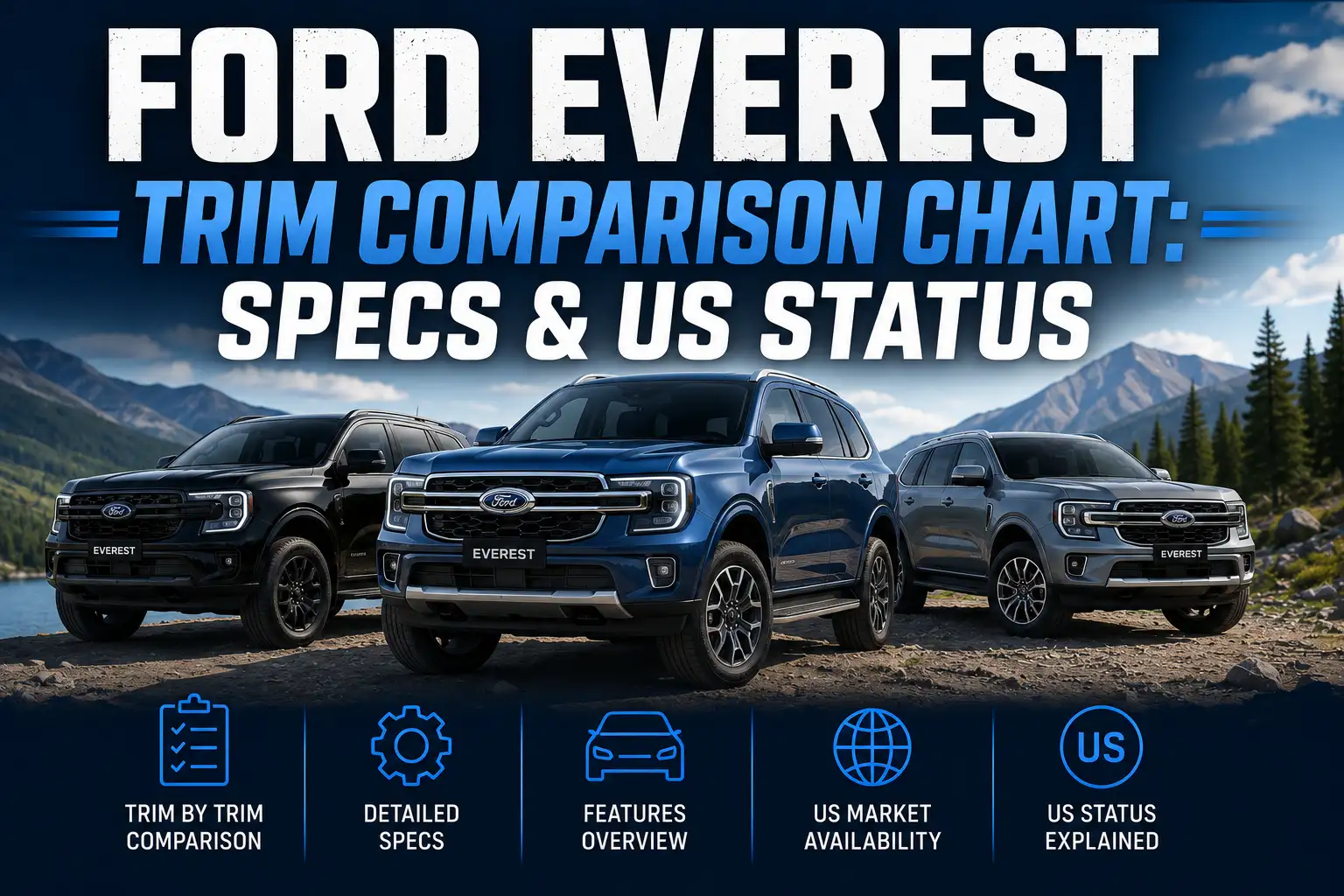
The Ford Everest is a three-row, body-on-frame SUV built on the global Ranger platform. It is not sold at Ford dealerships in the United States, and Ford has confirmed there are no plans to bring it here. It’s currently sold in Australia, Southeast Asia, the Middle East, South Africa, and New Zealand. This chart breaks down every current Everest trim and engine, its towing numbers, and why American buyers are stuck watching from the sidelines.
What Is the Ford Everest
Recommended Best Deal Products

If you own a Ranger, the Everest is easiest to understand as its SUV sibling. It shares the Ranger’s body-on-frame chassis and drivetrain architecture, but wraps it in a fully enclosed three-row body instead of a pickup bed. That’s a different approach from the Explorer, which uses a unibody structure built for on-road comfort rather than heavy-duty towing and off-road use.

Prime for Young Adults — 6 Months Free
Students and 18–24s get six months of Prime free, then half price.
Start 6 Months Free As an Amazon Associate I earn from qualifying purchases.The Everest has been through three generations since 2003, with the current-generation model (sold since 2022 and updated for the 2026 model year) built in Thailand for Asia-Pacific, Middle East, and African markets. It has become a strong seller in Australia specifically, where it ranked as the country’s sixth-best-selling new vehicle in 2024.
Ford Everest at a Glance (2026 MY26.5 Lineup)
Trims, engines, towing, and why it’s not sold in the US
| Trim | Standard Engine | Power / Torque | Drivetrain |
|---|---|---|---|
| Active | 2.0L single-turbo I4 | 125 kW / 405 Nm | Part-time 4×4 |
| Sport | 2.0L I4 (V6 available) | 125 kW / 405 Nm or 184 kW / 600 Nm | Part-time or full-time 4×4 |
| Tremor | 3.0L V6 turbo-diesel | 184 kW / 600 Nm | Full-time 4×4 |
| Platinum | 3.0L V6 turbo-diesel | 184 kW / 600 Nm | Full-time 4×4 |
Body-on-frame Ranger platform vs. unibody Explorer platform drives most of this gap, not just engine output.
Ford Everest Trim Comparison Chart (2026 MY26.5 Lineup)
Ford Australia restructured the Everest lineup for the 2026.5 model year, dropping the Ambiente and Trend grades in favor of a new Active entry trim. Here’s how the current range breaks down:
| Trim | Standard Engine | Power / Torque | Transmission | Drivetrain | Notes |
|---|---|---|---|---|---|
| Active | 2.0L single-turbo 4-cyl diesel | 125 kW / 405 Nm | 10-speed automatic | Part-time 4×4 | V6 optional for the first time on this grade; 12-inch touchscreen and leather-accented seats standard |
| Sport | 2.0L single-turbo 4-cyl diesel (V6 available) | 125 kW / 405 Nm (2.0L) or 184 kW / 600 Nm (V6) | 10-speed automatic | Part-time or full-time 4×4 (engine-dependent) | Mid-range trim with more standard tech than Active |
| Tremor | 3.0L V6 turbo-diesel | 184 kW / 600 Nm | 10-speed automatic | Full-time 4×4 | Off-road-focused suspension and hardware |
| Platinum | 3.0L V6 turbo-diesel | 184 kW / 600 Nm | 10-speed automatic | Full-time 4×4 | Range-topping trim, V6 only |
[UNVERIFIED — needs manual check: current dealer pricing] Australian Everest pricing shifts frequently with model-year updates and regional offers. As of mid-2026, the Active starts from roughly AUD $58,990–$59,000 before on-road costs, and the Platinum starts from roughly AUD $83,490 before on-road costs, but these figures should be confirmed against Ford Australia’s official Everest pricing page before publishing, since dealer driveaway pricing varies by state and current promotions.
The single-turbo 2.0L is the volume engine across the range now that the older bi-turbo 2.0L has been discontinued for this model year. The V6 remains the engine to pick if towing or highway passing power matters, and it’s now available on the Active grade for the first time, not just Sport, Tremor, and Platinum.
Engine Options Compared: 2.0L Single-Turbo vs. 3.0L V6
Recommended Best Deal Products


The current Everest lineup runs two diesel engines:
- 2.0L single-turbo 4-cylinder diesel — 125 kW (168 hp) and 405 Nm (299 lb-ft), matched to a 10-speed automatic. This engine replaced the previous bi-turbo 2.0L for the 2026.5 model year and uses a timing chain instead of a wet timing belt, addressing a common reliability complaint with the outgoing bi-turbo unit.
- 3.0L V6 turbo-diesel — 184 kW (247 hp) and 600 Nm (443 lb-ft), also paired with the 10-speed automatic, but running a full-time 4×4 system rather than the four-cylinder’s part-time setup.
Both engines share the same transmission and basic architecture found in the Ford Ranger, which is the closest thing US buyers have to hands-on experience with Everest running gear, since the current Ranger generation is sold stateside.

Audible — Listen Free for 30 Days
One free credit a month and thousands of titles included.
Listen Free for 30 Days As an Amazon Associate I earn from qualifying purchases.Everest Towing Capacity
Every current Everest, regardless of engine, is rated to tow up to 3,500 kg (about 7,716 lbs). That number applies across the Active, Sport, Tremor, and Platinum grades — Ford doesn’t split the rating by engine on this generation.
For context, a 2026 Ford Explorer sold in the US is rated to tow up to 5,000 lbs, standard across all trims with the Class III Trailer Tow Package included. On paper, the Everest’s 7,716 lbs figure is meaningfully higher than the Explorer’s 5,000 lbs — but that comparison also reflects the fundamental difference between the Everest’s body-on-frame Ranger platform and the Explorer’s unibody design, not just an engine or equipment gap. Full year-by-year Explorer towing figures are in the Ford Explorer Towing Capacity Chart.
Why the Ford Everest Isn’t Sold in the US
Recommended Best Deal Products


Ford has stated directly that the Everest won’t be coming to US dealerships, and this isn’t a new development — the previous-generation Everest wasn’t sold here either. A few things drive that decision:
- Lineup overlap. The Everest’s size and three-row layout would compete directly with the Explorer and, to a lesser extent, the Bronco. Ford has said adding it risks cannibalizing sales from vehicles it already builds and sells profitably in North America.
- Certification cost. The Everest is engineered and built for right-hand-drive and left-hand-drive export markets outside US crash, emissions, and safety standards. Certifying it for FMVSS and EPA compliance would require significant re-engineering and cost.
- Diesel-heavy lineup. The Everest’s engine range leans entirely on diesel, which doesn’t match current US buyer preference for gas and hybrid powertrains in this segment.
- Manufacturing location. The Everest is built in Thailand, not North America, adding import tariffs and logistics costs that a US version would need to absorb.
Everest test mules have occasionally been spotted testing in the US (including sightings in Detroit and Colorado), but that reflects Ford’s normal global engineering activity, not confirmation of a US launch. As of now, there’s no official Ford announcement indicating that will change.
Closest Ford Alternatives Available in the US
If you’re interested in the Everest’s mix of size, capability, and three-row seating, two Ford models sold in the US come closest, depending on what you actually want it for:
- Ford Explorer — closest in size and three-row family use, though it’s unibody rather than body-on-frame. Best fit if on-road comfort and daily driving matter more than off-road capability. Towing specs are covered in the section above.
- Ford Bronco — closer in spirit to the Everest’s body-on-frame, off-road-focused engineering, though it doesn’t offer the Everest’s three-row family layout in most configurations. Compare trims and capability in the Ford Bronco Model Comparison Chart.
FAQ
Can I import a Ford Everest to the US?
It’s technically possible through registered importers once a vehicle is old enough to qualify under EPA and NHTSA exemption rules, but a current-generation Everest doesn’t qualify yet. This is general information, not legal or import compliance advice — consult a registered importer for your specific situation before pursuing this.
Is the Ford Everest the same as the Ford Explorer?
No. They’re both three-row Ford SUVs, but the Everest is body-on-frame and built on the Ranger platform, while the Explorer uses a unibody structure designed specifically for the North American market.
Will Ford ever sell the Everest in the US?
There’s no official plan to do so. Ford has stated the Everest won’t be sold in the US, and the previous generation wasn’t sold here either. Test mule sightings reflect normal engineering activity, not a confirmed launch.