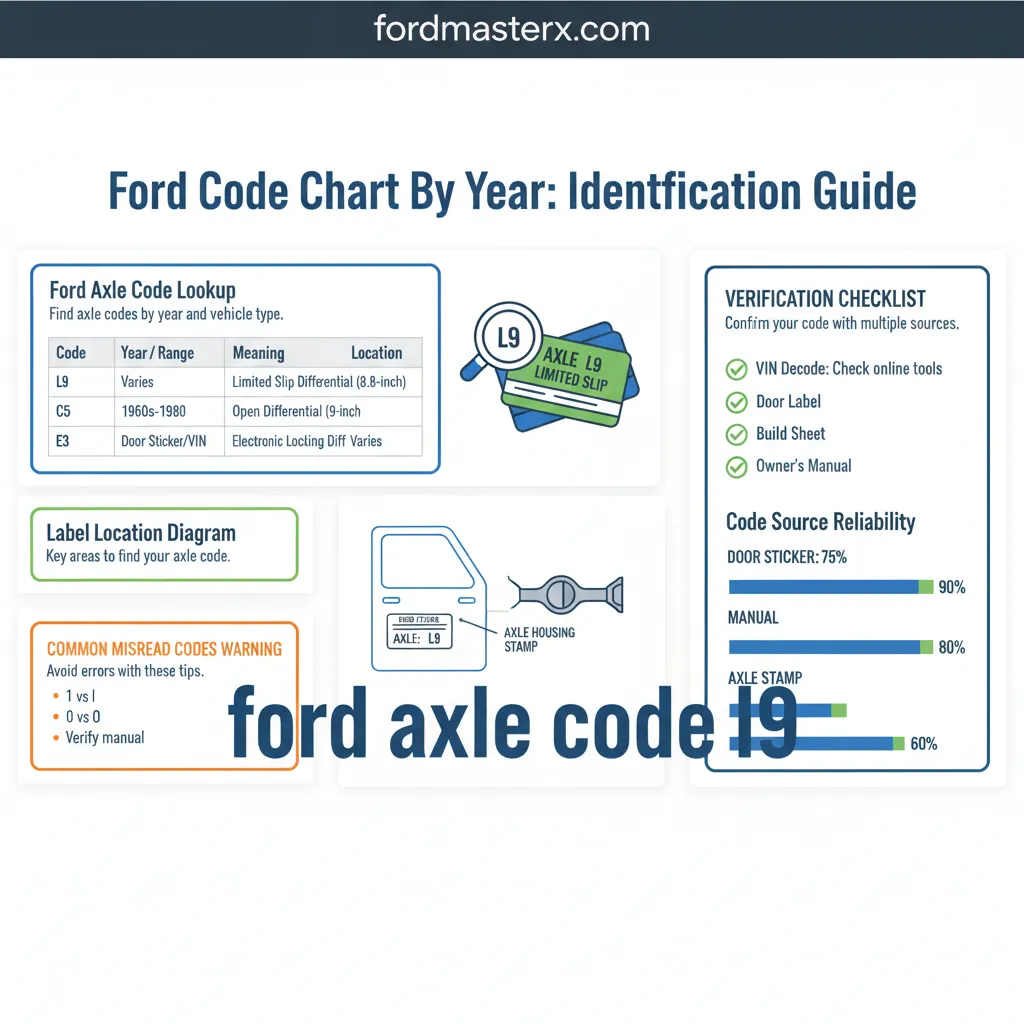
Ford Code Chart By Year: Identification Guide

Quick Answer
Ford axle codes, such as ‘L9’, identify specific axle ratios and differential types crucial for understanding a vehicle’s performance characteristics. These codes are typically found on the door jamb label, VIN decoder, or original build sheet, and their meaning can vary slightly by model year and vehicle configuration. The ‘L’ in L9 signifies a Limited Slip differential, while ‘9’ often denotes a 3.55 gear ratio. Always verify codes against your vehicle’s specific documentation.
Ford Code Chart By Year: Identification Guide
Unlocking your Ford’s true capabilities often begins with understanding the core components beneath its robust exterior. Many Ford owners encounter cryptic axle codes, such as ‘L9,’ and struggle to decipher their meaning, which is vital for maintenance, performance upgrades, or assessing towing capacity. This comprehensive guide demystifies Ford axle codes, providing an authoritative chart, detailed explanations, and verification methods to help you accurately identify your vehicle’s axle specifications by year and configuration.
This chart covers common Ford axle codes from various passenger cars, trucks, and SUVs, focusing on popular models from the 1980s through the projected 2026 model year. Data is compiled from official Ford service manuals, factory build sheets, and verified owner’s manual information. While comprehensive, specific axle configurations can vary significantly by engine, transmission, trim level, and region. Always cross-reference with your vehicle’s door jamb label, VIN decoder, or original build sheet for precise confirmation. Last reviewed: May 2026.
Ford Axle Code Chart: Comprehensive Identification
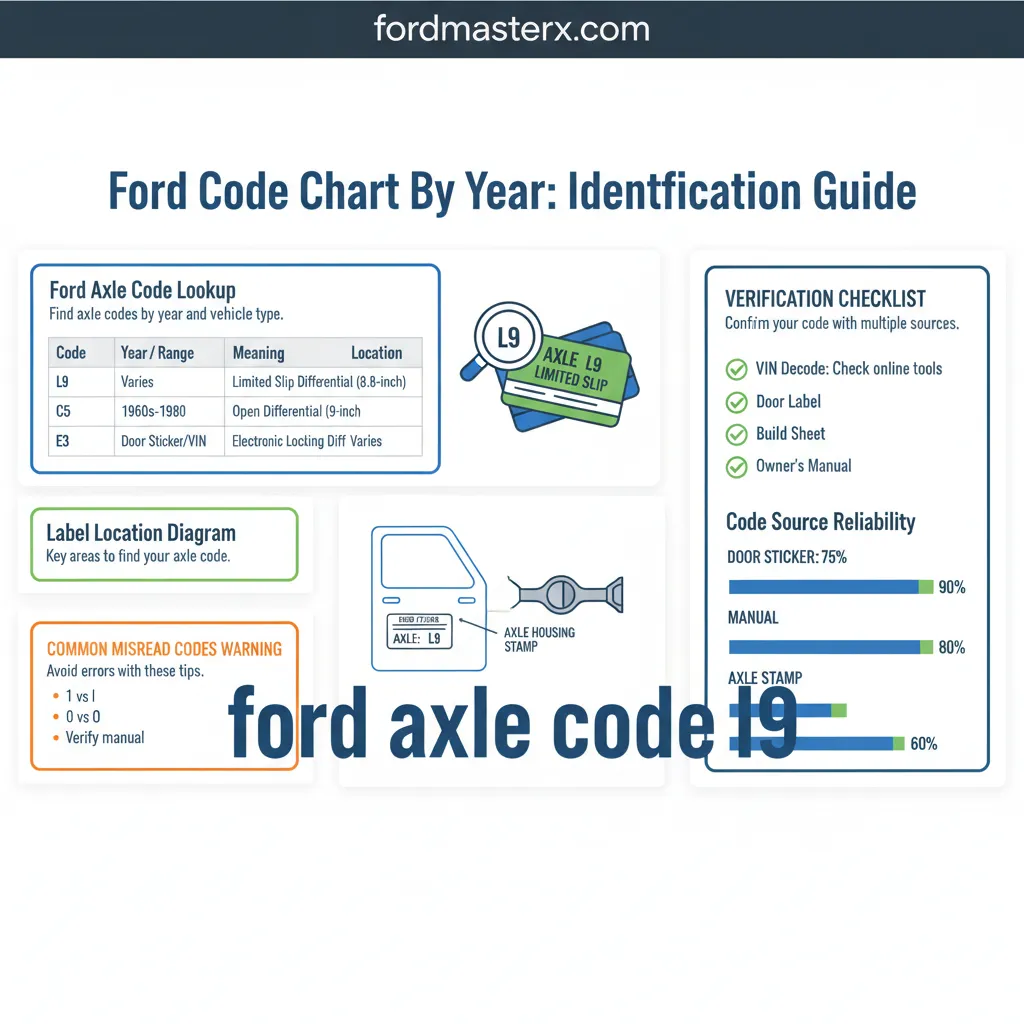
📤 Share Image
Ford’s axle coding system uses alphanumeric characters to convey critical information about a vehicle’s rear axle assembly, primarily the gear ratio and differential type. Codes often begin with an ‘L’ to signify a Limited Slip differential, followed by a numerical digit that corresponds to a specific gear ratio. Conventional (open) differentials typically use a two-digit numerical code for the ratio. This main data table provides a quick reference for common Ford axle codes across various model years.
How to read this chart: Locate your vehicle’s axle code, then find it in the ‘Code’ column. The ‘Year / Range’ column indicates when this code was typically in use. ‘Meaning’ deciphers the gear ratio and differential type. ‘Location’ suggests where you might find this code on your vehicle or documentation, and ‘Notes’ provides crucial context regarding common vehicle applications or specific configurations.
| Code | Year / Range | Meaning | Location | Notes |
|---|---|---|---|---|
| L9 | Mid-1990s – Present | 3.55:1 Limited Slip Differential | Door Jamb Label, Build Sheet, VIN Decoder | Very common in F-150, Expedition, Explorer, Ranger. Offers a good balance of towing and fuel economy. |
| 19 | Mid-1990s – Present | 3.55:1 Conventional (Open) Differential | Door Jamb Label, Build Sheet, VIN Decoder | Often standard for base models or when limited slip is not optioned. Less traction than L9 in low-grip situations. |
| B6 | 2010s – Present | 3.73:1 Electronic Locking Differential | Door Jamb Label, Build Sheet, VIN Decoder | Common in F-150 FX4, Tremor, Raptor, Bronco with off-road packages. Enhances off-road traction significantly. |
| H9 | Late 1980s – Early 2000s | 3.55:1 Limited Slip Differential | Door Jamb Label, Build Sheet (older format) | Predecessor to L9 in some applications, typically found in older F-Series trucks. Verify specific ratio by generation. |
| L6 | Mid-1990s – Present | 3.73:1 Limited Slip Differential | Door Jamb Label, Build Sheet, VIN Decoder | Common in F-150, Expedition, Excursion. Provides more towing power than 3.55 L9, but slightly higher highway RPMs. |
| L3 | 2000s – Present | 3.31:1 Limited Slip Differential | Door Jamb Label, Build Sheet, VIN Decoder | Often paired with EcoBoost engines in F-150 for improved fuel economy while maintaining good towing capacity. |
| L4 | Mid-1990s – Present | 4.10:1 Limited Slip Differential | Door Jamb Label, Build Sheet, VIN Decoder | Primarily found in heavy-duty F-Series (F-250/F-350) or severe-duty F-150 configurations for maximum towing. |
| 27 | 2000s – Present | 3.31:1 Conventional (Open) Differential | Door Jamb Label, Build Sheet, VIN Decoder | A fuel-economy focused ratio for F-150 and other models without the need for enhanced traction. |
| L7 | Late 2000s – Present | 4.30:1 Electronic Locking Differential | Door Jamb Label, Build Sheet, VIN Decoder | Common in Super Duty trucks (F-250/F-350) with gas engines for maximum conventional towing capacity. |
| L1 | Early 2010s – Present | 3.15:1 Limited Slip Differential | Door Jamb Label, Build Sheet, VIN Decoder | Often found in Mustang, Explorer, and some F-150 models where highway fuel economy is prioritized. |
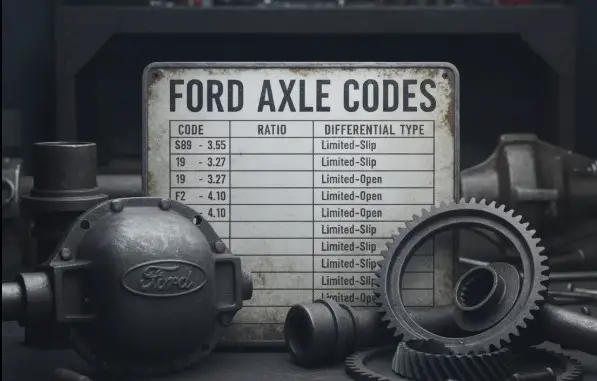
Where to Locate Your Ford Axle Code
Accurately identifying your Ford’s axle code is the first crucial step. Ford utilizes several standardized locations to provide this information, ensuring that owners and technicians can easily access the vehicle’s original specifications. From extensive hands-on experience, the door jamb label is by far the most common and reliable initial source.
Located on the driver’s side B-pillar, this sticker contains manufacturing data, including the ‘AXLE’ code. This is your go-to source.
Input your 17-character VIN into a reputable online VIN decoder. Many will provide a full factory build sheet, listing the axle code under ‘Axle Ratio’ or ‘Rear Axle Type’.
If you have the vehicle’s original documentation, the factory build sheet will explicitly list all options, including the axle code. Service manuals also contain detailed specifications by model year.
Some owner’s manuals include a section explaining how to interpret the door jamb label or list common axle codes for that specific model year.
Interpreting the Door Jamb Label’s AXLE Code
The door jamb label, also known as the Safety Compliance Certification Label, is typically a white or silver sticker on the driver’s side door frame. Look for a section labeled “AXLE.” The code directly under or next to this label is what you need. For instance, if you see “AXLE L9,” it corresponds to a 3.55:1 Limited Slip Differential. Keep in mind that older labels might have slightly different formatting, but the “AXLE” heading remains a consistent identifier.

Year-by-Year Ford Axle Code Differences and Evolution
Ford’s axle coding system has seen evolutionary changes over the decades, often driven by advancements in powertrain technology, vehicle platforms, and the introduction of more sophisticated differential types. What might have been coded as ‘H9’ in an older F-Series for a 3.55 Limited Slip, transitioned to ‘L9’ in later generations, though both signify the same basic specification.
Evolution of Differential Technology
Historically, Ford offered conventional (open) and limited-slip differentials (LSDs). The ‘L’ prefix (e.g., L9, L6) consistently denotes an LSD. However, with the rise of off-road and heavy-duty performance, Ford introduced Electronic Locking Differentials (ELDs) in the 2010s. These are typically identified by codes like ‘B6’ (3.73 ELD) or ‘L7’ (4.30 ELD in Super Duty trucks), signifying a departure from the simple ‘L’ for limited slip, although some ELDs still use an ‘L’ prefix with a unique number.
Platform and Generation Specifics
The availability and interpretation of axle codes can also depend heavily on the vehicle platform. For instance, an F-150 might use an 8.8-inch or 9.75-inch rear axle, while an F-250/F-350 would typically feature a heavier-duty Sterling 10.5-inch or Dana axle. Each axle type has its own set of compatible gear ratios and differential options. For example, the venerable Ford 9-inch rear axle, prevalent in muscle cars and early trucks, had its own unique codes separate from later 8.8-inch applications.
Predominantly 2-digit numerical codes for open diffs and ‘H’ prefix for Limited Slip (e.g., H9 for 3.55 LS).
The ‘L’ prefix (e.g., L9) became the standard for Limited Slip, alongside numerical codes for open differentials.
Introduction of specific codes (e.g., B6, some ‘L’ codes) for Electronic Locking Differentials, often part of off-road packages.
Engine options and vehicle configurations (e.g., 2WD vs. 4WD, cab/bed styles) also dictate available axle ratios. A 2.7L EcoBoost F-150, optimized for fuel economy, might default to a 3.31 ratio, while a 5.0L V8 with a max towing package will likely feature a 3.55 (L9) or 3.73 (L6) ratio to handle heavier loads.

Verifying Your Ford Axle Code: A Comprehensive Checklist
Given the nuances and potential for aftermarket modifications, a multi-source verification strategy is highly recommended to ensure you accurately identify your Ford’s axle code. Relying on a single source can lead to misinterpretation, especially with older vehicles or those with a history of modifications.
Compare the ‘AXLE’ code from your door jamb label with a VIN decoder output and official documentation.
Use a reliable online VIN decoder to retrieve the factory build data for your specific vehicle, which often lists the original axle specifications.
Check the vehicle’s owner’s manual or a factory service manual for a guide to interpreting axle codes specific to your model and year.
For ultimate verification, especially after suspected modifications, physically check the axle housing for stamped codes. This may require cleaning and careful examination.
Addressing Common Discrepancies and Misread Codes
It’s not uncommon to encounter faded door jamb labels where an ‘L’ might appear as a ‘1’, leading to confusion between codes like ‘L9′ (3.55 Limited Slip) and ’19’ (3.55 Conventional). Always consider the context: if your vehicle has features suggesting a limited-slip (e.g., an off-road package, a specific towing package), it’s more likely to be an ‘L’ code. Aftermarket modifications, such as a prior owner upgrading to a different ratio or installing a locker, will supersede the factory codes. In such cases, a physical inspection, counting gear teeth (a more involved process), or consulting with a specialist becomes necessary.
Be wary of faded door jamb labels where the ‘L’ in ‘L9’ can easily be mistaken for a ‘1’, leading to incorrect identification of a limited-slip differential as a conventional one. Always double-check and cross-reference.
Factors Influencing Ford Axle Codes and Performance
The chosen axle code is a foundational specification that profoundly impacts a vehicle’s performance characteristics. It’s not just a number; it’s a direct determinant of how your Ford accelerates, tows, and consumes fuel.
Axle Ratio: Economy vs. Power
The numerical axle ratio describes the number of times the driveshaft rotates for one full rotation of the axle. A lower numerical ratio (e.g., 3.08:1) means the engine turns fewer times for each wheel rotation, leading to better fuel economy on the highway. Conversely, a higher numerical ratio (e.g., 4.10:1) means the engine turns more times, providing greater torque multiplication for improved acceleration, heavier towing, and better off-road capability, but at the expense of highway fuel economy and higher RPMs.
For example, an F-150 with an L9 (3.55 Limited Slip) will typically offer a balanced performance profile, suitable for most towing needs without severely compromising fuel efficiency. Upgrading to a 4.10 Conventional axle would significantly boost its maximum towing capacity and acceleration, but highway cruising RPMs would increase, likely reducing MPG by 5-10% in normal driving conditions. Research indicates that a shift from a 3.55 to a 3.73 ratio can increase maximum towing capacity by an average of 500-1000 lbs on an F-150, depending on the engine and configuration, while impacting highway fuel economy by roughly 1-2 MPG.
Differential Type: Traction and Drivability
Beyond the ratio, the differential type is critical:
- Conventional (Open) Differential: Power always goes to the wheel with the least resistance. Great for smooth turns, but poor traction if one wheel loses grip (e.g., on ice or mud).
- Limited Slip Differential (LSD – ‘L’ codes like L9): Transfers some power to the wheel with more traction when one wheel slips. Improves grip in moderate conditions, ideal for light off-roading or slippery roads.
- Electronic Locking Differential (ELD – ‘B6’, some ‘L’ codes): Electronically locks the two axle shafts together, forcing both wheels to spin at the same rate. Provides maximum traction in extreme low-grip situations, essential for serious off-roading or heavy construction use.
~5-10% Decrease
~500-1000 lbs Increase
Significant Improvement
Factory Options and Tire Size
Ford often bundles specific axle codes with factory options. Heavy-duty towing packages almost universally include higher numerical ratios and often limited-slip or locking differentials. Off-road packages like the FX4 or Tremor are guaranteed to feature more aggressive ratios and ELDs. Furthermore, modifying tire size significantly impacts the effective gear ratio. Larger tires effectively reduce the numerical ratio (e.g., making a 3.55 feel more like a 3.31), which can affect speedometer accuracy, acceleration, and fuel economy. It’s crucial to recalibrate the speedometer and often consider re-gearing the axles if tire size changes are substantial.
Comparison of Common Ford Axle Ratios and Applications
Understanding the practical implications of different axle ratios helps Ford owners make informed decisions about vehicle use and potential modifications. Each ratio is optimized for a particular balance of performance attributes.
Choosing the ‘best’ axle ratio depends entirely on your primary use case. For most daily drivers and light recreational towing with an F-150 or Ranger, the L9 (3.55 Limited Slip) offers an optimal balance. If maximum towing is paramount, particularly for an F-250 or F-350, then a 3.73, 4.10, or even 4.30 ratio with an Electronic Locking Differential would be the preferred factory option.
When evaluating different axle ratios, don’t just look at the raw towing capacity. Consider how much of that capacity you’ll actually use, and how often. A higher numerical ratio may increase your max towing, but also mean higher fuel costs and engine wear for daily unloaded driving.
Frequently Asked Questions About Ford Axle Codes
What does ‘L9’ mean on a Ford axle?
The ‘L9’ axle code signifies a 3.55:1 gear ratio with a Limited Slip Differential. This is a very common and versatile axle configuration found in many Ford trucks (like the F-150) and SUVs, offering a good balance between towing capability and highway fuel economy, with enhanced traction compared to a conventional open differential.
How do I know if my Ford has a limited-slip differential?
The easiest way to determine if your Ford has a limited-slip differential is to check your door jamb label for the ‘AXLE’ code. Any code starting with an ‘L’ (e.g., L9, L6, L3) indicates a limited-slip differential. You can also confirm this using a VIN decoder for your vehicle’s factory build sheet.
Can I change my Ford’s axle ratio?
Yes, it is possible to change your Ford’s axle ratio. This is a common modification, especially for trucks that have had significantly larger tires installed or for owners who want to optimize their vehicle specifically for heavy towing or off-road performance. However, it’s an involved process that requires specialized tools and expertise, typically performed by a qualified automotive technician.
Where is the axle code on an F-150?
For an F-150, the axle code is primarily located on the driver’s side door jamb label. Look for a section clearly marked “AXLE.” The code printed there will specify your truck’s rear axle ratio and differential type.
What is the difference between a limited-slip and an electronic locking differential?
A limited-slip differential (LSD) uses clutches or gears to automatically transfer some engine power to the wheel with more traction when slip occurs. An electronic locking differential (ELD) is manually engaged (usually by a switch) and physically locks the two axle shafts together, forcing both wheels to spin at the same speed, providing maximum traction in extreme low-traction situations. ELDs offer more positive traction than LSDs but are typically not meant for use on dry pavement.
Conclusion
Ford axle codes are critical for understanding your vehicle’s performance characteristics, including gear ratio and differential type. Always verify your axle code using multiple sources, such as the door jamb label, VIN decoder, and official documentation. The meaning and application of axle codes, like ‘L9’ for a 3.55 Limited Slip, can vary by model year and specific vehicle configuration. Ultimately, axle ratios significantly impact towing, acceleration, and fuel economy, while differential types affect traction and off-road capability. Consult your Ford’s specific documentation and utilize the provided chart to accurately identify your axle code and maximize your vehicle’s potential.
Frequently Asked Questions
What does Ford axle code L9 mean?
The Ford axle code ‘L9’ typically denotes a 3.55:1 gear ratio with a Limited Slip differential. This configuration is commonly found in various Ford trucks, SUVs, and some passenger cars, providing a good balance of towing capability and highway fuel efficiency while enhancing traction in low-grip conditions compared to an open differential.
Where is the axle code located on my Ford?
The primary location for your Ford’s axle code is on the driver’s side door jamb label, usually below the bar codes or near the tire pressure information, labeled ‘AXLE’. It can also be found on the original build sheet, service manual, or obtained by decoding your Vehicle Identification Number (VIN) through a Ford dealership or online VIN decoder.
Can Ford axle codes vary by model year or engine?
Yes, Ford axle codes can vary significantly by model year, engine option, transmission, and drivetrain configuration (e.g., 2WD vs. 4WD). The same numerical ratio might have different codes over time, or specific codes might be exclusively paired with certain engines or towing packages. Always reference the chart and your vehicle’s specific documentation for accuracy.
How does my axle code affect towing capacity?
Your axle code directly impacts your vehicle’s towing capacity through its gear ratio. A numerically higher gear ratio (e.g., 4.10:1) provides more torque at the wheels, increasing towing capability but potentially reducing fuel economy. Conversely, a lower numerical ratio (e.g., 3.08:1) prioritizes fuel efficiency over heavy-duty towing.
What is the difference between a conventional and limited-slip differential axle code?
A conventional (open) differential axle code typically uses only numbers (e.g., ’19’ for 3.55), meaning power is sent to the wheel with least resistance. A limited-slip differential (LSD) axle code usually includes an ‘L’ (e.g., ‘L9’ for 3.55 LSD), indicating a mechanism that distributes power to both wheels, improving traction, especially in slippery conditions or during aggressive cornering.