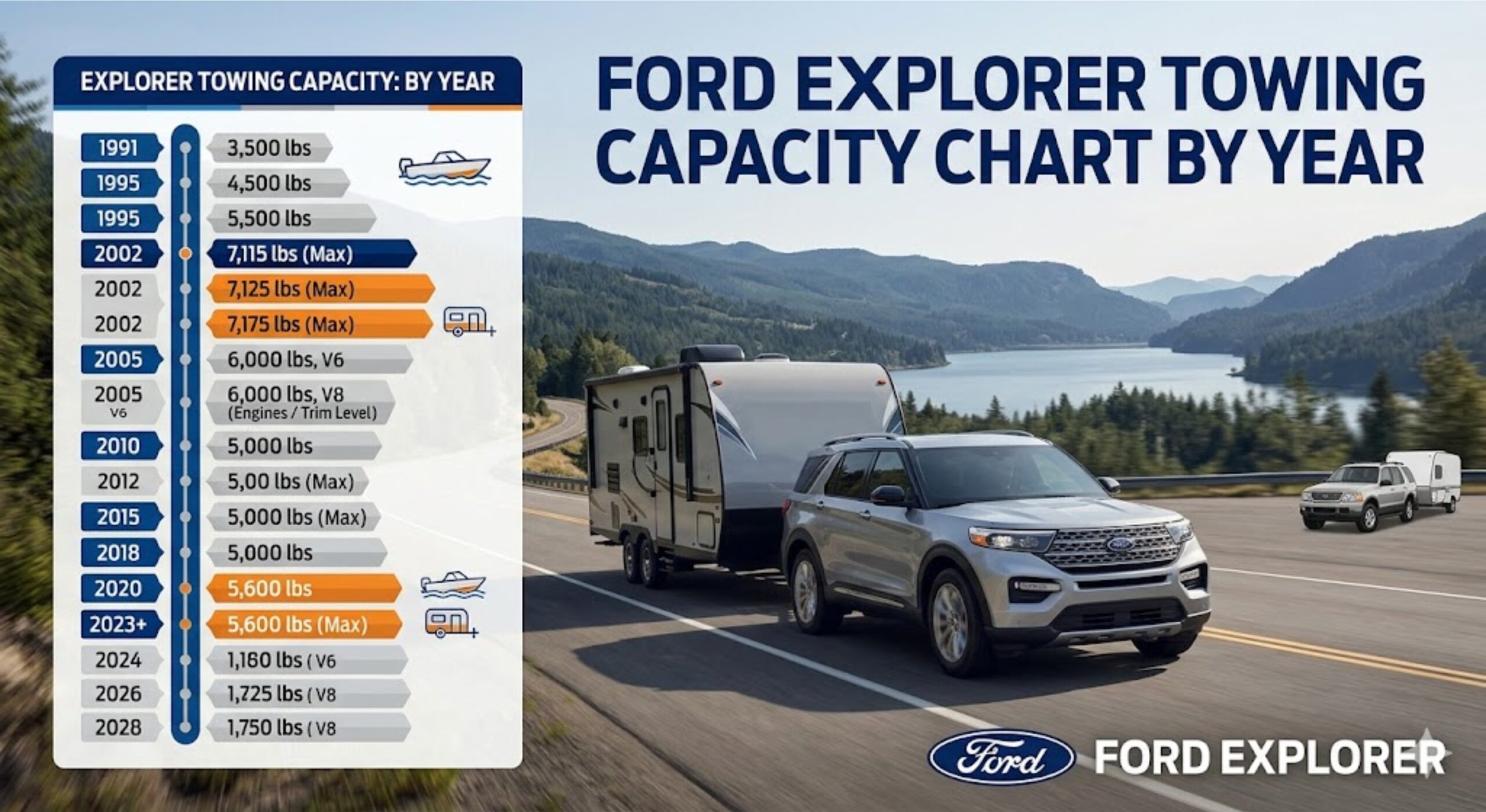
Ford Explorer Towing Capacity Chart by Year (All Generation)

The Ford Explorer has served as a foundational pillar of the sport utility vehicle segment since replacing the Bronco II in the 1991 model year. Over six distinct generations, the vehicle has undergone profound architectural transformations—shifting from a rugged, truck-based, body-on-frame utility vehicle to a sophisticated, unibody crossover.
This structural evolution has directly dictated the vehicle’s trailering capabilities, engine configurations, and payload limits. Assessing the towing capacity of a Ford Explorer requires a deep understanding of longitudinal versus transverse engine layouts, differential axle ratios, and the critical distinction between models equipped with factory-installed tow packages versus those without.

Prime for Young Adults — 6 Months Free
Students and 18–24s get six months of Prime free, then half price.
Start 6 Months Free As an Amazon Associate I earn from qualifying purchases.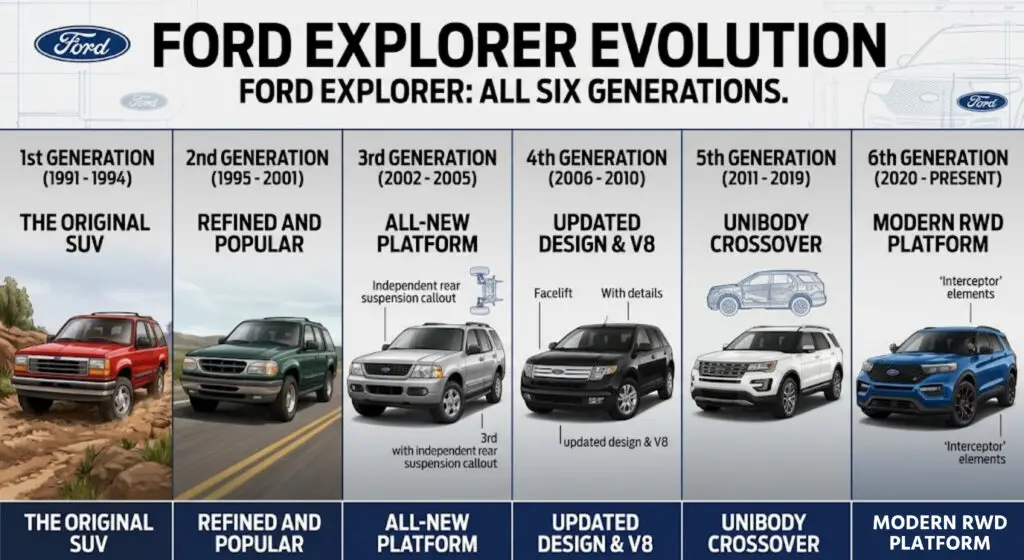
Visualizing Maximum Towing Capacity by Generation
Recommended Best Deal Products


Core Data for Chart Integration:
| Generation | Years | Architecture | Peak Towing Capacity (lbs) |
| First Generation | 1991–1994 | Body-on-Frame | 5,700 |
| Second Generation | 1995–2001 | Body-on-Frame | 6,500 |
| Third Generation | 2002–2005 | Body-on-Frame | 7,300 |
| Fourth Generation | 2006–2010 | Body-on-Frame | 7,300 |
| Fifth Generation | 2011–2019 | Unibody (FWD Bias) | 5,000 |
| Sixth Generation | 2020–2025 | Unibody (RWD Bias) | 5,600 |
Sixth Generation (2020–2025): The Rear-Wheel-Drive Renaissance
The introduction of the sixth-generation Ford Explorer in 2020 represented a critical engineering pivot. Ford engineers departed from the front-wheel-drive-biased D4 platform of the fifth generation, deploying an entirely new longitudinal engine architecture with a rear-wheel-drive bias. This structural overhaul significantly improved weight distribution, payload management, and trailering stability, allowing the peak towing capacity to increase from 5,000 pounds to 5,600 pounds when properly equipped.
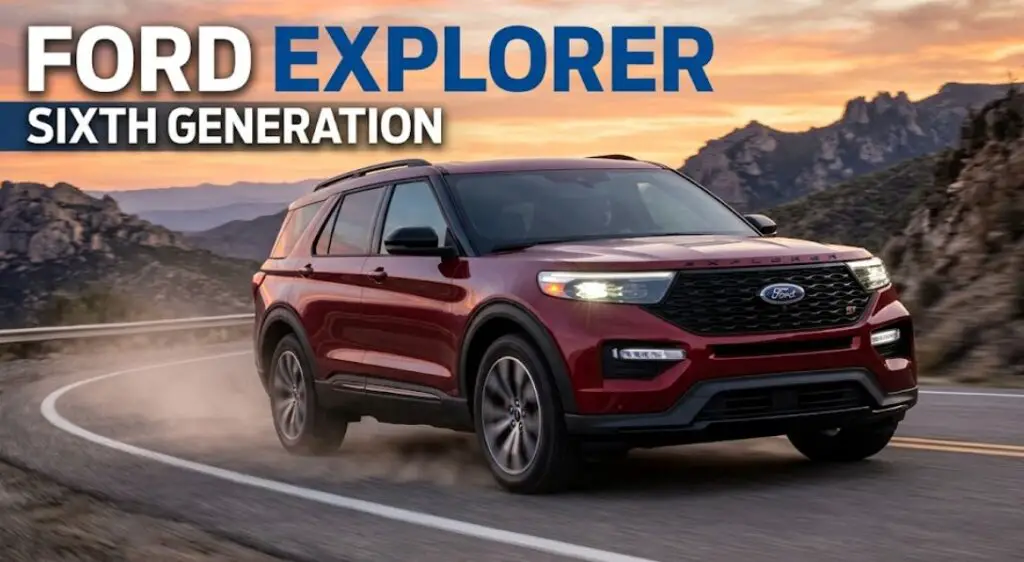
For the 2025 mid-cycle refresh, Ford altered its trailering strategy by standardizing the Class III Trailer Tow Package across all trim levels, including the Active, ST-Line, Platinum, and ST. While this ensures that every new Explorer rolling off the assembly line is immediately capable of hauling a travel trailer or boat, it resulted in a standardized maximum towing capacity of 5,000 pounds, a slight reduction from the 5,600-pound peak available in the 2020 through 2024 model years.
Prior to the 2025 standardization, towing capacity was heavily contingent upon the selected powertrain and the optional Class IV Trailer Tow Package (Option Code 52T). The standard 2.3-liter turbocharged EcoBoost inline-four engine, generating 300 horsepower and 310 lb-ft of torque, achieved a 5,300-pound maximum towing capacity when equipped with the trailering package.
Conversely, the potent 3.0-liter Twin-Turbo EcoBoost V6—standard on the ST and available on Platinum trims—produced up to 400 horsepower and 415 lb-ft of torque, unlocking the maximum 5,600-pound rating. Furthermore, the 3.3-liter Hybrid V6 powertrain managed to deliver an impressive 5,000-pound towing capacity, effectively balancing fuel efficiency with substantial utility.
6th Generation Towing Specifications Matrix (2020-2024)
| Engine Configuration | Drivetrain | Towing Capacity w/o Package (lbs) | Towing Capacity w/ Package (lbs) | GCWR Range (lbs) |
| 2.3L EcoBoost I-4 | RWD / 4WD | 3,000 | 5,300 | 7,700 – 10,300 |
| 3.0L Twin-Turbo EcoBoost V6 | RWD / 4WD | N/A (Package Standard) | 5,600 | 10,600 – 10,800 |
| 3.3L HEV V6 (Hybrid) | RWD / 4WD | 3,000 | 5,000 | 8,500 – 10,600 |
Fifth Generation (2011–2019): The Unibody Transition
Recommended Best Deal Products


The fifth-generation Ford Explorer drastically altered the vehicle’s DNA. Exiting the midsize body-on-frame truck segment, Ford utilized a unibody structure based on the D4 platform, sharing components with the Ford Flex and Taurus.
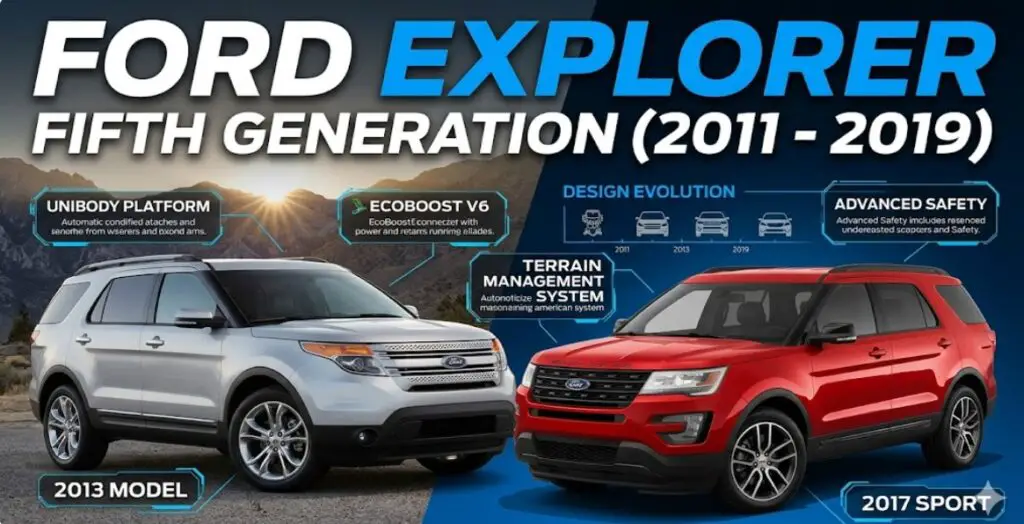
This transition optimized fuel economy, ride comfort, and cabin space, but required compromises in absolute towing power. The maximum towing capacity fell from over 7,000 pounds in previous years to a strict limit of 5,000 pounds.
During this era, trailering safely required specific factory interventions. For models equipped with the naturally aspirated 3.5-liter Ti-VCT V6 or the 3.5-liter Twin-Turbo EcoBoost V6, achieving the 5,000-pound threshold necessitated the factory-installed Class III Trailer Tow Package (Option Code 52T).
This package integrated a 7-wire harness, a 4-/7-pin connector, a frame-mounted hitch receiver, and a critical engine oil cooler to manage powertrain thermal loads. Attempting to tow without this factory package restricted the 3.5-liter engines to a mere 2,000-pound maximum.

Audible — Listen Free for 30 Days
One free credit a month and thousands of titles included.
Listen Free for 30 Days As an Amazon Associate I earn from qualifying purchases.Similarly, the smaller 2.0-liter and 2.3-liter EcoBoost inline-four engines were originally restricted to 2,000 pounds, though the addition of the Class II Trailer Tow Package (Option Code 52R) raised this limit to 3,000 pounds. Ford engineering also placed strict limits on the aerodynamic drag a trailer could impose during this generation.
The “Frontal Area Limitation” mandated that the square footage of the trailer exposed to air resistance not exceed 40 square feet when using the Class III package, preventing excessive aerodynamic strain on the transverse transmission.
5th Generation Towing Specifications Matrix (2011-2019)
| Engine Configuration | Standard Towing (No Package) | Maximum Towing (With Package) | Required Factory Equipment |
| 2.0L / 2.3L EcoBoost I-4 | 2,000 lbs | 3,000 lbs | Class II Trailer Tow Package (52R) |
| 3.5L Ti-VCT V6 | 2,000 lbs | 5,000 lbs | Class III Trailer Tow Package (52T) |
| 3.5L EcoBoost V6 | N/A | 5,000 lbs | Class III Trailer Tow Package (52T) |
Third & Fourth Generations (2002–2010): The Peak Towing Era
For consumers utilizing the secondary market to acquire a dedicated towing rig, the third (2002–2005) and fourth (2006–2010) generations of the Explorer represent the absolute zenith of the nameplate’s pulling power. Engineered on a rugged body-on-frame chassis, these SUVs operated with the mechanical fortitude of a midsize pickup truck while offering the passenger comfort of a closed cabin.
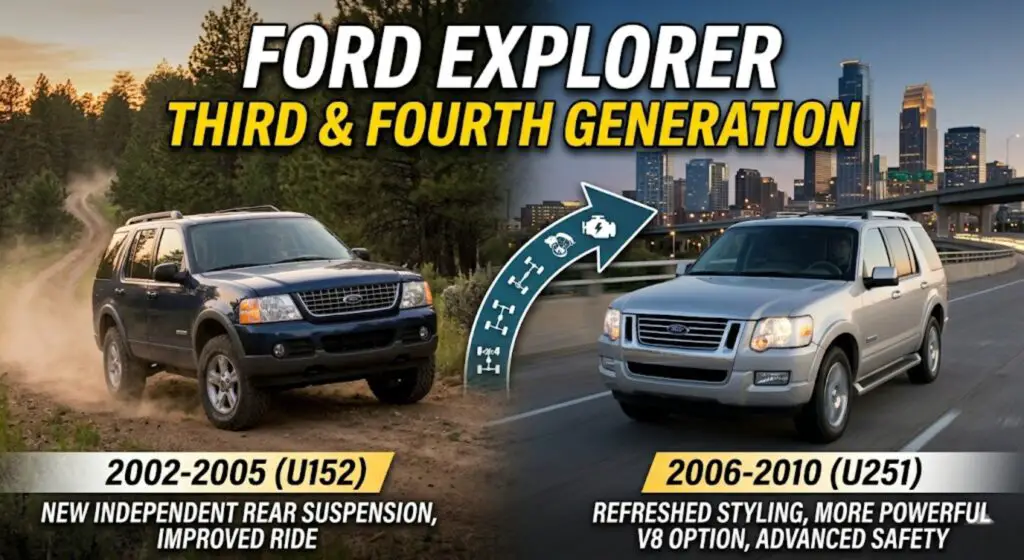
The third generation introduced an independent rear suspension (IRS), which enhanced ride stability without compromising the rigid frame essential for heavy trailering.
The introduction of the 4.6-liter SOHC V8 engine transformed the Explorer into a highly capable hauler. Between 2002 and 2005, the 239-horsepower V8 could pull between 7,140 and 7,300 pounds when paired with the heavy-duty Class III/IV towing prep package and a 3.73 Limited Slip rear differential.
The subsequent 2006 update introduced a 3-valve version of the 4.6-liter V8 producing 292 horsepower mated to a new 6-speed automatic transmission. This enhanced powertrain maintained a massive 7,300-pound maximum towing capacity and boasted a Gross Combined Weight Rating (GCWR) of 12,000 pounds.
Even the standard 4.0-liter SOHC V6 engine, producing 210 horsepower, proved to be a formidable workhorse. When properly configured with a 3.73 axle ratio and Class III/IV hitch, the V6 models could confidently tow up to 5,380 pounds.
However, V6 models equipped with the standard 3.55 axle ratio and a Class II bumper hitch were strictly limited to 3,500 pounds. To verify the specific hardware equipped on these older vehicles, buyers can reference historical documentation via the(https://www.ford.com/towing/).
3rd & 4th Generation Towing Specifications Matrix (2002-2010)
| Engine Options | Axle Ratio | Drive Type | GCWR (lbs) | Max Towing Capacity (lbs) |
| 4.0L SOHC V6 | 3.55 | 4×2 / 4×4 | 7,700 – 8,500 | 3,110 – 3,500 (Class II) |
| 4.0L SOHC V6 | 3.73 | 4×2 / 4×4 | 10,000 | 5,205 – 5,380 (Class III/IV) |
| 4.6L SOHC V8 (2-Valve) | 3.73 | 4×2 / 4×4 | 11,600 | 7,140 – 7,300 (Class III/IV) |
| 4.6L SOHC V8 (3-Valve) | 3.55 / 3.73 | 4×2 / 4×4 | 12,000 | 7,115 – 7,300 (Class III/IV) |
First & Second Generations (1991–2001): The Ranger Roots
The original Ford Explorer debuted in 1991 as a refined replacement for the compact Bronco II. Constructed on a modified Ford Ranger pickup truck platform, the first generation (1991–1994) utilized a 4.0-liter OHV V6 engine producing 155 horsepower. Despite modest power figures by modern standards, its traditional truck-based chassis permitted a highly respectable towing capacity of 5,400 to 5,700 pounds when utilizing a frame-mounted, weight-distributing hitch system.
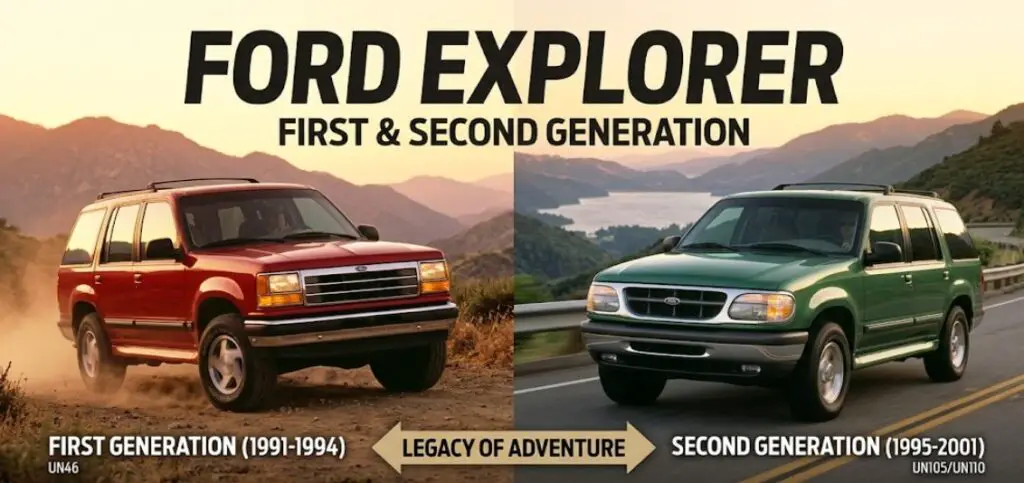
The second generation (1995–2001) implemented significant aerodynamic and mechanical refinements. The most consequential upgrade for towing enthusiasts was the integration of Ford’s legendary 5.0-liter (302 cubic inch) OHV V8 engine in 1996. Generating 210 horsepower and 280 lb-ft of torque, the V8 outmuscled the V6 significantly, boosting the maximum towing capacity to 6,500 pounds when equipped with the required four-speed automatic transmission and the optional trailering package.
Audible Premium Plus — Annual Membership
12 audiobook credits up front, plus the full Audible catalogue.
See Annual Plans As an Amazon Associate I earn from qualifying purchases.Meanwhile, 4.0-liter V6 models equipped with automatic transmissions generally maintained a towing ceiling of 4,800 to 5,000 pounds. Vehicles equipped with manual transmissions faced severe thermal restrictions, dropping the towing limit to approximately 2,500 pounds.
People Also Ask
What is the Ford Explorer towing capacity without a tow package?
Operating a Ford Explorer without a factory-installed tow package severely handicaps its capabilities. For the fifth (2011–2019) and sixth (2020–2024) generations, towing without the Class III or Class IV package restricts the vehicle to a maximum limit of 2,000 to 3,000 pounds. The absence of necessary thermal management hardware, such as heavy-duty radiators and engine oil coolers, creates a severe risk of drivetrain overheating. An aftermarket hitch receiver bolted to the frame does not circumvent the lack of internal cooling capacity.
Does the Ford Explorer require a trailer brake controller?
Unlike heavier F-Series trucks, the Ford Explorer does not roll off the assembly line with an Integrated Trailer Brake Controller (ITBC) embedded in the dashboard. However, towing any trailer exceeding 1,500 to 3,000 pounds generally requires trailer brakes by law across various jurisdictions. Consequently, owners must install an aftermarket electronic trailer brake controller. The Class III tow package facilitates this by providing a 7-wire harness and a 4-/7-pin connector.
How do I find my GCWR and Axle Ratio?
The Gross Combined Weight Rating (GCWR) dictates the maximum legal weight of the tow vehicle, trailer, passengers, and cargo combined. Exceeding this figure is dangerous and compromises the vehicle’s structural integrity. To find the exact GCWR and the differential axle ratio, owners must reference the Safety Compliance Certification Label located on the driver’s side door jamb. The two-digit code under the word “AXLE” (e.g., 3A for a 3.31 ratio, 3C for a 3.73 ratio) corresponds to the gearing charts found in the Ford owner resources portal.
What is the difference between Class III and Class IV tow packages?
Receiver classes describe the hardware rating of the hitch itself rather than the final towing capability of the vehicle. A Class III hitch features a 2-inch receiver and is typically rated for up to 6,000 pounds of Gross Trailer Weight (GTW) and 600 pounds of tongue weight. The Ford Explorer primarily utilizes a Class III setup. A Class IV hitch, while also featuring a 2-inch receiver, utilizes heavier-duty construction capable of managing up to 10,000 pounds of GTW when used with a weight-distributing system—hardware usually reserved for larger body-on-frame SUVs like the Ford Expedition or F-150.
Concluding
The evolution of the Ford Explorer’s towing capacity serves as a fascinating case study in automotive engineering trends. The transition from the rigid, truck-based body-on-frame architecture of the early 2000s—where capacities soared to 7,300 pounds—to the lighter unibody designs of the modern era illustrates a consumer-driven shift toward enhanced fuel economy and passenger comfort.
Nevertheless, advanced engineering has empowered the contemporary unibody Explorer to operate as a highly effective tow vehicle. By returning to a rear-wheel-drive architecture and leveraging torque-dense EcoBoost engines, the modern Explorer effectively manages up to 5,600 pounds.
Safely navigating these limits requires more than referencing a brochure; it demands a thorough assessment of the vehicle’s specific axle ratio, payload constraints, and the presence of factory thermal management systems. By adhering to the precise metrics established by the vehicle’s internal certification labels, operators can ensure a secure and efficient trailering experience.
Full towing capacity guide: Ford F-150 Towing Capacity Chart (2004–2026)