Ford Focus Wet Belt Replacement Cost, Diagnostics, and Engineering Guide In 2026

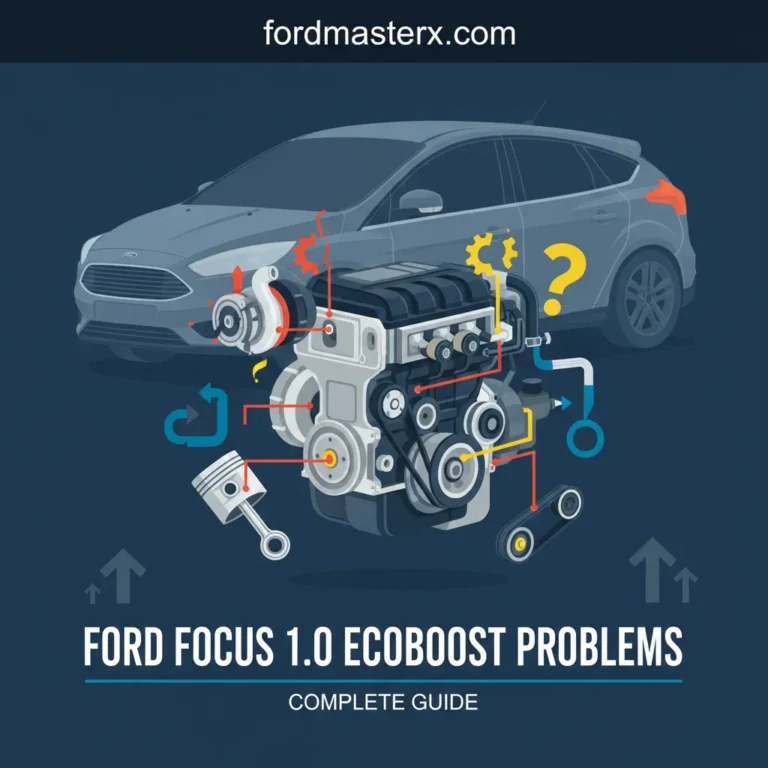
The automotive industry’s pursuit of enhanced fuel efficiency and reduced emissions catalyzed the widespread adoption of downsized, turbocharged engine architectures. At the forefront of this engineering transition was the Ford EcoBoost family, notably the 1.0-litre three-cylinder variant introduced in 2012.
To minimize internal parasitic friction and reduce Noise, Vibration, and Harshness (NVH), mechanical engineers implemented a Belt-in-Oil (BiO) system, universally referred to as a wet timing belt. While the design achieved its immediate efficiency parameters, it introduced significant long-term maintenance complexities that have dominated aftermarket discussions.
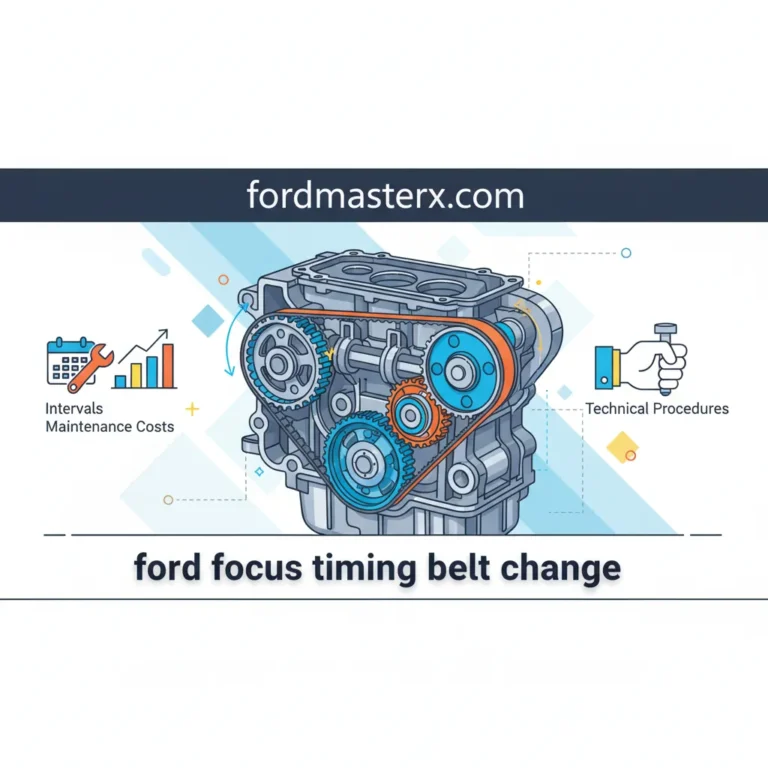
For Ford Focus owners, the chemical degradation of the wet timing and oil pump belts represents a critical operational and financial vulnerability. This report provides an exhaustive analysis of the Ford Focus wet belt replacement cost, exact engineering specifications, component failure symptoms, official manufacturer recalls, and the highly technical replacement procedures required to prevent catastrophic engine failure.
The Economics of Replacement: Cost Analysis and Market Pricing
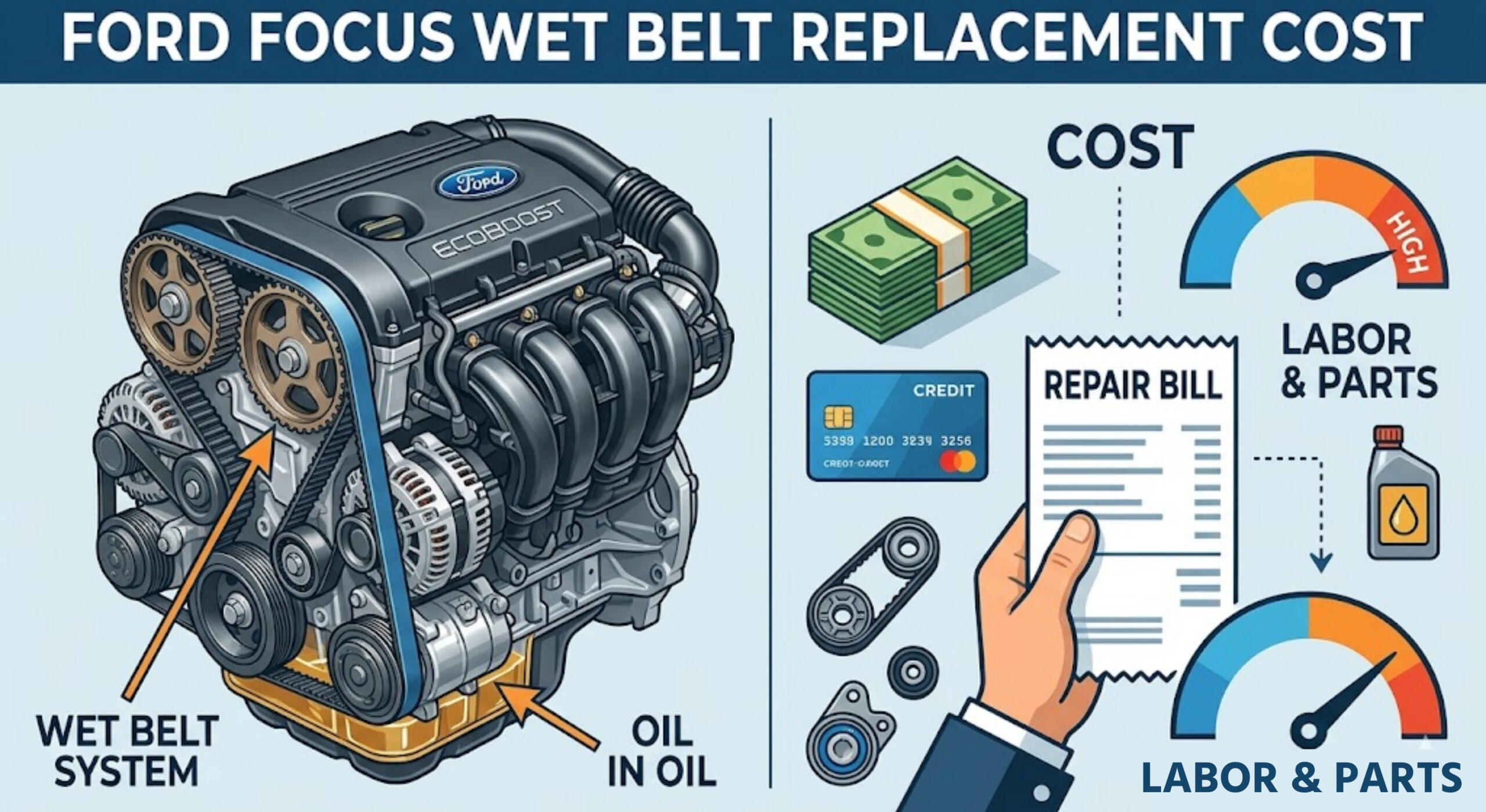
The financial burden associated with replacing a wet belt is substantially higher than that of a traditional dry timing belt or a conventional metallic timing chain. This expense is driven primarily by the extreme labor requirements, the necessity for specialized locking tooling, and the strict mandate to use single-use, torque-to-yield fasteners.
Extensive market research indicates that the average price for a Ford wet belt replacement in the United Kingdom is approximately £981.07. However, this figure functions merely as a baseline. Depending on the vehicle’s age, specific engine variant, and the chosen service provider, total preventative maintenance costs fluctuate between £800 and £1,800.
Main franchised dealerships frequently quote in the upper echelon of this range, with invoices often reaching £1,500 to £2,000—a pricing strategy that independent specialists often interpret as a deterrent against undertaking the highly complex labor.
The total invoice is structurally divided between parts, specialized fluids, and extensive labor hours. The physical components required for a comprehensive wet belt service are specialized. The replacement process demands between eight and twelve hours of active labor, frequently followed by an overnight curing period to allow the specialized sealants on the timing cover and sump to vulcanize properly before engine oil is reintroduced. Labor rates in the UK range from £40 to £180 per hour, rendering the labor cost the dominant financial factor.
| Cost Component | Description | Estimated Pricing (UK £) |
| Wet Belt Kit | Primary camshaft drive belt, lower oil pump belt, tensioners, and idlers. | £350 – £450 |
| Single-Use Fasteners | Crankshaft pulley bolt, timing cover bolts, camshaft sprocket bolts. | Included in premium kits |
| Sealants & Gaskets | Ford silicone sealant, crankshaft oil seal, fuel pump O-ring. | £30 – £50 |
| Fluids & Filters | Mandatory OEM-specification oil flush, premium engine oil, oil filter. | £100 – £200 |
| Active Labor | 8 to 12 hours of mechanical disassembly, cleaning, and precise timing calibration. | £800 – £1,200 |
Delaying a wet belt replacement constitutes a severe financial gamble. If the belt sheds material or snaps entirely, the emergency repair costs escalate exponentially. Emergency repairs following a belt failure but preceding complete engine destruction start at approximately £2,560. If the engine seizes due to oil starvation, the vehicle requires either a full engine rebuild or a complete replacement engine, costing between £3,500 and £6,000.
In older Ford Focus models, the cost of a replacement engine routinely exceeds the residual value of the vehicle, resulting in an economic total loss. For a deeper look at average pricing models across the country, owners can consult aggregator data from platforms like(https://www.whocanfixmycar.com/advice/how-much-does-a-ford-wet-belt-replacement-cost).
Engine Architectures and Model Year Variations
The Ford Focus has utilized several different EcoBoost and EcoBlue engine configurations since 2012. Identifying the precise engine architecture is paramount, as the presence and function of wet belts vary dramatically by model year and engine displacement.
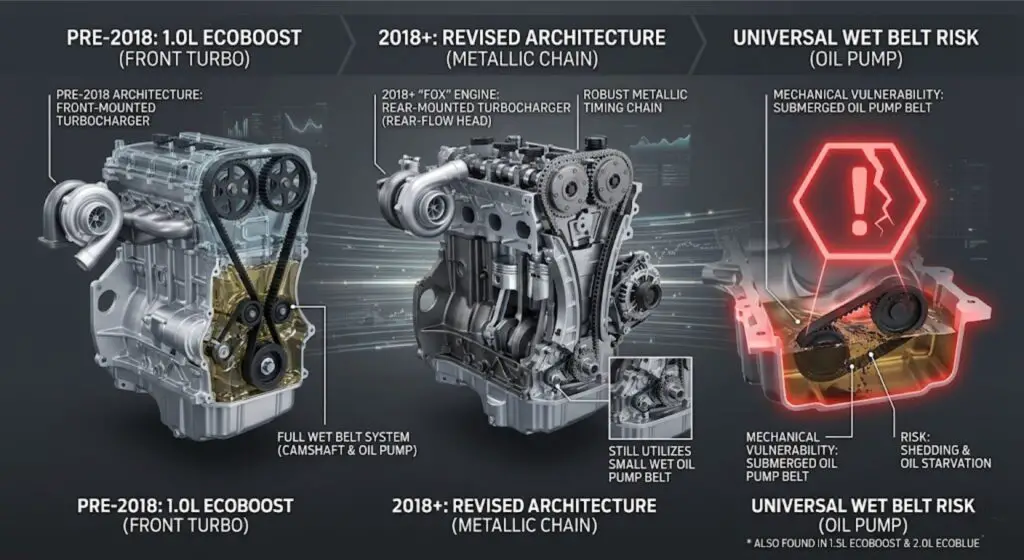
The 1.0-litre three-cylinder EcoBoost is the most prevalent engine associated with wet belt failures. However, Ford silently implemented a massive engineering revision in 2018. Pre-2018 models utilize a large wet timing belt for the main camshaft drive and a secondary, smaller wet belt for the oil pump drive. These early iterations are visually identifiable by the turbocharger being mounted at the front of the engine bay.
Conversely, the 2018 and newer “Fox” engines feature a revised architecture where the camshaft drive utilizes a robust metallic timing chain. Despite this upgrade, the revised engines still rely on a small wet belt to drive the oil pump. These later models feature a reversed-flow cylinder head with the turbocharger mounted at the rear, near the firewall.
There is also widespread market confusion regarding the 1.5L EcoBoost inline-four engine found in the Focus Mk3 and Mk4. Unlike the early 1.0L engines, the 1.5L EcoBoost utilizes a traditional, external dry timing belt for the camshafts. However, it retains an internal wet belt specifically to drive the oil pump.
While less prone to total mechanical snapping than a primary timing belt, this oil pump wet belt is highly susceptible to shedding and causing oil starvation. Furthermore, the 2.0L EcoBlue diesel engines also heavily feature wet belt technology, which has exhibited high failure rates due to oil dilution from Diesel Particulate Filter regeneration cycles.
| Engine Model | Years Active | Camshaft Drive System | Oil Pump Drive System | Known Vulnerabilities |
| Focus 1.0L EcoBoost | 2012 – 2017 | Wet Belt | Wet Belt | Primary belt delamination, oil starvation. |
| Focus 1.0L EcoBoost | 2018 – Present | Timing Chain | Wet Belt | Oil pump belt shedding, blocked oil strainer. |
| Focus 1.5L EcoBoost | 2014 – Present | Dry Belt | Wet Belt | Oil pump belt shedding leading to turbo failure. |
| Focus 2.0L EcoBlue | 2016 – Present | Wet Belt | Wet Belt | Rapid belt degradation due to diesel oil dilution. |
Mechanics of Chemical Degradation
To comprehend the necessity of exact, timely replacements, one must analyze the engineering behind the Belt-in-Oil system. The wet belt synchronizes the movement of the engine’s crankshaft and camshafts, ensuring precise timing for intake and exhaust valves. By immersing a specially formulated rubber belt in the engine’s oil bath, engineers theoretically achieved superior cooling, enhanced durability, and protection from external particulate contaminants.
Despite these initial advantages, the system contains an inherent chemical vulnerability. Over tens of thousands of miles, the rubber compound is continuously exposed to thermal cycling, mechanical stress, and modern synthetic engine oils. The problem is exacerbated by incomplete combustion blow-by gases, unburnt fuel, and moisture that inevitably mix with engine oil.
This chemical cocktail attacks the belt’s internal structure. Instead of simply snapping abruptly like a dry belt, a wet belt slowly delaminates. It sheds fibrous teeth and small rubber particles directly into the oil pan.
This shedding initiates a catastrophic mechanical cascade. The rubber flakes accumulate in the oil sump and rapidly clog the mesh strainer of the engine’s oil pickup pipe. With the strainer blocked, the oil pump cannot maintain adequate fluid pressure.
The turbocharger, which spins at speeds exceeding 150,000 RPM and relies on a constant feed of high-pressure oil for its fluid bearing, is invariably the first component to fail from starvation. Eventually, the main bearings and camshaft journals run dry, resulting in irreversible engine seizure.
Replacement Intervals and Preventative Maintenance Protocols
A significant point of contention within the automotive diagnostic community is the timeline for preventative maintenance. Following the manufacturer’s initial guidelines has proven historically insufficient for many drivers, leading to widespread engine failures. Upon the launch of the 1.0L EcoBoost, Ford marketed the wet belt as a “life of car” component. This was later formally revised to a recommendation of 10 years or 150,000 miles, whichever occurs first, for the 1.0L and 1.5L EcoBoost engines.
Empirical data from independent workshops clearly demonstrates that the belts rarely survive to the 150,000-mile mark. The degradation process is heavily influenced by driving topography. Vehicles used primarily for short, urban journeys rarely reach optimal operating temperatures, preventing moisture and combustion byproducts from evaporating out of the oil. This accelerates the formation of acidic oil sludge that rapidly destroys the belt.
Consequently, independent experts strongly advocate for a drastically reduced service interval. Treating the wet belt replacement as an 80,000-mile maintenance item rather than a 150,000-mile item is considered mandatory insurance against a £5,000 engine rebuild.
| Engine Variant | Ford Official Interval | Expert Recommended Interval |
| 1.0L EcoBoost | 10 years or 150,000 miles | 5–8 years or 50,000–80,000 miles |
| 1.5L EcoBoost | 10 years or 150,000 miles | 7 years or 80,000–100,000 miles |
| 2.0L EcoBlue | 6 years or 100,000 miles (Revised) | 5–6 years or 60,000–80,000 miles |
Routine servicing is equally critical. The rubber compound used in Ford’s wet belts was formulated and tested against highly specific motor oil. Using incorrect, budget, or off-the-shelf universal oils will introduce incompatible detergents that aggressively accelerate the swelling and flaking of the rubber.
Owners must exclusively use Ford-approved OEM oil, specifically Motorcraft or alternatives meeting the WSS-M2C948-B specification. Furthermore, automotive engineers suggest introducing an interim service where the oil and filter are changed every 12 months or 9,000 miles to flush out belt-degrading contaminants.
Symptoms of Failure
Because the wet belt is sealed inside the engine block, visual inspection without mechanical disassembly is impossible. Owners and technicians must rely on secondary auditory, electronic, and visual cues to diagnose belt degradation. Catching these symptoms early is the only viable method to prevent total mechanical loss.
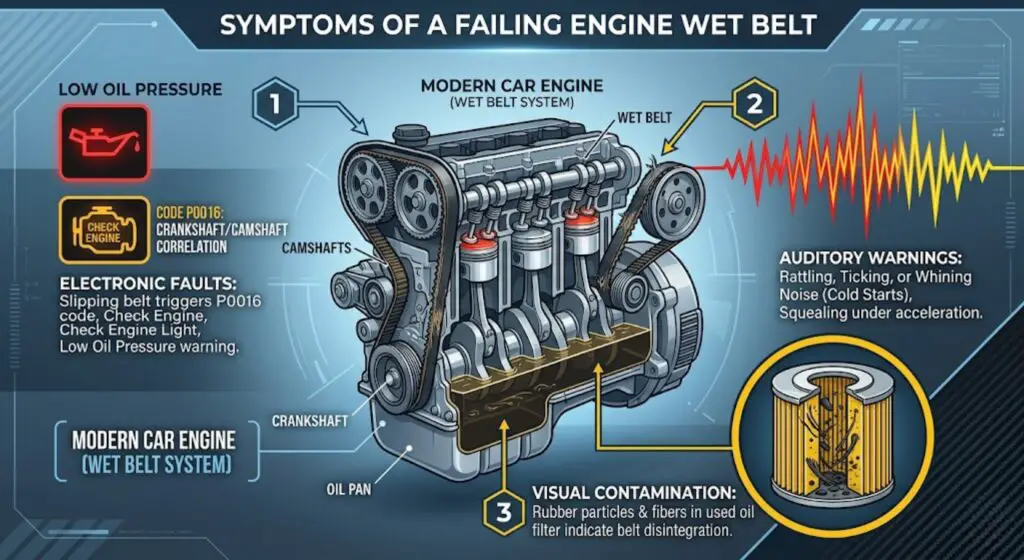
Auditory warning signs manifest early in the degradation cycle. A worn or stretching wet belt frequently produces a distinct rattling, ticking, or whining noise from the engine bay, particularly during cold starts when oil pressure is initially low and the hydraulic tensioner has not fully pressurized. As the belt frays and loses optimal tension against the gears, it may slip, causing abnormal rotational squealing under acceleration load.
Electronic and performance faults provide the most urgent diagnostic data. The most critical warning sign is the sudden illumination or flickering of the red oil pressure light on the dashboard. This directly indicates that rubber debris has clogged the oil pickup pipe, necessitating immediate engine shutdown.
As the belt degrades and timing correlation slips, the engine will exhibit a lumpy idle, misfires, and severe hesitation during power delivery. A slipping belt will trigger the Engine Management Light (EML), and diagnostic OBD2 scanners will frequently reveal code P0016 (Crankshaft Position – Camshaft Position Correlation), proving the mechanical timing has jumped.
Visual oil contamination offers definitive proof of degradation. During routine oil changes, technicians should rigorously inspect the drained oil and actively cut open the used oil filter. The presence of black specks, fibrous strands, or rubber particles within the filter pleats is absolute confirmation that the wet belt is actively disintegrating.
Technical Replacement Procedure and Specialized Tooling
The labor cost associated with a Ford Focus wet belt replacement is justified entirely by the extreme complexity of the operation. This is not a standard maintenance procedure; it requires a sterile working environment, a mastery of torque physics, and significant financial investment in specialized Ford tooling.
The procedure begins with the removal of the right-hand engine mount, starter motor, and alternator to gain access to the timing cover. The vehicle is lifted to remove the oil sump pan. Replacing the belt is only a fraction of the necessary labor; the technician must painstakingly clean the entire bottom end of the engine.
The oil pump pickup strainer must be removed and either chemically purged of all rubber debris or completely replaced. If a new belt is installed but the strainer remains partially blocked, the engine will suffer immediate oil starvation upon restart. The mating surfaces for the timing cover and sump must be made immaculately clean; any residual sealant will result in highly pressurized oil leaks, ruining the repair.
Precise engine synchronization requires locking the rotating assembly in a fixed position. Without these exact tools, the valves will collide with the pistons, destroying the engine instantly.
| Ford Special Tool | Part Number | Function in Replacement Procedure |
| Flywheel Locking Tool | 303-1602 | Secures the crankshaft from rotating via the starter motor aperture. |
| Crankshaft TDC Peg | 303-1604 | Machined pin inserted into the block to establish exact Top Dead Center. |
| Camshaft Alignment Tool | 303-1605 | Secures the variable valve timing phasers. |
| Tensioner Locking Pin | 303-1054 | Holds the hydraulic tensioner in place during belt routing. |
| Torque Multiplier | 303-1611 | Planetary gear system required for tightening the crankshaft bolt. |
The most critical phase of the reassembly involves the crankshaft pulley bolt. Because the 1.0L EcoBoost uses a “floating crank” design lacking a traditional keyway, the immense friction of the bolt is the sole mechanism holding the engine timing together. Ford explicitly specifies the use of a Torque Multiplier (Tool 303-1611). This tool utilizes a planetary gear system with a gear ratio of roughly 5.45:1 to multiply the input force applied by the technician.
The fastening procedure requires a staggering final torque output that cannot be achieved safely with a standard breaker bar in the transverse engine bay. The technician must first torque the single-use stretch bolt to 25 Nm, followed by 70 Nm directly. The torque multiplier is then attached. The technician applies 60 Nm of input force via the multiplier, followed by five successive 90-degree turns. Failing to execute this exact sequence will cause the crank pulley to slip, instantly ruining the engine’s internal geometry.
To maintain uniform clamping force, Ford uses Torque-to-Yield (TTY) bolts that permanently stretch. The front pulley crankshaft bolt, timing cover bolts, and high-pressure fuel pump bolts must be discarded and replaced during every wet belt service. Reusing these components is a primary reason why uncertified garages offer lower quotes, presenting an unacceptable mechanical risk.
Safety Recall 23S64
In response to the volume of catastrophic failures and subsequent pressure from international automotive safety regulators, Ford has acknowledged the engineering defects in specific production runs.
In late 2023, Ford issued Safety Recall 23S64 for certain 2016–2022 model year Ford EcoSport and Ford Focus vehicles equipped with the 1.0L engine and 6F15 automatic transmission. Ford acknowledged that the engine oil pump drive belt material can rapidly degrade and lose teeth, or the tensioner arm can fracture, resulting in a total loss of oil pressure.
The safety risk is severe: the loss of oil pressure disables the mechanical vacuum pump, which provides power braking assist. Losing brake assist unexpectedly severely increases the risk of a high-speed collision.
Under the terms of the recall, if a qualifying vehicle’s engine fails due to a damaged oil pump belt prior to the availability of the final repair parts, Ford authorized dealerships to replace the entire engine assembly completely free of charge to the customer. Final remedy parts were scheduled for rollout in the first quarter of 2025.
Owners must verify their Vehicle Identification Number (VIN) via the official(https://www.ford.com/support) recall portal to confirm eligibility, as the recall strictly covers vehicles manufactured between March 24, 2015, and May 4, 2018. Vehicles outside of these specific parameters—such as those with manual transmissions—are currently excluded, leaving owners to bear the £1,000+ preventative maintenance costs independently.
The Viability of Chain Conversions
Given the anxiety surrounding rubber degradation in oil, a highly sought-after solution among Ford owners is retrofitting a metallic timing chain in place of the wet belt. The engineering viability of a conversion depends entirely on the engine variant and the specific belt in question.
Converting the primary camshaft drive from a wet belt to a chain on a pre-2018 1.0L EcoBoost is effectively impossible without replacing the entire cylinder head, tensioning system, and ECU architecture. The physical space, lubrication ports, and tensioner mounting points for a chain simply do not exist on the early engine blocks.
Conversely, converting the lower oil pump belt to a chain is possible on certain engines. Aftermarket kits exist that swap the toothed rubber belt gears for chain sprockets. Wet belt to chain conversion kits are readily available for certain diesel variants, such as the Ford 1.8 TDCi and 2.0 EcoBlue. For the 1.8 TDCi, the conversion kit retails for approximately £219.99 for the parts alone.
Specialist garages offer this fixed-price conversion, including sump removal and cleaning, for around £595. While a chain conversion for the oil pump provides substantial peace of mind against oil starvation, it does increase mechanical NVH slightly. However, for the primary 1.0L EcoBoost cam belt, owners must accept the reality of ongoing, highly technical wet belt replacements.
FAQs
How much does it cost to replace a Ford Fiesta wet belt compared to a Focus?
The replacement cost is remarkably similar due to the shared 1.0L EcoBoost engine architecture across platforms. Market data indicates the average price for a Fiesta wet belt replacement is £938.49, while the Focus averages £968.09. Smaller vehicles like the Fiesta or Focus generally require marginally less labor time than larger commercial vehicles like the Transit Custom, where engine bay access is highly restricted, driving up total labor hours.
Can an independent garage replace a wet belt, or is a Ford dealer strictly required?
An independent garage is entirely capable of replacing the wet belt, provided they operate as a reputable engine specialist equipped with the exact Ford timing locking tools (303-1605, 303-1604) and the Torque Multiplier (303-1611). The critical requirement is that the independent garage explicitly utilizes new single-use TTY bolts and OEM sealant specifications. Reputable independents frequently deliver this highly specialized expertise at a significantly lower hourly rate than main franchised dealers.
When did Ford officially stop using wet belts in the Focus?
For the primary camshaft timing drive, Ford transitioned away from the wet belt in the 1.0L EcoBoost starting in 2018, moving to a timing chain on the revised “Fox” engine. However, it is a critical engineering distinction that even the post-2018 chain-driven engines still utilize a small wet belt to drive the internal oil pump. Therefore, the wet belt architecture was never entirely eradicated from the EcoBoost platform.
Is it safe to drive with a rattling cold start noise on an EcoBoost engine?
Absolutely not. A rattling noise on a cold start is a primary diagnostic symptom of a degraded, stretching wet belt or a failing hydraulic tensioner struggling to build pressure. Operating the vehicle under these conditions risks the belt slipping a tooth, which instantly destroys valve timing, or snapping completely. If the oil pressure light illuminates concurrently with the noise, the vehicle must be towed immediately to prevent total internal engine seizure.
Does the Ford 1.5 EcoBoost feature a wet belt?
The 1.5L EcoBoost engine utilized in the Ford Focus features a hybrid architectural approach. It uses a traditional, external dry timing belt to drive the camshafts. However, it utilizes an internal wet belt to drive the oil pump. Therefore, while it does not possess a “wet timing belt,” it remains highly vulnerable to the risk of the wet oil pump belt degrading, shedding material, and fatally clogging the oil pickup.
What happens if incorrect oil is used in the EcoBoost engine?
Utilizing motor oil that fails to meet Ford’s strict WSS-M2C948-B specification is a primary chemical catalyst for premature wet belt failure. Incompatible detergents and additives present in standard or budget synthetic oils cause the specialized rubber of the wet belt to swell, soften, and disintegrate aggressively. Adhering to exact oil specifications and shortening change intervals to 9,000 miles is the singular most effective preventative measure an owner can take.