
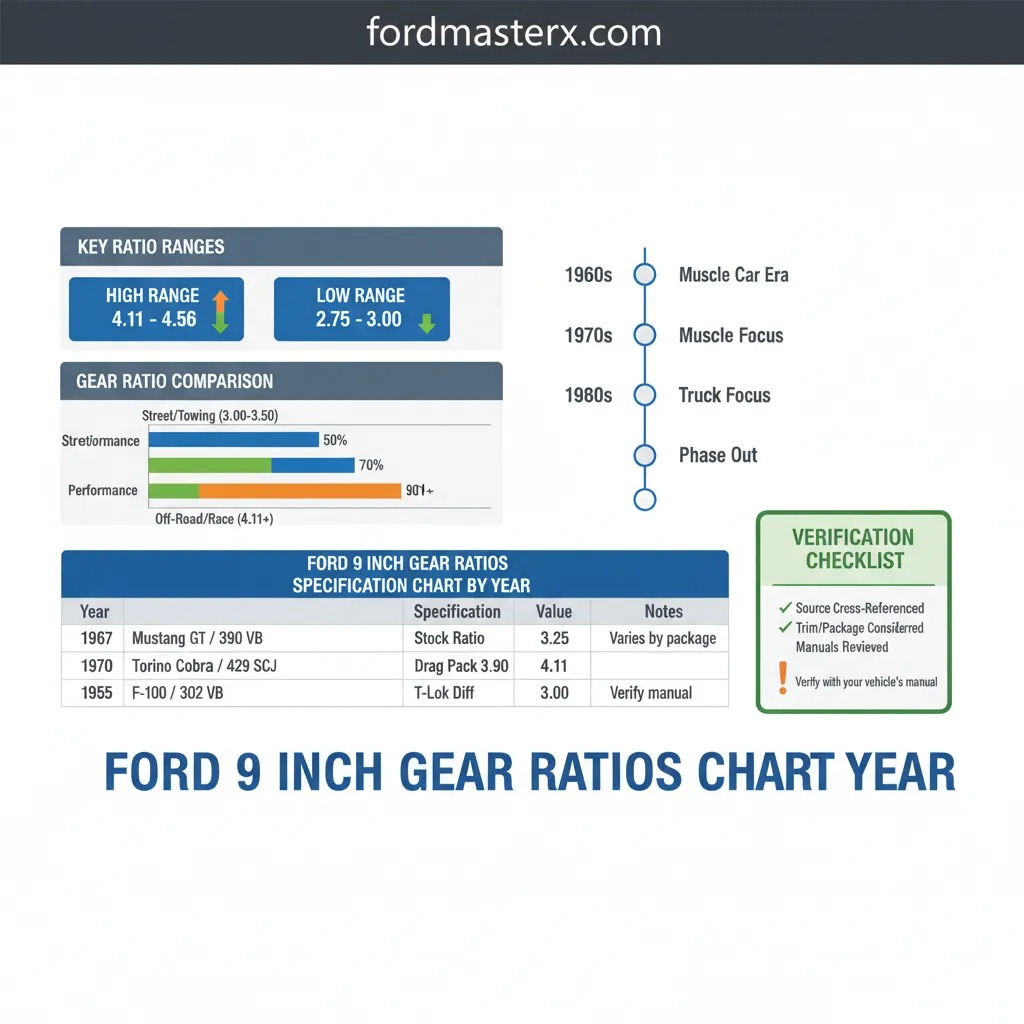
Ford 9 Inch Gear Ratios Specification Chart By Year

Quick Answer
The Ford 9-inch rear end offered a broad spectrum of gear ratios from approximately 2.50:1 to over 5.00:1, with common factory specifications ranging from 2.75:1 to 4.11:1. These ratios varied significantly based on the vehicle’s year, engine option, transmission type, and intended application, from passenger cars to heavy-duty trucks, necessitating verification against specific vehicle documentation.
After identifying the ratio and differential type, use our Ford 9-inch gear-oil guide to compare viscosity and limited-slip requirements.

Prime for Young Adults — 6 Months Free
Students and 18–24s get six months of Prime free, then half price.
Start 6 Months Free As an Amazon Associate I earn from qualifying purchases.The Ford 9-inch rear end remains an iconic and highly sought-after differential in automotive performance and restoration, celebrated for its robust design and ease of modification. Enthusiasts and mechanics often struggle to determine the correct factory gear ratios for specific models and years, leading to mismatched components or suboptimal performance. This authoritative guide provides a detailed specification chart of Ford 9-inch gear ratios by year, outlining historical variations, configuration-specific details, and critical factors influencing their selection and performance across its primary application period from 1957 through approximately 1987.
This chart compiles typical factory Ford 9-inch gear ratios from 1957 through approximately 1987, covering various passenger cars, trucks, and performance models. Values represent common specifications, but exact ratios could vary significantly by specific model year, trim level, engine option, transmission type, and optional equipment packages. Always verify your vehicle’s specific ratio via the axle code on the door jamb sticker, original build sheet, or owner’s manual. Aftermarket modifications are common and may deviate from these factory specifications. Last reviewed: May 2026.
Ford 9-Inch Gear Ratios Specification Chart by Year (1957-1987)
Recommended Best Deal Products

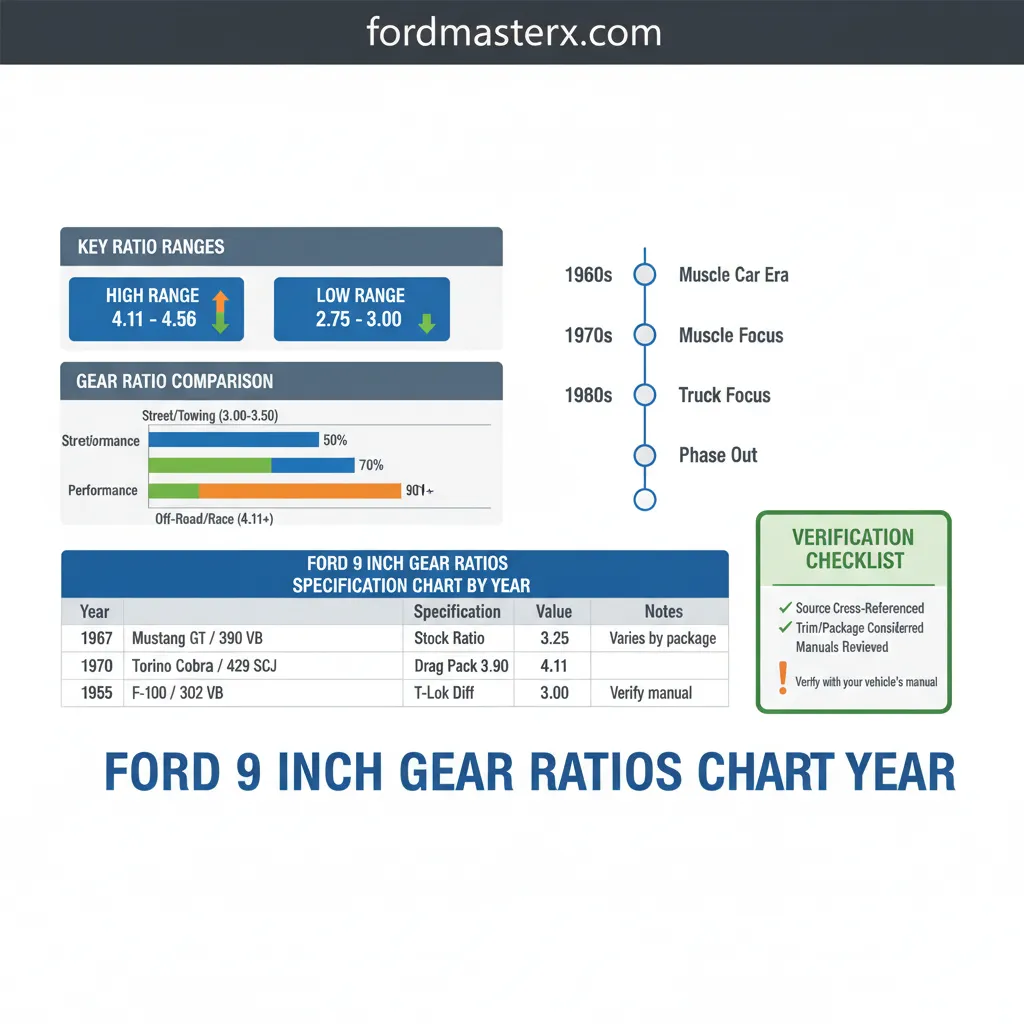
This primary data reference provides typical factory Ford 9-inch rear end gear ratios. These values reflect the common configurations offered during the 9-inch’s extensive production run. The versatility of the 9-inch, particularly its removable third member design, made it a favorite for diverse applications, from economical passenger cars to high-performance muscle cars and heavy-duty trucks.
📤 Share Image
How to Read This Chart: Each row indicates a typical factory gear ratio for a given year and vehicle type. “OEM Ratio” specifies the numeric ratio (e.g., 3.00:1). “Common Application” details the vehicle segment or engine type where this ratio was frequently found. “Notes” provide additional context, such as common axle codes or specific performance packages. Remember that these are representative values, and your specific vehicle’s configuration may differ.
| Year | Model / Engine | OEM Ratio (Value) | Common Application | Notes |
|---|---|---|---|---|
| 1957-1960 | Passenger Cars (V8), F-Series | 2.75:1 – 3.10:1 | Economy/Cruising, Light Truck | Common for early highway efficiency. |
| 1961-1964 | Galaxie, Fairlane, F-Series | 2.80:1 – 3.25:1 | Standard Passenger, Mid-range Truck | Good balance of performance and economy. |
| 1965-1968 | Mustang, Falcon, F-Series | 3.00:1 – 3.50:1 | Early Muscle Car, General Truck | Performance options became more common. |
| 1969-1971 | Mustang Mach 1, Boss 302/429, F-250/350 | 3.25:1 – 4.11:1 | Peak Muscle Car, Heavy Duty Truck | Aggressive ratios for high-performance engines; includes optional ‘N-case’ and ‘Daytona’ pinions. |
| 1972-1975 | Torino, F-Series | 2.75:1 – 3.70:1 | General Passenger, Work Truck | Shift towards lower numeric ratios for fuel economy in passenger cars. |
| 1976-1980 | LTD, Bronco, F-Series | 2.47:1 – 3.50:1 | Economy Passenger, SUV, Truck | Lowest numeric ratios appeared for efficiency. Limited-slip (Trac-Lok) options were common. |
| 1981-1987 | F-Series (as 9-inch phase-out) | 3.00:1 – 3.73:1 | Truck/Heavy Duty | Primarily found in trucks; phasing out of passenger cars. |
Footnote: All ratios are approximate factory specifications. Always consult your vehicle’s specific documentation or axle tag for precise verification. Performance packages often included unique, higher numeric ratios.
~2.47:1
~4.11:1
~3.00:1
1969-1971

Historical Overview: Ford 9-Inch Gear Ratio Changes by Year and Model
The evolution of Ford 9-inch gear ratio offerings reflects a dynamic interplay of market demands, technological advancements, and regulatory pressures. Its history can be broadly categorized into three distinct periods, each characterized by prevalent gearing philosophies.
Early Period (Late 1950s – Early 1960s): Cruising & Capability
In its nascent years, the Ford 9-inch was fitted with a diverse range of ratios. Lower numeric ratios, such as 2.75:1 to 3.00:1, were common for mainstream passenger cars like the Ford Galaxie, prioritizing smooth highway cruising and fuel economy—a notable concern even then. Simultaneously, light trucks and early performance models utilized ratios around 3.25:1 to 3.50:1, balancing load-hauling capability with respectable acceleration. Research indicates that these early ratios established the 9-inch as a versatile differential suitable for a broad spectrum of Ford’s vehicle lineup.
Mid-Period (Mid-1960s – Early 1970s): The Muscle Car Era
This era marked the zenith of the muscle car, and the Ford 9-inch was at its heart. Numerically higher performance ratios became highly prevalent, especially with high-horsepower engine options. Iconic models like the 1969 Mustang Mach 1 with a 428 Cobra Jet engine could feature 3.50:1, 3.91:1, or even 4.11:1 ratios. This period saw the introduction of specialized “N-case” and “Daytona” pinions designed for extreme durability in racing applications, often paired with these aggressive ratios. For instance, a 1965 Mustang 289 V8 might have come standard with a 3.00:1 ratio, but a performance-tuned variant could easily have 3.50:1 or higher for enhanced acceleration.

Audible — Listen Free for 30 Days
One free credit a month and thousands of titles included.
Listen Free for 30 Days As an Amazon Associate I earn from qualifying purchases.Later Period (Mid-1970s – Late 1980s): Efficiency & Phasing Out
The mid-1970s brought a significant shift. Increasing emission regulations, coupled with rising fuel costs, pushed manufacturers towards greater fuel efficiency. This led to a general trend of numerically lower gear ratios in passenger cars, with options like 2.47:1 or 2.75:1 becoming commonplace to reduce engine RPM at cruising speeds. While the 9-inch began phasing out of passenger car applications in favor of lighter, more efficient designs, it continued its robust service in F-Series trucks and SUVs like the Bronco, where higher ratios (e.g., 3.50:1, 3.70:1) remained essential for towing and heavy-duty work. Research indicates the average factory ratio in passenger car applications decreased by approximately 0.5 points from the 1960s to the 1980s.
Focus on highway economy (2.75-3.10) & light truck utility. Balanced approach.
Aggressive gearing (3.50-4.11) for muscle cars. “N-case” and “Daytona” axles.
Lower numeric ratios (2.47-3.25) in cars due to emissions/fuel, trucks retain higher.
Primarily in F-Series, emphasis on durability and towing. Passenger car fade-out.
Decoding 9-Inch Gear Ratios: Engine, Vehicle, and Configuration-Specific Details
Understanding the factory-installed Ford 9-inch gear ratios requires a nuanced look at how various vehicle configurations, engine options, and transmission types critically influenced Ford’s engineering choices. These details are paramount for accurate identification and application understanding.
Engine Displacement and Power Output
There’s a direct correlation between an engine’s characteristics and its paired gear ratio. Engines with higher displacement and torque output, particularly those in larger sedans or trucks, often received numerically lower ratios (e.g., 2.75:1 to 3.00:1) to provide smooth, economical highway manners. Conversely, high-revving performance engines, like those found in Boss 302 Mustangs, were paired with numerically higher ratios (e.g., 3.50:1 to 4.11:1) to maximize off-the-line acceleration and responsiveness, keeping the engine within its optimal power band.
Transmission Type and Number of Gears
The transmission plays a pivotal role. Automatic transmissions, due to torque converter slip and typically fewer forward gears (e.g., 2 or 3-speed), often featured numerically higher rear-end ratios to compensate and improve perceived acceleration. Manual transmissions, especially those with more gears (e.g., 4-speed), could utilize a wider range of ratios, sometimes opting for slightly lower numeric ratios for a broader speed range, as the driver had more control over engine RPM through gear selection. For example, a 1968 Ford Fairlane with a 302 V8 and manual transmission might have a 3.25:1 ratio for balanced performance, while an automatic version might lean towards 3.50:1.
Vehicle Application: Cars vs. Trucks vs. Performance
The intended use of the vehicle was a primary determinant:
- Passenger Cars: Generally balanced performance with fuel economy, leading to ratios like 2.75:1 to 3.25:1.
- Trucks: Prioritized towing and hauling capabilities, demanding numerically higher ratios (e.g., 3.50:1 to 3.70:1, or even 4.10:1 in heavy-duty applications). Factory towing guides confirmed that the gear ratio directly influenced a truck’s Gross Vehicle Weight Rating (GVWR) and Gross Combined Weight Rating (GCWR). A 1970 Ford F-250 with a 390 V8 and automatic transmission would typically feature a 3.70:1 ratio for towing.
- Dedicated Performance/Off-Road Models: Received specialized gearing, often 3.91:1, 4.11:1, or higher (even 4.56:1+ for drag-strip specific options) to maximize acceleration or low-speed torque.
Performance Packages and Optional Equipment
Ford frequently bundled numerically higher gear ratios within special performance packages such as GT, Cobra Jet, or Super Cobra Jet options. These packages aimed to maximize acceleration and perceived horsepower delivery. Moreover, limited-slip differentials, such as Ford’s Trac-Lok, were often factory-paired with these performance-oriented gear ratios to ensure power was effectively put to the ground.
Audible Premium Plus — Annual Membership
12 audiobook credits up front, plus the full Audible catalogue.
See Annual Plans As an Amazon Associate I earn from qualifying purchases.The exact gear ratio for any Ford 9-inch application is highly dependent on the vehicle’s specific build. Factors like engine size, transmission type (manual vs. automatic, number of gears), and whether it was part of a performance or towing package directly altered the factory ratio. Always cross-reference with official Ford documentation for your specific VIN.
Understanding the Impact: Interpreting Ford 9-Inch Gear Ratio Values
The chosen gear ratio for a Ford 9-inch differential profoundly influences a vehicle’s performance characteristics. It’s a critical component in defining how a vehicle accelerates, its top speed potential, fuel efficiency, and the engine’s operating RPMs.
Numerically Higher Ratios: Acceleration Focus
Numerically higher ratios (e.g., 3.70:1, 4.11:1, 4.56:1) mean the driveshaft rotates more times for every rotation of the wheels. This translates directly to:
- Quicker Acceleration: Enhanced off-the-line performance and improved responsiveness, as more torque is delivered to the wheels.
- Increased Torque at Wheels: Ideal for drag racing, heavy towing, or off-roading where maximizing pulling power is essential.
- Higher Engine RPMs: The engine will operate at higher revolutions per minute for any given road speed, especially at cruising velocities.
- Reduced Top Speed Potential: The engine will hit its redline sooner, limiting maximum speed (though often not a practical concern for street use).
- Lower Fuel Economy: Due to higher RPMs at cruising speeds, fuel consumption typically increases.
For instance, a vehicle with a 4.11:1 ratio might achieve exceptional 0-60 mph times but will turn significantly higher RPMs on the highway compared to a vehicle with a 3.00:1 ratio, leading to increased noise and fuel consumption.
Numerically Lower Ratios: Efficiency and Top Speed
Numerically lower ratios (e.g., 2.75:1, 3.00:1, 3.25:1) mean fewer driveshaft rotations per wheel rotation. The effects are largely the opposite:
- Slower Acceleration: Less torque multiplication at the wheels, resulting in a more leisurely take-off.
- Lower Engine RPMs: The engine operates at lower RPMs at cruising speeds, reducing wear and noise. A typical change from a 3.00:1 to a 3.50:1 ratio results in an approximate 16-17% increase in engine RPM at any given road speed.
- Improved Highway Fuel Economy: Lower RPMs directly translate to better gas mileage.
- Higher Top Speed Potential: The engine can reach higher road speeds before hitting its redline.
- Reduced Towing/Hauling Capacity: Less mechanical advantage for heavy loads.
A car with a 3.00:1 ratio might cruise at 2500 RPM at 70 mph, whereas the same vehicle with a 4.11:1 ratio could be operating at 3500+ RPM at the same speed. This highlights the fundamental trade-off between acceleration and highway efficiency.
Choosing the Right Ratio for Your Use Case
Selecting the ‘right’ gear ratio is about aligning it with the vehicle’s primary intended use and complementing the engine’s power band and transmission characteristics. For a daily driver or highway cruiser, lower numeric ratios are generally preferred. For a drag car, off-road vehicle, or heavy-duty truck, higher numeric ratios are essential. It’s a precise tuning process to achieve the desired balance of performance and drivability.
RPM at 70 MPH (Illustrative Comparison)
Factors Influencing Ford 9-Inch Gear Ratios and Performance Optimization
Beyond factory specifications, several critical factors influence the performance of a Ford 9-inch differential and its chosen gear ratio, particularly when considering aftermarket modifications or performance optimization.
Tire Size: The Often Overlooked Factor
Changing tire diameter significantly alters the effective final drive ratio. Larger tires (e.g., switching from 28-inch to 32-inch diameter) effectively make your existing gear ratio numerically lower, reducing acceleration and potentially lugging the engine. Conversely, smaller tires make the ratio numerically higher. For optimal performance and speedometer accuracy, any substantial change in tire size necessitates a corresponding adjustment to the gear ratio. For example, an off-road truck with significantly oversized tires (e.g., 35-inch diameter) will require numerically higher gears (e.g., 4.56:1 or 4.88:1) to compensate for the larger diameter and restore effective gearing compared to stock.
Vehicle Weight, Aerodynamics, and Rolling Resistance
Heavier vehicles require more torque to get moving and accelerate, often benefiting from numerically higher gear ratios. Similarly, vehicles with poor aerodynamics or high rolling resistance (e.g., off-road tires) also benefit from higher numeric ratios to overcome these forces efficiently. These factors are especially crucial for heavy towing applications or when building specialized vehicles like drag racers or rock crawlers.
Matching the Engine’s Power Band
The most effective gear ratio keeps the engine operating within its optimal RPM range for the intended purpose. A performance engine thrives when it can rapidly reach and maintain its peak horsepower band, which numerically higher ratios facilitate. For a street car, a ratio that keeps the engine in its peak torque range for highway passing is often desired. This precise matching is key to maximizing both performance and fuel efficiency.
Aftermarket Options and Component Considerations
The Ford 9-inch’s enduring popularity is partly due to its modular design, allowing for relatively straightforward gear ratio changes. The aftermarket offers an extensive range of gear ratio options, often in finer increments (e.g., 3.89:1, 4.30:1, 4.88:1, 5.14:1) than factory specifications, enabling precise tuning. When upgrading, it’s vital to consider the strength of associated components:
- Housing and Axles: Upgraded axles (e.g., 31-spline, 35-spline) are often necessary for high-horsepower applications.
- Differential Case: Nodular iron cases (“N-case”) are stronger than standard cast iron for high-stress use.
- Pinion Support: “Daytona” style or aftermarket billet pinion supports offer increased strength.
- Differential Type: Open, limited-slip (Trac-Lok, Detroit Locker), or spool options impact power delivery.
A drag racer might choose 5.00:1+ ratios for maximum launch and quarter-mile times, necessitating a fully built 9-inch rear end.
Professional Installation and Maintenance
Regardless of the ratio chosen, professional installation is paramount. Correct gear mesh, backlash, and preload settings are critical for longevity and quiet operation. Using the specified differential fluid and adhering to proper break-in procedures (e.g., avoiding heavy loads for the first 500 miles, allowing gears to cool) are essential to prevent premature wear, noise, or catastrophic failure of any new gear set.
Locate the metal tag on the differential cover bolts. Look for a two-digit code indicating ratio (e.g., “300” for 3.00:1).
For later models, an axle code on the door jamb sticker can denote the ratio and differential type.
Official factory documentation provides definitive specifications by VIN or model.
Lift rear, mark driveshaft & tire, rotate tire 10x, count driveshaft rotations (e.g., 3.5 turns for 3.50:1). Always safer with help.
Frequently Asked Questions About Ford 9-Inch Gear Ratios
What is the most common Ford 9-inch gear ratio?
During the 9-inch’s heyday, ratios like 3.00:1 and 3.25:1 were very common in passenger cars for balanced performance and economy. In performance models and trucks, ratios such as 3.50:1 and 3.70:1 were prevalent due to their focus on acceleration or towing capabilities.
How do I find my Ford 9-inch gear ratio?
The most reliable methods include checking the metal tag attached to the differential cover bolts (often stamped with a three-digit code like “300” for 3.00:1), locating the axle code on the driver’s door jamb sticker, or consulting your vehicle’s owner’s manual or factory service manual for specifications related to your VIN. Alternatively, a manual rotation test (lifting the rear wheels and counting driveshaft rotations per wheel rotation) can provide an approximate ratio.
Can I change the gear ratio in my Ford 9-inch?
Yes, changing the gear ratio in a Ford 9-inch is one of its most celebrated features due to its robust and modular design (removable third member). This makes it relatively straightforward for experienced mechanics or enthusiasts to swap out the gear set to tune performance for specific applications like drag racing, off-roading, or highway cruising.
What is the impact of changing tire size on my effective gear ratio?
Changing to larger diameter tires will effectively make your existing gear ratio numerically lower, reducing acceleration and causing your speedometer to read slow. Conversely, switching to smaller tires will make the effective ratio numerically higher, improving acceleration but causing your speedometer to read fast. It’s crucial to adjust your gear ratio to compensate for significant tire size changes to maintain desired performance and accuracy.
Why is the Ford 9-inch so popular for performance applications?
The Ford 9-inch is renowned for its strength, durability, and ease of modification. Its unique removable third member (or “drop-out” center section) allows for quick and relatively easy gear ratio changes, making it ideal for performance tuning. Its robust design, particularly the pinion support’s two bearings and large ring gear, can withstand immense horsepower and torque, leading to its widespread use in racing, hot rods, and custom builds.
Ford 9-inch gear ratios represent a broad spectrum, meticulously tailored for diverse vehicle applications from high-performance cars to heavy-duty trucks. Accurate factory specifications are inherently dependent on the specific model year, engine, transmission, and overall vehicle configuration. A thorough understanding of how gear ratios impact acceleration, fuel economy, and engine RPMs is paramount for making informed decisions regarding vehicle performance and any subsequent modifications. For precise validation, always consult your vehicle’s specific documentation or engage with a qualified differential specialist to confirm the ideal gear ratio for your Ford 9-inch rear end and your intended vehicle use.
Frequently Asked Questions
What is the most common Ford 9-inch gear ratio?
While there isn’t a singular ‘most common’ ratio across all Ford 9-inch applications, factory installations frequently included 3.00:1, 3.25:1, and 3.50:1 for passenger cars, balancing performance with cruising efficiency. For light trucks and heavy-duty applications, ratios like 3.70:1 were prevalent, providing robust torque for hauling and towing needs.
How do I find my Ford 9-inch gear ratio?
To determine your Ford 9-inch gear ratio, first check the vehicle’s door sticker, owner’s manual, or a VIN decoder for axle codes. If these sources are inconclusive, physically inspect the differential’s third member for stamped identification numbers. As a practical method, you can also jack up the rear, mark a tire and the driveshaft, and count driveshaft rotations for one full wheel rotation (with the opposite wheel held stationary), then multiply that count by two.
What gear ratio is best for a Ford 9-inch for street driving?
For balanced street driving with a Ford 9-inch, gear ratios typically ranging from 3.00:1 to 3.50:1 are generally recommended. This range offers a good compromise between spirited acceleration for around-town driving and reasonable highway fuel economy with comfortable engine RPMs. The optimal choice will depend on your engine’s power band, transmission, and tire size.
Will changing my Ford 9-inch gear ratio affect my speedometer?
Yes, changing your Ford 9-inch gear ratio will almost certainly affect your speedometer’s accuracy. The speedometer typically relies on a calibration based on the original gear ratio and tire size. After a gear change, recalibration of your speedometer is necessary, often achieved by replacing the speedometer drive gear in the transmission or utilizing an electronic calibrator, to ensure precise speed readings.
What is a ‘nodular’ Ford 9-inch differential and how does it affect gear ratios?
A ‘nodular’ Ford 9-inch differential refers to the main housing (often called the ‘third member’ or ‘center section’) being cast from nodular iron, which is significantly stronger and more durable than standard gray cast iron. While the nodular case itself doesn’t change the gear ratios, its superior strength means it was frequently paired with numerically higher, more aggressive gear ratios in high-performance or heavy-duty applications to withstand increased stress and torque loads.
Full gear ratio guide: Ford F-150 Gear Ratio Chart By Year & Axle Code

One Comment