
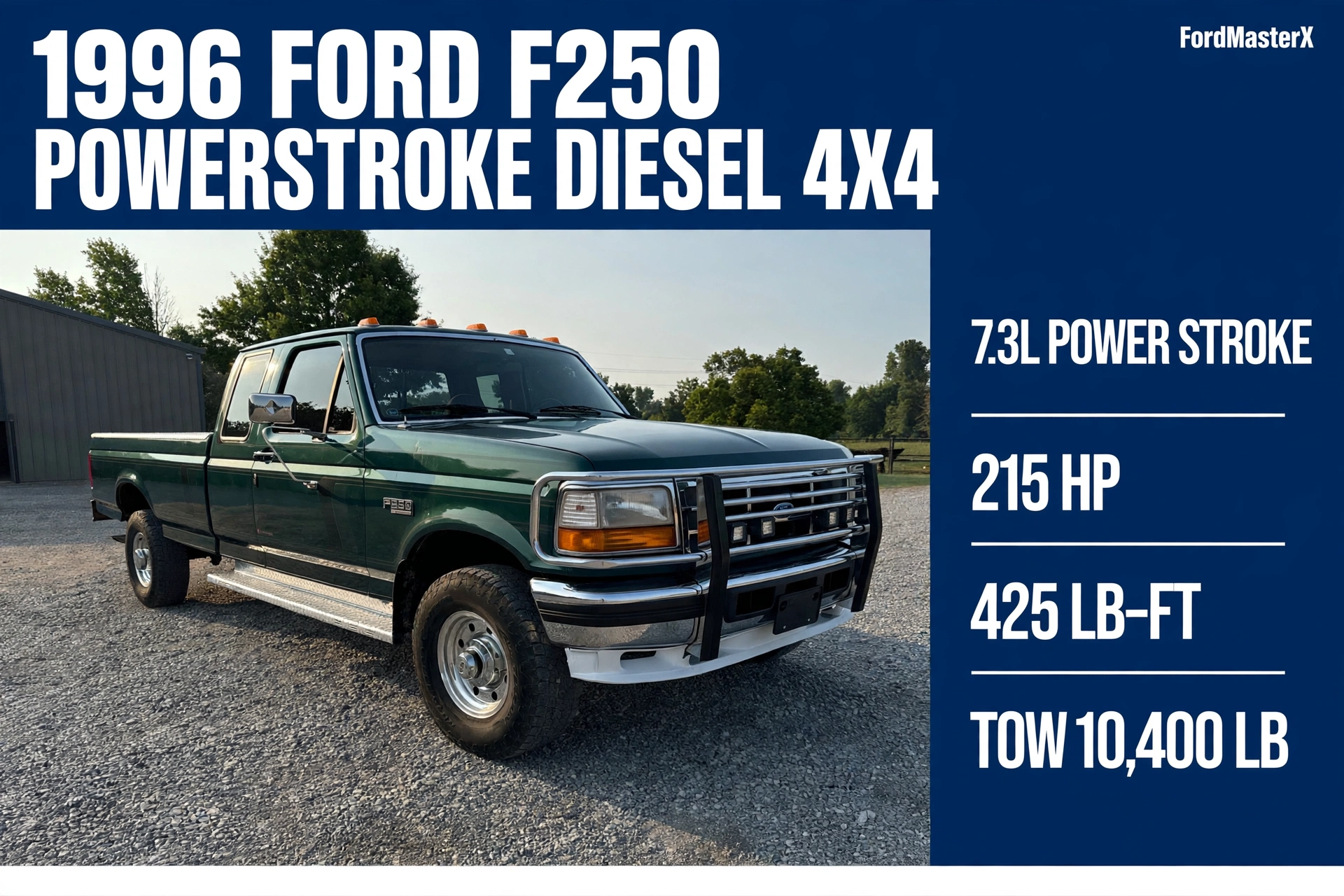
1996 Ford F250 Powerstroke Diesel 4×4 With 7 Proven Facts for 2026

Yes, a 1996 Ford F250 Powerstroke diesel 4×4 is still worth buying in 2026 if you want a simple diesel truck that tows 10,400 pounds and can run past 300,000 miles. The 7.3L Power Stroke makes 215 horsepower and 425 lb-ft of torque in Ford’s advertised rating, and its HEUI fuel system has no complex emissions equipment to fail.
Buy one only after a rust check, a cold start test, and a look at the cam sensor, fuel bowl, and transmission. This guide covers the verified specs, real tow numbers, five common problems, honest fuel economy, and 2026 prices from live listings.


7 Verified 1996 F250 Powerstroke Specs That Still Matter
The 1996 F-250 sits in the OBS, or Old Body Style, generation built from 1992 through 1997. There was no 1998 F-250, so the 1996 and 1997 trucks are the last of this body style before the 1999 Super Duty arrived.
| # | Spec | 1996 F-250 7.3L Power Stroke 4×4 |
|---|---|---|
| 1 | Engine | 7.3L Power Stroke V8 diesel (International T444E) |
| 2 | Horsepower | 215 hp at 3,000 rpm |
| 3 | Torque | 425 lb-ft at 2,000 rpm |
| 4 | Fuel system | HEUI direct injection |
| 5 | Turbo | Garrett TP38, wastegated, no intercooler |
| 6 | Transmissions | E4OD 4-speed automatic or ZF S5-47 5-speed manual |
| 7 | Transfer case | BorgWarner BW1356, part-time 4×4 |
The torque number needs an honest note. Diesel Power Products lists the 1996 rating as 215 horsepower and 425 lb-ft of torque, matching Ford’s advertised figures.
DieselHub’s 7.3L Power Stroke spec tables print that figure. So does the 1994-1997 Powerstroke buyer guide from Diesel Power Products.
Several other reputable sources list 450 lb-ft for 1996 instead, and that figure matches the manual-transmission rating. Check the identification tag on the passenger-side valve cover of the truck you are buying.
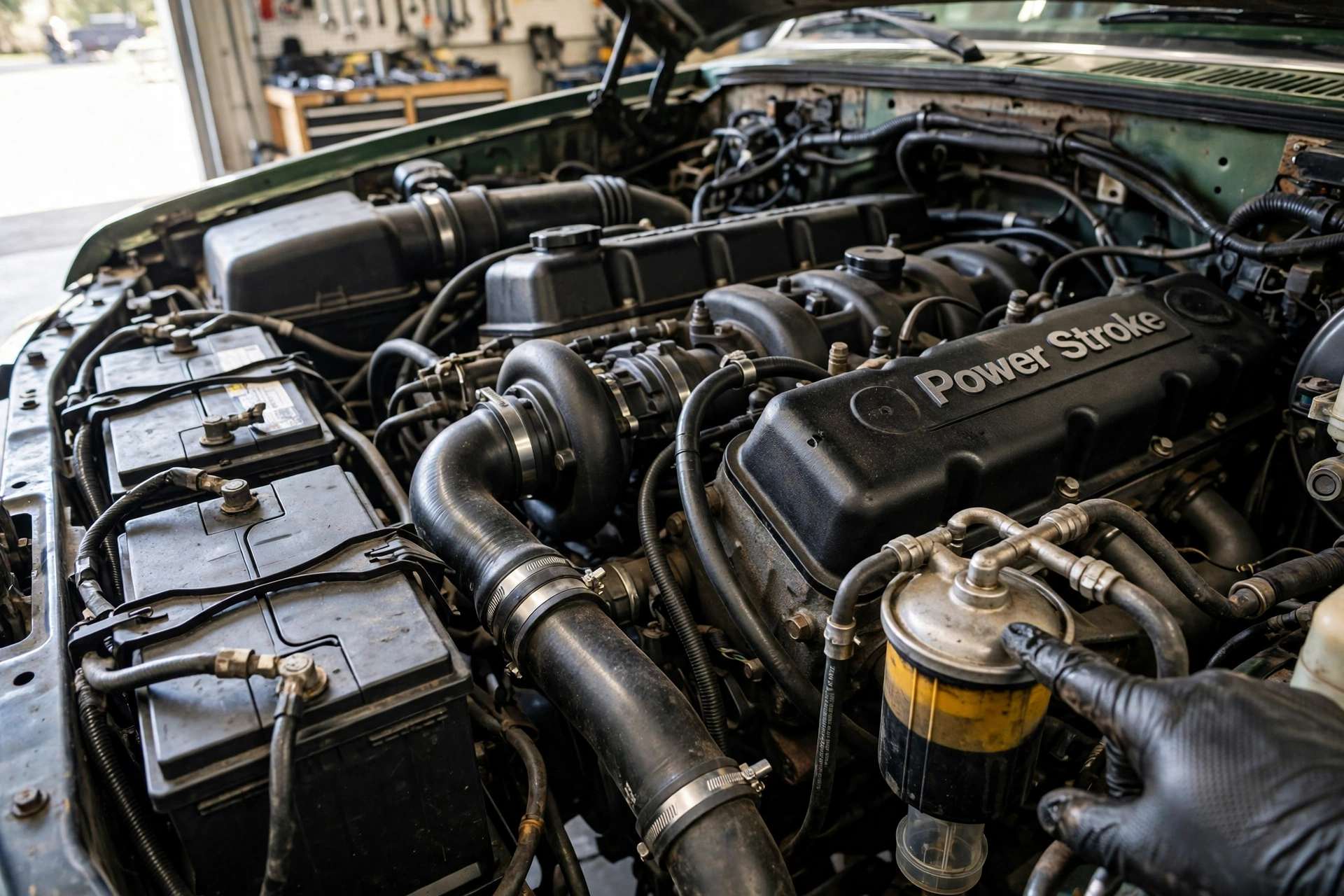
The engine itself is the reason these trucks still sell. It is a cast-iron block and heads with forged steel connecting rods, and it uses HEUI injectors that fire with pressurized engine oil instead of a mechanical injection pump.
That design is simple by modern diesel standards, and it makes oil condition critical. It displaces 444 cubic inches at 17.5 to 1 compression.
Dirty or low oil causes hard starts and weak injectors, so check the service history before you trust the odometer. The engine takes 15.0 quarts with a filter change. Our oil change interval guide explains what good records look like.


1996 Ford F250 Powerstroke Diesel 4×4 at a Glance
Verified 7.3L Power Stroke figures from Ford’s advertised ratings and the 1996 towing guide.
Torque note: some sources list 450 lb-ft for 1996, which matches the manual-transmission rating. Check the valve-cover tag on the truck you buy. Payload: about 2,000-2,400 lb; the door-jamb sticker governs.


The 7.3L replaced the older 7.3L IDI diesel in mid-1994, adding electronic control and direct injection. Our 7.3 IDI vs 7.3 Powerstroke comparison covers that change in detail.
How Much Can a 1996 F250 7.3 Diesel 4×4 Tow


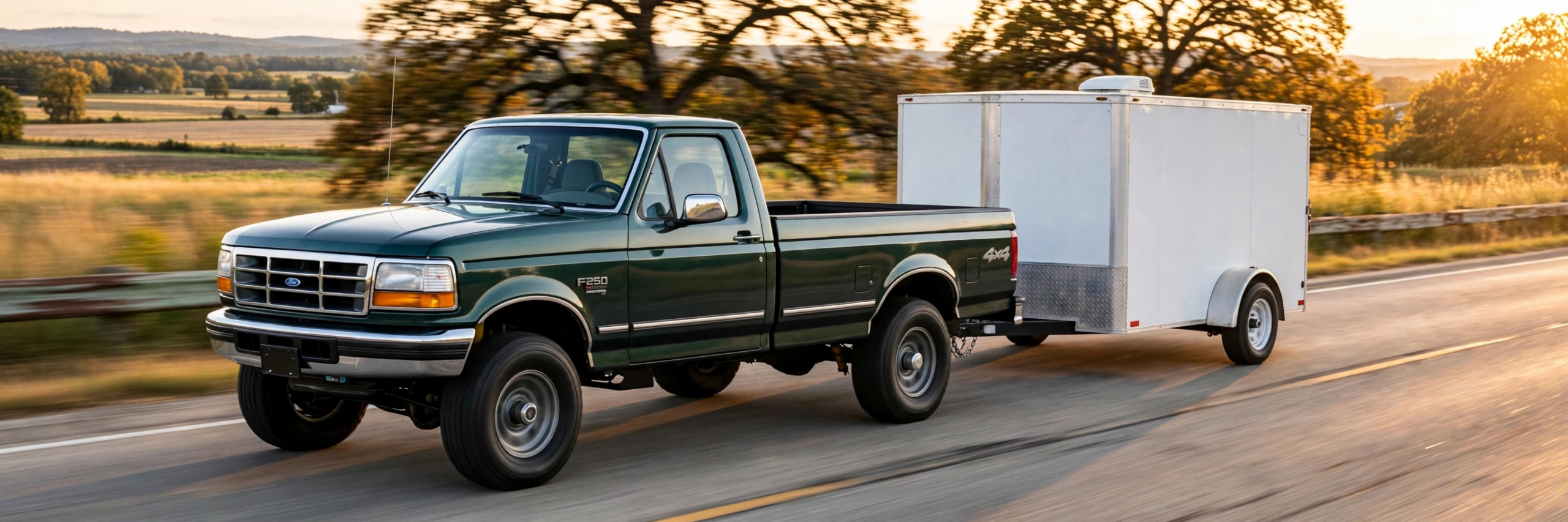
A 1996 F-250 7.3L diesel 4×4 tows about 10,400 pounds with a conventional trailer when it is a SuperCab with the 139-inch wheelbase. Ford’s 1996 towing guide, as quoted by owners from the factory manual, lists a gross combined weight rating (GCWR) of 16,000 pounds for that configuration.
The longer 155-inch wheelbase SuperCab is rated at 10,200 pounds on the same 16,000-pound GCWR. Your exact rating depends on cab, bed length, axle ratio, and transmission, so read the towing section of the owner’s manual.


| Configuration | GCWR | Max Trailer Weight |
|---|---|---|
| SuperCab, 139-in wheelbase | 16,000 lb | 10,400 lb |
| SuperCab, 155-in wheelbase | 16,000 lb | 10,200 lb |
Some aftermarket guides quote up to 12,500 pounds, but that is higher than Ford’s manual numbers. Treat 10,400 pounds as the honest working number.
Payload is the limit that surprises most buyers. The 1996 F-250 HD carries a gross vehicle weight rating (GVWR) of 8,800 pounds, and a diesel 4×4 typically has only about 2,000 to 2,400 pounds of payload once the heavy engine and options are counted.
That means a fifth-wheel trailer can overload the rear axle long before the tow rating is reached.
Our Ford F-250 towing capacity chart puts these numbers next to every other F-250 year, and our F-250 payload capacity chart by year shows how payload changes by cab and engine. Always confirm the number on the door-jamb sticker, because that sticker governs your exact truck.
Towing with this truck also means towing slowly by modern standards. The 7.3L makes its peak torque at just 2,000 rpm, so it pulls steadily rather than quickly.
5 Common 7.3 Powerstroke Problems to Check Before Buying


These trucks earned their reputation because the core engine lasts, but the parts bolted to it fail on a schedule. Check these five problems on every 1996 F-250 you consider.
1. Camshaft Position Sensor Failure


The camshaft position sensor, or CPS, is the most common reason a 7.3L stalls or refuses to start. It sits just above the crankshaft damper and tells the computer when to fire the injectors.
When it fails, the engine can quit while driving, often with no warning and no trouble code. On a 1996 truck, watch the tachometer while cranking: if the needle does not move, the CPS is likely dead.
Ford recalled the CPS on 1997 through 2003 trucks under Safety Recall 07S57, but the 1996 is not covered, so budget for the sensor yourself and keep a spare in the glove box. If the truck cranks but will not fire, our 7.3 Powerstroke crank no start guide walks through the CPS check first.
2. Fuel Bowl Leaks
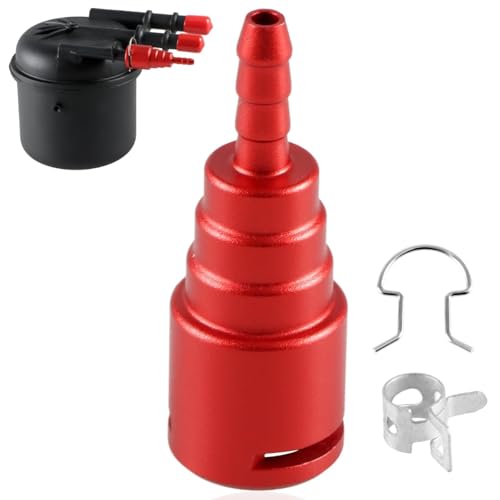
The fuel bowl is the fuel filter housing in the engine valley, and it is the most common source of fuel leaks on a 7.3L. Its O-rings harden with age and leak, especially in cold weather, and the drain valve on the back is the usual spot.
The fuel heater inside the bowl can also short out and blow the number 22 maxi fuse, which disables the powertrain control module and causes a no-start. Look for diesel smell, wetness in the valley, and fuel dripping under the truck.
A full reseal with an O-ring kit is the right fix, not a single O-ring at a time. Our 7.3 Powerstroke fuel bowl diagram and fix guide shows the housing, the drain valve, and the heater location.
3. Leaking Turbo Up-Pipes


The pipes that carry exhaust gas from the manifolds to the turbo use donut gaskets that burn out over time. Leaking up-pipes cost boost, cost power, and coat the back of the engine in soot.
Listen for an exhaust leak hiss under load and look for black soot around the turbo pedestal. Replacement pipes with better seals are a common upgrade, and the job is labor-heavy rather than parts-heavy.
4. Glow Plug Relay and Harness Wear
Cold starting is the weak point of this engine. The glow plug relay switches high current to all eight glow plugs at once, and when it fails the truck cranks hard or not at all in cold weather, often with white smoke.
The under valve cover harness, or UVCH, carries power to both the injectors and the glow plugs through the valve cover gasket.
Its connectors loosen or burn with age, and that causes rough running and misfires. Test a cold start yourself, and do not accept a seller who has already warmed the truck up before you arrive.
If you need parts, our best glow plugs for 7.3 Powerstroke guide lists the options that fit.
5. E4OD Wear and OBS Rust


The E4OD automatic is the weak link behind a strong engine. It was built for the torque, but after 200,000 miles the torque converter and overdrive section wear, and a neglected fluid change shortens its life.
Check for delayed engagement, slipping in overdrive, and burnt-smelling fluid. A ZF 5-speed manual truck avoids this risk entirely, and it is one reason manual trucks command higher prices.
Rust is the other deal breaker. Check the frame rails, cab corners, rocker panels, bed wheel arches, and the front core support.
OBS trucks rust from the inside out, so poke suspect areas rather than trusting paint. A truck with a solid frame and a tired engine is a project, while a truck with a rotted frame is parts.
Dead Head Diesel’s 7.3 Powerstroke problems list covers the same failures in depth and matches the symptoms described here.
What Is a 1996 F250 Powerstroke 4×4 Worth in 2026
Prices for clean OBS 7.3L 4×4 trucks stay high because supply is fixed and demand keeps growing. The bands below come from live listings observed on November 15, 2026.
CarGurus listings ranged from about $6,300 to $63,500 across all trims, while clean dealer examples of low-mileage 7.3L 4×4 XLT trucks asked $22,900 to $43,900.
| Condition | Typical Asking Price | What You Get |
|---|---|---|
| Driver quality | $8,000 to $15,000 | Runs and tows, high miles, cosmetic wear, needs small repairs |
| Clean daily driver | $15,000 to $25,000 | Solid body, working 4×4, service history, 150,000 to 200,000 miles |
| Low-mileage collector grade | $25,000 to $44,000 | Under 150,000 miles, rust-free, loaded trim |
Four things move the price most: 4×4, the ZF 5-speed manual, a rust-free body, and mileage under 150,000. A regular cab work truck with the automatic and 200,000 miles sits at the bottom, while a SuperCab or Crew Cab 4×4 with the manual and a clean frame sits at the top.
Kelley Blue Book lists about $3,100 private-party for a base 1996 F-250 Regular Cab, but clean 7.3L 4×4 trucks sell for far more. Compare current 1996 Ford F-250 listings on CarGurus in your area before you make an offer.
1996 F250 Powerstroke Fuel Economy in Real Owner Reports
Owners report 15 to 20 mpg empty and 10 to 13 mpg towing, with most trucks landing near 14 to 15 mpg in mixed driving. Trucks with 3.55 axle gears do better on the highway, while 4.10 gears tow better and drink more.
One owner with 4.10 gears reported 16 mpg in town and 18 to 20 mpg on the highway with a light load. Another reported about 21 mpg highway.
For scale, Fuelly data for the later 1999 7.3L F-250 averages 14.41 mpg across 148 owners and 3 million miles. That is a reference point, not a 1996 figure.
E4OD vs ZF 5 Speed in the 1996 F250 4×4
The 4×4 system on a 1996 F-250 is a part-time BorgWarner BW1356 transfer case with a 2.69 to 1 low range. Shift it with a floor lever or an electronic switch, and use 4H only on loose surfaces because part-time 4×4 binds on dry pavement.
The front axle is a Dana 50 Twin Traction Beam, and the rear is a Ford Sterling 10.25 full-floating axle. Check that 4H and 4L both engage without grinding from the front hubs.
The transmission choice shapes the whole truck. The E4OD 4-speed automatic is common and easy to drive, but it is the most expensive part to rebuild, and a tired one slips in overdrive.
The ZF S5-47 5-speed manual is rarer, tougher, and worth a premium, and it pairs with the 450 lb-ft torque rating some sources list for 1996. If you tow heavy and often, the manual is the better buy.
7 Point Pre Purchase Inspection for a 1996 F250 4×4
- Cold start it yourself. Arrive before the seller warms it up, cycle the glow plugs, and watch for white smoke and long cranking.
- Check the tach while cranking. No needle movement points to a failing camshaft position sensor.
- Look in the engine valley. Wetness or diesel smell means fuel bowl O-rings or the drain valve are leaking.
- Inspect the frame and cab corners. Poke rust with a screwdriver, and walk away from a rotted frame.
- Engage 4H and 4L. Both must shift smoothly, and the front hubs must lock without grinding.
- Drive it with a trailer if you can, and check the transmission fluid for a burnt smell.
- Read the door-jamb sticker and the valve-cover tag. The sticker gives GVWR and axle ratio, and the tag gives the real horsepower rating for that truck.
Should You Buy a 1996 Ford F250 Powerstroke Diesel 4×4
Buy one if you want a simple diesel truck with no diesel particulate filter, no DEF, and no complex emissions system. Buy one if you tow under 10,000 pounds, do your own maintenance, and can find a rust-free 4×4 with service records.
The 7.3L is one of the most durable light-duty diesels Ford ever sold, with a B50 life rating of 350,000 miles. Skip one if the frame is rusted, the E4OD slips, or the seller will not let you cold start it.
Skip one if you need modern towing capacity, safety equipment, or a quiet highway ride. A clean manual 4×4 is worth the premium, while a cheap automatic with rust is not a bargain at any price.
If you do buy, a mild tow tune and gauges are the first upgrades most owners choose. Our best tuner for 7.3 Powerstroke guide covers the safe options.
1996 F250 Powerstroke Buying Questions Answered
1996 F250 7.3 Horsepower and Torque
It makes 215 horsepower at 3,000 rpm in Ford’s advertised rating. Torque is 425 lb-ft at 2,000 rpm, although some sources list 450 lb-ft for manual-transmission trucks.
1996 F250 7.3 Towing Capacity
About 10,400 pounds with a conventional trailer for a SuperCab with the 139-inch wheelbase, on a 16,000-pound GCWR from Ford’s 1996 towing guide. Cab, bed, axle ratio, and transmission change the exact number.
Is the 1996 7.3 Powerstroke Reliable
Yes, the core engine is one of the most reliable light-duty diesels Ford built, with a B50 life of 350,000 miles. The failures are in the bolt-on parts: the cam sensor, fuel bowl seals, glow plug relay, and the E4OD automatic.
1996 F250 7.3 Fuel Economy
Owners typically report 15 to 20 mpg empty and 10 to 13 mpg towing, with about 14 to 15 mpg in mixed driving. Gears, tires, and speed change the result by several mpg.
1996 F250 Powerstroke 4×4 Value
Driver-quality trucks run $8,000 to $15,000, clean daily drivers $15,000 to $25,000, and low-mileage rust-free 4×4 examples $25,000 to $44,000. The manual transmission, 4×4, and a rust-free body add the most value.
Final Word on the 1996 F250 Powerstroke 4×4
The 1996 Ford F250 Powerstroke diesel 4×4 is a simple, honest truck that still earns its keep thirty years after it left the factory. Its 10,400-pound tow rating, 15 to 20 mpg highway economy, and 350,000-mile design life explain why clean examples now sell for $25,000 and more.
Buy the cleanest, most rust-free 4×4 you can afford, insist on a cold start, and check the cam sensor, fuel bowl, and transmission before money changes hands. That combination of simple engineering and proven durability is why clean trucks still command strong prices.