
7.3 Powerstroke Crank No Start: Common Causes & Fixes

A 7.3 Powerstroke crank no start is most frequently caused by a failure in the high-pressure oil system or a faulty Camshaft Position Sensor (CPS). To fire the injectors, the engine must reach at least 500 psi of Injection Control Pressure (ICP) and have a functioning Injector Driver Module (IDM).
Prime Day Pick
Limited-time Prime Day price. Check current discount on Amazon.
🎯 Key Takeaways
- Monitor the tachometer for movement to verify the Camshaft Position Sensor (CPS) is working.
- Confirm the ‘Wait to Start’ light illuminates to ensure the PCM is receiving power.
- Check the HPOP reservoir level; it must be within an inch of the top plug.
- Verify that the fuel bowl is filling to rule out fuel pump or filter issues.
- Inspect the IPR valve tin nut to ensure the solenoid is properly seated.
If your 7.3 Powerstroke cranks vigorously but refuses to fire, you are likely missing one of three critical ingredients: high-pressure oil, fuel delivery, or a synchronization signal. Unlike a traditional gasoline engine, the 7.3 uses a HEUI (Hydraulic Electronic Unit Injection) system that requires a minimum of 500 PSI of oil pressure just to trigger the injectors. Without this specific hydraulic force, your fuel injectors remain closed, no matter how much you pump the accelerator or how long you drain the batteries.
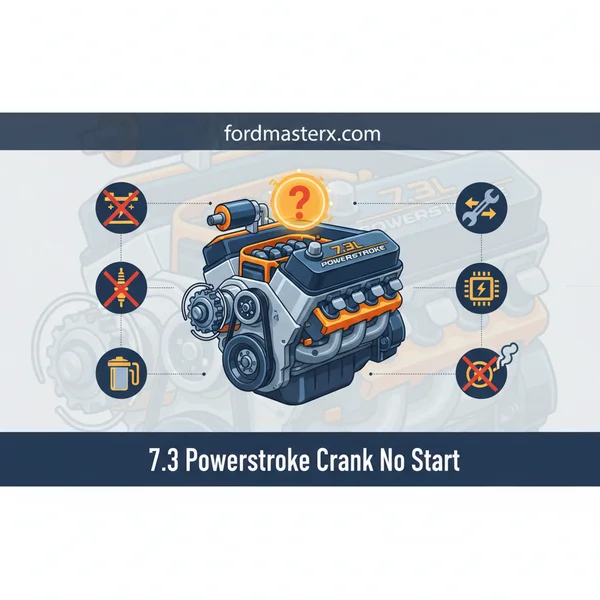
Understanding the diagnostic flow is essential because it prevents you from wasting hundreds of dollars on an Injector Driver Module (IDM) or a High-Pressure Oil Pump (HPOP) when the culprit is often a simple fifteen-dollar sensor or a torn o-ring. By following a structured troubleshooting path, you can pinpoint whether the issue is mechanical, electrical, or hydraulic before you ever pick up a wrench to replace expensive components. This guide focuses on the specific data points you need to observe to get your truck back on the road.
Prime Day Pick
Limited-time Prime Day price. Check current discount on Amazon.
Understanding the HEUI System and Injection Pressure Requirements
The 7.3 Powerstroke operates on a system where engine oil is pressurized to act as the “hammer” that forces fuel through the injector nozzle. If your engine oil is too thin, the level is too low, or if there is a leak in the high-pressure circuit, the injectors will never fire. This is the most common reason for a crank-no-start condition, especially in cold weather or after an oil change.
📤 Share
💾 Download
Prime Day Pick
Limited-time Prime Day price. Check current discount on Amazon.
The 500 PSI Threshold and the IPR Valve
During cranking, your High-Pressure Oil Pump (HPOP) must generate at least 500 PSI of Injection Control Pressure (ICP). If the Powertrain Control Module (PCM) sees anything less than 500 PSI, it will not signal the Injector Driver Module (IDM) to cycle the injectors. You can verify this using an OBD-II scanner capable of reading live data. If your ICP pressure stays at 200 or 300 PSI while cranking, the engine will never start. Common culprits for low pressure include:
- Check the HPOP Reservoir: Remove the small inspection plug on top of the HPOP reservoir (usually requires a 1/4-inch drive or an Allen wrench). The oil should be within one inch of the top. If it is empty, your Low-Pressure Oil Pump (LPOP) might be failing, or the oil is draining back into the pan due to a bad anti-drain back valve.
- Inspect the IPR Valve: The Injection Pressure Regulator (IPR) valve is responsible for controlling the oil pressure. A common failure point is the tin nut on the back of the valve falling off, causing the solenoid to slide off the shaft. If the nut is present, the internal o-rings may have torn. If the o-rings are blown, the high-pressure oil simply bypasses the injectors and returns to the crankcase.
- Unplug the ICP Sensor: If you suspect a faulty ICP sensor is giving a false low reading, unplug it. The PCM will default to a “limp” value that assumes 500+ PSI, which should allow the truck to start if the sensor was the only problem.
Critical Sensors and Their Impact on Starting Synchronicity
Even if you have perfect oil pressure, the engine needs to know exactly where the pistons are located to time the injection pulse. This timing is handled by a handful of sensors that must communicate perfectly with the PCM. If the signal is lost or “noisy,” the computer will hold back the firing signal as a safety measure to prevent engine damage. In many cases, the truck simply doesn’t know you are trying to start it.
Prime Day Pick
Limited-time Prime Day price. Check current discount on Amazon.
Identifying a Failed Camshaft Position Sensor (CPS)
The Camshaft Position Sensor is the most notorious failure point on the 7.3 Powerstroke. It monitors the rotation of the camshaft to tell the PCM when to fire each cylinder. If the CPS fails, the engine has no way of knowing the timing, resulting in a continuous crank with zero combustion. A quick way to test this is to watch your tachometer while you are cranking the engine.
- Tachometer Movement: While cranking, the needle should bounce slightly (usually around 100 to 200 RPM). If the needle stays dead on the pin, the PCM isn’t receiving a signal from the CPS. Note: On some 2002-2003 models, the tachometer may not move by design; in these cases, a scanner is required to verify “RPM Sync.”
- Magnetic Interference: Sometimes, a failing starter or a bad ground can create electromagnetic interference that messes with the CPS signal, even if the sensor itself is technically functional. Ensure your batteries are fully charged to maintain a clean electrical signal.
Fuel Bowl Inspection and Pump Delivery
If your tachometer is moving and your oil pressure is high, the next stop is the fuel bowl. The 7.3 uses an electric frame-mounted fuel pump to push fuel into the filter housing (the fuel bowl) located in the engine valley. If the bowl is empty or the pressure is too low, the injectors will be firing “dry,” which can lead to damage and a refusal to start.
Prime Day Pick
Limited-time Prime Day price. Check current discount on Amazon.
- Check the Fuel Bowl: Open the yellow drain lever on the back of the fuel bowl and turn the key to the “on” position. Fuel should spray out of the drain tube under the truck. If it only trickles or doesn’t move at all, your fuel pump may be dead or your fuel filter is completely clogged.
- Listen for the Pump: Turn the key to “on” and listen near the driver-side frame rail. You should hear a distinct hum for about 20 seconds. No hum usually means a blown fuse (specifically Fuse 22 on older models), a tripped inertia switch, or a dead pump motor.
- Fuel Pressure Requirements: While the 7.3 can technically idle on low pressure, you generally need 45-60 PSI of fuel pressure for reliable starting and operation. If you see bubbles in the fuel bowl, you may have an air leak in the suction line from the tank.
Analyzing the Role of the IDM and PCM in the Firing Sequence
The 7.3 Powerstroke relies on a sophisticated “handshake” between the Powertrain Control Module (PCM) and the Injector Driver Module (IDM). If this communication chain is broken, your engine will spin indefinitely without ever catching. Think of the PCM as the brain and the IDM as the muscle that actually triggers the injectors.
📤 Share
💾 Download
The “Wait-to-Start” Light and PCM Power
A classic diagnostic starting point involves the “Wait-to-Start” light on your dashboard. When you turn the key, this light indicates the PCM is powered up and communicating. If that light fails to appear, the PCM might not be receiving power at all. This is frequently caused by a shorted fuel heater blowing Fuse 22 in the under-hood junction box. Because this fuse also powers the PCM, a simple heater failure can mimic a total engine breakdown.
IDM Water Intrusion and High Voltage
The IDM is responsible for sending a high-voltage signal—roughly 110 to 120 volts—to the injectors. Because it is mounted in the driver-side fender well, it is highly susceptible to water intrusion and internal corrosion over time. Even a small amount of moisture can cause internal shorts that prevent the injectors from firing.
- The Buzz Test: If you have access to a diagnostic tool, running an injector “buzz test” is the best way to verify the IDM is healthy. If the injectors sound weak or stay silent, the IDM is likely the culprit.
- Wiring Harness Checks: Inspect the Under Valve Cover Harness (UVCH). Heat and oil can cause these connectors to melt or vibrate loose, breaking the connection between the IDM and the injectors.
Fuel Delivery vs. High-Pressure Oil: Distinguishing the Symptoms
Because the 7.3 uses the HEUI (Hydraulic Electronic Unit Injection) system, it requires both diesel fuel and high-pressure engine oil to operate. Differentiating between a fuel delivery failure and a High-Pressure Oil (HPO) failure is key to a fast recovery.
Smoke as a Visual Diagnostic Tool
One of the most effective ways to narrow down the cause is to watch the tailpipe while cranking the engine. The presence or absence of smoke tells a significant story about what is happening inside the combustion chamber.
- White Smoke While Cranking: This is actually a positive sign. It indicates that the injectors are delivering fuel, but it isn’t igniting. This usually points to glow plug issues or low compression rather than a fuel delivery failure.
- Zero Smoke: If the tailpipe is completely clear while cranking, the injectors are not opening. This typically points to a lack of high-pressure oil or an electronic signal failure.
The 500 PSI Threshold
The PCM will not authorize the injectors to fire until it sees at least 500 PSI of high-pressure oil. If your Injection Pressure Regulator (IPR) valve is stuck open or your High-Pressure Oil Pump (HPOP) is worn, you might only reach 200 or 300 PSI. To the ear, the engine sounds like it wants to start, but the electronics are intentionally preventing it from firing to protect the system.
Practical Tip: Always check your engine oil level first. Because the injectors are powered by oil, being a few quarts low can lead to a “crank no start” condition, especially when parked on an incline.
Final Thoughts on Troubleshooting Your 7.3
A “crank no start” condition on a 7.3 Powerstroke can be daunting, but it almost always comes down to the basics of the HEUI system. By verifying that your PCM has power, ensuring your IDM is dry, and confirming that you are hitting that critical 500 PSI oil threshold, you can eliminate the most common failure points. Most 7.3 issues are sensor-related rather than mechanical, meaning a focused diagnostic approach can save you a trip to the mechanic.
Your next step should be to check for stored fault codes using a Ford-specific diagnostic tool like FORScan. This will allow you to see exactly what the sensors are reporting in real-time. Still having trouble getting your 7.3 to fire up? Leave a comment below with your symptoms, and let’s get that legendary diesel back on the road!
❓ Frequently Asked Questions
What are the symptoms of a failing Injector Driver Module (IDM)?
A failed IDM often results in a crank no start or a severe misfire. It is commonly caused by water intrusion or internal component failure, preventing the high-voltage signal from reaching the injectors.
How do I check the HPOP reservoir level during a no-start?
Remove the small inspection plug on top of the HPOP reservoir using a 1/4-inch drive ratchet. The oil level should be within roughly one inch of the top; if it is low, the pump cannot prime the high-pressure system.
Why does a shorted fuel bowl heater cause a no-start?
In many 7.3 models, the fuel bowl heater and the PCM share the same fuse. When the heater shorts out, it blows the fuse, cutting power to the computer and preventing the engine from firing.
Is it safe to use starting fluid on a 7.3 Powerstroke?
No, you should never use starting fluid on a 7.3 Powerstroke because the glow plugs can ignite the ether prematurely. This can result in broken pistons, bent connecting rods, or engine explosions.
What specific ICP voltage should I look for while cranking?
While cranking, you should see approximately 0.20 to 0.25 volts at key-on, rising to at least 0.85 volts (which correlates to 500 psi) to enable the fuel injection sequence.
How do I know if the fuel pump is the problem?
Drain the fuel bowl using the yellow lever, then cycle the key. If the bowl does not refill quickly with fresh diesel, the electric fuel pump or the fuel pickup in the tank has failed.