
Ford Lightning Charging Time Chart: 2026 Models Compared Side-by-Side

On a 150kW DC fast charger, the Ford F-150 Lightning charges from 15% to 80% in approximately 41 to 44 minutes, depending on the battery pack. Achieving a full charge at home using the Ford Charge Station Pro typically requires 8 to 10 hours. This article provides essential data on charging durations, variables affecting your speed, performance differences between battery configurations, and best practices for long-term battery health management.
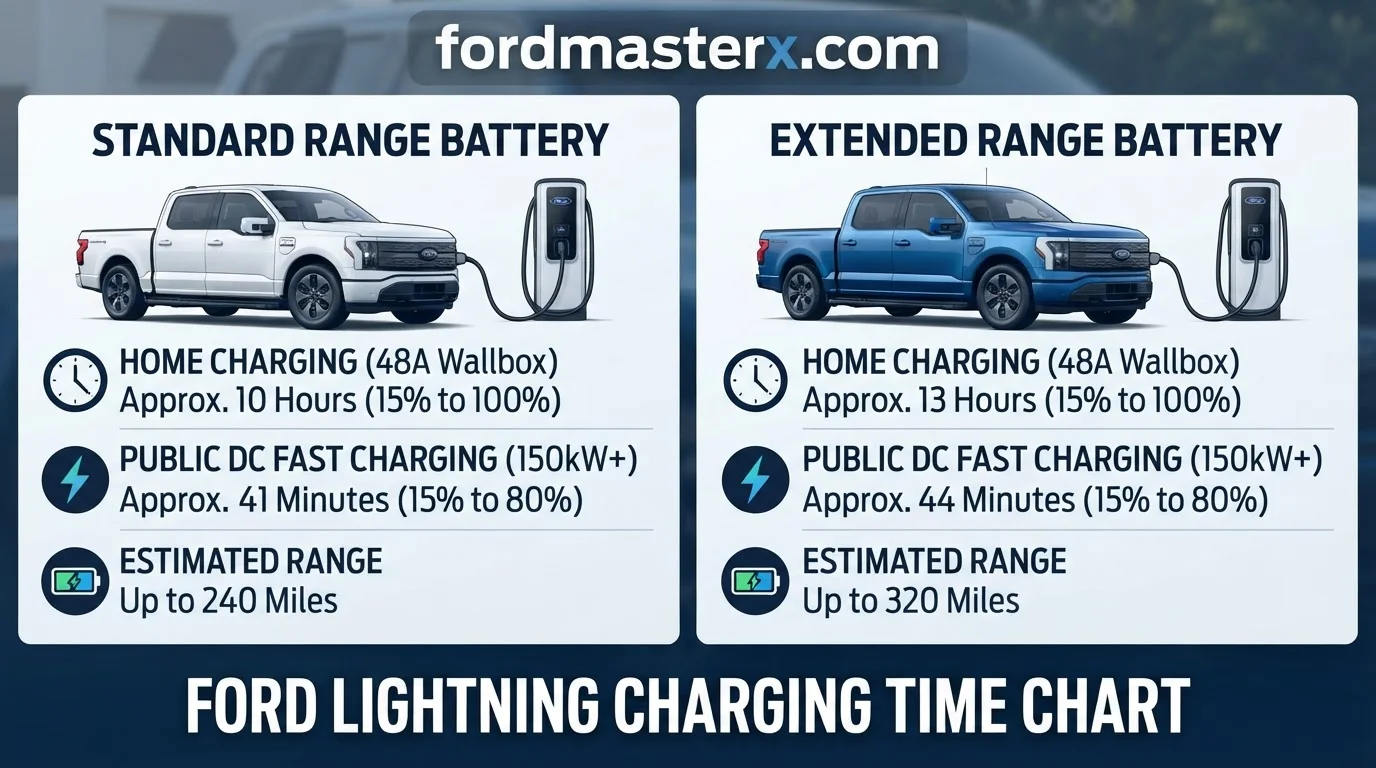
Ford Lightning Charging Time Chart: 15% to 80% Estimates
How to Read This Chart
This table displays estimated timeframes to replenish your Ford F-150 Lightning battery from a 15% state of charge to 80%. The “Charger Type” column indicates the power delivery of the equipment, measured in kilowatts (kW) for DC fast chargers and amperage (A) for Level 2 home stations.


Use the “Standard Range” or “Extended Range” columns to match your specific vehicle battery configuration. These estimates assume ideal conditions; actual performance may fluctuate based on ambient temperature, current battery age, and the specific thermal management state of the vehicle at the moment you plug in.

Note that the 15% to 80% benchmark is a common industry standard used because charging speeds drop significantly after reaching 80% to protect battery longevity. Always check your Ford-specific documentation or the onboard charging interface to verify your vehicle’s current peak intake rate during a live session.
Understanding DC Fast Charge vs. Level 2 Efficiency


Charging an electric truck involves a fundamental trade-off between speed and hardware longevity. DC Fast Charging (Level 3) bypasses the truck’s onboard charger to deliver high-voltage direct current into the battery pack. While this is necessary for road trips, the intense energy flow generates heat, which is why charging speeds are non-linear.
The speed curve is aggressive at lower states of charge (10% to 50%) but tapers off as the battery approaches its maximum capacity. This “tapering” prevents damage to the battery cells. Because of this, DC fast chargers are best reserved for occasional use rather than daily charging routines.
In contrast, Level 2 charging provides a steady, controlled AC current that the vehicle converts to DC internally. While significantly slower, it is the recommended method for daily replenishment. It is much gentler on your battery chemistry and allows the truck to manage thermal conditions more efficiently over the course of several hours.
If you have the Extended Range pack, note that while it holds more energy, it is capable of higher peak charging rates on capable DC infrastructure. However, you will still see the same non-linear behavior as the battery nears full capacity, ensuring that even at the fastest stations, the final 20% of your charge will take longer than the first 20%.
Variables Influencing Ford Lightning Charging Speed


Real-world charging times for the Ford Lightning often fluctuate significantly from manufacturer estimates. While the charging charts provided by Ford reflect idealized conditions, physical variables frequently dictate the actual speed of energy transfer. Understanding these limitations is key to managing your expectations during daily use.



Most discrepancies between data sheets and real-world results stem from environmental factors, hardware limitations, and the fundamental chemistry of the lithium-ion battery pack. These variables determine exactly how many kilowatts (kW) the vehicle pulls from the charger at any given moment.


Thermal Management and Cold Weather Impacts
Temperature is the most significant factor affecting charging speed. Lithium-ion batteries function optimally within a narrow temperature window. If the battery is too cold or too hot, the vehicle’s onboard management system automatically limits the power input to protect the cells from long-term degradation.
In winter months, the battery may require significant energy just to reach an acceptable operating temperature. If you plug in a cold Ford Lightning, the vehicle must prioritize battery pre-conditioning. This process consumes energy and prevents the system from accepting the full charging speed typically seen in warmer conditions.
On a 75°F summer day, a Ford Lightning might achieve peak DC fast-charging speeds almost immediately. Conversely, if that same truck is plugged in after sitting in 20°F weather, the charging session will start slowly as the internal heater works to warm the pack, potentially doubling the time spent at the station.
Battery Management System and Power Acceptance Rates


The Battery Management System (BMS) acts as a traffic controller for electricity. It continuously monitors the temperature, voltage, and health of each individual battery cell. Even when using a high-capacity charger, the BMS may restrict current to prevent overheating or internal damage.


A primary factor in power acceptance is the State of Charge (SoC). Batteries exhibit a “tapering” effect during the charging process. As the battery fills, the internal resistance increases. To maintain safety, the BMS drastically throttles the charging speed once the battery surpasses 80% capacity.
This is why the final 20% of a charge always takes significantly longer than the first 20%. The onboard charger capacity also sets a hard ceiling on power intake. While the Lightning’s internal hardware is designed to handle high-speed DC inputs, it is ultimately governed by the BMS to ensure the longevity of the Extended or Standard range battery pack.
Furthermore, external factors like grid instability or shared charging infrastructure can limit power delivery. If a public charging station is shared with other vehicles, the available power might be distributed across multiple stalls. This reduces the total kW available to your truck, further deviating from the performance charts provided in ideal laboratory environments.
Ford Charge Station Pro and Home Charging Specifications


| Hardware Type | Amperage (A) | kW Output | Application |
|---|---|---|---|
| 120V Mobile Cord | 12A | 1.4 kW | Emergency use only |
| Standard Level 2 EVSE | 30A | 7.2 kW | Overnight charging |
| Ford Charge Station Pro | 80A | 19.2 kW | Maximum home speed |
How to Read This Chart
This table compares the power delivery capabilities of various residential charging methods. The “Amperage” column indicates the electrical current flow, while the “kW Output” reflects the actual power delivered to the vehicle’s onboard charger.
The Ford Charge Station Pro represents the manufacturer’s recommended hardware to achieve the fastest possible home charging speeds for the F-150 Lightning. Note that lower amperage hardware increases the time required to reach a full charge, particularly for Extended Range battery packs.
Selecting the Right Level 2 EVSE for Your Home


Choosing an Electric Vehicle Supply Equipment (EVSE) unit depends on your daily driving habits and home electrical infrastructure. While a 120V trickle charger is included with many vehicles, its 1.4 kW output is insufficient for the F-150 Lightning, often requiring several days to restore a depleted battery.
For most owners, a dedicated Level 2 wall-mounted unit is essential. A 30A mobile cord or hardwired station provides a significant upgrade over trickle charging, comfortably replenishing the battery overnight. However, for maximum efficiency, the Ford Charge Station Pro is designed specifically for the Lightning platform.
The Ford Charge Station Pro supports an 80A current, allowing it to deliver up to 19.2 kW of power. This high-capacity hardware is the only way to tap into the truck’s maximum onboard charging capability, significantly reducing downtime between long work shifts or weekend trips.
Home Charging Limits and Amperage Constraints
Your home charging speed is strictly limited by the capacity of your electrical circuit. Before installing an 80A system like the Ford Charge Station Pro, you must verify that your home’s electrical panel can support a 100A dedicated circuit breaker. This is a heavy load that requires professional inspection.
Safety is the primary consideration during installation. If your panel cannot accommodate a 100A breaker, you may need to install a lower-amperage Level 2 station. Standard 30A or 50A chargers are more common in residential settings, as they utilize smaller breakers that are easier to integrate into existing electrical systems.
Always consult with a licensed electrician to perform a load calculation on your residence. Overloading an existing circuit can lead to tripped breakers or hazardous overheating. Proper installation ensures your truck charges safely and efficiently while maintaining the integrity of your home’s electrical distribution system.
Performance Differences: Standard Range vs. Extended Range
Note: Refer to Ford Pro charging documentation or your vehicle’s specific build sheet for exact 131 kWh total charge time estimates under identical amperage.
How to Read This Chart
This table compares the two primary battery packs available for the Ford F-150 Lightning. The “Energy Capacity” column represents the total usable storage, measured in kilowatt-hours (kWh). Higher numbers indicate a larger energy reserve.
The “Approx. 0-100% Time” indicates the duration required to reach a full charge when using a 240V source at 30 amps. These figures are estimates based on standard residential charging hardware, such as the Ford Mobile Power Cord.
Values provided apply specifically to the 2025 model year and earlier F-150 Lightning configurations. Charging times may vary based on external temperatures and hardware efficiency. Consult your owner’s manual to confirm the specific amperage limitations of your home charging installation.
Comparing Capacity and Throughput
The primary difference between the Standard Range (98 kWh) and Extended Range (131 kWh) packs is the volume of energy they hold. Because the Extended Range battery is physically larger, it naturally requires more time to reach a 100% state of charge.
Think of the battery as a fuel tank; a larger tank requires more time to fill at the same flow rate. When using Level 2 AC charging, both packs are limited by the vehicle’s onboard charger capacity, which dictates how quickly the incoming AC power is converted into usable energy.
DC Fast Charging performance also scales with battery size. The charging “curve”—the speed at which the battery accepts power—will often remain higher for longer on the Extended Range pack. However, as the battery nears full capacity, the system intentionally slows down charging to protect internal cell health.
Impact of Battery Size on Daily Charging Routines
Choosing the correct pack depends heavily on your daily commute and access to infrastructure. If your daily driving is modest, the Standard Range battery is sufficient, as most charging occurs overnight while the vehicle is parked.
If you regularly commute long distances or use your truck for towing, the Extended Range pack is essential. While it takes longer to achieve a 100% charge, the additional range reduces the frequency of necessary charging stops during the workday or on the road.
When planning your routine, remember that most owners rarely need to reach 100% charge daily. By charging only to the level required for your next day’s travel, you mitigate the “long fill” time associated with the larger 131 kWh battery while simultaneously promoting better long-term battery health.
How to Find Your Ford Lightning Charging Data
Your specific Ford F-150 Lightning configuration directly dictates your vehicle’s charging capabilities. Because charging efficiency varies significantly based on battery capacity—Standard Range versus Extended Range—and the specific onboard hardware installed at the factory, verifying your unique build details is essential for obtaining accurate charging time estimates.
Checking Your VIN for Battery Specifications
To confirm your exact battery type and factory-installed hardware, use your 17-character Vehicle Identification Number (VIN). This code acts as a digital fingerprint for your truck, revealing the specific modules and systems installed during assembly.
📋
Step-by-Step Lookup Guide
Navigate to the official Ford owner website or the “Window Sticker” lookup tool. Enter your full 17-character VIN into the search field to retrieve your original factory build sheet.
Review the build document for references to battery pack capacity. Distinguishing between the Standard Range and Extended Range packs is the most critical step for aligning with the correct charging time charts.
Using FordPass for Real-Time Charging Metrics
The FordPass app serves as your primary interface for monitoring active charging sessions. Once your vehicle is connected to a power source, the app displays real-time data, including the current state of charge percentage and the estimated time remaining until the target level is reached.
Monitor the “Charging” tab within the app to observe charge rates in kilowatts (kW). If you notice speeds lower than your equipment’s maximum rating, check the vehicle’s ambient temperature or software settings. Charging efficiency frequently fluctuates based on external equipment quality and thermal management factors.
Finally, observe the charging port indicator lights located on the exterior charge port door. A pulsing white light signifies that charging is in progress, while a solid light indicates the session has finished. Rapidly blinking red lights generally indicate a fault or connection error that requires immediate troubleshooting.
Optimizing Your Charging Routine for Battery Health
Maximizing the lifespan of your Ford Lightning battery depends heavily on how you manage its charge cycles. Lithium-ion batteries function best when they are not pushed to extreme states of charge on a regular basis, as the internal chemical stress is highest at the very top and very bottom of the battery capacity.
DC Fast Charging Etiquette and Battery Preservation
DC Fast Charging (DCFC) is designed specifically for long-distance road trips where time efficiency is critical. While the Ford Lightning is engineered to handle high-speed charging, relying on these stations for your daily commute can accelerate battery degradation due to the intense heat and high power flow generated during the process.
Avoid using DC Fast Charging as your primary power source. Constant exposure to the high thermal loads associated with Level 3 charging may diminish the long-term capacity of your battery pack. Reserve these fast-charging sessions for when you are traveling long distances and require a quick boost to reach your next destination.
If you must use a public fast charger, attempt to unplug once your vehicle reaches 80% capacity. Charging speeds significantly drop after this point, known as the “tapering phase,” meaning you pay for a premium service while receiving a diminishing return on your time. This habit also helps keep the battery cells in their ideal operational window.
Daily Charging Best Practices
For most daily driving needs, set your Ford Lightning to charge to 80% or 90% via the vehicle’s infotainment system or the FordPass app. Regularly charging to 100% daily can stress the battery chemistry, potentially reducing its total usable life. Reserve 100% charging only for occasions where you need maximum range for a specific trip.
Utilize scheduled charging to align with your local utility company’s off-peak hours. Not only does this reduce your electricity costs, but it also allows the vehicle to manage thermal conditions more effectively. By setting a departure time in the FordPass app, the truck can precondition the battery and cabin while plugged into the wall, drawing power from the grid rather than your stored battery range.
Consider this sample routine for a typical daily commute: If you drive 40 miles round-trip, set your home charger to replenish only what you used the previous day, capping the limit at 80%. If you return home at 60%, the charger will bring the battery back to 80% overnight. This “shallow cycling” is significantly gentler on the battery cells than deep discharges and high-voltage recharges, ensuring your Lightning remains healthy for years to come.
Key Takeaways
-
✓
15% to 80% state-of-charge for the Extended Range battery takes approximately 41 minutes under optimal conditions. -
✓
Home charging with the Ford Charge Station Pro maximizes 19.2kW output for faster overnight recovery compared to standard mobile cords. -
✓
Cold weather remains a primary disadvantage, significantly increasing charging times and reducing overall battery efficiency. -
✓
Standard Range and Extended Range battery architectures feature different peak charging curves, impacting mid-session speed. -
✓
Optimizing your charging routine by avoiding 100% capacity stops extends long-term battery health and reduces wait times.
❓ Frequently Asked Questions
1
What is the Ford Lightning charging time chart?
This chart serves as a reference for how long your truck takes to reach an 80% charge. It details the relationship between charger power outputs—ranging from 120V Level 1 to 150kW DC fast chargers—and your specific battery configuration, providing clear expectations for refueling stops during daily use or long-distance travel.
2
How does the charging speed vary between models?
Charging speed is primarily dictated by the battery size and the onboard charger’s limitations. Extended Range models feature a higher capacity battery that accepts higher current rates, but they inherently take longer to reach full capacity compared to the Standard Range variant due to the sheer volume of energy being transferred.
3
Why is the charging curve important?
The charging curve represents the decrease in power intake as the battery nears full capacity. Charging is fastest between 15% and 80%, after which the vehicle software throttles the speed to protect battery health. Understanding this curve helps you plan stops effectively, avoiding the diminishing returns of charging past 80%.
4
What are the pros and cons of public fast charging?
The primary advantage of public DC fast charging is rapid refueling during road trips. However, the disadvantages include higher costs per kilowatt-hour, potential wait times at busy stations, and the risk of battery degradation if fast charging is the primary method used for daily vehicle replenishment.
5
How can I get started with optimizing my charging?
Start by installing a dedicated Level 2 home charging station to replace standard household outlets. Use the FordPass app to set preferred charging times during off-peak hours to save money and ensure your battery is at the ideal temperature before you begin your morning commute.
6
Can I use a standard 120V outlet to charge the Lightning?
Yes, but it is a ‘trickle’ charge. It is very slow and generally insufficient for daily commuting needs, adding only a few miles of range per hour.