
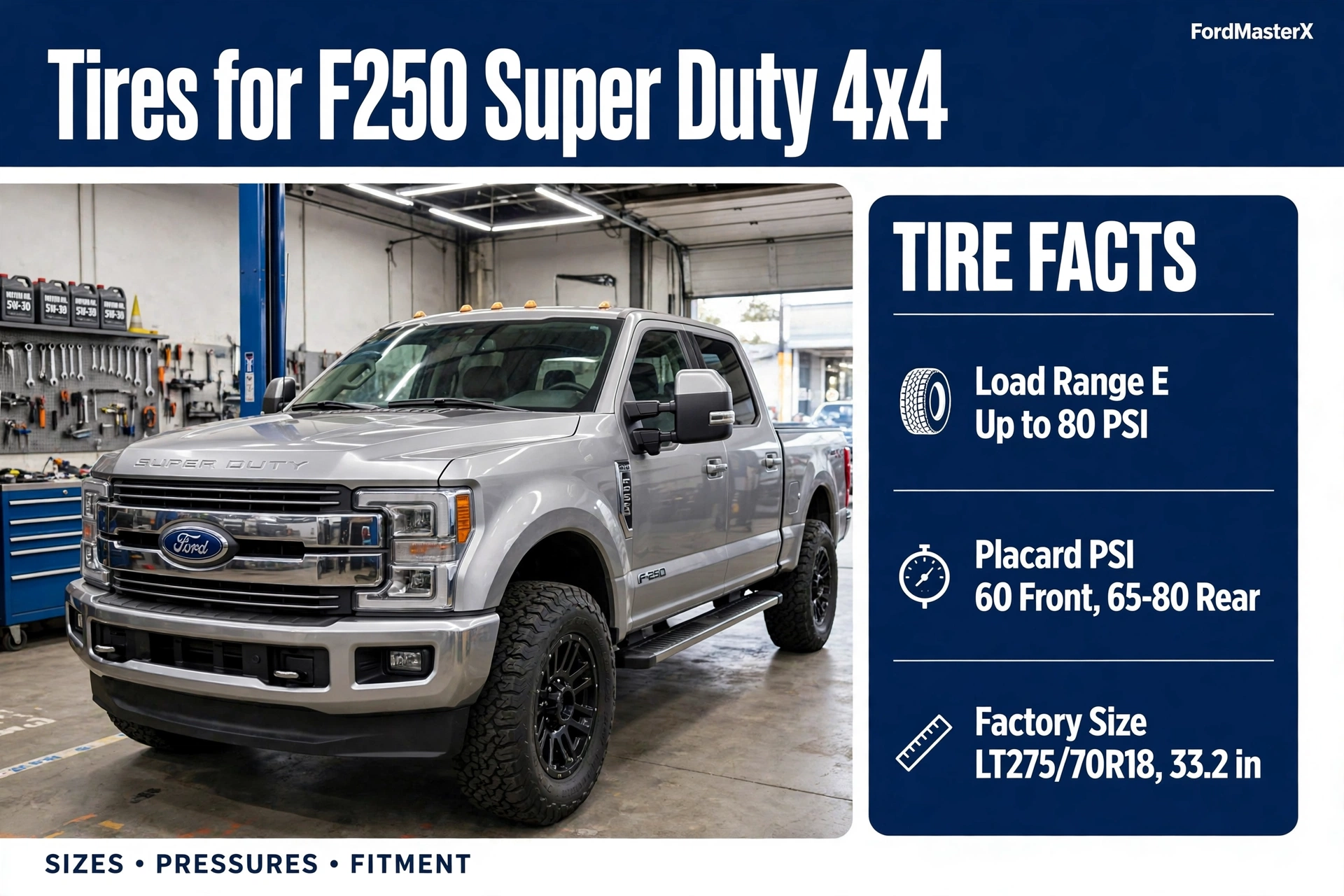
Tires for F250 Super Duty 4×4 With 7 Proven Facts for 2026

Yes, the right tires for F250 Super Duty 4×4 trucks are LT-metric tires in Load Range E, in the factory size for your trim, inflated to the cold PSI on your door-jamb sticker. Most 2017 to 2026 trucks run LT275/70R18 or LT275/65R20, and some King Ranch trucks run LT275/65R18, typically at 60 PSI front and 65 to 80 PSI rear based on 2024 placard values.
The Tremor package runs 35-inch LT285/75R18 tires from the factory. This guide gives you the factory sizes, the Load Range E rule, placard pressures, and a clear answer on 35-inch tires.


7 Proven F250 Super Duty 4×4 Tire Facts
The factory size depends on the wheel package, not the engine.
| Trim and Wheel | Factory Tire Size | Overall Diameter |
|---|---|---|
| XL, 17-inch wheels | LT245/75R17 | 31.5 in |
| XLT, Lariat, King Ranch, 18-inch wheels | LT275/70R18 | 33.2 in |
| King Ranch, 18-inch wheels (2024 placard) | LT275/65R18 | 32.1 in |
| Platinum, Limited, 20-inch wheels | LT275/65R20 | 34.1 in |
| Tremor Off-Road Package, 18-inch wheels | LT285/75R18 | 34.8 in |
Our Ford F-250 tire size chart lists these factory sizes by year, wheel, and trim, so you can match your exact truck before you shop.
1. Every factory tire is an LT tire in Load Range E. Ford fits no P-metric passenger tire to a Super Duty, because LT means light truck construction and Load Range E means a 10-ply equivalent casing built for up to 80 PSI, except tires wider than 295 mm, which top out at 65 PSI.
2. The size on your door sticker beats any chart. Trim, wheel package, and option packages change the factory size. The tire and loading label on the driver-side door frame lists the exact size and cold PSI, so check it before you order.
3. The Tremor runs a real 35-inch tire from the factory. The Tremor Off-Road Package uses LT285/75R18 tires that measure about 34.8 inches in diameter. That is the factory 35-inch setup.
4. Diameter matters more than width for fitment. A wider tire rubs the radius arms and fender liners at full steering lock, while a taller tire changes ride height and speedometer readings. Compare the overall diameter first, then the width.
5. A bigger tire changes your speedometer. Moving from LT275/70R18 at 33.2 inches to LT285/75R18 at 34.8 inches adds about 4.8 percent to the circumference. At 60 mph on the gauge, the truck really travels about 63 mph.
6. The bolt pattern is 8×170 on every 1999 and newer single rear wheel truck. The hub bore is 124.9 mm. Wheels from a 1988 to 1997 truck use the older 8×165.1 pattern and will not fit.
7. The 6.7L Power Stroke punishes weak front tires. The diesel adds roughly 400 to 500 pounds of total curb weight versus a gas V8, most of it over the front axle, according to Sarasota Ford, and that weight is why front pressure matters most on diesel trucks.


F250 Super Duty 4×4 at a Glance
Verified factory sizes, load ratings, and placard pressures for the Super Duty 4×4.
Pressure rule: the door-jamb sticker on your truck governs, not any chart. Wide-tire note: Load Range E tires wider than 295 mm run a lower maximum pressure of 65 PSI, so read the sidewall.
Why Load Range E Is the Minimum


Load Range E is not a suggestion on an F-250 Super Duty 4×4. It is the minimum construction that matches the truck’s weight rating and rear axle rating, which runs up to 6,340 pounds on the rear axle alone on some 10,000-pound GVWR trucks, so check the door sticker for your truck’s rating.
A Load Range E tire carries a 10-ply equivalent casing and is rated to 80 PSI at its maximum load, for sizes up to 295 mm wide. Tires wider than 295 mm run a lower maximum pressure of 65 PSI.


Ford’s own tire engineers say every Super Duty leaves the factory with LT tires in Load Range E, and warn owners not to buy a cheaper Load Range C tire.
Ford’s F-250 tire guidance on Ford-Trucks.com quotes that engineering position directly, including the rule that load capacity must match the original equipment rating.
The load index on the sidewall tells the same story in numbers. A common F-250 size in load index 125/122S carries up to 3,638 pounds per tire as a single and is speed rated to 112 mph.
Two of those tires give 7,276 pounds of capacity on one axle, which covers the rear axle rating with margin.
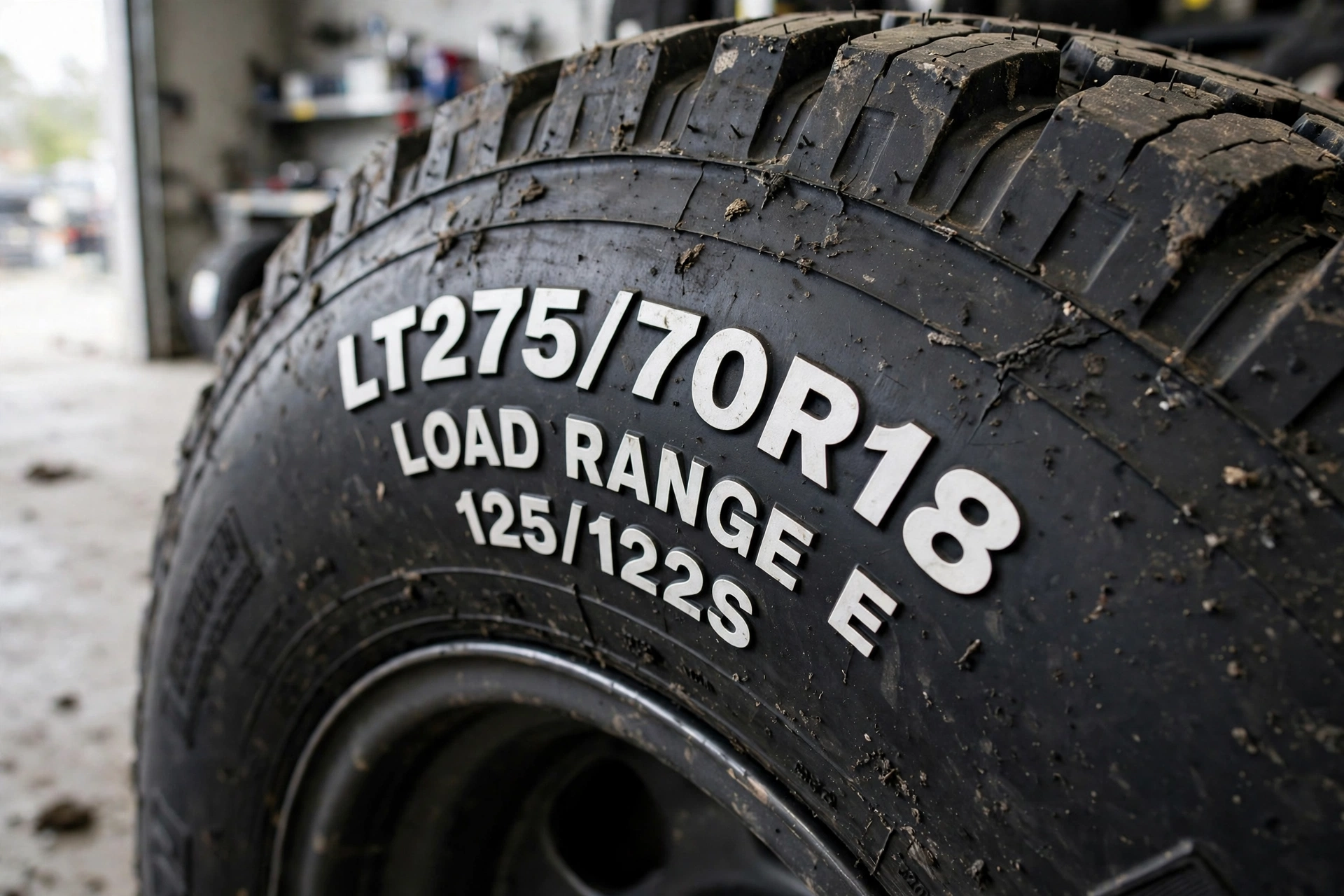
Never fit a P-metric passenger tire to an F-250. A P-metric tire is built for a car or half-ton truck, and its softer casing flexes under a Super Duty load.
The result is vague steering, fast shoulder wear, and a real risk of failure under a heavy trailer. The LT marking on the sidewall is the first thing to check on any tire you consider.
The owner manual states the rule plainly: only use replacement tires and wheels the same size as those originally provided. Find the required size, load, and speed index on the tire label on the driver-side door frame.
The Ford owner manual tire care section also says to check all tire pressures cold at least once every two weeks.
F250 Super Duty Tire Pressure by Trim
There is no single correct PSI for an F-250. The pressure depends on tire size, trim, and whether the truck carries a snow plow package, so the door-jamb sticker is the only number that counts for your truck. The table below shows verified 2024 placard values.
| 2024 Trim and Tire Size | Front PSI | Rear PSI |
|---|---|---|
| XL, LT245/75R17 | 65 to 70 | 80 |
| King Ranch, LT275/65R18 | 60 | 75 |
| King Ranch, LT275/70R18 | 60 | 65 |
| King Ranch, LT275/65R20 | 60 | 65 |
| Lariat with Snow Plow Package, LT275/65R18 | 70 | 75 |
The most common pattern in the Fanttik F-250 PSI guide is 60 PSI front and 65 PSI rear, appearing in 72 of its 138 reference entries for 2020 to 2025 trucks. If your door sticker is unreadable, check the tire label in the owner manual or ask a Ford dealer instead of guessing a pressure.
TirePressure.org lists the 2024 F-250 Super Duty placard values by trim, including the snow plow package trucks that run 70 PSI in front.
Pressure changes with load, and that is where most owners get it wrong. The placard pressure is the cold pressure for the truck at its rated load, so it is the right number when you tow.
Running the placard pressure empty gives a firm ride, and many owners drop the rear tires a few PSI for comfort. Never drop below the placard number while towing or hauling, because low pressure under load builds heat in the sidewall and wears the shoulders fast.
Check pressures cold, before driving, with a gauge you trust. Driving even a few miles warms the tires and raises the reading by several PSI. The tire pressure monitoring system is a backup, not a gauge.
Your trailer cares about tire pressure too, because the tow rating assumes placard pressure. Our Ford F-250 towing capacity chart shows how the rating changes by year, engine, and cab.
35 Inch Tires on a Stock F250 4×4


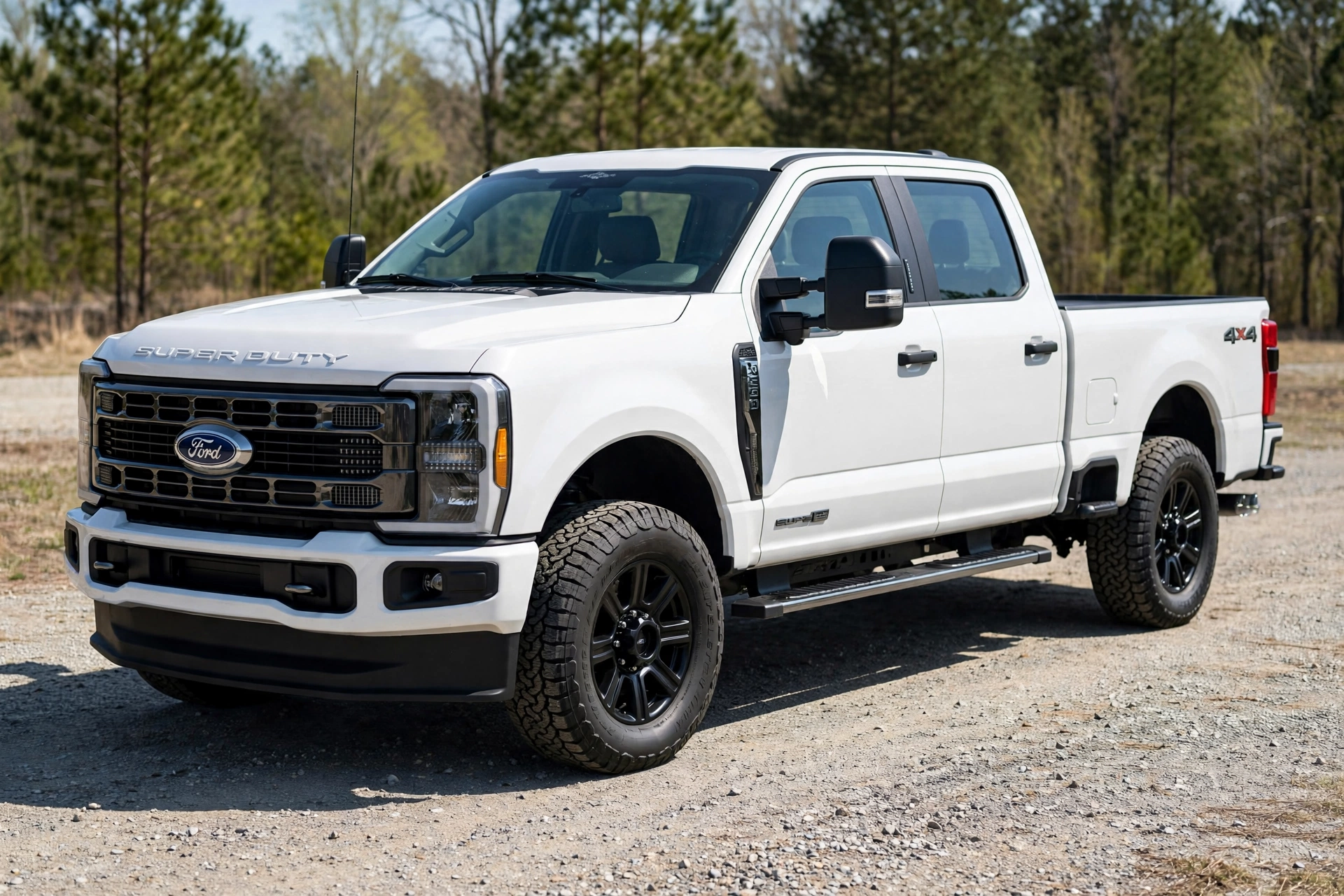
Yes, 35-inch tires fit most stock 2017 and newer F-250 Super Duty 4×4 trucks with minimal to no rubbing. The Tremor proves it by shipping with LT285/75R18 tires that measure about 34.8 inches.
Some trims still need minor fender-liner trimming at full steering lock, especially with wider 35×12.50 sizes on aftermarket wheels. The width causes more trouble than the height, because a 12.50-inch wide tire swings a wider arc and meets the radius arm and liner sooner.
Older trucks are a different story. On 2005 to 2016 Super Duty trucks, fitting 35×12.50 tires usually needs a 2 to 3 inch suspension lift or fender trimming.
On a 2004 and earlier truck, a 285/70R17 is often a direct fit, while a 315/70R17 needs a lift. Tread and Brake’s 2004 F250 tire size guide covers those older fitments in detail.
Age and body style change the answer, so do not copy a 2023 fitment onto a 2008 truck.
A leveling kit is the cheapest fix when a 35-inch tire rubs slightly. It raises the front to match the rear and adds the clearance the tire needs at full lock.
A leveling kit does not change the load rating, and you still need an alignment after the install. Our best shocks for F250 Super Duty diesel 4×4 guide covers the suspension parts that pair well with a leveled truck.
Before you buy, check the wheel as well as the tire. Any replacement wheel must match the 8×170 bolt pattern, the 124.9 mm hub bore, and the load rating in the owner manual. Our Ford F-250 bolt pattern chart lists the pattern and bore by year.
All Terrain vs Mud Terrain vs Highway
The tread pattern is a trade, not a ranking. Each type wins in one use and loses in another.
All Terrain Tires


All-terrain tires are the default choice for most F-250 Super Duty 4×4 owners, and the right one for mixed use. They grip gravel, dirt, and light mud, stay quiet enough for highway driving, and wear evenly under a heavy truck.
Buy all-terrain tires if your truck splits time between pavement, gravel roads, and job sites. Our 9 best tires for Ford F250 Super Duty roundup focuses on all-terrain picks for this exact use.
Mud Terrain Tires
Mud-terrain tires win in deep mud, clay, and loose soil, where their large lugs dig and self-clean. They lose on pavement, where they are loud, wear faster, and give up wet-road grip.
Buy mud-terrain tires only if your truck works off-road most weeks. A truck that tows a heavy trailer on the highway with mud tires gives up stability for grip it rarely uses.
Highway Tires for Pavement


Highway tires win on pavement. They are the quietest, longest-wearing, and most fuel-efficient choice, with the best wet-road braking of the three types. They lose the moment the pavement ends.
Buy highway tires if your truck tows on highways and rarely leaves asphalt. A work truck that lives on the interstate does not need all-terrain lugs.
| Tread Type | Towing Stability | Tread Life | Off-Road Grip | Road Noise |
|---|---|---|---|---|
| All-terrain | Good | Good | Good | Moderate |
| Mud-terrain | Fair | Short | Best | Loud |
| Highway | Best | Best | Poor | Quiet |
The F250 4×4 Tire Decision by Use
Match the tire to the job with this decision table.
| Your Main Use | Tread Type | Size | Pressure Rule |
|---|---|---|---|
| Heavy towing, mostly highway | Highway or all-terrain | Factory size | Placard PSI |
| Daily driving plus weekend towing | All-terrain | Factory size | Placard PSI |
| Work truck on gravel and job sites | All-terrain | Factory size or 35-inch | Placard PSI |
| Serious off-road and mud | Mud-terrain | 35-inch | Placard PSI on road |
| Snow plow work | All-terrain, severe snow rated | Factory size | Snow plow PSI, 70 front |
If you tow heavy, stay at the factory size and spend the money on load capacity instead of diameter. A factory-size Load Range E tire at placard pressure tows better than an underinflated 35-inch tire.
If you drive mostly on pavement, a highway tire in the factory size gives the best return.
If your truck works off-road every week, buy an all-terrain tire first and a mud-terrain tire only if the all-terrain leaves you stuck.
Diesel owners should check the front axle first. The 6.7L Power Stroke adds roughly 400 to 500 pounds of total curb weight versus a gas V8, most of it over the front axle, according to Sarasota Ford, so front tire load index and front pressure matter more on a diesel than on a gas truck.
Our 7 best tires for Ford F250 4×4 diesel roundup lists diesel-specific picks that account for that weight.
Rotation Wear and Replacement Timing
An F-250 eats front tires faster than rear tires, because the heavy front axle steers and brakes. Rotation evens that wear out. Ford recommends rotating tires every 5,000 miles, or at every oil change.
The 4×4 rotation pattern moves the front tires straight back and crosses the rear tires to the front. On a dually, the pattern is different, and our how to rotate tires on a dually guide covers that layout step by step.
Check wear with a gauge, not your eyes. Wear in the center means overinflation, wear on both shoulders means underinflation, and wear on one shoulder means an alignment problem. Fix the cause before the next set goes on.
Replace tires at 4/32 inch of tread if you tow or drive in rain, as Tire Rack recommends for wet conditions. The legal minimum is 2/32 inch, but wet grip falls off well before that.
The Ford owner manual states that tires should be replaced after six years regardless of tread wear, so check the manufacture date on the sidewall.
Bigger tires also change braking. A taller, heavier tire adds rotating mass that the brakes must stop. Our best brake pads for F250 Super Duty guide lists the options that hold up under the extra load.
F250 Super Duty Tire Questions Answered
What Size Tires Come on an F250
It depends on the trim and wheel package. The XL runs LT245/75R17, most mid trims run LT275/70R18, and some King Ranch trucks run LT275/65R18, higher trims run LT275/65R20, and the Tremor runs LT285/75R18. Check the door-jamb sticker for your exact size.
Can I Run 35 Inch Tires Stock


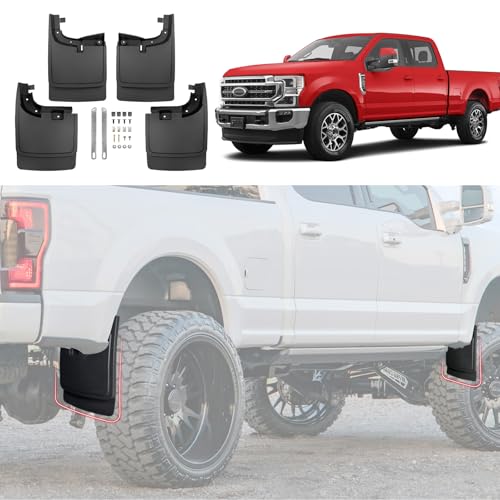
Yes, on most 2017 and newer F-250 Super Duty 4×4 trucks, 35-inch tires fit with minimal to no rubbing. Some trims need minor fender-liner trimming at full lock, and wider 35×12.50 sizes may need a leveling kit. Older trucks usually need a 2 to 3 inch lift.
What PSI for F250 Tires Towing
Use the cold PSI on your door-jamb sticker, typically 60 PSI front and 65 to 80 PSI rear depending on trim and tire size. Inflate to the placard number before every tow.
Do I Need Load Range E Tires
Yes, every F-250 Super Duty needs Load Range E tires at minimum. The truck’s weight and axle ratings exceed what lighter load ranges can carry. Never substitute a P-metric or Load Range C tire.
How Often Should I Rotate F250 Tires
Rotate every 5,000 miles, or at every oil change, as Ford recommends. Use the owner manual pattern, which moves the front tires straight back and crosses the rear tires forward.
Final Word on Tires for F250 Super Duty 4×4
The tires for F250 Super Duty 4×4 trucks are not a style choice, they are a load decision. Match the factory size for your trim, buy Load Range E, and run the cold PSI on your door-jamb sticker.
That combination keeps the truck stable under a trailer and safe in the wet.
Pick the tread by your real use, not your wish list. All-terrain tires suit most owners, highway tires suit pavement trucks, and mud tires suit trucks that work off-road every week. Buy the tire for the job your truck actually does.