Best Tires for Ford F250 4×4 Diesel: Top 2024 Heavy-Duty Picks

Load Range E (10-ply) tires are essential for the Ford F-250 Diesel due to the extreme weight of the PowerStroke engine and high towing demands. The best options must prioritize sidewall integrity and high torque resistance to ensure safety and longevity under heavy-duty 4×4 use.
🎯 Key Takeaways
Recommended Best Deal Products


- Select Load Range E or higher to support the PowerStroke engine weight.
- All-terrain tires offer the best balance for mixed highway and off-road use.
- Highway-terrain tires maximize fuel efficiency and offer the quietest ride for towing.
- Verify the 3-Peak Mountain Snowflake rating for superior winter and snow performance.
- Frequent tire rotations are vital to combat uneven wear from high diesel torque.
Choosing tires for a Ford F-250 4×4 Diesel is a high-stakes decision because of the massive weight and torque involved. Unlike the gas-powered versions, a Super Duty equipped with the 6.7L Power Stroke carries an extra 1,100 pounds over the front axle alone. You need a tire that doesn’t just fit the rim, but one capable of managing nearly 1,000 lb-ft of torque and a gross vehicle weight rating (GVWR) that often exceeds 10,000 pounds. The right set ensures your front end doesn’t “plow” in corners and your rear tires don’t shred when the turbo kicks in while towing.
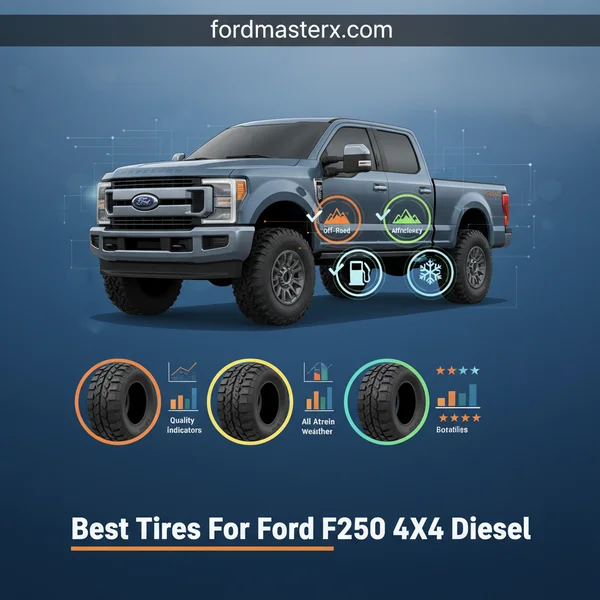
Practically, the wrong tire choice leads to premature tread wear, “death wobble” amplification, and dangerous sidewall flex under heavy gooseneck loads. To maximize your truck’s 4×4 capability without sacrificing highway stability, you must prioritize tires with reinforced carcasses and compounds specifically engineered for high-pressure applications. This guide breaks down the top-tier options that have proven to withstand the unique physics of the heavy-duty diesel platform in 2024.

Prime for Young Adults — 6 Months Free
Students and 18–24s get six months of Prime free, then half price.
Start 6 Months Free As an Amazon Associate I earn from qualifying purchases.Top-Rated Tires for the F-250 Diesel by Performance Category
The F-250 Diesel requires a specific balance of stiff sidewalls for towing and aggressive biting edges for 4×4 traction. Because the diesel engine puts so much weight on the front end, “soft” off-road tires will wear out in less than 20,000 miles. These selected models are the industry gold standard for 2024, specifically chosen for their ability to handle diesel-level stress.

Best All-Terrain Performance: BFGoodrich All-Terrain T/A KO2 / KO3
The KO2 has long been the benchmark for the F-250, and the new KO3 builds on that legacy with better wet traction. These tires feature CoreGard Technology, which uses bruise-resistant sidewall rubber derived from desert racing tires. This is critical for 4×4 diesel owners who take their trucks into rocky or debris-heavy job sites where the sheer weight of the truck could easily force a sharp rock through a weaker sidewall.
- Pros: Severe snow rated (3PMSF), exceptional sidewall puncture resistance, and predictable handling on gravel.
- Cons: Can become noisy as the tread wears past 50%; require strict 5,000-mile rotations due to the heavy diesel front end.
- Best For: Drivers who split time 50/50 between highway commuting and technical off-road trails.
Best Highway Longevity and Heavy Towing: Michelin LTX A/T2
If your F-250 spent its life hitched to a 15,000-pound fifth-wheel, the Michelin LTX A/T2 is the most logical choice. Michelin uses a specific MaxTouch Construction that optimizes the tire’s contact patch. This is vital for diesel trucks because it distributes the high torque of the Power Stroke evenly, preventing the “scalloping” or uneven wear often seen on the rear drive tires during heavy acceleration.
- Pros: Best-in-class tread life (often exceeding 60,000 miles), extremely quiet at 70 mph, and superior fuel economy.
- Cons: Least aggressive tread pattern in this list; struggles in deep mud or slick clay.
- Best For: Long-haul hotshot drivers and owners who prioritize mileage and stability over aggressive looks.
Best Hybrid for Torque and Traction: Nitto Ridge Grappler
The Nitto Ridge Grappler is a “hybrid” tire, sitting between an all-terrain and a mud-terrain. It features a reinforced block foundation to reduce tread flex. For an F-250 diesel, this is a game-changer because it prevents the individual tread blocks from “squirming” under the massive low-end torque of the diesel engine, providing a more planted feel on the pavement.
- Pros: Stunning aggressive aesthetics without the roar of a mud tire; dual sidewall designs allow for a custom look.
- Cons: Heavier than the Michelin, which can slightly impact MPG; performance in ice is average compared to 3PMSF-rated tires.
- Best For: Owners who want the “big truck” look and off-road grip without the vibrations of a dedicated MT.
Why Load Range E is Critical for Heavy-Duty Diesel Trucks
Recommended Best Deal Products

When shopping for F-250 tires, you will encounter various load ratings, but for a diesel 4×4, Load Range E is non-negotiable. This rating indicates a 10-ply equivalent construction. While modern tires use actual polyester or steel plys rather than ten physical layers, the rating signifies the tire’s ability to hold up to 80 PSI of air pressure. This high pressure is what provides the structural “pillar” of support your truck needs when the bed is loaded or a trailer is tongue-heavy.
Understanding the Load Index 121 to 125
Beyond the “E” rating, you must look at the Load Index, typically found after the tire size (e.g., 121R or 125S). For a Ford F-250 Diesel, you should look for a Load Index of 121 (3,197 lbs per tire) or 125 (3,638 lbs per tire). Since the front end of a diesel F-250 can easily weigh 4,500 lbs empty, a lower load index tire would be operating near its maximum capacity at all times, leading to internal heat buildup and eventual blowout.
The Danger of “P-Metric” or Load Range D Tires
You might find a great deal on a tire that looks aggressive but is rated as “SL” (Standard Load) or Load Range D. Never install these on a diesel Super Duty. These tires have thinner sidewalls designed for the lighter F-150. On a diesel, these sidewalls will bulge and flex excessively. This flex creates heat, and heat is the primary cause of tire failure. Furthermore, Load Range D tires cannot handle the 80 PSI required by the F-250’s TPMS (Tire Pressure Monitoring System), meaning you would have a permanent warning light on your dash and a truck that feels “mushy” and unstable in turns.
- 80 PSI Capability: Allows for maximum load carrying and cooler operation under heavy towing.
- Sidewall Stiffness: Reduces “trailer sway” and improves steering response under the weight of the Power Stroke engine.
- Torque Resistance: Reinforced belts prevent the tire from deforming when the 1,050 lb-ft of torque is applied to the pavement.
Analyzing Tread Life and Durability Under High Diesel Torque
When you are driving a Ford F250 with a 6.7L Power Stroke diesel engine, you aren’t just driving a pickup; you are piloting a high-torque machine. That massive torque—often exceeding 1,000 lb-ft in newer models—can be a “tire killer.” Every time you accelerate, especially while towing a heavy trailer, that energy is transferred directly to the contact patch of your tires. If your rubber isn’t built to handle that force, you will see your tread depth disappear much faster than you would on a gas-powered truck.

The Power Stroke Factor: Torque vs. Rubber
Diesel engines add significant weight to the front end of your F250, often weighing several hundred pounds more than their gasoline counterparts. This front-heavy bias means your front tires bear the brunt of steering and braking forces, while the rear tires handle the raw acceleration torque. To combat this, look for tires featuring advanced rubber compounds designed for “chip and cut” resistance. These materials are specifically engineered to stay intact under high stress and preventing the tread from “chunking” when you’re pulling a heavy load on gravel or rough pavement.

Audible — Listen Free for 30 Days
One free credit a month and thousands of titles included.
Listen Free for 30 Days As an Amazon Associate I earn from qualifying purchases.Load Range E: The Non-Negotiable Standard
For a heavy-duty diesel 4×4, anything less than a Load Range E (10-ply) rating is a safety risk. These tires are constructed with reinforced sidewalls that can handle the high internal pressures required to support the F250’s Gross Vehicle Weight Rating (GVWR). Key durability features to look for include:
- Reinforced Steel Belts: These provide a stable footprint and help the tire maintain its shape under heavy tongue weights.
- High Silica Compounds: This helps with heat dissipation, which is crucial during long summer hauls.
- Scuff Guards: Thickened rubber on the sidewalls protects against curb damage and sharp rocks in off-road environments.
Choosing Between All-Terrain and Highway-Terrain for Your 4×4
One of the most common dilemmas for F250 owners is deciding between an All-Terrain (A/T) and a Highway-Terrain (H/T) tire. Because the F250 is a 4×4, there is a natural inclination to go for the most aggressive look possible. However, the “best” tire depends entirely on where your truck spends 90% of its time. A diesel engine is already loud; choosing the wrong tire can turn your cabin into a drone zone during long highway trips.
Highway-Terrain (H/T): The Long-Haul Specialist
If your F250 is primarily a “tow rig” that stays on the pavement, an H/T tire is your best bet. These tires feature closed shoulder designs and continuous ribs that minimize road noise and maximize fuel efficiency. For a diesel owner, this translates to a smoother ride and better stability at cruising speeds. You’ll also generally see a much longer tread life—often 60,000 miles or more—compared to more aggressive patterns.
All-Terrain (A/T): Versatility for the 4×4 Life
For those who use their 4×4 for job sites, ranch work, or weekend adventures, an A/T tire provides the necessary bite. Modern A/T tires have come a long way in terms of road manners. They utilize “varied pitch” tread blocks to cancel out harmonic noise while still offering deep grooves for mud and snow traction. Choose an A/T tire if:
- You frequently drive on unpaved access roads or muddy job sites.
- You live in a climate with significant snowfall and need the “Three-Peak Mountain Snowflake” (3PMSF) rating.
- You prefer a rugged aesthetic that matches the heavy-duty stance of the F250.
- You are willing to trade a small amount of fuel economy for increased “go-anywhere” confidence.
Conclusion
Selecting the best tires for your Ford F250 4×4 Diesel is about balancing the immense weight and torque of the Power Stroke engine with your specific driving needs. Whether you opt for the long-lasting efficiency of a Highway-Terrain tire or the rugged versatility of an All-Terrain model, always prioritize a Load Range E rating to ensure your truck remains safe and capable. Remember that the “perfect” tire is the one that supports your heaviest trailer while keeping you comfortable on the road.
Ready to upgrade your ride? Start by checking your current tire wear patterns and verifying your required load index. Investing in the right rubber today will save you money at the pump and keep your heavy-duty Ford performing at its peak for miles to come!
❓ Frequently Asked Questions
Why do F-250 diesel trucks require specific tire ratings?
The PowerStroke diesel engine is significantly heavier than gas engines, placing massive pressure on the front tires. Load Range E (10-ply) tires feature reinforced sidewalls designed to prevent blowouts and maintain stability under these extreme front-end loads.
What are the best all-terrain tires for an F-250 4×4?
The BFGoodrich All-Terrain T/A KO2 and Falken Wildpeak A/T3W are top choices due to their durable compounds and excellent traction. These tires are designed to resist chipping on gravel while providing reliable grip in mud and snow.
How often should I rotate tires on my F-250 Diesel?
Tires should be rotated every 5,000 to 7,500 miles because of the weight concentration on the front axle. Failure to rotate frequently leads to ‘cupping’ on the front tires and faster wear on the rear driving wheels.
Are mud-terrain tires a good choice for a daily driver F-250?
While they offer superior off-road grip, mud-terrain tires typically have shorter tread life and increased road noise. For most daily drivers, an aggressive all-terrain tire offers a better balance of performance and longevity.
Audible Premium Plus — Annual Membership
12 audiobook credits up front, plus the full Audible catalogue.
See Annual Plans As an Amazon Associate I earn from qualifying purchases.What does the 3-Peak Mountain Snowflake (3PMSF) rating mean for my truck?
This rating indicates the tire meets specific snow traction requirements for severe winter weather. For F-250 owners in cold climates, this ensures better braking and acceleration on ice and packed snow compared to standard M+S tires.
How does tire pressure affect F-250 diesel performance?
Maintaining recommended PSI (usually 60-80 PSI) is critical for load capacity and heat management. Under-inflated tires can lead to sidewall failure and decreased fuel economy, especially when the truck is carrying a heavy load.