Dually Tire Rotation: Patterns, Polished Rims & Torque Specs

The most effective dually rotation follows a front-to-inner-rear, inner-to-outer-rear, and outer-rear-to-front cycle. Because many duallys use polished aluminum outers and steel inners, tires often require professional dismounting and flipping to maintain proper wheel aesthetics and alignment.
🎯 Key Takeaways


- Use the front-to-inner, inner-to-outer, outer-to-front rotation cycle for even wear.
- Mixed rim materials (aluminum/steel) require dismounting tires rather than simple wheel swaps.
- Maintain identical tire diameters on rear pairs to prevent load imbalance and overheating.
- Always use a calibrated torque wrench; most duallys require 140 to 165 lb-ft.
- Directional tires must be flipped on the rim if moving to the opposite side.
To rotate tires on a dually truck correctly, you must follow a specific six-tire cycle: move the front tires to the inner rear position, the inner rears to the outer rear position, and the outer rears to the front. This “front-to-inner, inner-to-outer, outer-to-front” sequence ensures that every tire eventually occupies every position on the truck. By alternating between the high-steering stress of the front axle and the heavy load-bearing requirements of the rear dually setup, you significantly extend the life of your tread and maintain better traction.
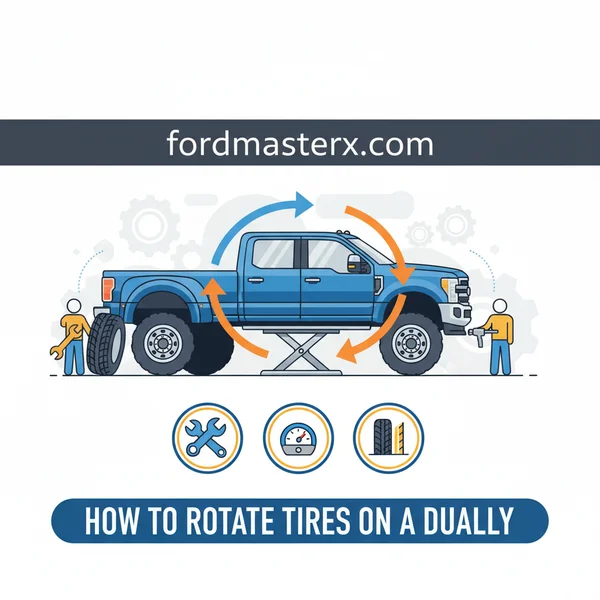
Proper rotation is critical for duallies because the rear tires do not wear at the same rate as the fronts. Front tires often suffer from “cupping” or edge wear due to steering geometry, while the rear duals can develop “heel-toe” wear patterns from constant torque. If you ignore this cycle, you risk premature tire failure or a rough ride caused by uneven tread heights. In a six-wheel configuration, even a small difference in diameter between paired rear tires can cause the larger tire to carry a disproportionate amount of the load, leading to overheating and blowouts.
Understanding Standard vs. Directional 6-Tire Rotation Patterns
The goal of a dually rotation is to move tires between the three distinct roles they play: steering, inner-drive, and outer-drive. Because weight distribution and scrub angles differ at each corner, a simple front-to-back swap is insufficient. You must move the tires in a way that reverses their wear patterns while keeping the truck stable.
The Standard Non-Directional Rotation Path
For trucks equipped with standard all-season or all-terrain tires that are not directional, the most effective pattern involves crossing sides to neutralize wear. Following this specific path is the industry standard for 4×2 and 4×4 dual rear wheel (DRW) pickups:
- Front Tires: Move these straight back to the Inner Rear positions on the same side.
- Inner Rear Tires: Move these outward to become the Outer Rear tires on the same side.
- Outer Rear Tires: Cross these to the Front axle on the opposite side (e.g., Left Outer Rear moves to Right Front).
This pattern is preferred because it moves tires from the inside of the dually pair—where heat builds up more quickly—to the outside, and eventually to the front where they can wear down any “scalloping” that occurred while they were on the rear axle.
Managing Directional Treads and Mismatched Sets
If you run dedicated mud-terrain tires with a directional arrow on the sidewall, your options are limited. Directional tires cannot be crossed from one side of the truck to the other without being dismounted from the rim and flipped. If you do not want to pay for a shop to flip the tires, you must stick to a same-side rotation. In this scenario, the front moves to the inner rear, the inner moves to the outer, and the outer moves back to the front—all on the same side of the vehicle. This helps with tread depth consistency but won’t fix side-specific wear issues like those caused by crowned roads.
The Ultimate Dually Tire Rotation Walkthrough
Owning a dual rear wheel (dually) truck means you are likely hauling heavy loads or towing large trailers, which puts immense pressure on your tires. Rotating six tires instead of four might seem daunting, but it is a critical maintenance task that ensures even tread wear, extends the lifespan of your expensive rubber, and maintains optimal traction. Because duallys have unique wheel offsets and often different rim materials (like polished aluminum on the outside and steel on the inside), the process requires more strategy than a standard sedan. This guide will walk you through the specialized patterns and heavy-duty safety protocols required to get the job done right in your own driveway.
Step 1: Prepare Your Workspace and Gather Heavy-Duty Gear
What you need: A level concrete surface, heavy-duty wheel chocks, a 3-ton or 6-ton floor jack, at least four 6-ton jack stands, and a high-torque impact wrench or a long breaker bar with a 7/8″ or 15/16″ deep-well socket (verify your specific lug size).
Instructions: Safety is paramount when dealing with a vehicle that can weigh over 8,000 lbs. Park the truck on a flat, solid concrete surface—never grass or dirt, as the jack stands can sink. Engage the parking brake firmly and place chocks in front of and behind the tires that will remain on the ground initially. If you are lifting the rear first, chock the front. Before lifting, take a moment to clear the area of any debris. Dually wheels are significantly heavier than standard wheels, so ensure you have enough physical space to maneuver these 80-100 lb assemblies without straining your back or hitting the truck’s fenders.
Pro Tip: Loosen the lug nuts about half a turn while the tires are still touching the ground; this prevents the wheels from spinning in the air while you struggle with a stuck nut.
Step 2: Identify Your Specific Rotation Pattern
What you need: Your vehicle’s owner manual and a piece of sidewalk chalk or masking tape to mark the tires.
Instructions: Dually rotation is complex because of the “dish” or offset of the wheels. If all six wheels are identical (usually steel), the most common pattern is: Fronts move to the inner rear, inner rears move to the outer rear, and outer rears move to the front. However, if your truck has polished aluminum outer wheels and steel inner wheels, you cannot simply swap them without dismounting the tires from the rims, as the “inside” of an aluminum wheel is not finished. In this case, you may only be able to swap the fronts side-to-side and the rear pairs side-to-side. Use your chalk to mark each tire with its current position (e.g., “RF” for Right Front) and its destination (e.g., “RRI” for Right Rear Inner) to avoid confusion once they are all off the truck.
Pro Tip: If you have a matching full-size spare, consider a 7-tire rotation to ensure the spare doesn’t dry rot while sitting unused for years.
Step 3: Securely Lift and Support the Chassis
What you need: A high-lift floor jack and heavy-duty jack stands rated for the truck’s Gross Vehicle Weight Rating (GVWR).
Instructions: Locate the factory-approved jacking points. For the front, this is usually the frame rail or a specific point on the lower control arm. For the rear, the differential housing (pumpkin) or the axle tubes are common, but check your manual to avoid damaging the diff cover. Lift the truck high enough so the tires clear the ground by at least three inches. Place your jack stands under the frame rails or the axle tubes. Slowly lower the jack until the truck’s weight is fully supported by the stands. Shake the truck gently to ensure it is rock-solid. Never work on a vehicle supported only by a hydraulic jack, as seals can fail without warning.
Pro Tip: When lifting the rear, place the jack stands as wide as possible on the axle tubes to provide maximum stability for the wide dually rear end.
Step 4: Remove the Rear Dual Assemblies
What you need: Impact wrench or breaker bar, and a tire iron or “buddy bar” for leverage.
Instructions: Remove the lug nuts from the rear wheels. On a dually, the outer wheel will come off first, followed by the inner wheel. These wheels are often “hub-centric,” meaning they fit tightly around the center hub. If they are stuck due to rust, do not hit the wheel with a metal sledgehammer. Instead, use a rubber mallet on the tire sidewall or use the “loose lug nut” technique (loosening the nuts slightly and rocking the truck) before lifting. Once removed, inspect the “mating surfaces” between the two wheels. Rust or debris trapped between the inner and outer rear wheels can cause “wheel hop” or lead to the lug nuts loosening over time. Use a wire brush to clean the hub and the mounting faces of the wheels.
Pro Tip: Take this opportunity to inspect your rear brake pads and rotors, as they are much easier to see with both wheels removed.
Step 5: Execute the Tire Swap
What you need: The tires you marked in Step 2 and a tread depth gauge.
Instructions: Physically move the tires to their new designated positions according to your chosen pattern. If you are moving a front tire to the inner rear position, ensure the valve stem is pointing in a direction that will be accessible once the outer wheel is installed. While the tires are off, use your tread depth gauge to check for uneven wear. If the front tires are wearing heavily on the inside or outside edges, your truck may need an alignment. If the rear tires show “cupping,” your shocks may be failing. This is the best time to catch these issues before they ruin a new set of tires. Ensure that the tires being paired together on the rear axle have nearly identical tread depths; a significant difference in diameter can cause the larger tire to carry more load and overheat.
Pro Tip: Use a soapy water solution to clean the wheel studs and inspect them for any stripped or stretched threads before reinstalling the nuts.
Step 6: Mount the Inner and Outer Rear Wheels
What you need: A little bit of anti-seize (optional, check manufacturer specs) and a steady hand.
Instructions: Slide the inner wheel onto the studs first. Ensure it seats flush against the hub. Next, slide the outer wheel on. Crucially, you must align the valve stems. On a dually, the inner valve stem should point outward, and the outer valve stem should point inward, spaced 180 degrees apart. This allows you to check the air pressure of both tires through the hand-holes of the outer wheel. If you misalign them, you will find it impossible to add air to the inner tire without removing the outer wheel again. Hand-tighten the lug nuts in a star pattern to ensure the wheels seat evenly against each other and the hub. This prevents the “sandwich” from being crooked, which causes massive vibration at highway speeds.
Pro Tip: If the wheels are heavy, use a long pry bar under the tire to help lift and guide it onto the studs without straining your arms.
Step 7: Lower the Vehicle and Final Torque
What you need: A calibrated torque wrench capable of reaching 140–165 lb-ft (or your specific manufacturer’s spec).
Instructions: Raise the truck slightly to remove the jack stands, then slowly lower the vehicle until the tires touch the ground enough to prevent spinning, but do not let the full weight down yet. Using your torque wrench, tighten the lug nuts in a “star” or “cross” pattern. For an 8-lug dually, follow a sequence like 1-5-3-7-2-6-4-8. This ensures even clamping force. Once all nuts are snug, lower the truck completely and perform a final torque pass. Most duallys require significantly higher torque than standard trucks—often 140 lb-ft for older models and up to 165 lb-ft or more for modern Rams, Chevys, and Fords. Double-check every single nut; with 32 to 40 lugs total, it’s easy to miss one.
Pro Tip: Never use an impact wrench for the final tightening. Over-torquing can stretch studs or warp brake rotors, while under-torquing can lead to wheel separation.
Step 8: Adjust Tire Pressures
What you need: A high-quality tire pressure gauge and an air compressor.
Instructions: Front and rear tires on a dually often require different pressures. Typically, front tires run at a higher PSI (e.g., 75-80 PSI) to support the heavy diesel engine, while the rear duals may run lower (e.g., 60-65 PSI) when the truck is empty to prevent the “crown” of the tire from wearing out. Now that the tires have switched positions, you must adjust the air pressure to match their new locations. Refer to the tire placard on the driver’s side door jamb for the recommended “Cold PSI.” Check the pressure in the inner rear tire first using a dual-head air chuck, then the outer, and finally the fronts. This step is vital for fuel economy and safety.
Pro Tip: If you frequently tow heavy, consider installing valve stem extensions or a Tire Pressure Monitoring System (TPMS) specifically designed for duallies to make this maintenance easier in the future.
✅ Final Checklist
- Confirm all 32-40 lug nuts have been torqued to the specific foot-pound rating in the owner’s manual.
- Verify that the rear valve stems are positioned 180 degrees apart and are accessible for pressure checks.
- Check that the “mating surfaces” between the inner and outer wheels are flush with no visible gaps.
- Ensure tire pressures are adjusted: Fronts usually require higher PSI than rears on an unloaded dually.
- Remove all tools and chocks from the work area before starting the engine.
Important Notes:
- Safety Warning: Always re-torque your lug nuts after the first 50–100 miles of driving. The “settling” of the dual wheels can cause a slight loss in clamping force.
- When to Seek Help: if you notice significant “cupping” or “feathering” on the tread, or if you feel a vibration at high speeds after rotation, take the truck to a professional for a balance and alignment.
- Estimated Time: 60–90 minutes for a DIYer.
- Cost Range: $0 (if you own the tools) vs. $80–$150 at a commercial tire shop.
The Polished vs. Steel Rim Constraint: Dismounting vs. Swapping
The biggest hurdle in dually rotation isn’t the pattern; it is the physical wheel. Most modern dually trucks use a “4+2” configuration: four high-quality polished aluminum or alloy wheels (the two fronts and the two outer rears) and two plain steel wheels (the inner rears). These wheels are not interchangeable. You cannot simply bolt a raw steel inner wheel onto the front axle without ruining the truck’s aesthetics, and often, the wheel offsets or lug seating surfaces are different between the inner and outer rims.
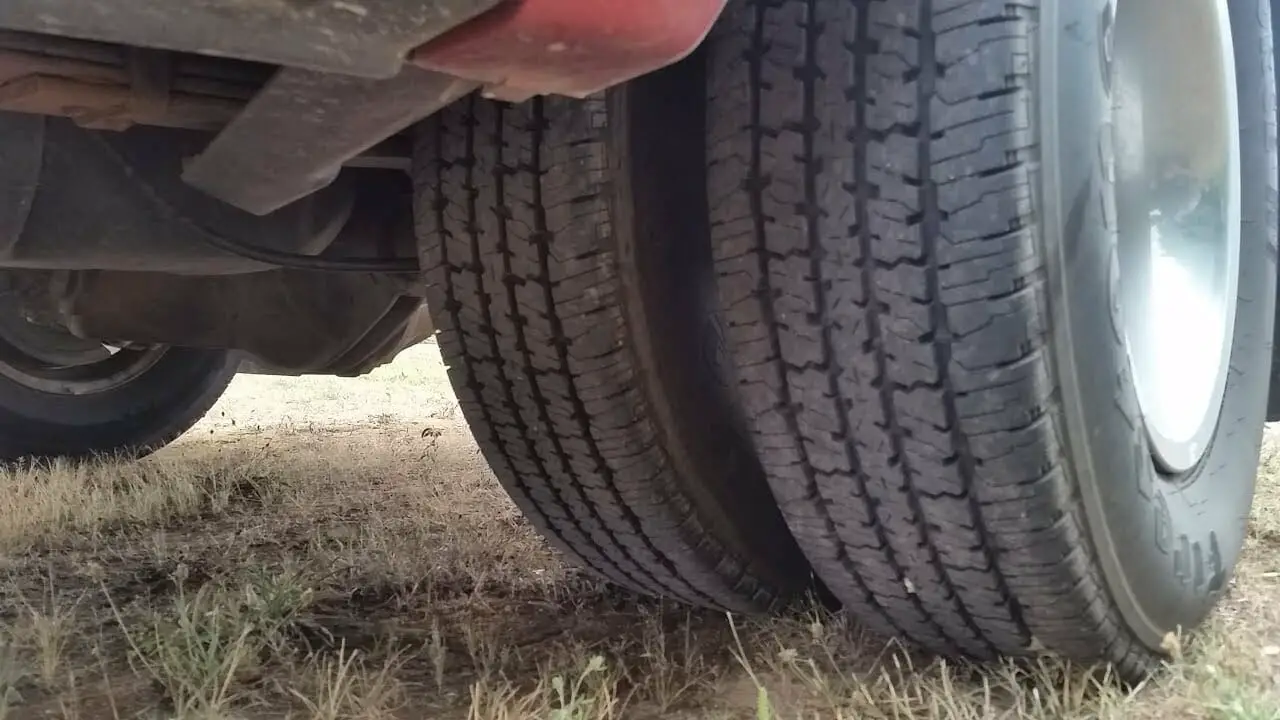
Why You Can’t “Just Swap” Wheels
On a dually, the inner rear wheel is usually hidden and exists purely for structural support. It is typically a concave steel dish. The outer rear wheel is a convex polished rim. Because the front wheels also need to be polished and usually have a specific offset to clear brake calipers, you are left with three different wheel “looks” or types. If you follow the standard rotation pattern mentioned above, you would end up with a black steel wheel on your front hub and a polished aluminum wheel hidden inside the rear dual setup. This is why a dually tire rotation is rarely a “DIY” project in a driveway; it almost always requires a tire machine.
The Dismount-and-Flip Requirement
To maintain the look of your truck while following a proper rotation pattern, a technician must dismount the tires from the rims. This is the only way to move the rubber while keeping the polished wheels on the “show” positions (front and outer rear). Here is what that process looks like in a professional shop:
- The tires are removed from all six rims.
- The “Front” tires are mounted onto the steel inner rims.
- The “Inner Rear” tires are mounted onto the polished outer rims.
- The “Outer Rear” tires are mounted onto the polished front rims.
- Every assembly must be re-balanced after mounting to ensure no vibration at highway speeds.
While this process is more expensive than a standard four-wheel rotation, it is the only way to ensure your tires wear evenly without compromising the appearance of your Alcoa or factory polished wheels. If you skip the dismount and only swap the front and outer rear wheels, you are completely ignoring the inner tires, which will eventually lead to a significant tread depth mismatch on the rear axle.
Critical Load Ratings and Torque Specifications for Heavy-Duty Trucks
When you’re dealing with the massive weight of a one-ton truck, the margin for error with wheel fasteners is razor-thin. Unlike a compact car, a dually generates immense lateral force, especially when towing a fifth-wheel or hauling a heavy camper. This makes your torque wrench the most important tool in your garage during the rotation process.
The Dangers of Incorrect Torque
It’s a common mistake to think “the tighter, the better,” but over-torquing can actually stretch and weaken your wheel studs. Conversely, under-torquing leads to microscopic vibrations that can eventually shear the studs off entirely. Always refer to your owner’s manual, as modern heavy-duty trucks from Ford, RAM, and GM often require significantly higher torque than older models—sometimes reaching 150 to 165 lb-ft.
- Always use a calibrated torque wrench: Never rely on an impact gun or a “calibrated arm” to set the final tightness.
- Check for surface debris: Ensure the mating surfaces between the dual wheels and the hub are bone dry and free of rust or grit, which can cause “false torque” readings.
- Follow the star pattern: Tightening in a criss-cross pattern ensures the wheel seats perfectly flat against the hub, preventing wobbles at highway speeds.
The 50-Mile Retorque Rule
Heavy-duty wheels go through a “settling” period after being reinstalled. As the metal components heat and cool during your first few miles of driving, the lug nuts can shift slightly. Professional fleet managers always recommend checking your torque again after the first 50 to 100 miles. It only takes five minutes, but it is a vital safety step to prevent a catastrophic wheel-off incident while under load.
Long-Term Benefits of Maintaining Synchronized Dual Rear Tread Wear
In a dually setup, the two tires on each side of the rear axle must work as a perfectly synchronized team. If one tire is significantly more worn than its partner, their overall diameters will differ. This seemingly minor discrepancy can lead to expensive mechanical failures and increased operational costs over the life of the truck.
Eliminating the “Scrubbing” Phenomenon
Because dual wheels are bolted together and forced to spin at the exact same speed, a smaller (more worn) tire will actually be “dragged” by the larger (newer) tire. This causes “scrubbing,” where the tires fight for traction against the pavement. This doesn’t just eat through your tread at an accelerated rate; it also hurts your fuel economy because the engine has to work harder to overcome the constant friction of the tires fighting each other.
- Matching Diameters: Regular rotation ensures both tires in the rear pair stay within 1/8th of an inch of each other in tread depth.
- Heat Management: Mismatched tires build up heat unevenly. Excessive heat is the leading cause of blowouts, particularly in the inner rear tire which gets less airflow.
- Vibration Control: Synchronized wear keeps the rear end stable, reducing the “chatter” or vibration often felt when driving an empty dually.
Preserving Your Differential and Axle Components
The stress of mismatched duals travels beyond the rubber. It moves up through the axle and into the differential gears. Over time, this constant “tugging” and uneven load distribution can wear out bearings and seals prematurely. By rotating your tires to maintain even wear, you aren’t just saving money on tires—you’re protecting the high-cost driveline components that make your truck a true workhorse.
Conclusion
Maintaining a dually’s tires requires more attention than a standard vehicle, but the payoff is found in safety and longevity. By following the correct rotation patterns for your specific wheel type, protecting your polished rims from damage, and strictly adhering to torque specifications, you ensure your truck remains a reliable tool. Remember that synchronized tread wear is the secret to getting the maximum mileage out of your rubber and preventing unnecessary strain on your drivetrain.
To keep your truck in top shape, check your owner’s manual for your specific torque settings today and set a recurring maintenance reminder for every 5,000 to 7,500 miles. Don’t wait until you see visible uneven wear—stay proactive and keep those wheels turning smoothly!
❓ Frequently Asked Questions
Why is tire rotation different for dually trucks compared to standard pickups?
Duallys have six tires and often use different wheel materials for inner and outer positions, making simple swaps impossible without dismounting. Proper rotation prevents cupping on the front tires and ensures the rear duals stay perfectly matched in diameter to share the load equally.
What happens if I have polished aluminum outers and steel inners?
Because the inner and outer wheels have different finishes and offsets, you cannot simply swap the wheel assemblies. You must have a tire shop remove the tires from the rims and move the rubber to the appropriate wheel to maintain the polished aesthetic on the outside.
Is it necessary to balance dually tires during every rotation?
While not mandatory every time, balancing the front tires is highly recommended during every rotation to prevent steering wheel vibration. Rear duals are more forgiving but should be checked if you notice any uneven wear patterns or ‘hopping’ at highway speeds.
What are the risks of incorrect lug nut torque on a dually?
Under-torqued lugs can lead to wheel separation, while over-torquing can stretch studs or crack the wheel hub. Duallys carry immense loads, so using a calibrated torque wrench to hit specific manufacturer specs (usually 140-165 lb-ft) is a critical safety requirement.
Can I rotate tires side-to-side on a dually truck?
You can, but only if the tires are non-directional. If you have directional tread patterns, side-to-side rotation requires dismounting and flipping the tires on the rims to keep the tread orientation correct for water evacuation and grip.
How does tread depth difference affect the rear dual setup?
If dual tires have significantly different diameters, the larger tire will carry more of the load and scrub against the road, leading to rapid wear and potential overheating. Always ensure paired rear tires are within 1/4 inch of circumference of each other for safety.