
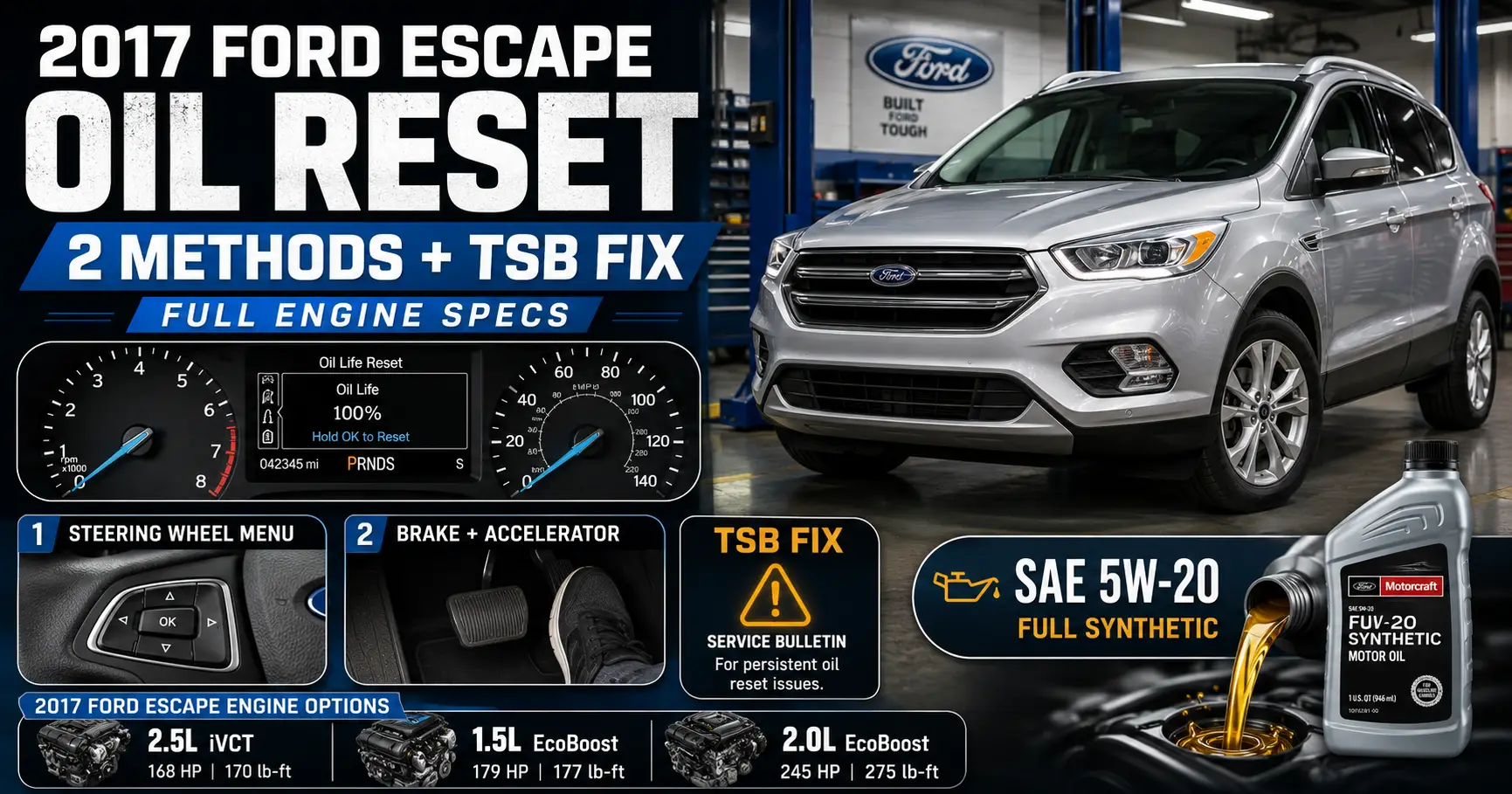
2017 Ford Escape Oil Reset — 2 Methods, TSB Fix, and Full Engine Specs

The 2017 Ford Escape brought significant powertrain changes — a new 1.5L EcoBoost replacing the outgoing 1.6L, a twin-scroll 2.0L EcoBoost, and the SYNC 3 infotainment system. But maintenance fundamentals stayed the same: after every oil change, you need to manually reset the Intelligent Oil-Life Monitor so the PCM restarts its countdown from 100%.
This guide covers both reset methods in full, the critical TSB 20-2031 software defect affecting early 2017 builds, engine oil specs for all three powerplants, a complete drivetrain fluid reference, and a full professional oil change walkthrough.
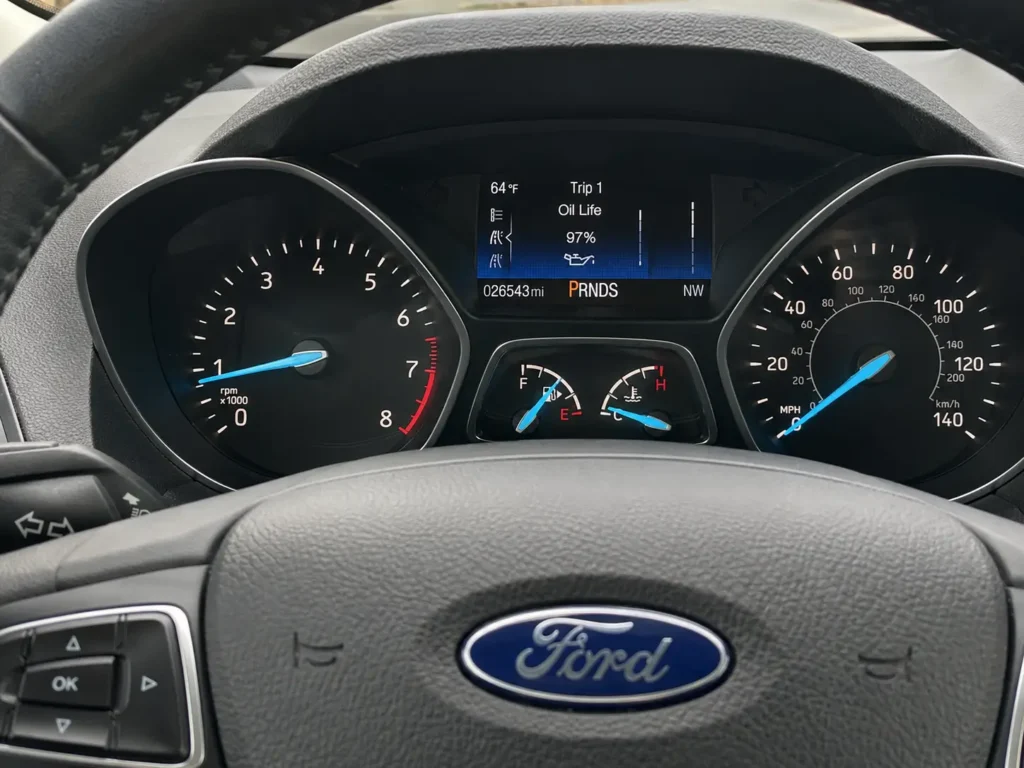
Quick Answer: Ignition ON, engine OFF → steering wheel left D-pad → Settings → Vehicle → Oil Life → hold OK until “Reset Successful.” Alternatively, press both accelerator and brake pedals fully to the floor and hold for 25–30 seconds. Both methods work on all 2017 Escape trims.
2017 Ford Escape Oil Reset — methods, TSB 20-2031 fix, engine specs
Recommended Best Deal Products


How the 2017 Ford Escape Oil-Life Monitor Works
The 2017 Escape does not use a physical sensor in the oil pan to measure the fluid’s clarity or condition. The Intelligent Oil-Life Monitor (IOLM) is a pure software algorithm running inside the Powertrain Control Module (PCM) — it models oil degradation by processing millions of real-time data points from engine sensors.
The IOLM assigns weighted values to specific driving behaviors. Frequent short trips where the engine never reaches optimal operating temperature heavily penalize the countdown — condensation and unburned fuel never evaporate from the crankcase, causing rapid fuel dilution and oil thinning. Sustained highway cruising at consistent RPMs lets the system extend the interval toward a theoretical 10,000-mile maximum.
High engine load — frequent high-RPM bursts, turbo boost requests, towing — accelerates the oxidation of oil and depletes anti-wear additives. Extreme ambient temperatures, both sub-zero winter cold and desert heat, also modify the degradation curve.
The Two Warning Stages
“Change Engine Oil Soon” — IOLM calculates approximately 5% oil life remaining. The additive package is nearing exhaustion. Schedule the service immediately.
“Oil Change Required” — Oil life has hit 0% and a persistent chime activates. Replace the fluid and filter right away. Continued operation accelerates wear on EcoBoost turbocharger bearings, VCT phasers, and timing chain components.
Because the IOLM is entirely software-driven with no awareness of when fresh oil is actually poured in, you must execute a manual reset after every service. Without it, the alert reappears at the next ignition cycle and the maintenance tracking is completely wrong. 👉 Related: Ford Check Engine Light — 7 Common Causes and What to Do
Method 1: Steering Wheel Menu Reset (SE and Titanium Trims)
Recommended Best Deal Products


For SE and Titanium trims equipped with the multi-color digital information display between the gauges, the primary reset method uses the left-side directional control pad on the steering wheel. This communicates directly with the Instrument Panel Cluster (IPC) module.
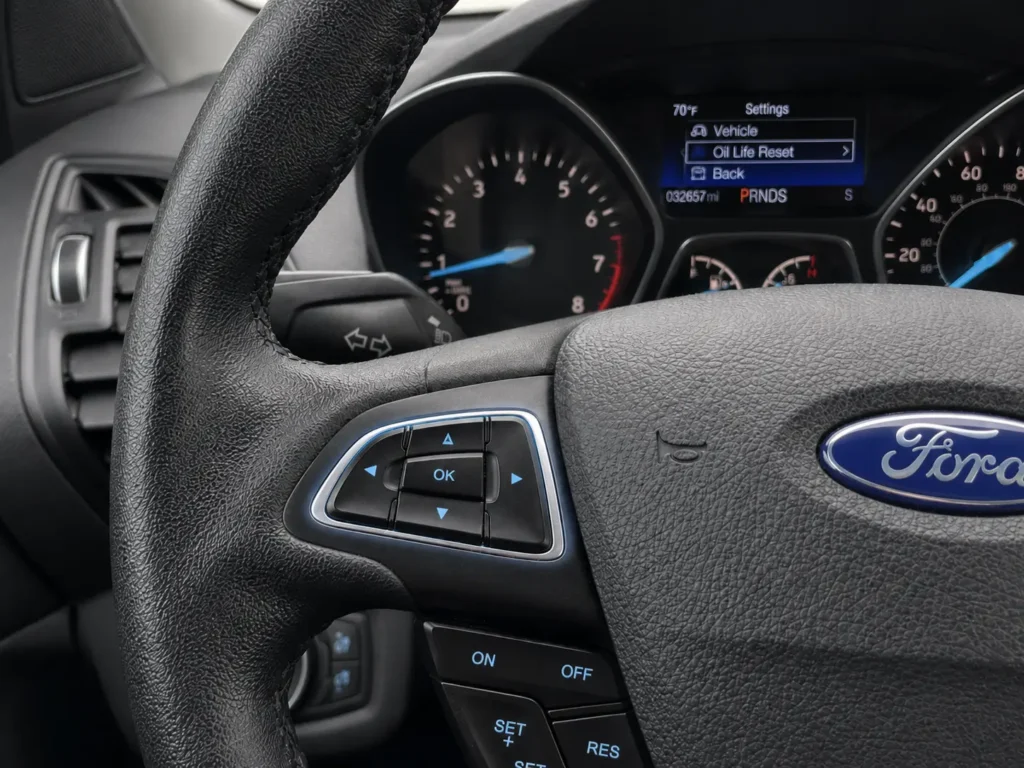
Steps — Steering Wheel Menu
- Enter Accessory Mode (engine OFF): For keyed ignition, turn the key clockwise to the ON position — stop before the start detent. For push-button Intelligent Access, press the Start/Stop button once with your foot completely off the brake. If you touch the brake, the engine cranks and the reset won’t work.
- Wait for the dashboard to fully illuminate and the initial self-test chimes to finish.
- Using the left D-pad on the steering wheel, press the left arrow to back out to the top-level main menu.
- Scroll down until “Settings” is highlighted. Press the right arrow or OK to enter.
- Navigate to “Vehicle” (or “Vehicle Maintenance” depending on SYNC software build) and confirm the selection.
- Scroll until “Oil Life” or “Oil Life Reset” appears. Select it — the screen shows your current oil life percentage.
- Press and hold the central OK button. A progress bar or processing animation appears.
- Continue holding without interruption until the display reads “Reset Successful” or “Oil Life Set To 100%.”
- Release the button. Cycle the ignition off. Start the engine normally to verify the warning is cleared.
Method 2: Accelerator and Brake Pedal Override (All Trims)
This hardware-level method works on every 2017 Escape trim — including base S models with the simpler monochrome cluster that lacks deep nested menus. It bypasses the graphical interface entirely and communicates directly with the PCM via analog pedal position sensor signals.
The PCM’s reset logic gate opens when it detects simultaneous 100% input from both the Accelerator Pedal Position (APP) sensor and the Brake Pedal Position (BPP) sensor while the engine is off. A 25-second sustained hold is the intentional safety lockout — a brief accidental press of both pedals won’t trigger a reset.
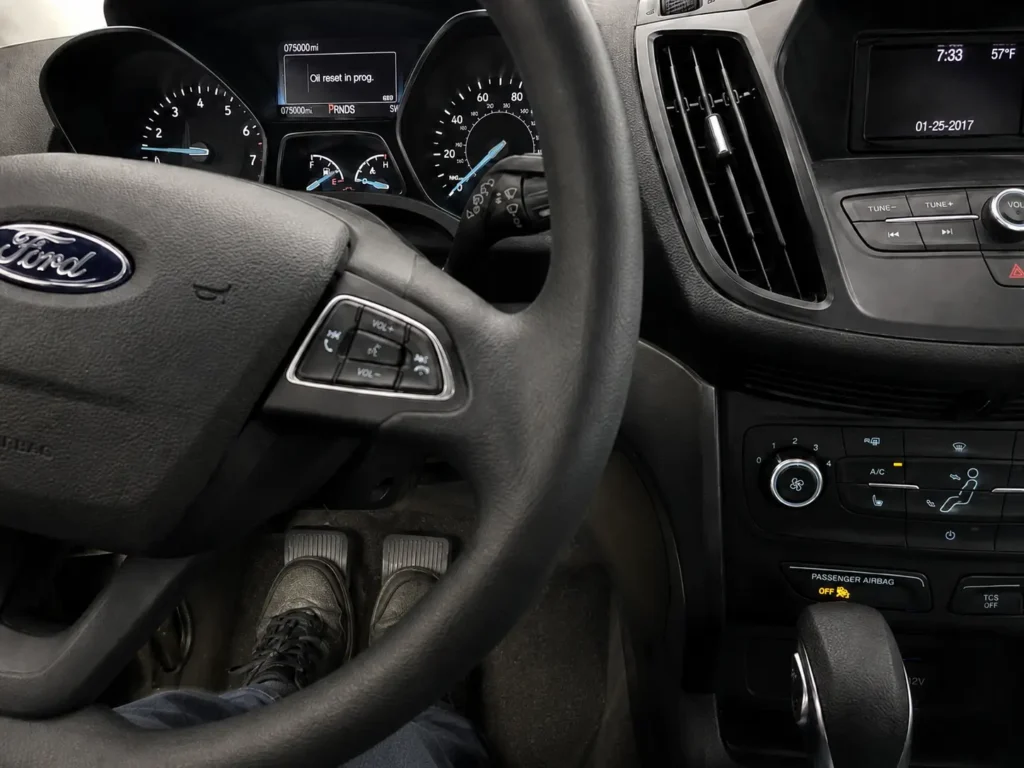
Steps — Pedal Override
- Park safely on a level surface. Apply parking brake. Shift into Park.
- Enter Accessory Mode with the engine off (key to ON detent, or press Start/Stop once without touching the brake).
- Immediately press both the accelerator pedal and brake pedal fully and simultaneously to the floorboard. Apply firm, unyielding pressure.
- After approximately 3 seconds, the instrument cluster displays: “Service: Oil reset in prog.”
- Do not release the pedals. Maintain full depression for the full 20–30 seconds. Releasing even a fraction of an inch during this phase aborts the sequence instantly.
- The display updates to: “Service: Oil reset complete.”
- Release both pedals. Turn ignition off. Wait a few seconds, then start the engine and verify the oil warning is extinguished.
If the reset still fails after 45+ seconds of correct pedal application: Check whether your vehicle was built before May 18, 2017. If so, it may be affected by TSB 20-2031 — see the section below. 👉 Related: FORScan Setup Guide for Ford Owners — Beginner to Advanced
TSB 20-2031 — The IPC Software Defect Affecting Early 2017 Builds
Recommended Best Deal Products


If both reset methods fail completely — the “Oil Life” option is missing from the Settings menu and holding the pedals yields no response at all — this is not operator error. It is a documented manufacturing defect.
Ford issued Technical Service Bulletin 20-2031 on February 14, 2020, specifically targeting 2017 Ford Escape vehicles built on or before May 18, 2017. The bulletin identifies a critical logic error in the Instrument Panel Cluster (IPC) software that corrupts or deletes the hexadecimal pathways responsible for triggering IOLM reset commands.
This defect often surfaces after the IPC receives a software update during a routine dealership visit, or when the IPC module is replaced under a separate warranty claim. The new software architecture inadvertently wipes the reset trigger pathways — permanently locking the vehicle out of both reset methods.
The Fix — IPC Physical Replacement
Unlike most software issues that can be resolved by flashing updated firmware via Ford IDS, TSB 20-2031 requires physical replacement of the entire Instrument Panel Cluster assembly.
Replacement part numbers by market:
- US vehicles (Miles): Part Number GJ5Z-10849-TG
- Canadian vehicles (Kilometers): Part Number GJ5Z-10849-XG
Ford allocated Labor Operation Number DR202031A for this repair at a flat rate of 0.5 hours. Because this is a recognized factory defect, the repair is covered under the New Vehicle Limited Warranty (NVLW), Service Part Warranty (SPW), Special Service Part (SSP), or Extended Service Plan (ESP) — and requires no Prior Approval from the dealership under the NVLW. Bring a copy of the TSB to any Ford dealer to initiate the claim.
MyKey Restriction Blocking the Oil Life Reset
If your 2017 Escape was built after May 18, 2017 (so TSB 20-2031 doesn’t apply), but the Oil Life option is still greyed out or invisible in the Settings menu — check whether you’re using a MyKey.
Ford’s MyKey system allows owners to program specific restrictions into a key fob — speed limits, audio caps, traction control lockouts for teen drivers. When a restricted MyKey is used to power the vehicle, the PCM locks out numerous advanced Settings menus to prevent the restricted driver from modifying safety parameters. The Oil Life Reset option is among them.
The fix: use the Admin Key (the master fob with full unrestricted access) to cycle the ignition. The Settings menus will repopulate fully, and the Oil Life Reset option will reappear.
If the Admin Key is lost, independent diagnosticians use FORScan with an ELM327 OBD2 adapter to interface with the Body Control Module (BCM) and force either a master reset of the MyKey parameters or a direct oil life reset to 100%. Dealer intervention via Ford IDS is the official route, which requires two unprogrammed keys to wipe and reprogram the PATS system. 👉 Related: How to Turn Off Ford MyKey Without an Admin Key
Engine Oil Capacity and Viscosity — All Three 2017 Escape Engines
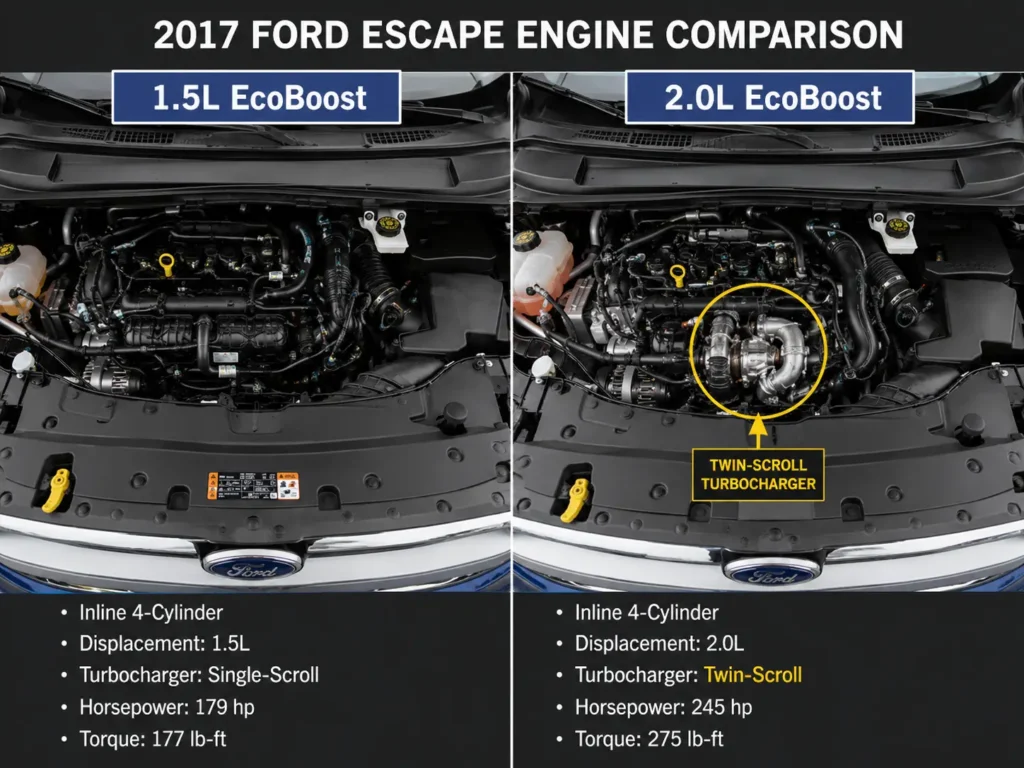
The 2017 Escape introduced the 1.5L EcoBoost as the new standard turbocharged engine, replacing the problematic 1.6L from prior years. Each of the three engines has distinct capacity, viscosity, and Ford material specification requirements. Using the wrong values risks catastrophic damage.
| Engine | Type | HP / Torque | Capacity (w/ filter) | Viscosity | Ford Spec | Drain Plug Torque |
|---|---|---|---|---|---|---|
| 1.5L EcoBoost I-4 | Turbocharged Direct Injection | 179 hp / 177 lb-ft | 4.3 Qts (4.1L) | SAE 5W-20 | WSS-M2C945-A | 21 ft-lbs |
| 2.0L EcoBoost I-4 | Twin-Scroll Turbo / Direct | 245 hp / 275 lb-ft | 5.7 Qts (5.4L) | SAE 5W-30 | WSS-M2C946-A | 21 ft-lbs |
| 2.5L Duratec I-4 | Naturally Aspirated / Multiport | 168 hp / 170 lb-ft | 5.7 Qts (5.4L) | SAE 5W-20 | WSS-M2C945-A | 21 ft-lbs |
1.5L EcoBoost — New Standard Engine for 2017
The 1.5L replaced the 1.6L as the high-volume SE powertrain. Built on an aluminum block with DOHC architecture and a 9.99:1 compression ratio, it generates 179 hp and 177 lb-ft at a low 2,500 RPM. Capacity is 4.3 quarts of SAE 5W-20 meeting WSS-M2C945-A.
The aluminum oil pan is delicate — the drain plug torques to exactly 21 ft-lbs. Impact guns strip these threads permanently. Always use a calibrated torque wrench.
The 1.5L is particularly susceptible to Low-Speed Pre-Ignition (LSPI) — a catastrophic combustion event where microscopic oil droplets in the combustion chamber auto-ignite before the spark plug fires. The resulting counter-force shatters spark plug insulators, cracks piston ring lands, and bends connecting rods. Using an API SP or ILSAC GF-6 rated full synthetic is critical — these formulations replace volatile calcium detergents with magnesium-based compounds that provide cleaning without acting as LSPI catalysts.
2.0L Twin-Scroll EcoBoost — Updated for 2017
Ford significantly updated the 2.0L for the 2017 model year with a twin-scroll turbocharger mounted to an integrated exhaust manifold. Channeling exhaust pulses from alternating cylinders independently to the turbine wheel drastically reduces turbo lag and boosts output to 245 hp and 275 lb-ft of torque.
The higher thermal and mechanical demands of the twin-scroll system require a thicker SAE 5W-30 oil — the only engine in the lineup specified for 5W-30. This higher “30” weight rating maintains a thicker hydrodynamic oil wedge between crankshaft journals and bearings under heavy boost pressure, resisting thermal shear. Capacity is 5.7 quarts meeting WSS-M2C946-A. Do not substitute 5W-20 in this engine.
2.5L Duratec iVCT — Base S Trim Only
The naturally aspirated 2.5L Duratec is exclusive to the base S trim, delivering 168 hp and 170 lb-ft via sequential multiport fuel injection and independent variable cam timing (iVCT). No turbocharger means significantly lower oil thermal stress.
Capacity is 5.7 quarts of SAE 5W-20 meeting WSS-M2C945-A. The iVCT system still depends on clean, correctly pressurized oil to actuate the camshaft phasers — sludge buildup from delayed changes clogs VCT solenoids and triggers P0011/P0022 codes with rough idle symptoms. 👉 Related: How Long Do EcoBoost Turbos Last — and How Oil Maintenance Affects It
Why WSS-M2C945-A and WSS-M2C946-A Matter — LSPI and Turbo Coking
Matching viscosity grade (5W-20 or 5W-30) is necessary but not sufficient. The chemical formulation must meet Ford’s WSS material specifications or the turbocharged EcoBoost engines face two specific failure modes that generic oils cannot prevent.
Low-Speed Pre-Ignition (LSPI)
LSPI is unique to small-displacement Gasoline Turbocharged Direct Injection (GTDI) engines. During high-load, low-RPM driving, microscopic oil droplets seep past piston rings into the highly pressurized combustion chamber. Traditional motor oils use calcium-based detergents — but under extreme cylinder pressure, calcium droplets auto-ignite the air-fuel mixture before the spark plug fires.
The counter-force from premature detonation is catastrophic: shattered spark plug insulators, cracked piston ring lands, bent connecting rods — in a single event. WSS-certified oils address this by drastically reducing volatile calcium detergent concentrations and substituting magnesium-based compounds that clean without triggering pre-ignition.
Turbocharger Coking
When an EcoBoost engine is shut down after hard driving, oil trapped within the superheated turbocharger center cartridge can rapidly boil. This leaves hard carbon deposits — called coking — that progressively destroy the turbine bearings from the inside.
WSS-certified full synthetic oils maintain molecular integrity far longer than conventional mineral oils, continuing to dissipate heat and resist oxidation during the critical post-shutdown heat soak period. The owner’s manual permits synthetic blends, but independent master technicians universally recommend upgrading to full synthetic for any 1.5L or 2.0L EcoBoost variant.
The Motorcraft FL-910S Filter — Engineering Requirements
All three 2017 Escape engines use the same oil filter: Motorcraft FL-910S (Part No. BE8Z-6731-AB). This unification is intentional — the filter’s specific engineering parameters are calibrated to the hydraulic demands of both turbocharged and naturally aspirated variants in this platform.
Silicone Anti-Drain Back Valve
The FL-910S filter is mounted horizontally on the front of the engine block near the A/C compressor. Gravity constantly attempts to drain oil back out of the filter when the engine shuts off. The silicone anti-drain back valve traps a column of oil in the upper engine galleys — delivering instant hydraulic pressure to the timing chain tensioners and VCT phasers on the next cold start.
Economy filters use cheap nitrile rubber valves that harden and crack under EcoBoost heat levels. A failed anti-drain back valve causes the recognizable “death rattle” from the timing chain on cold starts — and turbocharger bearing damage within seconds of ignition.
Bypass Valve Calibration
The FL-910S bypass relief valve opens if the filter media is clogged or if cold-weather oil is too viscous to flow through. Inferior aftermarket filters use weak bypass springs that open too easily, circulating unfiltered, debris-laden oil through the turbocharger bearings.
If the FL-910S is unavailable, acceptable premium substitutes include the Mobil 1 Extended Performance M1-102A, the WIX XP 51348XP, or the FRAM Extra Guard PH3614 — all featuring silicone valves and high-efficiency filtration media.
Complete Drivetrain Fluid Capacities — 2017 Ford Escape
Proper maintenance extends beyond the engine crankcase. The 2017 Escape uses several drivetrain sub-systems with specific fluid volumes and OEM chemistry requirements.
| Subsystem | OEM Fluid Specification | Capacity |
|---|---|---|
| Automatic Transmission (6F35) | Motorcraft MERCON LV ATF | ~9.0 Qts (8.5L) dry fill |
| Engine Coolant | Motorcraft Orange Prediluted (WSS-M97B44-D2) | ~12.5 Qts (11.8L) |
| Power Transfer Unit (PTU — AWD) | Motorcraft SAE 75W-140 Synthetic Gear Lube | 17.9 fl oz (0.53L) |
| Rear Differential (AWD) | Motorcraft SAE 80W-90 Premium Rear Axle Lube | 2.4 Pints (1.15L) |
| Brake Hydraulic System | Motorcraft DOT 4 LV Fluid | Fill to MAX line |
| A/C Refrigerant | R-134a | 24 oz (0.68 kg) |
| A/C Compressor Oil | Motorcraft PAG Refrigerant Compressor Oil | 4.5 fl oz (133 ml) |
Critical Warning: The Power Transfer Unit (PTU) “Lifetime Fill” Myth
For AWD-equipped 2017 Escapes, the Power Transfer Unit (PTU) routes power from the front transaxle to the rear differential. Ford originally marketed its 75W-140 synthetic gear oil as a “lifetime fill” requiring no maintenance.
Independent drivetrain specialists have definitively proven this claim false. The PTU sits directly adjacent to the catalytic converter — extreme sustained heat causes the tiny 17.9-ounce fluid charge to bake into thick abrasive sludge, destroying the internal gearset and generating a $2,000+ repair bill.
Automotive experts strongly recommend replacing PTU fluid every 30,000 to 40,000 miles, regardless of Ford’s “lifetime” marketing claim. The fluid change is inexpensive — the repair it prevents is not.
Step-by-Step Professional Oil Change Procedure
The 2017 Escape oil change is straightforward when done correctly. Pay close attention to the drain plug torque and the double-gasket warning — these are the two most common causes of post-service oil leaks.
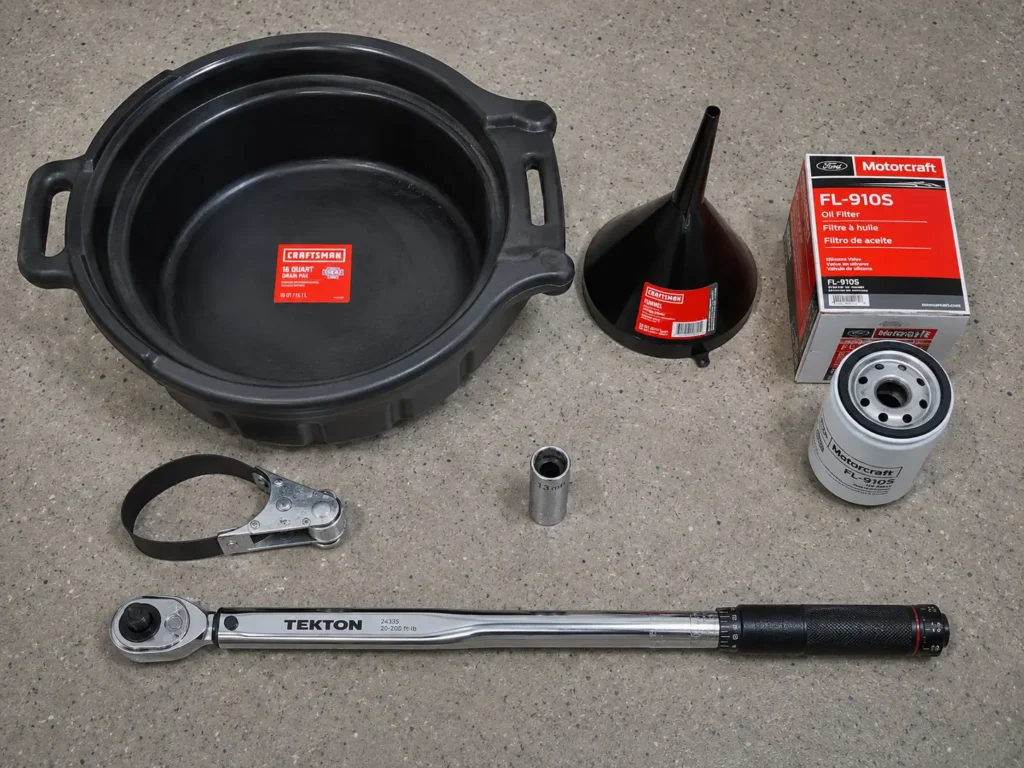
Required Tools
- Hydraulic lift or heavy-duty ramps with wheel chocks
- 13mm six-point socket + 3/8″ ratchet (drain plug)
- T30 Torx bit + 7mm socket (underbody acoustic shield fasteners)
- 74–76mm oil filter flute wrench or adjustable filter pliers
- Calibrated torque wrench (must accurately measure 21 ft-lbs)
- Drain pan — minimum 7-quart capacity
- Clean funnel + shop towels + clean nitrile gloves
Step 1 — Thermal Preparation
Bring the engine to operating temperature before draining. Warm oil flows far more freely than cold oil, evacuating suspended contaminants completely. However, let the exhaust manifold and catalytic converter cool after shutoff — thermal burns from a hot cat are severe.
Step 2 — Remove the Underbody Acoustic Shield
Raise the vehicle safely. Remove the numerous T30 Torx and 7mm fasteners securing the fabric acoustic/aerodynamic undertray to the subframe. Slide the tray rearward to disengage the front locking tabs and set it aside. This is a required step — the drain plug and filter are inaccessible without removing it.
Step 3 — Drain the Oil
Position the drain pan under the aluminum oil pan. Using the 13mm socket, loosen the drain plug counter-clockwise. Inspect the plug threads and the integrated elastomer O-ring seal for tearing, thermal degradation, or cross-threading before reinstalling. Allow the oil to drain completely until flow drops to an intermittent drip.
Step 4 — Reinstall the Drain Plug to Torque
Wipe the oil pan mating surface clean. Thread the drain plug in by hand first to prevent cross-threading. Tighten to exactly 21 ft-lbs with a calibrated torque wrench. Do not use an impact gun — the aluminum oil pan threads strip permanently under over-torque, requiring a costly pan replacement.
Step 5 — Remove the Old Filter (Critical Double-Gasket Warning)
Reposition the drain pan under the horizontally mounted oil filter on the front of the engine block near the A/C compressor. Use the filter wrench to remove the spent FL-910S.
Before installing the new filter, inspect the old one and confirm its black rubber O-ring gasket came off with it. Thermal cycling can fuse the gasket to the engine block machined surface. Installing a new filter over a stuck old gasket creates a double-gasket scenario — the hydraulic pressure will immediately blow the seal on the first start, evacuating all 5.7 quarts of fresh oil onto the floor within seconds and destroying the engine.
Step 6 — Install the New Filter
Dip a clean, gloved finger into fresh synthetic oil and generously lubricate the rubber gasket of the new FL-910S. This prevents the gasket from bunching or tearing during installation. Thread the filter onto the block by hand until the gasket makes firm contact with the mating surface, then tighten an additional 3/4 to 1 full turn by hand. Never use a filter wrench to tighten — it will crush the casing and compromise the seal.
Step 7 — Fill and Verify
Lower the vehicle. Remove the oil filler cap on the valve cover, insert a clean funnel, and pour in the exact specified capacity for your engine (4.3 quarts for the 1.5L; 5.7 quarts for the 2.0L and 2.5L). Reinstall the filler cap.
Start the engine and idle for 60 seconds. Monitor the cluster to confirm the red oil pressure warning turns off immediately. Inspect under the vehicle with a flashlight to verify the drain plug and filter housing show zero seepage.
Shut off the engine. Wait at least 3 minutes for oil to drain from the upper cylinder head back into the sump. Pull the bright yellow dipstick, wipe clean, reinsert fully, and pull again. The level must sit precisely between the MIN and MAX crosshatch markers. Overfilling is as dangerous as underfilling — excess oil causes crankshaft aeration, whipping the lubricant into foam that the pump cannot pressurize.
Reinstall the underbody shield without overtightening the plastic retainer fasteners. Execute the oil life reset using either method detailed above. 👉 Related: 2016 Ford Escape Oil Reset — Full Guide
The 10,000-Mile Interval Myth for EcoBoost Engines
Ford’s IOLM can theoretically extend service intervals to 10,000 miles. This figure comes from laboratory-style highway driving conditions. Real-world EcoBoost operation rarely matches those conditions — and the difference matters.
The primary threat is fuel dilution. Gasoline Direct Injection (GDI) systems spray atomized fuel directly into the combustion chamber under thousands of PSI. Trace amounts of raw gasoline inevitably bypass the piston rings into the crankcase. Over 6,000–7,000 miles, a high-quality 5W-30 oil shears down to 5W-20 viscosity — or lower — from combined fuel dilution and turbocharger thermal stress.
When viscosity collapses, the hydrodynamic oil wedge protecting engine internals fails. Timing chains stretch against their guides, VCT phasers clog with suspended particulates, and turbocharger journal bearings suffer direct metal-on-metal contact.
Engineering consensus for 1.5L and 2.0L EcoBoost owners: regardless of what the IOLM dashboard percentage says, change oil and filter every 5,000 miles or 6 months using premium full synthetic meeting the WSS specification. The cost of an oil change is negligible compared to a turbocharger replacement or engine overhaul.
People Also Ask
Will disconnecting the battery reset the 2017 Escape oil life monitor?
No. The oil life percentage is stored in the PCM’s Non-Volatile RAM (NVRAM) — a memory sector that retains data without power, similar to a computer BIOS chip. Disconnecting the negative battery terminal resets radio presets, clears adaptive transmission learning tables, and reboots SYNC — but the IOLM counter survives intact. Only the active pedal or steering wheel reset procedures overwrite it.
My oil smells heavily of gasoline after only 3,000 miles — is that normal?
A mild fuel odor from the dipstick is a recognized characteristic of 1.5L and 2.0L EcoBoost engines from direct injection blow-by. However, if the oil level on the dipstick is actively rising above the MAX line, this indicates severe critical fuel dilution — potentially a failing high-pressure fuel pump (HPFP) leaking directly into the valve cover. This requires immediate diagnostic intervention. Do not continue driving.
My Escape shows “Oil Change Required” but the dipstick level looks fine. Is the sensor broken?
There is no sensor measuring oil condition. The IOLM is pure software — it tracks engine hours, thermal cycles, and load parameters. The vehicle could theoretically be full of brand-new oil, but if the monitor wasn’t reset at the last service, the algorithm continues its countdown from wherever it left off and will eventually hit 0% regardless of the fluid’s physical state. Execute the reset and the alert clears.
Can I use 5W-30 in my 1.5L EcoBoost for extra protection?
No. The 1.5L EcoBoost’s VCT solenoids contain microscopic oil passages calibrated precisely for the flow characteristics of 5W-20. Introducing the thicker 5W-30 causes sluggish VCT actuation during cold starts — rough idle, reduced fuel economy, and P0011/P0022 check engine codes for camshaft timing faults. Maintain the factory 5W-20 specification but use full synthetic formulation to maximize protection within that viscosity grade.
The pedal reset held for 45+ seconds and “Reset Complete” never appeared — what’s wrong?
If pedal pressure was correctly applied for over 45 seconds with no response, check the vehicle build date. Vehicles built on or before May 18, 2017 are almost certainly affected by the IPC software corruption described in TSB 20-2031. The repair requires physical replacement of the Instrument Panel Cluster at the dealership, covered under warranty at no cost.
Does the 2017 Ford Escape have an oil level sensor?
No — it relies on a traditional low oil pressure switch, not a level sensor. By the time the red oil can icon illuminates while driving, the engine has already lost hydraulic pressure — often because the oil level has dropped so low that the pickup tube is ingesting air. At that point, catastrophic bearing damage is either imminent or has already occurred. Check the dipstick visually every 1,000 miles rather than waiting for a warning light.
Final Thoughts
The 2017 Ford Escape oil reset is a quick procedure once you know which method applies to your trim. The steering wheel menu is the cleaner route for SE and Titanium models. The pedal override is the universal fallback for any trim level. If neither works, check your build date against TSB 20-2031 before assuming you did anything wrong.
Beyond the reset itself: use the correct viscosity for your engine (5W-20 for the 1.5L and 2.5L, 5W-30 for the 2.0L), verify it meets the WSS specification, install a genuine Motorcraft FL-910S filter, and check the double-gasket before buttoning everything up. Those five minutes of attention prevent the repairs that cost thousands.
Drop your engine variant and build date in the comments — happy to confirm which reset method applies to your specific 2017 Escape.
👉 Related: 2016 Ford Escape Oil Reset — Complete Guide
👉 Related: How to Turn Off Ford MyKey Without an Admin Key
👉 Related: Ford Adaptive Learning Transmission Reset
Looking for another year? See the full How To Reset Ford Escape Oil Light (All Generations 2001–2026).
Other Ford models: Ford Oil Life Monitor Reset Guide (All Models & Years)

One Comment