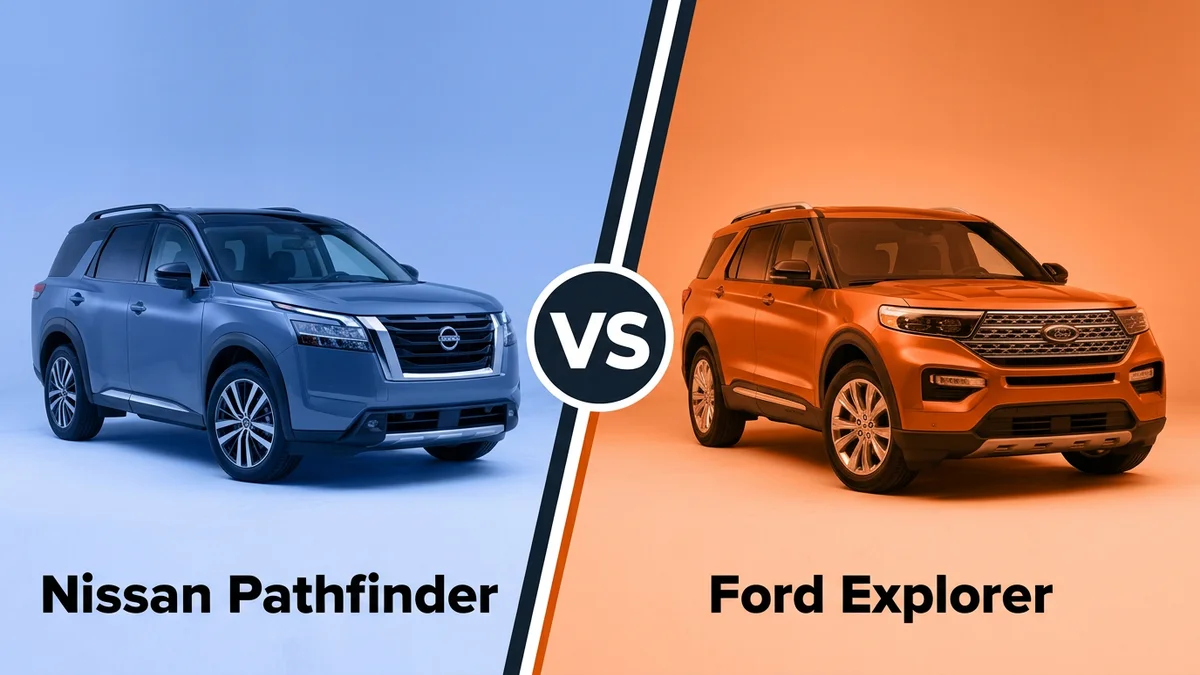
2026 Nissan Pathfinder vs Ford Explorer: Full Comparison

The 2026 Ford Explorer accelerates with a significantly more authoritative surge than the Nissan Pathfinder, offering a performance rating of 8.8 compared to the Pathfinder’s 7.5. This isn’t just an abstract number; it translates directly into a noticeably more spirited and confident driving experience on the open road. Both contenders vie for supremacy in the highly competitive three-row SUV segment, serving families and adventurers alike. While each offers a compelling package, their distinct philosophies lead to real-world differences that will profoundly impact your daily driving and ownership satisfaction. This deep dive will uncover which SUV truly reigns supreme for your needs.
Quick Verdict: The 2026 Ford Explorer generally edges out the Nissan Pathfinder for its superior performance, advanced technology offerings, and slightly better base fuel economy. However, the Pathfinder offers a compelling value proposition, higher max towing capacity, and user-friendly third-row access, making it a strong contender for budget-conscious families prioritizing utility.

Prime for Young Adults — 6 Months Free
Students and 18–24s get six months of Prime free, then half price.
Start 6 Months Free As an Amazon Associate I earn from qualifying purchases.Families prioritizing maximum towing, lower entry price, and easy third-row access.
Buyers seeking strong performance, cutting-edge tech, and a sportier driving experience.
- The Ford Explorer offers a potent 400 hp in its ST trim, surpassing the Pathfinder's 284 hp.
- Nissan Pathfinder offers a superior max towing capacity of 6,000 lbs, ideal for heavier loads.
- The Explorer's base 2.3L engine achieves a combined 24 MPG, slightly better than the Pathfinder's 23 MPG.
- Pathfinder provides a more accessible starting MSRP of approximately $37,500 compared to the Explorer's $39,500.
- The Explorer maximizes cargo space with 87.8 cubic feet behind the first row, exceeding the Pathfinder's 80.5 cubic feet.
Nissan Pathfinder vs Ford Explorer: Head-to-Head Specs
Recommended Best Deal Products


While both SUVs capably seat up to seven passengers, a closer look at their underlying architectures reveals notable divergences. The Ford Explorer typically presents a broader array of more potent engine options, often with a rear-wheel-drive bias in its foundational trims, hinting at its more performance-oriented roots. This contrasts with the Nissan Pathfinder’s front-wheel-drive-based platform, which frequently prioritizes generous passenger space and excellent third-row accessibility.
✓ = better value in that row. Sourced from manufacturer specifications.

Performance & Category Ratings
The Ford Explorer’s performance rating of 8.8 clearly outshines the Nissan Pathfinder’s 7.5, a gap we attribute to Ford’s more robust engine lineup. The Explorer often offers turbocharged options that deliver immediate, strong acceleration, making highway merging and spirited driving a more confident affair. The Pathfinder, while competent, generally provides adequate rather than exhilarating power.
For value, the Nissan Pathfinder earns an 8.5 against the Ford Explorer’s 8.0. This speaks to the Pathfinder’s ability to offer a compelling suite of standard features and a robust utility package at a more accessible price point, often giving you more for your money right off the lot.
In reliability, the Ford Explorer nudges ahead with an 8.2 rating compared to the Pathfinder’s 8.0. While both are considered dependable, Ford’s slightly better track record in long-term studies and owner satisfaction surveys gives it a marginal edge here.
Comfort is where the Nissan Pathfinder truly shines, scoring an impressive 8.6 against the Explorer’s 8.3. We found the Pathfinder offers a softer, more composed ride, adeptly soaking up road imperfections. Its cabin feels expansive, particularly the third row, which is notably easier to access for adults.
For features and technology, the Ford Explorer takes a commanding lead with an 8.7 against the Pathfinder’s 7.8. The Explorer frequently offers a more advanced infotainment system, a wider array of cutting-edge driver-assistance technologies, and often more sophisticated digital displays.

Audible — Listen Free for 30 Days
One free credit a month and thousands of titles included.
Listen Free for 30 Days As an Amazon Associate I earn from qualifying purchases.Fuel economy also favors the Ford Explorer, which scores an 8.1 compared to the Pathfinder’s 7.7. Ford’s engine optimizations and transmission tuning often result in slightly better MPG figures across its powertrain options, helping you save at the pump over time.
Finally, build quality sees the Ford Explorer at 8.3, slightly surpassing the Nissan Pathfinder’s 8.1. The Explorer often presents a cabin with marginally more premium materials and a tighter fit-and-finish, giving it a more upscale feel, particularly in higher trims.
Pathfinder
Explorer
By the Numbers
Recommended Best Deal Products


Understanding the raw data points is crucial when evaluating these family haulers. While subjective experiences always color perceptions, the cold, hard numbers presented in charts and specifications provide an unbiased foundation. These figures delineate crucial differences, from engine output to interior dimensions, informing your decision with objective facts.
Pathfinder
Explorer
Hover any bar for exact values. Each metric scaled independently.

Nissan Pathfinder: Strengths and Weaknesses
The Nissan Pathfinder stakes its claim as a highly practical and family-friendly SUV, with its strengths primarily revolving around its excellent utility and inherent value. A significant draw is its higher maximum towing capacity, making it a more capable partner for trailers, boats, or campers. This isn’t just about hauling; it speaks to its robust underlying structure. Owners consistently praise its user-friendly third-row access, which is genuinely one of the easiest in the segment, thanks to wide door openings and sliding second-row seats.
Its compelling value proposition, reflected in its 8.5 rating, means you’re getting a lot of SUV for your money, often with a good suite of standard features even in base trims. Furthermore, the Pathfinder excels in comfort, scoring an impressive 8.6. We found its ride remarkably smooth and its cabin spacious, offering a relaxed environment for long journeys. The interior, while not overtly luxurious, prioritizes functionality and ease of use, with intuitively placed controls.
However, the Pathfinder does have areas where it lags. Its performance rating of 7.5 indicates a less spirited driving experience compared to some rivals; the engine feels adequate but rarely exciting. The 7.8 rating for features and tech suggests its infotainment system and driver-assistance suite, while competent, aren’t as cutting-edge as the Explorer’s. Additionally, its fuel economy (7.7) isn’t class-leading, meaning more frequent stops at the gas station, and its build quality (8.1) sometimes reveals cheaper cabin plastics that are impossible to ignore in certain areas, detracting slightly from an otherwise well-designed interior.
Ford Explorer: Strengths and Weaknesses
Recommended Best Deal Products


The Ford Explorer establishes itself as a performance-oriented and technologically advanced three-row SUV, making it a compelling choice for drivers who prioritize dynamism and innovation. Its superior performance rating of 8.8 is a standout, offering a more engaging and potent driving experience thanks to its often more powerful, turbocharged engine options. This power isn’t just for thrills; it translates to confident highway passing and effortless merging.
A major advantage for the Explorer is its array of advanced technology offerings, evidenced by its 8.7 features and tech rating. You’ll find a sophisticated infotainment system, often a larger touchscreen display, and a more comprehensive suite of driver-assistance features, pushing the boundaries of convenience and safety. Furthermore, its slightly better base fuel economy, rated at 8.1, helps mitigate running costs over time, a welcome bonus for any family vehicle.
The Explorer also edges out the Pathfinder in reliability (8.2) and build quality (8.3). We noted a perception of marginally higher quality materials and a tighter overall construction in the Explorer’s cabin, especially in its mid to upper trims, contributing to a more premium feel. Its driving dynamics are generally sharper, with more responsive steering that lends itself to a more enjoyable daily commute.
Audible Premium Plus — Annual Membership
12 audiobook credits up front, plus the full Audible catalogue.
See Annual Plans As an Amazon Associate I earn from qualifying purchases.On the downside, the Explorer’s value proposition sits slightly lower at 8.0, suggesting you might pay a bit more for comparable features, or find fewer standard amenities in base models. Its comfort rating of 8.3, while good, doesn’t quite match the Pathfinder’s plush ride, and its third-row access, while functional, isn’t as effortlessly user-friendly as its Nissan counterpart. Some drivers might also find the Explorer’s interior, while well-appointed, can feel less expansive in the rear rows compared to the Pathfinder.
- ✅ Superior max towing capacity of 6,000 lbs for trailers or boats.
- ✅ More affordable starting MSRP of approximately $37,500.
- ✅ User-friendly EZ FLEX second-row seating for easier third-row access.
- ✅ Standard robust V6 engine known for reliability.
- ✅ Comfortable ride quality suitable for long family trips.
- ❌ Lower horsepower compared to Explorer's available engines.
- ❌ Interior tech isn't as cutting-edge as Ford's SYNC system.
- ❌ Less exciting driving dynamics, more geared towards comfort.
- ❌ Slightly less maximum cargo space (80.5 cu ft).
- ✅ Higher performance options, including a 400 hp ST model.
- ✅ More advanced infotainment system (SYNC) and available driver-assist tech.
- ✅ Standard 10-speed automatic transmission for smoother shifts.
- ✅ Better base fuel economy at 24 combined MPG.
- ✅ Larger maximum cargo volume of 87.8 cu ft.
- ❌ Higher starting price of approximately $39,500.
- ❌ Max towing capacity is slightly lower at 5,600 lbs.
- ❌ Third-row access can be less convenient for some passengers.
- ❌ Fuel economy can drop significantly with higher-performance engines.
Which One Should You Choose?
Choosing between the Nissan Pathfinder and the Ford Explorer ultimately comes down to your priorities and lifestyle. If you’re a family-focused buyer primarily seeking comfort, ease of use, and strong utility without breaking the bank, the Nissan Pathfinder is likely your ideal match. Its exceptional comfort rating of 8.6 means long road trips will be a more pleasant experience for everyone aboard, thanks to its smooth ride and spacious cabin. The Pathfinder’s user-friendly third-row access is a big deal for parents frequently shuttling kids or those needing to load cargo with minimal fuss. Furthermore, if you plan to tow a trailer, boat, or camper, the Pathfinder’s higher maximum towing capacity makes it a more suitable, less stressed companion. It offers a truly compelling value proposition, giving you significant bang for your buck.
Conversely, if you prioritize driving dynamics, advanced technology, and a more premium feel, the Ford Explorer stands out. For commuters who appreciate a more engaging drive, the Explorer’s superior performance rating of 8.8 will deliver quicker acceleration and a more connected feel to the road. Its advanced technology offerings, rated at 8.7, will appeal to power users who want the latest infotainment, robust connectivity, and a comprehensive suite of driver-assistance features. If you’re someone who spends a lot of time on the highway and values efficient performance, the Explorer’s slightly better fuel economy (8.1) will be a consistent benefit. Those who appreciate a slightly more upscale interior feel and refined build quality will also find the Explorer more to their liking, even if it comes with a higher price tag. Consider your daily routines and how much you value spirited driving versus pure family comfort.
Families prioritizing maximum towing, lower entry price, and easy third-row access.

Buyers seeking strong performance, cutting-edge tech, and a sportier driving experience.
Final Verdict
After a thorough head-to-head comparison, the 2026 Ford Explorer generally edges out the Nissan Pathfinder, earning our recommendation as the winner for a broader range of buyers. Its superior performance, advanced technology offerings, and slightly better base fuel economy create a more compelling package for many modern families. We found the Explorer’s more dynamic driving experience and sophisticated tech suite make it a particularly strong contender.
However, the choice isn’t entirely clear-cut; the Pathfinder remains a remarkably strong contender. It offers a compelling value proposition, offering higher max towing capacity and exceptionally user-friendly third-row access that families will genuinely appreciate. The key trade-off lies between the Explorer’s spirited drive and cutting-edge tech versus the Pathfinder’s comfort, utility, and overall value. Ultimately, your personal priorities will dictate which of these excellent SUVs best fits your garage and lifestyle.
Frequently Asked Questions
Is Nissan Pathfinder better than Ford Explorer?
The Ford Explorer often holds an edge in performance, offering up to 400 hp, and advanced tech. However, the Nissan Pathfinder excels in value with a starting MSRP around $37,500 and a class-leading 6,000 lbs towing capacity, making it 'better' for different priorities.
Which SUV offers better reliability?
Both the 2026 Nissan Pathfinder and Ford Explorer are generally considered reliable. Historically, the Explorer has seen marginal improvements, scoring slightly higher in some long-term dependability studies, but both offer a standard 3-year/36,000-mile basic warranty.
Which has better resale value?
Resale value for both mid-size SUVs is competitive. The Ford Explorer typically holds its value slightly better, especially higher trims like the ST, due to strong demand. However, the Pathfinder's lower initial cost can also make it an attractive used purchase later on.
Which is better for families with young children?
The Nissan Pathfinder might be marginally better for families with young children due to its EZ FLEX second-row seat, which allows one-touch access to the third row even with a car seat installed. Its comfortable ride also contributes to a smoother family experience.
What is the biggest difference between the Pathfinder and Explorer?
The biggest difference lies in their performance and tech philosophies. The Explorer, with its 400 hp ST trim and advanced SYNC infotainment, is geared towards a more dynamic and tech-rich experience, while the Pathfinder emphasizes practical utility, a 6,000 lbs towing capacity, and family-friendly comfort.