
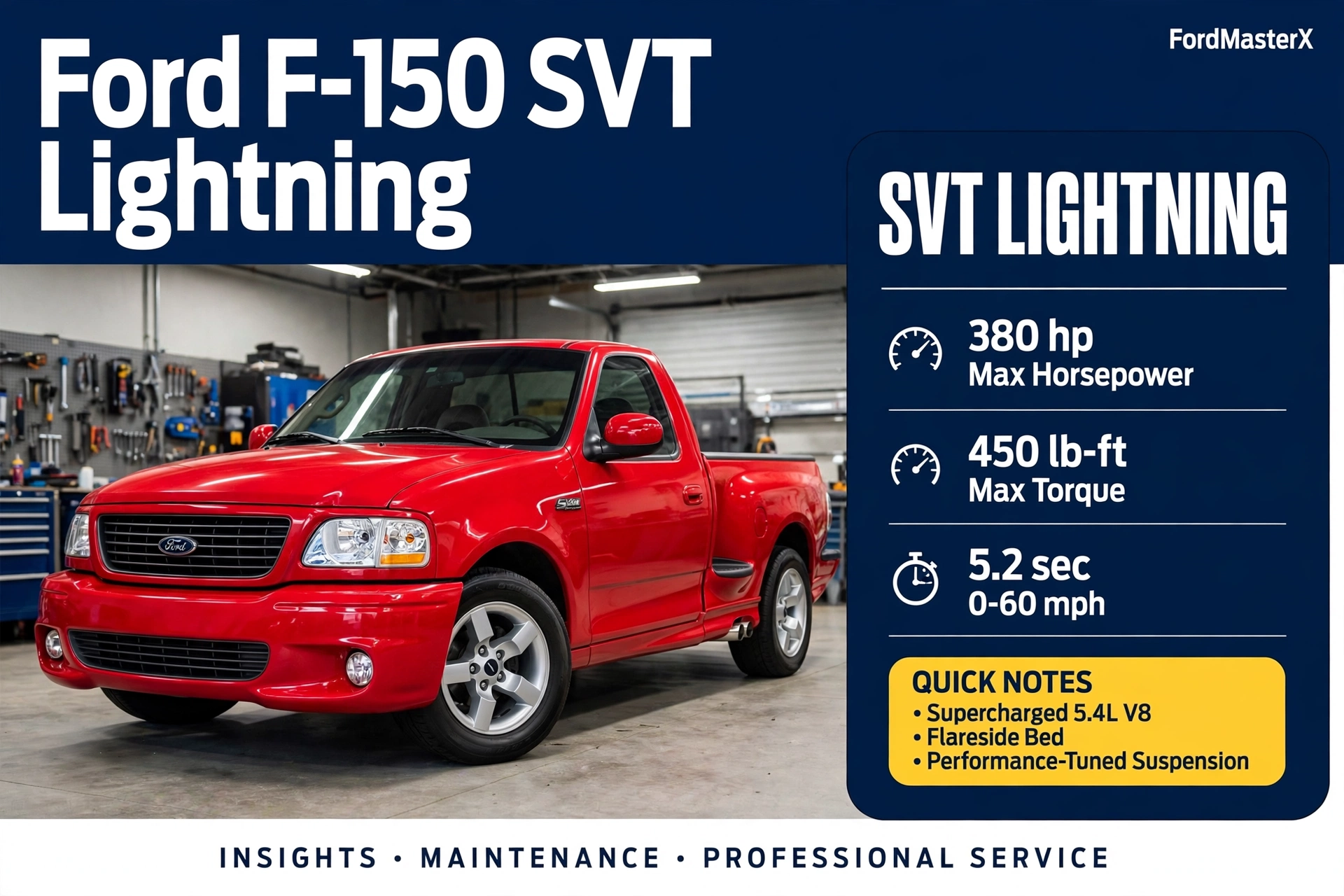
2001 Ford F-150 SVT Lightning 2026 Complete Buyer Guide

2001 Ford F-150 SVT Lightning buyers get the fastest truck Ford had ever built at that point, with 380 horsepower and a 0 to 60 time near 5.2 seconds.
The 2001 model year is the sweet spot of the second-generation Lightning. Ford raised output to 380 horsepower and 450 lb-ft of torque, fitted a shorter 3.73 rear axle, and built 6,381 trucks, the highest total of the whole 1999 to 2004 run.
That combination is the whole story. The 2001 truck is quicker than the 1999 and 2000 trucks, more common than the later trucks, and old enough now that condition and originality decide the price.
This guide gives you the verdict first, then the numbers behind it, the problems to check, the values to expect, and a head-to-head table against modern performance trucks.
The Short Answer in 5 Numbers
Five numbers decide most 2001 Lightning purchases. The table below holds them, and the infographic after it gives you the same facts to save or share.
| Number | What it is | What it means for you |
|---|---|---|
| 380 hp | Supercharged 5.4L V8 output | Up 20 hp over the 1999 and 2000 trucks |
| 5.2 seconds | 0 to 60 mph, Car and Driver test | Faster than most sports cars of its day |
| 6,381 built | 2001 production total | Highest year of the run, easiest to find |
| $32,460 | Original base price in 2001 | Strong value against a base Corvette near 40,000 dollars |
| $25,000 to $35,000 | Driver-quality value today | Clean stock trucks cost far more |
2001 SVT Lightning At a Glance
The five numbers that decide a 2001 Lightning purchase, as observed in November 2026.
| Measure | Observed figure | Result |
|---|---|---|
| Max horsepower | 380 hp at 4,750 rpm | Up 20 hp over 1999 and 2000 |
| Max torque | 450 lb-ft at 3,250 rpm | Up 10 lb-ft over 1999 and 2000 |
| 0 to 60 mph | 5.2 seconds, Car and Driver test | Near supercar pace for a pickup |
| 2001 production | 6,381 trucks built | Highest year of the 1999 to 2004 run |
| Original base price | $32,460 in 2001 | Strong value against sports cars of its day |
Direct answer: The 2001 Ford F-150 SVT Lightning is the best buy in the second-generation Lightning range. It has the full 380 horsepower engine, the shorter 3.73 axle, and the highest production total, so it is quicker than the early trucks and easier to find than the late trucks.
Sources: MotorWeek 2001 road test; Hemmings SVT Lightning history; CarGurus SVT Lightning buying guide; F150Hub second-generation Lightning specifications. Performance times differ by tester, so both MotorWeek and Car and Driver figures are given in the article.
The verdict changes with the buyer. A collector who wants an untouched truck gets a different answer than a driver who wants a fast weekend pickup.
The rest of this guide works through each buyer type in turn. It starts with what the truck costs and what its engine gives you.
What the 2001 Lightning Costs and Delivers
The 2001 Lightning is a regular cab, rear-wheel drive, two-seat pickup with a Flareside short bed. Ford built it as a street performance truck, not a work truck, and every choice in the spec sheet shows that aim.
The base price was 32,460 dollars when new. That bought a truck that could outrun most sports cars of its day while still carrying a Ford warranty and a full-size pickup bed.
That price point matters more than the headline power number. A buyer in 2001 paid about 8,000 dollars less than a base Chevrolet Corvette and got a truck that ran the quarter mile in under 14 seconds.
Our guide to the F-150 towing capacity chart shows how the Lightning towing rating compares with regular F-150 trucks. The Lightning trades towing for speed, and the chart makes that trade plain.
Three Ways the Power Grew
The heart of the truck is a supercharged 5.4 liter Triton V8 with an iron block, forged internals, and aluminum heads. An Eaton Generation 4 Roots-type supercharger sits on top, with a water-to-air intercooler keeping the charge cool at 8 psi of boost.
The compression ratio is 8.4 to 1, lowered from the 9.0 to 1 ratio of the standard 5.4 liter V8 so the engine can take boost safely. Peak power is 380 horsepower at 4,750 rpm, and peak torque is 450 lb-ft at 3,250 rpm.
That torque figure is the one that shapes the driving feel. Full torque arrives at just 3,250 rpm, so the truck pulls hard from a standstill without needing high revs.
The engine sends power through a heavy-duty 4R100 four-speed automatic to a 9.75-inch limited-slip rear axle with a 3.73 to 1 ratio. A 4.5-inch aluminum driveshaft links the two, replacing the 3.5-inch steel shaft of the 1999 and 2000 trucks.
Our guide to the Ford transmission identification chart helps you confirm which transmission a given truck has. The 4R100 is the only automatic fitted to the second-generation Lightning.
Supercharger and Intercooler Facts
The Eaton M112 supercharger is the part that defines the truck. It forces air into the engine at 8 psi, and the water-to-air intercooler cools that air before it reaches the cylinders.
That cooling step matters because hot intake air costs power and invites detonation. The intercooler system uses an electric pump to circulate coolant through a heat exchanger, and that pump is one of the parts to check on any used truck.
The engine redline is 5,250 rpm, with fuel cut at 5,400 rpm. The truck is not a high revving machine, and it does not need to be, since the supercharger fills in the low end.
Fuel economy is poor by any modern measure. The EPA figures are 13 mpg in the city and 17 mpg on the highway, and hard driving can push the real number into single digits.
Our Ford engine oil recommendation chart lists the exact oil spec for Ford truck engines. A supercharged engine needs clean oil on schedule more than a standard engine does.
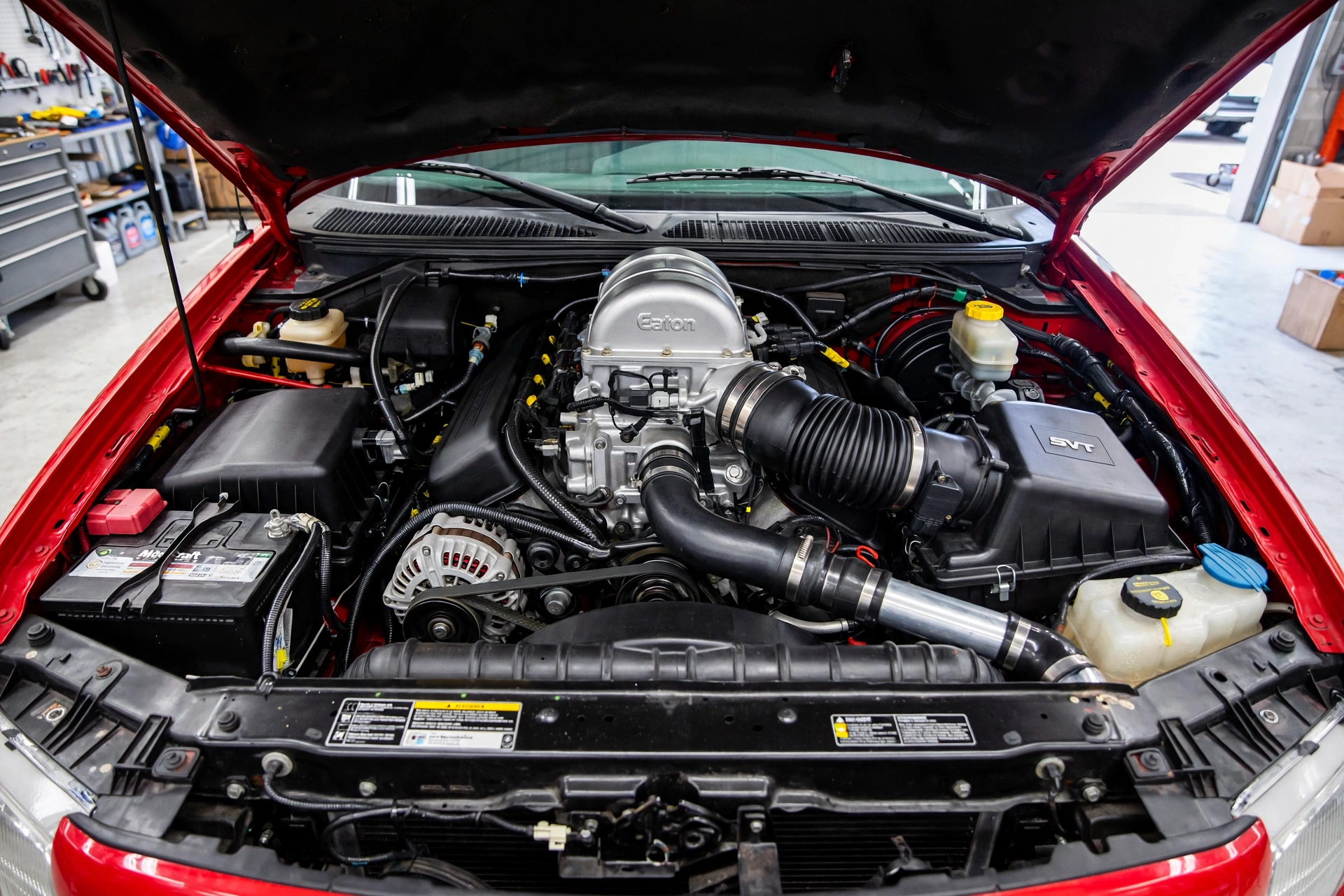
AI-generated illustration: the supercharged 5.4 liter V8 engine bay in a 2001 Ford F-150 SVT Lightning.
Towing and Payload Limits
The Lightning tows 5,000 pounds and carries 800 pounds of payload. Those numbers look weak next to a regular F-150, and they are weak, because Ford cut the ratings to protect the performance suspension and tires.
A standard 2001 F-150 Styleside carried a 3,180-pound payload rating. The Lightning carries about a quarter of that, so it is a poor choice for heavy hauling.
That trade is the point of the truck. Ford fitted soft performance springs, Bilstein shocks, and wide Goodyear Eagle F1 tires, and none of those parts suit a loaded bed.
Buy the Lightning to go fast, not to tow a heavy trailer. A buyer who needs real towing capacity should look at a regular F-150 from the same year instead.
Our guide to the 2010 Ford F-150 XL shows what a later work-focused F-150 offers. The contrast with the Lightning shows how far Ford tuned the two trucks apart.
What Changed for the 2001 Lightning
The 2001 model year brought the biggest single update of the second-generation run. Ford changed the engine, the axle, the driveshaft, the shocks, and the look of the truck in one year.
The engine changes came first. A larger air inlet and a redesigned lower intake manifold raised output from 360 horsepower to 380, and torque from 440 lb-ft to 450.
Those 20 extra horsepower cost Ford almost nothing in new parts. The bigger inlet let the supercharger breathe, and the revised manifold fed the cylinders more evenly.
The axle change came next. Ford swapped the 3.55 to 1 rear axle for a 3.73 to 1 ratio, which sharpened launch feel and cut the 0 to 60 time.
The driveshaft grew from a 3.5-inch steel unit to a 4.5-inch aluminum unit. The larger shaft handles the extra torque with less rotating weight, and it is one of the parts that tells a 2001 truck apart from a 2000 truck.
Bilstein shocks arrived for 2001, along with a new grille, new headlamps, clear taillamps, and a six-disc CD changer. The truck also kept its 1.5-inch front drop, SVT coil springs, and 31-mm solid front anti-roll bar.
The brakes came from the three-quarter-ton F-250, with 12.1-inch front rotors and 13.1-inch rear discs. Those brakes stop a 4,670-pound truck from speed without fade on a short run.
The 2001 truck is the first year with the full package. A 1999 or 2000 truck is slower and softer, while a 2001 truck has every performance upgrade except the revised cylinder heads that arrived in 2003.
Is the 2001 Lightning Reliable Enough to Own
Reliability is where the Lightning story splits in two. The engine block and internals are strong, and the parts around them need watchful care.
The forged internals and iron block handle stock boost with ease. Many owners run these trucks past 150,000 miles on the original engine when the truck stays near stock power.
The weak spots are the spark plug threads, the intercooler pump, and the supercharger snout seals. All three are known, all three are checkable, and none of them is a reason to walk away from a good truck.
MotorWeek tested the 2001 Lightning at 0 to 60 in 5.4 seconds and the quarter mile in 13.9 seconds at 101 mph. Car and Driver went quicker, at 5.2 seconds and 13.8 seconds at 104 mph, so the article gives both figures and names the tester for each.
Those two tests used different trucks on different days. The gap between them is normal test variation, not a sign that either magazine got the truck wrong.
Our guide to how reliable Ford Rangers are covers the same kind of owner-reported problem pattern on a different Ford truck. The method is the same: named sources, model years attached, and no vague reliability claim.
Spark Plugs and Revised Heads
The best-known Lightning problem is the spark plug blowout. The 5.4 liter heads have shallow plug threads, so a plug can work loose and blow out of the head under boost.
Ford revised the cylinder heads for 2003 with more plug threads. A 2001 truck has the early heads, so plug history matters more on a 2001 than on a 2003 or 2004 truck.
Ask the seller about plug changes and look for thread repair inserts in the service records. A truck with a documented plug service and no blowout history is a safer buy than one with no records at all.
The CarGurus SVT Lightning buying guide notes that the 1999 to 2001 Lightnings seem to have the most problems. Early models are known for intercooler issues and for launching spark plugs, since the plugs do not sit very deep in the cylinder head.
Intercooler Pump and Supercharger Wear
The electric intercooler pump is the most common Lightning-specific replacement part. When it fails, intake temperatures climb and the engine loses power under boost.
Listen for the pump when you turn the key to on. You should hear a brief whir from under the truck as the pump cycles, and silence can mean a dead pump or a failed relay.
Check the supercharger snout for oil residue where it meets the intake manifold. Seepage means worn snout seals, and a shop rebuild runs about 1,500 to 2,000 dollars.
Test the transmission under boost on the drive. The 4R100 should shift firmly without slipping, and the 2001 and later transmissions are seen as stronger than the 1999 and 2000 units.
Our guide to the Ford factory warranty explains what cover a truck like this had when new. A 2001 truck is long past that cover now, so the pre-purchase check is the warranty.
5 Problems to Check Before You Buy
No truck is perfect, and the Lightning has a short list of known issues. Check each one on any 2001 truck, and check the first two before you pay anything.
- Spark plug blowout. The shallow plug threads in the early 5.4 liter heads can let a plug blow out under boost. Ask for plug service records, look for thread repair inserts, and favor a truck with a clean plug history.
- Intercooler pump failure. The electric pump and its relay fail often, and a dead pump costs power and risks detonation. Listen for the pump at key-on and watch intake temperatures on the test drive.
- Supercharger snout seal leaks. Oil residue around the snout means worn seals and a rebuild near 1,500 to 2,000 dollars at a shop. A dry snout with a quiet supercharger is a good sign.
- Heavy modifications. Pushing the engine far past stock boost raises the chance of problems later. A stock or lightly modified truck is a safer buy than one with a smaller pulley and no tune records.
- Fake trucks and clones. A real second-generation Lightning has a “2” as the eighth digit of the VIN for the supercharged 5.4 liter engine. Check the VIN, the door sticker axle code, and the Flareside bed before you pay collector money.
That list is short, and that is good news. The Lightning has no single catastrophic engine failure that defines it, unlike some other performance trucks of its era.
The transmission is the one item that can turn into a big bill. A fluid change on schedule is the cheapest insurance, and a slipping 4R100 under boost is a reason to walk away.
Our guide to how to check your Ford warranty shows how to confirm cover by VIN before you pay. The same VIN check also confirms the truck is a real Lightning.
Which Lightning Years Are the Best Bets
The year matters as much as the badge on a Lightning. The truck ran from 1999 to 2004, and the reliability story changes sharply between the early and late trucks.
The table below gives production, power, and the verdict for each year, using the F150Hub second-generation Lightning specifications for the production totals. The 2001 truck sits in the middle of the run on price and at the top on production.
| Years | Production | Power | Verdict |
|---|---|---|---|
| 1999-2000 | 4,000 and 4,966 | 360 hp, 440 lb-ft | Slower, early heads, most problems |
| 2001-2002 | 6,381 and 4,726 | 380 hp, 450 lb-ft | Sweet spot, full power, easiest to find |
| 2003-2004 | 4,270 and 3,781 | 380 hp, 450 lb-ft | Best heads, rarest, highest prices |
The 1999 and 2000 trucks are the ones to buy with the most care. They have the lower output, the taller 3.55 axle, the steel driveshaft, and the early heads with the shallowest plug threads.
The 2001 and 2002 trucks are the sweet spot for most buyers. Ford fixed the power and the axle, production peaked, and prices stay below the late trucks.
The 2003 and 2004 trucks are the best on paper. Ford revised the cylinder heads to fix the plug thread problem, and 2004 had the lowest production at 3,781 trucks.
That rarity costs money. A clean 2004 truck can cost far more than a clean 2001 truck, even though the two trucks drive almost the same.
True Blue was a 2002-only color, with 1,130 trucks built, the rarest color of the run. Sonic Blue and Dark Shadow Grey arrived in 2003, and Dark Shadow Grey totaled 1,818 trucks over two years.
Our guide to the Ford Ranger years to avoid covers the same year-by-year method on a different Ford truck. Read it to see how model year changes the buying advice.
2001 Lightning Versus Modern Performance Trucks
The 2001 Lightning ran the quarter mile in under 14 seconds when new. That pace still impresses today, even though modern trucks are quicker.
The table below compares the 2001 Lightning with the trucks that carry its spirit today. The old truck wins on price and simplicity, and it loses on speed and comfort.
| Measure | 2001 SVT Lightning | Modern F-150 Raptor | Modern Electric Lightning |
|---|---|---|---|
| Power | 380 hp, supercharged V8 | 450 hp, twin-turbo V6 | 452 to 580 hp, dual motor |
| 0 to 60 mph | 5.2 seconds | About 5.0 seconds | About 4.0 seconds |
| Towing | 5,000 lb | 8,200 lb | 7,700 to 10,000 lb |
| Payload | 800 lb | 1,400 lb | 1,800 to 2,235 lb |
| Price today | $25,000 to $35,000 used | Over $75,000 new | Over $50,000 used |
| Best for | Collector value and sound | High speed off-road | Instant torque and tech |
The modern Raptor is quicker and far more capable off-road. It also costs three times as much as a driver-quality 2001 Lightning.
The electric Lightning is quicker still, with instant torque and a quiet cabin. It does not sound like a supercharged V8, and that sound is half the reason buyers want the 2001 truck.
The 2001 Lightning is the cheapest way into the Lightning name. It is also the only one of the three with a supercharged V8 and a regular cab.
Buy the old truck for character and collector value. Buy a modern truck for speed, comfort, and a warranty.
Our guide to is the Ford Ranger a good truck gives the same kind of verdict for the midsize truck. The method is the same, and the Ranger guide pairs well with this one.
Who Should Buy a 2001 Lightning in 2026
The 2001 Lightning fits some buyers better than others. These three profiles cover most shoppers, and each one gets a different recommendation.
Daily Drivers Who Want Speed
Buy a driver-quality 2001 truck with a full service history. It runs 0 to 60 in about 5.2 seconds, and it costs 25,000 to 35,000 dollars.
This is the Lightning sweet spot. It does everything the truck is good at, and it skips the collector premium on the rare colors and the late years.
Collectors Who Want Original Trucks
Buy a stock, low-mileage 2001 truck with original paperwork. Low miles, stock condition, and rare colors drive the top of the market, with a 2001 truck reaching 86,900 dollars at Mecum in early 2026. Hemmings featured a 2001 Lightning with just 5,525 miles on its odometer, a sign of how few clean low-mileage trucks remain.
Check the VIN eighth digit, the door sticker, and the bed before you pay. A clone with Lightning badges is worth far less than a real truck.
Used Truck Shoppers on a Budget
Buy a 2001 or 2002 truck with a clean plug history and a working intercooler pump. Those two checks cost you an hour and can save you thousands.
Skip a truck with a slipping transmission or a heavy pulley swap and no tune records. A cheap Lightning with a bad transmission is not cheap at all.
Our guide to what Ford diesel engines to avoid covers the same pre-purchase discipline on the diesel side. The checklist habit transfers across every Ford truck.
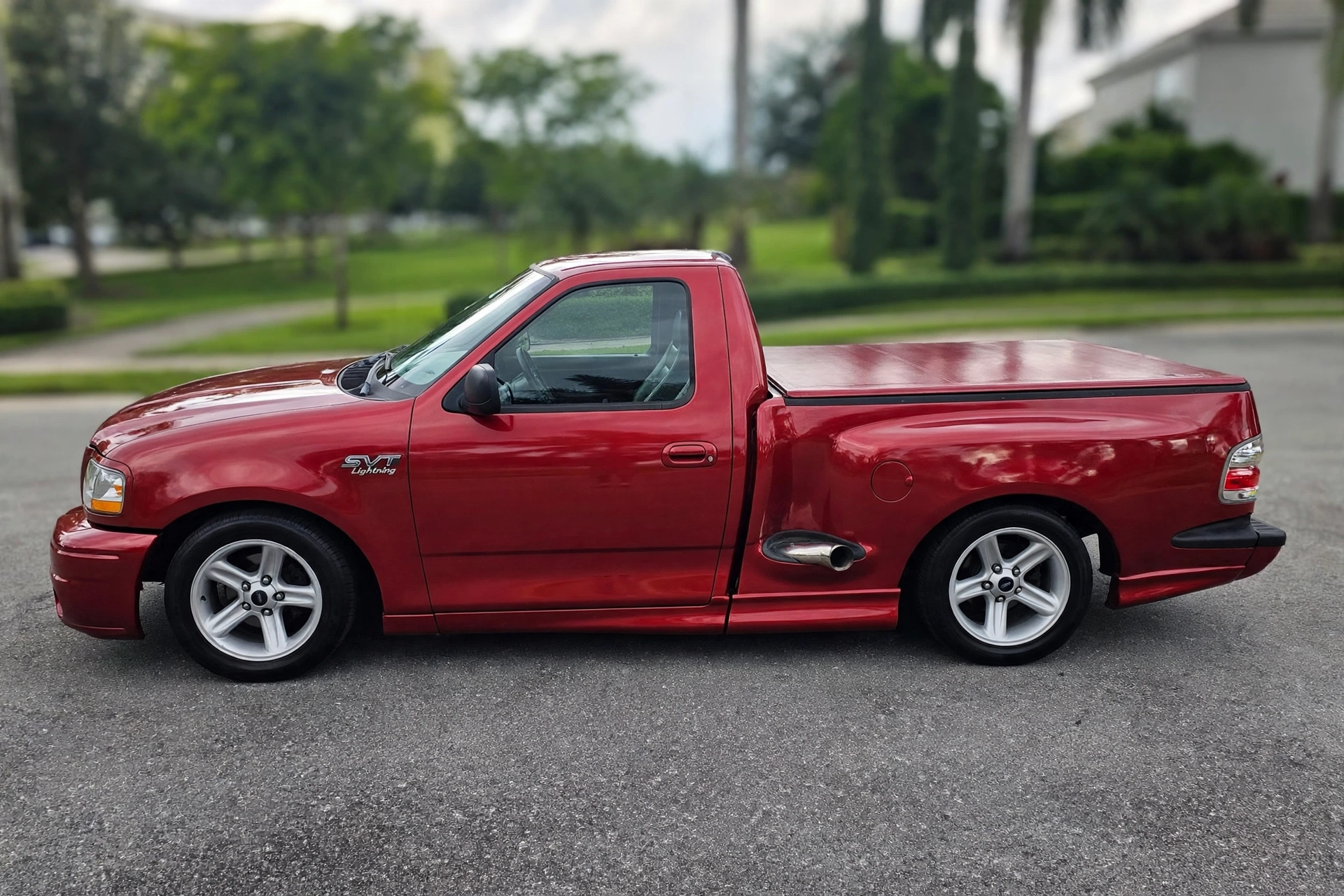
AI-generated illustration: a red 2001 Ford F-150 SVT Lightning in side profile.
Questions Ford Owners Ask About the Lightning
How Much Horsepower Does It Have
A 2001 Ford F-150 SVT Lightning has 380 horsepower at 4,750 rpm and 450 lb-ft of torque at 3,250 rpm. That is up 20 horsepower and 10 lb-ft over the 1999 and 2000 trucks.
How Fast Is a 2001 SVT Lightning
MotorWeek tested 0 to 60 in 5.4 seconds and the quarter mile in 13.9 seconds at 101 mph. Car and Driver went quicker at 5.2 seconds and 13.8 seconds at 104 mph, with a top speed near 142 mph.
How Many 2001 Lightnings Were Built
Ford built 6,381 Lightnings for the 2001 model year, the highest total of the 1999 to 2004 run. The colors were Black at 1,908, Bright Red at 1,722, Silver Metallic at 1,581, and Oxford White at 1,170.
What Is a 2001 Lightning Worth Today
Driver-quality second-generation Lightnings sell in the 25,000 to 35,000 dollar range. Hagerty puts an excellent second-generation truck at about 45,300 dollars, and a 2001 truck reached 86,900 dollars at Mecum in early 2026.
What Problems Does a 2001 Lightning Have
The main problems are spark plug blowout from shallow head threads, intercooler pump failure, and supercharger snout seal leaks. Ford revised the cylinder heads for 2003, so a 2001 truck needs a closer plug history check.
Is the 2001 Lightning a Good Buy
Yes, for most buyers who want a fast classic truck. It has the full 380 horsepower engine, the shorter 3.73 axle, and the highest production total, so it is the easiest Lightning year to find in good shape.
Your 5 Step Check Before You Buy
2001 Ford F-150 SVT Lightning buyers get a truck with 380 horsepower, a 0 to 60 time near 5.2 seconds, and the highest production total of the Lightning run.
Run the five step check before you buy. Confirm the VIN eighth digit reads “2”, check the plug history and look for thread repairs, listen for the intercooler pump at key-on, test the transmission under boost, and buy the stockest truck with the best records you can afford.
That check costs you an hour. It can save you from the one expensive Lightning problem, and it leaves you with the fastest truck Ford had ever built when it was new.