
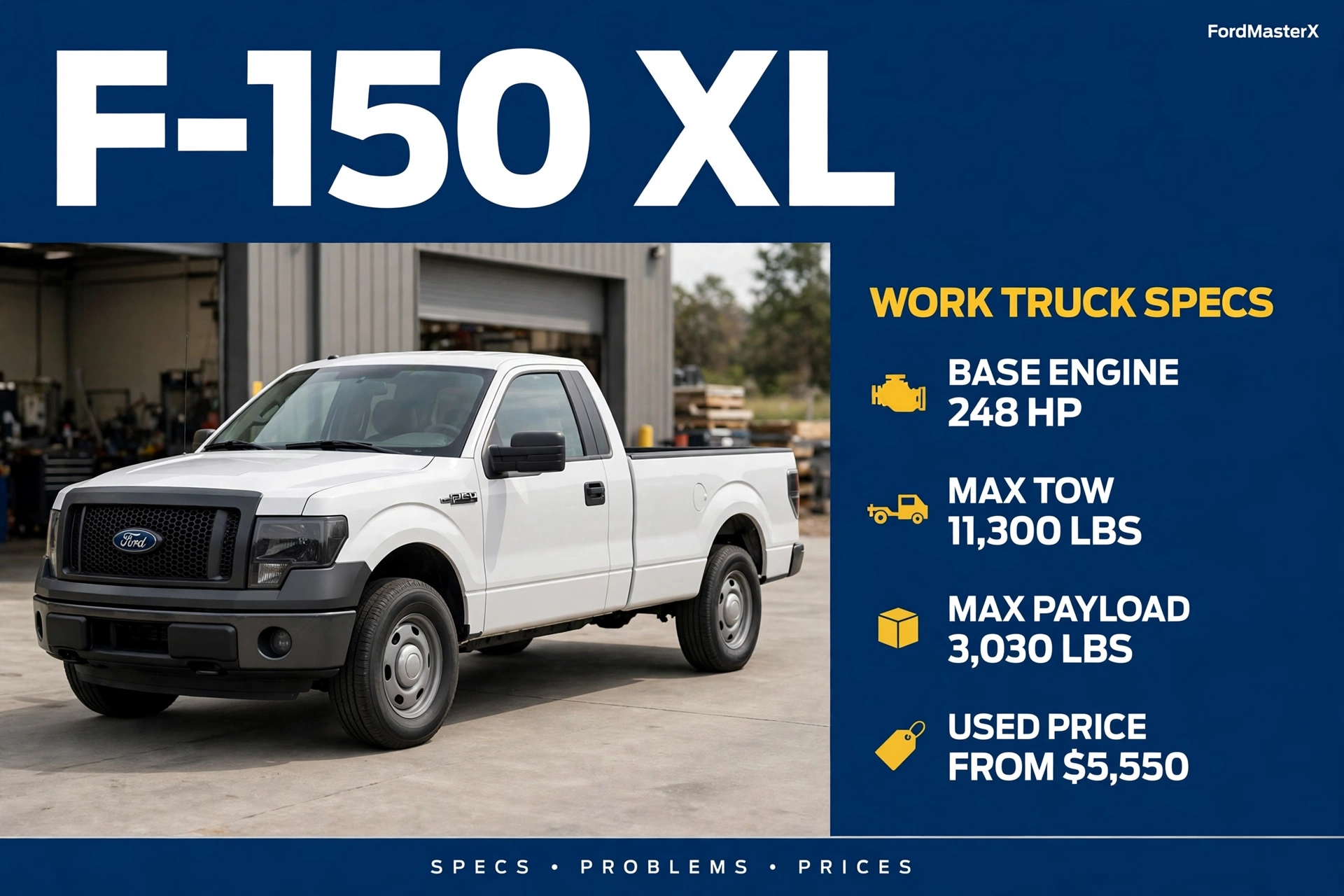
2010 Ford F-150 XL Work Truck Guide With Proven Specs for 2026

Yes, a 2010 Ford F-150 XL is worth buying as a cheap work truck if you pick the right engine and run the checks in this guide before you pay. The base XL is the plainest 12th generation F-150, and in 2026 it sells for about $5,550 to $11,500 depending on cab and mileage.
Buy it if you want a simple full-size truck for work, towing, and hauling, and you can live with vinyl seats and manual windows. Skip it if you need modern safety tech, or if the seller cannot show proof of spark plug service on a 5.4L truck.
This guide gives you the XL-only facts: all three engines, towing and payload by engine, the exact standard equipment, the problems that hit this year, and current used prices. Every figure is tied to its source.
The Short Answer on the 2010 Ford F-150 XL
The XL is the base trim of a truck that was redesigned for 2009, so the 2010 model is the second year of the 12th generation. Changes for 2010 were limited to packaging, which means the 2010 XL is nearly the same truck as the 2009 XL.
Three V8 engines were offered, and the XL could be ordered with any of them. The base 4.6L two-valve V8 makes 248 horsepower, the 4.6L three-valve V8 makes 292 horsepower, and the 5.4L three-valve V8 makes 310 horsepower on gasoline.
2010 Ford F-150 XL At a Glance
Base work trim specs for the 12th generation F-150. Check your door sticker for your exact tow and payload ratings.
| Engine | Power | Max tow | Max payload |
|---|---|---|---|
| 4.6L 2 valve V8 | 248 hp | 6,000 lbs | 1,890 lbs |
| 4.6L 3 valve V8 | 292 hp | 9,500 lbs | 1,980 lbs |
| 5.4L 3 valve V8 | 310 hp | 11,300 lbs | 3,030 lbs |
Direct answer: the base XL is a $5,550 to $11,500 used work truck in 2026. Buy the 4.6L 3 valve V8 for the best mix of power and simplicity.
Sources: 2010 Ford F-150 brochure and RV and Trailer Towing Guide; Kelley Blue Book Fair Purchase Price, November 2026; Ford-Trucks 2010 specifications.
Maximum towing and payload are best-case figures for a properly equipped truck. The 11,300 pound tow rating and the 3,030 pound payload rating both need the Heavy-Duty Payload Package or the Max Trailer Tow Package, and the top tow figure is reached by Regular Cab and SuperCab trucks with the 5.4L engine and the 3.73 axle ratio.
The base XL started at $21,380 when new, for a Regular Cab two-wheel drive truck with the 6.5 foot bed. That low starting price is the whole point of the XL, and it is why so many of these trucks spent their first years as fleet and work trucks.
3 Engines in the 2010 Ford F-150 XL
Every 2010 F-150 XL is a V8 truck. Ford offered no V6 in the 2010 F-150.
All three engines are single overhead cam V8s from the modular engine family, and Ford-Trucks technical specifications list the power and torque figures for each one. The 2010 model year was the last for the 4.6L and 5.4L engines in the F-150, because Ford replaced them with the 5.0L Coyote V8 and the EcoBoost V6 engines for 2011.
Engine choice is the biggest decision in this truck, because it sets your towing limit, your transmission, and your repair risk. The sections below give each engine its own verdict.
4.6L 2 Valve V8
The 4.6L two-valve V8 is the standard XL engine. It makes 248 horsepower at 4,750 rpm and 294 pound-feet of torque at 4,000 rpm, from 281 cubic inches.
It pairs with a four-speed automatic transmission, which is the oldest gearbox in the lineup. That four-speed is the reason this engine gets slightly worse fuel economy than the more powerful 4.6L three-valve, even though it makes less power.
This is the simplest engine in the truck, and that is its strength.
It has no variable cam timing tricks to fail, and it tows up to 6,000 pounds, which covers a small trailer, a boat, or a loaded work trailer. Buy this engine if you want the cheapest XL and the simplest maintenance.
4.6L 3 Valve V8
The 4.6L three-valve V8 makes 292 horsepower at 5,700 rpm and 320 pound-feet of torque at 4,000 rpm. It is the same 281 cubic inch block as the base engine, with three valves per cylinder instead of two.
It pairs with the six-speed automatic transmission, which is a newer and smoother gearbox than the four-speed. The six-speed is also why this engine returns the best fuel economy in the lineup, at 15 mpg city and 21 mpg highway in two-wheel drive.
This is the engine we recommend for most XL buyers. It tows up to 9,500 pounds, it has the better transmission, and it avoids the worst of the 5.4L problems. Our Ford transmission identification chart shows how to confirm which gearbox your truck has from its tag and pan shape.
5.4L 3 Valve V8
The 5.4L three-valve Triton V8 makes 310 horsepower at 5,000 rpm and 365 pound-feet of torque at 3,500 rpm on gasoline. On E85 flex fuel it makes 320 horsepower and 390 pound-feet of torque, but fuel economy drops to 10 mpg city and 14 mpg highway.
It pairs with the six-speed automatic transmission, and it is the only engine that can reach the 11,300 pound maximum tow rating. It is also the engine with the most reported problems, which the problems section below covers in full.
Buy the 5.4L only if you need its towing power and the seller can show recent spark plug service.
A 2003 F-150 with the same Triton family shows how these engines age, and our 2003 Ford F-150 XLT Triton V8 guide covers the earlier trucks that share this engine family. For the 5.4L service specs, our 2010 F-150 5.4L oil capacity guide lists the 7 quart fill and the 5W-20 grade.
2010 Ford F-150 XL Towing and Payload Limits
Towing capacity in the 2010 XL runs from 5,100 pounds to 11,300 pounds depending on engine, cab, axle ratio, and tow package. The spread is wide, so the engine badge alone does not tell you what your truck can tow.
Ford states that trailer weight must not exceed 5,000 pounds without a tow package. Above that weight, the truck must have a Trailer Towing Package, a Heavy-Duty Payload Package, or a Max Trailer Tow Package, plus a weight-distribution hitch.
Payload is just as variable. The XL range runs from 1,600 pounds to 3,030 pounds, and the top figure needs the Heavy-Duty Payload Package. A base Regular Cab XL with the 4.6L two-valve engine sits near the bottom of that range.
The table below gives the maximum by engine, and the door jamb sticker gives the exact rating for one truck. Our Ford F-150 towing capacity chart covers every year and engine, so you can compare the 2010 XL against any other F-150 before you buy.
| Engine | Max towing | Max payload | Transmission |
|---|---|---|---|
| 4.6L 2 valve V8 | 6,000 lbs | 1,890 lbs | 4 speed automatic |
| 4.6L 3 valve V8 | 9,500 lbs | 1,980 lbs | 6 speed automatic |
| 5.4L 3 valve V8 | 11,300 lbs | 3,030 lbs | 6 speed automatic |
Axle ratio matters as much as the engine. A 3.73 axle ratio is the one that unlocks the top tow ratings.
A 3.55 axle ratio leaves up to 1,500 pounds on the table. Check the axle code on the door sticker before you trust any advertised tow figure.
Four-wheel drive also cuts into the rating. A 4×4 XL tows less than the same 4×2 truck, because the extra hardware adds weight and changes the gearing. The best tow numbers in this article are properly equipped 5.4L trucks with the 3.73 axle ratio.
What the 2010 Ford F-150 XL Includes as Standard
The XL is a work truck, and the standard equipment list shows it. Ford-Trucks 2010 review calls the basic XL quite respectable for about $21,000.
Ford spent the money on the frame, the V8, and the safety gear, and left the comfort items off the list. That is the trade that makes the XL cheap to buy and cheap to keep.
Air conditioning is standard, which matters for a work truck that spends all day in the sun. Stability control with roll stability control is also standard, along with front seat-mounted airbags and side-curtain airbags.
XL Exterior Equipment
The XL rides on 17 inch grey styled-steel wheels with all-season tires. The bumpers are argent-painted step bumpers, the grille is a black bar-style grille with a black surround, and the mirrors are black manual mirrors on Regular Cab and SuperCab trucks.
A locking tailgate, four cargo box tie-downs, and a cargo box lamp are standard. The fuel filler is the capless design Ford used across the 2010 lineup, and a trailer tow package with a four-pin connector and trailer sway control is standard.
XL Interior Equipment
Inside, the XL has vinyl 40/20/40 split front bench seats and a vinyl floor covering that hoses out after a work day.
SuperCab and SuperCrew trucks add a vinyl 60/40 split flip-up rear seat. The steering wheel is urethane, and it tilts.
Regular Cab and SuperCab XL trucks have manual windows, while the SuperCrew XL has power windows and door locks as standard. The stereo is an AM/FM unit with a clock, and a tachometer and a display center are standard.
MyKey, the programmable key that limits speed and volume, is standard on every 2010 trim except the base XL, where it was optional. The optional XL Decor Group adds cloth seats and chrome bumpers for buyers who want a slightly less plain truck.
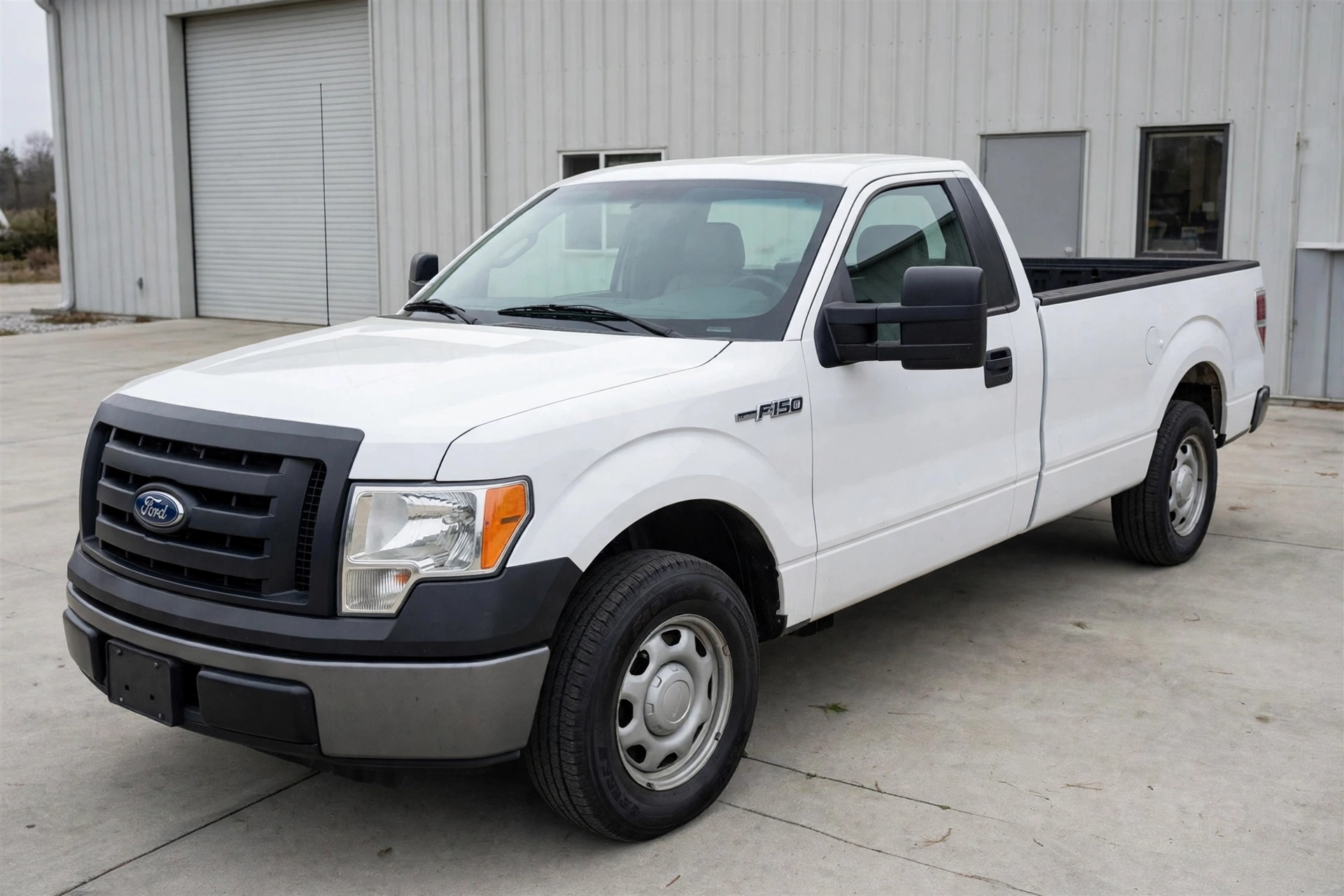
AI-generated illustration: a 2010 Ford F-150 XL regular cab work truck in white with steel wheels, black bumpers, and an 8 foot bed.
5 Cab and Bed Choices on the 2010 F-150 XL
The XL came in all three cabs, but not every bed fits every cab. Ford offered three bed lengths, 5.5 feet, 6.5 feet, and 8 feet, and the combinations follow a fixed pattern. Knowing the pattern helps you spot a truck that has been mislabeled in a listing.
Regular Cab XL trucks came with the 6.5 foot standard bed or the 8 foot long bed. SuperCab XL trucks came with the same two beds. SuperCrew XL trucks came with the 5.5 foot short bed or the 6.5 foot bed.
Two combinations do not exist: there is no short-bed Regular Cab, and no long-bed SuperCrew. If a listing claims one of those, the seller has the cab or the bed wrong. Our Ford F-150 bed size chart lists every cab and bed combination with the real measurements.
| Cab | Bed options | Seats | Notes |
|---|---|---|---|
| Regular Cab | 6.5 ft or 8 ft | 3 | Cheapest XL, lightest cab |
| SuperCab | 6.5 ft or 8 ft | 5 to 6 | Rear doors open backward |
| SuperCrew | 5.5 ft or 6.5 ft | 5 to 6 | Four full-size doors, power windows |
The Regular Cab is the work truck pick. It is the lightest cab, the cheapest to buy, and the one that reaches the 11,300 pound tow rating. It seats three across the front bench, which is tight for three adults on a long trip.
The SuperCab adds small rear seats behind backward-opening rear doors, and the SuperCrew adds four full-size doors with real rear legroom. SuperCrew XL trucks cost the most used, because they are the most useful as a family truck as well as a work truck.
6 Problems to Check Before Buying a 2010 F-150 XL
The 2010 F-150 has a mixed reliability record, and the XL is no exception. Owner complaints filed with NHTSA in the first three years total 248, with electrical problems as the top category at 23 percent.
CarComplaints counts reported by MotorBiscuit put rear window shattering first at about 170 complaints, electrical problems second at about 150, and transmission problems third at about 70.
Those are complaint counts, not failure rates, and most 2010 trucks on the road today have already had their weak points fixed or have never shown them. The six checks below cover the problems that cost real money, in the order a buyer should check them.
Cam Phaser Rattle on 5.4L
The 5.4L three-valve engine uses variable cam phasers to control valve timing. A worn phaser can fail and lock, which causes a diesel-like rattling or knocking noise at warm idle, a loss of power, and a check engine light.
Owners report phaser failure as early as 60,000 miles, with owner-reported replacement costs of $550 to $850 according to MotorVerso. Listen at warm idle with the hood open, and walk away from any 5.4L truck that rattles like a diesel when warm.
Snapping Spark Plugs on 3V
The three-valve engines use two-piece spark plugs that can snap inside the cylinder head when they are removed. This is the best-known service trap on the 2009 and 2010 trucks, and it turns a simple tune-up into an extraction job.
Ask the seller for proof of a recent plug change, and ask which plugs were used. A truck with fresh one-piece replacement plugs is worth more than the same truck with its original plugs still in place.
Our best spark plugs guide for the F-150 lists the plug types that fit these engines.
Fuel Pump Fuse 27 Melts
Fuse 27, a 20 amp fuse in the underhood fuse box, powers the fuel pump circuit. The terminal can overheat and melt, which cuts power to the pump and leaves the truck cranking without starting. Owners often replace the pump first and still have the same no-start, because the fuse box terminal is the fault.
Pull fuse 27 and look at both the fuse and the terminals for heat damage or melting. Ford issued a service bulletin with a fuse relocation kit, and owners report the kit costs about $18. A melted fuse 27 is a cheap fix, but only if you find it before you pay for a pump.
Hard Shifts From 6R80
The six-speed automatic can shift hard from first to second, shudder around 45 mph, or bang into gear. These symptoms show up in owner complaints for the 2010 trucks, and they cover all three engines, not just the 5.4L.
Test drive the truck cold and warm, and feel every shift under light and firm throttle. One thing to know: the sudden-downshift recalls for the 6R80 cover the 2011 to 2013 trucks, not the 2010.
A 2010 truck with a harsh shift needs a fluid check and a scan, not a recall. Our guide to checking transmission fluid on a 2016 F-150 shows the same 6R80 check procedure, because the transmission family is the same.
Rear Window Shattering Reports
The single largest complaint category for the 2010 F-150 is the rear window shattering, with about 170 complaints on CarComplaints. Drivers report the rear glass breaking without an impact, often while driving.
Check the rear glass closely for chips, stress cracks, or a replacement that does not match the factory tint. A replaced rear window is not a deal breaker, but it is a point to use in the price talk.
Exhaust Manifold Ticking
Cracked exhaust manifolds are common on the 5.4L, and they cause a loud ticking noise on a cold start that fades as the engine warms. The tick is easy to miss on a warm truck, so insist on a cold start.
Start the truck stone cold and listen from the front wheel wells before the engine warms up. A cracked manifold is a repair that costs real money, because the studs often snap during removal. The 5.4L has a known list of weak points, and a cracked manifold is only one of them.
On recalls, the 2010 F-150 has exactly one US safety recall on file with NHTSA: campaign 11V049000, Ford campaign 11S15, filed with NHTSA in January 2011. The interior door handle spring can fracture, so the handle may not return to its stowed position, and in a side-impact crash the door latch can open.
Ford inspects each interior door handle and adds a spring reinforcement or replaces the module free of charge. Check any truck you buy against the NHTSA recall database by VIN before you pay.
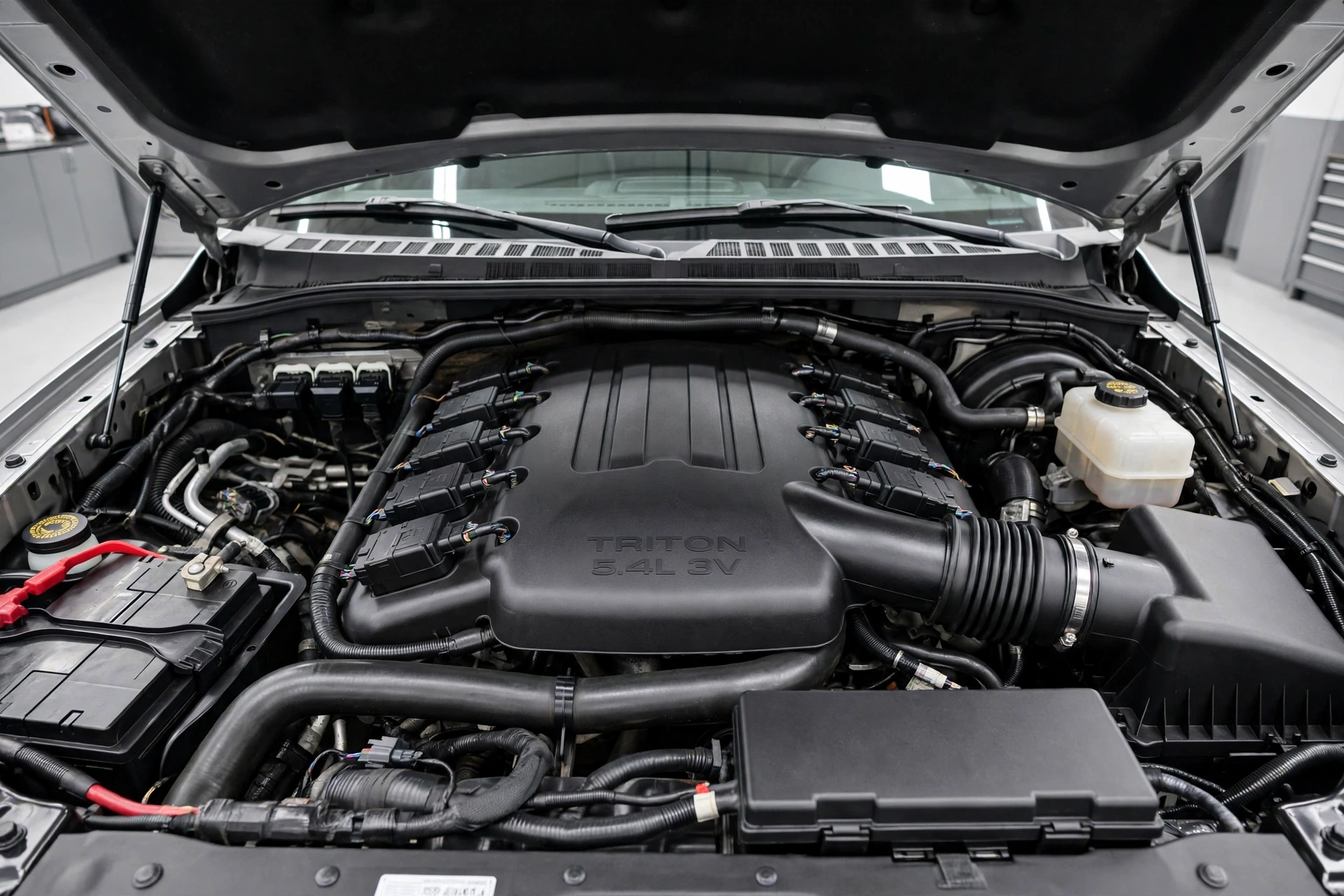
AI-generated illustration: the 5.4L three-valve Triton V8 engine bay of a 2010 F-150, showing the ignition coil packs on both banks.
What a 2010 Ford F-150 XL Costs in 2026
A 2010 F-150 XL is a $5,550 to $11,500 truck in 2026 for most buyers. The cab sets the price more than the engine does, and mileage sets it more than either. Rough high-mileage work trucks start near $2,000, while clean low-mileage SuperCrew four-wheel drive trucks sell above $11,000.
Kelley Blue Book Fair Purchase Prices for November 2026 put the Regular Cab XL at $5,550 for the 6.5 foot bed and $5,625 for the 8 foot bed. The SuperCrew XL runs $7,375 for the 5.5 foot bed and $8,875 for the 6.5 foot bed.
Those are dealer prices for trucks in typical condition, and KBB updates them weekly.
| XL configuration | KBB Fair Purchase Price |
|---|---|
| Regular Cab, 6.5 ft bed | $5,550 |
| Regular Cab, 8 ft bed | $5,625 |
| SuperCrew, 5.5 ft bed | $7,375 |
| SuperCrew, 6.5 ft bed | $8,875 |
Edmunds True Market Value figures land in the same range, with Regular Cab XL trucks listed from $5,534 to $7,487 and SuperCab XL trucks near $8,523. Live listings observed in November 2026 match the guides: $5,995 for an XL with 227,588 miles in Tennessee, $8,899 for an 8 foot bed XL with 121,000 miles in Florida, and $11,500 for a SuperCrew four-wheel drive XL with 148,293 miles in Missouri.
Three things move the price most. Four-wheel drive adds about $1,000 to $2,000 over the same two-wheel drive truck.
The SuperCrew cab adds about $1,800 to $3,300 over the Regular Cab. Mileage past 200,000 pulls the price down hard, even on a clean truck.
Kelley Blue Book owner reviews give the 2010 F-150 a 4.5 out of 5 rating from 1,006 owners, with 88 percent recommending it and 76 percent giving five stars.
Comfort and styling score highest, while value scores lowest, which fits a truck that is now cheap to buy but thirsty to run.
Fuel Economy and Running Costs of the 2010 F-150 XL
Fuel economy is the XL’s weak point, and no engine fixes it. The best figure in the lineup is 15 mpg city and 21 mpg highway for the 4.6L three-valve two-wheel drive truck, and the worst is 10 mpg city and 14 mpg highway for the 5.4L running on E85.
The base 4.6L two-valve engine is rated 15 mpg city and 19 mpg highway in two-wheel drive. Four-wheel drive costs 1 to 2 mpg on every engine. The 5.4L on gasoline is rated 14 mpg city and 20 mpg highway in two-wheel drive.
| Engine and drive | City mpg | Highway mpg |
|---|---|---|
| 4.6L 2 valve, 4×2 | 15 | 19 |
| 4.6L 3 valve, 4×2 | 15 | 21 |
| 5.4L, gasoline, 4×2 | 14 | 20 |
| 5.4L, E85, 4×2 | 10 | 14 |
The fuel tank holds 26 gallons on most XL trucks, which gives a highway range near 500 miles with the 4.6L three-valve engine. Some configurations carry a 36 gallon tank, so check the build sheet if range matters to you.
The fueleconomy.gov listing for the 2010 F-150 4WD flex-fuel truck shows 14 mpg city and 18 mpg highway on gasoline, with a 26 to 36 gallon tank range.
Oil changes are cheap and simple. The 4.6L engines take 6.0 quarts of 5W-20 with a filter, and the 5.4L takes 7.0 quarts of the same grade.
Ford specification WSS-M2C930-A is the grade to ask for, and our Ford engine oil recommendation chart lists the spec for every engine.
Budget for the problems, not just the fuel. A cam phaser job, a set of snapped plugs, or a cracked manifold can each cost more than a year of fuel savings from picking the cheaper engine.
Which 2010 Ford F-150 XL Engine Should You Choose
The 4.6L three-valve V8 is the right pick for most buyers. It tows up to 9,500 pounds, it has the six-speed automatic, it returns the best fuel economy in the lineup, and it avoids the worst of the 5.4L repair bills.
The 4.6L two-valve V8 is the right pick if your budget is tight and your towing stays under 6,000 pounds. It is the simplest engine in the truck, and its four-speed automatic is a known quantity.
You give up power and fuel economy, but you also give up the cam phaser and plug risks that come with the newer engines.
The 5.4L three-valve V8 is the right pick only if you need to tow more than 9,500 pounds. It is the only engine that reaches 11,300 pounds, and it is the only one that can use the Heavy-Duty Payload Package to its full 3,030 pound limit.
Buy it only with proof of spark plug service, a quiet warm idle, and a cold-start check for manifold ticking. Our 2004 Ford F-150 5.4 Triton guide covers the earlier trucks that share this engine.
The verdict flips in two cases. If the 5.4L truck is a fleet truck with full dealer service records and a recent plug change, it can be a better buy than a neglected 4.6L truck with no history.
And if you tow less than 5,000 pounds, the base 4.6L two-valve is the smarter buy, because you pay less and you carry less repair risk.
7 Checks Before You Pay for an F-150 XL
Run these seven checks in order, and do not skip the cold start. A seller who will not allow a cold start or a scan is telling you something, and the price should reflect it.
- Cold start listen. Start the truck stone cold and listen for manifold ticking from the front wheel wells and for a cam phaser rattle at warm idle. Both noises fade as the engine warms, so a warm truck hides them.
- Pull fuse 27. Remove the 20 amp fuse 27 from the underhood fuse box and look for melted plastic or heat damage on the fuse and the terminals. A melted fuse 27 explains a no-start that a new fuel pump will not fix.
- Scan for codes. Plug in a scanner and read stored codes for misfires, cam timing, and transmission faults. A flashing check engine light at start means an active misfire, and that truck needs a diagnosis before a price.
- Drive every shift. Drive the truck cold and warm, and feel the 1-2 shift under light and firm throttle. Note any shudder near 45 mph or any bang into gear, and check the fluid condition if the shifts feel wrong.
- Check the rear glass. Look at the rear window for chips, stress cracks, or a replacement that does not match the factory tint. Rear window shattering is the top complaint category for this year.
- Read the door sticker. Confirm the cab, bed, axle ratio, and the tow and payload ratings from the door jamb sticker, not from the listing. The sticker is the only rating that applies to that one truck.
- Run the VIN. Check the VIN against the NHTSA recall database for the door handle recall 11V049000, and pull a history report for accidents, title brands, and odometer flags before you pay.
Questions Ford Owners Ask About the 2010 Ford F-150 XL
How Much Does a 2010 Ford F-150 XL Cost?
Most 2010 F-150 XL trucks sell for $5,550 to $11,500 in 2026, based on Kelley Blue Book Fair Purchase Prices. Regular Cab trucks sit at the bottom of that range, and SuperCrew four-wheel drive trucks sit at the top.
What Engine Does a 2010 Ford F-150 XL Have?
The base engine is the 4.6L two-valve V8 with 248 horsepower and a four-speed automatic. The 4.6L three-valve V8 with 292 horsepower and the 5.4L three-valve V8 with 310 horsepower were both available, and both pair with a six-speed automatic.
How Much Can a 2010 Ford F-150 XL Tow?
It depends on the engine and the equipment. The 4.6L two-valve tows up to 6,000 pounds, the 4.6L three-valve tows up to 9,500 pounds, and the 5.4L tows up to 11,300 pounds when properly equipped with a tow package and a weight-distribution hitch.
Is the 2010 Ford F-150 XL Reliable?
It is reliable if you buy the right engine and check the known faults first. Owners give the 2010 F-150 a 4.5 out of 5 rating on Kelley Blue Book, but the 5.4L engine carries cam phaser, spark plug, and manifold risks that hit the 5.4L hardest.
What Is the Most Common Problem With the 2010 F-150?
Rear window shattering drew the most owner complaints, at about 170 reports. The most expensive problems are the 5.4L cam phaser rattle, snapping spark plugs, and the fuel pump fuse 27 terminal that melts in the underhood fuse box.
Does the 2010 Ford F-150 XL Have Power Windows?
Regular Cab and SuperCab XL trucks have manual windows as standard, while the SuperCrew XL has power windows and door locks as standard. Power windows were available as an option on the other cabs, so check the truck in front of you rather than trusting the trim badge.
Is the 2010 Ford F-150 XL Worth Buying in 2026
The 2010 Ford F-150 XL is worth buying in 2026 as a cheap, simple work truck, and the 4.6L three-valve engine is the one to hunt for. It gives you 292 horsepower, the six-speed automatic, the best fuel economy in the lineup, and towing up to 9,500 pounds.
Buy the base 4.6L two-valve if your budget is tight and your trailer stays under 6,000 pounds. Buy the 5.4L only if you need its 11,300 pound tow rating and the seller can prove the plugs were changed and the engine idles quiet when warm.
Run the seven checks, read the door sticker, and check the VIN for the door handle recall before you pay. A clean XL with a straight frame and a quiet engine is a truck that can work for years.