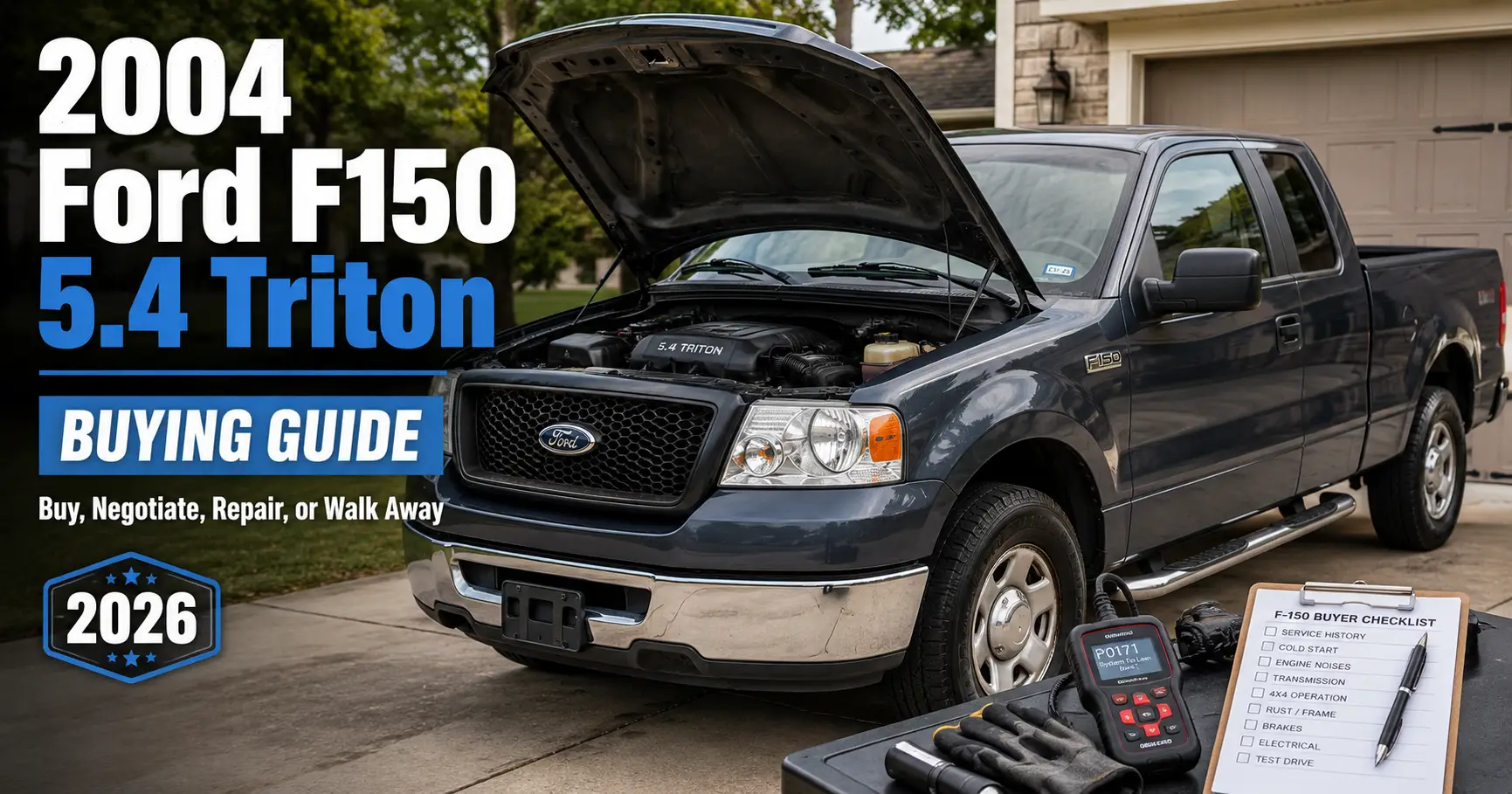
2004 Ford F150 5.4 Triton Buying Guide In 2026

The 2004 Ford F150 5.4 Triton can be a solid used truck, but only if the engine is quiet, the maintenance history is clean, and the price leaves room for age-related repairs.
This is not a truck you should buy only because it looks clean.

Prime for Young Adults — 6 Months Free
Students and 18–24s get six months of Prime free, then half price.
Start 6 Months Free As an Amazon Associate I earn from qualifying purchases.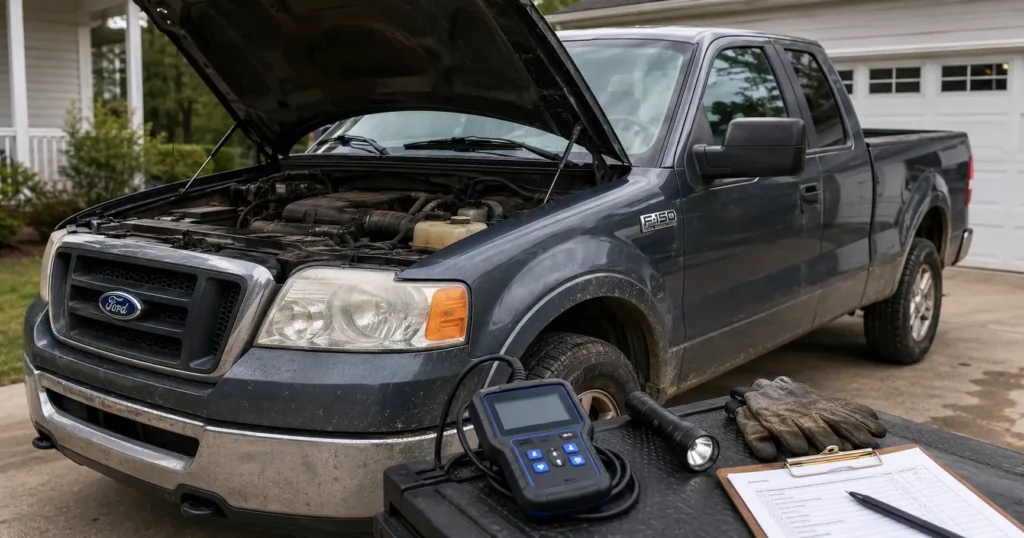
The 2004 model year matters because the F-150 received the newer 5.4L 3-valve Triton V8 with variable cam timing. That engine made 300 horsepower and 365 lb-ft of torque, but it also introduced repair risks that buyers need to understand before paying used-truck money.
Use this guide as a decision path. You will know when to buy, when to negotiate, when to repair, and when to walk away.
Is The 2004 Ford F150 5.4 Triton Worth Buying
Recommended Best Deal Products


If the truck has clean maintenance history and no timing noise, a 2004 F150 5.4 Triton deserves a closer look.
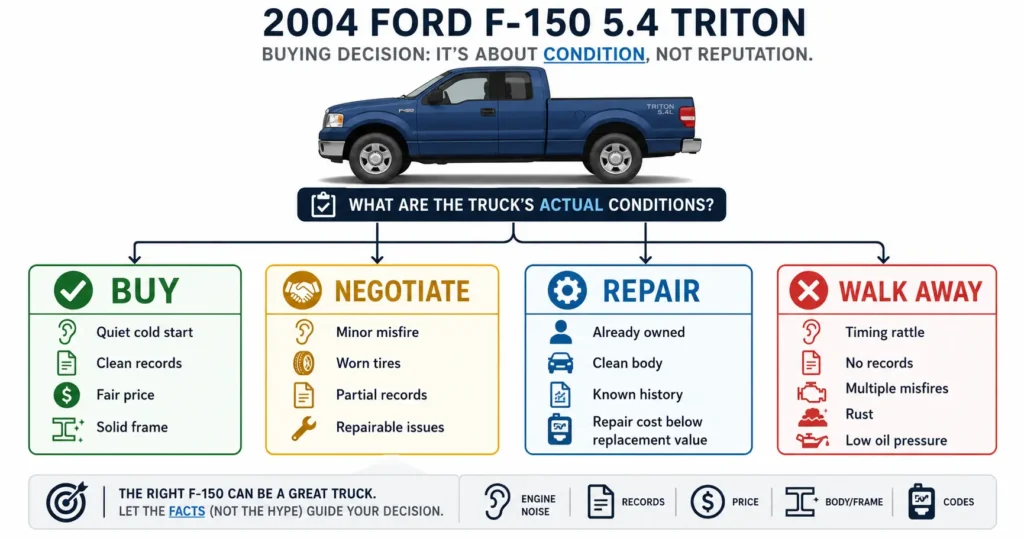
If it has startup rattle, no oil-change records, active misfire codes, or a high asking price, the risk changes fast.
The key is not whether the 5.4 Triton is “good” or “bad.” The better question is whether this specific truck has been maintained well enough to avoid the expensive failure path.
A clean 2004 F-150 can still work well as a light-duty truck, farm truck, hunting truck, or weekend hauler. The problem starts when the seller prices it like a low-risk truck while the engine shows high-risk symptoms.
Kelley Blue Book shows many 2004 F-150 Super Cab trims sitting around the mid $4,000 to mid $6,000 fair-purchase range, depending on trim and condition. KBB also notes that value varies heavily by mileage, location, and condition.
Use this simple rule first:
- If the truck is quiet, documented, and fairly priced, inspect it seriously.
- If it is cheap but noisy, treat the low price as a warning.
- If it is expensive and still has unknown engine history, do not rush.
The decision becomes clearer when you separate the truck into six conditions.

Audible — Listen Free for 30 Days
One free credit a month and thousands of titles included.
Listen Free for 30 Days As an Amazon Associate I earn from qualifying purchases.6 Conditions That Change The Buying Decision
Do not judge the 2004 5.4 Triton by mileage alone.
Mileage matters, but engine noise, oil history, rust, and price matter more. A 140,000-mile truck with records can be safer than a 90,000-mile truck with cold-start rattle and no paperwork.
Check these six conditions before deciding.
- Mileage
If the truck is under 120,000 miles and has service records, it belongs in the lower-risk group.
If it is between 120,000 and 180,000 miles, inspect more carefully.
If it is over 180,000 miles, the price must reflect age, wear, and possible timing work.
- Maintenance Records
If the seller can show regular oil changes, that is a strong positive sign.
If the seller says “it was maintained” but has no receipts, treat that as unknown history.
- Cold-Start Noise
If the engine starts quietly after sitting overnight, that is good.
If it rattles, knocks, or sounds like a diesel at idle, slow down and inspect the timing system.
Audible Premium Plus — Annual Membership
12 audiobook credits up front, plus the full Audible catalogue.
See Annual Plans As an Amazon Associate I earn from qualifying purchases.- Misfire Or Check Engine Light
If one cylinder has a simple coil issue, the truck may still be negotiable.
If it has multiple misfire codes, rough idle, and timing noise together, the risk is much higher.
- Rust And Frame Condition
If the frame, cab corners, rocker panels, and bed mounts are solid, the truck may be worth repairing.
If rust is severe, even a decent engine may not justify the purchase.
- Asking Price Compared With Repair Cost
If the truck costs around typical market value and needs only minor work, it may be fair.
If it needs timing work, plugs, coils, suspension, tires, and rust repair, the total cost can pass the truck’s value quickly.
Once those conditions look favorable, the truck moves into the good-buy path.
When A 2004 F150 5.4 Triton Is A Good Buy
Recommended Best Deal Products


If the engine is quiet on cold start, the records are clean, and the price leaves repair room, this truck can make sense.
A good-buy truck usually has several green lights at the same time.
Green Light Signs
- Cold start is quiet.
- Idle is smooth after warmup.
- No active check engine light.
- No low oil pressure warning.
- Oil looks clean and is filled correctly.
- Transmission shifts without slipping or hard engagement.
- Frame rust is light or manageable.
- Seller has oil-change and repair records.
- Price is close to normal market value, not collector pricing.
For most buyers, the safest purchase is not the cheapest truck. It is the truck with the fewest unknowns.
A clean 2004 F150 5.4 priced around normal private-party or dealer value can be reasonable if it passes inspection. KBB’s current pricing data for 2004 F-150 Super Cab trims shows typical fair-purchase prices around $4,425 to $6,350 depending on trim, while private-party values often sit lower.
That gives you a practical buying rule.
If the truck is priced near $5,000 to $6,500, it should be clean, quiet, and documented. If it is priced higher, the condition must be exceptional.
However, a few warning signs should change your offer or stop the purchase entirely.
When To Negotiate Or Walk Away
If one problem is isolated, negotiate. If several expensive problems appear together, walk away.
A 20-year-old truck will not be perfect. The issue is whether the problems are normal used-truck repairs or signs of a failing 5.4 Triton.
| Situation | Best Decision | Why |
|---|---|---|
| One cylinder misfire with clear coil code | Negotiate | A coil or plug issue may be repairable |
| Minor oil seepage with clean oil level | Negotiate | Common on older trucks if not severe |
| Tires, brakes, or shocks are worn | Negotiate | Normal age-related maintenance |
| No maintenance records but engine is quiet | Negotiate cautiously | Unknown history should lower price |
| Timing rattle on cold start | Walk away or inspect deeply | Timing work can be expensive |
| Multiple misfire codes plus rough idle | Walk away unless priced very low | Stacked engine risk |
| Low oil pressure warning | Walk away | Possible internal wear |
| Overheating history | Walk away | Can indicate deeper engine damage |
| Heavy rust plus engine issues | Avoid | Repair cost can exceed truck value |
Timing-chain and cam-phaser work on the 5.4L 3-valve Triton is not a small buyer-risk item. A 2026 repair-cost guide estimates F-150 timing-chain replacement for the 5.4L 3V Triton around $1,800 to $3,500, depending on parts, labor, and shop rate.
That means your negotiation should be serious.
If a seller wants $6,000 for a truck that may need $2,500 in timing work, you are not buying a $6,000 truck. You are possibly buying an $8,500 truck before tires, brakes, suspension, and fluids.
If the engine risk is stacked, check Ford F150 engine replacement cost before you commit. FordMasterX estimates older 5.4L Triton installed replacement cost around $5,000 to $8,000, which can easily overtake the value of a 2004 truck.
The biggest decision changers are the known 5.4 Triton problem areas.
5.4 Triton Problems To Check Before Buying
Recommended Best Deal Products


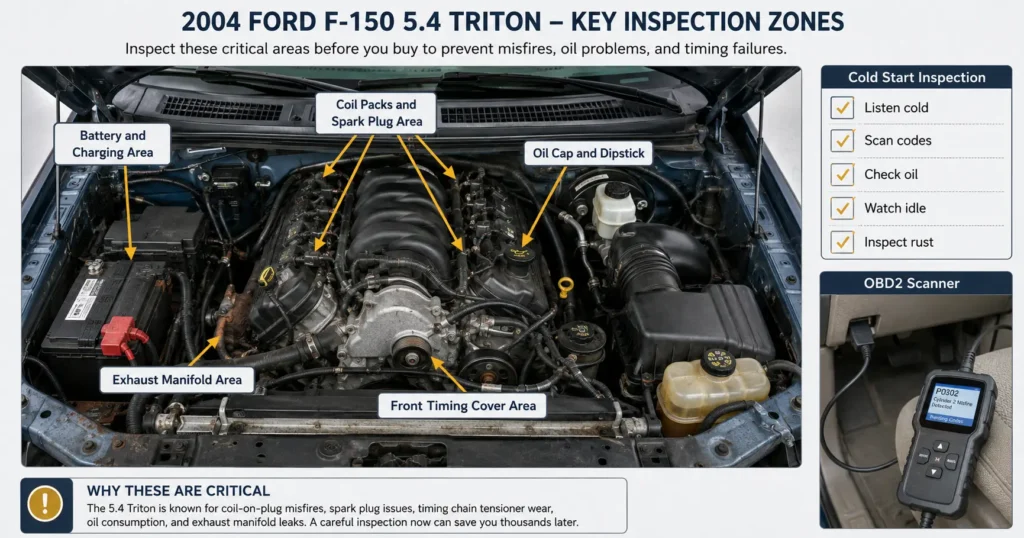
The 5.4 Triton problems that matter most are the ones that turn a cheap truck into an expensive truck.
The 2004 5.4L uses a 3-valve design with variable cam timing. Ford-Trucks notes that this engine used three valves per cylinder, variable cam timing, and a 4R75E automatic transmission pairing.
That design gives the engine good low-end torque, but it also makes oil condition and timing-system health very important.
| Problem | What You Notice | Why It Matters | Decision |
|---|---|---|---|
| Cam phaser noise | Diesel-like ticking or rattle at idle | Can point to variable cam timing wear | Inspect deeply or negotiate hard |
| Timing chain guide wear | Rattle on startup or front-engine noise | Repair is labor-heavy | Walk away if price is not low |
| Spark plug service risk | Seller avoids plug history | 3-valve plug service can be difficult | Verify before buying |
| Coil-on-plug misfire | P0301 to P0308 codes, rough idle | May be simple, but can hide deeper issues | Diagnose before purchase |
| Oil neglect | Sludge, low oil, dirty oil, no records | VCT system depends on oil pressure and cleanliness | High risk |
| Exhaust manifold leak | Ticking sound near manifold | Common older-truck issue | Negotiable if engine is otherwise good |
| Transmission shift issue | Harsh shifts, slipping, delayed engagement | Adds major cost beyond engine risk | Avoid unless heavily discounted |
| Severe rust | Soft frame areas, cab rust, bed mount rust | Limits the value of any repair | Usually avoid |
If the truck has a misfire code, use a 5.4 Triton firing order guide before replacing random parts.
If the code points to a specific cylinder, a 5.4 Triton coil pack diagram can help match the diagnostic code to the correct coil location.
The best inspection is a cold-start inspection. Arrive before the seller starts the truck. Listen for rattles, watch idle quality, scan for codes, and check whether monitors were recently cleared.
Specs matter too, but only when they help you judge how the truck fits your use.
2004 F150 5.4 Specs That Matter Most
The 2004 F-150 5.4 is important because it uses the newer 3-valve Triton, not the older 2-valve setup.
Here are the specs that matter for a buyer.
| Spec | 2004 F150 5.4 Triton |
|---|---|
| Engine | 5.4L Triton V8 |
| Valve Design | 3 valves per cylinder |
| Horsepower | 300 hp at 5,000 rpm |
| Torque | 365 lb-ft at 3,750 rpm |
| Timing System | Variable cam timing |
| Transmission | 4R75E automatic |
| Fuel Economy Range | About 14 to 16 combined mpg depending on cab and trim |
Ford’s 2004 powertrain information confirms the 5.4L 3-valve Triton produced 300 horsepower and 365 lb-ft of torque. It also confirms variable cam timing and the upgraded 4R75E automatic transmission.
For more engine background, see FordMasterX’s broader 5.4 Triton specs and reliability guide.
The main takeaway is simple. The 5.4 has useful torque for truck work, but the 3-valve system makes maintenance history more important than the spec sheet.
Now combine the symptoms, price, and specs into a simple decision matrix.
2004 F150 5.4 Triton Decision Matrix
Use this matrix when the seller’s story sounds good but the truck gives mixed signals.
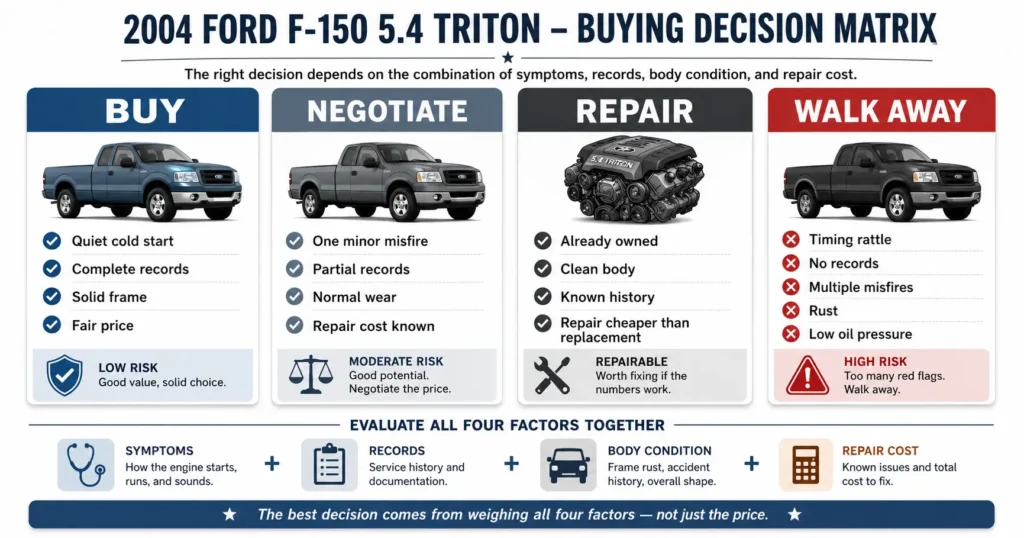
| Truck Condition | Engine Symptoms | Records | Price Signal | Decision |
|---|---|---|---|---|
| Clean body, quiet cold start | None | Complete | Around normal market value | Buy after inspection |
| Good body, one misfire code | Isolated coil or plug symptom | Partial | Discounted at least repair cost | Negotiate |
| Clean truck, high price | No symptoms | Complete | Far above KBB range | Negotiate or wait |
| Timing rattle, no records | Rattle or rough idle | Missing | Any normal price | Walk away |
| Owned already, solid body | Repairable known issue | Known history | Repair is less than replacement truck | Repair |
| Rust plus engine issue | Multiple problems | Unknown | Any price | Avoid |
| Low oil pressure warning | Internal-risk symptom | Any | Even cheap | Walk away |
Here is the practical if/then version.
If the truck is quiet, documented, structurally clean, and priced near normal market value, then it can be worth buying.
If the truck has one isolated issue, then negotiate by at least the repair cost.
If the truck has timing noise, no records, misfires, and rust together, then walk away.
If you already own the truck and the body is clean, compare repair cost against replacement cost. A $2,500 timing repair may make sense on a clean truck you know. A $7,000 engine job on a rusty 2004 usually does not.
If you are comparing model-year risk, read FordMasterX’s guide on bad 5.4 Triton years before choosing between 2004 and later trucks.
If you still cannot place the truck clearly in one row, get a mechanic involved.
When To Get A Mechanic Inspection
If the truck has any engine noise you cannot identify, do not guess.
A pre-purchase inspection is cheaper than buying a bad 5.4 Triton. This is especially true when the asking price is above $5,000 or when you plan to tow.
Get a mechanic inspection before buying if:
- You hear rattle, ticking, knocking, or diesel-like idle noise.
- The check engine light is on.
- The seller says codes were “just cleared.”
- The truck has no service records.
- The oil is low, dirty, or smells burnt.
- You feel transmission slipping or delayed engagement.
- The frame has rust near structural areas.
- You plan to tow a trailer.
- You cannot personally diagnose misfires.
Ask the mechanic for a cold start, code scan, oil inspection, charging-system check, coolant check, road test, and underbody inspection.
A basic inspection often costs far less than one wrong purchase. If the inspection finds timing-system trouble or internal engine risk, compare the estimate with Ford F150 engine replacement cost before deciding.
These are the questions buyers usually ask before making the final call.
Frequently Asked Questions
Is The 2004 Ford F150 5.4 Triton Reliable
The 2004 Ford F150 5.4 Triton can be reliable if it has clean oil history, no timing noise, and no active misfire problems. It becomes risky when maintenance records are missing and the engine already shows cam phaser, timing, or oil-pressure symptoms.
Is The 2004 F150 5.4 A 3 Valve Engine
Yes. The 2004 F-150 5.4L Triton is a 3-valve V8 with variable cam timing. Ford’s powertrain information lists the engine at 300 horsepower and 365 lb-ft of torque.
What Are The Worst 2004 F150 5.4 Problems
The worst problems are timing-chain noise, cam phaser rattle, oil neglect, spark plug service problems, and repeated misfires. One small issue may be repairable, but several of these problems together can make the truck a poor buy.
How Many Miles Can A 2004 F150 5.4 Last
A well-maintained 2004 F150 5.4 can last beyond 200,000 miles, but mileage alone does not prove condition. A quiet engine with records is more important than a low odometer reading with no maintenance history.
Should I Buy A 2004 F150 5.4 With A Check Engine Light
Only buy it after scanning the codes and confirming the problem is minor. A single coil-related misfire may be negotiable. Multiple misfires, timing codes, low oil pressure, overheating history, or rough running should make you walk away or demand a much lower price.
Final Verdict
The 2004 Ford F150 5.4 Triton is not automatically a bad truck, but it is condition-sensitive.
Buy one only when the engine is quiet, the records are strong, the frame is solid, and the price matches the risk. Negotiate if the truck has isolated, diagnosable problems. Walk away if timing noise, misfires, no records, rust, and high repair costs appear together.
Before paying strong money, inspect it cold, scan for codes, check the oil, and compare the asking price with likely repair cost.
A clean 2004 F-150 5.4 can still be useful. A neglected one can become expensive fast.