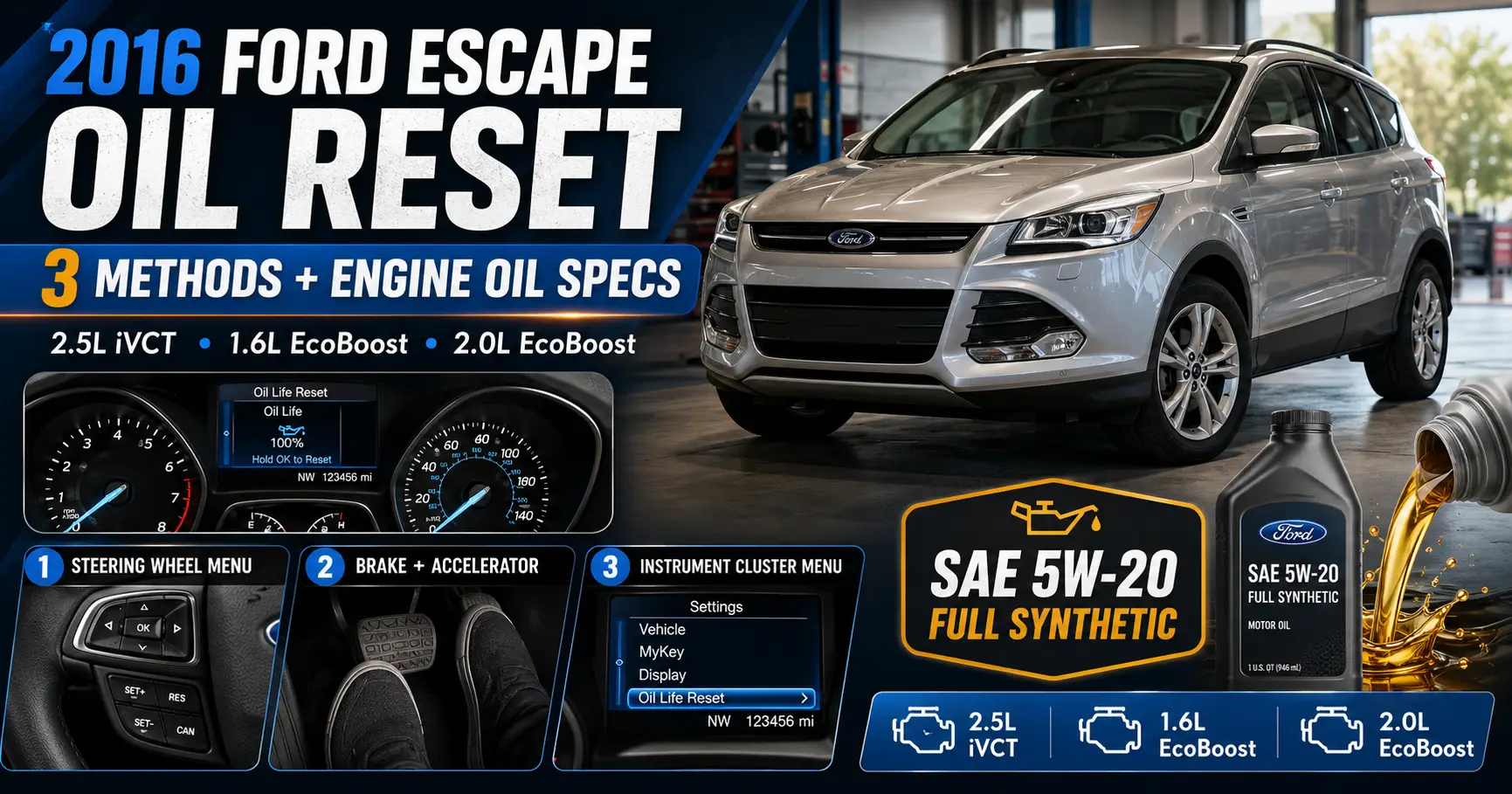
2016 Ford Escape Oil Reset — 3 Methods + Engine Oil Specs for All Engines

The 2016 Ford Escape uses an Intelligent Oil-Life Monitor (IOLM) — a dynamic algorithm that calculates exactly when your oil needs changing based on how you actually drive. When the alert hits, a simple reset after your oil change tells the system you’re starting fresh.
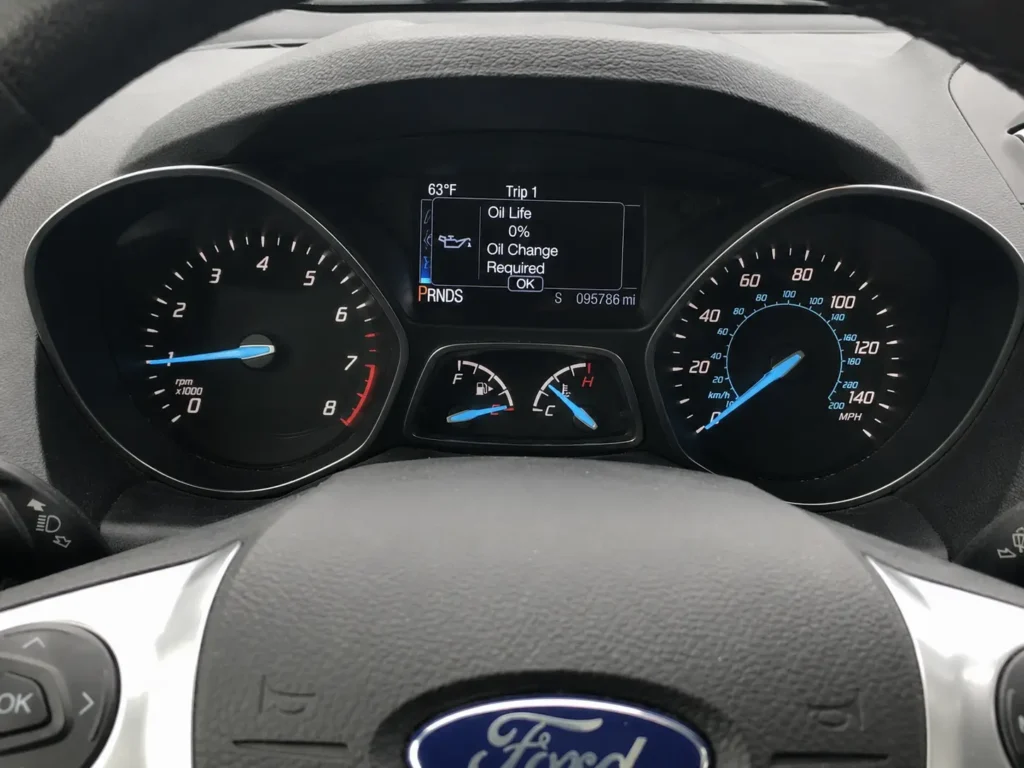
There are three ways to do it: the pedal override method (works on all trims), the steering wheel menu method (SE and Titanium), and the text-based console method (base S trim). All three are covered below, along with engine oil specs, filter details, and troubleshooting when the reset refuses to clear.

Prime for Young Adults — 6 Months Free
Students and 18–24s get six months of Prime free, then half price.
Start 6 Months Free As an Amazon Associate I earn from qualifying purchases.Quick Answer: With the engine OFF and ignition ON, press both the accelerator and brake pedals fully to the floor at the same time. Hold for 25–30 seconds until the display reads “Oil reset complete.” This works on every 2016 Escape trim level.
2016 Ford Escape Oil Reset — 3 methods, engine specs, and warning light guide
Recommended Best Deal Products


All Trim Levels
Intelligent Access Trims
SE & Titanium Only
How the 2016 Ford Escape Oil Life Monitor Actually Works
Older vehicles used a simple mileage countdown — change oil every 3,000 miles, no matter what. The 2016 Escape’s Intelligent Oil-Life Monitor works completely differently.
The Powertrain Control Module (PCM) continuously pulls data from multiple engine sensors: coolant temperature fluctuations, total engine idle hours, average RPMs, ambient operating temperatures, and driveline load. It feeds this data into a mathematical model that estimates the actual chemical state of your oil in real time.
A vehicle driven mostly on open highways in moderate weather may push oil life to 10,000 miles or 12 months. The same vehicle doing constant short city trips in sub-freezing winter temperatures will trigger the alert closer to 5,000 miles. The system reacts to your actual driving — not a fixed calendar.
The Two Alert Stages
“Change Engine Oil Soon” — This preliminary warning means the IOLM calculates approximately 5% oil life remaining. The base oil and additive packages are close to the end of their ability to suspend contaminants and neutralize acidic blow-by gases. Schedule the change immediately.
“Oil Change Required” — Oil life has reached 0%. The fluid and filter must be replaced right away. Continuing to drive at this stage accelerates wear on EcoBoost turbocharger bearings and the variable camshaft timing (VCT) phasers — components that are expensive to repair.
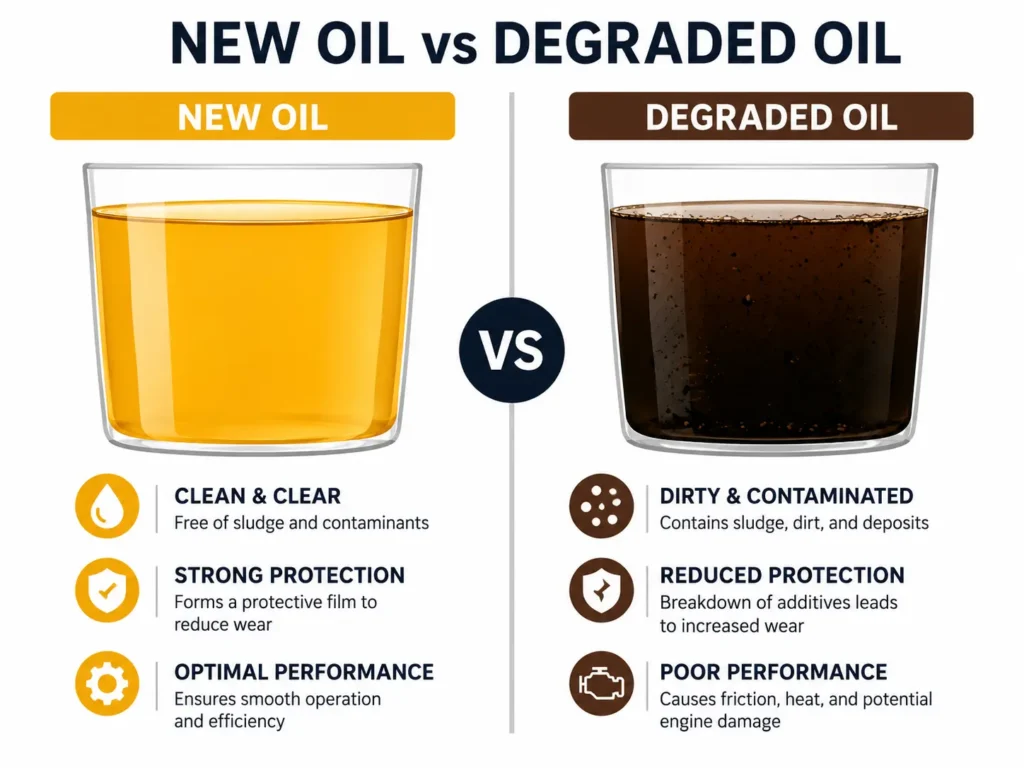
Resetting without physically changing the oil is dangerous. The PCM will restart its countdown assuming fresh oil with full friction modifiers, detergents, and stable base oils — when the actual fluid is already chemically exhausted. 👉 Related: Ford Check Engine Light — 7 Common Causes and What to Do
What the Oil-Life Monitor Is Actually Tracking
Recommended Best Deal Products


Understanding what the IOLM models helps you understand why skipping the reset — or skipping the oil change — causes real damage.
Oxidation and Thermal Breakdown
In the 1.6L and 2.0L EcoBoost engines, oil must lubricate turbocharger bearings that routinely exceed 400°F (204°C). At these temperatures, hydrocarbon molecules react with oxygen in the crankcase — a process called oxidation. The oil permanently thickens, generates insoluble sludge, and loses its ability to flow through tight oil galleries.

Audible — Listen Free for 30 Days
One free credit a month and thousands of titles included.
Listen Free for 30 Days As an Amazon Associate I earn from qualifying purchases.The PCM monitors coolant temperature sensors to estimate thermal stress on the oil and reduces the remaining oil life percentage faster during sustained high-heat operation.
Shear Stability and Viscosity Loss
Modern multi-grade oils like 5W-20 and 5W-30 use long-chain polymer additives called Viscosity Index (VI) improvers. These polymers expand in heat to prevent the oil from thinning too much at operating temperature. As oil is repeatedly forced through tight crankshaft journals and oil pump gears, these polymer chains are physically sheared apart and permanently destroyed.
Once the VI improvers degrade, the oil can no longer maintain the hydrodynamic wedge needed to separate metal surfaces. The PCM tracks engine RPM and load to estimate cumulative shearing damage over time.
Fuel Dilution and Acid Accumulation
During cold starts, unburned fuel and blow-by gases slip past piston rings into the crankcase. In EcoBoost direct-injection engines, fuel dilution is a particular concern — gasoline acts as a solvent, sharply reducing oil viscosity and destroying its film strength.
Blow-by gases also contain sulfur and nitrogen compounds that react with crankcase moisture to form sulfuric and nitric acids. The oil’s detergent package — primarily calcium and magnesium sulfonates — neutralizes these acids. Once the detergent package is depleted, metal surfaces corrode rapidly.
The IOLM monitors cold start frequency and idle time to estimate the rate of fuel dilution and acid accumulation — which is why short-trip city driving burns through oil life so much faster.
Method 1: Pedal Override Reset (All Trim Levels — Keyed Ignition)
This is the most universal method. It works on every 2016 Escape trim, bypasses the display menus entirely, and sends a direct hardware-level command to the PCM via the accelerator and brake pedal position sensors.
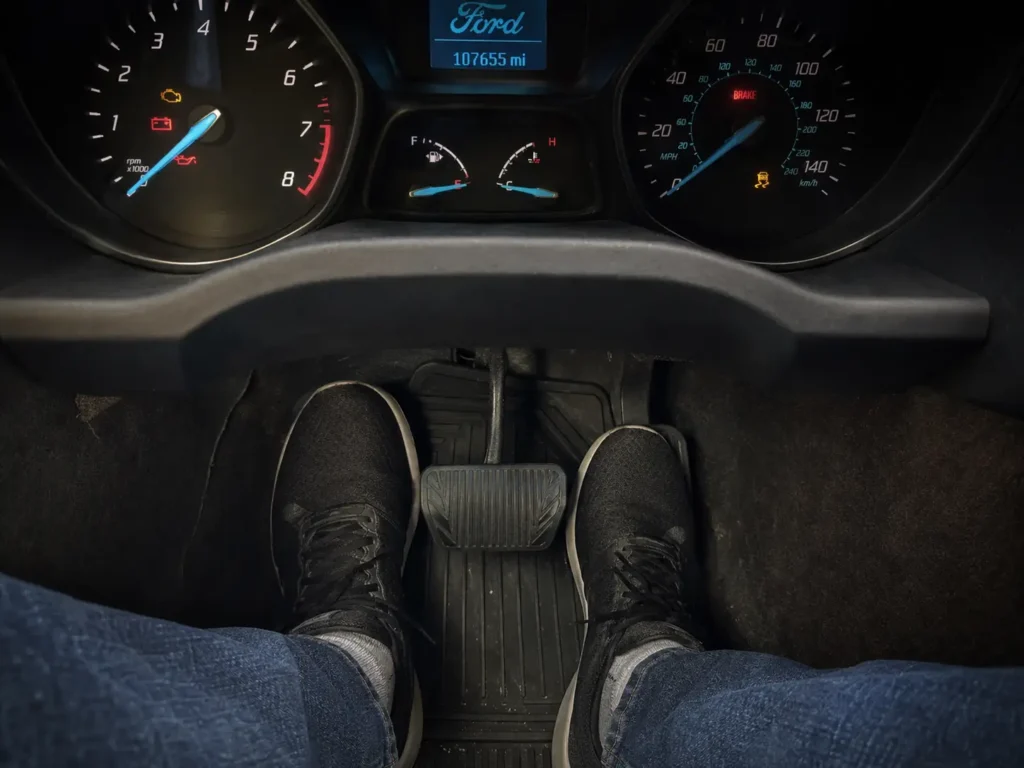
The 2016 Escape uses a drive-by-wire system — there is no physical throttle cable. Instead, an Accelerator Pedal Position (APP) sensor and a Brake Pedal Position (BPP) sensor send voltage signals to the PCM. When both sensors simultaneously signal 100% (full deflection) while the engine is off, the PCM triggers its oil life diagnostic reset routine and overwrites the NVRAM value.
Steps — Keyed Ignition
- Park safely on a level surface. Apply the parking brake. Shift into Park.
- Insert the key and rotate to the ON position (second detent). Do not crank the engine. The dashboard illuminates — engine stays off.
- Immediately depress both the accelerator pedal and brake pedal simultaneously, pushing both fully to the floor.
- After approximately 3 seconds, the instrument cluster displays: “Service: Oil reset in prog.”
- Hold both pedals firmly against the floor for 20–25 seconds without releasing. The PCM needs a continuous, unbroken signal to complete the write operation.
- The display shifts to: “Service: Oil reset complete.”
- Release both pedals. Turn the ignition key back to the OFF position. Done — the PCM now tracks from 100%.
Method 2: Pedal Override Reset (Push-Button / Intelligent Access Trims)
Recommended Best Deal Products


On Titanium and SE trims with the push-button Intelligent Access system, the first step changes slightly. If you press the Start button while touching the brake, the engine cranks — and the pedal method won’t work with the engine running. The key is activating accessory mode only.
Steps — Push-Button Start
- Park safely. Apply parking brake. Shift into Park.
- Press the Start/Stop button ONCE — without touching the brake pedal at all. The dashboard and infotainment system illuminate. Engine stays off. This is accessory mode.
- Wait for the startup chimes to finish.
- Now press both the accelerator pedal and brake pedal firmly to the floor simultaneously.
- The instrument cluster displays: “Service: Oil reset in prog.”
- Hold both pedals down for 20–30 seconds until the display reads: “Service: Oil reset complete.”
- Release both pedals. Press the Start/Stop button once more to power down. Reset is stored permanently.
👉 Related: Ford Intelligent Access System — How It Works and Common Issues
Audible Premium Plus — Annual Membership
12 audiobook credits up front, plus the full Audible catalogue.
See Annual Plans As an Amazon Associate I earn from qualifying purchases.Method 3: Steering Wheel Menu Reset (SE and Titanium Trims)
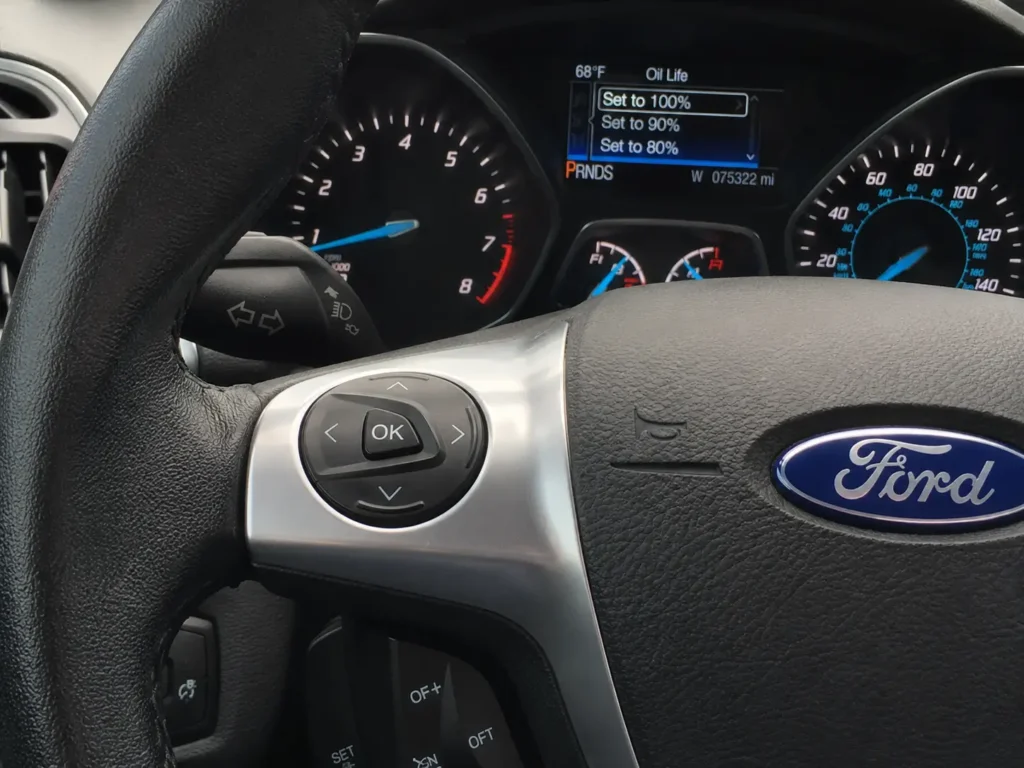
SE and Titanium trims with the advanced multi-information LCD cluster support a software-based reset through the directional pad on the steering wheel. This method communicates via the Body Control Module (BCM) across the CAN bus to the PCM — no pedal input required.
Steps — Steering Wheel Menu
- Turn ignition to ON (engine off) to illuminate the instrument cluster.
- Use the left arrow on the steering wheel directional pad to back out to the main root menu.
- Scroll down with the directional pad until “Settings” is highlighted. Press the right arrow or OK to enter.
- Select “Vehicle” from the Settings submenu.
- Scroll through Vehicle options until “Oil Life” or “Oil Life Reset” appears. Press the right arrow to select it.
- The screen shows the current oil life percentage. Press and hold the OK button in the center of the directional pad.
- A progress bar fills across the screen. Continue holding until the display reads “Reset Successful” or “Oil Life: 100%.”
Base S Trim / Text-Based Console
Base S trim models with a simpler text-based message center use dashboard-mounted Setup, Reset, and Info buttons instead of the steering wheel directional pad. Press Setup repeatedly until “Oil Reset” appears on the LCD line, then press and hold Reset for approximately two seconds until the display confirms 100%.
| Reset Method | Works On | Primary Input | Hold Time |
|---|---|---|---|
| Pedal Override | All trim levels | Both pedals fully to floor simultaneously | 25–30 seconds |
| Steering Wheel Menu | SE & Titanium trims | Directional pad → Settings → Vehicle → Oil Life → hold OK | Until progress bar completes |
| Dashboard Console | Base S trim / Fleet | Setup button → “Oil Reset” → hold Reset button | ~2 seconds |
Engine Oil Capacity and Viscosity — All Three 2016 Escape Engines
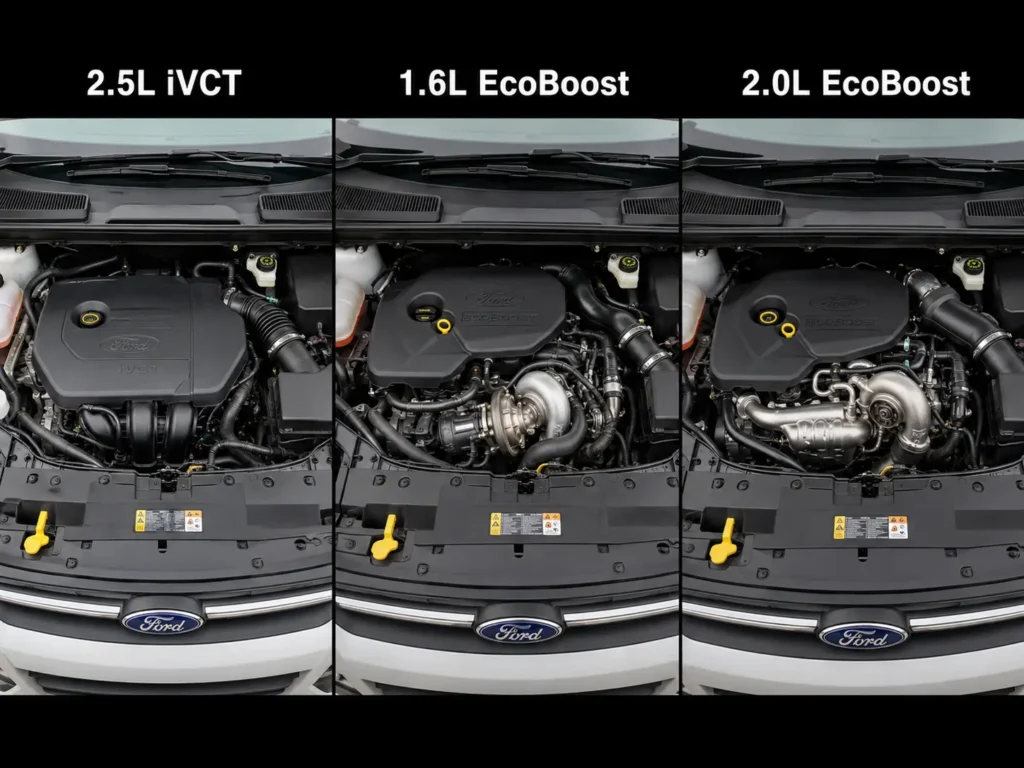
Resetting the monitor without using the correct oil type and volume is pointless — and potentially destructive. The 2016 Escape came with three different engines, each requiring different fluid volumes and viscosity grades. Do not mix these up.
| Engine | Type | Oil Capacity (with filter) | Viscosity Grade | Ford Standard |
|---|---|---|---|---|
| 2.5L iVCT I-4 | Naturally Aspirated | 5.7 Quarts (5.4L) | SAE 5W-20 | WSS-M2C945-A |
| 1.6L EcoBoost I-4 | Turbocharged Direct Injection | 4.3 Quarts (4.1L) | SAE 5W-20 | WSS-M2C945-A |
| 2.0L EcoBoost I-4 | Turbocharged Direct Injection | 5.7 Quarts (5.4L) | SAE 5W-30 | WSS-M2C946-A |
Overfilling is as dangerous as underfilling. An overfull crankcase causes the crankshaft counterweights to whip air into the oil, creating foam that the pump cannot pressurize. This leads to sudden drops in oil pressure and immediate bearing failure. Always verify with the dipstick after filling.
2.5L Duratec iVCT — Naturally Aspirated Base Engine
The 2.5L is the most straightforward of the three. No turbocharger means significantly lower thermal stress on the oil. Capacity is 5.7 quarts of SAE 5W-20 meeting WSS-M2C945-A.
The 5W-20 viscosity minimizes pumping losses, reducing drag on the gerotor oil pump and improving fuel economy. However, this engine still uses an independent Variable Camshaft Timing (iVCT) system that relies on clean, adequately pressurized oil to actuate the camshaft phasers. Sludge buildup from delayed changes clogs the VCT solenoids and triggers rough idle and check engine lights.
1.6L EcoBoost — The Smallest, Highest-Stress Engine
Despite its small 1.6-liter displacement, the EcoBoost turbocharger spins at over 150,000 RPM, generating immense localized heat. The oil sump holds only 4.3 quarts — the smallest capacity of the three engines — which means a smaller thermal buffer and a steeper oil degradation curve.
The 1.6L is also uniquely susceptible to Low-Speed Pre-Ignition (LSPI) — an anomalous combustion event where microscopic oil and fuel droplets prematurely detonate before the spark plug fires. LSPI can destroy pistons and connecting rods in a single event. Using an API SP or ILSAC GF-6 rated full synthetic oil is critical for this engine, as these formulations contain specific calcium/magnesium detergent ratios engineered to suppress LSPI. The smaller sump makes strict adherence to the reset schedule especially important.
2.0L EcoBoost — The High-Output Premium Engine
Generating 240 horsepower and 270 lb-ft of torque, the 2.0L EcoBoost runs under substantially higher thermal and mechanical stress than the 1.6L. Ford responded by specifying a thicker SAE 5W-30 viscosity — the only engine in the 2016 Escape lineup that requires 5W-30.
The higher “30” weight designation provides a thicker hydrodynamic oil wedge between crankshaft journals and bearings under heavy boost pressure, offering superior shear stability during peak torque delivery. It shares the 5.7-quart capacity with the 2.5L. Using 5W-20 in this engine risks insufficient film thickness under load. 👉 Related: How Long Do EcoBoost Turbos Last — and How Oil Maintenance Affects It
The Motorcraft FL-910S Filter — Why the OEM Spec Matters
All three 2016 Escape engines use the Motorcraft FL-910S (Part No. BE8Z6731AB) as the OEM-specified oil filter. This is not a branding decision — it reflects specific hydraulic engineering requirements that economy aftermarket filters fail to meet.
Silicone Anti-Drain Back Valve
When you shut off the engine, the oil pump stops. Gravity attempts to drain oil back out of the upper cylinder head, VCT components, and timing chain galleys, down into the pan. The anti-drain back valve traps a column of oil in the upper engine — providing immediate lubrication during the next cold start, before the pump builds pressure.
The FL-910S uses a high-temperature silicone valve (orange). Economy filters typically use cheaper nitrile rubber (black) valves that harden, crack, and fail under EcoBoost heat levels. A failed valve causes destructive dry starts, timing chain rattle, and premature turbocharger bearing wear — all within seconds of ignition.
Bypass Relief Valve Calibration and Position
Every oil filter contains a bypass relief valve — a spring-loaded failsafe that opens if the filter media clogs with sludge or if oil is too cold and viscous to flow through the paper. The FL-910S bypass valve is calibrated precisely to an 8–11 PSI differential. An improperly calibrated valve either starves the engine by staying closed too long, or constantly bypasses dirty oil back into the engine.
Critically, the FL-910S positions its bypass valve at the threaded base end of the filter — not the dome. When the valve opens during a cold start, the bypassing oil does not wash across the dirty filter media, preventing trapped carbon and metal particles from flushing directly back into the engine block. Most economy filters position the valve at the dome, which creates exactly this contamination risk.
| Feature | Motorcraft FL-910S (OEM) | Typical Economy Filter |
|---|---|---|
| Anti-Drain Back Valve Material | High-heat silicone (orange) | Standard nitrile rubber (black) |
| Bypass Valve Location | Threaded base end | Dome end |
| Bypass Opening Pressure | 8–11 PSI differential | Variable / uncalibrated |
| Filter Media | Cellulose/polyester blend | Basic pleated paper |
Wrench Light vs. Oil Change Light — A Critical Difference
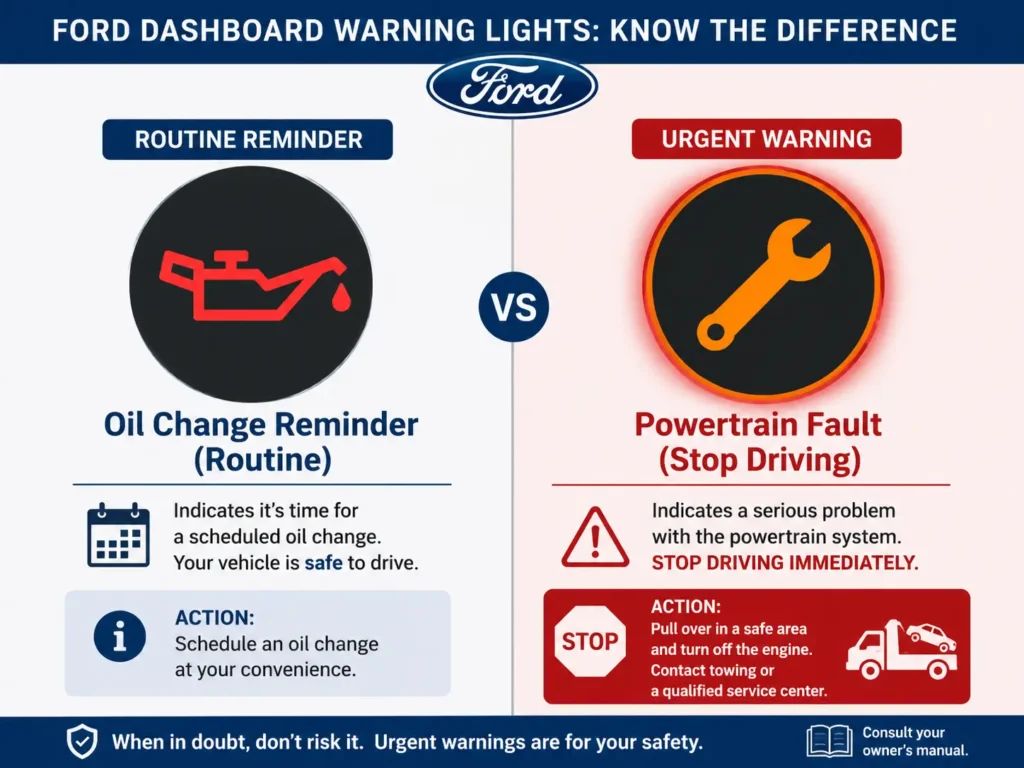
This is one of the most dangerous points of confusion on the 2016 Escape. A yellow or orange wrench icon appearing on the dashboard is not an oil change reminder. Many owners ignore it assuming it’s a routine service prompt. It is not.
The wrench symbol is the Powertrain Malfunction / Reduced Power light. When it illuminates, the PCM has detected a critical electronic or mechanical fault threatening the transmission, electronic throttle body, or all-wheel-drive Power Transfer Unit (PTU). The computer immediately puts the vehicle into Limp Mode to prevent catastrophic damage.
What Limp Mode Does to Your 2016 Escape
RPM governing: The PCM restricts fuel injector pulse widths and throttle plate opening, preventing the engine from exceeding approximately 3,000 RPM regardless of how far you press the accelerator.
Speed restriction: Maximum vehicle speed is electronically capped, typically between 35–40 mph, allowing you to safely exit the highway and reach a service center.
Transmission restriction: Automatic shifting is heavily limited, often locking the vehicle into second or third gear to prevent further drivetrain heat and shock loading.
AC shutoff: The air conditioning compressor clutch may be disabled entirely to reduce parasitic engine load and lower under-hood temperatures.
No pedal pressing or steering wheel menu navigation will clear the wrench light. The vehicle needs an OBD-II scanner with Ford-specific CAN bus software — FORScan or the dealer-level Ford IDS tool — to extract the proprietary fault codes. Common wrench light triggers on the 2016 Escape include Electronic Throttle Body (ETB) failures, transmission range sensor faults, and communication loss with the AWD control module. 👉 Related: Ford Adaptive Learning Transmission Reset — Complete Guide
Troubleshooting: Oil Reset Won’t Clear
If you follow the reset procedure correctly and the “Oil Change Required” alert still reappears on the next startup, one of the following is the cause.
Engine Was Running During the Pedal Reset
This is the most common failure. If the engine is running when you press both pedals, the PCM reads it as conflicting driving inputs — not a diagnostic command. The reset logic gate never opens. The procedure absolutely requires ignition ON, engine OFF throughout.
Pedals Released Too Early
The PCM requires a sustained, unbroken analog voltage signal from both the APP and BPP sensors. Releasing the pedals the moment “Reset in prog” appears aborts the sequence immediately. Hold both pedals firmly for the full 25–30 seconds until the “Reset complete” message is fully displayed on screen.
Floor Mats Blocking Full Pedal Travel
Heavy rubber floor mats or debris wedged beneath the accelerator pedal can physically prevent the drive-by-wire sensor from reaching its 100% Wide-Open Throttle (WOT) voltage threshold. The system requires both pedals to be fully bottomed out. Check that nothing is under the accelerator before attempting the reset.
CAN Bus Communication Lag or ICM Glitch
In rare cases, a communication lag across the Controller Area Network or a glitch within the Instrument Cluster Module (ICM) prevents the reset from completing even when the physical procedure is executed perfectly. This requires a bi-directional OBD-II diagnostic scan tool connected to the vehicle’s data link connector under the dashboard. The technician accesses the service functions menu and manually commands the BCM and PCM to force an oil life reset to 100%, bypassing the physical sensor inputs entirely.
👉 Related: FORScan Setup Guide for Ford Owners — Beginner to Advanced
Normal vs. Severe Duty — How Driving Style Affects Your Reset Interval
The IOLM calculates your next service interval based on your actual driving pattern. Full synthetic oil under perfect highway conditions can push intervals toward 10,000 miles. The following factors classify your Escape as “Severe Duty” and will trigger the alert much sooner — often between 3,000 and 5,000 miles.
- Constant short trips under 5 miles, especially in sub-freezing weather. The engine never reaches the 212°F (100°C) needed to boil off accumulated water condensation and fuel blow-by from the oil.
- Extensive idling in heavy urban traffic or fleet use — accumulates engine hours without accruing meaningful mileage.
- Towing utility trailers or heavy car-top carriers — places maximum load on transmission and engine components.
- Heavily dusty or unpaved environments — increases particulate contamination entering the crankcase through the PCV system.
For both EcoBoost variants specifically, most experienced technicians recommend a strict 5,000-mile full synthetic interval regardless of what the IOLM displays. The intense, localized heat around the turbocharger bearings and the VCT solenoids makes early oil changes the most cost-effective form of insurance against a $2,000+ turbocharger replacement.
Oil Additives Warning — Do Not Use Supplemental Additives
The 2016 Ford Escape owner’s manual explicitly prohibits aftermarket supplemental engine oil additives, friction modifiers, and heavy oil thickeners. This is not a suggestion — it is an engineering mandate with warranty implications.
Modern API SP and ILSAC GF-6 synthetic oils are already blended with a precisely calibrated cocktail of anti-wear agents (ZDDP), advanced detergents, and dispersants. Introducing an over-the-counter additive disrupts this chemical balance. In EcoBoost engines, aftermarket thickeners can restrict oil flow through the microscopic screens feeding the VCT phasers, leading to timing chain stretch, failure, and P0011 or P0012 camshaft over-retarded trouble codes.
Ford’s position is explicit: internal engine damage caused by unapproved fluid additives voids the powertrain warranty.
People Also Ask
Will disconnecting the 12V battery reset the oil life monitor?
No. The oil life percentage is stored in the Non-Volatile RAM (NVRAM) of the Powertrain Control Module — a memory sector that retains data with no battery power, similar to how a BIOS chip retains settings on a computer motherboard.
Disconnecting the battery will reset radio presets, clear the adaptive transmission learning tables, and zero out emissions readiness monitors — but the IOLM counter remains completely intact. The active reset procedures are the only way to overwrite it.
What happens if I keep driving with the “Oil Change Required” alert active?
The Escape will not force itself into limp mode solely due to the oil life reaching zero. But continuing to drive accelerates a chain of failures. As the additive package depletes, the oil loses its ability to suspend carbon soot — which agglomerates into thick sludge that can block the oil pickup tube screen in the pan, completely starving the engine of hydraulic pressure.
Beyond mechanical risk, ignoring the reset desynchronizes the vehicle’s entire maintenance history, which significantly impacts resale value and can complicate warranty claims.
Why does the 1.6L EcoBoost hold less oil than the 2.0L EcoBoost?
Despite both being four-cylinder turbo direct-injection engines, they come from entirely different engine families. The 1.6L belongs to the Ford Sigma engine family — a lighter, more compact aluminum block architecture with a smaller oil pan geometry, yielding the 4.3-quart maximum. The 2.0L EcoBoost derives from the larger Mazda L-engine architecture, featuring a substantially deeper sump and greater internal oil gallery volume, requiring 5.7 quarts for adequate thermal stability under high horsepower loads.
Is it safe to switch from synthetic blend to full synthetic during the next oil change?
Absolutely — and it is strongly recommended, particularly for the EcoBoost variants. Full synthetic provides a far more uniform molecular structure, offering enhanced resistance to high-temperature volatility (burn-off), superior cold-weather pumpability, and meaningfully better shear stability under turbo boost pressure.
No special engine flush is required. Drain the old fluid, refill with the correct full synthetic viscosity grade for your engine (5W-20 or 5W-30), install a fresh Motorcraft FL-910S filter, and execute the dashboard reset. The transition is immediate and clean.
Final Thoughts
The 2016 Ford Escape oil reset is a straightforward procedure — but understanding what sits behind it makes you a better owner. The pedal override works on every single trim without any tools. The steering wheel menu works on SE and Titanium trims if you prefer navigating the display. Either way, the PCM restarts its algorithm from 100% and your maintenance tracking is accurate again.
The reset only means something if the physical oil change was done correctly — with the right viscosity for your specific engine (5W-20 for the 2.5L and 1.6L, 5W-30 for the 2.0L), the right volume, and a genuine Motorcraft FL-910S filter. Get those three right, reset the monitor, and the Intelligent Oil-Life Monitor does the rest.
Drop your engine variant and trim in the comments if you need help confirming which method or oil spec applies to your specific Escape.
👉 Related: How to Change Battery in Ford Key Fob — Complete Guide
👉 Related: Ford Check Engine Light — 7 Common Causes
👉 Related: Ford Adaptive Learning Transmission Reset
Looking for another year? See the full How To Reset Ford Escape Oil Light (All Generations 2001–2026).
Other Ford models: Ford Oil Life Monitor Reset Guide (All Models & Years)