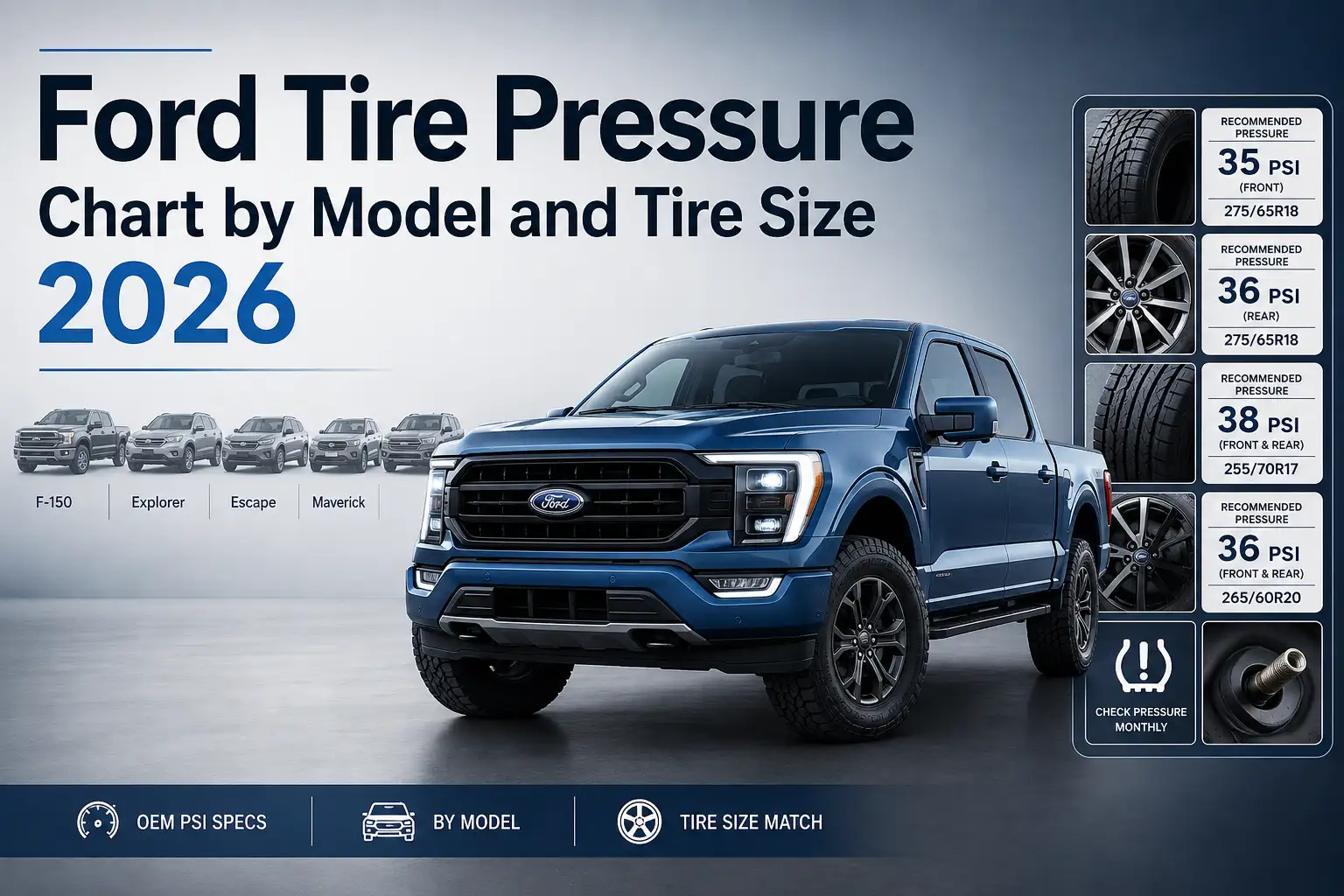
Ford Tire Pressure Chart by Model and Tire Size 2026

The Ford tire pressure chart by model below helps you find the recommended cold PSI for popular Ford trucks, SUVs, cars, and EVs. There is no single pressure that works for every Ford because tire size, trim, payload package, and model year can change the specification.
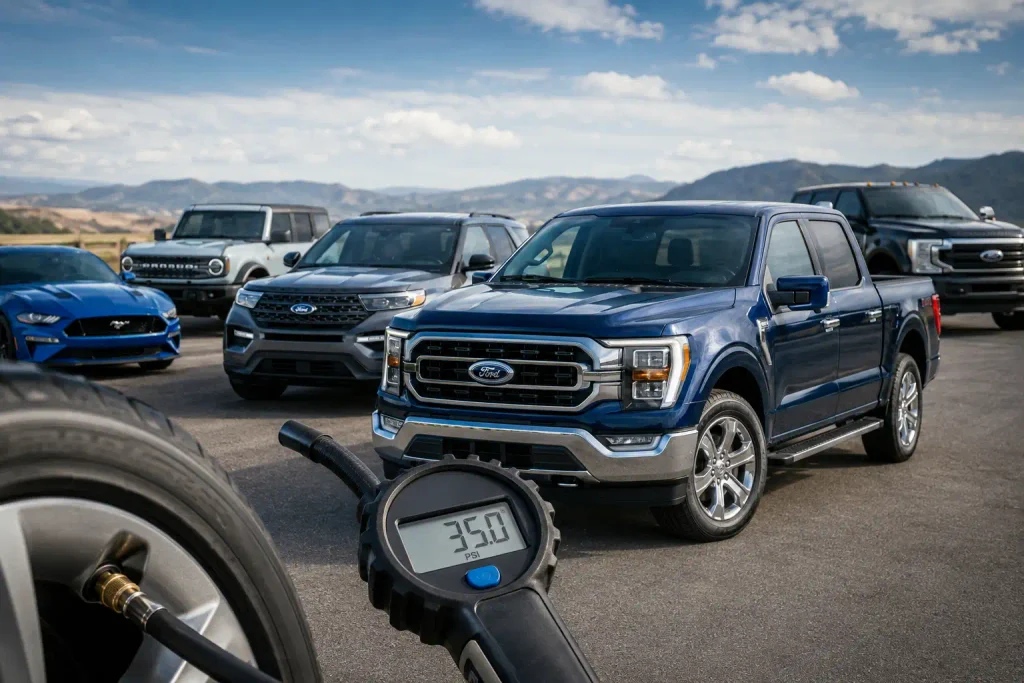
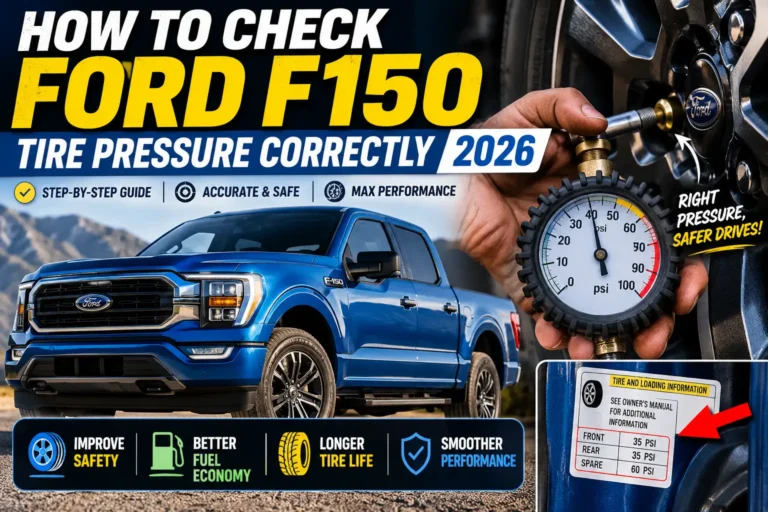
Use these figures as a quick lookup, then confirm the exact number on the Tire and Loading Information label on your driver’s-side door frame. Ford says that label provides the recommended PSI for your specific configuration and recommends checking pressure when the tires are cold, ideally after the vehicle has been parked for at least three hours.

Prime for Young Adults — 6 Months Free
Students and 18–24s get six months of Prime free, then half price.
Start 6 Months Free As an Amazon Associate I earn from qualifying purchases.FordMasterX Quick Reference
Ford Tire Pressure By Model
Recommended Best Deal Products

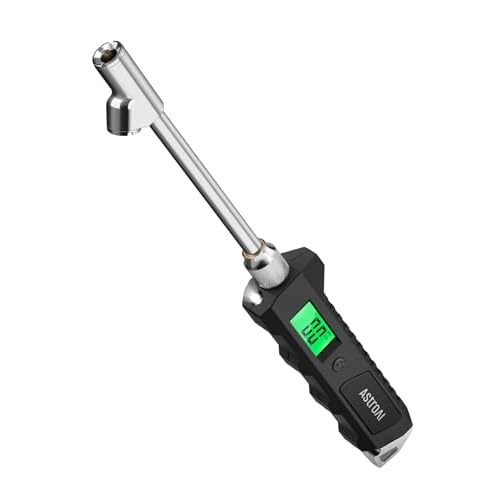

Use these common recent factory cold PSI values as a quick guide, then confirm the exact front and rear pressure on your Ford’s driver-side Tire and Loading Information label.
Quick PSI Guide for Popular Ford Models
F-150
Most standard 2025 factory setups with P-metric tires.
35 PSI / 35 PSIF-150 Lightning
Common 275/60R20 factory EV configuration.
42 PSI / 42 PSIF-250 Super Duty
Common LT275/70R18 factory setup.
60 PSI / 65 PSIF-350 Super Duty
Common SRW LT275/70R18 configuration.
60 PSI / 80 PSIRanger
Typical recent factory setup with 255/70R17 tires.
35 PSI / 35 PSIMaverick
Common 225/65R17 configuration.
35 PSI / 35 PSIBronco
Typical non-Raptor factory setup.

Audible — Listen Free for 30 Days
One free credit a month and thousands of titles included.
Listen Free for 30 Days As an Amazon Associate I earn from qualifying purchases.Bronco Sport
Common 225/65R17 factory setup.
33 PSI / 33 PSIExplorer
Typical recent 255/65R18 configuration.
33 PSI / 33 PSIExpedition
Common 275/60R20 factory setup.
36 PSI / 36 PSIEscape
Common 225/65R17 factory setup.
33 PSI / 33 PSIEdge
Most recent factory packages use equal pressure.
35 PSI / 35 PSIMustang
Typical 235/50R18 road configuration.
32 PSI / 32 PSIMustang Mach-E
Common 225/55R19 electric setup.
39 PSI / 39 PSIHow To Verify The Exact PSI On Your Ford
Check Tires Cold
Let the truck or SUV sit before checking pressure. Cold readings are the correct reference.
Open The Driver Door
Look for the Tire and Loading Information label on the door jamb or door frame.
Match Tire Size
Make sure the tire size on the placard matches the tires installed on your Ford.
Audible Premium Plus — Annual Membership
12 audiobook credits up front, plus the full Audible catalogue.
See Annual Plans As an Amazon Associate I earn from qualifying purchases.Set Front And Rear PSI
Inflate each axle to the placard value. Super Duty trucks often use different front and rear pressure.
3 Rules For Using A Ford Tire Pressure Chart
Match Model And Tire Size
A standard F-150, Lightning, and Heavy Duty Payload F-150 can all use different pressure values.
Keep Front And Rear Separate
Do not assume all four tires take the same PSI. F-250 and F-350 trucks often require higher rear pressure.
Use The Door Placard First
If the chart and the placard do not match, use the placard for your exact truck, SUV, or car.
Ford Tire Pressure Chart for 15 Popular Models
The chart below uses common recent US-spec factory configurations. Where one model has several valid pressures, the range reflects different original tire or equipment packages, not an adjustable pressure range for one truck.
| Ford Model | Reference Year | Common OE Tire Example | Front Cold PSI | Rear Cold PSI |
|---|---|---|---|---|
| F-150 | 2025 | 265/70R17, 275/65R18, 275/60R20 | 35 | 35 |
| F-150 Heavy Duty Payload | 2025 | LT245/70R17 or LT275/65R18 | 40 | 40 |
| F-150 Lightning | 2025 | 275/60R20 | 42 | 42 |
| F-250 Super Duty | 2025 | LT275/70R18 | 60 | 65 |
| F-350 Super Duty SRW | 2025 | LT275/70R18 | 60 | 80 |
| Ranger | 2025 | 255/70R17 | 35 | 35 |
| Maverick | 2025 | 225/65R17 | 35 | 35 |
| Bronco | 2025 | 255/70R16 | 35 | 35 |
| Bronco Sport | 2025 | 225/65R17 | 33 | 33 |
| Explorer | 2025 | 255/65R18 | 33 | 33 |
| Expedition Active | 2025 | 275/60R20 | 36 | 36 |
| Escape | 2025 | 225/65R17 | 33 | 33 |
| Edge | 2024 | 245/60R18 V | 35 | 35 |
| Mustang | 2025 | 235/50R18 | 32 | 32 |
| Mustang Mach-E | 2025 | 225/55R19 | 39 | 39 |
Important: The table does not mean every trim of each model uses that PSI. For example, a 2025 F-150 Raptor, F-150 Heavy Duty Payload Package, and standard F-150 can have different requirements. Always match the tire size and configuration to the door placard.
Ford Truck Tire Pressure by Model and Size
Recommended Best Deal Products
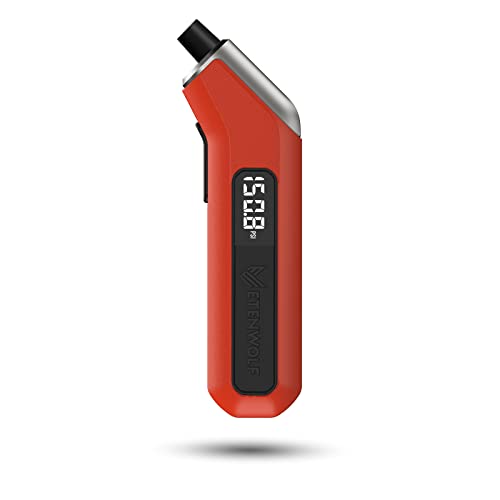


Ford pickup tire pressure varies more than many SUV and passenger-car applications. Standard P-metric tires, LT tires, off-road packages, EV weight, and payload equipment all affect the number Ford specifies.
Ford F150 Tire Pressure
Most common 2025 F-150 P-metric factory packages cluster around 35 PSI front and rear. The Heavy Duty Payload Package can use 40 PSI with LT tires, while Raptor applications can use a higher setting.
| 2025 F-150 Tire Size or Package | Front PSI | Rear PSI |
|---|---|---|
| 265/70R17 | 35 | 35 |
| 275/65R18 | 35 | 35 |
| 275/55R20 | 35 | 35 |
| 275/50R22 | 35 | 35 |
| LT245/70R17 Heavy Duty Payload | 40 | 40 |
| LT275/65R18 Heavy Duty Payload | 40 | 40 |
| LT315/70R17 Raptor | 38 | 38 |
| 37×12.50R17 Raptor | 38 | 38 |
Wheel changes can also affect which tire package fits your truck. Our Ford F-150 bolt pattern chart is useful before changing factory wheels.
If you plan to move to a larger tire, check both load capacity and wheel clearance rather than copying the pressure used with the original size. Our guide to the biggest tires on stock F-150 20-inch rims covers that fitment question separately.
Ford Lightning Tire Pressure
The F-150 Lightning generally needs more pressure than a conventional F-150 because its tire packages are designed around the heavier battery-electric truck.
For 2025, published OE configuration data shows 42 PSI front and rear with 275/60R20 tires and 275/50R22 tires. A 275/65R18 configuration is listed at 36 PSI front and rear.
| 2025 Lightning Tire Size | Front PSI | Rear PSI |
|---|---|---|
| 275/65R18 | 36 | 36 |
| 275/60R20 | 42 | 42 |
| 275/50R22 | 42 | 42 |
Ford Ranger Tire Pressure
A 2025 Ranger does not have one universal PSI across every tire package.
A US-spec 2025 Ranger SuperCrew 4×2 XL tested by NHTSA carried a placard specifying 240 kPa, or about 35 PSI, front and rear with 255/70R17 tires.
Other Ranger configurations can differ, particularly larger wheels and Raptor tires. Ford’s Ranger documentation repeatedly directs owners back to the driver-side tire label for the applicable size and pressure.
Ford Maverick Tire Pressure
For common 2025 Maverick configurations, 225/65R17 and 235/65R17 tires are listed at 35 PSI front and rear. The 225/55R19 package is listed at 36 PSI front and rear.
That makes tire size worth checking even when two Mavericks look nearly identical from outside.
Ford Super Duty Tire Pressure by Configuration
Super Duty tire pressure needs more attention than a standard F-150 because F-250 and F-350 trucks commonly use LT tires with much higher load ratings.
The rear axle can also require substantially more pressure than the front. Do not assume that all four tires should match.
Ford F250 Tire Pressure
Common 2025 F-250 configurations include:
| Tire and Configuration | Front PSI | Rear PSI |
|---|---|---|
| LT275/70R18 | 60 | 65 |
| LT275/65R20 | 60 | 65 |
| LT275/65R18 | 60 | 75 |
| LT245/75R17 XL configuration | 65 to 70* | 80 |
| LT265/70R17 XL configuration | 60 to 65* | 80 |
| LT275/65R18 with Snow Plow Package | 70 | 75 |
*The exact front value depends on configuration, so use the placard rather than selecting a number within the listed range yourself.
Before replacing Super Duty tires, our existing Ford F-250 tire size chart can help identify the factory size for your truck.
Ford F350 Tire Pressure
Single-rear-wheel 2025 F-350 configurations commonly use 60 PSI front and 80 PSI rear with LT275/65R18, LT275/65R20, or LT275/70R18 tires.
Snow Plow Package trucks can call for 70 PSI at the front, while dual-rear-wheel configurations differ again.
| F-350 Configuration | Front PSI | Rear PSI |
|---|---|---|
| SRW LT275/65R18 | 60 | 80 |
| SRW LT275/65R20 | 60 | 80 |
| SRW LT275/70R18 | 60 | 80 |
| Snow Plow LT275/65R18 | 70 | 80 |
| DRW LT245/75R17 | 65 to 70* | 65 to 70* |
Super Duty owners should treat the door placard as the controlling specification because GVWR, axle configuration, snow-plow equipment, and tire package can all change pressure.
Ford F450 Tire Pressure
F-450 tire pressure should be taken directly from the truck’s certification and tire label rather than copied from an F-250 or F-350 table.
F-450 configurations vary by cab, wheel, rear-axle setup, GVWR, and commercial equipment. Ford identifies the driver-side certification label as the source for the installed tire size and recommended inflation pressure.
Ford SUV Tire Pressure for 6 Popular Models
Recommended Best Deal Products


Ford SUV pressures are usually lower than Super Duty figures, but tire package differences still matter.
| Ford SUV | Recent OE Tire Example | Front PSI | Rear PSI |
|---|---|---|---|
| Explorer 2025 | 255/65R18 | 33 | 33 |
| Explorer 2025 | 255/55R20 | 33 | 33 |
| Expedition Active 2025 | 275/60R20 | 36 | 36 |
| Bronco 2025 | 255/70R16 | 35 | 35 |
| Bronco 2025 | LT285/70R17 | 39 | 39 |
| Bronco Sport 2025 | 225/65R17 | 33 | 33 |
| Escape 2025 | 225/65R17 | 33 | 33 |
| Escape 2025 | 225/60R18 | 35 | 35 |
| Edge 2024 | 245/60R18 V | 35 | 35 |
Ford Explorer Tire Pressure
Current 2025 Explorer configurations commonly use 33 PSI front and rear with 255/65R18, 255/55R20, and 275/45R21 factory packages.
Do not apply that number automatically to older Explorers. Previous generations used different tire sizes and some configurations are listed at 35 PSI.
Ford Expedition Tire Pressure
An NHTSA test record for a 2025 Ford Expedition Active 4×2 documented a factory tire placard specifying 36 PSI front and 36 PSI rear with 275/60R20 tires.
Larger wheels, MAX configurations, and other trims should still be checked against the individual placard.
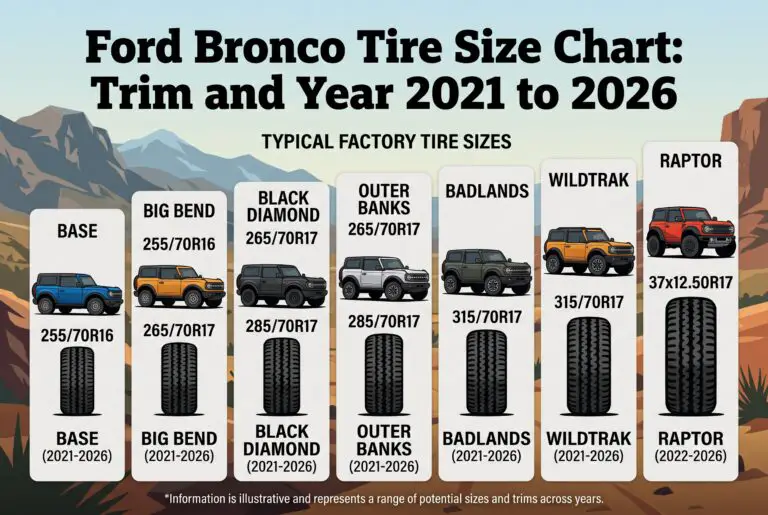
Ford Bronco Tire Pressure
The 2025 Bronco ranges from standard road-oriented tires to 37-inch Raptor tires.
Published OE data lists 255/70R16, 255/70R18, and 255/75R17 packages at 35 PSI. LT265/70R17, LT285/70R17, and LT315/70R17 configurations are listed at 39 PSI, while the 37×12.50R17 Raptor package is listed at 38 PSI.
Ford Bronco Sport Tire Pressure
The 2025 Bronco Sport uses a simpler pattern. Common 225/60R18, 225/65R17, and 235/65R17 factory packages are listed at 33 PSI front and rear.
Ford Escape Tire Pressure
The 2025 Escape varies by factory tire package.
- 225/65R17: 33 PSI
- 225/60R18: 35 PSI
- 225/55R19: 33 PSI
All values are front and rear for the listed configurations.
Ford Edge Tire Pressure
The Ford Edge ended its US production run after the 2024 model year, so 2024 is the relevant recent reference.
Most 2024 Edge packages with 245/60R18, 245/55R19, 245/50R20, and 265/40R21 tires use 35 PSI front and rear. Some 245/60R18 H-rated applications are listed at 38 PSI.
For broader wheel compatibility information across Ford models, see our Ford bolt pattern chart.
Ford Mustang and MachE Tire Pressure by Size
Mustang and Mustang Mach-E share a badge, but their tire pressure requirements are very different.
Ford Mustang Tire Pressure
Most 2025 Mustang road configurations use 32 PSI front and rear.
| 2025 Mustang Tire Package | Front PSI | Rear PSI |
|---|---|---|
| 235/50R18 | 32 | 32 |
| 255/40R19 | 32 | 32 |
| 255/45R18 | 32 | 32 |
| 255/40R19 front and 275/40R19 rear | 32 | 32 |
| 265/35R20 | 36 | 36 |
| 305/30R19 front and 315/30R19 rear | 33 | 33 |
These variations are another reason to identify the actual tire package instead of assuming every Mustang takes the same PSI.
Mustang MachE Tire Pressure
The heavier electric Mach-E generally uses higher pressure than the gasoline Mustang.
For 2025:
| Mach-E Tire Size | Front PSI | Rear PSI |
|---|---|---|
| 225/55R19 | 39 | 39 |
| 235/55R19 Rally | 38 | 38 |
| 245/45R20 GT | 39 | 39 |
The 2021 through 2025 Mach-E range is commonly listed between 38 and 39 PSI, depending on the original tire package.
How to Verify Your Ford Tire Pressure
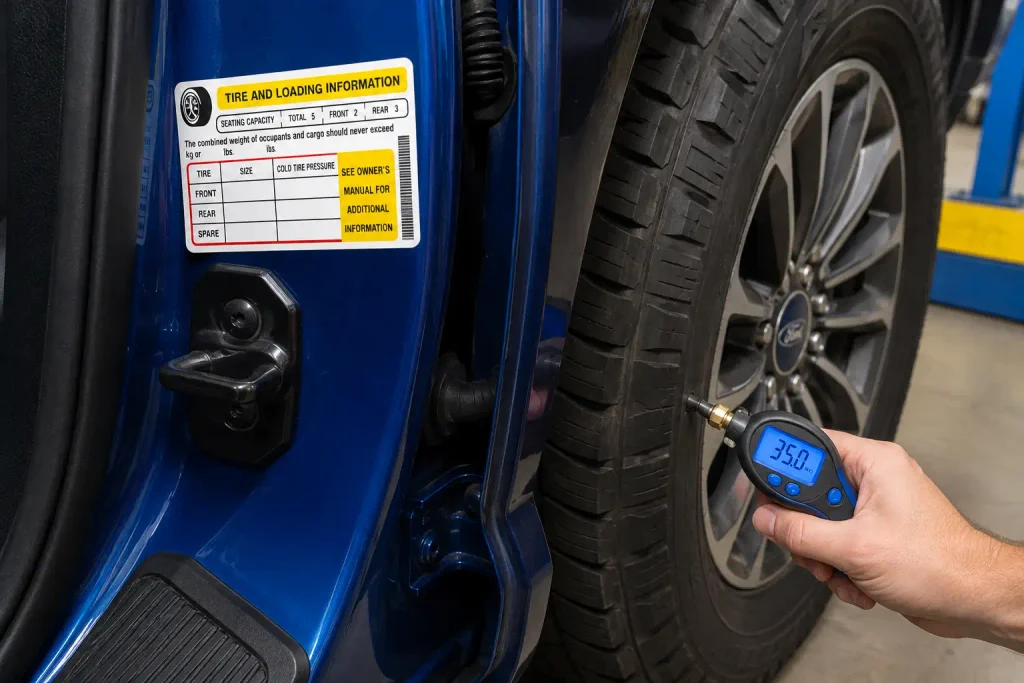
Your Ford’s door label is the final authority for normal cold tire pressure. Ford’s own support documentation says the driver-side door frame or door-jamb label provides the recommended inflation pressure.
Use this six-step check:
- Park the Ford long enough for the tires to cool. Ford recommends checking after the vehicle has not been driven for at least three hours when possible.
- Open the driver’s door.
- Locate the Tire and Loading Information or certification label.
- Confirm the tire size shown on the label matches your installed factory-size tire.
- Read the front and rear cold PSI separately.
- Set each tire to the placard value with an accurate gauge.
NHTSA also defines the manufacturer’s recommended pressure as a cold pressure and notes that front and rear tires may legitimately require different amounts.
Door Placard PSI Versus Tire Sidewall PSI
The maximum pressure molded into a tire sidewall is not automatically the pressure you should use for daily driving.
| Driver Door Placard | Tire Sidewall |
|---|---|
| Specified by Ford for the truck or SUV | Specified by the tire manufacturer |
| Gives recommended cold operating PSI | Shows tire limits and load information |
| Accounts for Ford’s axle load and configuration | Applies to the tire itself |
| May specify different front and rear PSI | Does not override the Ford placard |
Ford explains that the operating pressure on the certification or tire decal is normally lower than the maximum inflation pressure molded into the tire.
Ford’s owner-manual tire information also states that maximum inflation pressure on the sidewall is normally higher than the manufacturer’s recommended cold pressure on the vehicle label.
If you install a different tire size, load index, or type, do not simply reuse a sidewall maximum or copy another owner’s setup. The load requirements of the specific Ford still have to be satisfied.
How Ford TPMS Works With Correct Tire PSI
Ford’s Tire Pressure Monitoring System warns you when it detects significant underinflation, but the warning threshold is not your target inflation pressure.
When the warning light comes on, Ford tells owners to check the tires and inflate them to the Ford recommended tire pressure.
TPMS also does not replace an actual pressure gauge. Ford recommends checking tire pressure manually on a regular basis even when no warning is showing. On compatible Ford models equipped with a modem, pressure information may also be available through the FordPass app.
A TPMS light that returns after inflation can indicate that one or more tires are still below the required pressure, a tire is losing air, or the monitoring system needs inspection.
3 Rules for Using Ford Tire Pressure Charts
The safest way to use a Ford tire pressure chart by model is to apply three simple rules.
- Match the exact model and tire size. A standard F-150 and Heavy Duty Payload F-150 can require different PSI even within the same model year.
- Use cold pressure and keep front and rear values separate. This becomes especially important on F-250 and F-350 trucks.
- Let the door placard win. If an online chart disagrees with the Tire and Loading Information label on your Ford, use the label for that truck or SUV.
That approach gives you the convenience of a chart without losing the configuration-specific accuracy Ford intended.
7 Common Ford Tire Pressure Questions Answered
What PSI Should Ford Tires Be Inflated To?
There is no single PSI for every Ford. Recent models in this chart range from the low 30s on some passenger and SUV applications to 80 PSI on certain Super Duty rear tires, so use the driver’s-side tire label for the exact specification.
Is 35 PSI Correct for Every Ford Model?
No. While 35 PSI is common on models such as many F-150, Ranger, Maverick, and Bronco configurations, other Fords use 32, 33, 36, 38, 39, 40, 42, 60, 65, 75, or 80 PSI depending on the factory setup.
Where Do I Find the Correct PSI on My Ford?
Look at the driver’s-side door frame or door jamb. Ford says its certification or Tire and Loading Information label includes the recommended tire inflation pressure for the specific configuration.
Should Front and Rear Ford Tires Use the Same PSI?
Not always. Many F-150s and Ford SUVs use equal front and rear pressure, while Super Duty trucks often require more rear pressure because of axle and load requirements.
Should I Use the PSI Written on the Tire Sidewall?
Do not use the sidewall maximum as the normal target unless it also matches Ford’s specified pressure. Ford says normal operating pressure is found on the certification or tire label, while the sidewall carries tire-specific maximum inflation information.
Does Tire Pressure Change With Different Tire Sizes?
It can. The correct pressure depends on the complete tire specification, including size, construction, load index, and the Ford application, which is why Ford directs owners to the tire label when replacement wheels or tires differ from the originals.
Why Is My Ford TPMS Light On After Adding Air?
One or more tires may still be below Ford’s recommended pressure, pressure may have fallen again, or the TPMS may have a fault. Check all tires with a gauge against the door-label cold PSI before treating the warning as a sensor problem.