How To Check Ford F150 Tire Pressure – Correctly In 2026

To check Ford F150 tire pressure correctly, find the recommended PSI on the driver-side door label, check each tire with a tire pressure gauge when the tires are cold, then confirm the reading through the TPMS screen if your truck has one.
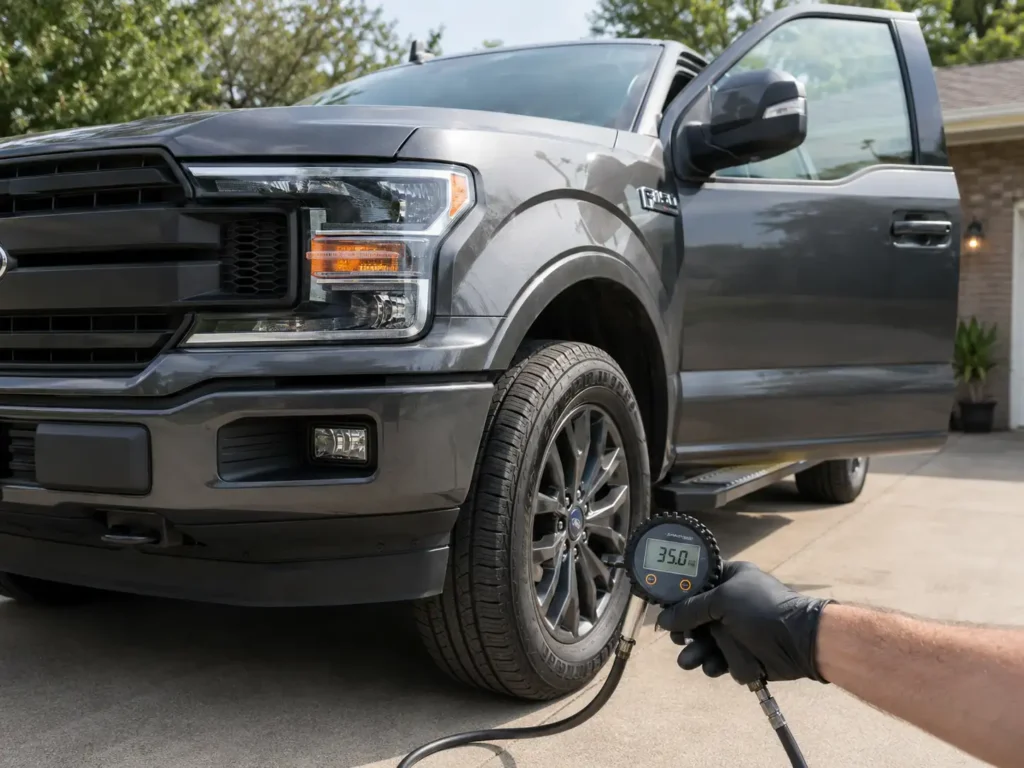
Do not use the maximum PSI printed on the tire sidewall as your normal driving pressure. That number is a tire limit, not the pressure Ford selected for your truck’s weight, tire size, and load rating.

Prime for Young Adults — 6 Months Free
Students and 18–24s get six months of Prime free, then half price.
Start 6 Months Free As an Amazon Associate I earn from qualifying purchases.This guide shows the correct order: door label first, gauge second, TPMS or FordPass third.
How To Check Ford F150 Tire Pressure
Recommended Best Deal Products
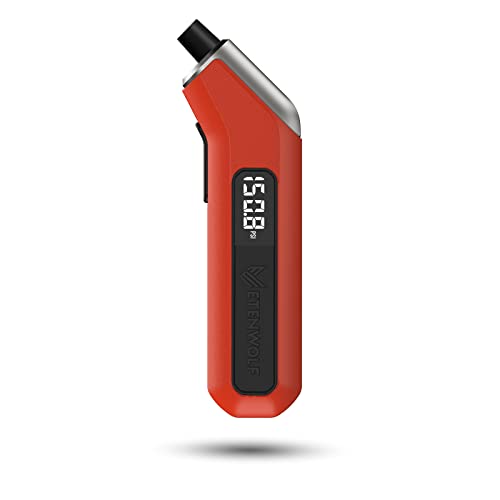
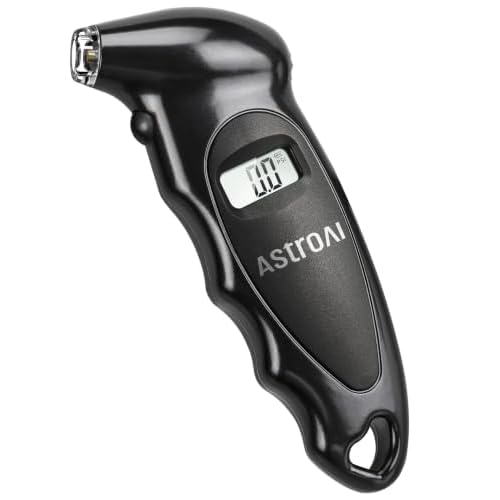

Use the door label for the correct PSI, check the tires cold with a gauge, then use TPMS or FordPass as a supporting check.
Where To Find The Correct PSI
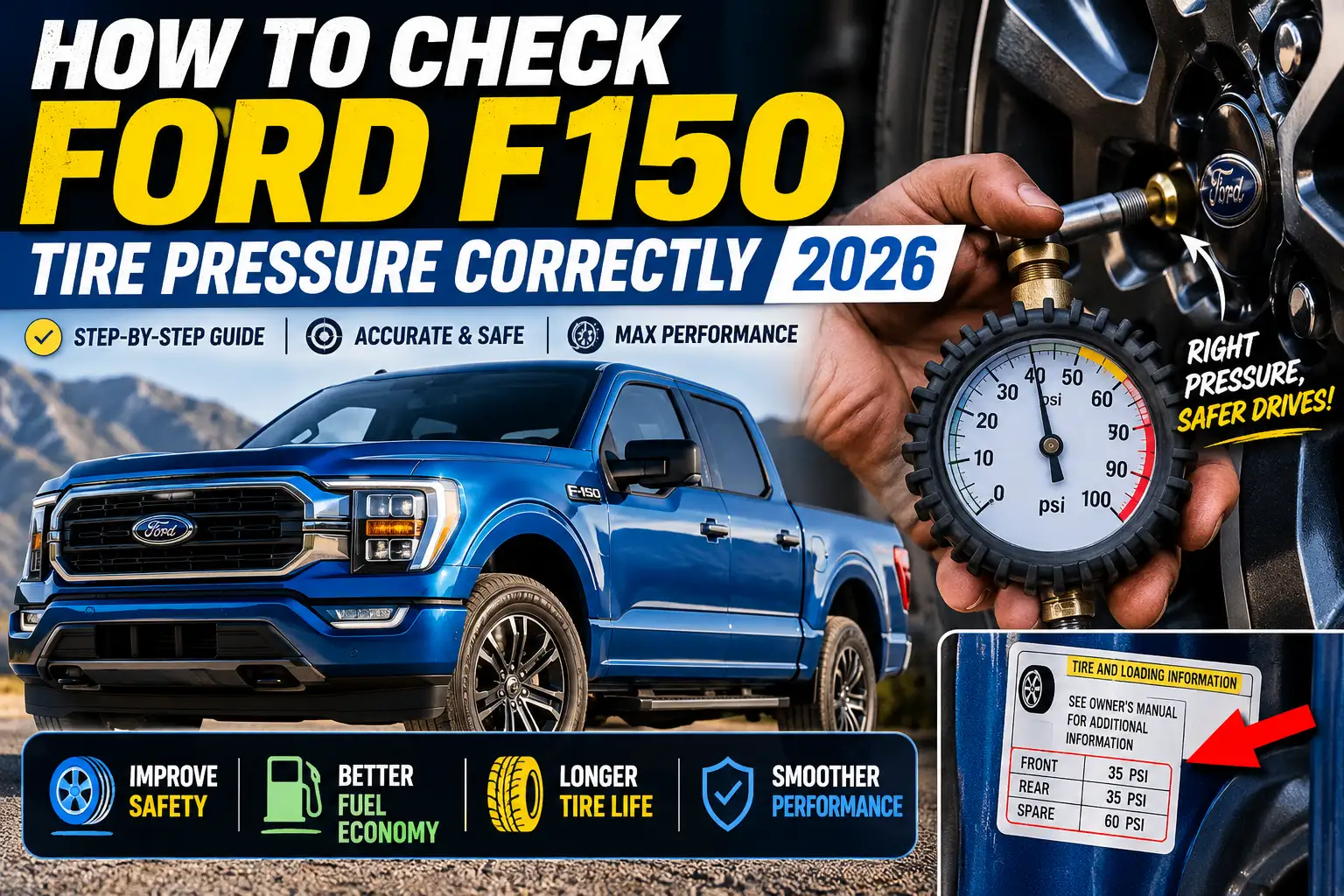
The right tire pressure for your Ford F150 is printed on the driver-side Tire and Loading Information label. Do not use the maximum PSI printed on the tire sidewall as your normal driving pressure.
Why Cold Pressure Matters
Check tire pressure before driving or after the truck has been parked for at least 3 hours. Warm tires can read higher than the true cold pressure. This is why a cold morning often triggers the low tire pressure warning light.
5 Step Check Process
Read Door Label
Open the driver door and find the Tire and Loading Information label.
Check Tires Cold
Measure pressure before driving or after the truck sits long enough to cool.
Use A Tire Gauge
Press the gauge firmly onto each valve stem until the air hissing stops.
Adjust PSI
Add or release air until each tire matches the door label pressure.
Let TPMS Update
If the warning light stays on, drive above 20 mph for at least 2 minutes.

Audible — Listen Free for 30 Days
One free credit a month and thousands of titles included.
Listen Free for 30 Days As an Amazon Associate I earn from qualifying purchases.TPMS Reminders
- A solid TPMS light usually means one or more tires are underinflated.
- A flashing light followed by a solid light may point to a TPMS system fault.
- Use the dashboard reading as a convenience check, not a replacement for a manual gauge.
When To Check More Often
- Before towing or hauling heavy cargo
- Before long highway trips
- After major temperature drops
- After changing wheels or tire sizes
What PSI Should Your Ford F150 Tires Have
Your Ford F150’s correct PSI is printed on the driver-side door label.
Ford says the recommended tire inflation pressure is found on the Tire Label and Door Jamb Label on the driver-side door jamb. Ford also says tire pressure should be checked in the morning before the truck has been driven.
That label matters because F150 tire pressure can vary by model year, tire size, trim, payload package, and special configurations such as Raptor or off-road packages.
The sidewall number is different. NHTSA says the correct pressure is the vehicle manufacturer’s recommended pressure on the Tire and Loading Information Label, not the pressure listed on the tire itself.
Do not publish a universal “all F150s use 35 PSI” rule. Some F150 door labels may show 35 PSI, but the publish-safe answer is always the PSI on the specific truck’s door label.
Once you know the correct PSI, the most reliable check happens at the valve stem with a gauge.
How To Check Ford F150 Tire Pressure With A Gauge
Recommended Best Deal Products


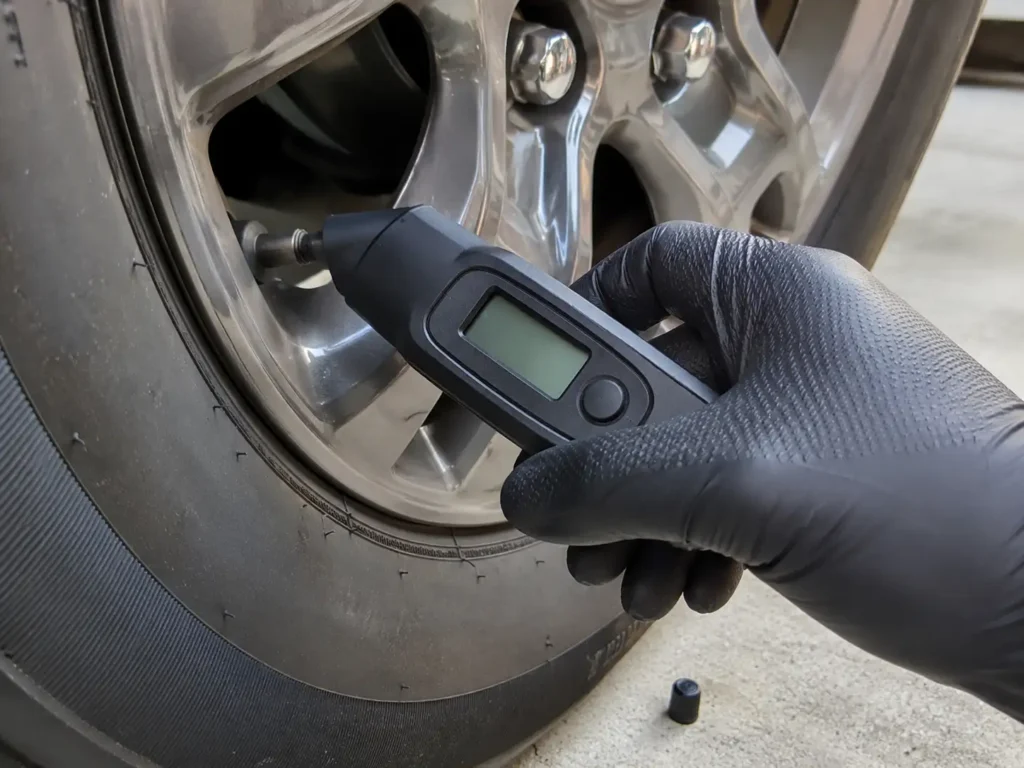
A manual tire pressure gauge gives the most dependable Ford F150 tire pressure reading.
Use a digital gauge or a standard stick-type tire pressure gauge. Ford says both types work, as long as the gauge seals correctly on the valve stem.
- Park your F150 on level ground.
- Let the tires cool. Ford says cold tires mean the truck has not been driven for at least 3 hours.
- Open the driver door and read the Tire and Loading Information label.
- Write down the recommended PSI for the front and rear tires. Some trucks may use the same pressure front and rear. Some setups may not.
- Remove the valve cap from the first tire.
- Press the tire pressure gauge straight onto the valve stem until the air hissing stops.
- Read the PSI on the gauge.
- Compare the gauge reading with the PSI on the door label.
- Add air if the reading is low. Release air slowly if the reading is too high.
- Recheck the tire after adjusting pressure.
- Repeat the process on all four road tires.
How To Read Ford F150 Tire Pressure On The Dashboard
Many newer Ford F150 trucks can show individual tire pressure readings in the instrument cluster.
The exact menu path varies by year, cluster style, and SYNC setup. On many late-model trucks, start with the steering wheel controls, open the truck information or vehicle status menu, then look for the tire pressure screen.
Audible Premium Plus — Annual Membership
12 audiobook credits up front, plus the full Audible catalogue.
See Annual Plans As an Amazon Associate I earn from qualifying purchases.Use this as a convenience check. The Ford owner manual states that the tire pressure monitoring system measures pressure in the four road tires and sends the readings to the truck.
The key limit is accuracy timing. TPMS readings may not update at the exact second you add air. The system is designed to warn you when pressure is low, not to replace a monthly gauge check.
If the dashboard says one tire is lower than the others, check that tire manually. Also inspect the tread and sidewall for a nail, screw, bead leak, cracked valve stem, or visible damage.
The dashboard helps you identify the tire. The gauge confirms the real pressure.
FordPass can do a similar job on some connected trucks.
How To Check Ford F150 Tire Pressure With FordPass
Recommended Best Deal Products


FordPass can show tire pressure on some connected Ford F150 trucks, but it is a secondary check.
Ford says that if the truck has a modem, tire pressure can also be checked using the FordPass App. This does not apply to every F150, and the app layout can change over time.
Use this basic process:
- Open FordPass and select your F150.
- Look for vehicle status, tire pressure, or tire monitoring information.
- Compare the app reading with the door label PSI.
FordPass readings can lag behind a recent pressure change. If you just added air, drove a short distance, or parked in changing weather, verify the tire with a gauge.
Pressure readings only help when you understand cold and hot tire behavior.
When To Check Ford F150 Tires Cold Or Hot
Cold tire pressure is the number that matters for your Ford F150.
Ford says tires should ideally be checked when cold, meaning the truck has not been driven for at least 3 hours. Warm tires can show extra pressure because driving builds heat in the tire.
The Ford owner manual gives two useful numbers. Normal driving can raise tire pressure by about 2 to 4 PSI from a cold start. A 30°F drop in outside temperature can lower tire pressure by about 3 PSI.
That explains why the TPMS light often appears on cold mornings. A tire that was close to the minimum pressure yesterday may fall below the warning threshold after a cold night.
Example: if your door label says 35 PSI and the tire reads 32 PSI on a cold morning after a sharp temperature drop, bring it back to the door label pressure while cold.
Do not bleed air from a warm tire just because it reads 2 to 4 PSI above the cold label number after driving. Recheck it cold before adjusting downward.
If the warning light is already on, handle it in the right order.
What To Do If The Ford F150 TPMS Light Stays On
A Ford F150 TPMS light does not always turn off the moment you add air.
First, check all four road tires with a gauge. Inflate each tire to the pressure on the driver-side door label. Then drive the truck and give the TPMS time to update.
Ford says that after inflating tires to the recommended pressure, the truck may need at least two minutes of driving over 20 mph before the warning light turns off.
| TPMS Light Behavior | Likely Meaning | What To Do |
|---|---|---|
| Solid warning light | One or more tires are underinflated | Check all tires cold and inflate to the door label PSI |
| Light stays on after filling | TPMS may not have updated yet | Drive over 20 mph for at least two minutes |
| Flashing for about one minute then solid | Possible TPMS malfunction | Check pressure manually and inspect for sensor or wheel issues |
| Light on with spare installed | Spare tire use may affect system function | Repair and reinstall the original road wheel and tire |
| Light after tire rotation | Sensor training may be needed on trucks with different front and rear pressures | Check owner manual or have the system retrained |
The Ford manual says TPMS malfunctions can happen after replacement tires, alternate wheels, or wheel changes if the system cannot function correctly.
If your tires are properly inflated and the spare is not installed, but the light stays on, the issue may be sensor-related.
Quick 5 Step Ford F150 Tire Pressure Check
Use this quick process when you only need the answer.
- Read the driver-side door label.
Find the Tire and Loading Information label on the driver door jamb. Use that PSI, not the tire sidewall maximum.
- Let the tires cool.
Check pressure before driving or after the truck has been parked for at least 3 hours.
- Check each valve stem with a gauge.
Remove the valve cap and press the gauge firmly until air stops hissing.
- Add or release air.
Match each tire to the door label PSI. Recheck after every adjustment.
- Drive if the TPMS light needs to clear.
After filling the tires, drive over 20 mph for at least two minutes if the warning light stays on.
Towing, payload, and aftermarket tire setups can change how carefully you need to check pressure.
When Ford F150 Tire Pressure Needs Extra Care
Some Ford F150 tire pressure checks need more care than a normal driveway reading.
Towing And Payload
Check tire pressure before towing, hauling, or taking a long highway trip.
Heavy tongue weight, passengers, tools, and bed cargo all add load. Tire pressure does not change your legal payload rating, but underinflated tires create more heat and wear when the truck is loaded.
If you are checking tire pressure before pulling a camper or trailer, also verify your truck’s real tow rating through the Ford F150 towing capacity by year chart.
Aftermarket Tires
Aftermarket tire size, load range, and wheel changes can affect the correct pressure.
If your F150 no longer has the factory tire size, do not guess from the old door label alone. Use the tire manufacturer’s load inflation data or ask a qualified tire shop to match pressure to the truck’s axle load.
Wheel changes can also affect TPMS behavior. Before changing wheels, confirm fitment with the Ford bolt pattern and wheel fitment chart.
Larger Tire Setups
Larger tires can change more than ride height. They can affect load rating, sidewall feel, steering response, and TPMS expectations.
If you are moving beyond stock sizing, check the practical fitment limits in the biggest tires on stock F150 20-inch rims guide before choosing pressure strategy.
Tire Rotation
Some F150 setups may require sensor retraining after rotation, especially if front and rear pressures differ.
If you rotate wheels or swap sets seasonally, pressure and TPMS behavior should both be checked after the work. For year-to-year fitment questions, use the what year F150 wheels are interchangeable guide before assuming another wheel set will work.
The final rule stays simple: label first, gauge second, TPMS third.
The Safe Way To Check Every F150 Tire
The safe way to check Ford F150 tire pressure starts with the door label.
Use the driver-side Tire and Loading Information label for the correct PSI. Then check every road tire with a gauge while the tires are cold. Use the dashboard or FordPass reading only as a supporting check.
If the TPMS warning stays on after filling the tires, drive over 20 mph for at least two minutes. If the light flashes, stays on with correct pressure, or appears after wheel changes, inspect for TPMS or sensor problems.
Check Ford F150 tire pressure monthly, before long trips, and before towing. That simple habit protects tire life, fuel economy, handling, and safety.
6 Common Ford F150 Tire Pressure Questions
What Is The Correct Tire Pressure For A Ford F150
The correct tire pressure for a Ford F150 is the PSI printed on the driver-side Tire and Loading Information label. Do not rely on a universal number unless it matches your exact door label.
Should I Use The PSI On The Tire Sidewall
No. The PSI on the tire sidewall is not the normal driving pressure for your F150. NHTSA says to use the vehicle manufacturer’s recommended pressure from the door label or owner manual.
Can I Check Ford F150 Tire Pressure From The Dashboard
Yes, many newer Ford F150 trucks can show tire pressure in the instrument cluster. Use that screen as a convenience check, but confirm pressure monthly with a manual gauge.
Why Is My Ford F150 TPMS Light Still On After Adding Air
The TPMS light may need driving time before it clears. Ford says the truck may need up to two minutes of driving over 20 mph after the tires are filled to the recommended pressure.
How Often Should I Check Ford F150 Tire Pressure
Check Ford F150 tire pressure at least once a month when the tires are cold. Also check before towing, long trips, heavy payload use, or major temperature swings.
Why Does My F150 Tire Pressure Drop In Cold Weather
Tire pressure drops in cold weather because air contracts as temperature falls. Ford’s manual says pressure may drop about 3 PSI for a 30°F drop in outside temperature.