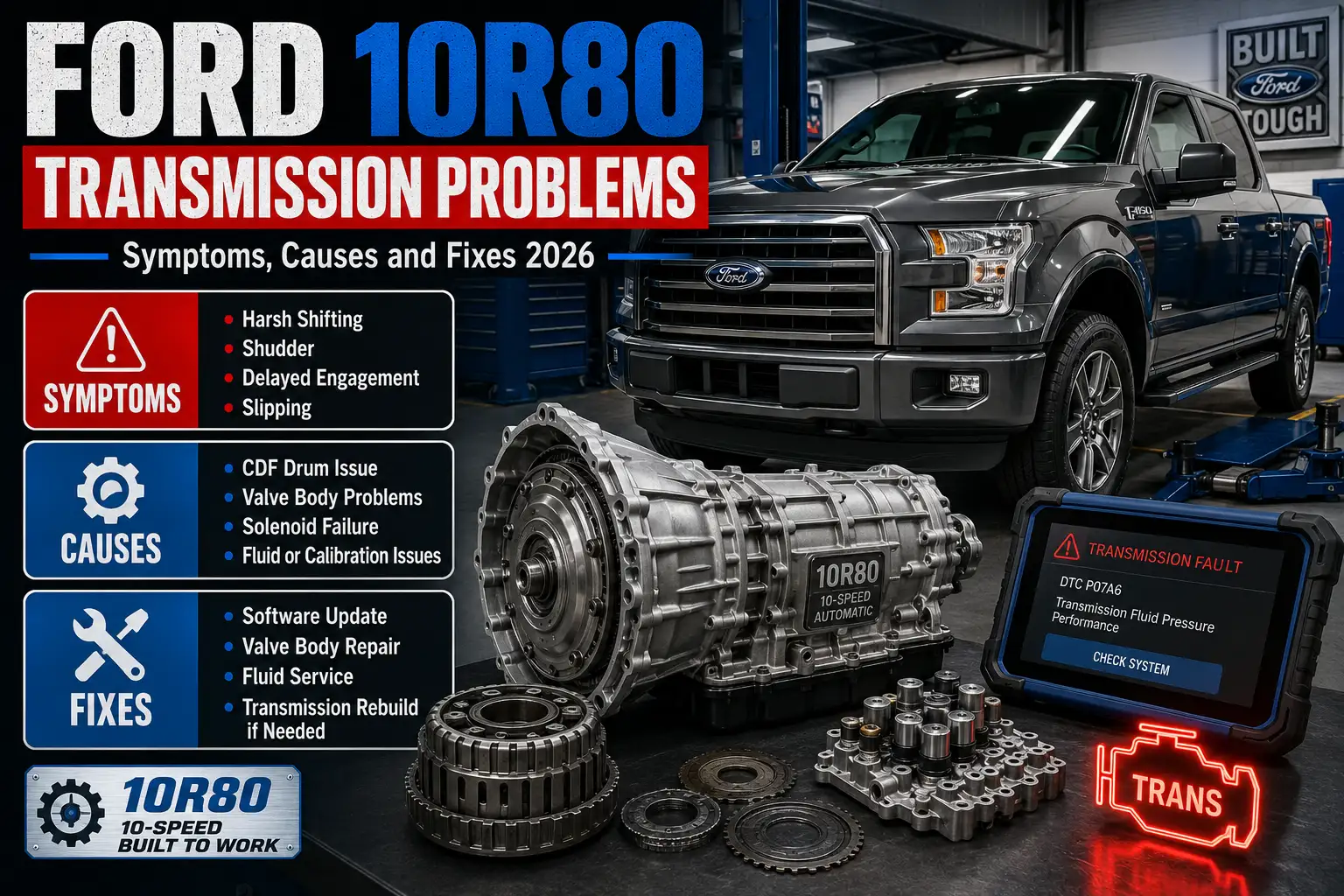
Ford 10R80 Transmission Problems: Symptoms, Causes and Fixes 2026

Ford 10R80 transmission problems range from harsh or delayed shifts to internal CDF clutch-cylinder failure. A hard shift by itself does not prove that your transmission needs a rebuild.
Ford’s service information separates these complaints into several possible causes, including adaptive calibration, transmission solenoid strategy, sticking valves in the main control valve body, and movement of the CDF clutch-cylinder sleeve.

Prime for Young Adults — 6 Months Free
Students and 18–24s get six months of Prime free, then half price.
Start 6 Months Free As an Amazon Associate I earn from qualifying purchases.
Ford’s 2025 TSB 25-2126 specifically addresses harsh engagement, delayed engagement, harsh shifts, delayed shifts, and several related DTCs on 2017 to 2020 F-150s equipped with the 10R80.
The best approach is to identify exactly what your truck is doing, scan it for transmission codes, and then follow the correct diagnostic branch.
Ford 10R80 Problem Diagnosis at a Glance
Use the symptom pattern, stored DTCs, and gear behavior together before deciding whether your F-150 needs a relearn, valve-body work, internal repair, or a rebuild.
Identify the Symptom
- Harsh cold shift
- Delayed Drive or Reverse
- Gear hunting
- RPM flare
- Missing gears
Scan for DTCs
- P0729
- P0731 to P0736
- P0751 to P0772 groups
- P2700 to P2708 groups
Check Shift Behavior
- Cold versus warm
- All gears available
- Engagement delay
- Repeatable slipping
- Codes returning
Choose the Repair Path
- Adaptive relearn
- Main-control diagnosis
- CDF internal repair
- Rebuild or replacement
Harsh shifting only, all gears work, and no recurring ratio codes. Start with scan data and the correct adaptive-learning procedure.
Delayed engagement, repeat harsh shifts, or solenoid and friction-element codes. Investigate main-control valve-body and hydraulic operation.
Missing gears, repeated ratio codes, slipping, neutral-like flare, or no Drive or Reverse. Escalate to internal 10R80 diagnosis.
What 5 Signs Point to Different 10R80 Problems
Recommended Best Deal Products


Your exact shift symptom tells you more than the phrase “10R80 problem” ever will.
Some symptoms point toward adaptive or valve-body problems. Others make an internal hydraulic leak or clutch problem much more likely.
| Symptom | First Area to Check | Higher Risk Clue |
|---|---|---|
| Harsh cold shifts | Adaptive strategy | Continues when fully warm |
| Delayed Drive or Reverse | Main control hydraulics | Delay gets progressively worse |
| Gear hunting | Calibration and valve body | Ratio DTCs appear |
| Missing gears | Internal hydraulic or clutch fault | Multiple ratio codes |
| No Drive or Reverse | Major transmission fault | Repeated failure to engage |
Harsh Cold Shifts
A 10R80 may shift firmly when cold and become smoother as transmission temperature rises.

Audible — Listen Free for 30 Days
One free credit a month and thousands of titles included.
Listen Free for 30 Days As an Amazon Associate I earn from qualifying purchases.That pattern alone does not confirm CDF failure. Ford specifically warns that resetting the adaptive transmission strategy can produce firmer-than-normal upshifts and downshifts during the relearning period.
Concern increases when the same harsh shift remains after the transmission warms up or becomes progressively worse.
Delayed Drive Engagement
A noticeable pause after selecting Drive or Reverse deserves more attention than a single firm shift.
The truck may hesitate, engine speed may rise slightly, and then the transmission may engage suddenly. Ford includes delayed engagement among the conditions addressed in its 10R80 service procedures.
Repeated delays can point toward a hydraulic-control problem rather than normal adaptive behavior.
Gear Ratio Codes
Incorrect gear-ratio codes are stronger diagnostic evidence than shift feel alone.
Ford’s 10R80 bulletins include P0729 and P0731 through P0736 among the DTCs that may accompany harsh or delayed shifting.
A truck that has both harsh shifting and repeated ratio codes needs deeper diagnosis before another adaptive reset is attempted.
Gear Hunting and Skipping
Occasional skip shifting can be part of normal 10-speed operation because the transmission does not have to use every gear during every acceleration event.
Repeated hunting, RPM flare, unexpected downshifts, or failure to hold the commanded gear are different. Those symptoms deserve a scan for stored PCM or TCM codes.
Audible Premium Plus — Annual Membership
12 audiobook credits up front, plus the full Audible catalogue.
See Annual Plans As an Amazon Associate I earn from qualifying purchases.No Reverse or Drive
Failure to engage Drive or Reverse moves the problem into a much more serious category.
If the gear is selected but the truck will not move, repeatedly clearing adaptive tables is not a suitable repair strategy. The transmission needs proper hydraulic and mechanical diagnosis.
That symptom map gives you the starting point. The next question is whether the problem is still within the adaptive-learning branch.
If Shifts Are Harsh Check Adaptive Learning First
If every gear still works and harshness is the main complaint, calibration is one of the lower-cost areas to investigate first.
The 10R80 uses an adaptive shift strategy. The transmission controller learns operating characteristics over time and adjusts shift control accordingly.
Ford states that resetting this strategy starts another learning process and that upshifts or downshifts may feel firmer than normal for several days afterward.
If your truck has recently had transmission work, programming, a valve-body service, or an adaptive reset, some temporary change in shift quality does not automatically indicate hardware failure.
For the correct Ford-specific procedure, see our Ford adaptive learning transmission reset guide.
The diagnostic path changes if the truck has any of these symptoms:
- Repeated incorrect-ratio DTCs
- Significant RPM flare between shifts
- A gear that disappears or will not hold
- Delayed Drive or Reverse engagement
- Harsh shifts that quickly return after the correct relearn procedure
If those conditions exist, another reset can hide symptoms temporarily without repairing the underlying hydraulic or mechanical problem.
A relearn cannot repair a sticking valve or an internal pressure leak. That brings the valve body into the diagnosis.
If Relearning Fails Check 3 Valve Body Clues
Recommended Best Deal Products


A relearn that changes nothing pushes the diagnosis toward hydraulic control rather than driving-style adaptation.
Ford has repeatedly addressed the 10R80 main control valve body in technical service information for harsh and delayed shift complaints.
Repeat Harsh Engagement
A repeatable slam or bump when selecting Drive or Reverse is more significant when it continues after a proper adaptive drive cycle.
The same applies to harsh shifts that occur consistently through specific gears instead of appearing only during the first few relearn cycles.
Multiple Solenoid Codes
Ford lists several solenoid-performance DTCs in its 10R80 service guidance, including:
- P0751 and P0752
- P0756 and P0757
- P0761 and P0762
- P0766 and P0767
- P0771 and P0772
These codes should not automatically be interpreted as proof that an individual solenoid needs replacement. Ford’s diagnostic process also considers solenoid strategy, main-control valve operation, and internal hydraulic leakage.
Friction Apply Codes
Ford also lists P2700 through P2705, P2707, and P2708 among the DTCs that can appear with the affected 10R80 conditions.
The useful pattern is not one isolated code. It is the combination of DTCs, repeatable symptoms, and the transmission’s ability to apply and hold the commanded gear.
If you need a scan tool capable of reading more than basic engine codes, our guide to the best OBD2 scanners for Ford F-150 covers Ford-compatible diagnostic options.
If valve-body work and relearning do not correct the problem, Ford’s service path can move deeper into the transmission.
When 5 Symptoms Suggest CDF Drum Failure
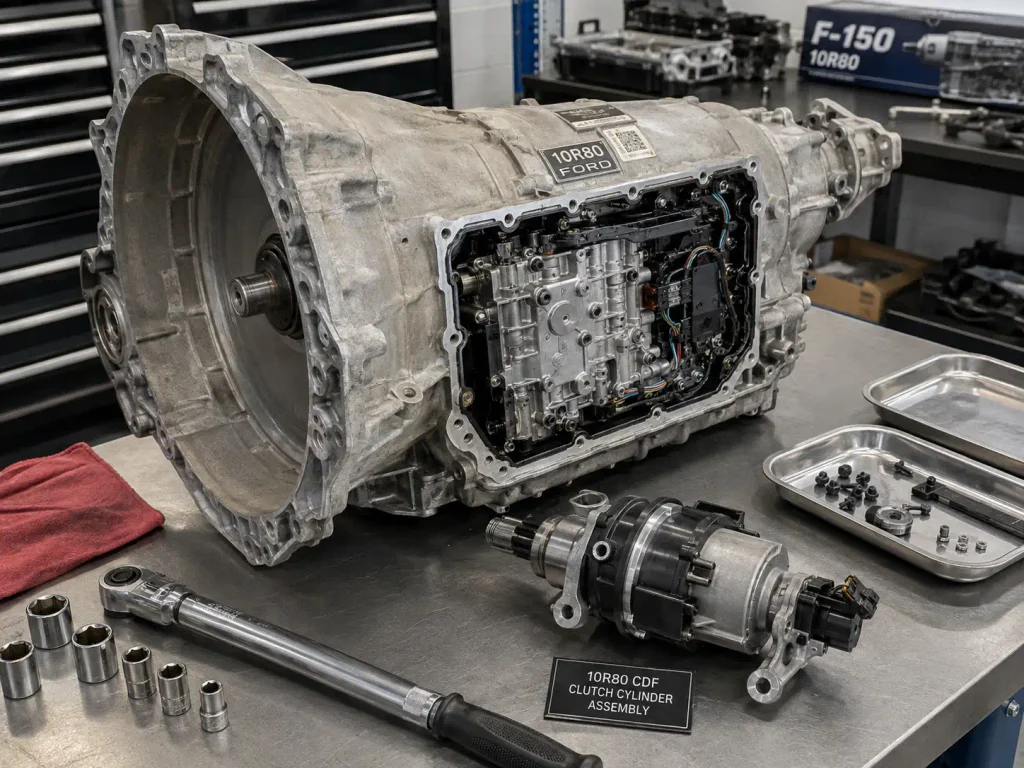
CDF clutch-cylinder failure becomes more credible when several symptoms appear together, especially incorrect-ratio codes plus delayed or missing gears.
The CDF assembly contains clutch circuits used by the 10R80. Ford service information identifies axial movement of the CDF clutch-cylinder sleeve as a possible source of hydraulic circuit leakage.
Harsh Multi Gear Shifts
A single rough shift is weak evidence.
Repeated harsh shifts across several gears, especially when they become more frequent, give you a stronger reason to investigate internal hydraulic pressure and clutch application.
Delayed Shift Engagement
CDF-related hydraulic leakage can interfere with the pressure needed to apply clutch elements correctly.
Ford’s 2024 TSB 24-2254 specifically states that movement of the CDF sleeve can cause hydraulic circuit leaks on covered vehicles. That bulletin includes certain 2021 and 2022 F-150 applications built within its stated production criteria.
Incorrect Ratio Codes
P0731 through P0736 identify incorrect-ratio conditions for individual gears.
One code still requires diagnosis. Multiple recurring ratio errors combined with slipping, flare, or harsh engagement make an internal problem harder to dismiss as calibration alone.
Missing Specific Gears
A truck that stops using or holding specific gears has moved beyond a simple shift-quality complaint.
One 2026 NHTSA complaint from a 2018 F-150 owner reported pressure loss, harsh shifting, missing gears, neutral-like behavior, and DTCs including P0732, P076F, P07F6, and P07F7. Owner complaints do not prove the cause by themselves, but they show why code and symptom combinations matter during diagnosis.
Problems Worsen Over Time
There is no verified universal mileage at which a 10R80 CDF assembly fails.
Recent owner reports show large variation. One 2019 F-150 owner reported dealer-confirmed CDF failure at about 110,000 miles and a $6,300 rebuild quote. Another participant in the same 2026 discussion reported a 2021 transmission rebuild at 67,000 miles. These are individual experiences, not an expected service-life range.
Ford’s bulletin-based diagnostic procedure is more useful than guessing failure based on mileage alone.
Once the transmission starts losing gears or engagement, the decision changes from “which reset should I try?” to “is it still reasonable to drive?”
When 4 Warning Signs Mean Stop Driving
Recommended Best Deal Products


Some 10R80 complaints affect comfort. Loss of a commanded gear or propulsion is a different category.
1 No Drive or Reverse
If the transmission repeatedly fails to engage Drive or Reverse, stop treating the problem as an adaptive-learning issue.
A truck that cannot reliably engage a commanded direction needs mechanical diagnosis.
2 Repeated RPM Flare
RPM flare occurs when engine speed increases without the expected increase in road speed during a shift.
A small isolated change is not enough to condemn the transmission. Repeated flare combined with delayed engagement or missing gears is a stronger warning.
3 Multiple Ratio DTCs
One stored code gives you a starting point.
Several recurring ratio or friction-element codes indicate that the transmission is having difficulty applying or holding the expected gear. Continuing to clear the codes removes useful diagnostic evidence.
4 Limp Mode or Lost Gears
If the truck enters a reduced-function mode, loses several gears, unexpectedly neutralizes, or cannot maintain propulsion, professional diagnosis should take priority over further relearn attempts.
Recent NHTSA complaints from 10R80-equipped 2018 F-150 owners describe loss of propulsion, harsh shifts, missing gears, and sudden downshifts. Complaints are owner-submitted reports and do not establish a defect by themselves, but these symptoms are serious enough to justify stopping normal driving until the cause is identified.
Not every noise carries the same meaning. Ford has previously described some 10R80 whine as a characteristic condition on certain applications rather than evidence of reduced transmission durability.
Serious engagement or gear-loss symptoms are different. Use a structured diagnosis rather than trying random fixes.
How to Diagnose Your 10R80 in 5 Steps
Use the 10R80 diagnosis in this order so you do not jump from one harsh shift straight to a rebuild quote.
Step 1 Confirm Your Transmission
Make sure your truck actually has a 10R80.
The 10-speed appeared in the F-150 during the 2017 model year, but transmission application varies by year, engine, and configuration. Some 2017 F-150s used the older 6R80.
Use our Ford transmission identification chart before applying a 10R80-specific diagnostic procedure.
Step 2 Scan Every Stored DTC
Do not scan only for generic engine codes.
Check both PCM and TCM information when your scan tool supports it. Record codes before clearing anything.
Separate the results into three broad groups:
- No-code harsh shifting
- Solenoid or friction-element codes
- Gear-ratio codes
That distinction determines what should happen next.
Step 3 Compare Cold and Warm Behavior
Write down when the symptom happens.
Record:
- First cold start behavior
- Shift quality after the truck warms up
- Drive and Reverse engagement time
- Which gears show the problem
- Whether RPM flares before engagement
Repeatable evidence is far more useful to a transmission technician than saying the truck “sometimes shifts weird.”
Step 4 Follow the Calibration Path
If all gears operate, no significant ratio codes are present, and harshness is the main complaint, Ford’s adaptive or solenoid-strategy diagnostic path may apply.
Use the correct Ford procedure rather than disconnecting the battery and assuming the transmission has been repaired.
Step 5 Escalate Hardware Diagnosis
Move beyond relearning if:
- Ratio DTCs return
- A gear repeatedly disappears
- Drive or Reverse engagement fails
- The transmission slips or neutralizes
- Valve-body service does not correct the complaint
Ford’s current service procedure for covered 2017 to 2020 F-150s can progress to checking the CDF clutch-cylinder when the documented conditions require it.
Here is the quick decision path.
| Your 10R80 Does This | First Diagnostic Path | Escalate When |
|---|---|---|
| Harsh shifts but all gears work | Scan and adaptive diagnosis | Harshness returns |
| Delayed Drive or Reverse | Main-control diagnosis | Delay worsens |
| Incorrect-ratio DTC | Hydraulic and internal diagnosis | Codes repeat |
| Missing one or more gears | Internal diagnosis | Immediately |
| No Drive or Reverse | Transmission specialist | Do not keep resetting |
The diagnosis tells you which repair level makes sense.
Which 4 10R80 Repairs Fit Each Failure Level
The correct 10R80 repair depends on where the diagnosis stops.
A software or adaptive issue should not receive the same repair as a confirmed CDF hydraulic leak.
Calibration and Relearn
This is the least invasive repair path.
It makes sense when the truck retains all gears, the diagnostic procedure points toward adaptive strategy, and no evidence shows an internal mechanical failure.
Ford’s documentation states that shift quality can temporarily feel firmer while the transmission relearns after adaptive strategy has been reset.
Main Control Repair
The next level involves the main control valve body and related hydraulic-control components.
Ford service bulletins have directed technicians to inspect or overhaul the main control valve body as part of the 10R80 harsh or delayed shift repair path.
A valve-body repair should follow diagnosis. It should not be installed simply because the truck shifts hard.
Internal CDF Repair
A confirmed CDF clutch-cylinder problem requires internal transmission work.
Ford TSB 25-2126 states that axial movement of the CDF clutch-cylinder sleeve can create hydraulic circuit leaks in covered 2017 to 2020 F-150 applications. The service procedure can require internal transmission inspection and CDF-related repair when diagnosis confirms that condition.
Rebuild or Replacement
Rebuild or replacement becomes relevant when internal damage extends beyond a simple control repair.
Real owner costs vary sharply by location, damage, parts, labor rate, and whether the transmission is repaired, rebuilt, remanufactured, or replaced.
A May 2026 F150Forum report described a dealer-confirmed CDF failure on a 2019 3.5L EcoBoost F-150 with 110,000 miles and a quoted $6,300 rebuild. Another owner in the same discussion reported being quoted about $7,100 for repair or $9,700 for a remanufactured transmission.
A separate 2026 NHTSA complaint from a 2018 F-150 owner reported paying $6,429.58 for a remanufactured transmission after failure at 100,653 miles.
These are real examples, not a national average.
| Diagnosis | Typical Repair Direction |
|---|---|
| Adaptive issue | Relearn or calibration procedure |
| Main-control issue | Valve-body diagnosis and repair |
| Confirmed CDF hydraulic leak | Internal CDF repair |
| Extensive internal damage | Rebuild or replacement |
Get the diagnosis in writing before approving a several-thousand-dollar transmission repair.
What Most 10R80 Owners Should Do Next
The best next step depends on whether your 10R80 is shifting badly or actually failing to hold the commanded gear.
For mild harsh shifting with all gears available, start by confirming the transmission, scanning for DTCs, and checking whether Ford’s adaptive diagnostic path applies.
Persistent ratio codes, delayed engagement, RPM flare, missing gears, or loss of Drive or Reverse move the diagnosis toward valve-body or internal transmission faults. Ford’s current service guidance confirms that CDF clutch-cylinder sleeve movement can create hydraulic leakage on specific affected 10R80 applications.
The key to handling Ford 10R80 transmission problems is simple. Diagnose the symptom and code pattern first, then authorize the repair that matches the evidence.
5 Common Questions About Ford 10R80 Problems
What Are the Most Common Ford 10R80 Transmission Problems?
Common complaints include harsh or delayed engagement, harsh shifts, delayed shifts, RPM flare, gear-ratio faults, valve-body problems, and CDF clutch-cylinder hydraulic leakage. Ford service bulletins confirm several of these conditions on specific 10R80-equipped models and years.
Does a Harsh Shift Mean the CDF Drum Failed?
No. A harsh shift alone does not confirm CDF failure.
CDF problems become more credible when harsh shifting appears with recurring ratio codes, slipping, delayed engagement, lost gears, or evidence of hydraulic leakage during Ford’s diagnostic procedure.
Can an Adaptive Reset Fix a 10R80?
An adaptive reset can help when the problem involves learned shift strategy or when Ford’s service procedure calls for a relearn. It cannot repair a sticking valve, damaged clutch, or CDF sleeve that is creating an internal hydraulic leak.
Which F150 Years Have the 10R80 Transmission?
The F-150 began using the 10R80 during the 2017 model year, with application depending on engine and configuration. Ford’s TSB 25-2126 specifically covers 2017 to 2020 F-150s with the 10R80 for its listed harsh or delayed shift conditions, while separate Ford bulletins cover certain later applications.
Should I Rebuild or Replace a Failed 10R80?
Choose between repair, rebuild, and replacement only after the failed components are identified. A valve-body fault may not justify replacing the whole transmission, while extensive CDF, clutch, converter, or hard-part damage can make a rebuild or replacement more practical.
Identify any Ford transmission by code and year: Ford Transmission Identification Chart
Other 10-speed variants (10R60, 10R140): see the broader Ford 10-Speed Transmission Problems overview.