Ford F150 Lug Nut Size Chart: Complete Torque & Thread Specs (1980-2026)

Wheel fasteners are arguably the most critical safety components on any vehicle, serving as the sole physical connection between the unsprung wheel mass and the vehicle’s chassis. On a high-capacity platform like the Ford F-150, lug nut specifications carry profound engineering significance.
Over the past five decades, the F-150 has transformed from a light-duty agricultural utility vehicle into a highly advanced, aluminum-bodied towing powerhouse. This massive evolution in gross vehicle weight rating (GVWR) has necessitated multiple architectural overhauls to the wheel mounting hardware.

Prime for Young Adults — 6 Months Free
Students and 18–24s get six months of Prime free, then half price.
Start 6 Months Free As an Amazon Associate I earn from qualifying purchases.Ford engineers have continuously modified bolt patterns, thread pitches, and clamping force requirements to safely manage escalating horsepower and torque. The introduction of twin-turbo EcoBoost engines and heavy battery packs in the Lightning EV models places unprecedented stress on wheel studs.
Understanding the precise lug nut specifications for a specific F-150 model year is not just a matter of basic maintenance. It is a fundamental requirement for operational safety, ensuring that wheels remain securely mated to the hub under extreme towing conditions.
The landscape of Ford F-150 lug nuts is notoriously complex, characterized by mid-generation thread pitch alterations and highly specialized heavy-duty payload packages. The historical transition from five-lug setups in the 1990s to modern six-lug configurations highlights a shift in half-ton truck capability.
Furthermore, the widespread adoption of two-piece, chrome-capped lug nuts by the manufacturer introduced severe, unintended maintenance hurdles. These specific lug nuts have stranded countless motorists, ruined tools, and even sparked massive class-action litigation.
This exhaustive technical report synthesizes decades of mechanical specifications, metallurgical properties, and aftermarket solutions. By examining every generation of the truck, this guide provides the definitive resource for Ford F-150 wheel fastener dimensions, torque limits, and safety protocols.
Ford F-150 Lug Nut Size & Torque Chart
Recommended Best Deal Products


Never guess your wheel specs again. We have compiled the exact thread pitches, socket sizes, and torque requirements for every F-150 generation.
Using the wrong socket can strip the notorious two-piece Ford lug nuts. Read our definitive guide before rotating your tires.
Quick Reference
Current Specs (2015 – Present)
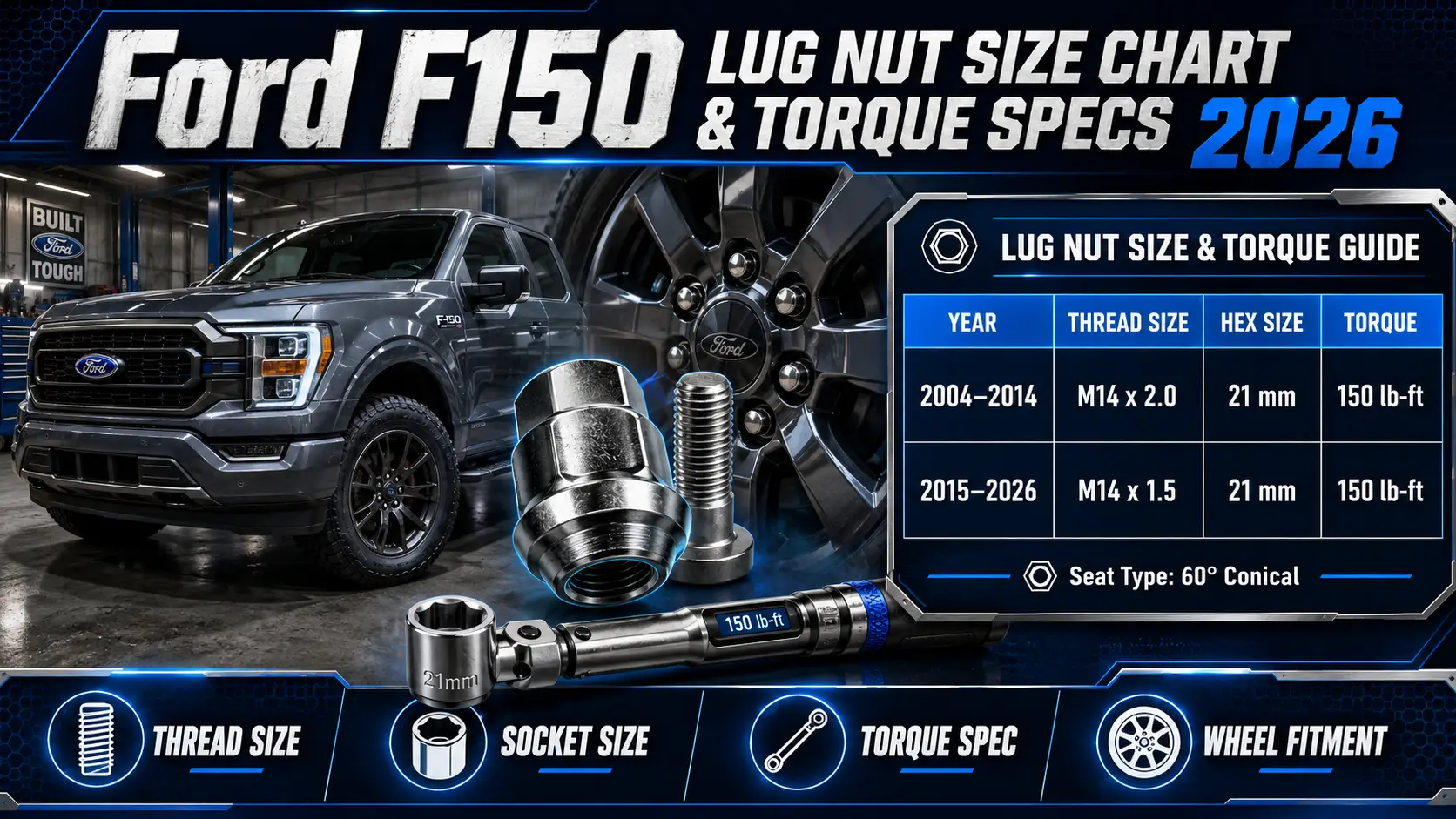
If you drive a 13th or 14th generation Ford F-150 (2015 and newer), your specs are standardized.

Audible — Listen Free for 30 Days
One free credit a month and thousands of titles included.
Listen Free for 30 Days As an Amazon Associate I earn from qualifying purchases.Ford moved away from the older 2.0 thread pitch to a finer 1.5 pitch for better clamping force. Always use a calibrated torque wrench.
The Master Generational Chart
Recommended Best Deal Products

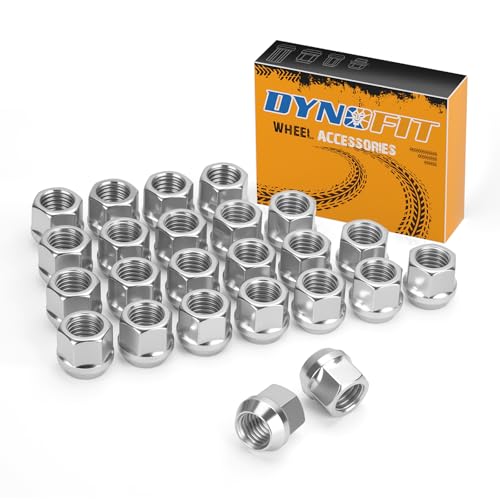

Finding specs for older trucks can be frustrating. Ford has changed the F-150 lug nut thread pitch three major times since the 1990s.
Check your model year below. Note that 1997-1999 models have some crossover where early builds used M12 hardware before fully transitioning to M14.
| Years / Generation | Thread Size | Hex / Socket | Torque (ft-lbs) |
|---|---|---|---|
| 2015 – Present (13th/14th Gen) | M14 x 1.5 | 21mm (13/16″) | 150 |
| 2004 – 2014 (11th/12th Gen) | M14 x 2.0 | 21mm (13/16″) | 150 |
| 2000 – 2003 (10th Gen) | M14 x 2.0 | 21mm (13/16″) | 150 |
| 1997 – 1999 (Early 10th Gen) | M12 x 1.75 | 19mm (3/4″) | 100 |
| Pre-1997 (9th Gen & Older) | 1/2″ – 20 | 21mm (13/16″) | 100 |
Evolution of Thread Pitch
Ford transitioned from standard imperial measurements to metric in the late 90s.
The shift from a 2.0 coarse thread to a 1.5 fine thread in 2015 was designed to resist vibration loosening.
Torque Spec Timeline
As the F-150’s towing capacity and curb weight increased, so did the clamping force required.
Modern F-150s require a massive 150 ft-lbs of torque. Many standard DIY torque wrenches max out at 150, meaning you might need a heavy-duty wrench.
The “Swollen” Lug Nut Problem
Millions of F-150s use a two-piece lug nut design: a steel core wrapped in a decorative chrome/aluminum cap.
Moisture gets trapped between the layers, causing the steel to rust and expand. This swells the outer cap, making standard 21mm sockets impossible to fit.
Swells from 21mm to 21.5mm or 22mm due to underlying rust expansion.
Audible Premium Plus — Annual Membership
12 audiobook credits up front, plus the full Audible catalogue.
See Annual Plans As an Amazon Associate I earn from qualifying purchases.Actually holds the wheel. Rusts when moisture penetrates the seam.
The Solution
-
1.
Keep a 21.5mm flip socket in your truck. This intermediate size will grip mildly swollen nuts without stripping them.
-
2.
Never use an impact wrench on swollen two-piece nuts; it will immediately mangle the outer cap.
-
3.
Replace OEM nuts with solid, one-piece aftermarket lug nuts (like McGard or Gorilla) for a permanent fix.
The Master Ford F150 Lug Nut Size Chart (1980–2026)
Recommended Best Deal Products


To understand the trajectory of Ford’s payload engineering, we must first examine the exact dimensional specifications of their wheel hardware across different eras. The following table aggregates thread pitches, hex sizes, bolt patterns, and torque specifications.
| Generation / Era | Model Years | Thread Size | Bolt Pattern | Hex Socket Size | Torque Spec |
| 14th Generation & EV | 2021–2026 | M14 x 1.5 | 6x135mm | 21mm | 150 ft-lbs |
| 13th Generation | 2015–2020 | M14 x 1.5 | 6x135mm | 21mm | 150 ft-lbs |
| 11th & 12th Generation | 2004–2014 | M14 x 2.0 | 6x135mm | 21mm | 150 ft-lbs |
| 10th Gen (7700 HD) | 2000–2003 | M12 / M14 | 7x150mm | 19mm / 21mm | 100 or 150 ft-lbs |
| 10th Generation (Base) | 1997–2003 | M12 x 1.75 | 5x135mm | 19mm (3/4″) | 100 ft-lbs |
| 7th, 8th, 9th Generation | 1980–1996 | 1/2-20 SAE | 5×139.7mm | 13/16″ | 100 ft-lbs |
Analyzing 13th and 14th Generation Models (2015–2026)
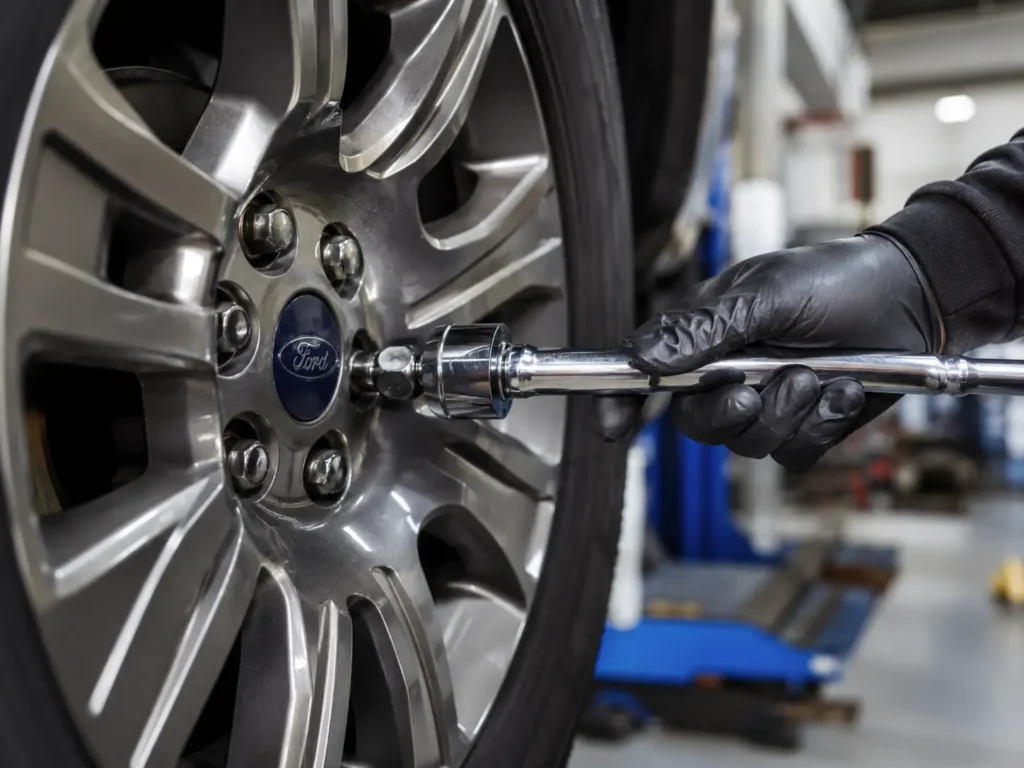
Starting with the 2015 model year, Ford initiated a paradigm shift in truck manufacturing by adopting aerospace-grade aluminum-alloy body panels. While this lightweight body material dominated industry headlines, a quieter but equally vital change occurred directly at the wheel hub.
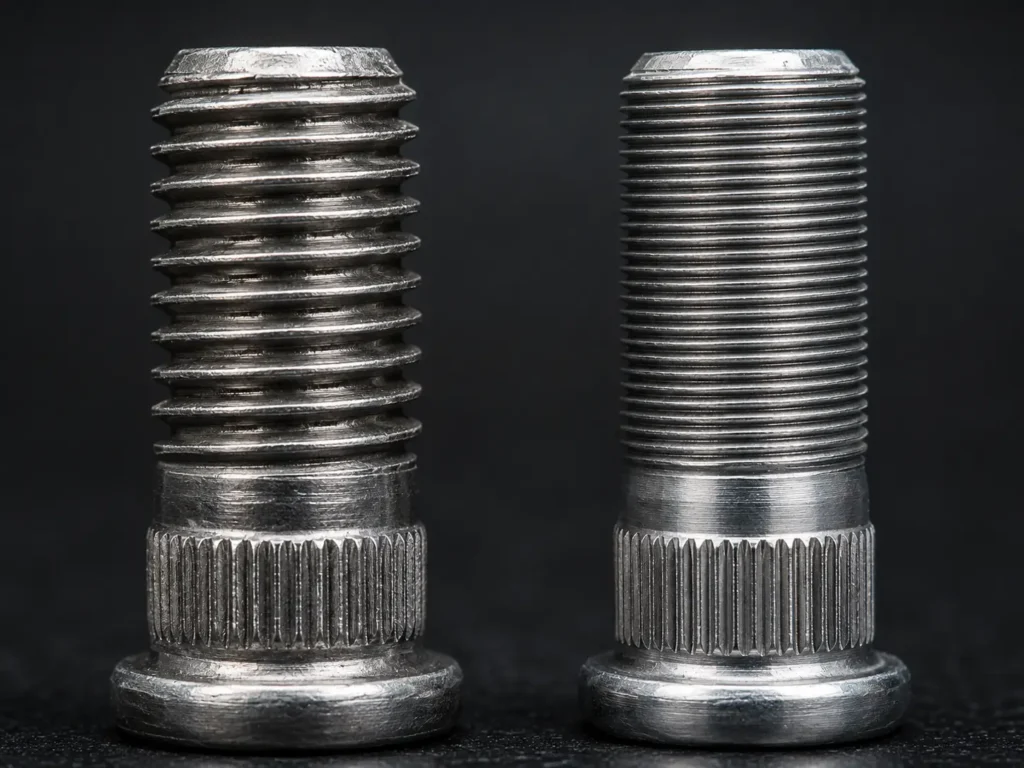
Ford transitioned the F-150’s lug nut thread pitch from a coarse M14x2.0 specification to a significantly finer M14x1.5 specification. This transition to a finer thread pitch represents a highly calculated, safety-oriented engineering decision by the manufacturer.
Finer threads, with only 1.5 millimeters of distance between thread peaks, provide a vastly larger surface contact area between the internal nut threads and the external wheel stud. This increased surface area generates superior friction lock, making the hardware exponentially more resistant to loosening under severe vibration.
For a vehicle specifically designed to navigate washboard dirt roads and haul maximum payloads, this resistance to vibrational back-off is an absolute necessity. All standard trims from 2015 to 2026, including the 2.7L EcoBoost, 3.5L PowerBoost, and 5.0L Ti-VCT, utilize this refined M14x1.5 specification.
To properly service these fasteners, automotive technicians require a 21mm, 6-point socket. Attempting to use a 12-point socket is highly discouraged, as the reduced surface contact can easily round off the edges of the factory chrome caps.
The introduction of the all-electric Ford F-150 Lightning perfectly maintained this structural continuity with its internal combustion counterparts. The 2022–2026 Lightning EV models utilize the exact same 6x135mm bolt pattern and M14x1.5 lug nuts as the gas models.
This parts standardization is incredibly beneficial for fleet managers and consumers alike. It allows for the seamless cross-compatibility of wheel accessories, winter tire sets, and aftermarket lug nuts across the entire modern F-150 ecosystem.
Because electric vehicles generate maximum torque instantaneously from zero RPM, the clamping force on the wheel hub must be absolute. The 150 ft-lbs torque specification on these M14x1.5 studs ensures the massive 775 lb-ft of electric motor torque is safely transferred to the pavement.
Analyzing 11th and 12th Generation Models (2004–2014)
The 2004 model year marked a watershed moment in the lineage and capability of the Ford F-150 platform. Ford completely redesigned the truck’s architecture to handle substantially heavier commercial payloads, introducing a rigid, fully boxed ladder frame.
To support this enhanced physical capability, the wheel mounting system was immediately upgraded. The legacy five-lug configuration was abandoned in favor of a much more robust six-lug 6x135mm bolt pattern. This pattern evenly distributes lateral cornering forces across six pivot points rather than five.
Accompanying this bolt pattern upgrade was a massive increase in the sheer thickness and tensile strength of the wheel studs. The manufacturer discarded the previous 12mm hardware in favor of heavily reinforced 14mm carbon steel studs.
Specifically, all 2004 to 2014 F-150 models utilize an M14x2.0 thread pitch. The 2.0 coarse thread design was highly beneficial for rapid assembly line installation at the factory, as cross-threading is significantly less likely when utilizing wider thread peaks.
Because of this massive jump to a 14mm stud diameter, the clamping force requirements skyrocketed accordingly. Ford officially increased the recommended wheel torque from the historical 100 ft-lbs standard up to a massive 150 ft-lbs.
This 50% increase in torque application ensures that the wheels remain securely mated to the aluminum hub, even when the truck is maxed out at its structural towing capacity limits. Owners of these generations must utilize a heavy-duty torque wrench capable of reaching 150 ft-lbs accurately.
Analyzing 10th Generation Models (1997–2003)
The 10th generation F-150, introduced for the 1997 model year, featured a radical, highly aerodynamic “jellybean” body style. This design fundamentally departed from the boxy, square-body trucks of the past, signaling a new era of highway-focused truck design.
Underneath the chassis, Ford introduced a unique and relatively short-lived 5x135mm bolt pattern. This metric sizing officially ended the long-standing era of traditional Standard American Equivalent (SAE) measurements on F-150 wheel hubs.
For this specific generation, the lug nuts were significantly downsized to a metric M12x1.75 thread specification. Because these studs were thinner and physically weaker than modern iterations, the engineering tolerances for clamping force were noticeably lower.
This resulted in a standard factory torque specification of only 100 ft-lbs for the vast majority of 10th generation trucks. To service these specific lug nuts, professional mechanics and owners standardly deploy a 19mm (or 3/4-inch) socket.
It is highly critical for owners of 10th-generation trucks to verify their specific model year before purchasing aftermarket wheels or hardware. Due to the highly unique 5x135mm layout, wheels from pre-1997 F-150s or post-2003 F-150s will absolutely not fit onto the hubs.
The aftermarket ecosystem for the 5x135mm pattern remains much smaller than other mainstream patterns. This makes precise lug nut thread pitch and wheel seat pairing absolutely essential for safe vehicle operation.
Analyzing Classic F-150 Models (1980–1996)
Trucks manufactured between 1980 and 1996 represent the beloved classic era of the Ford F-150. During this extended sixteen-year production period, Ford utilized a highly standardized 5×5.5 inch (equivalent to 5×139.7mm) bolt pattern.
This specific bolt pattern was legendary in the automotive industry for its ruggedness and simplicity. It was also shared across many classic off-road vehicles and competitor trucks, making junkyard wheel swapping highly popular among off-road enthusiasts.
The fasteners for these classic models adhered strictly to SAE measurements, utilizing a coarse 1/2-20 thread pitch. These 1/2-inch steel studs require a standard torque application of 100 ft-lbs to maintain proper clamping force against the cast iron rotors.
The hex head on these classic lug nuts typically requires a 13/16-inch socket for removal. This completely differentiates them from the modern metric toolkit required to service any F-150 built after 1997.
As these classic trucks increasingly transition into expensive restorations and collector status, sourcing the correct hardware is vital. Maintaining original factory specifications requires finding high-quality conical seat 1/2-20 lug nuts.
Many modern aftermarket suppliers, such as(https://www.dormanproducts.com/) and McGard, continue to produce excellent cold-forged replacements for this classic hardware. These modern replacements often feature superior corrosion resistance compared to original 1980s factory parts.
Specialized F-150 Models and Fitment Anomalies
While standard F-150 mass-production runs follow highly predictable hardware patterns, Ford has occasionally released specialized trims that defy convention. Recognizing these anomalies is critical for technicians and owners to avoid catastrophic hardware mismatches.
The Heavy-Duty 7700 Payload Package (2000–2003)
Perhaps the most notorious and confusing anomaly in F-150 history is the 7700 Heavy-Duty Payload Package. Produced during the 10th generation, this package was essentially a mechanical hybrid between a standard F-150 and an F-250 Light Duty truck.
It was specifically engineered to achieve a Gross Vehicle Weight Rating (GVWR) of exactly 7,700 pounds. To handle this massive weight without upgrading the entire frame to Super Duty status, it required substantially beefed-up axles, leaf springs, and wheel hubs.
Ford engineers implemented a bizarre 7-lug wheel hub with a 7x150mm bolt pattern to manage the increased payload forces. This 7-lug design is incredibly rare in the automotive world, making aftermarket wheel procurement exceedingly difficult for current owners of these trucks.
Lug nut sizing on the 7700 models is similarly convoluted and prone to error. While early 10th-generation trucks used 12mm studs, many late-run 7700 package trucks were upgraded to massive 14mm studs to handle severe towing stresses.
Consequently, torque specifications for these specialized trucks jump from 100 ft-lbs up to 150 ft-lbs depending on the exact build date and stud diameter. Owners must physically measure their studs or check their required socket size (19mm vs 21mm) to determine their exact torque requirement.
Ford F-150 Raptor and Raptor R Models
The SVT Raptor and the modern supercharged Raptor R variants are extreme-performance desert runners. They are equipped with highly specialized long-travel suspension geometry designed for high-speed off-road impacts.
However, despite their significantly widened track width and massive 37-inch factory tires, the core wheel hub layout remains surprisingly standard. The Raptor maintains faithful adherence to the standard 6x135mm F-150 bolt pattern.
The primary difference lies in the highly specific lug nut seating geometry required for the OEM beadlock-capable wheels. Standard aftermarket lug nuts frequently fail to seat deeply enough into the Raptor’s thick forged aluminum wheel bore.
Owners attempting to use generic conical nuts risk the fastener bottoming out on the stud. This prevents the nut from achieving a proper clamping load against the actual wheel face, leading to immediate wheel vibration.
To ensure absolute safety at high speeds over uneven terrain, Raptor models utilize an oversized bulge acorn style lug nut with an M14x1.5 thread pitch. These heavy-duty bulge acorns spread the immense clamping force over a much wider surface area of the wheel seat.
This distributed pressure prevents the expensive alloy rim from cracking or fatiguing under extreme vertical suspension impacts. Raptor owners must specifically seek out “large acorn” or “OEM bulge” aftermarket nuts when upgrading.
The Swollen Lug Nut Crisis: Two-Piece Chrome Caps
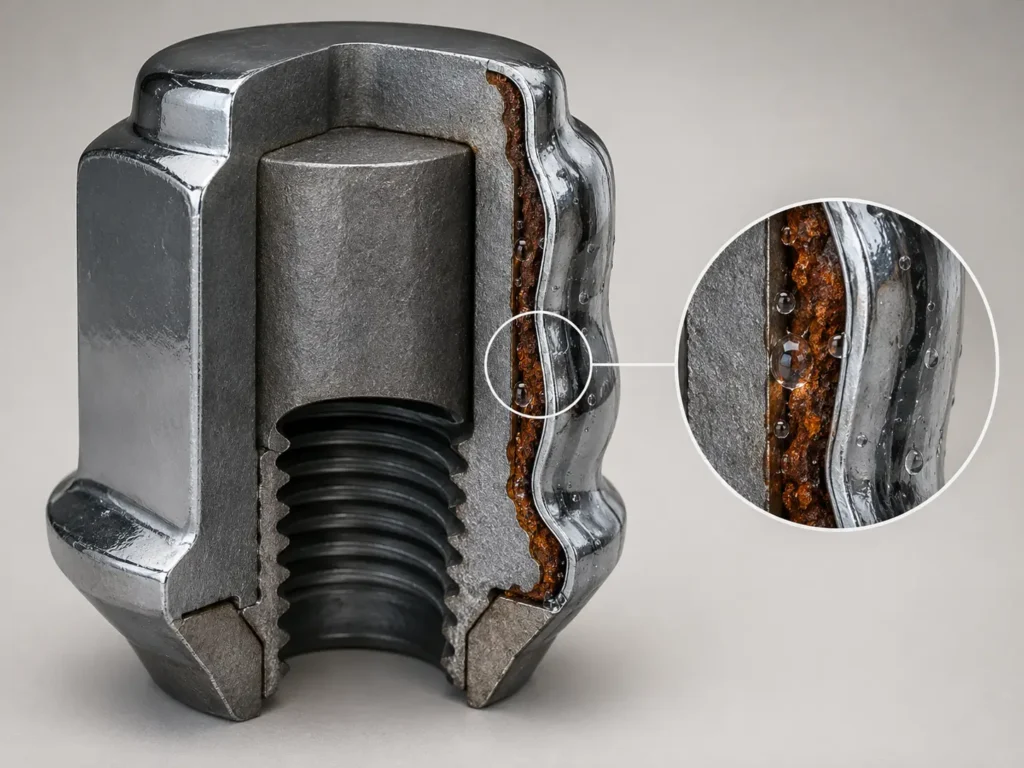
Undoubtedly, the most prevalent and deeply researched mechanical issue surrounding modern Ford F-150 lug nuts is the phenomenon of “swollen” fasteners. This engineering flaw has plagued millions of vehicles over the last decade.
For well over ten years, Ford utilized a highly controversial two-piece lug nut design across their entire truck and SUV lineup. This manufacturing decision resulted in widespread mechanical failure, stranded drivers, and intense consumer frustration.
The Anatomy of the Two-Piece Fastener Design
To significantly reduce bulk manufacturing costs while maintaining a premium aesthetic appearance, engineers designed a composite lug nut. At its structural core sits a standard, highly functional, but visually unappealing steel hex nut.
Over this structural core, a thin, decorative cap made from chrome, aluminum, or stainless steel is tightly crimped into place. On the showroom floor, these two-piece components appear completely identical to solid, high-quality one-piece chrome fasteners.
However, the composite design contains a fatal, inherent flaw: a microscopic physical seam exists where the outer cap meets the inner steel core. When these vehicles are exposed to harsh environmental factors, this seam becomes a critical vulnerability.
Specifically, rain, snow, and corrosive winter road salts easily penetrate this delicate microscopic seam. Once trapped inside the void between the cap and the core, the moisture initiates highly aggressive galvanic corrosion between the dissimilar metals.
As the internal steel core inevitably rusts, the iron oxide expands outward. Because the outer decorative chrome shell is relatively thin and malleable, the expanding internal rust pushes outward with immense force, causing the exterior cap to physically balloon.
This outward swelling alters the precise outer diameter of the lug nut significantly. It transforms a precision-machined 21mm hex head into an unrecognizable, distorted 21.5mm or 22mm metallic obstruction.
Roadside Hazards and Maintenance Nightmares
The practical, real-world consequences of swollen lug nuts are severe for the average motorist. In the event of a sudden flat tire, a driver stranded on the side of a busy highway will retrieve their factory-supplied 21mm lug wrench from the vehicle.
They quickly discover the standard tool physically cannot slide over the bloated, swollen nut. What should be a routine, ten-minute roadside tire change rapidly escalates into an expensive tow-truck recovery scenario.
Professional mechanics face similar daily frustrations in automotive service bays. Technicians attempting to force standard 21mm sockets onto the swollen nuts frequently round off the soft chrome edges entirely.
This completely strips the fastener, requiring highly destructive extraction methods involving air chisels or welding to remove the ruined nut from the stud. Furthermore, high-torque pneumatic impact wrenches rapidly accelerate this destruction during routine tire rotations.
According to industry professionals and master technicians, once a two-piece lug nut begins to swell or deform, it must be permanently discarded into the trash. Reusing these compromised fasteners severely degrades the safety of the wheel hub assembly.
Putting a swollen nut back on a vehicle merely passes a guaranteed catastrophic problem onto the next technician or the vehicle owner. Total replacement is the only viable mechanical solution.
The Hagens Berman Class Action Lawsuit
The systemic, widespread failure of these two-piece fasteners eventually culminated in high-profile legal action against the manufacturer. In 2017, the prominent automotive litigation firm(https://www.hbsslaw.com/) filed a massive class-action lawsuit against Ford.
The comprehensive 120-count legal complaint alleged that the swollen lug nuts caused undue financial hardship, safety hazards, and a reduction in overall vehicle value. The plaintiffs argued that the aesthetic cap delaminated and cracked so severely that it endangered public safety.
The suit detailed instances where even professional tow truck drivers, equipped with heavy-duty tools, could not remove the swollen hardware on the side of the road. They sought compensation for out-of-pocket replacement costs and expensive towing fees.
The plaintiffs demanded that the manufacturer be held financially liable for what they deemed a fundamentally defective and dangerous engineering design. However, the legal system ultimately did not rule in favor of the consumers.
In January 2019, U.S. District Court Judge Stephen Murphy dismissed the lawsuit entirely. The judge ruled that the plaintiffs lacked sufficient cross-state legal standing to bring claims under the varying consumer protection laws of all fifty states.
Furthermore, under the strict legal guidelines of the federal Magnuson-Moss Warranty Act, the plaintiffs failed to adequately prove the mechanical failures occurred within the specific timeframe and mileage limits of the manufacturer’s express warranty. Despite this legal dismissal, the mechanical reality of the swelling defect remains a massive, persistent issue for millions of F-150 owners.
Tooling Solutions: Flip Sockets and Half-Sizes
To combat this epidemic of swollen fasteners in service bays, the automotive tool industry rapidly developed specialized extraction equipment. Professional technicians now rely heavily on impact-rated “flip sockets” specifically machined to half-millimeter increments.
[Visual Plan: A simple engineering diagram illustrating a dual-ended flip socket. One end is prominently labeled 21mm (for standard, healthy nuts), and the opposite end is labeled 21.5mm (for swollen nuts). An internal 1/2-inch drive square sits exactly in the middle of the tool.]
These specialized socket sets typically feature precise combinations such as 19mm/21mm, 21mm/21.5mm, and 22mm/22.5mm. When an F-150 arrives in the bay with bloated, rusted hardware, the technician can simply flip their tool to the 21.5mm or 22mm side.
This slight oversize allows the socket to slide tightly over the expanded chrome cap without instantly rounding the fragile edges. It facilitates safe, non-destructive removal of the ruined hardware, saving hours of labor time.
Once removed, experts unanimously recommend replacing the entire set with high-quality aftermarket, one-piece cold-forged steel lug nuts. Solid steel variants from reputable brands like McGard, Gorilla, or Dorman completely eliminate the risk of cap delamination forever.
OEM vs. Aftermarket Lug Nuts: Seat Styles and Compatibility
A frequent catalyst for dangerous wheel vibration and hardware failure involves the improper pairing of lug nuts with wheel seat styles. Lug nuts are not universally interchangeable pieces of hardware; they are precision-machined components.
The bottom contact surface of the lug nut (known as the “seat”) must perfectly mirror the machined cavity drilled into the wheel hub. If these angles do not match exactly, clamping force is lost, and the wheel will eventually detach.
Understanding Lug Nut Seat Geometry
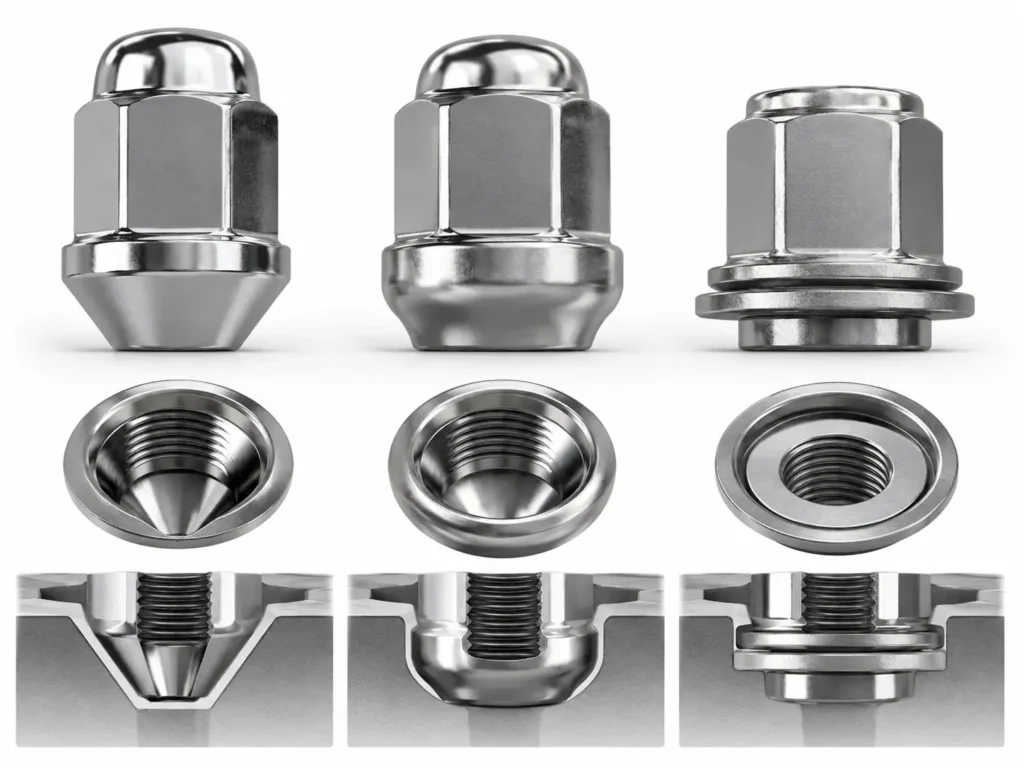
There are three primary geometric seat styles utilized in light-duty trucks and aftermarket wheels. The most common is the Conical Seat (Acorn), which features a precise 60-degree tapered bottom that self-centers the wheel precisely on the stud as the nut is tightened.
The second type is the Bulge Acorn, which is essentially a standard conical seat with an extended, significantly wider base ring. This bulge is designed specifically for heavy trucks like the F-150, distributing massive clamping force over a much larger surface area to prevent aluminum fatigue.
The third type is the Flat Seat (Mag Style), which features a completely flat, 90-degree bottom. This style typically utilizes an integrated or separate captive washer to apply pressure squarely and flatly against the wheel face, rather than wedging into a taper.
Factory OEM Ford F-150 lug nuts are almost exclusively engineered as cone seat (acorn or bulge acorn) fasteners. These specific 60-degree tapers are mathematically calculated by Ford engineers to match the OEM aluminum and steel wheels perfectly.
Transitioning to Aftermarket Wheels
When an F-150 owner upgrades from factory wheels to popular aftermarket variants (such as Fuel, Vossen, or KMC rims), the OEM lug nuts are frequently rendered completely obsolete.
Many modern aftermarket truck wheels are cast with incredibly deep, narrow lug pockets designed for visual depth and aesthetic sleekness. The thick, wide-bodied OEM bulge acorn nuts simply will not physically fit inside these narrow, recessed cavities.
Consequently, fitting aftermarket wheels often requires the purchase of specialized “spline drive” or “tuner style” lug nuts. These aftermarket fasteners are manufactured with a significantly thinner overall outer diameter to slide into the narrow wheel bores.
Furthermore, instead of a standard hex head, they feature a fluted exterior that requires a proprietary splined key adapter for installation and removal. This also provides a basic level of theft deterrence for expensive aftermarket rims.
If an incorrect seat style is utilized—for instance, attempting to force a standard conical nut into a flat mag-style wheel seat—the fastener will only make microscopic point-contact rather than full surface-contact.
This severe lack of physical friction causes the nut to back out and unthread almost immediately at highway speeds, creating a highly dangerous, life-threatening scenario. Therefore, verifying the specific seat requirement of any newly purchased rim is absolutely paramount before mounting.
Center Bore, Wheel Offset, and Hub-Centric Mechanics
In conjunction with proper bolt patterns and lug nut tapers, safe wheel fitment relies heavily on center bore dimensions and offset metrics. Modern F-150 platforms produced from 1997 straight through to 2026 maintain a highly consistent center hub bore measurement of 87.1 millimeters.
Hub-Centric vs. Lug-Centric Design Principles
Ford F-150s are meticulously designed with a “hub-centric” wheel mounting system. This engineering term means the precise 87.1mm center hole of the metal wheel fits intimately and tightly over the protruding circular lip of the vehicle’s axle hub.
In a hub-centric design, the massive physical weight of the truck rests entirely on that thick steel hub lip. The lug nuts themselves bear almost zero vertical weight; they merely provide the lateral clamping force necessary to keep the wheel pinned tightly against the brake rotor face.
When utilizing aftermarket wheels, the center bore is frequently machined much larger (e.g., 106mm or 110mm) by the manufacturer. They do this to ensure one wheel sku can fit a wider variety of truck brands, cutting down on manufacturing costs.
If installed as-is with a gap around the hub, the system becomes “lug-centric,” forcing the relatively thin 14mm wheel studs to bear the entire vertical crushing weight of the vehicle. This rapidly leads to stud shearing, metal fatigue, and violent steering wheel vibrations at highway speeds.
To safely correct this mismatch, technicians must install polycarbonate or machined aluminum hub-centric rings. These simple adapter rings fill the empty space, perfectly adapting the larger 110mm wheel bore back down to the exact 87.1mm Ford factory specification.
Understanding Wheel Offset Parameters
Offset determines exactly how far inward or outward the wheel centerline sits relative to the mounting hub face. Stock F-150 factory wheel offsets typically range from a positive +30mm to +44mm.
This high positive offset tucks the wheel deep inside the protective fender well. This optimizes aerodynamic drag, preserves delicate factory suspension geometry, and keeps mud and road debris safely contained inside the wheelhouse.
For owners lifting or leveling their trucks, custom aftermarket offset ranges expand dramatically, frequently reaching from -76mm to +44mm. A lower or negative offset (e.g., -12mm or -44mm) pushes the wheel aggressively outward, creating a much wider, aggressive stance.
While this enhances lateral stability and provides necessary clearance for oversized 35-inch mud-terrain tires, it severely alters the vehicle’s scrub radius. Pushing the heavy wheels outward acts as a mechanical fulcrum, exponentially increasing leverage and strain.
This leverage puts massive, unintended stress against the wheel bearings, ball joints, and specifically, the wheel studs. Thus, maintaining proper 150 ft-lb lug nut torque becomes even more critical on heavily modified trucks with high negative offsets, as the sheer forces are radically multiplied.
Wheel Stud Replacement Costs and Procedures
Despite adhering to all best practices, wheel studs frequently stretch, strip, or snap completely. Whether caused by a hurried tire shop using an over-torqued pneumatic impact gun, extreme off-road sheer forces, or cross-threading during hasty installation, replacing a broken stud is an inevitable reality for high-mileage F-150s.
Parts Cost vs. Labor Rate Breakdown
The physical wheel lug stud itself is a remarkably inexpensive component to purchase. High-quality replacement studs, cold-forged from tensile-tested carbon steel and treated for superior corrosion resistance, generally retail for just $3.00 to $20.00 each, depending on the manufacturer (e.g., Dorman, Yukon Gear).
However, the total financial cost of a stud replacement is driven almost entirely by mechanic labor rates. Depending on the exact model year and whether the broken stud is located on the front or rear axle, the repair complexity varies wildly.
Often, the massive brake caliper, the heavy brake rotor, and sometimes the entire sealed wheel hub assembly must be completely removed. This intensive teardown is required simply to provide the physical clearance necessary to press out the broken shank and press in the new hardware.
Industry aggregate repair data indicates that the average cost for a single Ford F-150 wheel lug stud replacement ranges between $77 and $106. Labor costs from independent shops are typically estimated between $60 and $89 for the procedure.
Meanwhile, the OEM-equivalent hardware parts average approximately $17. However, these baseline costs fluctuate heavily based on geographical location and whether the owner utilizes a certified dealership, which carries premium labor rates.
For instance, replacing a front passenger side wheel stud on a 2016 F-150 at a certified Ford dealership can see total repair invoices ballooning from $416 to over $550. This occurs if the factory service manual mandates complete hub removal or the shop bills at significantly higher hourly rates.
Consequently, many mechanically inclined truck owners treat wheel stud replacement as a weekend DIY procedure. Utilizing a standard C-clamp press or specialized stud-installer bearing tools, they can draw the new knurled stud tightly into the hub flange, saving hundreds of dollars in labor.
Torque Specifications and the Physics of Clamping Force
Correctly torquing wheel fasteners is an absolutely non-negotiable requirement for overall vehicle safety. Under-torquing a lug nut allows the heavy wheel to vibrate against the hub, eventually shearing the steel wheel studs and causing immediate, catastrophic wheel separation at speed.
Conversely, over-torquing a lug nut physically stretches the carbon steel stud beyond its elastic yield strength. This induces microscopic metal fractures deep within the threads, leading to sudden and unpredictable catastrophic failure when hitting a pothole.
The 100 ft-lbs vs. 150 ft-lbs Engineering Paradigm
The proper torque specification for any F-150 is entirely dependent on the physical diameter of the installed wheel stud. As a rigid, highly reliable rule of thumb, vehicles equipped with older 12mm or 1/2-inch studs strictly require 100 ft-lbs of torque.
In stark contrast, modern vehicles equipped with massive 14mm heavy-duty studs require a much higher 150 ft-lbs of torque. This massive 50% jump in required torque directly correlates to the increased tensile strength of the thicker 14mm steel shaft.
| Stud Diameter / Thread Pitch | Applicable F-150 Generations | Required Torque Specification |
| M14 x 1.5 (Fine Thread) | 2015–2026 (Gen 13 & 14) | 150 lb-ft (204 Nm) |
| M14 x 2.0 (Coarse Thread) | 2004–2014 (Gen 11 & 12) | 150 lb-ft (204 Nm) |
| M12 x 1.75 (Metric) | 1997–2003 (Gen 10 Base) | 100 lb-ft (135 Nm) |
| 1/2-20 SAE (Standard) | 1980–1996 (Gen 7, 8, 9) | 100 lb-ft (135 Nm) |
Professional Installation Methodology
Professional installation demands the strict use of a recently calibrated manual torque wrench. Fasteners must never be fully tightened using a pneumatic or heavy-duty electric impact gun, as these powerful devices simply cannot accurately regulate ultimate clamping force.
In modern, high-quality service bays, technicians utilize impact wrenches on their lowest possible settings merely to snug the nut gently against the wheel face. They then finalize the exact torque by hand in a crisscross or star-pattern sequence.
This alternating star pattern ensures the wheel is pulled perfectly flat against the rotor face, preventing brake rotor warpage and steering wheel shimmy. Furthermore, metallurgical settling requires a crucial, widely ignored follow-up procedure known as the re-torque.
According to official Ford manufacturer service data, technicians must explicitly instruct owners to re-torque all lug nuts after the vehicle has been driven approximately 50 to 100 miles. During this initial break-in driving period, extreme thermal expansion from brake heat and kinetic vibrations cause the wheel assembly to shift microscopically.
This mechanical settling process frequently causes initial torque values to drop significantly, loosening the wheel. Making the 100-mile manual re-torque a mandatory safety protocol ensures the clamping force remains permanent.
Prior to any wheel installation, the wheel pilot bore and hub mounting surfaces must be meticulously inspected and cleaned. Any visible corrosion, rust scale, or loose particulate matter trapped between the rotor face and the wheel hub will create a false, premature torque reading.
When that trapped debris eventually pulverizes into dust and falls out during highway driving, the wheel will immediately lose its clamping force and loosen. A simple wire brush cleaning of the hub face prevents this entirely.
F-150 Lug Nut FAQs: People Also Ask
To further synthesize the vast array of mechanical data surrounding this topic, addressing the exact queries of F-150 owners provides highly actionable insights. This section covers the most critical semantic search questions related to F-150 wheel hardware.
What size socket is required to remove Ford F-150 lug nuts?
The required socket size is entirely dependent on the specific generation of the truck you are servicing. All modern F-150s produced from 2004 through 2026 utilize a 21mm hex size, requiring a standard 6-point 21mm socket.
For older models manufactured between the years 1997 and 2003, a smaller 19mm (or 3/4-inch equivalent) socket is strictly required. Classic trucks built prior to the 1997 redesign require a larger 13/16-inch socket.
Why does a standard 21mm socket suddenly not fit my 2018 F-150 lug nuts?
If a high-quality 21mm socket no longer fits onto a 2004+ F-150, the vehicle is actively suffering from the notorious “swollen lug nut” manufacturing defect. The factory two-piece design allows acidic moisture to penetrate beneath the outer chrome cap, causing the internal steel core to rust rapidly.
This internal rust expansion physically balloons the outer cap outward, permanently changing its overall diameter to roughly 21.5mm or even 22mm. Specialized half-size flip-sockets are required to remove them safely without stripping them entirely.
Are all Ford F-150 wheel bolt patterns exactly the same?
No, Ford has utilized four completely distinct bolt patterns over the last four decades of truck production. From 1980 to 1996, the universal pattern was a 5-lug 5×139.7mm (commonly referred to as 5×5.5″).
From 1997 to 2003, it changed abruptly to a unique metric 5-lug 5x135mm pattern. From 2004 to the present day, the heavily standardized pattern is a 6-lug 6x135mm layout. A highly rare 7-lug 7x150mm pattern was also briefly used from 2000 to 2003 on Heavy Duty 7700 payload models.
Is it mathematically safe to reuse swollen lug nuts after they have been removed?
Under absolutely no circumstances should swollen, delaminated, or physically damaged two-piece lug nuts be reused on a vehicle. The structural and metallurgical integrity of the fastener is entirely compromised once swelling occurs.
The outer cap is highly likely to spin independently of the steel core during the next torque sequence, leaving the nut permanently stuck on the stud. They should be immediately discarded into the trash and replaced with solid, one-piece aftermarket lug nuts made of durable cold-forged steel.
Can Ford F-150 Lightning EV wheels be installed on a gas-powered F-150?
Yes, Ford specifically engineered the all-electric F-150 Lightning to share major chassis components with its gas counterparts. It utilizes the exact same 6x135mm bolt pattern, 87.1mm center bore, and M14x1.5 lug nut thread pitch as the modern 14th generation gas and hybrid models.
This brilliant engineering decision ensures complete wheel cross-compatibility between EV and internal combustion trims. Owners can easily swap factory rims between a 5.0L V8 model and a Lightning without buying new hardware.
What is the precise thread pitch for a 2024 Ford F-150 Raptor R?
Despite its extreme horsepower and desert-racing suspension, the 2024 Ford Raptor R utilizes the standard 14th generation thread pitch, which is M14x1.5. It also retains the standard 6x135mm bolt pattern.
However, due to the specialized factory beadlock-capable wheels, the Raptor R requires a much wider “bulge acorn” seat style to properly distribute clamping force. Standard aftermarket conical nuts will fail to seat safely in the deep Raptor wheel bore.
How do I know if my 2002 F-150 has 12mm or 14mm wheel studs?
The easiest way to determine stud size on a transitionary 10th-generation F-150 (especially 7700 payload models) is to check the required socket size. If the factory lug nut requires a 19mm (3/4″) socket, the truck is equipped with standard 12mm studs requiring 100 ft-lbs of torque.
If the factory lug nut requires a larger 21mm socket, the truck has been equipped with the upgraded heavy-duty 14mm studs. These thicker studs demand a much higher 150 ft-lbs of torque to ensure safe operation.
Strategic Summary and Preventative Maintenance Directives
The mechanical progression of the Ford F-150’s wheel fasteners serves as a microscopic lens into broader trends in modern automotive engineering. As consumer market demands forced the standard half-ton truck to adopt heavy-duty towing metrics previously reserved for the F-250 Super Duty class, the physical architecture of the wheel hub was forced to bulk up massively in response.
The historical journey from the standard SAE 1/2-20 threads on a five-lug hub, through the awkward transitionary phase of the 1990s metric sizing, illustrates constant innovation. Finally settling on the incredibly robust 6x135mm pattern with 14mm thick studs demonstrates a relentless, calculated pursuit of payload security and passenger safety.
The recent refinement from a 2.0 coarse thread pitch down to a 1.5 fine thread pitch on the modern aluminum-body trucks highlights an ongoing commitment to mitigating vibrational loosening. Finer threads simply hold tighter under extreme stress, a necessity for trucks towing 13,000-pound trailers.
However, this mechanical evolution has certainly not been without significant, costly missteps. The widespread adoption of two-piece cosmetic chrome lug nuts created an enduring, decade-long maintenance crisis for consumers and mechanics alike.
This design flaw severely damaged the brand’s reputation for rugged reliability, particularly in harsh, salt-heavy winter climates where corrosion runs rampant. While the federal legal systems ultimately failed to provide a class-action financial remedy for the massive consumer base , the robust aftermarket industry has successfully bridged the gap.
Companies like(https://www.bonoss.com/f150-lug-nuts-ljh307.html) and Gorilla provide highly durable, single-piece forged steel replacements that cure the swelling defect permanently. Swapping out factory two-piece nuts for solid aftermarket equivalents is now considered a mandatory preventative maintenance upgrade by seasoned F-150 veterans.
For commercial fleet managers, professional mechanics, and private owners, absolute vigilance regarding torque specifications remains the ultimate safety mandate. Applying exactly 150 ft-lbs of clamping force to modern M14 studs—and rigorously ensuring a proper 100-mile re-torque—is the defining factor between safe highway operation and catastrophic wheel separation.
By cross-referencing precise model years against exact thread pitches, seat styles, and hub bore dimensions, F-150 operators can ensure their vehicles remain securely grounded. With the correct hardware and diligent maintenance practices, the Ford F-150’s wheel assemblies will easily last the entirety of the truck’s grueling operational lifespan.