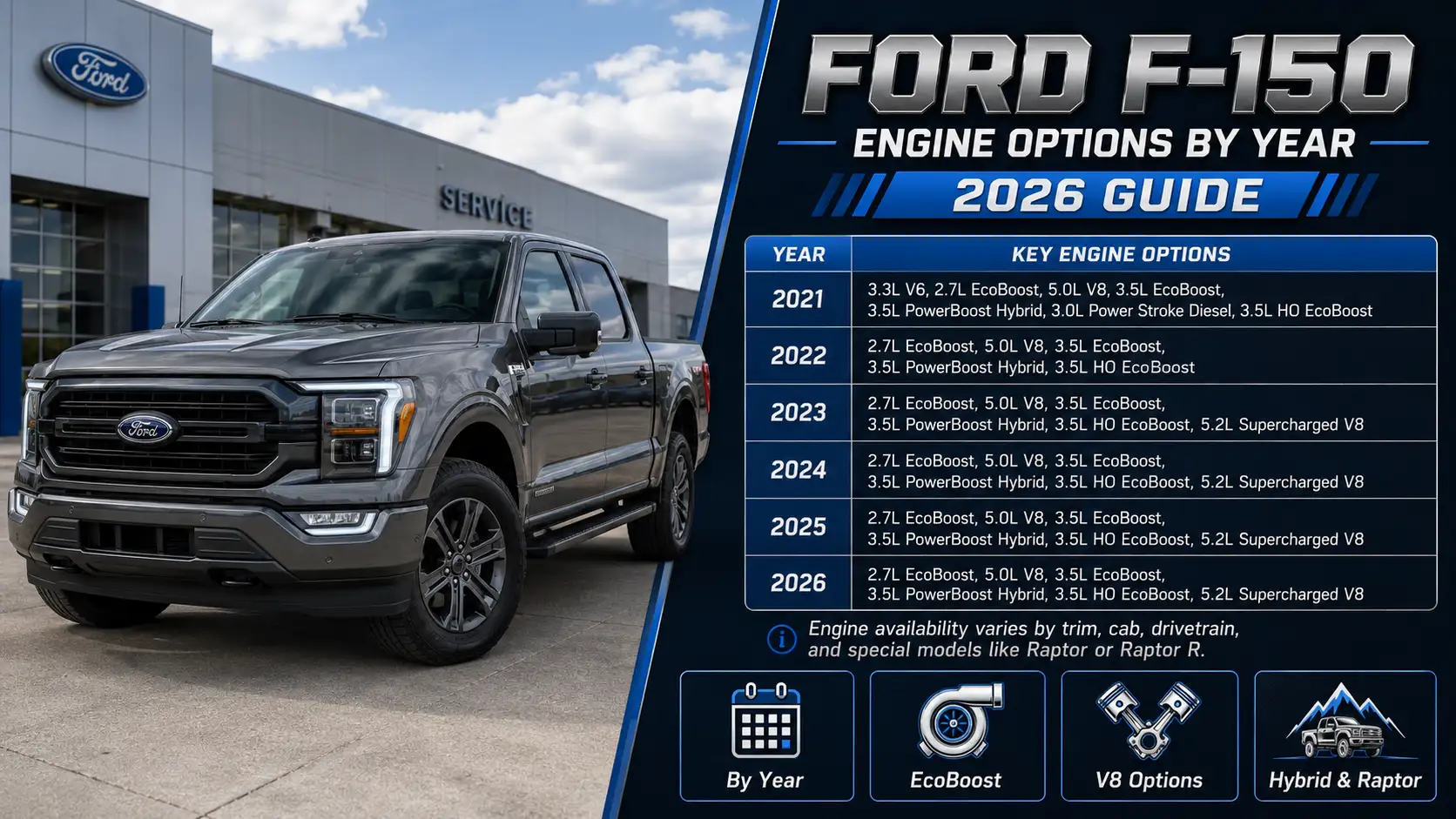
Ford F-150 Engine Options by Year Chart – 2026

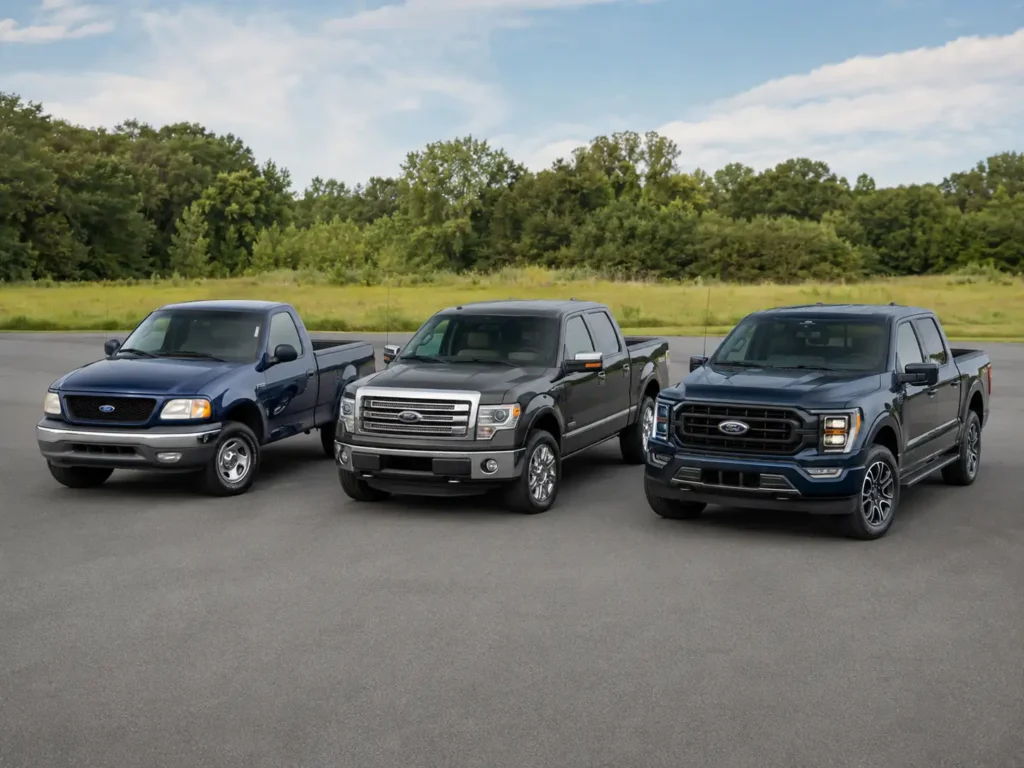
The Ford F-150 has offered more than a dozen distinct engine configurations across six generations since 1997, ranging from the naturally aspirated 4.2L Essex V6 to the 720 HP supercharged 5.2L Raptor R. Four major generation shifts drove engine lineup changes: 1997, 2004, 2011, and 2015 each brought entirely new powertrains rather than incremental updates.
This chart covers every F-150 engine option by model year from 1997 through 2026, organized by generation with verified horsepower and torque figures. Whether you’re shopping a used F-150 or tracking down specs for a repair job, this is the only reference you need.

Prime for Young Adults — 6 Months Free
Students and 18–24s get six months of Prime free, then half price.
Start 6 Months Free As an Amazon Associate I earn from qualifying purchases.Ford F-150 engine options by year from 1997 to 2026, showing horsepower and generation changes across six generations.
Recommended Best Deal Products


Ford F-150 engine options by year
Six generations · 1997–2026 · horsepower bars scaled to 720 HP max
Peak horsepower milestone by generation
Ford F-150 Engine Options by Year 1997 to 2026
Recommended Best Deal Products


Use this chart to find your model year’s engine options, horsepower, and torque at a glance. Years are grouped by generation because the lineup stays consistent within each generation block.
| Years | Engine | HP | Torque (lb-ft) | Notes |
|---|---|---|---|---|
| Generation 10 — 1997–2003 (Triton Modular Era Begins) | ||||
| 1997–2003 | 4.2L Essex V6 | 202–205 | 252–260 | Base engine; retired after 2008 |
| 1997–2003 | 4.6L Modular V8 (2v) | 220–231 | 265–293 | PI heads added 1999–2001; power bumped to 231 HP |
| 1997–2003 | 5.4L Modular V8 (2v) | 235–260 | 330–350 | 235 HP for 1997–98; 260 HP from 1999 with PI heads |
| Generation 11 — 2004–2008 (3-Valve Triton Upgrade) | ||||
| 2004–2008 | 4.2L Essex V6 | 202 | 260 | Carried over from Gen 10; dropped after 2008 |
| 2004–2008 | 4.6L Modular V8 (2v) | 231–248 | 293 | Power increased to 248 HP for 2008 model year |
| 2004–2008 | 5.4L Triton V8 (3v) | 300 | 365 | New 3-valve heads in 2004; VCT added; major upgrade over 2v |
| Generation 12 Phase 1 — 2009–2010 (Triton V8 Only) | ||||
| 2009–2010 | 4.6L Modular V8 (2v) | 248 | 294 | Base engine; no V6 offered 2009–2010 |
| 2009–2010 | 4.6L Modular V8 (3v) | 292 | 320 | Optional upgrade over 2v; same displacement, higher output |
| 2009–2010 | 5.4L Triton V8 (3v) | 310 | 365 | Top engine option; final generation of the Triton V8 in F-150 |
| Generation 12 Phase 2 — 2011–2014 (EcoBoost Arrives) | ||||
| 2011–2014 | 3.7L Ti-VCT V6 | 302 | 278 | New base engine; replaced aging 4.6L; 6-speed auto standard |
| 2011–2014 | 5.0L Ti-VCT V8 (Coyote) | 360 | 380 | All-new Coyote V8; replaced the 4.6L and 5.4L Triton |
| 2011–2014 | 3.5L EcoBoost V6 (Gen 1) | 365 | 420 | First EcoBoost Twin-turbo; outperformed the 5.0L V8 in towing |
| 2011–2014 | 6.2L V8 | 411 | 434 | SVT Raptor standard and available on heavy-payload trims only |
| Generation 13 — 2015–2020 (Aluminum Body; Diesel Added 2018) | ||||
| 2015–2017 | 3.5L Ti-VCT V6 | 282 | 253 | Base engine for 2015–2017; dropped when 3.3L took over in 2018 |
| 2015–2020 | 2.7L EcoBoost V6 | 325 | 375–400 | New 2015 “Pocket Hercules”; torque upgraded to 400 lb-ft in 2018 refresh |
| 2015–2020 | 5.0L Ti-VCT V8 (Coyote) | 385–395 | 387–400 | 385 HP / 387 lb-ft for 2015–2017; 395 HP / 400 lb-ft from 2018 |
| 2015–2020 | 3.5L EcoBoost V6 (Gen 2) | 365–375 | 420–470 | Gen 2 updated in 2017 with 10-speed auto; torque jumped to 470 lb-ft |
| 2017–2020 | 3.5L HO EcoBoost V6 | 450 | 510 | Raptor and F-150 Limited only; high-output twin-turbo variant |
| 2018–2020 | 3.3L Ti-VCT V6 | 290 | 265 | New 2018 Replaced 3.5L NA V6 as base engine; paired with 6-speed auto |
| 2018–2020 | 3.0L Power Stroke Diesel V6 | 250 | 440 | Diesel First light-duty diesel F-150; discontinued after 2021 model year |
| Generation 14 Phase 1 — 2021–2023 (Hybrid and Raptor R Launch) | ||||
| 2021–2023 | 3.3L Ti-VCT V6 | 290 | 265 | Base engine for 2021–2023; dropped after 2023 model year |
| 2021–2026 | 2.7L EcoBoost V6 | 325 | 400 | Becomes new base engine starting 2024 when 3.3L is retired |
| 2021–2026 | 5.0L Ti-VCT V8 (Coyote) | 400 | 410 | Updated to 400 HP for Gen 14; best-in-class payload capability |
| 2021–2026 | 3.5L EcoBoost V6 (Gen 3) | 400 | 500 | Max towing engine; up to 13,500 lb when properly equipped |
| 2021–2026 | 3.5L PowerBoost Hybrid V6 | 430 | 570 | Hybrid Gas + electric; best fuel economy; 12,700 lb max towing |
| 2021–2026 | 3.5L HO EcoBoost V6 (Raptor) | 450 | 510 | Raptor only; high-output twin-turbo |
| 2023–2026 | 5.2L Supercharged V8 (Raptor R) | 720 | 640 | Raptor R Most powerful factory F-150 ever built |
How F-150 Engines Changed Across 6 Generations
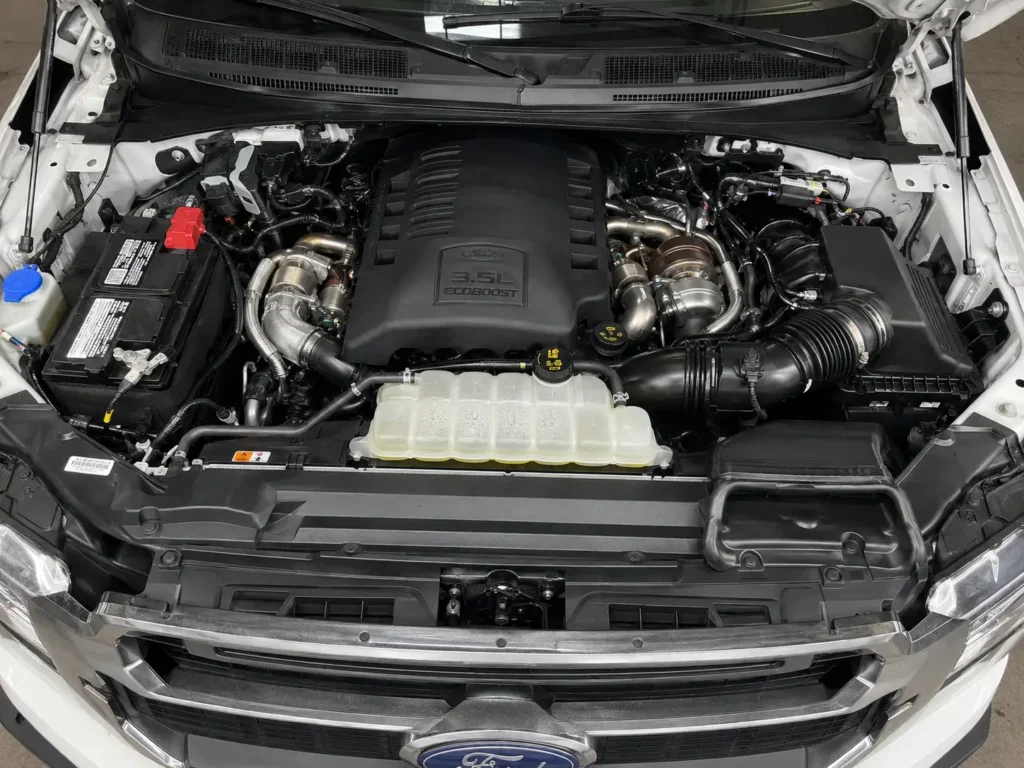
Gen 10 and 11 — The Triton V8 Era (1997–2010)
The 1997 F-150 introduced Ford’s Modular overhead-cam engine family to the truck lineup. The 4.6L and 5.4L Triton V8s defined this era, with the 2-valve design giving way to 3-valve heads in 2004. The 5.4L received its major upgrade in 2004, pushing output to 300 HP at 5,000 rpm and 365 lb-ft of torque at 3,750 rpm. The 4.2L Essex V6 carried through both generations as the budget option before Ford retired it after 2008.
One known issue to flag for buyers: 1997 through 2008 model year Modular engines have a documented history of spark plug threads stripping in the aluminum cylinder heads, a defect Ford acknowledged in multiple service bulletins.
Gen 12 — The EcoBoost Turning Point (2011–2014)
The 2011 F-150 was the year Ford bet on turbocharged V6s, and it paid off. Four all-new engines launched simultaneously: the 3.7L V6, the 5.0L Coyote V8, the 3.5L EcoBoost V6, and the 6.2L V8. The first-generation 3.5L EcoBoost debuted with 365 HP and 420 lb-ft of torque, numbers that were staggering for a V6 at the time.
For owners running a 2011–2014 3.5L EcoBoost, cam phaser wear is the most common long-term maintenance issue. Our full breakdown of 3.5L EcoBoost cam phaser replacement covers symptoms, costs, and the repair procedure in detail.
Gen 13 — Aluminum Body and the Diesel Option (2015–2020)
The 2015 F-150 shed nearly 700 lbs through its aluminum-intensive body, making every engine option feel more responsive without changing a single displacement figure. Ford introduced the 2.7L EcoBoost as an all-new option that year, a twin-turbo V6 that quickly became a fleet favorite. In 2018, the lineup expanded with the 3.0L Power Stroke diesel, which delivered 250 HP and 440 lb-ft. The diesel was discontinued after the 2021 model year.
The 2017 refresh updated the 3.5L EcoBoost to a second-generation tune, adding the 10-speed automatic and boosting torque to 470 lb-ft. That 2017-and-later second-gen 3.5L is a meaningfully different engine from the 2011–2016 version.

Audible — Listen Free for 30 Days
One free credit a month and thousands of titles included.
Listen Free for 30 Days As an Amazon Associate I earn from qualifying purchases.Gen 14 — Hybrid, Raptor R, and the Diesel Exit (2021–2026)
The current generation launched in 2021 with the 3.5L PowerBoost Hybrid as a major new option, pairing the proven 3.5L EcoBoost with an integrated electric motor for 430 HP and 570 lb-ft. Ford’s official specs place the 5.0L V8 at 400 HP and 410 lb-ft for the Gen 14 trucks, with the 3.5L EcoBoost reaching 400 HP and 500 lb-ft. The 3.3L V6 was dropped after 2023, making the 2.7L EcoBoost the new entry engine for the 2024 model year and beyond.
Which F-150 Engine to Choose When Buying Used
Recommended Best Deal Products


If you’re shopping a used F-150, the engine year matters as much as the mileage. Here is how the major options stack up for real-world use.
Best for Daily Driving and Fuel Economy
The 2.7L EcoBoost from 2015 onward hits the sweet spot for daily drivers. At 325 HP and 375–400 lb-ft, it hauls and tows without the cam phaser complexity found in the early 3.5L. Look for a 2018 or newer example to get the revised tune and 10-speed automatic.
Best for Towing and Payload
The second-generation 3.5L EcoBoost in 2017 and later trucks is the towing king. With 470 lb-ft in Gen 13 trim and 500 lb-ft in Gen 14, no naturally aspirated gas engine in this class keeps up. If towing capacity is your priority, pairing this engine with the Max Trailer Tow Package is where the numbers get serious. Check the full F-150 towing capacity by year chart to confirm ratings for your specific year and configuration.
Best for Long-Term Simplicity
The 5.0L Coyote V8 from 2011 onward is the no-turbos choice for owners who want to keep maintenance straightforward. No intercoolers, no cam phasers to chase, no turbo seals. The Gen 14 version at 400 HP and 410 lb-ft is the strongest iteration yet. Before any purchase, verify your oil spec against the Ford engine oil recommendation chart since the Coyote has specific viscosity requirements that vary by year.
Best for Budget Buyers
A clean 2004–2008 5.4L Triton with the 3-valve head is still a capable working truck and prices have softened considerably. Confirmed output is 300 HP and 365 lb-ft. The catch: the 5.4L 3-valve has a documented history of stuck spark plugs due to carbon deposit buildup in the plug bore, so budget for that maintenance. Avoid the 2009–2010 4.6L 3-valve if you need serious towing; the 248–292 HP range is thin for loaded trailer work.
Final Thoughts on F-150 Engine Options by Year
The Ford F-150 engine options by year chart above covers every generation from 1997 through 2026 across more than 20 distinct powertrains. What the data shows clearly is that generation context matters as much as the raw engine name. A 3.5L EcoBoost from 2012 and a 3.5L EcoBoost from 2019 are meaningfully different trucks, and the same applies to the 5.4L Triton between its 2v and 3v eras.
Use the chart to confirm what engine your specific year came with, then research that engine’s known issues before making a purchase or starting a repair. The generation breakdown above is the fastest path to understanding what you are actually working with under the hood.
F-150 Engine Options by Year — Frequently Asked Questions
What Engines Did the Ford F-150 Have in 2011?
The 2011 F-150 launched with four all-new engines simultaneously: the 3.7L Ti-VCT V6 at 302 HP, the 5.0L Ti-VCT V8 at 360 HP, the twin-turbo 3.5L EcoBoost V6 at 365 HP, and the 6.2L V8 at 411 HP. It was the most complete engine overhaul in F-150 history up to that point. All four were paired with a new 6-speed automatic transmission.
When Did Ford First Offer the EcoBoost in the F-150?
Ford introduced the 3.5L EcoBoost V6 in the F-150 for the 2011 model year. It debuted with 365 HP and 420 lb-ft of torque, making it more powerful than the 5.0L V8 in torque output from launch. The engine carried through largely unchanged until 2017, when a second-generation version with the 10-speed automatic raised torque to 470 lb-ft.
Audible Premium Plus — Annual Membership
12 audiobook credits up front, plus the full Audible catalogue.
See Annual Plans As an Amazon Associate I earn from qualifying purchases.What Is the Most Reliable F-150 Engine Across All Years?
The 5.0L Coyote V8 from 2011 onward is widely regarded as the most reliable long-term choice because it uses no turbochargers or cam phaser assemblies prone to early wear. The 2.7L EcoBoost from 2015 onward also has a strong track record in real-world owner data, particularly the post-2018 updated tune. Both engines have logged documented 200,000-plus mile examples on f150forum.com.
Did the Ford F-150 Ever Come with a Diesel Engine?
Yes. Ford offered the 3.0L Power Stroke turbodiesel V6 in the F-150 from 2018 through the 2021 model year. It produced 250 HP and 440 lb-ft of torque and delivered EPA-estimated 30 MPG highway, the best fuel economy in the F-150 lineup at the time. Ford discontinued the diesel after 2021 and has not reintroduced it in the current generation.
What Engine Does the 2024 Ford F-150 Come With as Standard?
The 2024 F-150 dropped the 3.3L V6 base engine and made the 2.7L EcoBoost V6 the new standard powertrain across the XL, STX, and XLT trims. It produces 325 HP and 400 lb-ft of torque. For owners who need maximum capability, the F-150 payload capacity chart breaks down how payload ratings vary across all 2024 engine and trim combinations.