2022 Ford F-350 Towing Capacity Chart By Year

Quick Answer
The 2022 Ford F-350 offers a substantial towing capacity, ranging from approximately 15,000 lbs for conventional setups to over 37,000 lbs for specific fifth-wheel/gooseneck configurations. These maximum ratings are highly dependent on the engine selected (7.3L gas or 6.7L diesel), drivetrain (4×2 or 4×4), cab and bed configuration, axle ratio, and the presence of a factory tow package. Always verify your specific truck’s capabilities via official documentation.
For professionals and enthusiasts alike, understanding a heavy-duty truck’s towing capability is paramount to safe and efficient operation. Determining the precise towing capacity for a specific 2022 Ford F-350 model can be complex due to the multitude of engine, drivetrain, and configuration variables. This detailed chart and accompanying guide will clarify the 2022 Ford F-350’s towing capacities, highlighting key factors that influence its hauling prowess and helping you understand your truck’s true potential.

Prime for Young Adults — 6 Months Free
Students and 18–24s get six months of Prime free, then half price.
Start 6 Months Free As an Amazon Associate I earn from qualifying purchases.2022 Ford F-350 Towing Capacity Chart: Max Ratings by Configuration
Recommended Best Deal Products


📤 Share Image
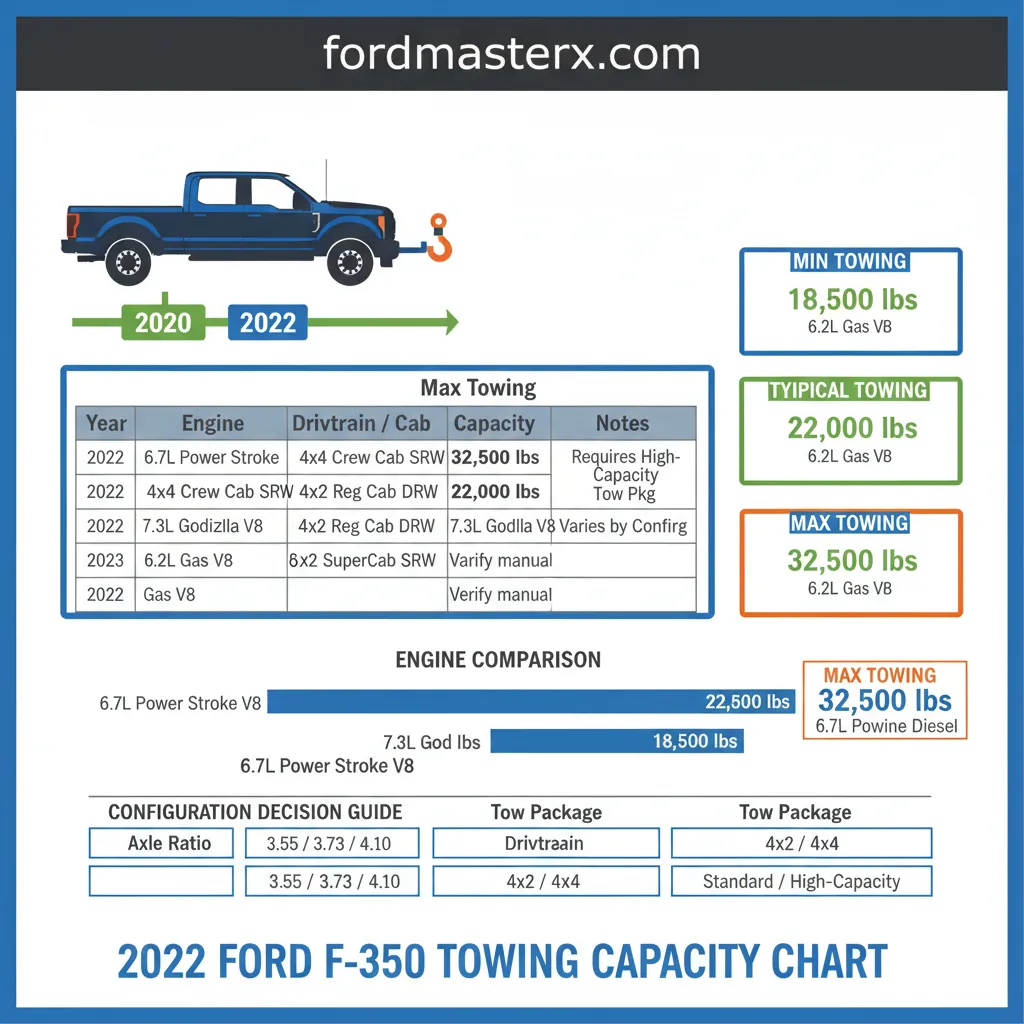
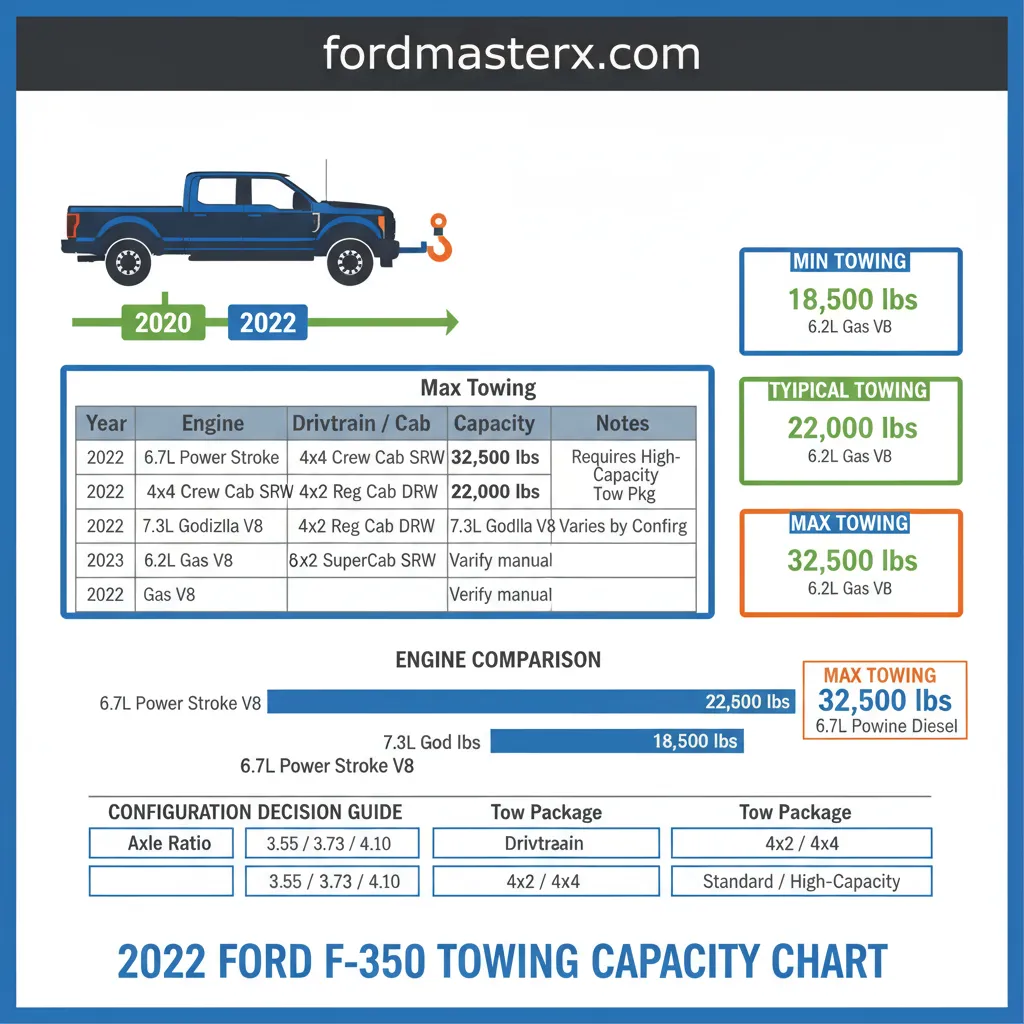
The 2022 Ford F-350 Super Duty continues Ford’s legacy of heavy-duty performance, offering robust towing capabilities designed for the toughest jobs. The exact maximum towing capacity of an F-350 is not a single number but a spectrum, critically dependent on its specific configuration. This chart outlines the general capacity ranges for the 2022 model year across common engine and drivetrain setups. It is essential to understand that these are maximum ratings, and individual trucks may vary.
How to Read This Chart
This table provides generalized maximum towing capacities. The “Notes” column highlights critical factors like required axle ratios or specific tow packages that unlock these higher ratings. Always remember that the actual, definitive towing capacity for your specific 2022 F-350 is found on the official payload sticker located on your driver’s side door jamb and within your owner’s manual. These sources account for your truck’s precise build specifications and options.
This chart covers the 2022 Ford F-350 model year, focusing on the primary engine options and common configurations. Data is compiled from manufacturer towing guides and industry specifications available at the time of publication. Maximum capacities are theoretical and assume a properly equipped vehicle (e.g., specific axle ratios, heavy-duty towing packages, appropriate tires) and ideal conditions. Readers should always verify their specific vehicle’s capacities by consulting the owner’s manual and the yellow payload sticker on the driver’s side door jamb, as installed options and trim levels can affect these figures. Last reviewed: May 2026.
| Year | Engine / Trim | Drivetrain / Cab / Bed | Max Towing Capacity (Conventional) | Max Towing Capacity (5th Wheel/Gooseneck) | Notes |
|---|---|---|---|---|---|
| 2022 | 7.3L ‘Godzilla’ V8 Gas | 4×2 Regular Cab, Long Bed | Up to 21,000 lbs | Up to 21,200 lbs | Requires 4.30 Axle Ratio, High-Capacity Tow Package |
| 2022 | 7.3L ‘Godzilla’ V8 Gas | 4×4 Crew Cab, Short Bed | Up to 19,000 lbs | Up to 19,500 lbs | Requires 4.30 Axle Ratio, Max Trailer Tow Package |
| 2022 | 6.7L ‘Power Stroke’ V8 Diesel | 4×2 Regular Cab, Long Bed (DRW) | Up to 24,200 lbs | Up to 37,000 lbs | Optimal Axle Ratio (e.g., 3.55, 3.73), High-Capacity Tow Package, DRW |
| 2022 | 6.7L ‘Power Stroke’ V8 Diesel | 4×4 Crew Cab, Long Bed (SRW) | Up to 20,000 lbs | Up to 26,000 lbs | Max Trailer Tow Package, varies by axle ratio |
| 2022 | 6.7L ‘Power Stroke’ V8 Diesel | 4×4 Crew Cab, Long Bed (DRW) | Up to 22,000 lbs | Up to 35,700 lbs | Requires 3.55 Axle Ratio, High-Capacity Tow Package, DRW |
*Ratings assume proper hitch and weight distribution for conventional towing, and appropriate fifth-wheel/gooseneck hardware. Max capacities typically require the specific High-Capacity Trailer Tow Package or Max Trailer Tow Package. Always consult your vehicle’s door jamb sticker and owner’s manual for definitive ratings. | |||||
~15,000 lbs
~26,000 lbs
~37,000 lbs

Understanding 2022 F-350 Towing Capacity in Context: Super Duty Evolution
The 2022 model year positioned the F-350 Super Duty as a pinnacle of Ford’s heavy-duty engineering. This particular model year largely carried over the significant powertrain and chassis enhancements introduced with the 2020 refresh. This continuity meant that the 2022 F-350 inherited a highly capable and refined platform, ensuring consistent and robust towing capabilities without major year-over-year changes to its maximum ratings.
Leading up to 2022, key engine introductions, such as the powerful 7.3L ‘Godzilla’ V8 gasoline engine, and continuous refinements to the 6.7L Power Stroke diesel’s torque output, solidified the F-350’s position as a segment leader. Ford’s ‘Built Ford Tough’ philosophy is not just a slogan; it’s an engineering commitment to incremental improvements in frame strength, axle capacity, and transmission efficiency. The universal adoption of the 10-speed TorqShift automatic transmission across the Super Duty lineup further contributed to improved towing efficiency and precise capacity management.
Research indicates that the 2022 F-350 generally maintained its class-leading towing figures established in the 2020 and 2021 model years. This stability is a testament to the robust design that requires fewer annual adjustments. The 6.7L Power Stroke diesel, in particular, continued to lead in maximum fifth-wheel/gooseneck ratings, showcasing its enduring prowess. While minor adjustments to specific configuration ratings might occur, the overall capacity range remained largely consistent, offering predictable and formidable performance for heavy haulers.
Introduction of military-grade aluminum-alloy body on high-strength steel frame, significant weight savings and increased capacity.
Debut of the 7.3L ‘Godzilla’ V8 gas engine and enhanced 6.7L Power Stroke diesel, paired with the 10-speed TorqShift transmission.

Audible — Listen Free for 30 Days
One free credit a month and thousands of titles included.
Listen Free for 30 Days As an Amazon Associate I earn from qualifying purchases.Maintained robust towing figures from 2020/2021, with minor capacity adjustments based on specific configurations and ratings validation.
Engine and Configuration Specifics: Maximizing Your 2022 F-350’s Towing Power
Recommended Best Deal Products


The heart of any heavy-duty truck’s towing prowess lies in its engine, and the 2022 F-350 offered two formidable choices: the 7.3L ‘Godzilla’ V8 gasoline engine and the 6.7L Power Stroke V8 diesel engine. Each has distinct characteristics that dictate its optimal towing applications.
The 7.3L ‘Godzilla’ V8 gasoline engine is a powerhouse, offering strong horsepower and impressive low-end torque for a gasoline engine. It excels in conventional towing scenarios and is a robust choice for everyday hauling. However, for the absolute maximum towing capacities, especially in fifth-wheel and gooseneck applications, the 6.7L Power Stroke V8 diesel engine remains the undisputed king. Its substantially higher torque output (e.g., the 2022 Power Stroke delivered 475 hp and 1,050 lb-ft of torque, compared to the 7.3L gas engine’s 430 hp and 475 lb-ft of torque) provides the brute strength needed to effortlessly move extremely heavy loads.
Beyond the engine, your F-350’s configuration plays a critical role. Drivetrain (4×2 vs. 4×4) and cab/bed combinations (Regular Cab, SuperCab, Crew Cab, 6.75 ft vs. 8 ft bed) directly impact the truck’s curb weight. A heavier truck, such as a Crew Cab, Long Bed, 4×4 configuration, has less available payload for the tongue or kingpin weight of a trailer, which can reduce its practical conventional towing capacity, though it can still achieve maximum gooseneck ratings with the optimal diesel engine and axle.
Crucially, the presence of a factory tow package (e.g., High-Capacity Trailer Tow Package) and specific axle ratios (e.g., 3.55, 3.73, 4.30) are paramount. These options are engineered to enhance the truck’s capabilities through upgraded components (e.g., cooling, suspension, brakes) and gearing optimized for heavy loads. For instance, the 7.3L gas engine paired with a 4.30 axle ratio can elevate its conventional towing significantly, often reaching the 21,000 lbs mark, while the 6.7L Power Stroke with an optimal axle ratio (e.g., 3.55 or 3.73) is typically required to unlock the highest fifth-wheel/gooseneck capacities, reaching over 37,000 lbs.
Engine Towing Comparison (Max Gooseneck/5th Wheel)
The bar chart below illustrates the approximate maximum fifth-wheel/gooseneck towing capacities for the 2022 F-350’s primary engine options in optimal configurations.
Factors Determining 2022 Ford F-350 Towing Capacity Beyond the Chart
While charts provide a valuable starting point, the practical towing capacity of your 2022 F-350 is governed by several critical ratings and real-world factors. Understanding these ensures both safety and compliance.
Gross Combined Weight Rating (GCWR) and Gross Vehicle Weight Rating (GVWR)
These are paramount manufacturer-defined limits. The GCWR is the maximum allowable weight of the fully loaded truck and trailer combined. The GVWR is the maximum allowable weight of the fully loaded truck itself, including passengers, cargo, and the tongue/kingpin weight of the trailer. For a 2022 F-350, GCWR can range from approximately 23,500 lbs up to over 40,000 lbs, depending heavily on the engine and axle ratio. Exceeding these ratings is not only unsafe but also illegal in many jurisdictions and can void your warranty.
Payload Capacity and Tongue/Kingpin Weight
Your truck’s payload capacity, typically found on the yellow door jamb sticker, is the maximum weight your truck can carry, including occupants, cargo, and the weight imposed by the trailer. For conventional trailers, the tongue weight (usually 10-15% of total trailer weight) directly consumes available payload. For fifth-wheel/gooseneck trailers, the kingpin weight (typically 15-25% of total trailer weight) similarly reduces your available payload. Payload capacities can vary widely on an F-350, from around 3,500 lbs for a heavily optioned Crew Cab to over 7,500 lbs for a stripped-down Regular Cab Dually, influencing the heaviest trailers you can safely tow.
Essential Components and Legal Considerations
Beyond the big numbers, several components are critical. Appropriate tire ratings (Load Range E or F) are non-negotiable for heavy towing. The hitch receiver class must match or exceed the trailer’s Gross Trailer Weight (GTW). For heavier conventional loads, a weight-distributing hitch is crucial for maintaining proper vehicle geometry and stability. Exceeding any of these manufacturer-specified ratings leads to compromised stability, reduced braking performance, increased wear on components, and significant safety risks.
Audible Premium Plus — Annual Membership
12 audiobook credits up front, plus the full Audible catalogue.
See Annual Plans As an Amazon Associate I earn from qualifying purchases.Your 2022 Ford F-350’s exact towing and payload capacities are unique to its specific build. The only authoritative sources are your truck’s owner’s manual and the yellow “Tire and Loading Information” sticker on the driver’s side door jamb. This sticker reflects the vehicle’s as-built weight and subtracts it from the GVWR to provide your true available payload.
Towing Configuration Decision Grid
This grid illustrates how key configuration choices interact to determine your F-350’s maximum potential.
Diesel (6.7L Power Stroke) provides significantly higher torque, enabling max 5th wheel/gooseneck ratings.
A higher numerical ratio (e.g., 4.30) increases towing capacity but may slightly reduce fuel economy.
4×2 often has a slightly higher payload/towing capacity due to lower curb weight than 4×4 counterparts.
Dual Rear Wheel (DRW) configurations offer substantially higher GVWR and consequently much greater fifth-wheel/gooseneck capacities.
Required to unlock maximum ratings, includes upgraded cooling, heavier-duty components, and appropriate hitch hardware.
Interpreting Your 2022 F-350’s Towing Ratings: Practical Considerations and Best Practices
Understanding the numbers is one thing; applying them safely in the real world is another. As an industry expert with extensive experience, I always advise caution and meticulous preparation when towing heavy loads with your 2022 F-350.
Beyond the “Max” Rating: Real-World Limits
Manufacturer ratings are achieved under ideal, controlled conditions. In reality, factors such as elevation, steep inclines, adverse weather conditions (e.g., strong headwinds, heavy rain), and varying road surfaces can all effectively reduce the safe and practical towing capacity. A trailer’s stated ‘dry weight’ of 10,000 lbs can easily become 14,000 lbs or more when loaded with gear, water, and fuel. Always compare the actual, loaded weight of your trailer against your truck’s specific ratings, not just the dry weight.
Weight Distribution and Pre-Trip Checks
Proper weight distribution is paramount for stability and control. For conventional trailers, the optimal tongue weight typically falls between 10-15% of the total trailer weight. For fifth-wheel/gooseneck trailers, kingpin weight is often 15-25%. Distribute cargo evenly within the trailer (front-to-back and side-to-side), and account for passengers and cargo in your F-350, as these directly consume your available payload. Prior to any trip, conduct essential pre-trip checks: verify tire pressure (truck and trailer), check all fluid levels, confirm all lights are functioning, test trailer brakes, and ensure all hitch connections are secure. Upgraded brakes, heavy-duty cooling systems, and auxiliary transmission oil coolers are common components of tow packages that aid in these areas.
Terminology and Professional Guidance
Familiarize yourself with key towing terminology: Conventional Towing, Fifth-Wheel Towing, Gooseneck Towing, Tongue Weight, Kingpin Weight, GVWR (Gross Vehicle Weight Rating), GCWR (Gross Combined Weight Rating), GAWR (Gross Axle Weight Rating), and GAW (Gross Axle Weight). If you’re new to heavy-duty towing, or even if you’re an experienced hand with a new setup, I highly recommend seeking professional assistance for proper hitch setup, brake controller installation, and even specialized training. The investment in knowledge and correct setup is minimal compared to the potential costs of an accident.
Never exceed any of your vehicle’s weight ratings (GVWR, GCWR, GAWR, tire ratings) or the stated capacity of your hitch. Doing so severely compromises safety, stability, and control, and can lead to mechanical failure, legal penalties, and voided warranties.
The 2022 Ford F-350 boasts impressive towing capacities, reaching over 37,000 lbs in optimal fifth-wheel/gooseneck configurations. Exact ratings are critically dependent on engine choice, drivetrain, cab/bed, axle ratio, and the presence of a factory tow package. Always verify your specific truck’s capabilities via the owner’s manual and door jamb sticker for safe and compliant towing practices. Consult your 2022 Ford F-350’s owner’s manual and the yellow payload sticker on the driver’s door jamb for the definitive towing capacities applicable to your unique vehicle configuration, ensuring safe and compliant towing operations every time.
Frequently Asked Questions
What is the maximum conventional towing capacity for a 2022 F-350?
The maximum conventional towing capacity for a 2022 Ford F-350 typically ranges from approximately 15,000 lbs to around 21,000 lbs. This rating varies significantly based on the engine (7.3L gas vs. 6.7L diesel), drivetrain (4×2 vs. 4×4), cab style, bed length, and crucially, the axle ratio and presence of a factory tow package. Diesel engines generally achieve higher conventional ratings.
Which engine offers the highest towing capacity in the 2022 F-350?
The 6.7L Power Stroke V8 turbo diesel engine consistently offers the highest towing capacity in the 2022 Ford F-350 lineup. When equipped with the appropriate axle ratio and a fifth-wheel/gooseneck prep package, diesel models can achieve maximum towing capacities well over 37,000 lbs, making it the choice for extreme heavy hauling.
Does a 4×4 configuration reduce towing capacity compared to 4×2?
Generally, a 4×4 configuration adds curb weight to the truck, which reduces its available payload capacity. This reduction in payload can slightly decrease the maximum conventional towing capacity as it limits the allowable tongue weight. However, for fifth-wheel/gooseneck ratings, the impact is often negligible on the maximum advertised capacity if the Gross Combined Weight Rating (GCWR) is the primary limiting factor.
Where can I find the exact towing capacity for my specific 2022 F-350?
For the most accurate and legally binding towing capacity for your specific 2022 Ford F-350, always refer to your vehicle’s owner’s manual. Additionally, locate the yellow payload sticker on the driver’s side door jamb. This sticker provides critical information specific to your truck’s unique configuration, including its maximum payload and Gross Vehicle Weight Rating (GVWR), which are essential for determining safe towing limits.
What is the importance of axle ratio for F-350 towing?
The axle ratio (e.g., 3.55, 3.73, 4.30) is a critical factor in determining the 2022 F-350’s towing capacity. A numerically lower (‘taller’) axle ratio provides better fuel economy but a lower towing capacity. Conversely, a numerically higher (‘shorter’) axle ratio provides more torque multiplication for the wheels, significantly increasing the maximum towing rating, especially for heavy loads. Higher ratios are often mandatory for achieving top-tier capacities.
Full towing capacity guide: Ford F-350 Towing Capacity Chart