2000 F350 7.3 Towing Capacity: Specs & Ratings Guide

The 2000 Ford F-350 with the 7.3L Power Stroke diesel offers a conventional towing capacity of up to 10,000 pounds and a fifth-wheel capacity reaching 14,500 pounds. These ratings depend heavily on axle ratios, cab configuration, and whether the truck is Single Rear Wheel (SRW) or Dual Rear Wheel (DRW).
🎯 Key Takeaways
Recommended Best Deal Products

- Maximum fifth-wheel towing reaches up to 14,500 lbs with the right configuration.
- Conventional bumper-pull towing is generally capped at 10,000 lbs.
- The 4.10 axle ratio significantly improves pulling power over the 3.73.
- DRW models offer higher stability and payload for heavy trailers.
- The 7.3L engine provides 500 lb-ft of torque for steady climbs.
The 2000 Ford F-350 equipped with the 7.3L Power Stroke diesel engine offers a maximum conventional towing capacity of 10,000 to 12,500 pounds, while 5th-wheel or gooseneck towing can reach up to 14,500 pounds. These figures vary significantly based on whether your truck is a single rear wheel (SRW) or dual rear wheel (DRW) model, its axle ratio, and its cab configuration. Because the 7.3L is a “low-revving” powerhouse, it excels at moving heavy loads steadily rather than quickly, making it a favorite for long-distance hauling even decades after its release.

Prime for Young Adults — 6 Months Free
Students and 18–24s get six months of Prime free, then half price.
Start 6 Months Free As an Amazon Associate I earn from qualifying purchases.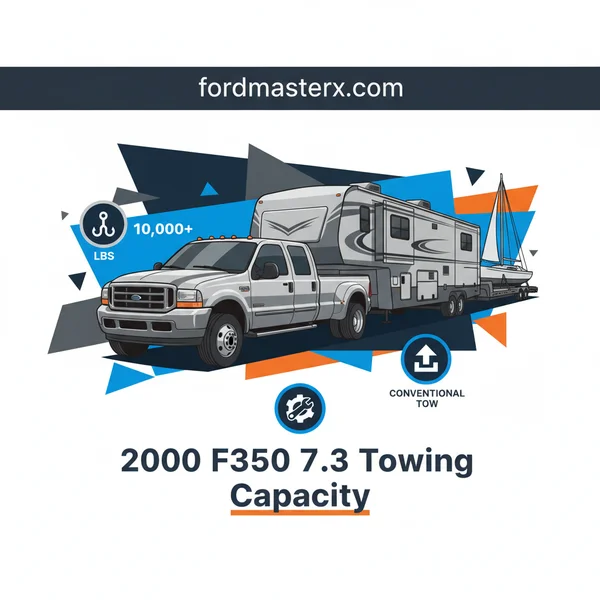
Understanding these specific ratings is critical because exceeding them puts immense stress on your 4R100 transmission and increases your braking distance dangerously. While the engine itself is legendary for its durability, the rest of the 2000-era chassis has physical limits that you must respect to ensure safety on the road. Knowing your exact Gross Combined Weight Rating (GCWR) helps you balance your trailer weight with your truck’s cargo to prevent mechanical failure during steep climbs or emergency stops.
Official Towing and Payload Ratings by Configuration
The towing capacity of your 2000 F-350 is not a single number; it is a calculation based on how your truck was built from the factory. The most capable version is the Dual Rear Wheel (DRW) model, often called a “dually.” This configuration provides a wider footprint and greater stability, which Ford used to authorize higher 5th-wheel ratings. If you are driving a Single Rear Wheel (SRW) model, your capacities will be lower due to the load-bearing limits of the two rear tires and the narrower rear axle.
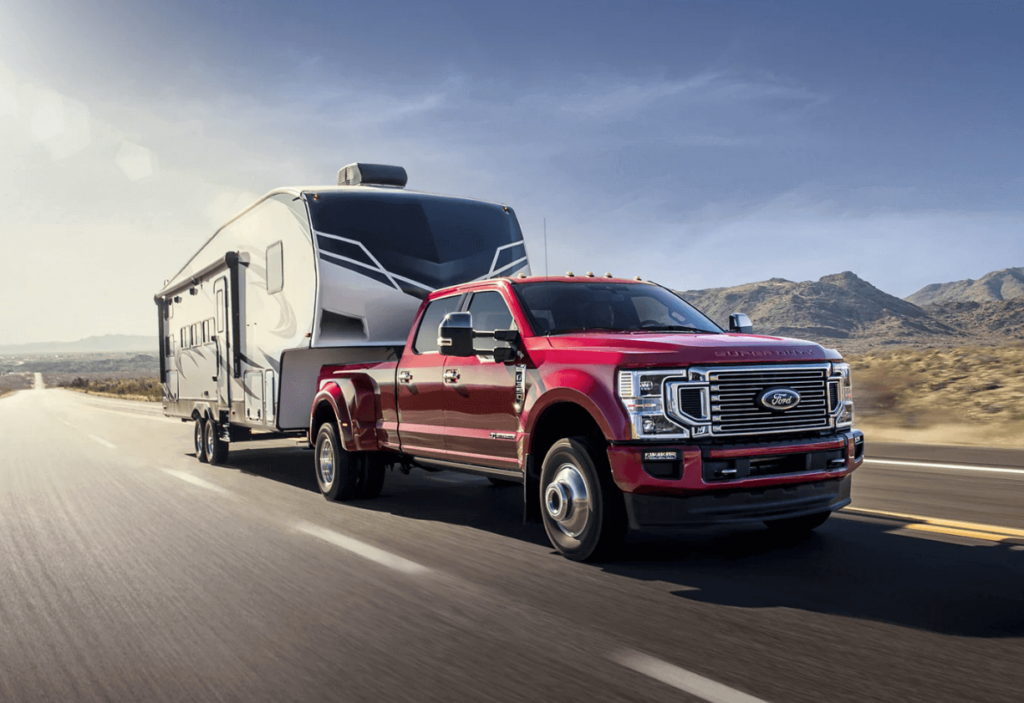
Conventional vs. 5th-Wheel Towing Limits
In the year 2000, Ford rated the F-350 7.3L for different types of hitches. For a standard bumper-pull or frame-mounted hitch, the capacity usually maxes out at 10,000 pounds unless you have a weight-distributing system. When you move to a 5th-wheel setup, which places the tongue weight directly over the rear axle, the numbers increase significantly. Here are the general breakdowns for the 2000 model year:
- F-350 SRW (Single Rear Wheel): Max conventional towing is typically 10,000 lbs; 5th-wheel towing maxes out around 12,500 to 13,000 lbs.
- F-350 DRW (Dual Rear Wheel): Max conventional towing remains near 10,000 lbs (limited by hitch class); 5th-wheel towing reaches the 14,500 lbs peak.
- Manual vs. Automatic: Interestingly, the 6-speed manual (ZF6) often carries similar or slightly higher ratings in specific configurations compared to the 4-speed automatic due to better heat management.
Gross Combined Weight Rating (GCWR) and Payload
The GCWR for a 2000 F-350 7.3L is generally 20,000 pounds. This is the maximum allowable weight of the truck, the passengers, the fuel, and the loaded trailer combined. If your truck weighs 7,500 pounds fully loaded with your family and gear, you technically have 12,500 pounds of “room” left for a trailer. Payload is another vital factor; an F-350 DRW can often handle a payload between 4,000 and 5,000 pounds, whereas the SRW models usually hover between 3,000 and 3,800 pounds depending on the cab style (Regular, SuperCab, or Crew Cab).
Everything You Need to Know About 2000 F350 7.3 Towing Capacity
The 2000 Ford F350 equipped with the 7.3L Powerstroke diesel engine is a legendary workhorse, often cited as one of the most reliable tow rigs ever built. However, “towing capacity” is not a single, static number; it is a variable figure that depends heavily on your truck’s specific configuration, including its rear-axle ratio, cab style, and whether it has single or dual rear wheels. Following this guide is essential because exceeding these limits doesn’t just risk a mechanical breakdown—it compromises your braking distance and vehicle stability, potentially leading to catastrophic failure on the road. This walkthrough will help you navigate the technical specifications and physical inspections required to safely maximize your truck’s potential.
Step 1: Identify Your Configuration and Rear Axle Ratio
What you need: Your vehicle’s VIN and the Door Jamb Sticker (Safety Compliance Certification Label) located on the driver’s side B-pillar.
Instructions: Before you can look up a chart, you must know exactly what you are driving. The 2000 F350 came in Regular Cab, SuperCab, and Crew Cab configurations, with either 2WD or 4WD. Most importantly, look for the “Axle” code on your door sticker. A code “31” or “C1” typically indicates a 3.73 ratio, while “37” or “F7” indicates a 4.10 ratio. In the 7.3L Powerstroke, the 4.10 ratio (commonly found on Dual Rear Wheel or DRW models) allows for a significantly higher Gross Combined Weight Rating (GCWR) than the 3.73. Identifying these details is the foundation of calculating your specific towing limit.
Pro Tip: If your door sticker is faded or missing, you can find a metal tag bolted to the rear differential housing itself. This tag will have the gear ratio stamped directly into it.
Step 2: Determine the Gross Combined Weight Rating (GCWR)
What you need: Your truck’s engine type (7.3L Diesel) and the axle ratio identified in Step 1.

Audible — Listen Free for 30 Days
One free credit a month and thousands of titles included.
Listen Free for 30 Days As an Amazon Associate I earn from qualifying purchases.Instructions: For the 2000 model year, the GCWR—the total allowable weight of the truck, passengers, cargo, fuel, and the trailer combined—is generally 20,000 lbs for the 7.3L Powerstroke with a 3.73 or 4.10 axle ratio. While some configurations may vary slightly, 20,000 lbs is the standard ceiling for this era’s 7.3 drivetrain. It is vital to remember that the GCWR is the absolute maximum; you can never exceed this number regardless of how many “heavy-duty” parts you add to the truck. This rating was determined by Ford engineers based on the structural integrity of the frame and the cooling capacity of the radiator and transmission.
Pro Tip: Do not confuse GCWR with the “Max Trailer Weight.” The trailer weight is always limited by what is left over after the truck’s own weight is subtracted from the GCWR.
Step 3: Calculate the “Real World” Max Trailer Weight
What you need: A local CAT scale or a certified truck scale, and a full tank of fuel.
Instructions: To find your actual towing capacity, take your truck to a scale. Weigh it with yourself and any regular passengers or tools inside. A 2000 F350 Crew Cab 4×4 Long Bed can easily weigh 7,500 to 8,000 lbs. If your GCWR is 20,000 lbs and your truck weighs 8,000 lbs, your remaining capacity for a trailer is 12,000 lbs. However, Ford’s official literature for the 2000 F350 usually capped conventional (hitch) towing at 10,000 lbs, while 5th-wheel/gooseneck towing could reach up to 13,000-14,000 lbs depending on the specific SRW (Single Rear Wheel) or DRW (Dual Rear Wheel) setup. Always use the lower of these two numbers (the calculated math vs. the manufacturer’s structural cap).
Pro Tip: Remember that “Dry Weight” advertised by RV manufacturers is a lie; always calculate based on the trailer’s GVWR (fully loaded weight) to ensure you stay within your truck’s limits.
Step 4: Inspect and Verify Your Hitch Class Rating
What you need: A flashlight and a wire brush to clean the hitch identification plate.
Instructions: Many 2000 F350s came with a factory Class IV hitch. Over the last 20+ years, these hitches can suffer from internal rust or “egging” of the pin hole. Check the sticker on the hitch receiver. A standard Class IV hitch is usually rated for 10,000 lbs with weight distribution. If you intend to tow a heavy trailer, you must ensure the hitch is not the bottleneck. If your truck is rated to tow 12,500 lbs but your hitch is only rated for 10,000 lbs, your legal and safe limit is 10,000 lbs. If the factory hitch is rusted or under-rated, consider upgrading to a Class V commercial-duty hitch, which can handle up to 15,000-20,000 lbs.
Pro Tip: Inspect the welds where the hitch meets the frame. The 2000 models are prone to frame-end corrosion in salt-heavy regions, which can compromise hitch mounting points.
Step 5: Evaluate Tire Load Ratings and Pressure
What you need: A tire pressure gauge and the sidewall information from your tires.
Instructions: Towing with an F350 requires “Load Range E” tires. Look at the sidewall of your tires for the “Max Load” rating and the “Psi” required to hit that rating. A typical Load Range E tire is rated for approximately 3,415 lbs at 80 PSI. If you are running Load Range D or standard passenger tires (common on used trucks sold with “cushy” rides), your towing capacity is effectively zero for heavy loads. When towing at the limit of the 2000 F350, your rear tires must be inflated to the maximum cold pressure indicated on the sidewall (usually 80 PSI) to handle the tongue weight or pin weight of the trailer without overheating or blowing out.
Audible Premium Plus — Annual Membership
12 audiobook credits up front, plus the full Audible catalogue.
See Annual Plans As an Amazon Associate I earn from qualifying purchases.Pro Tip: Never use a tire that is more than six years old for heavy towing, even if it has plenty of tread. The internal structure of the tire degrades over time, and the heat of towing will find the weak spots.
Step 6: Assess the 4R100 Transmission and Cooling System
What you need: An OBD-II monitor (like Edge Insight or Forscan) to check transmission fluid temperatures.
Instructions: The 4R100 automatic transmission is the primary “weak link” when towing at capacity with a 7.3L. Heat is the enemy. Under heavy load, your transmission fluid should ideally stay below 200°F and never exceed 220°F. If you plan to tow near the 12,000+ lb mark frequently, you should inspect your transmission cooler. Many owners of the 2000 model year upgrade to the much larger 6.0L Powerstroke transmission cooler, which is a near-direct fit and offers significantly better heat dissipation. If your fluid smells burnt or looks dark brown, change it immediately before attempting to tow, as the added stress will likely cause a transmission failure.
Pro Tip: If you have the ZF-6 manual transmission, you have more thermal headroom, but you must still watch your clutch engagement and avoid “riding” the clutch during low-speed maneuvers with a heavy trailer.
Step 7: Check Braking Power and Controller Settings
What you need: An integrated or aftermarket electric brake controller (e.g., Tekonsha P3).
Instructions: The brakes on the 2000 F350 were adequate for their time but are small by modern standards. When towing anything over 3,000 lbs, trailer brakes are a legal and physical requirement. Ensure your truck is equipped with a functioning brake controller. Test the “manual override” lever on the controller at low speeds (5-10 mph) to ensure the trailer brakes are engaging and can stop the entire rig. If you find the truck struggling to stop, you may need to upgrade to high-performance brake pads (like Hawk SuperDuty) and ensure your trailer’s drum or disc brakes are properly adjusted. A 20,000 lb GCWR rig requires all six or eight wheels (truck + trailer) to be braking effectively.
Pro Tip: In the 2000 model year, the brake controller wiring harness is tucked under the dash near the ash tray. If you don’t have a plug-and-play adapter, you’ll need to locate the blue wire, which is the dedicated trailer brake output.
✅ Final Checklist
- Weight Verification: Is the combined weight of the truck and trailer under 20,000 lbs?
- Tire Integrity: Are all tires Load Range E and inflated to the correct PSI (usually 80 PSI rear for heavy loads)?
- Fluid Levels: Is the transmission fluid bright red and the coolant level topped off?
- Hitch Security: Is the hitch rating (Class IV or V) higher than the trailer weight, and are the safety chains crossed and secured?
- Brake Test: Does the brake controller manual override successfully slow the vehicle without “pushing” from the trailer?
Important Notes:
- Safety First: Never exceed the Gross Axle Weight Rating (GAWR) on your rear axle, as this can lead to axle housing failure or snapped wheel studs.
- EGT Monitoring: If your 7.3L is “tuned,” you must monitor Exhaust Gas Temperatures (EGTs). Do not exceed 1,250°F for sustained periods, or you risk melting pistons.
- When to Seek Help: If you hear a “whining” from the rear differential or if the transmission slips between 2nd and 3rd gear while towing, consult a diesel specialist immediately.
- Estimated Time: Initial inspection takes 1-2 hours. Upgrading a hitch or cooling system can take 3-5 hours.
- Cost Range: Basic inspection is free. Upgrading tires, hitch, and transmission cooler can cost between $1,200 and $2,500.
Factors Influencing 7.3L Power Stroke Performance
The 7.3L Power Stroke is famous for its 500 lb-ft of torque, but how that torque translates to the ground depends on your mechanical setup. Unlike modern diesels that use 6 or 10-speed transmissions to stay in the powerband, the 2000 F-350 relies on raw displacement and specific gearing to move weight. Your performance while towing a 12,000-pound trailer will feel drastically different depending on your axle ratio and cooling capabilities.

Axle Ratios and Low-End Torque
Your truck likely came with either a 3.73 or a 4.10 axle ratio. This number dictates how many times your driveshaft spins for every one revolution of the tires. If you have the 4.10 gears, you will find it much easier to get a heavy trailer moving from a dead stop. It places less strain on the engine and transmission during the initial “tug.” However, the 3.73 gears are better for highway cruising at lower RPMs when you aren’t maxed out on weight. If you plan on towing near the 14,000-pound limit frequently, the 4.10 ratio is almost a necessity to keep the 7.3L in its optimal power range.
Transmission and Cooling Constraints
The 4R100 automatic transmission is often considered the “weak link” when pushing the 2000 F-350 to its towing limits. Heat is the primary enemy here. When you are pulling a heavy grade, the torque converter generates immense heat that can degrade transmission fluid and lead to internal slipping. To maximize your 7.3L’s towing performance, you must monitor your fluid temperatures. Many owners find that the stock transmission cooler is insufficient for modern heavy-duty towing and opt for the larger cooler found in the later 6.0L Power Stroke trucks to keep temps under 200 degrees Fahrenheit.
- Engine Braking: The 7.3L lacks a factory exhaust brake, meaning you must rely on downshifting and your trailer brakes for descents.
- EGT Monitoring: High Exhaust Gas Temperatures (EGTs) can occur when towing heavy loads uphill; staying below 1,250 degrees is vital for engine longevity.
- Suspension: The 2000 F-350 uses leaf springs on both the front (4WD models) and rear, providing a stiff but stable platform for heavy tongue weights.
Conclusion
In summary, understanding 2000 f350 7.3 towing capacity is essential for success in this area. Apply these insights to see real results.
❓ Frequently Asked Questions
How does the axle ratio affect the 2000 F350 towing capacity?
A 4.10 axle ratio provides better mechanical advantage for starting heavy loads compared to the 3.73, though it slightly reduces fuel economy at high speeds. Most max-towing configurations require the 4.10 ratio.
Can a 2000 F350 7.3 tow a modern 15,000 lb trailer?
Technically, this exceeds the official 14,500 lb limit; while the engine is capable, modern trailers often require more braking and suspension support than the stock 2000 model provides. Always stay within OEM limits for safety.
What is the difference between conventional and fifth-wheel towing on this truck?
Conventional towing uses the rear receiver hitch and is limited to 10,000 lbs, while fifth-wheel towing places weight directly over the rear axle, allowing for a higher capacity of up to 14,500 lbs.
What upgrades improve the 2000 F350’s towing performance?
Installing a larger transmission cooler, upgraded brake pads, and an EGT gauge helps monitor and manage the heat generated during heavy hauls. Many owners also upgrade the ‘wicked wheel’ to prevent turbo surge.
What is the payload capacity for a 2000 F350 DRW?
The payload for a Dually (DRW) can reach over 5,000 lbs depending on the cab, which is significantly higher than SRW models, making it ideal for large truck campers or heavy tongue weights.
Is the 4R100 transmission reliable for heavy towing?
While capable, the 4R100 transmission in the 2000 F350 is known to generate significant heat under load; adding an auxiliary cooler from a 6.0L Power Stroke is a common expert recommendation for longevity.
Full towing capacity guide: Ford F-350 Towing Capacity Chart