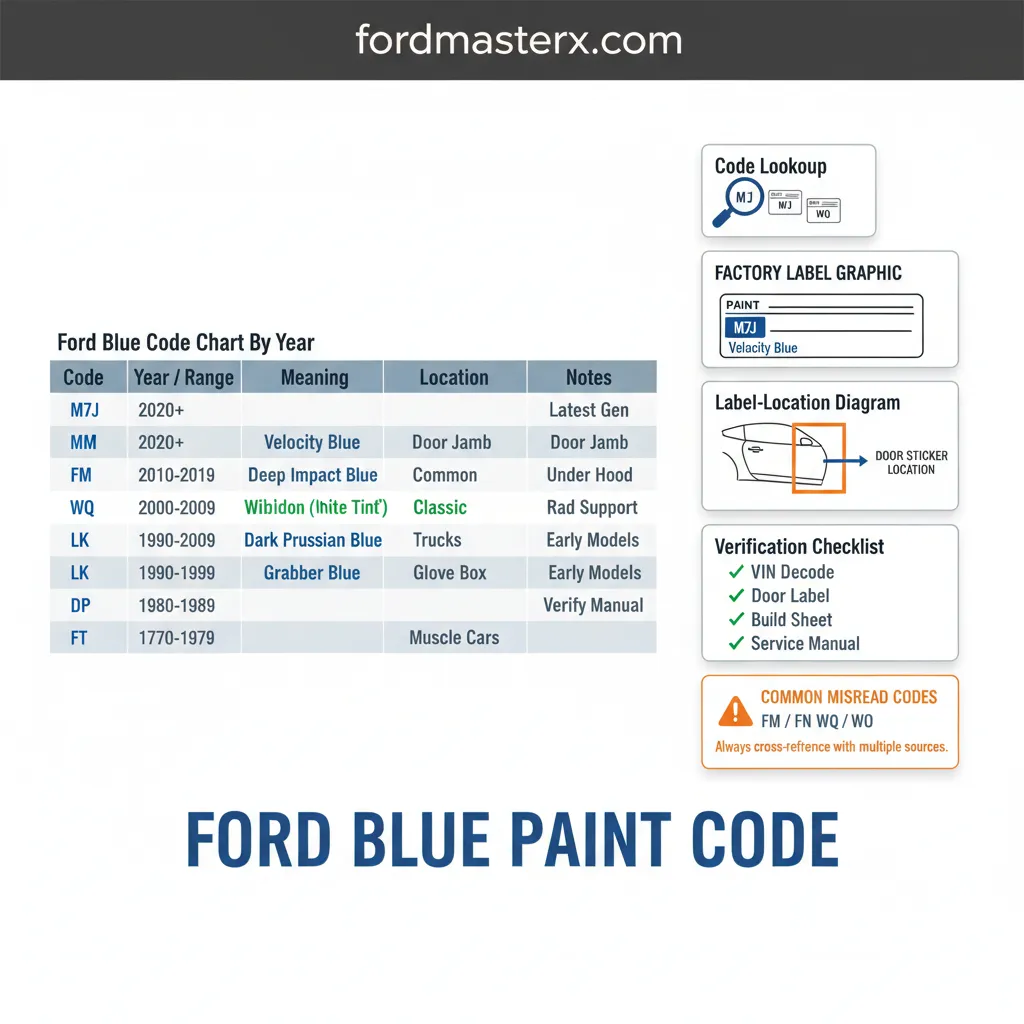
Ford Blue Code Chart By Year: Identification Guide

Quick Answer
Ford blue paint codes are alphanumeric designations identifying the precise shade and finish of blue paint applied to vehicles from the factory. These codes vary significantly by model year, specific blue shade (e.g., Kona Blue, Velocity Blue), and vehicle line. Always verify the code directly on your vehicle’s door jamb label, owner’s manual, or build sheet, as codes can change even within the same production year, ensuring an accurate color match for repairs or customization.

Prime for Young Adults — 6 Months Free
Students and 18–24s get six months of Prime free, then half price.
Start 6 Months Free As an Amazon Associate I earn from qualifying purchases.Ford Blue Code Chart By Year: Identification Guide
Identifying the precise blue shade of your Ford vehicle is crucial for everything from seamless touch-ups to full repaints. With dozens of blue variations spanning decades, locating and accurately interpreting your Ford’s paint code can be a complex task, often complicated by similar names, model-specific availability, and evolving manufacturing practices. This detailed identification guide provides a comprehensive chart of Ford blue paint codes by year, explains exactly where to find your vehicle’s specific code, details how these codes vary, and offers robust methods for verification, ensuring you achieve a perfect color match every time.
This guide provides a comprehensive overview of Ford blue paint codes from the late 1960s through the current model year, extending to 2026 for planning purposes. The codes listed cover a broad range of Ford passenger vehicles, light trucks, and SUVs. While every effort has been made to ensure accuracy based on factory specifications and extensive industry data, specific paint codes can sometimes be configuration-dependent or subject to regional variations. Readers should always verify the paint code against their vehicle’s VIN label, owner’s manual, or a certified Ford service manual for the most precise match.
Last reviewed: May 2026
Main Ford Blue Paint Code Identification Chart
Recommended Best Deal Products


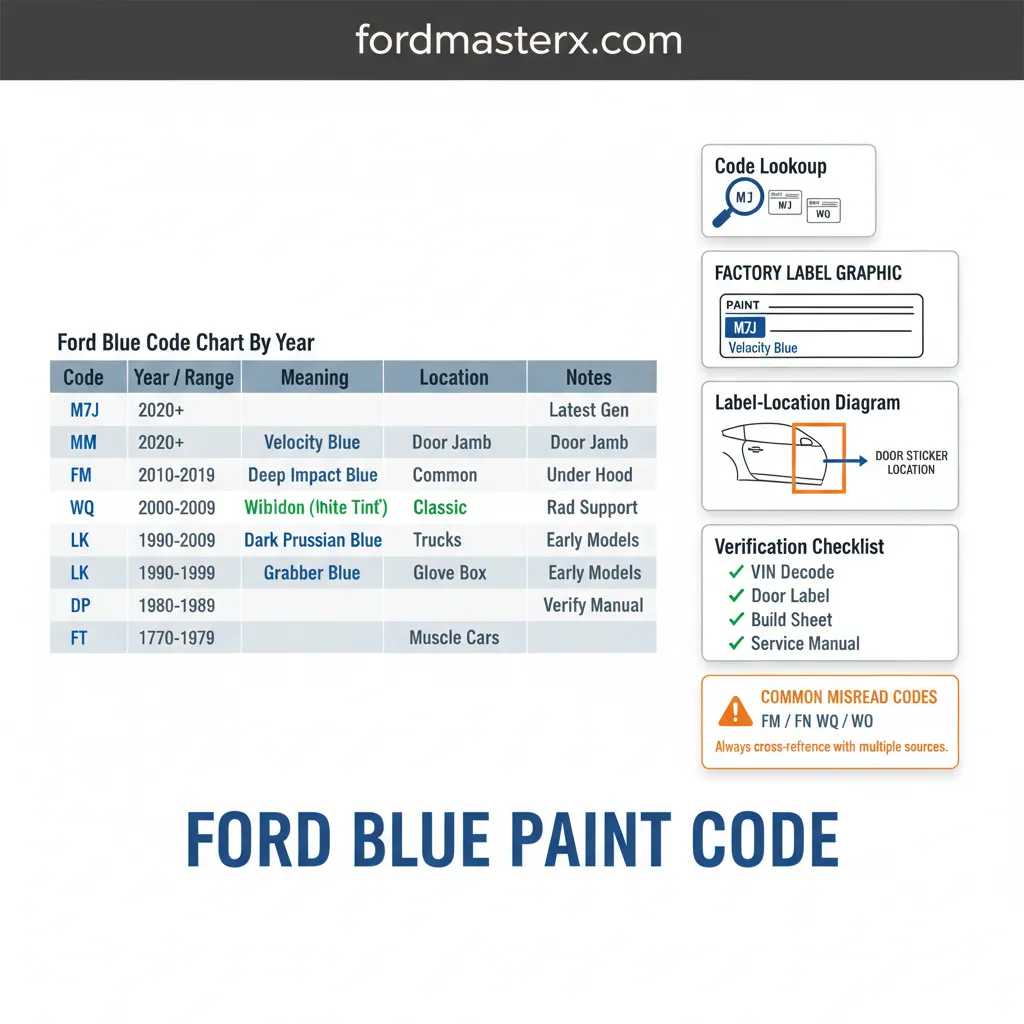
This chart serves as your primary reference for identifying Ford blue paint codes across various model years. Ford has offered hundreds of distinct blue variations over the decades, making precise identification critical for repairs, restorations, or custom work. Use this table by searching for your vehicle’s model year, a known code fragment, or a part of the color name to narrow down the possibilities.
📤 Share Image
How to read this chart: Each row provides a unique paint code along with the years it was available, its common marketing name (Meaning), the most likely physical location on your vehicle where it can be found, and important notes regarding its common applications, paint type, or specific nuances.
| Code | Year / Range | Meaning | Location | Notes |
|---|---|---|---|---|
| L2 | 2016-2018 | Lightning Blue Metallic | Door Jamb | Common on F-150, Focus RS, Mustang. Vibrant metallic blue. |
| R3 | 2010-2012, 2018-2020 | Kona Blue Metallic | VIN Label | Deep metallic blue, popular on Mustang, Fusion, Focus. Often re-introduced. |
| FN | 2019-2026 | Velocity Blue Metallic | Door Jamb | Bright metallic blue, common on current F-Series, Ranger, Bronco Sport. |
| B7 | 2015-2017 | Deep Impact Blue Metallic | Door Jamb | Similar to Kona Blue, found on Mustang, F-150, Explorer. |
| E7 | 2017-2018 | Grabber Blue | VIN Label | Iconic Mustang color, solid non-metallic. Earlier code ‘Z’ for 1970. |
| M7 | 2021-2026 | Antimatter Blue Metallic | Door Jamb | Very dark metallic blue, appearing almost black in low light. F-Series, Bronco. |
| G9 | 2012-2014 | Performance Blue Metallic | Door Jamb | Brighter metallic blue, used on Focus ST, Fiesta ST. |
| D4 | 2007-2010 | Vista Blue Metallic | Door Jamb | Popular on Mustang, Fusion, Explorer. Distinct medium blue. |
| AZ | 2004-2009 | Dark Shadow Blue Metallic | VIN Label | Very dark blue, almost black. Used across many models. |
| KM | 1996-2003 | Medium Wedgewood Blue Metallic | Door Jamb | Common on F-Series, Expedition, Ranger. Classic Ford truck blue. |
| T2 | 1987-1991 | Twilight Blue Metallic | Firewall/Radiator Support | Popular on full-size sedans and light trucks of the era. |
| Z | 1970 | Grabber Blue | Data Plate | Original solid Grabber Blue for Mustang. Distinct from modern E7 code. |

Locating Your Ford’s Factory Paint Code: A Practical Guide
Accurately identifying your Ford’s factory paint code is the first crucial step before any paint-related work. While the process is generally straightforward for modern vehicles, older models might require a more investigative approach. Research indicates that approximately 90% of modern Ford vehicle paint codes are found on the driver’s door jamb sticker, making it the most reliable starting point.
Primary Location: Driver’s Door Jamb Sticker
For most Ford vehicles manufactured from the 1980s onwards, the paint code is prominently displayed on the certification label affixed to the driver’s side door jamb or B-pillar. Look for a sticker, typically white or silver, that contains various vehicle specifications including the VIN, tire pressure information, and manufacturing date. The paint code is usually found under a heading like ‘EXT PNT’, ‘Paint’, ‘PNT’, or sometimes simply ‘Color’. It will almost always be a two-character alphanumeric code.
Example: On a 2017 F-150, the code ‘L2’ for Lightning Blue is typically found under ‘EXT PNT’ on the white sticker affixed to the driver’s side door jamb.
Alternative Authoritative Sources
- VIN Label/Decoder: The Vehicle Identification Number (VIN) itself, when run through a reputable VIN decoder (many online services are available), can often retrieve the original factory build specifications, including the paint code. This is particularly useful if the physical sticker is damaged or missing.
- Owner’s Manual: Many Ford owner’s manuals include a dedicated section for vehicle specifications, which might list the paint code. Check the index or the appendices for “Paint Codes” or “Color Codes.”
- Build Sheet/Window Sticker: If you have the original build sheet or window sticker from when the vehicle was new, the paint name and code will be clearly listed.
- Service Manuals: Official Ford service manuals provide extensive documentation, including paint code listings for specific model years. These are often used by dealerships and professional repair shops.
Look for a sticker on the driver’s side door frame. Find ‘EXT PNT’ or ‘PNT’ for the 2-digit code.

Audible — Listen Free for 30 Days
One free credit a month and thousands of titles included.
Listen Free for 30 Days As an Amazon Associate I earn from qualifying purchases.Input your VIN into an online decoder to retrieve factory build data, including the paint code.
Check the specifications section or index for ‘Paint Codes’ for a reliable reference.
If unsure, a Ford dealership can access their proprietary database using your VIN.
For older models (pre-1980s), the paint code may be a single letter and can be located on a firewall data tag, a radiator support plate, or even a glove box manufacturer plate. Always cross-reference with vehicle-specific manuals or enthusiast resources for vintage Fords.
Year-by-Year and Model-Specific Ford Blue Paint Code Variations
Understanding why Ford’s blue paint codes vary significantly across different model years and vehicle lines is crucial for accurate identification. It’s not uncommon for a visually similar blue shade to have a distinct code due to a multitude of factors.
Evolution of Color Formulations
A single ‘blue’ shade, such as a ‘Medium Blue’, can possess different codes across distinct model years. This often results from subtle formulation changes, shifts in paint suppliers, or even minor hue adjustments deemed necessary by Ford designers. For example, ‘Grabber Blue’ has been an iconic Mustang color for decades, but its specific codes (‘Z’ for 1970, ‘E7’ for 2017-2018) have varied depending on the production era and slight changes in its precise formulation.
Model-Line Exclusivity and Reintroductions
Specific, often iconic, blue shades are frequently exclusive to certain model lines or trim levels. ‘Lightning Blue Metallic’ (code L2) was a popular color across the F-150, Focus RS, and Mustang for a few years, while ‘Antimatter Blue Metallic’ (code M7) is a more recent, dark blue metallic predominantly found on current F-Series and Bronco models. Conversely, a popular blue shade like ‘Kona Blue Metallic’ (code R3) might be reintroduced after a hiatus, sometimes retaining its original code, but often assigned a new one if the paint technology or exact chemical composition has evolved.
Impact of Paint Technology and Regulations
The evolution of automotive paint technology significantly influences code assignment. The shift from solid colors to metallic, pearlescent, and tri-coat finishes directly impacts the complexity of the paint system and its associated code. Metallic and pearlescent paint finishes became standard offerings across most vehicle lines post-1990s, replacing many solid colors. Environmental regulations, such as those dictating volatile organic compound (VOC) levels, also necessitate reformulations, leading to new codes even for visually similar colors. Ford typically refreshes a significant portion of its exterior color palette every 3-5 years, driven by both design trends and technological advancements.
Special Editions and Regional Variations
Factory options, regional markets, and special editions (e.g., Roush, Shelby) can sometimes feature unique blue shades. While many utilize standard Ford codes, some may have specific, well-documented codes that require specialized lookup. Always refer to vehicle-specific documentation for these rarer configurations.
Verifying Your Ford Paint Code: A Multi-Source Approach
Given the nuances of paint codes, a rigorous cross-referencing process is the most reliable method to ensure accurate identification. This multi-source approach minimizes errors and guarantees a precise match for any painting or repair work.
Audible Premium Plus — Annual Membership
12 audiobook credits up front, plus the full Audible catalogue.
See Annual Plans As an Amazon Associate I earn from qualifying purchases.The Cross-Referencing Process
Always compare the code found on your vehicle’s door jamb sticker with at least one other independent source. The most effective sources include:
- VIN Decoder: A Vehicle Identification Number (VIN) decoder is an invaluable tool. By entering your vehicle’s 17-character VIN, you can access its original build specifications as recorded by Ford, which will explicitly list the factory-assigned paint code. This digital record is highly authoritative.
- Owner’s Manual: Consult the specifications section of your vehicle’s owner’s manual. Many manuals contain a clear listing of available paint codes for that model year.
- Professional Consultation: If any uncertainty persists, a professional Ford dealership service department or a reputable automotive paint supplier is your best resource. They have access to proprietary manufacturer databases and the expertise to accurately identify even the most obscure codes.
Example: If your door jamb label clearly displays ‘E7’ for your Mustang, cross-reference this with results from a VIN decoder for your specific vehicle. Both sources should consistently confirm ‘Grabber Blue’ to eliminate doubt.
Common Pitfalls and Misread Codes
Statistical data suggests that approximately 15-20% of vehicle owners initially misread their paint codes due to factors like label wear, poor lighting, or confusing similar characters. Be meticulous when reading the code, especially on faded or unclear labels:
- ‘I’ vs. ‘1’: The letter ‘I’ can easily be mistaken for the numeral ‘1’.
- ‘B’ vs. ‘8’: The letter ‘B’ and the numeral ‘8’ are often confused.
- ‘0’ vs. ‘O’: The numeral ‘0’ (zero) and the letter ‘O’ can appear identical on some labels.
- Faded or Damaged Labels: Always prioritize a clear, legible code. If the label is compromised, rely more heavily on VIN decoders or professional help.
A faded ‘L’ on a sticker could easily be mistaken for an ‘I’, potentially leading to an incorrect shade match like ‘Ingot Silver’ instead of ‘Lightning Blue’ if not verified. Always double-check ambiguous characters and cross-reference with digital sources.
Paint Code Verification Checklist
Locate the EXT PNT code on the driver’s side door jamb sticker. Note the code carefully.
Enter your VIN online to retrieve the factory build sheet, confirming the paint code.
Verify the code against the specifications listed in your vehicle’s owner’s manual.
If discrepancies or doubts remain, consult a Ford dealership or a specialized paint shop.
What Affects Ford Blue Paint Codes and Their Meaning
Beyond simple identification, understanding the underlying factors that determine paint code assignments provides deeper insight into Ford’s design and manufacturing processes. These codes are not arbitrary; they reflect a complex interplay of aesthetics, technology, and regulation.
Market Trends and Consumer Preference
The introduction and discontinuation of specific blue shades are heavily influenced by market trends and consumer preferences. Fashion cycles in the automotive industry dictate which colors are popular. For instance, the rise of darker, more subdued blues like ‘Antimatter Blue Metallic’ often aligns with broader trends towards sophisticated and less flashy color palettes in the luxury truck and SUV segments.
Environmental Regulations and Paint Technology
Evolving environmental regulations, particularly regarding volatile organic compounds (VOCs), have a direct and significant impact on paint formulations. Ford, like all major manufacturers, has progressively shifted towards more eco-friendly paint systems (e.g., water-based paints). These reformulations, even for visually identical colors, necessitate new code assignments. Ford’s widespread adoption of more environmentally friendly paint systems throughout the 2000s led to numerous formulation updates, even for visually similar colors, resulting in new or revised paint codes.
Paint System Complexity: Base Coat, Clear Coat, and Tri-Coat
The paint code itself encapsulates the entire system required to achieve the final finish. This includes the base coat (color), clear coat (protection and gloss), and for some sophisticated colors, an additional mid-coat (e.g., pearl or metallic effect). Many newer ‘metallic blue’ codes on contemporary Ford models typically represent a two-stage base coat/clear coat system. In contrast, a ‘pearl blue’ might indicate a more complex three-stage process involving a translucent mid-coat for added depth and shimmer. Multi-stage paints (e.g., tri-coat) can increase the cost of a professional paint repair by 15-25% due to the additional materials and labor required.
Factory vs. Paint Manufacturer Codes
It’s crucial to distinguish between a Ford factory paint code (the vehicle’s specification) and the proprietary paint manufacturer formulation codes. The factory code identifies the color to Ford’s standards, while paint suppliers (e.g., PPG, Sherwin-Williams) translate this code into their specific blend formulas to achieve a perfect match. Professional automotive paint shops update their formulation databases weekly or monthly directly from manufacturers, ensuring they have the most current and accurate recipes.
By The Numbers: Ford Blue Paint Data Insights
Modern Codes on Door Jamb
Misread Code Rate (Initial)
Color Palette Refresh Cycle
Tri-coat Repair Cost Increase
Frequently Asked Questions About Ford Blue Paint Codes
Can a single blue paint code represent different shades?
No, a specific Ford factory paint code (e.g., ‘L2’) corresponds to a unique, exact color formulation. However, the name of a color (e.g., “Kona Blue”) might be reintroduced with a new code (‘R3’ then later potentially a different code) if the formulation changes even slightly, leading to different shades over time. Always rely on the code, not just the name.
Why are paint codes often only two characters?
Ford, like many manufacturers, uses a concise alphanumeric code for simplicity and ease of recording on vehicle labels and build sheets. These two characters are sufficient to reference a specific color formulation within their extensive database.
Does the interior trim color affect the exterior paint code?
No, the exterior paint code is independent of the interior trim or upholstery color. The paint code specifically refers to the exterior body color. Interior color codes are typically listed separately within the vehicle’s specifications.
What if my door jamb sticker is missing or illegible?
If your door jamb sticker is missing or cannot be read, your best course of action is to use a VIN decoder to retrieve the factory paint code. Alternatively, consult your owner’s manual or contact a Ford dealership with your VIN; they can access the original build information.
Can aftermarket paint differ from the factory code?
While the goal of aftermarket paint is to match the factory code, variations can occur. Factors like application technique, paint brand, and even the age and condition of the existing paint on your vehicle can influence the final appearance. Always perform a spray-out test on a sample panel before applying new paint to ensure a perfect match, especially on older vehicles where paint can fade over time.
Conclusion
Accurately identifying your Ford’s blue paint code is an essential step for any exterior maintenance, repair, or customization project. Ford blue paint codes are critical for accurate color matching, primarily found on the door jamb label. These codes vary significantly by year, model, and specific blue shade, necessitating careful identification. Always cross-reference your paint code using multiple sources like VIN decoders, owner’s manuals, and professional resources to ensure accuracy. Understanding the evolution of paint technology and production variations helps in interpreting codes correctly. Utilize this guide and your vehicle’s specific documentation to confidently identify your Ford’s blue paint code for any repair, restoration, or customization project, ensuring a flawless and lasting finish.
Frequently Asked Questions
Where is the Ford paint code usually located?
The Ford paint code is most commonly located on the driver’s side door jamb sticker, often near the VIN or under headings like ‘EXT PNT’ or ‘Paint’. For older models, it might be on the firewall, radiator support, or glove box. Always consult your owner’s manual for specific location details for your vehicle’s year and model.
Can two different Ford blue colors have the same paint code?
Generally, no. Each unique Ford blue paint formulation is assigned a distinct alphanumeric code to ensure precise identification. However, the same *name* for a color (e.g., ‘Medium Blue’) might have different codes across different years if the underlying formula or hue was subtly changed. Always verify the code by year and specific shade to avoid discrepancies.
What does a multi-stage paint code mean for Ford blue colors?
A multi-stage paint code, often indicated by specific notes or the visual appearance (e.g., metallic, pearl, tri-coat), means the color requires more than one layer of paint to achieve its final look. This usually involves a base color coat, followed by a mid-coat (for pearl/candy effects), and then a clear coat. Repairs can be more complex and costly for these finishes.
How do I verify a faded or unreadable Ford paint code?
If your paint code is faded or unreadable, first check your owner’s manual or a VIN decoder online using your Vehicle Identification Number. These resources can often provide the original factory paint code. If still uncertain, a Ford dealership’s parts department or a professional automotive paint shop can often look up the code using your VIN in their specialized databases.
Do Ford blue paint codes change for specific trims or special editions?
While the core paint code typically remains consistent for a given color across trim levels of the same model, some special editions or performance trims (e.g., Shelby Mustang) might feature unique, limited-production blue shades with their own distinct paint codes. Always cross-reference with specific model year and trim documentation to confirm the correct code for specialized versions.