
P1000 Code Ford How to Fix: Diagnostic Procedures Explained

Got a P1000 code on your Ford and find yourself tempted to start panic-buying replacement O2 sensors or catalytic converters? You are not alone, but you are likely barking up the wrong tree. Many vehicle owners misinterpret the P1000 code as a sign of mechanical failure, leading to countless hours of unnecessary diagnostics and wasted capital on perfectly functional parts. The reality is far more benign: the P1000 code is an informational status, not a component defect. In this guide, we will break down exactly what this code signifies, why it appears in your scan tool, and the precise, manufacturer-sanctioned drive cycle steps required to clear it so you can regain readiness and pass your next emissions test with confidence.

Understanding the P1000 Code Ford How to Fix Logic
Recommended Best Deal Products



📤 Share Image
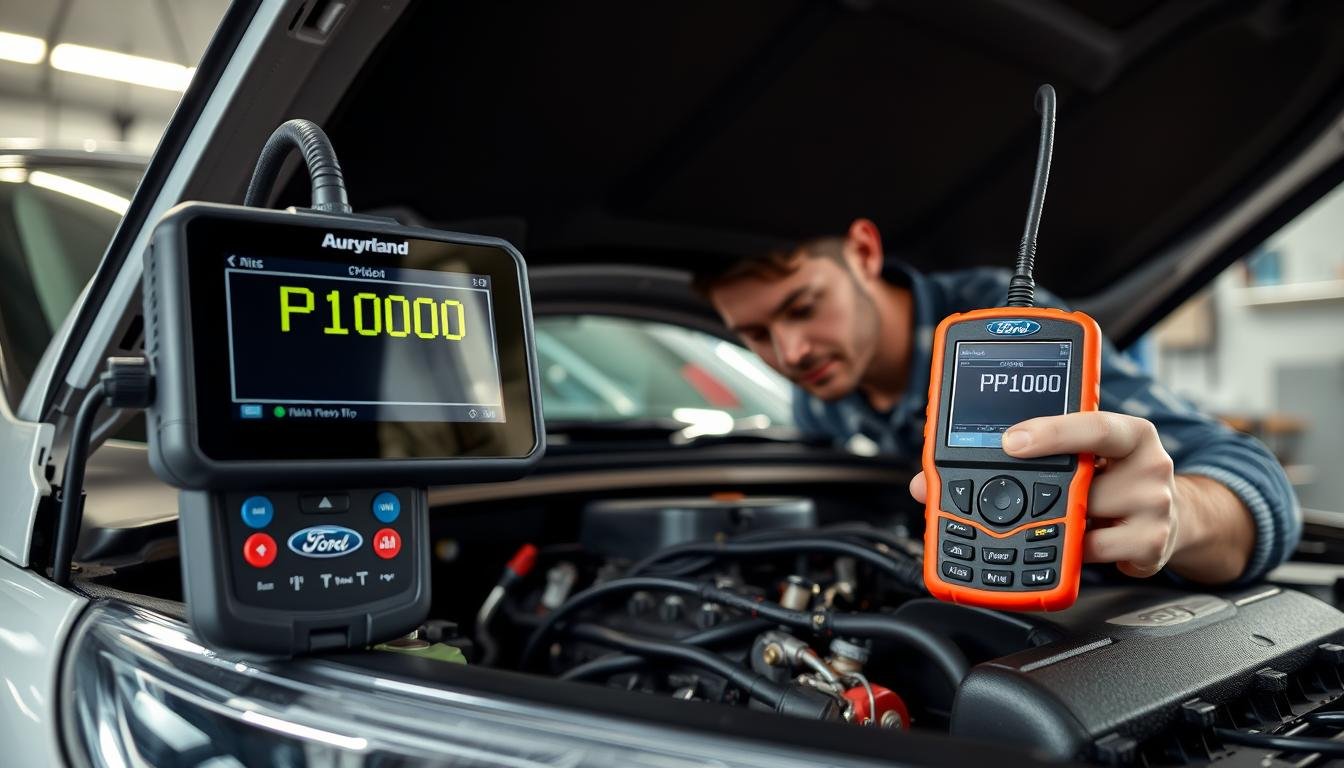
Why Clearing DTCs Triggers the P1000 Code
The P1000 Diagnostic Trouble Code (DTC) is essentially a digital “resume” status. Whenever you clear existing codes using an OBD-II scanner, or if your vehicle experiences a battery disconnection (or voltage drop), the Powertrain Control Module (PCM) undergoes a memory reset. During this reset, all emission-related monitor data stored in the PCM’s non-volatile memory is wiped clean. Because the PCM no longer has the current data required to confirm that all emission systems are functioning within federal guidelines, it sets the P1000 code as a placeholder. This code notifies technicians that the system is currently “not ready” for an official inspection.

P1000 vs. Hard Mechanical Fault Codes
It is critical to distinguish between informational flags and hard faults. A P1000 code does not trigger the “Check Engine” light, nor does it indicate that a specific sensor has failed. Conversely, a hard fault (such as a P0300 misfire or P0420 catalyst efficiency code) points to a tangible component failure that requires physical repair. While P1000 simply says, “I don’t have enough data yet,” a hard code says, “I have detected a performance error.” If you encounter a P1001 code alongside P1000, it usually indicates that the PCM is still struggling to finalize these monitor checks due to an underlying, persistent issue that prevents the completion of the OBD-II self-test routines.
The Role of the PCM in Emission Monitoring
The PCM is the brain of your emission control system. It continuously communicates with various sensors, including oxygen sensors, EGR valves, and the EVAP system, via the OBD-II port. When the system is reset, the PCM enters a “learn” phase. It must see specific driving conditions—varying engine loads, cold starts, and steady-state highway cruising—to verify that every component is within its expected operating range. Until every single monitor (the “I/M Readiness Monitors”) flips to a “Ready” or “Complete” status, the PCM will refuse to clear the P1000 code.
P1000 Code Ford How to Fix: The Drive Cycle Method
Executing the Required Drive Cycle
There is no “quick fix” for P1000. No amount of sensor replacement or software flashing will resolve it if the vehicle has not been driven under the correct conditions. To force the PCM to complete its diagnostic checks, you must perform a Ford-specific drive cycle. This is not just a casual trip to the grocery store; it requires specific parameters.
Allow the vehicle to sit for at least 8 hours (ideally overnight). This ensures the engine coolant and intake air temperature sensors are equalized to ambient temperature.
Start the engine and let it idle for 2-3 minutes. This allows the O2 sensor heaters and closed-loop fuel control systems to begin their calibration.
Drive at a steady speed between 55-65 mph for approximately 15 minutes. Avoid sudden accelerations or braking, as these interrupt the “monitor readiness” data collection.
How Many Miles Does the Monitor Readiness Take?
Industry data suggests that a complete drive cycle usually spans between 30 and 100 miles of varied driving. However, the EVAP (Evaporative Emission System) monitor is notoriously stubborn. It requires the fuel tank to be between 25% and 75% full, and it often requires an overnight cold soak followed by a specific, moderate driving profile. Do not expect the P1000 to vanish after a 5-mile trip to the gas station; patience and consistency are the only true “fix.”
Pitfalls to Avoid When Resetting Monitors
Many users make the mistake of using a scan tool to “clear” the P1000 code in an attempt to bypass the check. This is counterproductive; every time you command a code clear, the PCM dumps all the progress it has made toward readiness. You are effectively starting the clock back at zero every time you touch the “Erase” button.

Audible — Listen Free for 30 Days
One free credit a month and thousands of titles included.
Listen Free for 30 Days As an Amazon Associate I earn from qualifying purchases.Troubleshooting P1000 Code Ford How to Fix Issues
Recommended Best Deal Products


Using a Scanner to Monitor Readiness Status
To effectively diagnose why the code persists, you need an OBD-II scanner that supports “I/M Readiness” monitoring. Do not just look for trouble codes; look for the “Monitor Status” menu. This will show you exactly which systems are “Ready” and which are “Incomplete.” If you have been driving for over 150 miles and the EVAP monitor is still showing “Incomplete,” you are likely missing one of the driving conditions required to trigger that specific system’s test.
Why One Specific Monitor Refuses to Close
If a single monitor refuses to flip to “Ready,” it may be masked by a minor hardware issue. For example, if your gas cap is loose or the seal is degraded, the EVAP monitor will never complete because it cannot pass the pressure test. Similarly, if your engine thermostat is stuck slightly open, the engine may never reach the operating temperature required for the catalyst monitor to execute. In these cases, the monitor doesn’t just stay incomplete—it may eventually trigger a hard fault code for that specific system.
When to Consult a Professional Mechanic
- The 200-Mile Rule: If you have completed over 200 miles of varied driving, including multiple cold starts and highway sessions, and the P1000 remains, it is time to have a professional check for pending fault codes that might not yet have illuminated the check engine light.
- Unstable Idle/Performance: If the car exhibits rough idling or poor fuel economy during the drive cycle, there may be a vacuum leak or sensor issue preventing the PCM from entering its testing protocols.
- System Bugs: In some high-mileage Ford models, persistent P1000 issues can point to a failing PCM or a corrupted firmware version, which requires manufacturer-level diagnostic tools to resolve.
By The Numbers
Avg. Miles to Clear
Hours Cold Soak
Emission Testing and the P1000 Code Ford How to Fix Reality
Can I Pass Inspection With a P1000 Code?
In most states, the answer is a hard no. Emission testing stations hook their equipment into your OBD-II port specifically to look for the “Ready” status of your I/M monitors. If the system reports a P1000 code, the testing equipment interprets this as “system incomplete” and will immediately reject the vehicle. The inspector cannot proceed with the test, and you will be sent away to complete the drive cycle.
Verifying Readiness Before the Emissions Test
Before driving to the inspection center, ensure you have verified the readiness yourself. Most modern, inexpensive OBD-II scanners can display the monitor status. Do not risk the testing fee or the travel time if your tool shows any monitor as “Not Ready” or “Incomplete.”
The Truth About ‘Fixing’ the P1000 Code
The ultimate reality is that the P1000 code is a safeguard designed to ensure that you cannot hide underlying emission failures by simply resetting your computer. It forces the vehicle to prove its health through real-world operation. If your car is healthy, the monitors will clear naturally. If you have been struggling to clear it, stop looking for a “workaround” and start looking at the health of your fuel, exhaust, and temperature management systems. In the vast majority of cases, the solution is simply to drive the car as it was intended to be driven.
If you are in a time crunch for an inspection, many local auto parts stores offer free diagnostic scanning. Use them to check your status before heading to the official testing station to save yourself the hassle of a rejection.
To summarize: the P1000 code is an informational status, not a mechanical failure indicator. Do not replace parts based on this code alone, as it will not clear the fault. The only effective path to resolution is performing the proper drive cycle to allow the PCM to verify all emission monitors. Always use a reliable OBD-II scanner to confirm all monitors are set to “Ready” before arriving at an emissions testing center. Check your monitor status today, fuel up your vehicle appropriately, and hit the road to finalize your drive cycle—it is the only way to get your Ford back in compliance.
p1000 Code Ford How to Fix: Frequently Asked Questions
Recommended Best Deal Products


Will P1000 make me fail an emissions test?
Yes, in most cases. Emissions testing stations require your vehicle’s OBD-II monitors to be in a ‘Ready’ state to ensure the pollution control systems are functioning. If the P1000 code is present, it indicates that the system has not finished its self-checks, which will result in an automatic rejection at the inspection station until the monitors complete their cycles.
How do I clear a P1000 code?
You cannot clear a P1000 code using a scan tool. The code is a result of the system needing time to perform internal diagnostics. It will automatically clear itself once the PCM confirms that all emissions-related sensors have passed their readiness tests during a proper drive cycle. Do not attempt to force-clear it, as this will simply reset the monitor count to zero.
Do I need to replace a part to fix P1000?
No, you do not need to replace any parts to fix the P1000 code. Because it is a status indicator and not a mechanical failure, it does not point to a broken component. If you replace parts while the P1000 code is present, you are likely wasting money. The only ‘fix’ is the natural completion of the diagnostic readiness cycle through consistent driving.
Audible Premium Plus — Annual Membership
12 audiobook credits up front, plus the full Audible catalogue.
See Annual Plans As an Amazon Associate I earn from qualifying purchases.How many miles do I need to drive to reset the monitors?
There is no set mileage requirement to reset the monitors. Readiness depends on specific engine parameters, such as coolant temperature, time spent at cruising speeds, and deceleration. While it can happen in as few as 30 miles, it often takes 50 to 100 miles of mixed highway and city driving over several days to satisfy all the criteria for every monitor.
Does idling the engine help clear the P1000 code?
Idling contributes very little to clearing the P1000 code. Most readiness monitors require the vehicle to be moving to achieve the necessary airflow through the catalytic converter and to properly cycle the EVAP system. While some idle-based sensors may complete during a stationary warm-up, the majority of the system checks rely on the engine being under load during actual driving conditions.