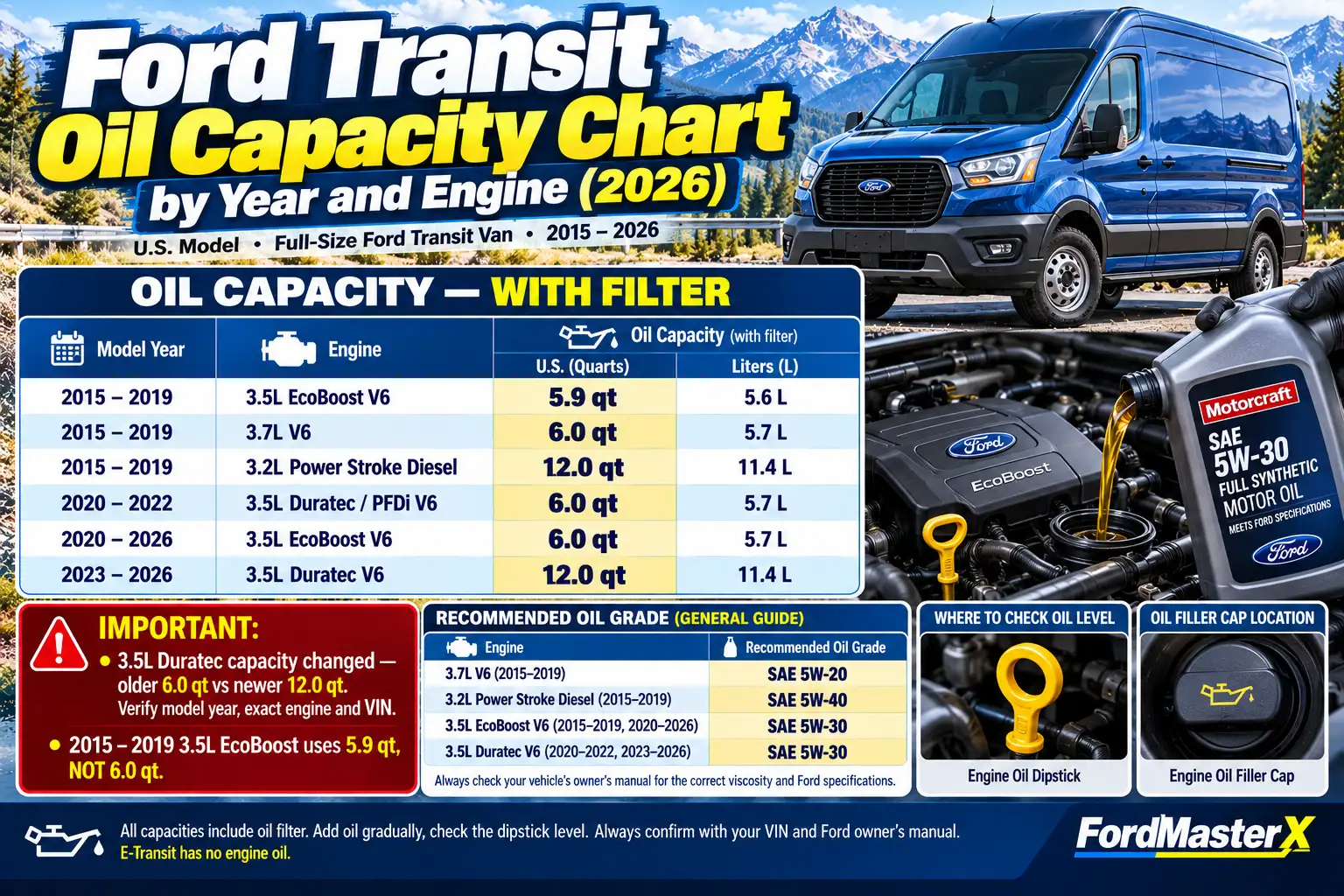
Ford Transit Oil Capacity Chart by Year and Engine 2015-2026

The Ford Transit oil capacity chart depends on the model year and engine, not simply whether the van is a Transit 150, 250, or 350. For U.S.-spec full-size Transits, many gasoline engines require about 6 quarts with a new oil filter, while the earlier 3.2L Power Stroke diesel requires 12 quarts. One late-model 3.5L engine has conflicting figures in Ford publications, so it needs extra care.
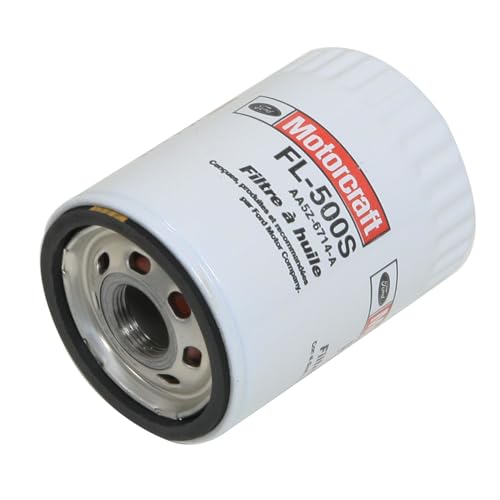


Use the chart to identify your engine and its stated refill capacity. Then confirm the quantity and oil specification against the manual or Ford service information for your particular van before adding oil.
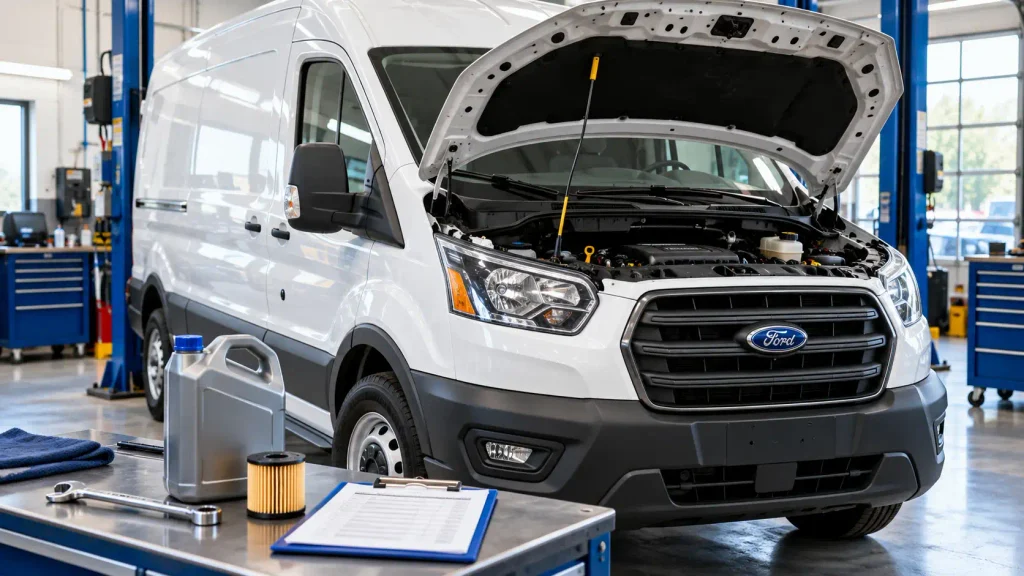
2015 to 2026 • Engine oil including a new filter • U.S. quarts and liters
Match both your model year and engine. Scroll the table sideways on smaller screens.
| Year | Engine | Oil with filter | SAE grade |
|---|---|---|---|
| 2015 | 3.5L EcoBoost V6 | 5.9 qt 5.6 L | 5W-30 |
| 2015 | 3.7L V6 | 6.0 qt 5.7 L | 5W-20 |
| 2015 | 3.2L Power Stroke diesel | 12.0 qt 11.4 L | 5W-40* |
| 2016 | 3.5L EcoBoost V6 | 5.9 qt 5.6 L | 5W-30 |
| 2016 | 3.7L V6 | 6.0 qt 5.7 L | 5W-20 |
| 2016 | 3.2L Power Stroke diesel | 12.0 qt 11.4 L | 5W-40* |
| 2017 | 3.5L EcoBoost V6 | 5.9 qt 5.6 L | 5W-30 |
| 2017 | 3.7L V6 | 6.0 qt 5.7 L | 5W-20 |
| 2017 | 3.2L Power Stroke diesel | 12.0 qt 11.4 L | 5W-40* |
| 2018 | 3.5L EcoBoost V6 | 5.9 qt 5.6 L | 5W-30 |
| 2018 | 3.7L V6 | 6.0 qt 5.7 L | 5W-20 |
| 2018 | 3.2L Power Stroke diesel | 12.0 qt 11.4 L | 5W-40* |
| 2019 | 3.5L EcoBoost V6 | 5.9 qt 5.6 L | 5W-30 |
| 2019 | 3.7L V6 | 6.0 qt 5.7 L | 5W-20 |
| 2019 | 3.2L Power Stroke diesel | 12.0 qt 11.4 L | 5W-40* |
| 2020 | 3.5L PFDI/Duratec V6 | 6.0 qt 5.7 L | 5W-20 |
| 2020 | 3.5L EcoBoost V6 | 6.0 qt 5.7 L | 5W-30 |
| 2021 | 3.5L PFDI/Duratec V6 | 6.0 qt 5.7 L | 5W-20 |
| 2021 | 3.5L EcoBoost V6 | 6.0 qt 5.7 L | 5W-30 |
| 2022 | 3.5L PFDI/Duratec V6 | 6.0 qt 5.7 L | Check VIN/manual |
| 2022 | 3.5L EcoBoost V6 | 6.0 qt 5.7 L | 5W-30 |
| 2023 | 3.5L PFDI/Duratec V6 | 6 vs 12 qt Ford documents conflict VIN CHECK REQUIRED | 5W-30 |
| 2023 | 3.5L EcoBoost V6 | 6.0 qt 5.7 L | 5W-30 |
| 2024 | 3.5L PFDI/Duratec V6 | 6 vs 12 qt Ford documents conflict VIN CHECK REQUIRED | 5W-30 |
| 2024 | 3.5L EcoBoost V6 | 6.0 qt 5.7 L | 5W-30 |
| 2025 | 3.5L PFDI/Duratec V6 | 6 vs 12 qt Ford documents conflict VIN CHECK REQUIRED | 5W-30 |
| 2025 | 3.5L EcoBoost V6 | 6.0 qt 5.7 L | 5W-30 |
| 2026 | 3.5L PFDI/Duratec V6 | 6 vs 12 qt Ford documents conflict VIN CHECK REQUIRED | 5W-30 |
| 2026 | 3.5L EcoBoost V6 | 6.0 qt 5.7 L | 5W-30 |
* Diesel viscosity and Ford WSS approval depend on conditions and the model-year manual. The 2022 PFDI oil grade also requires manual verification. The 6 qt versus 12 qt conflict does not apply to the 3.5L EcoBoost. Review the Ford references and detailed notes in the article before adding oil.


How to Identify Your Ford Transit Engine Before an Oil Change


Two Transit vans from the same year can have different engines. The 3.5L EcoBoost and naturally aspirated 3.5L V6 are not interchangeable entries.
- Confirm the model year. Check the registration, VIN record, or vehicle information supplied with your van.
- Identify the engine. Use the vehicle’s original window sticker, engine identification information, or VIN-specific Ford records. Do not rely on the Transit 150, 250, or 350 badge alone.
- Check the market and model. This chart covers the full-size, U.S.-market Transit. Transit Connect, E-Transit, and European Transit Custom or EcoBlue variants require their own specifications.
- Match the year and engine together. Only then select the listed oil quantity and viscosity.
Earlier models offered 3.7L gasoline, 3.5L EcoBoost, and 3.2L diesel engines. The 2020 redesign introduced a naturally aspirated 3.5L PFDI/Duratec alongside the 3.5L EcoBoost.
Ford Transit Oil Capacity Chart by Year and Engine


All listed refill quantities include a new engine oil filter. Figures use U.S. quarts and liters as published by Ford. Engine availability varies by configuration.
| Model Year | Engine | Oil With Filter | Normal SAE Oil Grade |
|---|---|---|---|
| 2015 | 3.5L EcoBoost V6 | 5.9 qt (5.6 L) | 5W-30 |
| 2015 | 3.7L V6 | 6.0 qt (5.7 L) | 5W-20 |
| 2015 | 3.2L Power Stroke diesel | 12.0 qt (11.4 L) | 5W-40* |
| 2016 | 3.5L EcoBoost V6 | 5.9 qt (5.6 L) | 5W-30 |
| 2016 | 3.7L V6 | 6.0 qt (5.7 L) | 5W-20 |
| 2016 | 3.2L Power Stroke diesel | 12.0 qt (11.4 L) | 5W-40* |
| 2017 | 3.5L EcoBoost V6 | 5.9 qt (5.6 L) | 5W-30 |
| 2017 | 3.7L V6 | 6.0 qt (5.7 L) | 5W-20 |
| 2017 | 3.2L Power Stroke diesel | 12.0 qt (11.4 L) | 5W-40* |
| 2018 | 3.5L EcoBoost V6 | 5.9 qt (5.6 L) | 5W-30 |
| 2018 | 3.7L V6 | 6.0 qt (5.7 L) | 5W-20 |
| 2018 | 3.2L Power Stroke diesel | 12.0 qt (11.4 L) | 5W-40* |
| 2019 | 3.5L EcoBoost V6 | 5.9 qt (5.6 L) | 5W-30 |
| 2019 | 3.7L V6 | 6.0 qt (5.7 L) | 5W-20 |
| 2019 | 3.2L Power Stroke diesel | 12.0 qt (11.4 L) | 5W-40* |
| 2020 | 3.5L PFDI/Duratec V6 | 6.0 qt (5.7 L) | 5W-20 |
| 2020 | 3.5L EcoBoost V6 | 6.0 qt (5.7 L) | 5W-30 |
| 2021 | 3.5L PFDI/Duratec V6 | 6.0 qt (5.7 L) | 5W-20 |
| 2021 | 3.5L EcoBoost V6 | 6.0 qt (5.7 L) | 5W-30 |
| 2022 | 3.5L PFDI/Duratec V6 | 6.0 qt (5.7 L) | See oil-grade note** |
| 2022 | 3.5L EcoBoost V6 | 6.0 qt (5.7 L) | 5W-30 |
| 2023 | 3.5L PFDI/Duratec V6 | 12.0 qt (11.4 L)† | 5W-30 |
| 2023 | 3.5L EcoBoost V6 | 6.0 qt (5.7 L) | 5W-30 |
| 2024 | 3.5L PFDI/Duratec V6 | 12.0 qt (11.4 L)† | 5W-30 |
| 2024 | 3.5L EcoBoost V6 | 6.0 qt (5.7 L) | 5W-30 |
| 2025 | 3.5L PFDI/Duratec V6 | 12.0 qt (11.4 L)† | 5W-30 |
| 2025 | 3.5L EcoBoost V6 | 6.0 qt (5.7 L) | 5W-30 |
| 2026 | 3.5L PFDI/Duratec V6 | 12.0 qt (11.4 L)† | 5W-30 |
| 2026 | 3.5L EcoBoost V6 | 6.0 qt (5.7 L) | 5W-30 |
Ford’s 2015 Transit owner’s manual gives the early gasoline and diesel figures. Ford’s 2020 Transit owner’s manual documents the redesigned gasoline engines. Ford/Motorcraft’s current oil reference covers the later years, including the unusual 2023-onward Duratec entry.

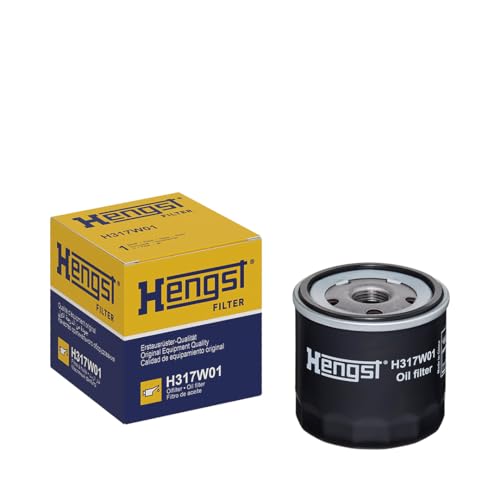

- Diesel oil: The 3.2L Power Stroke’s 5W-40 recommendation depends on operating temperature, duty cycle, fuel, and the applicable Ford diesel-oil specification. Earlier manuals use WSS-M2C171-E; later Motorcraft references use WSS-M2C171-F1. Check your particular manual rather than choosing by viscosity alone.
- 2022 gasoline oil: The 2022 Transit owner’s manual lists 5W-20, WSS-M2C960-A1, for the naturally aspirated 3.5L, while the more recent Motorcraft application chart places a 2022 Transit 3.5L entry under 5W-30. Confirm the VIN-specific requirement instead of assuming one oil grade applies to every build.
- † Important 2023–2026 exception: Ford/Motorcraft’s oil application chart and late-model online manual material list 12.0 quarts for the 3.5L naturally aspirated engine, but Ford technical specifications also publish 6 quarts for the same engine family. Do not pour 12 quarts into a 3.5L Transit based only on this chart. Read the discrepancy section below and verify the correct service information for the VIN.
Why the 2015–2019 EcoBoost reads 5.9 rather than 6.0: The applicable period owner manuals give the more precise 5.9-quart figure. Later quick-reference charts round the engine’s refill quantity to 6.0 quarts. Follow the vehicle-specific manual and finish by checking the dipstick.
What Changed in Ford Transit Oil Capacity After 2019


The major change came with the 2020 Transit engine lineup. The earlier 3.7L V6 and 3.2L Power Stroke diesel no longer belong in a general 2020–2026 U.S. Transit capacity table. The two gasoline choices for 2020 became the naturally aspirated 3.5L PFDI/Duratec and the turbocharged 3.5L EcoBoost.
Ford lists 6.0 quarts including the filter for both 2020 gasoline engines, with 5W-20 for the naturally aspirated V6 and 5W-30 for the EcoBoost.


Later oil-grade documents differ, and the Motorcraft reference shows a sharply different naturally aspirated capacity from 2023 onward.
Why 2023 to 2026 Transit Oil Capacities Conflict
Ford’s own publications disagree about the refill quantity for the late-model 3.5L naturally aspirated PFDI/Duratec. The disagreement does not apply to the 3.5L EcoBoost entry, which remains listed at 6.0 quarts.
Ford’s Motorcraft oil application and crankcase-capacity chart, Version 23, dated July 2026, specifies 12.0 quarts with an oil filter for the 2023–2026 3.5L naturally aspirated Transit. Its grid separately lists the 2022 Transit at 6.0 quarts. Ford’s 2024–2026 online owner-manual material also reflects the 12.0-quart number.


Yet Ford’s 2026 Transit technical specifications list 6 quarts for the 3.5L PFDI V6 and 6 quarts for the 3.5L EcoBoost. That technical sheet does not explain the difference from the Motorcraft oil-service chart.
| Ford Publication | Late-Model 3.5L PFDI Figure |
|---|---|
| Motorcraft oil application chart, 2023–2026 | 12.0 qt with filter |
| 2026 Transit technical specifications | 6 qt, filter basis not stated |
These two figures cannot both be used as a generic oil-change instruction. The documents reviewed do not establish whether the mismatch comes from a service-specific configuration, a publishing error, or another distinction. Before servicing a 2023–2026 PFDI van, ask a Ford service department to confirm the oil-fill quantity against the VIN and current workshop information. Also confirm the dipstick and oil level using Ford’s method. Never resolve a six-quart discrepancy by simply adding the larger amount.
Which Engine Oil Grade Does Your Ford Transit Need
Oil capacity tells you how much to add; viscosity and Ford WSS approval tell you which oil belongs in the engine. A bottle labeled 5W-30 is not automatically suitable unless it also satisfies the applicable specification.
For earlier full-size Transits, the common normal grades are 5W-30 for the 3.5L EcoBoost, 5W-20 for the 3.7L gasoline engine, and 5W-40 for the 3.2L diesel under the conditions described in its manual.
For 2020, Ford specifies 5W-20 meeting WSS-M2C945-B1 for the naturally aspirated 3.5L, and 5W-30 meeting WSS-M2C946-B1 for the EcoBoost. The 2021 manual uses newer specifications, including WSS-M2C960-A1 for 5W-20 and WSS-M2C961-A1 for 5W-30. Ford’s newer Motorcraft chart organizes later gasoline applications under WSS-M2C970-A1 and WSS-M2C971-A1. Match the approval to the exact model year and VIN.
For a broader explanation of viscosity grades and manufacturer requirements, see our Ford engine oil recommendation chart. The Transit capacity table here remains the reference for refill quantity, not a substitute for the oil approval printed in your manual.
Do Transit 150 250 and 350 Models Take Different Oil Amounts
The Transit 150, 250, and 350 badges do not independently determine engine oil capacity. They identify vehicle series and weight-related configurations. Two vans with different badges but the same model year and engine normally use the same engine specification.
An older Transit 350 with a 3.2L diesel cannot use the gasoline V6 figure. Likewise, a 2025 Transit 250 with naturally aspirated 3.5L should not automatically use the EcoBoost quantity.
Identify the engine first. Cargo van, passenger van, chassis cab, and camper conversions may need additional VIN-specific checks.
How to Check Ford Transit Oil Level After Refilling
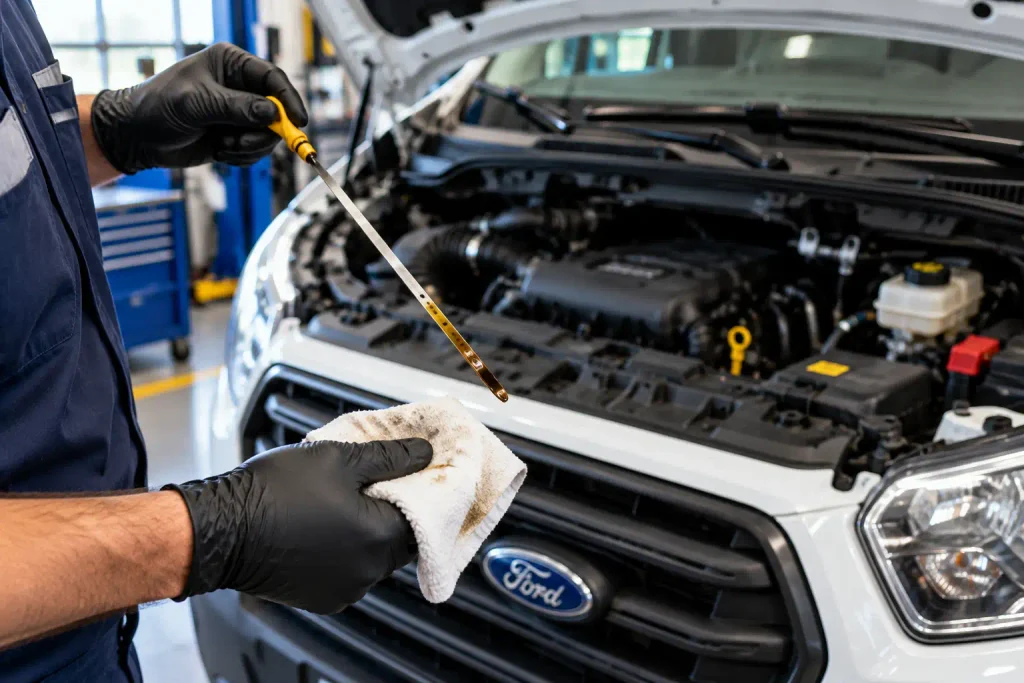
A listed capacity is not permission to pour in every quart without checking the level. Ford’s 2020 manual specifies level ground and a 10-minute wait after shutting off the engine.
- Park on level ground. Shut down the engine, secure the van, and follow the waiting instructions in its owner’s manual.
- Use the correct oil. After changing the filter and reinstalling the drain plug, add a conservative amount based on the verified specification. Do not use a disputed figure to decide the fill quantity.
- Read the dipstick. Remove it, wipe it with a lint-free cloth, insert it fully, and remove it again. The oil should be between the minimum and maximum marks.
- Add only as needed. Top up gradually when the indicated level is low. Check again according to the manual’s procedure; do not fill above maximum.
- Inspect for leaks. Confirm the filter and drain plug are secure, check for leakage after running the engine as directed, and recheck the level.
Do not confuse the total oil-change capacity with the amount needed to move the dipstick from minimum to maximum. Those are different measurements. If the oil-pressure warning stays on while the engine runs, stop the engine and investigate instead of continuing to drive.
When to Change Ford Transit Oil and Reset the Monitor
Ford’s Intelligent Oil-Life Monitor adjusts maintenance timing based on how the Transit is used. Frequent idling, dusty operation, short trips, and heavy commercial use can shorten the time between changes. Ford’s schedules commonly set an upper limit of one year or 10,000 miles, although severe-use conditions and individual model years may require earlier service.
Change oil and filter according to the van’s schedule, then reset the monitor. Our 2018 Ford Transit 250 oil-reset guide covers that vehicle’s reset process. A reset clears the reminder; it does not replace the oil change.
Which Ford Transit Oil Capacity Should You Use
The safest way to use a Ford Transit oil capacity chart is to start with the model year, identify the exact engine, and confirm that the listed amount includes an oil filter change. For 2015–2019 vans, this distinction is especially important because the 3.2L diesel holds much more oil than the gasoline V6 engines.
For 2020–2022 gasoline models, the chart provides the documented 6.0-quart figures, with a separate caution about the 2022 naturally aspirated engine’s oil grade. The 2023–2026 3.5L naturally aspirated engine requires particular attention because Ford’s documents disagree on capacity.
Before an oil change, check the VIN-specific Ford service instruction and verify the finished level with the dipstick. That confirmation matters more than treating any general chart as universal.
Ford Transit Oil Capacity Questions Answered
How Many Quarts of Oil Does a Ford Transit Take
It varies by year and engine. The 2015–2019 3.5L EcoBoost uses 5.9 quarts with a new filter, the 3.7L gasoline V6 uses 6.0 quarts, and the 3.2L diesel uses 12.0 quarts. Later models need an engine-specific lookup, especially the disputed 2023–2026 PFDI specification.
How Much Oil Does a Ford Transit 250 Need


The Transit 250 badge alone does not identify a refill capacity. Match its year with its engine: for example, a 2018 3.5L EcoBoost Transit 250 uses 5.9 quarts including the filter, while a 2021 3.5L EcoBoost Transit 250 uses 6.0 quarts.
What Is the Ford Transit 3.5 EcoBoost Oil Capacity


Ford specifies 5.9 quarts, or 5.6 liters, with the filter for 2015–2019 U.S. Transit 3.5L EcoBoost engines. The 2020–2026 EcoBoost is listed at 6.0 quarts, or 5.7 liters. Check the model year before purchasing oil.
Does the Ford Transit Oil Capacity Include the Filter


Yes. All refill figures in this chart refer to an oil change that includes a new oil filter, except that the Ford 2026 technical-sheet comparison does not state its filter basis. A refill without changing the filter can differ, and the dipstick should always confirm the final level.
Why Do Ford Manuals Show Different Transit Oil Capacities


For the 2023–2026 naturally aspirated 3.5L, the Motorcraft service chart says 12.0 quarts, but a Ford 2026 technical document says 6 quarts. The documents reviewed do not resolve the discrepancy. Do not assume either number is suitable for every VIN without confirming the correct Ford workshop instruction.
What Oil Does a Ford Transit 350 Use
That depends on the model year and engine. Earlier 3.7L gasoline models commonly specify 5W-20, the 3.5L EcoBoost commonly specifies 5W-30, and the 3.2L Power Stroke diesel uses an approved diesel oil such as 5W-40 under the appropriate conditions. Match the viscosity and Ford WSS approval to your van’s manual.