Ford 4.6 V8 Engine Diagram: Complete Component Layout Guide

A Ford 4.6L V8 is really three different engines sharing one name: 2V, 3V and 4V. Bank 1 (passenger side) holds cylinders 1 through 4. Bank 2 (driver side) holds 5 through 8, and the firing order is 1-3-7-2-6-5-4-8.


Which one you have changes where the PCV valve sits and what the cam design looks like. It also changes which torque spec applies, so confirm your variant before trusting any diagram.
Why one generic “4.6 diagram” cannot be trusted


Search this exact phrase and most results show a single labeled picture. No valvetrain is named. No year range is given.


That is the core problem. Ford built the 4.6L modular V8 from 1991 through 2014, and it was never one fixed design.
Worth knowing, in brief:
- 2V: two valves per cylinder, single overhead cam. Stayed in F-Series trucks and Panther-platform cars the longest.
- 4V: four valves, dual overhead cams. A high-output design for the Mark VIII and the Mustang Cobra.
- 3V: three valves per cylinder, variable camshaft timing. Arrived in 2005, replacing the 2V in the Mustang GT, Explorer and later F-150.
A diagram built for one of these and applied to another gets it wrong. The PCV valve, the cam sensor and the ignition hardware all move. Confirm your valvetrain first.
Which Ford 4.6 V8 do you actually have?


Pop the hood and count valves per cylinder, or check your build sheet. The table below covers every generation and where it was used.
Two independent references disagree on a few exact figures, noted in the table. Where they disagree, both numbers are shown rather than picking one and hiding the conflict.
| Generation | Valvetrain | Years and vehicles | Representative output | Ignition |
|---|---|---|---|---|
| 2V | SOHC, 2 valves per cylinder | Lincoln Town Car 1991-2011, Crown Victoria/Grand Marquis 1992-2012, F-Series 1997-2010, E-Series 1997-2014, Expedition 1997-2004, Explorer/Mountaineer 2002-2005, Mustang GT 1996-2004 | 190 hp (1991 Town Car) to 260 hp (1999-2004 Mustang GT) | Coil-in-plug from 1998 onward, per the technical record below |
| 4V | DOHC, 4 valves per cylinder | Lincoln Mark VIII 1993-1998, Mustang SVT Cobra 2003-2004 (supercharged, iron block) | 280 hp (Mark VIII) to 390 hp (2003-2004 Cobra) | Coil-in-plug |
| 3V | SOHC, 3 valves per cylinder, variable camshaft timing | Mustang GT 2005-2010, Explorer/Mountaineer/Sport Trac 2006-2010, F-150 2009-2010 | 292 hp (2010 F-150) to 315 hp (2010 Mustang GT) | Coil-in-plug |
Sources, cross-checked: Wikipedia’s Ford Modular engine entry, 8020 Automotive’s 4.6 guide, Engine Builder Magazine’s service history and F150hub’s spec reference.


These four sources disagree on a handful of points. Stroke is listed as 90.0mm (3.543in) by Wikipedia and 8020 Automotive, but 3.55in by F150hub.
F150hub lists compression as 9.0:1 to 9.375:1 to 9.8:1, by generation. 8020 Automotive gives a broader 9.0:1 to 10.1:1 range instead. The plastic intake manifold’s production run is dated 1991-2001 by 8020 Automotive and 1996-2001 by F150hub.
None of these gaps change which generation you have or where its parts sit. They are flagged here rather than smoothed into one false-confident number.



For the complete bolt-by-bolt torque specification table, see this site’s dedicated 4.6 Triton torque specs chart. We did not duplicate those figures here to keep one authoritative version.
Cylinder numbering and firing order


This holds across all three generations. Cylinder 1 is the front-most cylinder on the passenger side, and the banks are numbered front to rear.
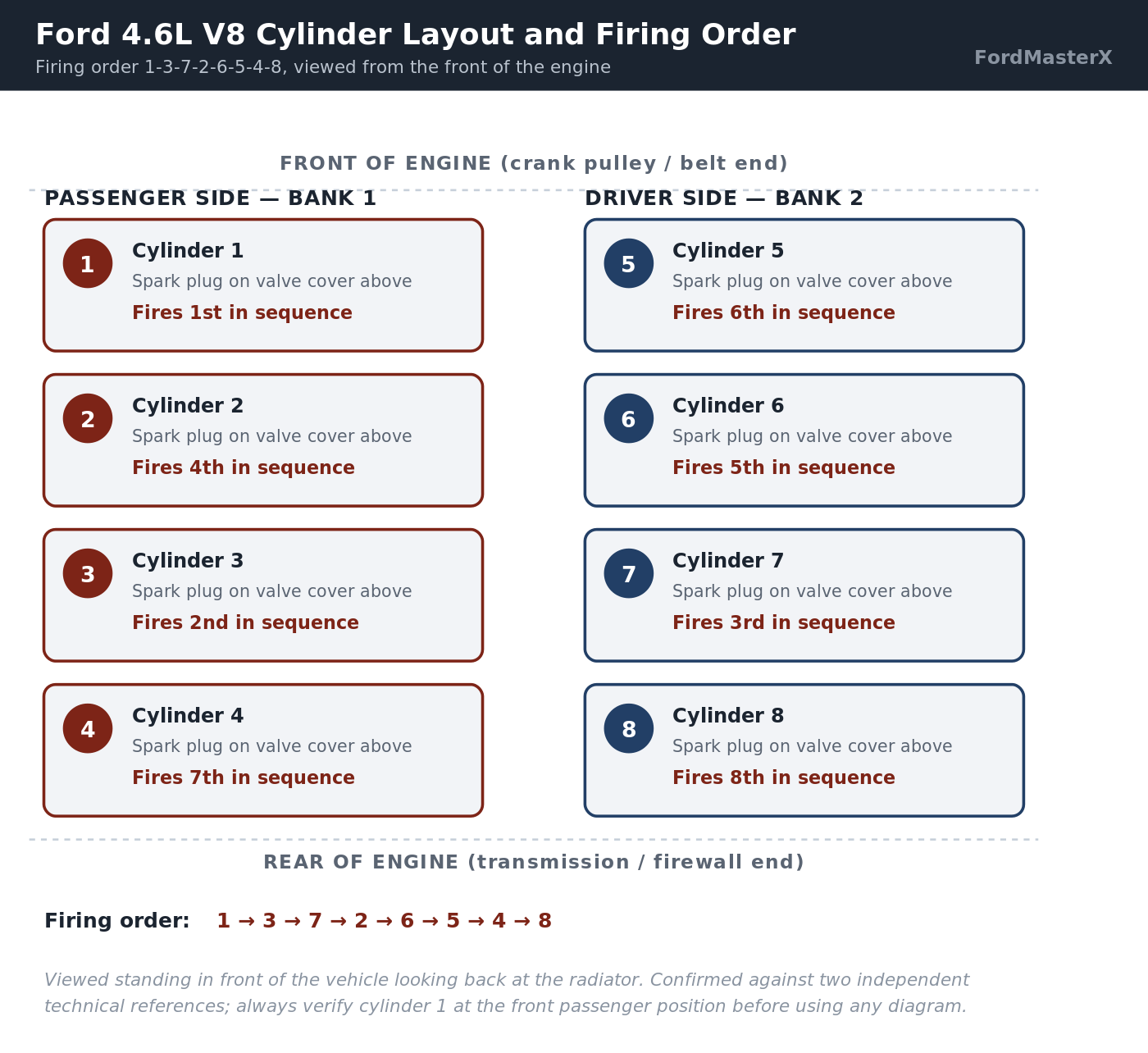
AA1Car’s Ford firing order reference and REREV’s 4.6L firing order page both confirm the 1-3-7-2-6-5-4-8 sequence. REREV states the bank assignment directly. Bank 1 is the passenger side, Bank 2 is the driver side, viewed from the radiator toward the windshield.


Misfire codes map straight to this layout. P0301 through P0304 point to cylinders 1 through 4 on the passenger bank. P0305 through P0308 point to cylinders 5 through 8 on the driver bank.
Where the major components sit
The table below covers the parts owners search for most, with the confidence level of the source behind each one.
| Component | Location | Source confidence |
|---|---|---|
| PCV valve (2V) | Plugs into the passenger-side valve cover | Single clear source. Forum reports on the Expedition conflict, see the section below. |
| Oil filter | Driver side of the block, best reached from underneath the truck | Single clear source (F150hub); other replies were too vague to use |
| Belt tensioner | Passenger side, front of the engine, just below the alternator | Single clear source (F150hub) |
| Alternator | Top of the accessory drive, last pulley in the belt wrap per F150hub’s routing note | Single clear source |
| Knock sensor(s) | Contested. See the dedicated section below. | Sources disagree, flagged rather than guessed |
| Composite intake manifold (2V, 1996-2001) | Top center of the engine, coolant crossover at the front and rear runners | Two independent sources agree |
Nothing here was found on three independent sources the way the generation table was. Where only one source answered clearly, that is stated plainly instead of padded out with a guess.
Where is the knock sensor, and why sources disagree
This is the one most owners cannot find, and forum answers genuinely conflict. We are reporting that honestly rather than picking a side.
One Mustang forum post places the knock sensor socket on the back of the block, just behind the lower intake. The same post claims most 4.6L applications use two sensors, one per bank.
A separate thread of F-150 owner replies disagrees. Some say it sits under the intake manifold, requiring removal. Others say the right side of the engine.
Generic knock codes follow the standard pattern regardless of exact sensor position. P0325 or P0327 points to bank 1, cylinders 1-4, passenger side. P0330 or P0332 points to bank 2, cylinders 5-8, driver side.
If you cannot locate the sensor by feel, plan on pulling the intake manifold. Multiple independent sources describing the 4.6L’s layout mention the intake blocking direct access.
Confirm your own engine’s sensor position with a service manual or a factory wiring diagram before ordering parts. A generic diagram here would be guessing, and this site does not publish guesses as data.
Where is the PCV valve?
F150hub’s maintenance reference covers the 2002-2004 model years. It states plainly that the PCV valve “is inserted into the passenger side valve cover” on the 2V 4.6L. That source also notes the location is “not universal for all 4.6L/5.4L engines,” which matches what we found elsewhere.
Owner forum replies about the Expedition’s 4.6L conflict on this. Some mechanics mark the passenger (right-hand) side, others the driver (left-hand) side, in the same thread.
Start on the passenger valve cover. If it is not there, check the driver side before assuming the part is missing.
Why Ford’s early intake manifolds cracked, and if you are covered
If your 4.6L is leaking coolant from the front or rear of the intake manifold, this is likely why. It is also the costliest and most litigated problem in this engine’s history, and it deserves its own section.
Ford’s original composite intake manifold on the 2V engine cracked under heat cycling. The strain of supporting the alternator’s weight made it worse. A 2002 Ford Technical Service Bulletin named the affected vehicles directly:
- 1996-1997 Ford Thunderbird
- 1996-2001 Ford Crown Victoria
- 1999-2001 Ford Mustang
- 2002 Ford Explorer
- 1996-2001 Lincoln Town Car
- 1996-1997 Mercury Cougar
- 1996-2001 Mercury Grand Marquis
Ford never issued a formal safety recall for this part. It did send a limited owner notification in May 2001, to Crown Victoria taxi, police and livery fleets. The January 2002 TSB followed.
Owners sued, and Ford settled in a 2005 class action covering 1.8 million 4.6L 2V vehicles. The settlement paid at least $735 to any qualifying owner who had already replaced a cracked manifold. It also extended the manifold’s warranty to seven years from the vehicle’s in-service date.
Ford’s redesigned manifold added a cast aluminum coolant crossover at the front. That version is documented to leak at a different spot instead. It leaks at the seam between the aluminum housing and the plastic body, not the original crack points.
Coolant that enters through a cracked manifold runs straight into the engine’s coolant passages, not just onto the ground. This site’s 4.6 coolant flow diagram traces the full path if you need to see where that coolant actually goes.
Symptom to component guide
Readers usually arrive with a symptom, not a part name. This maps the common ones to where to look.
| What is happening | Check this |
|---|---|
| Coolant pooling at the front or rear of the intake manifold | Cracked composite manifold, 1996-2001 2V engines. Check lawsuit-era warranty extension eligibility first. |
| Check engine light, code P0325 or P0327 | Bank 1 knock sensor circuit, passenger side cylinders 1-4 |
| Check engine light, code P0330 or P0332 | Bank 2 knock sensor circuit, driver side cylinders 5-8 |
| Rough idle, misfire isolated to cylinders 1-4 | Passenger bank, Bank 1: ignition coil, plug, or injector on that side |
| Rough idle, misfire isolated to cylinders 5-8 | Driver bank, Bank 2: ignition coil, plug, or injector on that side |
| Oil found low on the driver side, under the truck | Oil filter area; check the gasket and the drain slide above the front axle |
| Rattly ticking that changes with engine speed, 3V engines only | Variable camshaft timing (VCT) components, unique to the 3V design |
| Belt squeal, tensioner chatter | Tensioner, passenger side front, just below the alternator |
A knock code on an engine that also runs rough is worth reading with an actual scan tool. Do not guess from the symptom alone. A proper diagnostic tool separates a real bank-specific knock fault from a wiring issue in minutes.
Confirming continuity at the knock sensor connector before pulling the intake saves a wasted teardown. A basic automotive digital multimeter checks that in minutes.
4.6 V8 quick reference
The rows looked up most, in one place.
| Question | Answer |
|---|---|
| Firing order | 1-3-7-2-6-5-4-8 |
| Bank 1 | Passenger side, cylinders 1-4, front to rear |
| Bank 2 | Driver side, cylinders 5-8, front to rear |
| Oil capacity with filter | About 6 quarts per F150hub’s spec table; confirm against your underhood sticker |
| Ignition | Coil-in-plug from 1998 onward, confirmed by 8020 Automotive |
| Three generations | 2V (1991-2014, span varies by vehicle), 4V (1993-2004, high output), 3V (2005-2010, with VCT) |
If you are chasing a belt noise rather than an electrical fault, a correctly sized tensioner tool helps. It makes the swap a one-person job instead of a fight.
Replacing a cracked composite manifold yourself calls for a full gasket set rather than piecing one together. A complete intake manifold gasket set covers every surface in one box.
Still cannot pin down your exact generation from the badge or the build sheet alone? Count valves through the spark plug hole with a flashlight, or match your VIN’s engine code. That is the one check a generic diagram can never do for you.