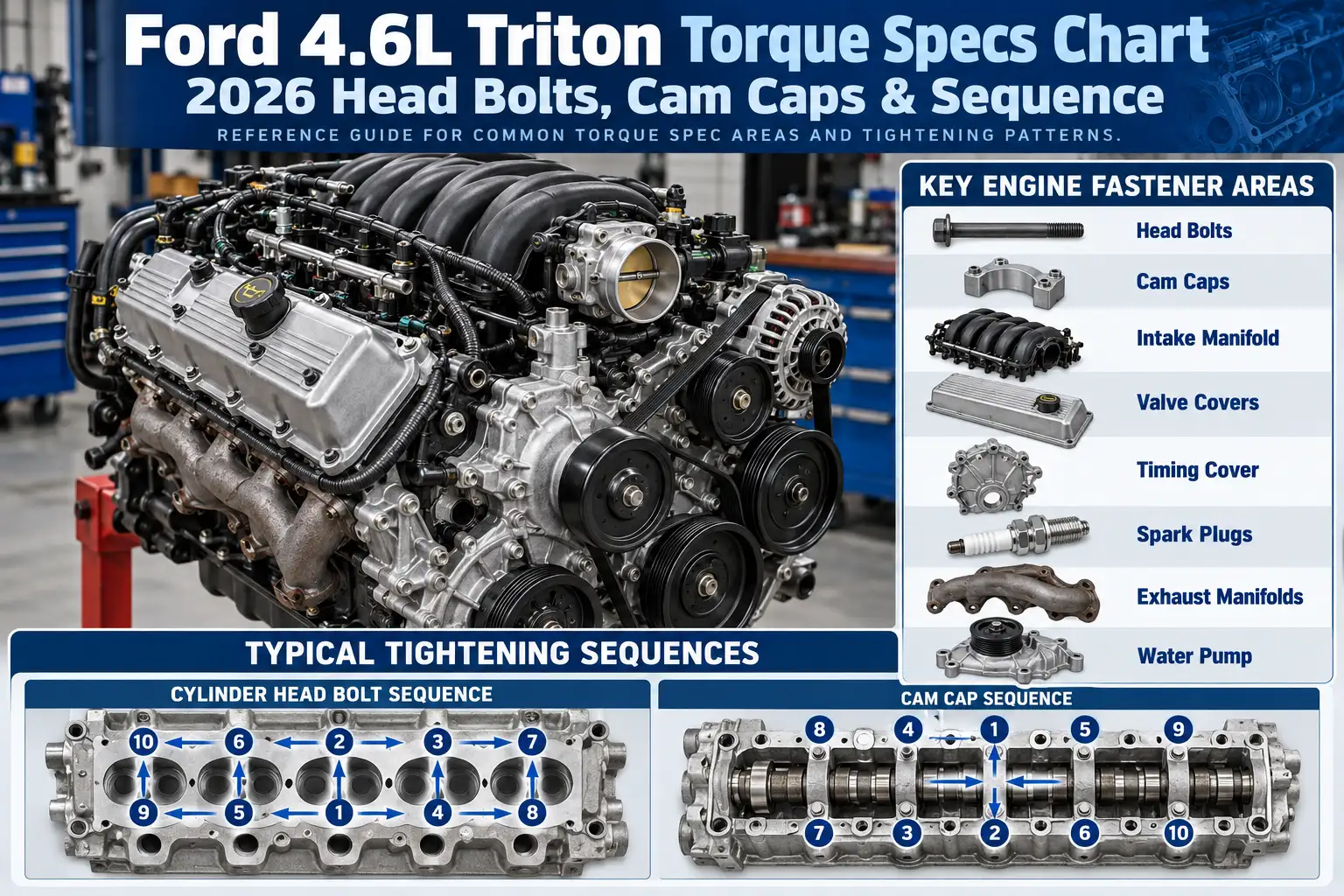
Ford 4.6L Triton Torque Specs Chart: Head Bolts, Cam Caps & Sequence 2026

Ford 4.6 Triton torque specs depend on the fastener, engine version, and model year. On a documented 2009 Ford F-150 4.6L, the cylinder head bolts require 40 Nm (30 lb-ft) followed by two 90-degree turns. That is a staged procedure, not a 30 lb-ft final torque setting.
This guide separates the 2009 F-150 4.6L 2-valve (2V) and 3-valve (3V) engines, with specifications for cylinder heads, bearings, intake manifolds, exhaust hardware, and timing components. It also flags a verified spark-plug difference between 2009 and 2010. Match your engine and service procedure before using any number below.
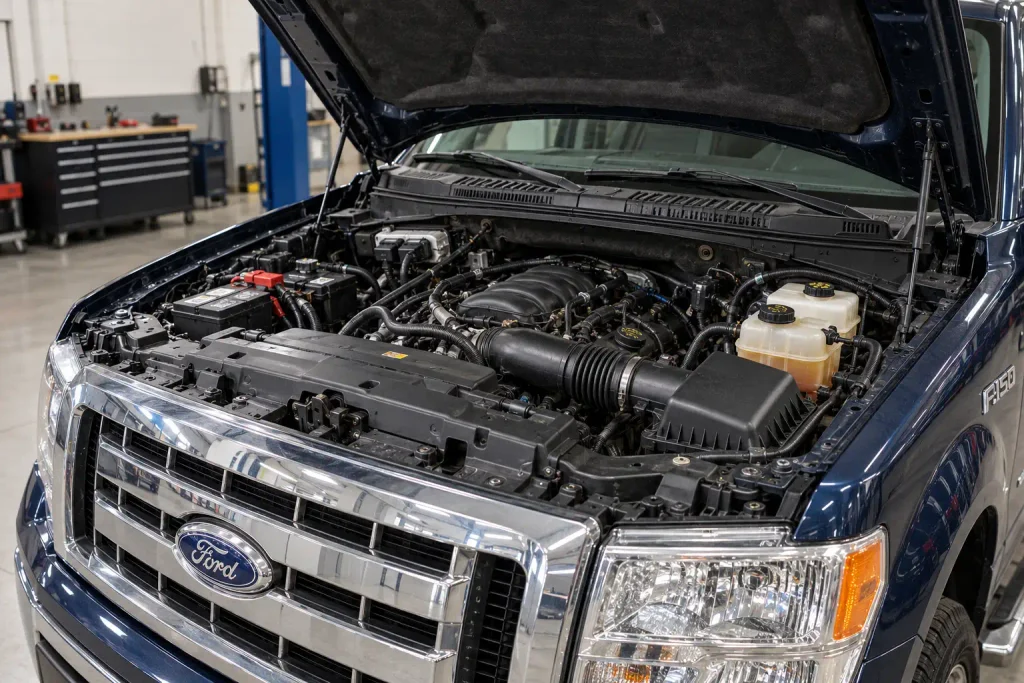
What Ford 4.6 Triton Version Is in Your Truck
Recommended Best Deal Products


The 4.6L Triton is part of Ford’s Modular V8 family. Ford used different 4.6L configurations in trucks and SUVs, and identical displacement does not guarantee identical service instructions.
For the 2009 F-150, the eighth VIN character identifies the two versions covered by the main charts:
| 2009 F-150 engine | Eighth VIN character | Identifying feature |
|---|---|---|
| 4.6L SOHC 2V | W | Two valves per cylinder, no 3V-style cam phasers |
| 4.6L SOHC 3V | 8 | Three valves per cylinder, variable camshaft timing |
The VIN is visible at the base of the windshield and on the driver’s door label. Use the complete vehicle identification and the matching repair manual to confirm the application; the VIN codes above are specifically documented for 2009, not a universal decoding rule for every year.
If you need help identifying engine components, use our Ford 4.6 Triton engine diagram before attempting a repair. Do not use this chart for a 5.4L, a 4.6L 4-valve Mustang engine, or another model solely because it belongs to the same engine family.
Ford 4.6 Triton Torque Specs by Component and Engine
The following tables cover the 2009 Ford F-150 4.6L 2V VIN W and 4.6L 3V VIN 8 service applications. They are not blanket specifications for all 1997–2010 4.6L engines. Values were checked against the published 2009 4.6L 2V engine specifications and 2009 4.6L 3V engine specifications.
| Component or fastener | 2009 4.6L 2V VIN W | 2009 4.6L 3V VIN 8 |
|---|---|---|
| Cylinder head bolts | 40 Nm (30 lb-ft), +90°, +90° | 40 Nm (30 lb-ft), +90°, +90° |
| Intake manifold bolts | 10 Nm (89 lb-in) | 2 Nm (18 lb-in), then 10 Nm (89 lb-in) |
| Camshaft bearing cap bolts | 10 Nm (89 lb-in) | 10 Nm (89 lb-in) |
| Main bearing cap vertical bolts | 40 Nm (30 lb-ft), then +90° | 40 Nm (30 lb-ft), then +90° |
| Main cap jackscrews | 5 Nm (44 lb-in), then 10 Nm (89 lb-in) | 5 Nm (44 lb-in), then 10 Nm (89 lb-in) |
| Main bearing cap side bolts | 21 Nm (15 lb-ft) | 21 Nm (15 lb-ft) |
| Connecting rod cap bolts | 23 Nm (17 lb-ft), 43 Nm (32 lb-ft), then +105° | 23 Nm (17 lb-ft), 43 Nm (32 lb-ft), then +105° |
| Crankshaft pulley bolt | 90 Nm, loosen 360°, 50 Nm, then +90° | 90 Nm, loosen 360°, 50 Nm, then +90° |
| Flexplate bolts | 80 Nm (59 lb-ft) | 80 Nm (59 lb-ft) |
| Oil pump bolts | 10 Nm (89 lb-in) | 10 Nm (89 lb-in) |
| Exhaust manifold nuts | 25 Nm (18 lb-ft) | 25 Nm (18 lb-ft) |
| Water pump bolts | 25 Nm (18 lb-ft) | 25 Nm (18 lb-ft) |
How to read the chart: Each comma-separated value is a successive tightening stage, not a choice of final torque. A “+90°” instruction means rotate the fastener another 90 degrees after the preceding stage. Follow the factory bolt-number sequence, replacement instructions, and thread-preparation requirements for the exact repair.
Unit check: 12 lb-in equals 1 lb-ft. For example, 89 lb-in is about 7.4 lb-ft, not 89 lb-ft. The original metric values and the manual’s rounded imperial equivalents are retained here.
For lug nuts, drain plugs, differential covers, and other non-engine hardware, use the separate Ford F-150 torque specs chart by year. The tables above focus on engine assembly fasteners.
How Ford 4.6 Cylinder Head Bolt Stages Differ
Recommended Best Deal Products

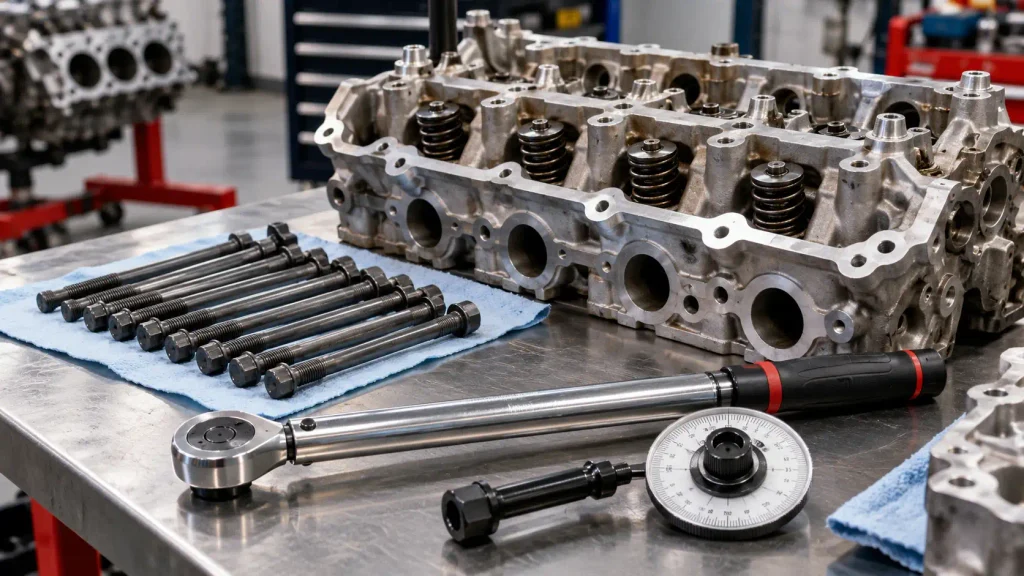
Both documented 2009 F-150 4.6L 2V and 3V configurations use the following cylinder head bolt stages. Each head has ten main head bolts, and Ford provides a separate illustrated order for the left and right banks.
- Stage 1: Tighten the head bolts in the specified order to 40 Nm (30 lb-ft).
- Stage 2: Turn each bolt an additional 90 degrees, following the same order.
- Stage 3: Turn each bolt another 90 degrees, again following the prescribed order.
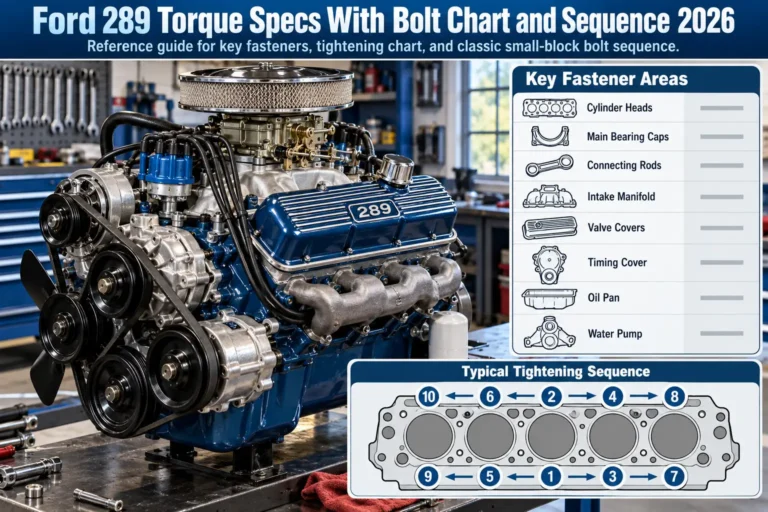
Ford identifies these head bolts as torque-to-yield fasteners. Discard removed head bolts and install new ones. Use the corresponding head-bolt sequence illustration in the service manual; the three stages above describe torque and angle, not bolt positions.
Do not assume this is every 4.6L head-bolt procedure. Some other Ford 4.6L applications include a full-turn loosening stage before retightening. That is an application-specific procedure, not an extra step to add to the 2009 F-150 instructions.
The head gasket also requires the prescribed surface preparation and installation method. Torque alone cannot compensate for damaged sealing surfaces, the wrong gasket, or previously stretched bolts.
What Ford 4.6 Main and Rod Bolts Require
The main bearing caps and connecting rod caps use different tightening stages. On the 2009 F-150 versions, the main cap’s vertical bolts, jackscrews, and side bolts are three distinct fastener groups.
Main Bearing Cap Vertical Bolts
Tighten the nine vertical main cap bolts and the stud bolt in the manual’s illustrated order. Apply 40 Nm (30 lb-ft), followed by 90 degrees. Keep the bearing caps in their designated positions and follow the bearing assembly procedure.
Main Cap Jackscrews and Side Bolts
Tighten the ten jackscrews to 5 Nm (44 lb-in), then 10 Nm (89 lb-in) in their specified order. Install and tighten the ten side bolts to 21 Nm (15 lb-ft). These are not interchangeable with the vertical bolt figures.
Connecting Rod Bearing Cap Bolts
The sixteen connecting rod cap bolts require 23 Nm (17 lb-ft), then 43 Nm (32 lb-ft), followed by an additional 105 degrees. Maintain each rod and cap’s correct matching orientation and complete the documented sequence.
If the engine is already apart, check the factory procedure for bearing clearances, bolt condition, and lubrication before assembly. A correct torque value does not by itself establish correct bearing clearance.
How 4.6 Triton Intake and Exhaust Bolts Differ
Recommended Best Deal Products


The 2009 2V intake manifold uses nine bolts tightened in the illustrated sequence to 10 Nm (89 lb-in). The 2009 3V intake manifold uses ten bolts with two passes: 2 Nm (18 lb-in), then 10 Nm (89 lb-in).
The final intake value is the same, but the bolt count and tightening method differ. Follow the applicable manifold pattern to seat the gasket evenly.
The same service references specify 25 Nm (18 lb-ft) for the exhaust manifold nuts. The cylinder-head installation instructions separately specify 12 Nm (106 lb-in) for exhaust manifold studs. The stud-to-head torque is not the same as the nut-to-stud torque.
These values apply to the referenced 2009 engines and designated fastener groups. Do not transfer them automatically to a damaged aftermarket manifold, different fastener material, or another model year.
What Ford 4.6 Timing Component Bolts Require
Timing-related hardware needs special attention because the 2009 2V and 3V use different camshaft hardware, even though several retaining bolts use similar torque-angle stages. The service procedure and bolt identity must be matched before tightening.
| Timing component | 2009 4.6L 2V VIN W | 2009 4.6L 3V VIN 8 |
|---|---|---|
| Camshaft sprocket or phaser retaining bolt | 40 Nm (30 lb-ft), then +90° | 40 Nm (30 lb-ft), then +90°; new phaser bolt |
| Timing chain guide mounting bolts | 10 Nm (89 lb-in) | 10 Nm (89 lb-in) |
| Camshaft bearing cap bolts | 10 Nm (89 lb-in) | 10 Nm (89 lb-in) |
On the 3V, the camshaft phaser sprocket bolts must be replaced as directed. The installation procedure also calls for a camshaft phaser locking tool; avoid using the phaser as a lever or lifting point. Tensioner mounting torque is deliberately excluded from this comparison: indexed 2009 3V timing and cylinder-head installation procedures give conflicting values. Use the exact Ford procedure for the installed tensioner rather than choosing either figure from a generic chart.
Both 2009 references specify a new crankshaft pulley bolt tightened in four stages:
- Tighten to 90 Nm (66 lb-ft).
- Loosen the bolt one full turn (360 degrees).
- Retighten to 50 Nm (37 lb-ft).
- Turn the bolt an additional 90 degrees.
The 2009 2V engine-front-cover fasteners include a 25 Nm (18 lb-ft) tightening instruction, along with a separate group of four bolts requiring 20 Nm (177 lb-in) plus 60 degrees. The 3V front-cover procedure requires its fifteen numbered fasteners at 25 Nm (18 lb-ft), then fasteners 6 and 7 at 48 Nm (35 lb-ft). Do not replace those numbered procedures with one blanket front-cover value.
Timing alignment is a separate operation from tightening. Our Ford 4.6 timing marks guide explains the alignment topic; use the appropriate workshop diagrams and positioning tools for your actual engine before rotating the crankshaft or camshafts with timing components removed.
How Ford 4.6 Spark Plug Torque Varies by Year
Spark plug tightening is another reason not to label every Ford 4.6L engine with one number. The documented 2009 F-150 4.6L 2V VIN W spark plug installation procedure specifies 15 Nm (133 lb-in).
The 2010 F-150 4.6L 2V VIN W procedure instead specifies 18 Nm (159 lb-in). The 2010 instructions also provide a specific engine-temperature precaution for removal.
| Verified application | Spark plug installation torque |
|---|---|
| 2009 F-150 4.6L 2V VIN W | 15 Nm (133 lb-in) |
| 2010 F-150 4.6L 2V VIN W | 18 Nm (159 lb-in) |
Do not apply either value to a 3V engine, a different year, or a different plug design without confirming that application. Ford’s procedures warn against using power tools to remove or install the plugs. Clean debris from the spark plug wells before removal, and start each replacement plug carefully by hand.
How to Verify Ford 4.6 Torque Before Tightening
The torque tables give documented reference values, but proper assembly also depends on matching each value to the installed engine and exact fastener.
- Identify the application. Record the vehicle year, model, engine variation, and VIN engine code. Confirm whether the engine is original or has been replaced.
- Open the matching service procedure. Use the Ford workshop information for that application, including illustrations that number the bolts and specify stages.
- Check hardware instructions. Identify one-time-use bolts, gaskets, seals, torque-angle requirements, and any instructions for clean, oiled, or otherwise prepared threads. Do not add lubricant or threadlocker unless specified.
- Use the right measuring tools. Select a torque wrench accurate within the required range. Use a torque-angle gauge for angular stages, and distinguish low-range lb-in measurements from lb-ft.
A normal click torque wrench cannot substitute for an angle gauge where the procedure specifies a further 90- or 105-degree turn. If the specified bolt order is unavailable, obtain the correct service diagram rather than guessing a center-out pattern.
5 Ford 4.6 Torque Mistakes That Cause Damage
1. Treating 2V and 3V as identical. The 2009 engines differ in their intake tightening steps and timing tensioner torques. Match the engine code before selecting a value.
2. Stopping at the first torque stage. Cylinder head and rod bolts require additional angular turns. The first Nm figure is not the finished tightening operation.
3. Reusing one-time-use hardware. The 2009 head bolts are torque-to-yield, and the crankshaft pulley requires a new bolt. The 3V phaser procedure also specifies new retaining bolts.
4. Confusing inch-pounds with foot-pounds. A valve-cover or intake bolt specified at 89 lb-in is only about 7.4 lb-ft. Reading that as 89 lb-ft creates a major over-tightening risk.
5. Guessing bolt order or preparation. Multiple fasteners must be tightened in a prescribed sequence. Thread condition, gasket installation, and specified bolt preparation all affect the repair.
When the manual cannot be matched to the hardware in front of you, stop the assembly and confirm the application before proceeding.
How to Use Ford 4.6 Torque Specs Safely
The right Ford 4.6 Triton torque specs are those that match your vehicle, engine version, and exact fastener group. For the documented 2009 F-150 2V and 3V engines, many bottom-end numbers match, but the intake manifold tightening stages and camshaft hardware requirements differ.
Cylinder head bolts, connecting rod bolts, and crankshaft pulley bolts also need complete staged procedures rather than one final torque figure. The 2009 and 2010 2V spark plug references demonstrate why year-specific checking matters, even for routine service.
Use these tables to identify a documented value quickly, then verify the bolt sequence, replacement hardware, and tightening conditions in the correct Ford workshop procedure before putting a wrench on the engine.
Ford 4.6 Triton Torque Specs Frequently Asked Questions
What Are the Ford 4.6 Head Bolt Torque Specs?
For the documented 2009 F-150 4.6L 2V and 3V engines, tighten new head bolts to 40 Nm (30 lb-ft), then an additional 90 degrees, then another 90 degrees, using the specified bolt sequence. Other Ford 4.6L applications may use different stages, so verify the model-specific manual.
Are Ford 4.6 2V and 3V Torque Specs the Same?
Not for every component. The 2009 F-150 2V intake uses a single 10 Nm pass, while the 3V uses 2 Nm followed by 10 Nm. The 3V also has camshaft phaser hardware and specified new-bolt requirements.
What Is the Ford 4.6 Spark Plug Torque?
For the 2009 F-150 4.6L 2V VIN W, the published service procedure specifies 15 Nm (133 lb-in). The 2010 2V VIN W procedure specifies 18 Nm (159 lb-in). Spark plug gap is a separate measurement; see our Ford 4.6 spark plug gap guide for that topic.
Can Ford 4.6 Cylinder Head Bolts Be Reused?
Not on the documented 2009 F-150 4.6L 2V or 3V head-bolt procedures. Ford identifies those fasteners as torque-to-yield and directs replacement after removal. Check the manual before reusing any other engine fastener.
Do All Ford 4.6 Engines Use the Same Torque Sequence?
No. Torque stages, bolt order, and even the number of fasteners can differ by vehicle and engine version. Use the exact factory illustrations rather than assuming an F-150 sequence will fit an Explorer, Mustang, or earlier Modular V8.