Ford 4R100 Shift Points Chart: 2026 All Years and Engines

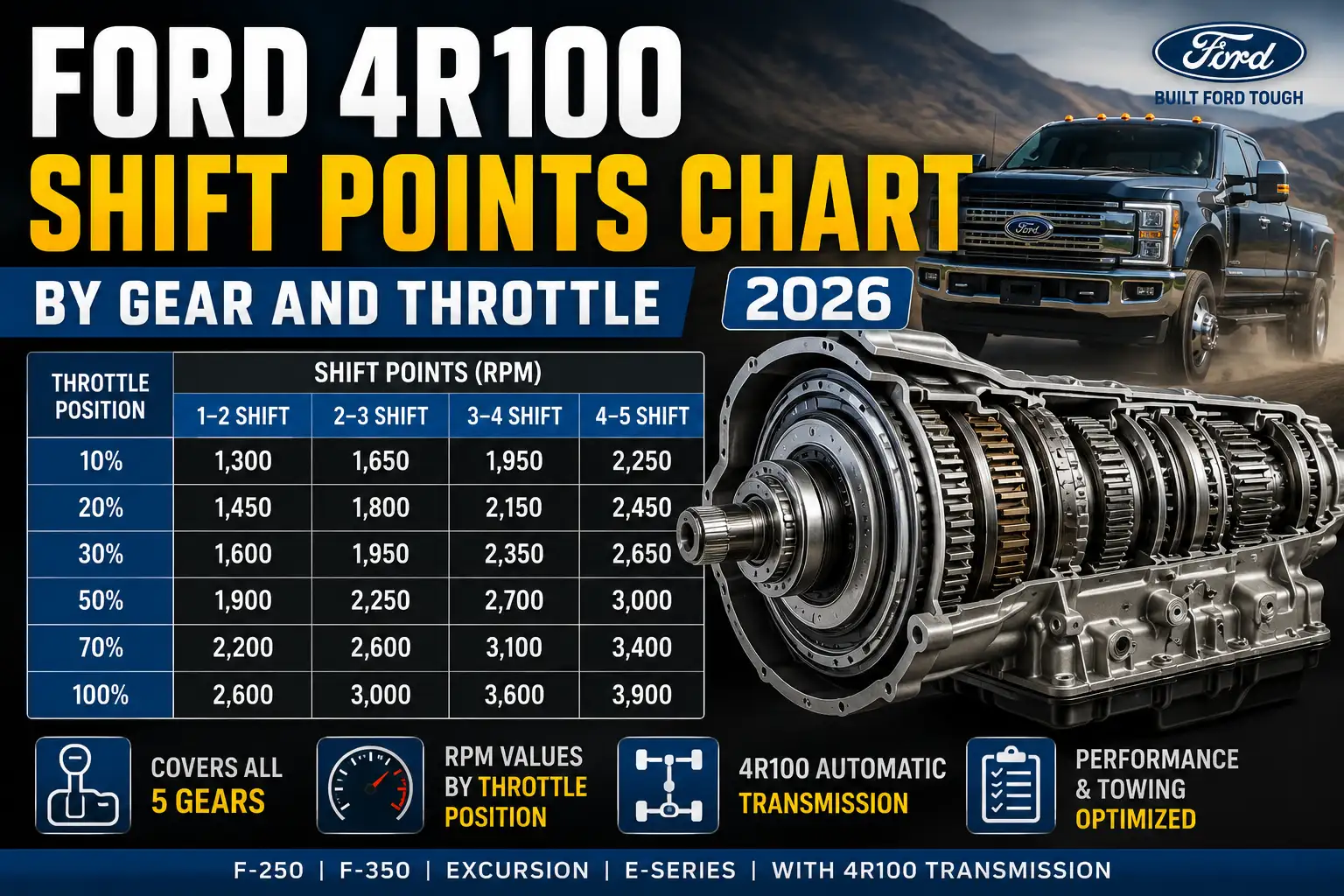
The Ford 4R100 is a four-speed automatic, and under light throttle it typically slides into second around 12 to 15 mph, third in the mid-20s, and overdrive near 40 mph, with the torque converter locking close to 45 mph. If you searched for a Ford 4R100 shift points chart, you most likely want to know one thing: is my truck shifting the way it should?
This guide pulls the scattered numbers from Super Duty owners and the transmission’s own spec sheet into one place. You will find the gear ratios, approximate shift speeds at light and heavy throttle, the full stop to overdrive sequence, and a side by side look at normal behavior versus the symptoms of a problem. Start with the ratios, because every shift point below is built on them.

Prime for Young Adults — 6 Months Free
Students and 18–24s get six months of Prime free, then half price.
Start 6 Months Free As an Amazon Associate I earn from qualifying purchases.Ford 4R100 Shift Points at a Glance
Four-speed automatic · 1999 to 2004 Super Duty, Excursion, and E-Series
Gear Ratios
Light-Throttle Shift Map (mph)
4R100 Gear Ratios for Every Forward Gear and Reverse
Recommended Best Deal Products


First gear in the 4R100 is a deep 2.71:1, which is part of why these trucks launch hard and tow well. The four forward ratios stay fixed across every 4R100, no matter the year or engine. What changes from truck to truck is when the transmission decides to move between them.
| 1st | 2nd | 3rd | 4th (Overdrive) | Reverse |
|---|---|---|---|---|
| 2.71:1 | 1.54:1 | 1.00:1 | 0.71:1 | 2.18:1 |
The 4R100 arrived for the 1999 model year as the electronic replacement for the E4OD. The two share the same gear ratios and a common C6 design heritage, but their internal parts are not interchangeable. Ford built the unit at its Sharonville, Ohio plant and rated it for up to 1,000 lb-ft of input torque, a figure that accounts for torque multiplication through the converter rather than raw engine output.
You will find the 4R100 behind several engines. Diesel trucks ran it with the 7.3L Power Stroke from 1999 through 2003. Gas Super Duty trucks, E-Series vans, and the Excursion used it with the 5.4L V8 and 6.8L V10 into the 2004 model year, and it even backed the supercharged 5.4L in the F-150 Lightning and Harley-Davidson editions. If you are not certain which unit sits under your truck, our Ford transmission identification chart breaks down how to read the tag and codes.
Where the 4R100 Shifts at Light Throttle and Wide Open
There is no single speed where a 4R100 shifts. The transmission reads vehicle speed and throttle position together, so a light foot produces early, low-rpm shifts while a heavy foot holds each gear far longer. That is why the same truck can feel like two different vehicles depending on how you drive it.
Under light, steady throttle, Super Duty owners consistently report a stock pattern in this range:
| Event | Approximate Speed |
|---|---|
| 1st to 2nd | 12 to 15 mph |
| 2nd to 3rd | 22 to 27 mph |
| Converter lockup in 3rd | 30 to 40 mph |
| 3rd to 4th (Overdrive) | 36 to 45 mph |
| Converter lockup in Overdrive | ~45 mph |
Approximate ranges from owner logs, not factory-published setpoints. Axle ratio, tire size, engine, and PCM calibration each shift these a few mph in either direction.

Audible — Listen Free for 30 Days
One free credit a month and thousands of titles included.
Listen Free for 30 Days As an Amazon Associate I earn from qualifying purchases.A 4.10 geared diesel and a 3.73 geared V10 will not shift at identical speeds, so treat these as a baseline rather than an exact rule. Open the throttle and the picture changes entirely. At wide open throttle the 4R100 holds each gear to roughly 3,200 rpm before upshifting, and overdrive is delayed until the truck is moving well. Owners describe the tach climbing to about 3,200 and dropping back to the 2,400 to 2,600 range on each shift at full power. Ford never published a wide open throttle mph chart for these trucks, and the exact speed each shift lands at depends heavily on engine and gearing, so rpm is the more reliable reference at full throttle.
How a Stock 4R100 Shifts From Stop to Overdrive
Recommended Best Deal Products


From a standstill, a healthy 4R100 moves through this sequence:
- Launches in first gear at 2.71:1.
- Shifts to second, then third as speed builds.
- Locks the torque converter, often while still in third.
- Shifts into fourth gear, which is overdrive at 0.71:1.
- Locks the converter again in overdrive for steady cruising.
The converter lockup is the part that throws people. The 4R100 uses a pulse width modulated converter clutch solenoid that mechanically couples the engine to the transmission once speed, temperature, and gear conditions are met. When it engages, rpm drops slightly and you feel a distinct bump that is easy to mistake for another gear change.
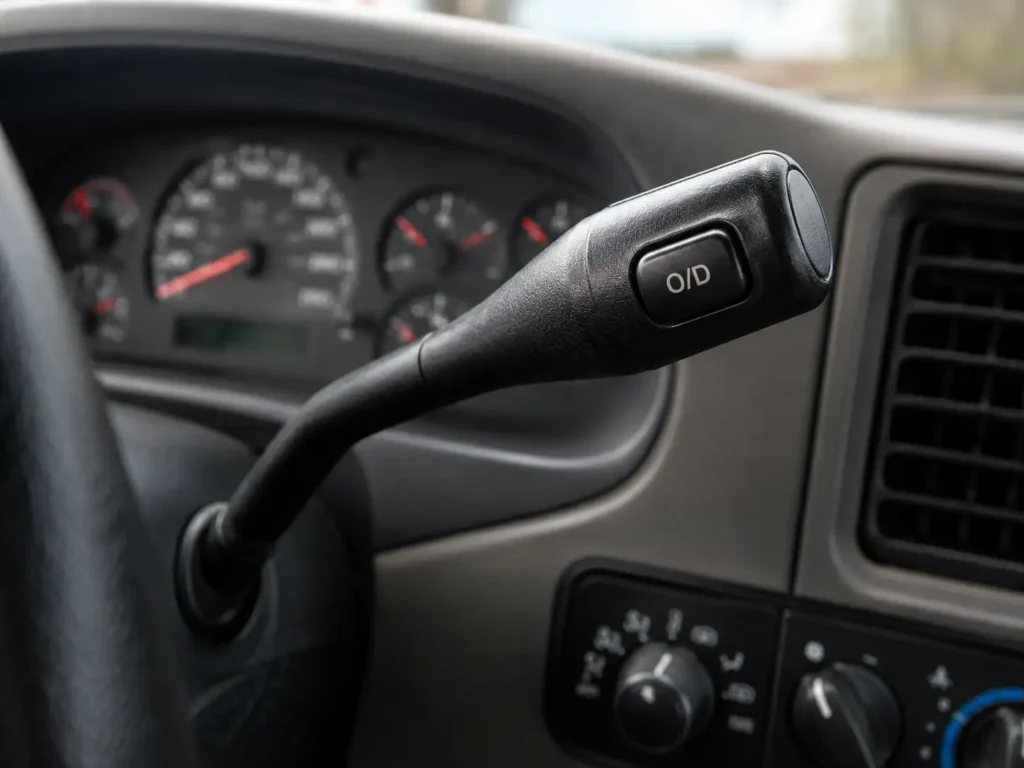
The overdrive button changes this sequence. Press OD off and the transmission drops out of fourth, holds third, and unlocks the converter. Owners tow and climb grades this way to keep the engine in its power band, though running unlocked carries a fuel penalty that Super Duty drivers commonly put at 2 to 4 mpg. If you are unsure when to use it, our guide on running with overdrive on or off walks through the trade-offs.
Normal 4R100 Shifting Versus Common Shift Problems
A healthy 4R100 shifts with purpose. The shifts are firm without slamming, rpm drops a few hundred on each upshift, overdrive arrives near 40 mph, and the converter locks smoothly around 45. Knowing that baseline makes problems easy to spot.
| Normal Behavior | Problem Sign |
|---|---|
| Firm, clean upshifts | Harsh slam on the 1st to 2nd shift |
| Slight rpm drop on each shift | Gears hang to 2,500-plus rpm at light throttle |
| Overdrive engages near 40 mph | No overdrive engagement at all |
| Converter locks once near 45 mph | Converter hunts, locking and unlocking at 60 to 75 mph |
| Shifts on speed and throttle | 1st to 2nd shift only happens when you lift off the throttle |
When something is off, the usual suspects are a worn valve body, a failing shift solenoid pack, a bad throttle position sensor, low line pressure, or a tired torque converter clutch. Early 1999 units also had a sprag issue tied to the 1st to 2nd shift. If the truck logs a code like P0731, that is the PCM reporting a gear 1 incorrect ratio, meaning it sees a mismatch between the gear it commanded and the gear it measures. The P0732 through P0734 codes flag the same fault in second, third, and fourth.
One honest caveat: late or lazy shifts are not always the transmission. A diesel that is down on power, often from fuel delivery problems, makes the 4R100 feel like it is shifting late when the real fault is the engine. Before condemning the transmission, rule out a slipping or failing torque converter and confirm the engine is making proper power.
Why Your 4R100 Feels Like It Has Five Gears
Recommended Best Deal Products

The 4R100 has four forward gears. Not five. The extra shift you feel on the highway is the torque converter locking, not a fifth ratio.
Here is why the confusion is so common. The converter can lock in third gear before the truck shifts into overdrive. So in a normal pull you feel first, second, third, a lockup that feels like a gear, then the shift into overdrive, then another lockup. That is five distinct sensations from a four-speed transmission.
A few quick myth corrections:
Audible Premium Plus — Annual Membership
12 audiobook credits up front, plus the full Audible catalogue.
See Annual Plans As an Amazon Associate I earn from qualifying purchases.- Turning OD off does not give you a different fifth gear. It holds third and unlocks the converter.
- The bump near 45 mph in a worry-free truck is lockup doing its job, not a slipping band.
- A 4R100 that feels like it shifts five or six times is usually shifting exactly as designed.
What Healthy 4R100 Shift Points Tell You
Read against this Ford 4R100 shift points chart, your truck tells you most of what you need to know. The gear ratios never change, the shift speeds move with your right foot, and the lockup you feel near 45 mph is the converter, not a phantom gear. A stock unit should reach overdrive around 40 mph at a steady cruise and lock up shortly after.
If your truck matches the normal column, drive it and stop second-guessing it. If it slams, hangs gears, refuses overdrive, or hunts at highway speed, scan it before assuming the worst. Many late-shift complaints trace back to a sensor, low fluid, or an engine down on power rather than a failed transmission. Compare first, then diagnose, and you will spend your money on the right repair.
Frequently Asked Questions About 4R100 Shift Points
At what speed does the 4R100 shift into overdrive?
Under light, steady throttle, a stock 4R100 shifts into overdrive around 36 to 45 mph, with most owners reporting close to 40 mph. The torque converter then locks near 45 mph. Heavier throttle delays the overdrive shift until the truck is moving faster.
Why does my 4R100 feel like it shifts five times?
Because the torque converter locks separately from the gear changes. The 4R100 has only four forward gears, but the converter can lock in third and again in overdrive, adding two felt bumps. That gives a four-speed the sensation of five shifts.
What RPM should a 4R100 shift at?
At wide open throttle, a stock 4R100 holds each gear to roughly 3,200 rpm before upshifting. Under light throttle it shifts much earlier and lower. Cruising in locked overdrive, most trucks settle near 1,500 to 1,800 rpm at highway speed.
Can you change 4R100 shift points without a transmission rebuild?
Yes. Shift speeds and converter lockup points are controlled by the PCM, so a custom tune can move them with no internal work. Many Super Duty owners retune shift points for towing to hold gears longer and lock the converter sooner.
Is it bad to drive a 4R100 with overdrive off?
No, it is fine for short stints like towing or climbing grades, which is exactly what the button is for. It keeps the engine in its power band but unlocks the converter, costing a commonly reported 2 to 4 mpg. For flat highway cruising, leave overdrive on.