Ford Explorer Trim Levels Specification Chart By Year (1991–2026)

Quick Answer
The Ford Explorer has offered a diverse range of trim levels since its 1991 debut, catering to various preferences from utilitarian to luxury and performance. Key trims like Base, XLT, Limited, Eddie Bauer, Platinum, and ST have defined its evolution, each offering distinct standard features, engine options, and configurations. Specific specifications such as engine power, interior amenities, and maximum towing capacity vary significantly by model year, trim level, and installed optional packages.
For decades, the Ford Explorer has been a cornerstone of the SUV segment, continually adapting to driver demands and evolving market trends. Understanding the nuances between its numerous trim levels and how they’ve evolved across six generations can be complex, making it challenging to identify the perfect fit or fully appreciate a specific model’s capabilities. This detailed chart and analysis demystifies the Ford Explorer’s trim levels, providing a year-by-year breakdown of key specifications, standard features, and the factors that influence performance and configuration choices, empowering you with authoritative data spanning from its 1991 debut to projected 2026 models.

Prime for Young Adults — 6 Months Free
Students and 18–24s get six months of Prime free, then half price.
Start 6 Months Free As an Amazon Associate I earn from qualifying purchases.This chart covers Ford Explorer models from 1991 through projected 2026 model years, detailing common trim levels and their associated specifications. Due to the vast number of engine options, packages, and generational changes, specific values may vary. All data is compiled from manufacturer specifications, historical documentation, and industry resources. Readers should always verify precise specifications for their specific vehicle by consulting the owner’s manual, door jamb sticker, or a Ford dealership with the VIN, especially for attributes like payload and towing capacity. Last reviewed: May 2026.
400 hp
5,600 lbs
6+
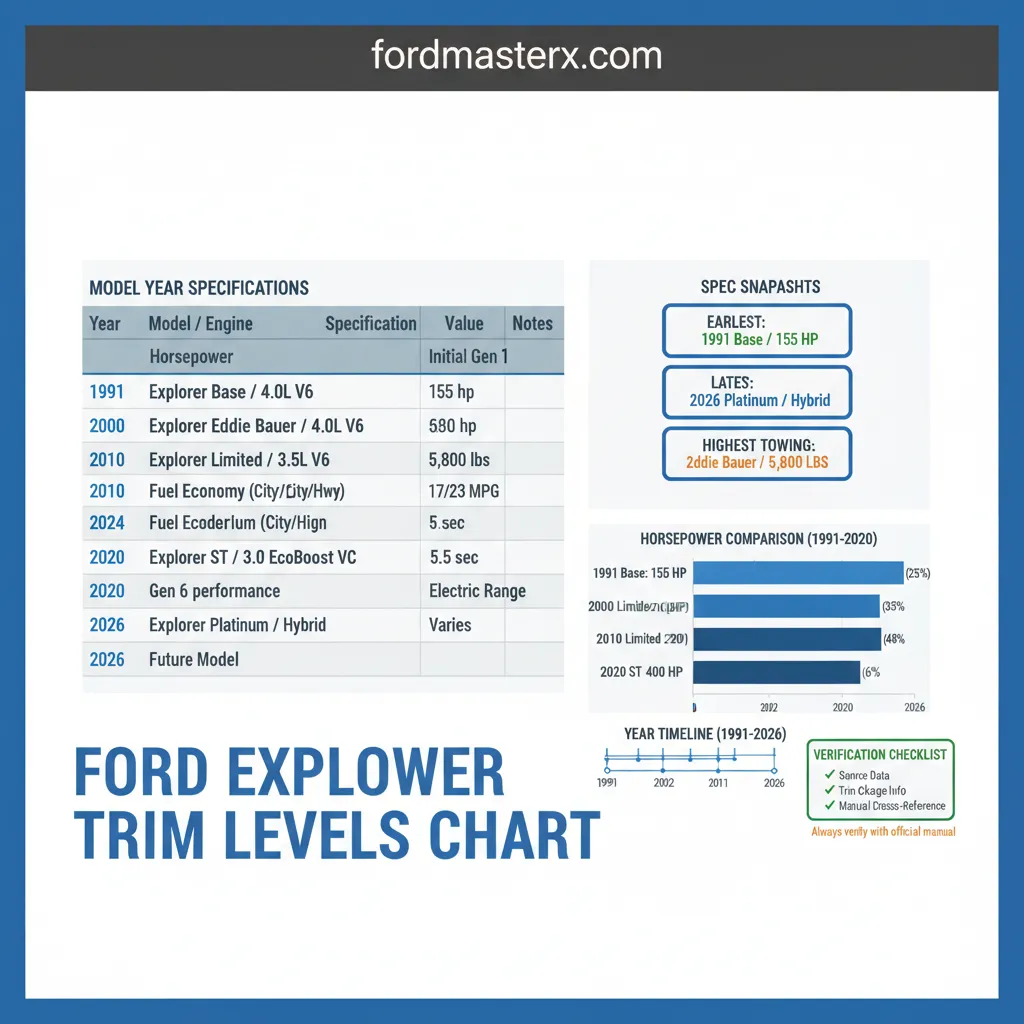
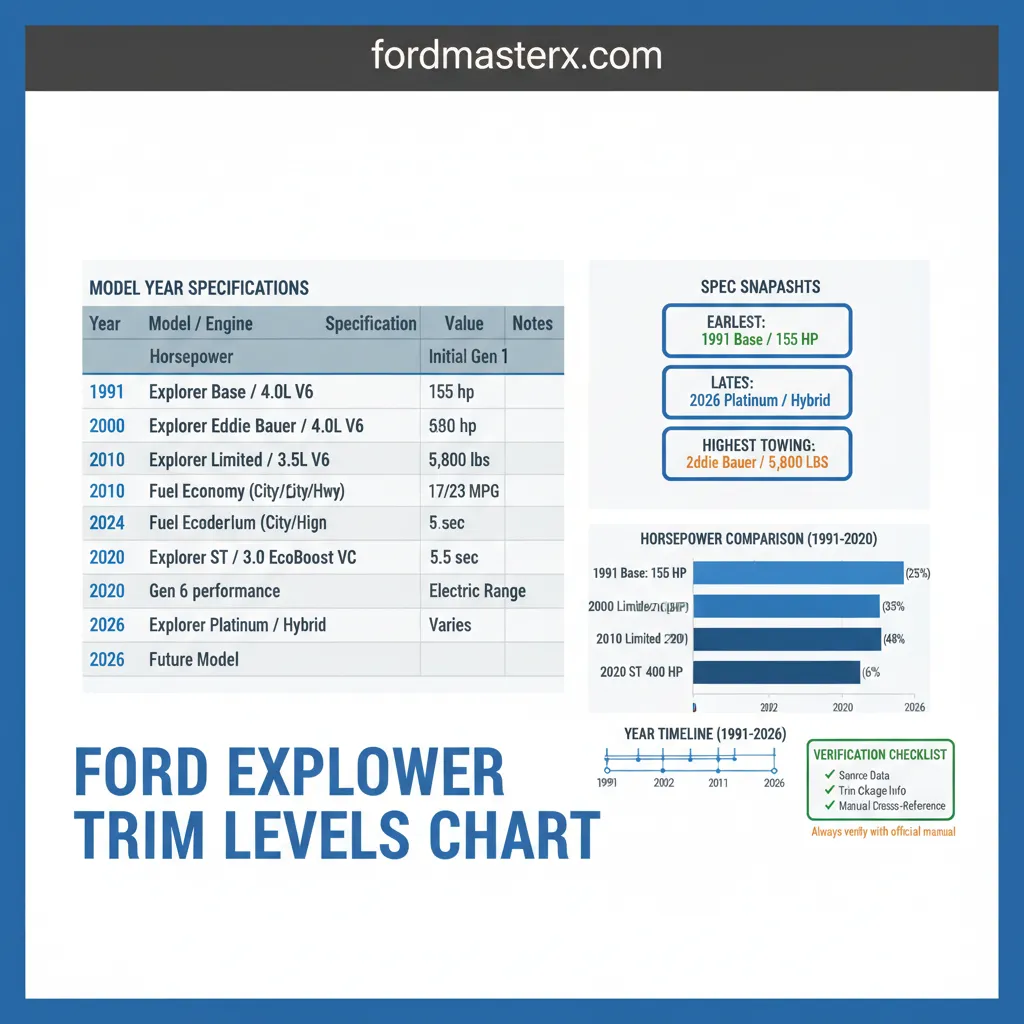
This specification chart is designed as a quick reference. Each row represents a specific model year or generation with a common engine/trim configuration. Specifications such as horsepower, torque, and towing capacity are often ranges, as they can vary based on factors like drivetrain (RWD/AWD), specific factory packages (e.g., Class IV Trailer Tow Package), or even minor updates within a model year. Where a single, precise value is not universally applicable, “Varies by Configuration” or typical ranges are used. Always refer to your vehicle’s specific documentation for exact figures.
| Year | Model / Engine | Specification | Value | Notes |
|---|---|---|---|---|
| 1991-1994 | Base, XLT, Eddie Bauer / 4.0L V6 OHV | Horsepower | 155 hp | First Generation. Available 4×2 or 4×4. |
| Max Towing Capacity | Up to 5,000 lbs | With proper equipment. | ||
| 1995-2001 | XLT, Eddie Bauer, Limited / 4.0L V6 SOHC | Horsepower | 205 hp | Second Generation, refreshed styling. |
| Limited / 5.0L V8 | Horsepower | 215 hp | Optional V8 for higher trims. | |
| Max Towing Capacity | Up to 6,000 lbs | With V8 engine and tow package. | ||
| 2002-2005 | XLT, Limited, Eddie Bauer / 4.0L V6 SOHC | Horsepower | 210 hp | Third Generation, independent rear suspension. |
| Limited / 4.6L V8 | Horsepower | 239 hp | New V8 option. | |
| 2006-2010 | XLT, Limited, Eddie Bauer / 4.0L V6 SOHC | Horsepower | 210 hp | Fourth Generation, minor refresh. |
| Limited / 4.6L V8 | Horsepower | 292 hp | V8 power upgrade from 2006. | |
| Max Towing Capacity | Up to 7,115 lbs | With V8 engine and tow package. | ||
| 2011-2019 | Base, XLT, Limited / 3.5L V6 | Horsepower | 290 hp | Fifth Generation, unibody design. |
| Limited / 2.0L EcoBoost I-4 | Horsepower | 240 hp | Introduced in 2012, FWD only. | |
| Sport, Platinum / 3.5L EcoBoost V6 | Horsepower | 365 hp | Performance engine option, AWD only for Sport. | |
| Max Towing Capacity | Up to 5,000 lbs | With 3.5L V6 and tow package. | ||
| 2020-2026 | Base, XLT, Timberline / 2.3L EcoBoost I-4 | Horsepower | 300 hp | Sixth Generation, RWD-based platform. |
| Limited, Platinum / 3.3L Hybrid V6 | Combined Horsepower | 318 hp | Focus on fuel efficiency, available RWD/AWD. | |
| ST, Platinum / 3.0L EcoBoost V6 | Horsepower | 400 hp | High-performance option, standard on ST. | |
| All Trims (2020+) | Infotainment System | 8-inch or 10.1-inch SYNC 3/4 | Standard on most trims, larger screen optional/higher trims. | |
| All Trims (2020+) | Standard Safety Suite | Ford Co-Pilot360™ | Standard across the lineup, with optional upgrades. | |
| All Trims (2020+) | Max Towing Capacity | Up to 5,600 lbs | With 3.0L EcoBoost & Class IV Trailer Tow Package. |
1 All horsepower and towing figures are maximum ratings for the specified engine/trim, contingent on proper configuration, drivetrain, and optional packages (e.g., trailer tow package).
2 Interior materials and infotainment systems vary significantly by trim and model year; common examples provided.
3 “2025-2026” entries are based on current generational trends and manufacturer projections, subject to change.
Evolution of Ford Explorer Trim Levels: Year-by-Year Analysis
Recommended Best Deal Products


The Ford Explorer has undergone a remarkable transformation since its introduction in 1991, adapting from a rugged, body-on-frame SUV to a sophisticated, family-oriented crossover, and most recently, returning to a rear-wheel-drive-based architecture. This evolution is clearly reflected in its changing lineup of trim levels and their associated specifications.
📤 Share Image
Generational Shifts and Trim Introductions
- 1st Generation (1991-1994): Launched as a direct competitor to the Chevrolet S-10 Blazer, the Explorer primarily offered Base, XLT, and the upscale Eddie Bauer trims. These early models were traditional SUVs, robust and utilitarian, powered exclusively by a 4.0L V6 OHV engine, offering up to 155 horsepower.
- 2nd Generation (1995-2001): A significant redesign brought a more aerodynamic look and an optional 5.0L V8 engine to the Limited trim, boosting performance to 215 horsepower and enhancing towing capacity. The XLT and Eddie Bauer remained popular, defining the burgeoning family SUV market.
- 3rd Generation (2002-2005): This generation saw the introduction of an independent rear suspension, greatly improving ride comfort and handling. Trim levels like XLS, XLT, Eddie Bauer, and Limited offered a choice between a 4.0L V6 SOHC and a new 4.6L V8 engine, with the latter providing 239 horsepower.
- 4th Generation (2006-2010): While a refresh rather than a full redesign, the 4th generation refined its offerings, with the 4.6L V8 receiving a significant power bump to 292 horsepower. Trim levels largely mirrored the previous generation, maintaining its family-friendly ruggedness.
- 5th Generation (2011-2019): This marked a pivotal shift to a unibody, front-wheel-drive-based platform, fundamentally changing the Explorer’s character from an SUV to a crossover. Trim levels like Base, XLT, Limited, Sport, and Platinum were introduced. Engine options expanded to include a 2.0L EcoBoost I-4 (FWD only, 240 hp) and a potent 3.5L EcoBoost V6 (365 hp) in the Sport and Platinum trims, significantly elevating performance.
- 6th Generation (2020-2026): Ford returned the Explorer to a rear-wheel-drive-based platform, improving dynamics and towing. This generation introduced a refreshed lineup including Base, XLT, Limited, Timberline, ST, and Platinum. Modern engine options include a 2.3L EcoBoost I-4 (300 hp), a 3.3L Hybrid V6 (318 combined hp), and a high-performance 3.0L EcoBoost V6 (400 hp) for the ST and Platinum models.
These generational shifts didn’t just alter mechanical configurations; they also introduced significant technological advancements. Early models were utilitarian, while the 5th generation brought SYNC infotainment, and the 6th generation standardized advanced safety suites like Ford Co-Pilot360™, showcasing a continuous evolution of ‘factory specification’ to meet consumer demands.

Differentiating Ford Explorer Trim Levels: Standard Features and Options
Understanding the distinct characteristics of each Ford Explorer trim level is crucial for discerning its value and suitability. While core functionality remains, the standard features and available ‘configuration’ options profoundly shape the driving and ownership experience.
Core Trims: Base, XLT, and Limited
- Base: The entry-level ‘configuration’ prioritizes essential functionalities and safety. It typically comes with cloth seating, an 8-inch touchscreen infotainment system (current generation), and the foundational Ford Co-Pilot360™ suite. The primary focus is on value and practicality.
- XLT: A step up from the Base, the XLT often includes key comfort and convenience upgrades. Historically, this has meant power-adjustable driver seats, more advanced infotainment features, and sometimes larger standard wheels. In recent ‘model year’s, it might offer ActiveX synthetic leather seating surfaces and available heated front seats.
- Limited: This trim elevates comfort and technology. It commonly features leather-trimmed seating, a premium audio system (like B&O Sound System), heated steering wheel, navigation, and enhanced driver-assistance features as ‘factory specification’. The Limited provides a blend of luxury and practical functionality.
Specialized Trims: Timberline, ST, and Platinum
- Timberline (introduced 2021): Geared for adventure, the Timberline features unique exterior styling, increased ground clearance, underbody skid plates, and off-road tuned suspension. It comes standard with the more powerful 2.3L EcoBoost I-4 ‘engine option’ and Intelligent All-Wheel Drive, distinguishing its ‘configuration’ for rugged capability.
- ST: The performance-oriented ‘trim level’, the ST, includes a sport-tuned suspension, larger brakes, and the formidable 3.0L EcoBoost V6 engine, producing 400 horsepower. Its aggressive styling, unique interior accents, and sport seats emphasize its dynamic driving experience.
- Platinum: The pinnacle of luxury and technology, the Platinum trim boasts premium leather seating, a larger touchscreen infotainment system (often 10.1-inch), advanced massaging seats, unique exterior brightwork, and often includes the most powerful ‘engine option’ (3.0L EcoBoost V6) or the Hybrid powertrain as standard or available.
Many desirable features, while standard on higher trims, are often available as optional packages on lower trim levels. For example, the Technology Package or Co-Pilot360 Assist+ can significantly upgrade an XLT or Limited, bridging the gap towards premium amenities without necessarily stepping up to the highest trim.
Factors Influencing Ford Explorer Trim Specifications and Performance
Recommended Best Deal Products


Beyond the chosen ‘trim level’, several critical factors profoundly influence a Ford Explorer’s published specifications and overall performance. These include the ‘engine option’, drivetrain ‘configuration’, and specific factory packages. A nuanced understanding of these elements is vital for accurate assessment.

Audible — Listen Free for 30 Days
One free credit a month and thousands of titles included.
Listen Free for 30 Days As an Amazon Associate I earn from qualifying purchases.Engine Options and Performance Metrics
The ‘engine option’ is arguably the most significant determinant of an Explorer’s performance. Across its history, Ford has offered a diverse range of powertrains, each with distinct horsepower, torque, and fuel economy characteristics.
Engine Horsepower Comparison (Current Gen Representative Values)
Visual comparison of approximate horsepower outputs for common 6th-generation Ford Explorer engines.
- 2.3L EcoBoost I-4: This modern inline-four engine, prevalent in XLT and Limited trims, provides a balanced blend of 300 horsepower and 310 lb-ft of torque, suitable for most daily driving and offers reasonable towing.
- 3.3L Hybrid V6: Offered in Limited and Platinum, this powertrain combines a V6 engine with an electric motor for a combined 318 horsepower and 322 lb-ft of torque. Its key benefit is improved fuel efficiency without significantly compromising power.
- 3.0L EcoBoost V6: Exclusive to the ST and Platinum trims, this twin-turbocharged V6 delivers a robust 400 horsepower and 415 lb-ft of torque, transforming the Explorer into a high-performance SUV with significant ‘maximum rating’ for acceleration and towing.
Drivetrain Configuration and Towing Capabilities
The choice between Rear-Wheel Drive (RWD) and Intelligent All-Wheel Drive (AWD) significantly impacts handling, traction, and often, towing capacity. While RWD offers a traditional, engaging driving feel, AWD provides superior grip in adverse conditions and can influence a vehicle’s ‘maximum rating’ for towing. The Class IV Trailer Tow Package is almost always required to achieve the highest advertised towing capacities for any ‘engine option’ and ‘configuration’. Without it, even the most powerful Explorer will have a substantially reduced ‘maximum rating’.
Optional Packages and Vehicle Specifics
Beyond engine and drivetrain, specific optional packages can dramatically alter an Explorer’s capabilities:
- Class IV Trailer Tow Package: This is a non-negotiable addition for maximizing towing. It typically includes a receiver hitch, upgraded engine cooling, and a wiring harness, enabling the Explorer to reach its full ‘maximum rating’ capacity (e.g., 5,600 lbs with the 3.0L EcoBoost).
- Off-Road Packages (Timberline): Specialized packages, like those found on the Timberline trim, include unique suspension tuning, all-terrain tires, and underbody protection, improving off-road ‘factory specification’ but potentially affecting on-road handling or fuel economy slightly.
- Wheel and Tire Configurations: Different wheel sizes and tire types (all-season, performance, all-terrain) can impact ride comfort, handling, and even fuel efficiency.
Your primary source for precise, vehicle-specific details on all capacities and settings.
Essential for exact payload capacity, tire pressures, and GVWR/GCWR specific to your vehicle.
A VIN lookup can confirm original factory build specifications and installed options.
For used vehicles, obtaining the original build sheet offers a complete history of installed features.
Comparing Ford Explorer Trims: Finding the Right Fit
Navigating the diverse range of Ford Explorer ‘trim level’s can be challenging, but understanding their comparative value and intended use cases simplifies the decision. From its early iterations to the current ‘model year’, Ford has consistently tailored its offerings to various segments of the market.
Tailoring to User Needs: From Budget to Performance
- Budget-Conscious & Family Use (Base/XLT): For those prioritizing affordability and core family hauling capabilities, the Base and XLT trims are ideal. They offer strong safety features, comfortable seating, and capable ‘engine option’ (e.g., 2.3L EcoBoost) without the added cost of luxury amenities. The XLT adds significant convenience features over the Base model, making it a popular choice.
- Comfort & Technology (Limited/Platinum): Drivers seeking a more refined experience with advanced technology will appreciate the Limited and Platinum trims. The Limited strikes a balance with features like leather, heated seats, and advanced SYNC systems. The Platinum elevates this further with premium materials, larger screens, massaging seats, and often the most potent ‘engine option’ available.
- Performance Enthusiasts (ST): The ST trim is distinctly for those who desire a sporty driving experience from their three-row SUV. With its 400-hp 3.0L EcoBoost V6, sport-tuned suspension, and aggressive styling, it’s designed to deliver exhilarating performance and handling that belies its size.
- Adventurous & Off-Road Capable (Timberline): Introduced in recent ‘year-by-year’ updates, the Timberline is built for mild to moderate off-road excursions. Its enhanced ground clearance, protective skid plates, and all-terrain tires make it the ‘configuration’ of choice for outdoor enthusiasts needing robust capability.
Advanced Features and Value Proposition
Across the Explorer lineup, advanced driver-assistance systems (ADAS) like Ford Co-Pilot360™ are increasingly becoming standard, even on base models. However, more advanced features, such as adaptive cruise control, lane-centering assist, and reverse brake assist, often appear as standard on Limited and higher trims, or as part of optional packages on XLT. The ‘value’ offered by each trim is a function of its standard ‘factory specification’ versus its starting MSRP, often making mid-range trims like the XLT and Limited the sweet spot for many buyers due to their balance of features and cost.
Audible Premium Plus — Annual Membership
12 audiobook credits up front, plus the full Audible catalogue.
See Annual Plans As an Amazon Associate I earn from qualifying purchases.Ultimately, selecting the right Explorer ‘configuration’ involves weighing priorities. Do you need maximum towing capacity (which requires the right ‘engine option’ and tow package, typically found on higher trims or as an option)? Is luxury and cutting-edge infotainment paramount? Or is a reliable, safe family hauler the primary goal? The Explorer’s comprehensive trim strategy ensures there’s a ‘model year’ and ‘trim level’ for nearly every requirement.
Frequently Asked Questions (FAQs)
Recommended Best Deal Products


What is the most luxurious Ford Explorer trim?
The Platinum trim generally represents the pinnacle of luxury for the Ford Explorer. It typically includes premium leather seating, advanced infotainment with larger screens, wood or aluminum trim accents, enhanced driver-assist technologies, and often the most powerful ‘engine option’ available.
Which Ford Explorer trim has the highest towing capacity?
The highest towing capacity for the Ford Explorer is achieved with specific engine options and the Class IV Trailer Tow Package. For recent generations (6th gen, 2020+), models equipped with the 3.0L EcoBoost V6 engine and the trailer tow package can achieve a ‘maximum rating’ of up to 5,600 pounds. Always consult your vehicle’s owner’s manual for specific figures based on your ‘configuration’.
Did the Ford Explorer always offer a V8 engine option?
No, the Ford Explorer did not always offer a V8 ‘engine option’. V8 engines were available during its second (5.0L V8, 1996-2001) and third/fourth (4.6L V8, 2002-2010) generations when it was a body-on-frame SUV. With the shift to a unibody platform for the fifth generation (2011-2019), V8 engines were discontinued in favor of powerful EcoBoost V6 engines. The current sixth generation (2020+) offers a potent 3.0L EcoBoost V6 as its highest performance ‘engine option’.
What is the significance of the Timberline trim?
The Timberline ‘trim level’, introduced in 2021, signifies Ford’s commitment to offering a more off-road-capable Explorer ‘configuration’ directly from the factory. It includes unique styling, increased ground clearance, underbody skid plates, an off-road-tuned suspension, and specialized tires, making it suitable for light to moderate trail driving, differentiating it from other Explorer trims focused on on-road comfort or performance.
The Ford Explorer’s trim levels have diversified significantly since 1991, offering varied features and performance to suit a broad spectrum of buyers. Key specifications, such as horsepower, towing capacity, and standard amenities, depend heavily on the ‘model year’, chosen ‘engine option’, and specific factory packages. Understanding these nuances is essential for making an informed decision about this iconic SUV. Utilize this chart as your primary resource for understanding Ford Explorer trim level distinctions, and always refer to your vehicle’s owner’s manual for verified data specific to your unique ‘configuration’.
Frequently Asked Questions
What is the difference between Ford Explorer XLT and Limited trims?
The XLT trim offers a strong balance of features and value, typically including power-adjustable seats, an 8-inch infotainment screen, and optional AWD. The Limited trim elevates this with standard leather-trimmed seating, heated and ventilated front seats, a premium B&O Sound System, and often more advanced safety features. Engine options may overlap, but the Limited generally offers a more luxurious and technology-rich experience as standard ‘factory specification’.
Which Ford Explorer trim level has the most horsepower?
For recent generations, the Ford Explorer ST and Platinum trims equipped with the 3.0L EcoBoost V6 ‘engine option’ typically offer the highest horsepower. This engine delivers around 400 horsepower and 415 lb-ft of torque, significantly outperforming the 2.3L EcoBoost I-4 found in lower trims. Earlier generations had performance-oriented V8 options, but the current 3.0L EcoBoost V6 represents the ‘maximum rating’ in modern models.
Does a Ford Explorer trim level affect towing capacity?
Yes, trim level can indirectly affect towing capacity, primarily because certain ‘engine option’ and the Class IV Trailer Tow Package are often tied to specific trims or optional only on higher trims. For instance, the 3.0L EcoBoost V6, usually available on ST and Platinum, allows for a higher ‘maximum rating’ when combined with the tow package than the base 2.3L engine. Always check the ‘factory towing guide’ or ‘owner’s manual’ for your exact ‘configuration’.
What are the common engine options across Ford Explorer trims?
Historically, common ‘engine option’ have included V6 and V8 naturally aspirated engines in earlier generations. Modern Explorer trims (since 2020) primarily offer the 2.3L EcoBoost I-4, a 3.3L Hybrid V6, and the potent 3.0L EcoBoost V6. The 2.3L is typically standard on Base, XLT, and Limited, while the 3.0L is reserved for ST and Platinum, and the Hybrid for specific ‘configuration’ ensuring diverse power and efficiency based on trim and ‘year-by-year’ availability.
What is the Ford Explorer Timberline trim designed for?
The Ford Explorer Timberline trim, introduced in recent years, is specifically designed for enhanced off-road capability. It features unique styling cues, higher ground clearance, off-road-tuned suspension, all-terrain tires, and a standard Intelligent All-Wheel Drive system with specialized traction management. This ‘configuration’ provides improved performance on unpaved roads and light trails compared to other more street-oriented Explorer trims, emphasizing adventure as a ‘factory specification’.