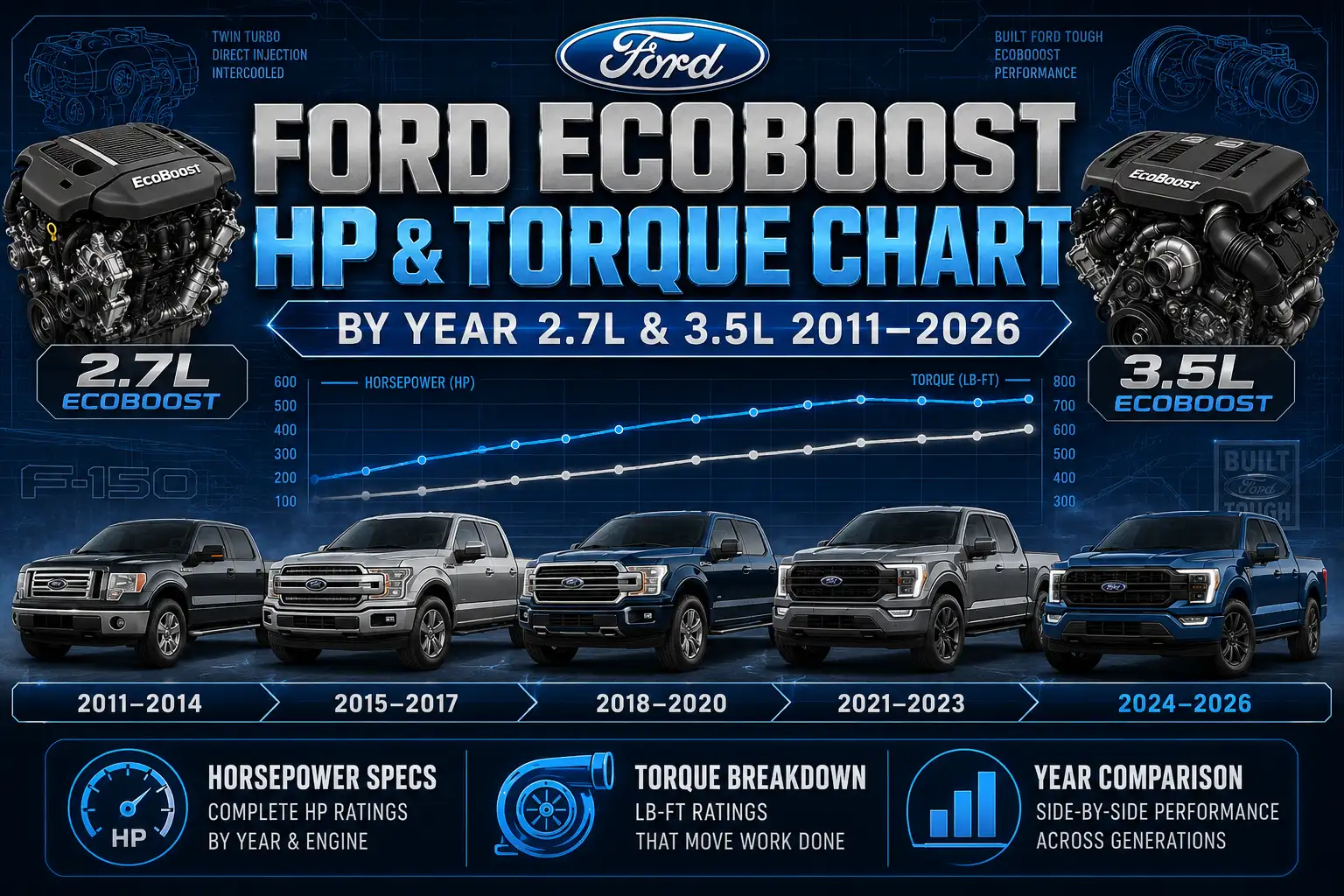
Ford EcoBoost HP & Torque Chart by Year (2.7L & 3.5L, 2011–2026)

Ford’s EcoBoost horsepower numbers have changed four separate times since the 3.5L V6 launched in 2011, and the 2.7L has its own separate history starting in 2015. If you’re trying to figure out exactly how much power your EcoBoost F-150 makes, the answer depends entirely on which model year and which engine you’re looking at.
This chart covers both the 2.7L and 3.5L EcoBoost V6 (not the smaller 2.3L four-cylinder, which powers the Ranger, Bronco, and Mustang and uses a different block entirely). It includes the 2026 model year power change tied to a new emissions component, and what’s reportedly coming for 2027.

Prime for Young Adults — 6 Months Free
Students and 18–24s get six months of Prime free, then half price.
Start 6 Months Free As an Amazon Associate I earn from qualifying purchases.Ford EcoBoost Horsepower by Year
2.7L & 3.5L V6, all generations, 2011–2026
Bar length scaled to peak output (450 hp = 100%). Torque shown for reference, not to scale. Source: FordMasterX research, cross-verified against Ford Authority, Truck Insiders, and Hotcars reporting — see full article for citations.
3.5L EcoBoost Horsepower and Torque by Year (2011–2026)
Recommended Best Deal Products


The 3.5L EcoBoost has been revised three times since its 2011 launch, and each revision moved the numbers up, with one exception in 2026.
| Model Years | Generation | Horsepower | Torque | Notes |
|---|---|---|---|---|
| 2011–2016 | 1st Gen | 365 hp @ 5,000 rpm | 420 lb-ft @ 2,500 rpm | Original F-150 EcoBoost launch engine |
| 2017–2020 | 2nd Gen | 375 hp @ 5,000 rpm | 470 lb-ft @ 2,500 rpm | New turbos, higher compression, paired exclusively with the 10-speed automatic |
| 2017–2025 | High-Output (Raptor) | 450 hp @ 5,000 rpm | 510 lb-ft @ 3,500 rpm | Raptor-specific tune; not offered on standard F-150 trims |
| 2021–2025 | 2nd Gen (updated) | 400 hp @ 6,000 rpm | 500 lb-ft @ 3,100 rpm | +25 hp / +30 lb-ft update for the F-150’s mid-cycle refresh |
| 2026–present | 3rd Gen | 382 hp @ 6,000 rpm | 500 lb-ft @ 3,100 rpm | 18-hp reduction tied to a new gasoline particulate filter (see below); Raptor’s high-output engine is not affected |
The base 3.5L stayed at 365/420 for six straight model years before the 2017 redesign, so if you’re shopping a used 2011–2016 truck, don’t assume it matches a newer truck’s numbers. If you’re chasing the cam phaser ticking noise that shows up across every generation of this engine, our 3.5 EcoBoost cam phaser replacement guide covers the fix regardless of which model year you have.
2.7L EcoBoost Horsepower and Torque by Year (2015–2026)
The 2.7L EcoBoost gained torque, not horsepower, when it was revised for the second generation, and it’s the one EcoBoost that has stayed untouched by the 2026 emissions update.
| Model Years | Generation | Horsepower | Torque | Notes |
|---|---|---|---|---|
| 2015–2017 | 1st Gen (Nano) | 325 hp @ 5,750 rpm | 375 lb-ft @ 3,000 rpm | Original F-150 2.7L, aluminum block |
| 2018–2023 | 2nd Gen | 325 hp @ 5,000 rpm | 400 lb-ft @ 2,750–3,000 rpm | Same horsepower, +25 lb-ft, peak power arrives 750 rpm sooner |
| 2024–2026 | 2nd Gen (current) | 325 hp @ 5,000 rpm | 400 lb-ft @ 3,000 rpm | Unchanged for 2026; explicitly excluded from the new particulate filter change |
Multiple outlets, including Ford-Trucks.com and TFLtruck, report a leaked 2027 F-150 order guide that drops the 2.7L EcoBoost entirely in favor of a new 3.0L EcoBoost V6. As of this writing, Ford has not officially confirmed the change or released final spec numbers, so treat this as a reported development, not a locked spec. For the full breakdown of what the 2.7L is good for and where it tends to develop problems, see Ford 2.7 EcoBoost Specs: Top 7 Facts Every Driver Should Know.
3.5L vs 2.7L EcoBoost: Which Has More Power?
Recommended Best Deal Products

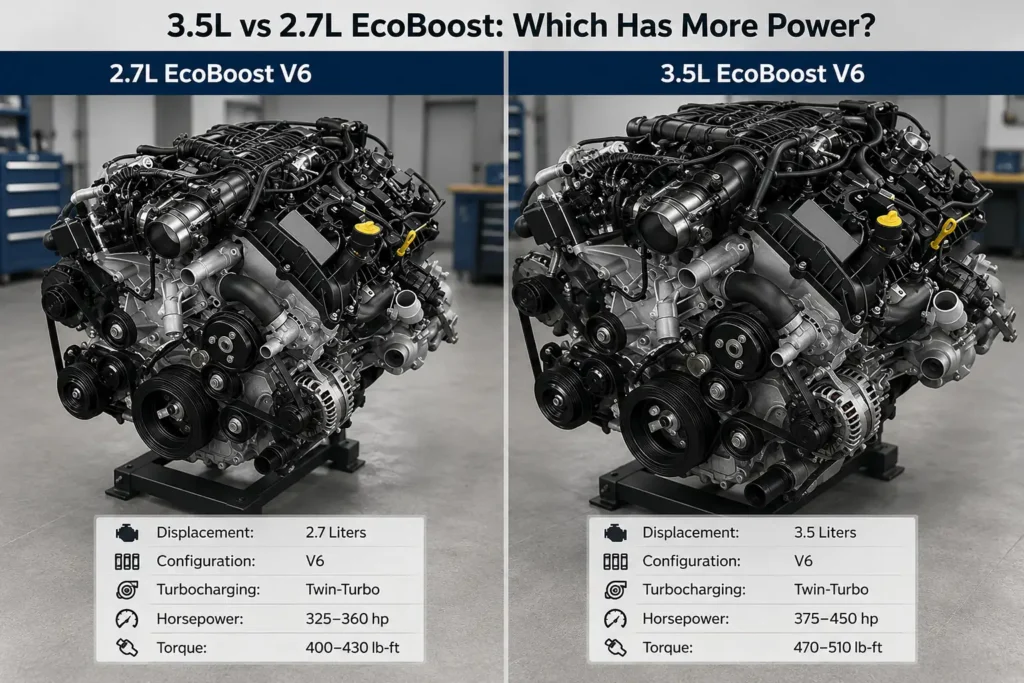
On paper, the 3.5L wins every category. The current 3.5L EcoBoost (400 hp / 500 lb-ft on 2021–2025 trucks) outproduces the 2.7L (325 hp / 400 lb-ft) by 75 hp and 100 lb-ft. That gap has been consistent since both engines have been offered side by side, and it’s the main reason the 3.5L carries the higher F-150 towing capacity by year and engine rating in nearly every trim comparison. The 2.7L’s advantage is weight and fuel economy, not peak output, so if maximum power and towing numbers are the priority, the 3.5L is the one to look for on the window sticker.
Why Ford Changed EcoBoost Horsepower Over the Years
The 2017 redesign of the 3.5L brought a new turbocharger design and a higher compression ratio, which is why horsepower and torque both jumped that year even though displacement stayed the same. The 2021 refresh pushed the 3.5L further, to 400 hp and 500 lb-ft, as part of a broader powertrain update Ford made across the F-150 lineup.

Audible — Listen Free for 30 Days
One free credit a month and thousands of titles included.
Listen Free for 30 Days As an Amazon Associate I earn from qualifying purchases.The 2.7L’s 2018 revision worked differently. Ford redesigned the block and turbos to add low-end torque for towing rather than chase a higher horsepower number, which is why the 325 hp rating never moved even as torque climbed from 375 to 400 lb-ft.
The 2026 change is not a performance update at all. It’s an emissions requirement. A gasoline particulate filter (GPF) traps ultra-fine soot particles from direct-injection engines before they leave the exhaust, similar in concept to a diesel particulate filter. Ford added a GPF to the 3.5L EcoBoost and PowerBoost hybrid to meet California Air Resources Board standards that now apply across roughly 17 states. The added exhaust backpressure from the filter is what cost the 3.5L its 18 hp, dropping it from 400 to 382 hp while torque held at 500 lb-ft.
How to Tell Which EcoBoost Generation You Have
Recommended Best Deal Products


The fastest way to confirm which generation EcoBoost is under your hood:
- Check your build date and model year against the charts above. Model year alone identifies the generation for most trucks.
- Pull your window sticker or door jamb sticker, which lists the specific engine and its output.
- Decode your VIN’s 8th digit, which corresponds to the engine code. Cross-reference it against Ford’s official VIN decoder rather than a third-party chart, since engine codes have been reused and revised across model years.
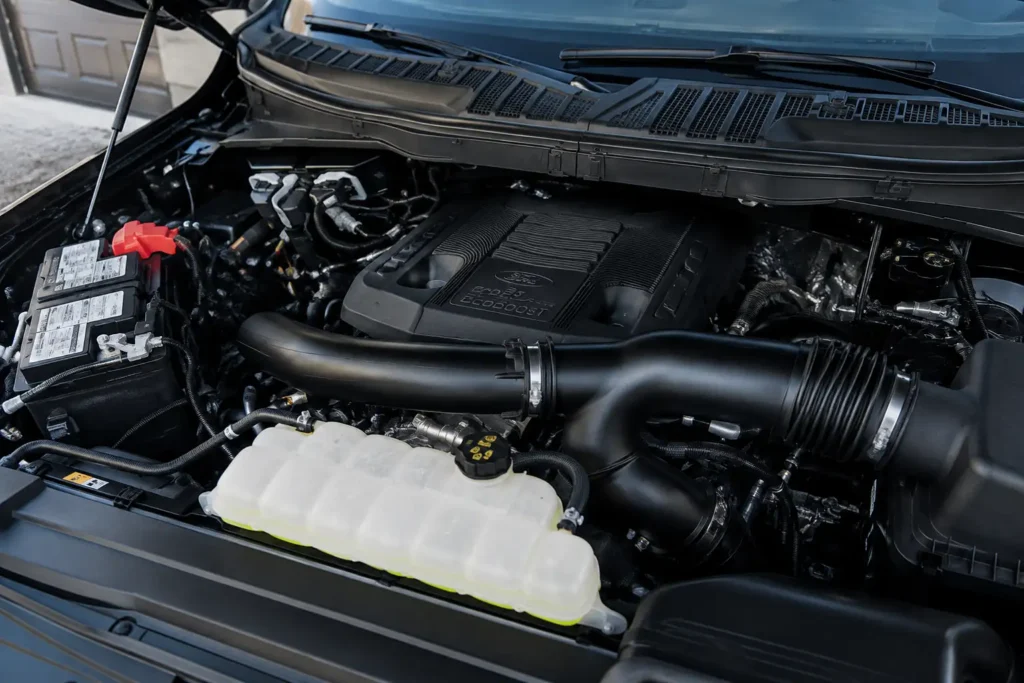
- If you’re working under the hood, the 2011–2016 3.5L and 2017+ 3.5L use visibly different turbo and intake layouts, and our MAP sensor location guide shows what the newer layout looks like if you need a visual reference point.
Ford EcoBoost Horsepower FAQs
What year EcoBoost has the most horsepower?
The F-150 Raptor’s High-Output 3.5L EcoBoost makes the most of any EcoBoost V6 offered in a Ford truck, rated at 450 hp and 510 lb-ft since its 2017 introduction. Among standard (non-Raptor) trims, the 2021–2025 3.5L EcoBoost’s 400 hp is the highest output offered.
Did the 2026 F-150 EcoBoost lose horsepower?
The standard 3.5L EcoBoost and PowerBoost hybrid did, dropping from 400 hp to 382 hp for 2026 due to a new gasoline particulate filter required for emissions compliance. The 2.7L EcoBoost and the Raptor’s high-output 3.5L were not affected.
Is the 2.7L or 3.5L EcoBoost more powerful?
The 3.5L is more powerful in every model year both engines have been offered together, currently outproducing the 2.7L by 75 hp and 100 lb-ft.
Will the 2.7L EcoBoost be discontinued?
As of this writing, it hasn’t been officially discontinued, but a leaked 2027 F-150 order guide reportedly drops the 2.7L in favor of a new 3.0L EcoBoost V6. Ford has not confirmed this publicly, so treat it as unconfirmed until an official announcement lands.